Feeds:
Posts
Comments

Archive for the ‘Harper’s’ Category

SOUNDTRACK: BOB MOULD-Sasquatch Festival, May 28, 2011 (2011).

I loved Hüsker Dü.  I loved Sugar (a tad less).  I loved Mould’s Workbook.  And then I kind of loss interest in the guy.  He recently wrote an autobiography, which I would consider reading, but musically, I assumed he was done.

So I wasn’t even that interested in listening to his set (shame on me).  This turns out to be a really cool set in which it’s just Bob and his electric guitar.  He plays a varied set of songs from throughout his career.  He plays some of his hits (“See a Little Light,” “Hoover Dam”) but mostly he plays interesting non-hits (“Chartered Trips” (!!), “I Apologize”).  (Is it possible that Grant Hart wrote all of Hüsker’s big hits?)

The most amazing thing about the set is Bob himself.  He sounds so cool and chilled out (even though I think he was like the very first opening act of the concert–which is a pretty shitty time slot).  He seems to be really happy playing (hearing him respond to a request with “I forgot how to play that one” is pretty darn funny.)  Of course, a little later when he says “What’s that?  I’m trying?” he almost sounds like Al Bundy.

But then, look at him, he’s an old man now.  And sure, he’s been playing music forever, so gosh, he’s got to be super old, right?  What?  He was born in 1960?  He’s nine years older than me?  Oh good grief.  So, wait the first Hüsker Dü album came out when he was 22?  He really crammed a lot of music into just a few years.  Not bad, Bob.

And yes, I’m fully invested in relistening to all the great music you’ve made now.  Thanks, Sasquatch.

[READ: July 13, 2011] “Incident in the Orient”

This very short story features a dead dog. I’m getting that out of the way since I know some people won’t read any further once they know that.

I rather liked the brevity of this story, how Theroux is able to cram a lot of information and a lot tension into just a couple of pages.  The story is also a strange little onion of a tale, with the narrator working for a man (Moses) who is a sort of mercenary construction boss.  The narrator gives a lot of insight into Moses, although he also admits that he doesn’t really know the man very well (how could anyone know him).

He has done work in various war-torn countries and has effectively built a crew out of a small group of devoted men, mingled with local help.  The most fascinating thing is that Moses is a short man with a lisp and yet he commands the respect of everyone who works for him.  He takes no shit, but he pays well and uses local materials (including tearing down materials from destroyed buildings if necessary).   (more…)

Read Full Post »

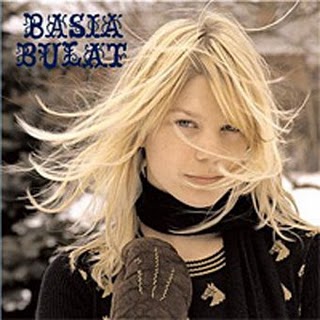
SOUNDTRACK: BASIA BULAT-“The Shore” (2010).

I loved Basia Bulat’s “In the Night” which wa s fun, uptempo folk rocker.  “The Shore” is a hauntingly beautiful, wistful ballad.  “In the Night” featured the autoharp as its main instrument, but “The Shore” features the pianoette as its sole instrument (on this recording anyway, I haven’t heard it on the record).

Listenin to the song is great, a wonderful expereicen.  But once you watch her play it, the song is even more powerful.  This video in particular is enchnating–where is this beautiful open room?  How did she learn to play the pianoette?  What is that little hammer she’s using?  Is anyone not blown away the first time she hits a string for multiple notes and the song goes from simple to majestic?

And what do you suppose uwolnijmuzyke means?  I don’t know, but it’s a really cool music site from Poland.

Pretty good, huh?

[READ: July 13, 2011] Dining with the Tiger

I wasn’t going to talk about this “review” either.  But several things stood out for me:  John Banville!  It’s hard to pass on him.  I also seem to be talking a lot about food this week (what with Will Self, Jun’ichirō Tanizaki and Lucky Peach in general).  And because I have to wonder if my friend Lar knows of any of restaurants that Banville mentions (now that he is a landed, married gentleman and not the post-graduate guy who would take an American mate to an “American” diner on Grafton Street–which was lorryloads of fun, make no mistake).

So Banville gives a brief run through of the state of Irish restaurants circa the end of WWII–as in, there were none.  Then came the 1990s and the critical moment in Irish culture–the scandal of Bishop Eamon Casey and his unexpected son. The scandal seemed to rock the country, but mostly it made them let fall the shackles of conformity across the country.  Banville suggests that such a major event could have shaken a Catholic country to the core, but in Ireland, it seems to have just woken everyone up to the possibility of making money. (more…)

Read Full Post »

SOUNDTRACK: BASIA BULAT-“In the Night” (2008).

I recently came across Basia Bulat via NPR.  She played a Tiny Desk concert and I discovered that she had several other entries in the NPR canon.

Basia is Canadian (of Polish descent); she has a beautiful strong mid-range/throaty voice and a great sense of melody.  She also has a bit of a gimmick: she plays all kinds of instruments (guitar, piano, sax, etc) including some really weird and unexpected instruments: Zither, pianoette (!) and autoharp–a couple of years before PJ Harvey brought it back to the mainstream.

pianoette

“In the Night” is a wonderfully chipper poppy song.  And that autoharp gives it just a tinge of “huh?’ that makes it more than just a simple pop song.  The beat is fast and energetic, the harmonies are wonderful and the melody is top-notch.

I really like this song a lot, and the other snippets of songs that I’ve heard from her are equally wonderful.   I’ve even noticed that lately she’s been singing a song in Polish!

[READ: July 12, 2011] “Gastronomania”

I’m not going to go crazy reviewing all of the book reviews in Harper’s (that way lies madness), but occasionally an author I like writes a bit that I want to mention.  So Will Self, who I like but have not read a lot of, wrote this essay/book review about food.  He reviews three books, but what I especially liked about it was his introduction, which uses Luis Buñuel’s Le fantôme de la liberté [The Phantom of Liberty] as its starting point.  In the film (which I have not seen), the house’s dining room is actually a well…watch this clip:

It’s a wonderfully bizarre introduction to an essay about food.

It was unclear to me what made Will Self suitable to review three books about cooking.  And then (news to me) he revealed that he used to be a food critic (columns are collected in his book Junk Mail) and that Anton Ego in Ratatouille (yes that Ratatouille) bears “an uncanny, if not legally actionable” resemblance to him.

This essay was so much fun.  Self is as viciously negative about these books as he apparently was about food back in the day.  But he’s not dismissive of them as cookbooks per se, he’s more about trashing the current worship of food (and many other things too of course). (more…)

Read Full Post »

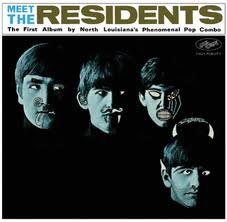
SOUNDTRACK: THE RESIDENTS-Meet the Residents plus Santa Dog EP (1973/1972).

Like a proto- Negativland meets Primus, The Residents took the world by storm in 1973.  Their debut album (pictured here) bore the unmistakable tagline: The First Album by North Louisiana’s Phenomenal Pop Combo.  And so it is.

Read more about the album in the Jon Savage essay below.

“Boots” is a sampled and remashed version of “These Boots Are Made for Walking.”  “Gylum Bardot” sounds like a Primus demo.  “Breath and Length” is noise and noise and effects and a soothing female vocal singing the title.   “Consuelo’s Departure” is a noisy soundtrack to nothing and “Smelly Tongues” sounds like a hammered dulcimer with a menacing bassline behind it until the vocals come in: “Smelly tongues looked just as they felt”.   And all 6 of these songs last less than ten minutes total.

“Rest Aria” changes tempo of things.  It’s five minutes long.  It starts as a simple piano track (slightly out of tune) but it slowly adds crazy horns and what sounds like children’s instruments.  The other longish song, “Spotted Pinto Beans” comes with a kind of faux chorus (female and then male) singing a kind of call and response which is overtaken by noise.

The one-minute “Skratz” comes between these two longer songs and is mostly  mumbling spoken vocal.  “Infant Tango” sounds like a normal song.  It opens with a funky wah wahed guitar.  Of course, the skronking horns and mumbled bass vocals tell you this is not going to be a hit.  It runs 6 minutes long with a strange little “guitar solo” in the middle.

“Seasoned Greetings” (with it’s weird holiday wishes at the end) segues into the 9 minute “N-Er-Gee (Crisis Blues”).  “N-Er-Gee” is a piano “melody” which is really someone banging the same notes very hard on the piano.  The voice on both tracks sounds like the aural equivalent of blackface until the sample (a very long sample that apparently voided placement on some releases) of “Nobody But You” morphs into a manipulated sampling of the word “boogaloo” and eventually becomes a dissonant chant of the title.

The appended Santa Dog is a bit more song-like.  Totally weird songs yes, but there’s actual melodies and lyrics.  Like on “Fire”: “Santa dog’s a Jesus fetus.”  “Aircraft Damage” is mostly a bunch of people reciting bizarre lyrics over each other.  The whole EP was about 12 minutes.  It’s weird but more palatable than the LP.

Despite how much this album foreshadowed loony alternative bands in the future, there is a clear predecessor in Trout Mask Replica.  Although Captain Beefheart followed a (relatively) more conventional song structure, you can hear elements of the Beefheart within.  This album is also notable for being made in the early 70s when the technology to do this easily was very far away.  You could whip this album up in a few minutes now, but back then with splice and paste, it would take ages.

It did not sell as well as the similarly titled Meet the Beatles.

[READ: June 16, 2011] Five Dials Number 11

Five Dials Number 10 was a special issue, but Number 11 goes back to the format we know.  It sort of has a theme about lists.   It contains half a dozen short essays and one long short story by Paul Murray (author of Skippy Dies).  This issue is also something of a surprise as it weighs in at a fairly small 16 pages (sometimes smaller is perfectly fine).  The issue also raised a couple of totally weird coincidences which I will point out as they come up.

CRAIG TAYLOR-A Letter from the Editor: On Wilton’s and Lists
Number 10 was designed to be ready for an evening at Wilton’s Music Hall on February 26th.  But the real theme of the issue is lists.  In part this is inspired by the Raymond Chandler entry, it’s also inspired because Taylor keeps lists around the office.  At the end of the letter he provides a list of all of the notes he’d left to himself in the office.  Some are about the issue (Paul Murray manuscript), other are seemingly more random (USA 5 Canada 3, men’s Olympic ice hockey result;  Canada 7-Russia 3, men’s Olympic ice hockey result; ‘Range Life’–Pavement).  And the one that is most coincidental to me–(The Umbrellas of Cherbourg–Jacques Demy).  This is coincidental because on the day that I read this, my friend Lar wrote a post about this very movie, which was completely unknown to me. (more…)
Read Full Post »

SOUNDTRACK: GOGOL BORDELLO-East Infection (EP Extra) (2005).

I learned about Gogol Bordello from some live shows available on NPR.  I enjoyed their sets so much I decided to check out their albums as well.  And I love them.  The albums are full of frenetic energy (they give Sarah agita, she says).  But everything that I love about fun, spirited, gypsy music is present here.

The band is essentially a band of gypsies, headed by wonderfully-mustachioed Eugene Hutz.  And their live show (as demonstrated by the included video) is a wild circus of fun (curtains and dancers and fire buckets and bowling pins and musicians jumping out of boxes), it’s like a wild party.  The video is for “Never Young Again” which would appear in full on their next album. It’s a fun song that reverses the age-old lament of wanting to be young again.  But mostly you watch this for the live footage.

This EP is probably not the best place to start as an introduction to Gogol Bordello (but it was really cheap so I bought it first).  Although it does offer many of the different aspects of Gogol’s music.  The EP features 6 songs and the video.  The songs are intense, hyper, crazy and wonderful.  “East Infection” opens with some nonsense lyrics (“Lee lee lee lee lee, la la la la la”) and morphs into what may be more nonsense, although there’s actual lyrics here.  “Ave B.” (which is also on their following album Gypsy Punks) is a more acoustic-based song, but it still has loud parts to it.

“Mala Vida” is a cover of a song by Manu Chao.  This version is a super fast punky track sung in Spanish (despite Eugene Hutz’ origins in the Ukraine, he has lived in Brazil for years and sings many songs in Spanish).  The original is very similar in temperament, although GB version is a bit more frenetic.

“Copycat” is the odd track on the disc, it’s a kind of dub track with big fat bass and a very slinky sound.  It and “Mala” were produced by Steve Albini.

“Strange Uncles from Abroad” is to me a very typical GB song: lots of violin, lots of dah dah dahs and a great melody.  It has a total gypsy feel, and goes through some loud and quiet moments.   The final track, “Madagascar-Roumania (Tu jésty fáta)” is the longest track by far (6 minutes).  It sounds like a demo and lacks the punch of the rest of the disc, but it showcases the softer side of the band (and yes there is one).

So, maybe this EP is a good place to start after all.  It’s certainly not throwaway material.  And the EP cover alone is pretty outstanding.

[READ: June 14, 2011] Five Dials Number 10

This is the issue of Five Dials that introduced me to the publication.  It is a special issue devoted to the memory of David Foster Wallace.  The entire issue is comprised of the eulogies given at the DFW memorial.  [The details are a little sketchy here…I’m not sure if these are all of the eulogies or just the eulogies from well known people.  I’m not even sure who would have been in the audience for this memorial.  The notes say “These tributes were given on 23 October, 2008 at the Skirball Center for the Performing Arts, New York University” and yet the Jonathan Franzen entry says “here at Pomona.”  So… details are sketchy].  Nevertheless, the tributes are heartfelt, informative and very moving.

Of course, I’m not going to ‘critique’ them, I’ll just try to summarize them.  But really, they’re all worth reading if you’re a fan. (more…)

Read Full Post »

SOUNDTRACK: WEEZER-Death to False Metal (2010).

This is a fascinating release.  I assumed it was a quick cash in of unreleased tracks.  And yet it doesn’t sound like a bunch of tracks from different eras thrown together.  A little digging reveals that it is sort of a collection of unreleased tracks.  The ten songs here were written over the band’s career but were either never finished or were finished but never released.  According to various places online, Rivers edited and manipulated the songs (and maybe re-recorded some?) to make them all sound current (and like they’re from the same time).  Thus he considers this to be the follow-up to Hurley.

The album is full of poppy songs (“Turning Up the Radio” has FIFTEEN people listed as composer on Allmusic–the true sign of a pop juggernaut).  There’s a couple of slightly heavier songs, “Blowin My Stack” has a big shouty chorus and “Autopilot” has a very electronic kind of sound.  But perhaps the most notable track is the cover of “Unbreak My Heart.”  That song came out in 1996, so one assumes that this version must be at least ten years old, because why would someone make a cover of an old pop hit from fourteen years ago?  It’s quite good, though, as Weezer covers tend to be.

If you like Weezer, this isn’t a throw away.  The songs are just as good as their other recent records (which means they’re not as good as their early ones, but are still poppy).  If you don’t like Weezer this will do nothing to change your mind.

Although I am amused by the album cover design that they chose for this title (which is a tribute to the band Manowar, obviously), I think a better cover would have been Weezer in loincloths.  Can you imagine Rivers Cuomo brandishing a giant sword?

[READ: May 21, 2011] “Medea”

Ludmilla Petrushevskaya had a story in The New Yorker recently.  The fact that she has one here as well can only mean she has a book coming out (although a quick look at Amazon does not indicate that she does).

The opening line says, “This is an awful story…”  And it’s true (not in the sense of being bad, but in the badness that it contains).  Petrushevskaya tends to write very dark stories (dark fairy tales is how they’re mostly categorized), and while this is not a fairy tale, it is certainly dark (and as with most of her stories, it’s quite short).

It’s a fairly simple story: the narrator hops in a cab and complains about how her seventy-three year old grandmother called for a cab to pick her up at a certain time but it never came–and never even called to say it wasn’t coming.  This meant she missed her plane, and the people waiting for her missed her and basically the whole day (and a lot of money) was lost because of a cab.

The cabbie didn’t have anything to do with that, but he tells her that it could be worse, and proceeds to launch into a story trying to outdo her story.  They jockey for position in terms of terrible stories (a woman whose baby dies on vacation–and that’s only the beginning of her problems) until finally he talks about himself. (more…)

Read Full Post »

SOUNDTRACK: TINDERSTICKS-BBC Sessions (2007).

Another great entry in the BBC Sessions series, this collection of 26 recordings, shows the band in fine form.  This works as a pretty excellent Greatest Hits collections (and surprisingly for a BBC Sessions recording there is only one duplicate song).

On the other hand, there’s not a whole lot of difference between these recordings and the originals.   Some notable exceptions include “Traveling Light” and “Buried Bones” which do not feature the female duet.  “Her” is also notably different since it’s on piano and not guitar.

But I have no criticism about the quality of the recordings. The band sounds wonderful.  Staples’ voice is great and the orchestration is perfect.  And, of course the recording quality is superb (as are all of the BBC sessions that I have are).

If you have the Tindersticks records already, there’s no compelling reason to get this set, but if you’re a fan of the band, it’s nice to have some slightly different versions of these great songs.

[READ: May 18, 2011] 2 book reviews

This month’s review is of two books.  The first is Paula Fox’s new book, News from the World: Stories and Essays.  (The book is also reviewed by Joan Acocella in The New Yorker, May 16, 2011 issue–she takes a much different angle than Zadie, and has a lot more biographical background, so the reviews work in conjunction very nicely).  I don’t know Fox (although perhaps I should, she has written a number of adult books and tons of children’s books), but Fox’s Desperate Characters has been championed by Jonathan Franzen and David Foster Wallace.

Fox sounds like an interesting character (her father was “a writer and a drunk”) and her granddaughter is Courtney Love.  And Zadie asserts that Fox has cultivated self-control and empathy and (in Fox’s own words) “a living interest in all living creatures.”  And in this new collection the interest spreads across fiction, memoir, lecture and essays (with no formal distinction between genres).

Although Zadie is fond of Fox (especially her fiction) she’s harder on Fox the essayist.  She suggests that many of Fox’s essays seem to boil down to the cliché: things were better back then.  But Zadie does make her fiction sound wonderful.  Acocella’s review is similar, saying that no one should start reading Paula Fox with this collection–the reader should go back and start with Fox’s earlier, better works. (more…)

Read Full Post »

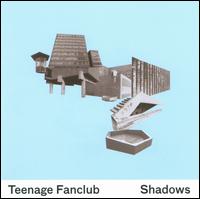
SOUNDTRACK: TEENAGE FANCLUB-Shadows (2010).

Back in the 90s, Teenage Fanclub released a few noisy, feedbacky records that were quintessential 90s alt rock.

Since then they have mellowed considerably, and this album is one of their most mellow to date. Usually for me this kind of mellowing is a sign that I’m done with a band; however, Teenage Fanclub’s songwriting gets better with every disc.  And these folky tracks are all fantastic.

What’s neat about the arrangement of the album is that each of the three members of the band writes four songs.  They are collated so that you cycle through each singer before repeating. You get maximum diversity–and it’s easy to tell which songwriter is your favorite.

The opening two songs, “Sometimes I Don’t Need to Believe in Anything” and “Baby Lee” are two wonderful upbeat pop confections.  They sound very different and yet both are infused with wonderful pop chops.

It seems that Blake is my favorite songwriter on this disc. He did “Baby Lee”, “Dark Clouds” (a pretty piano based number) and by far the prettiest song on the disc “When I Still Have Thee.”  It’s an amazingly catchy folk song that sounds timeless (and even has the great couplet: “The Rolling Stones wrote a song for me/It’s a minor song in a major key.”

That’s not to dismiss the other songwriters at all.  In fact, hearing their different takes on pop music is really pretty amazing.  It’s a shame that it takes them so long to put albums out (about 5 years these days).

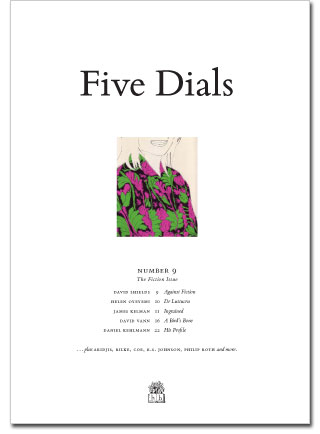
[READ: June 10, 2011] Five Dials Number 9

Five Dials Number 8, The Paris Issue, was pretty big (45 pages), but it had a lot of pictures.  Five Dials Number 9 is also pretty big (41 pages) and it’s (almost) all text.  For this is the Fiction Issue, and there are a lot of short stories in here.

CRAIG TAYLOR-A Letter from the Editor: On ‘Summer Reading’ and Fiction Issues.
Since most of what I talk about in the introduction to these posts is covered in Taylor’s Letter from the Editor, I figured I’d switch formats and start talking about his letter right away.  In this letter, Taylor talks about the serious pitfalls of  ‘Summer Reading’: We pledge to read mammoth books over the summer, but really we never finish War and Peace over the summer, do we? (except those of us who finished Infinite Summer, am I right?).  And so, this Fiction Issue was released in December (finally, a date is given to a Five Dials!).  Taylor briefly talks about all of the authors who contributed (including a pat on the back to Five Dials for securing the rights to a Philip Roth contribution in its first year of publication).  He also talks about the essay from David Shields that is decidedly anti-fiction.   And the final note is that Taylor’s own father has a piece in this issue (nepotism is alive and well!) (more…)

Read Full Post »

SOUNDTRACKDUNGEN -Skit I Allt (2010).

I’ve enjoyed every Dungen release that I’ve bought and this one is no exception.  Although I will admit that the other ones grabbed me a bit more (there are some amazing songs on earlier discs).  This one is a bit more sedate in general; perhaps this is Dungen’s ballad album.

It opens with “Vara Snabb,” an instrumental with lots of flute (!).  While  “Mid Edna Vän” is a gentle ballad (Gustav Ejstes’ voice is very nice: soft and delicate”).  “Brallor” is a duet with Anna Järvinen–her voice is haunting and beautiful.

“Soda” is another delicate ballad.  It opens with some loud drumming but quickly settles into a very gently sung song.  “Hogdalstoopen” opens with a quiet piano and slowly morphs into a noisy instrumental with an expansive, wailing guitar solo–the kind of which attracted me to Dungen in the first place.  It devolves into some chaotic noise, which is fun and works as a cathartic moment on this mstly quiet disc.

“Skit I Allt” is a pretty standard rock song (very 70s sounding).  And “Blandband” is a catchy piano number with a tone that reminds me of Peanuts, but which concludes with another trippy flute solo.  The last two songs return to the mellow quality of the earlier tracks and “Marken låg stilla” ends the disc with a super catchy chorus.

As I said, compared to their earlier discs which highlighted Ejstes’ firework-like guitar playing, this one shows the bands’ softer side.  It works as a nice companion piece (and still shows off the band’s instrumental chops).

Here’s your quick Swedish translation guide: Dungen (“the grove”), “Vara snabb” (“Being quick”) “Min enda vän” (“My only friend”) “Brallor” (“Pants”) “Skit i allt” (“Fuck it all”) “Barnen undrar” (“The children are wondering”) “Blandband” (“Mixtape”) Nästa sommar” (“Next summer”) “Marken låg stilla” (“The ground lay still”)

[READ: May 23, 2011] “What Animal Are You?”

Etgar Keret was recently in McSweeney’s 37 (I really liked his story).  This short piece is from his forthcoming book, and if they are all unusual like this I would be very excited to read it.

This story seems so much like non-fiction, that I can’t really decide what, if anything, has really happened to him already.  As the story opens, the narrator explains that he is writing for German Public Television.  Literally.  A reporter from GPT is in the room with him right now.  They are filming him for a show and need him to be “writing.”

He tries to fake it, but she says that it will look bad on TV.  So she insists that he write something for real, perhaps about her being there and how it makes him feel to be under pressure like this.  And so he begins writing.  Then his son comes home and gives him a big hug (he’s used to performing for cameras) but his wife (when she arrives) seems far more unnatural on camera–and will probably be cut.

The title comes from a phrase that his son (who is 4) says.  He sits on the stairs and asks everyone who walks by, “What kind of animal are you?”  The narrator reflects on how people respond to him: his wife, some random people who the boy encounters and, ultimately, the reporter.

The whole piece feels like several different snippets, and yet Keret ties them all together very nicely.  And it’s funny too.

It was translated by Miriam Schlesinger.

Read Full Post »

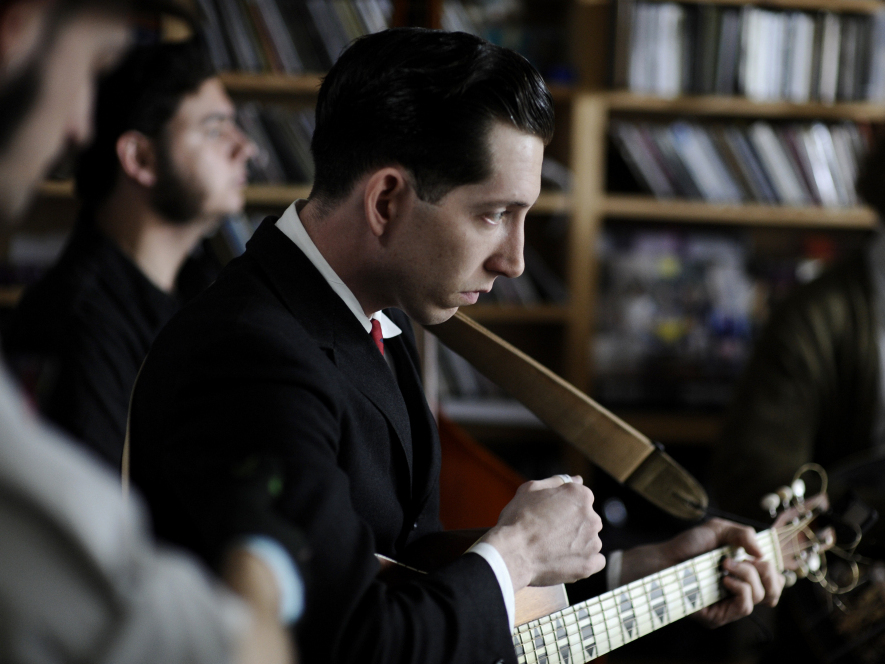
SOUNDTRACK: POKEY LaFARGE-Tiny Desk Concert #122 (April 20, 2011).

I had never heard of Pokey LaFarge before this Tiny Desk concert was sitting in my download folder.  In fact, the notes on the page say that they had never heard of him before they saw him wandering around SXSW.  And then he climbed onstage and played a great set.

LaFarge plays an old-timey style of music.  It’s a kind of Squirrel Nut Zippers retro sound.  As with the Zippers, I love their music in small doses.  And so, this Tiny Desk set is a perfect little sample of LaFarge’s music: happy, bouncy, jazzy.  There’s an upright bass solo, songs about being happy and singing “La La La” and other upbeat stuff.  It’s quite satisfying.

Especially if, as the notes say, you use it as a kind of antidote to the raucous music that you generally listen to.  A Pokey LaFarge song will perk you out of any self-inflicted gloom.  I just don’t need to hear more than three.

[READ: April 15, 2011] 2 book reviews

It looks like Zadie Smith has become a regular fixture at Harper’s.  I’m undecided if I’m going to review all of her book reviews from now on (perhaps I’ll lump some together in one post).  But in the meantime, I’m mentioning this one primarily because she reviews the story that I mentioned in yesterday’s post: Edouard Levé’s Suicide. (more…)

Read Full Post »

« Newer Posts - Older Posts »