Feeds:
Posts
Comments

Archive for the ‘LGBTQ’ Category

David Rakoff (1964-2012)

David Rakoff died Thursday from a resurgence of cancer.  For those unfamiliar with his work, think of darker, more cynical David Sedaris (did you think that was possible?).  The biggest difference between Rakoff and Sedaris is that Rakoff is Canadian.  And he is more of a world traveler.  I say this not really knowing anything about how much they actually traveled.  I mean, sure, Sedaris travels the world for book tours and such, but Rakoff actually lived in foreign lands.  Wait, you say, Sedaris lives in France.  Yes, but Rakoff lived in Tokyo (which automatically makes him more exotic).  And he actually knew Japanese (kind of) whereas Sedaris seems to have not learned any French in the years he has lived there–if his essays are to be believed.

All of this is by way of introduction to using Rakoff’s description of himself as a “New York writer” who also happened to be a “Canadian writer”, a “Jewish writer”, a “gay writer'” and an “East Asian Studies major who has forgotten most of his Japanese” writer.

I’ve only read one of Rakoff’s three books, Fraud.  And about that I said: (more…)

Read Full Post »

Gore Vidal [1925-2012]

Gore Vidal died last night at age 86 because of complications from pneumonia.

When I was younger, back in college, I loved Gore Vidal.  I read almost all of his essays and I tried to read most of his novels (I didn’t succeed–he has published some 50 books).  His book United States: Essays 1952–1992 is one of the best collection of political essays I have read.

People who know Vidal at all know him for different reasons.  Some know him as a writer of historical novels known as the Narratives of Empire: Burr (covering 1775-1805 and 1833-1836), Lincoln (1861-1865) 1876 (1875-1877), Empire (1898-1907), Hollywood (1917-1923), Washington D.C. (1937-1952) and The Golden Age (1939-1954).

Others know him for his outspoken pro-homosexuality stance.  His third novel 1948’s The City and the Pillar caused quite the controversy for presenting sympathetic gay characters.  He also wrote Myra Breckenridge about a transsexual character.  His published quote from about sexuality (from 1969) is:

We are all bisexual to begin with. That is a fact of our condition. And we are all responsive to sexual stimuli from our own as well as from the opposite sex. Certain societies at certain times, usually in the interest of maintaining the baby supply, have discouraged homosexuality. Other societies, particularly militaristic ones, have exalted it. But regardless of tribal taboos, homosexuality is a constant fact of the human condition and it is not a sickness, not a sin, not a crime … despite the best efforts of our puritan tribe to make it all three. Homosexuality is as natural as heterosexuality. Notice I use the word ‘natural,’ not normal.” (more…)

Read Full Post »

SOUNDTRACK: SIX ORGANS OF ADMITTANCE-“Even If You Knew” (2012).

Lars from NPR’s All Things Considered picked this as his summer music preview song.  I don’t know a thing about Six Organs of Admittance, but their discussion of this song makes it seem like this is atypical for the band (which has a massive output).  Evidently they’re usually more droney sounding. But man, this song is pummeling and wonderful.

It’s seven minutes long and opens with a simple, plodding heavy bass riff.  The vocals are kind of whispered and strained.  But then comes the guitar solo–a raging piece of distortion that complements the bass.  And that’s just the first three minutes.

The second half of the song features a quieter section–the bass is quieter, while the guitar noodles around and the vocals play over the rhythm.  The song slowly builds again, and by the last minute or so there’s another fierce guitar solo. Until the song is exhausted by the final distorted notes.

This is some beautiful noise.  And, no I have no idea what the band’s name means.

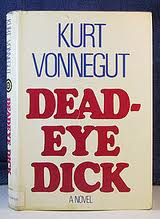
[READ: June 27, 2012] Deadeye Dick

Deadeye Dick is the last Vonnegut book that I was completely unfamiliar with.  I had no idea what it would be about.  So I didn’t realize until very late in the book, and then I looked online and confirmed that this book is set in the same location as Breakfast of Champions, Midland City, Ohio.  Indeed, some of the same characters appear in this book as appeared in that book.  But more about that later.

Vonnegut is not known for his happy books.  Misanthropy is pretty rampant in his pages.  But this book is one of his bleakest books yet.  The story concerns the Waltz family–Rudy (the protagonist) and his brother Felix are the only children of Otto and Emma Waltz.  Pretty early in the story we learn that Rudy is a double murderer.  Yipes!

As with most Vonnegut stories, this one is told in a convoluted and non-linear fashion.  He foreshadows (and really just casually mentions) a lot of crazy things that are going to happen in the book.  Like the fact that Midland City is going to be devastated by a neutron bomb.  In fact, his preface (like with many of his prefaces) tells us a lot about what’s in the book and who the characters are based on and the fact that there is a neutron bomb (but the reality of a neutron bomb is different from what he says).  There is something about knowing this information ahead of time that impacts the way you read the story.  Whether you think maybe he’s not telling the truth about what will happen (can the narrator really be a double murderer?) or maybe somehow the foreshadowing makes it even worse when it actually happens–the revelations are perhaps more deliberate.  But the style–a recursive style in which he says what happens and then he goes back and fills in the details, makes the events that much more powerful.

The funny thing about this story is that a lot happens to the characters in the beginning of the story and then not too much happens to them after that.  But that early stuff is pretty exciting and it has an impact all the way through. (more…)

Read Full Post »

SOUNDTRACK: MOGWAI-Special Moves (2010).

This is Mogwai’s first live album and it really captures the band in all of its intense glory.  This is a good year for a Mogwai live recording because they play some of their newer song which are a bit more melodic (and sometime have words) but they also revisit their older songs–which still sound intense.  It’s a great overview of their career so far and it’s a great testament to how different their music sounds over the course of so many years–even though they still sound like Mogwai

We get two songs from Their (then) latest The Hawk is Howling –“I’m Jim Morrison I’m Dead” and “I Love You I’m Going to Blow up Your School.” Two songs from Mr Beast “Friend of the Night” and the stunning set closer “Glasgow Mega Snake.” Two from Happy Music “Hunted by a Freak” and “I Know You Are But What am I.” Two from Rock Action “You Dont Know Jesus” and “2 Rights Make 1 Wrong.”  From Come On Die Young we get “Cody” and from their debut, two classics: “Like Herod” (which is amazing live) and “Mogwai Fear Satan” (also amazing)–each one over 10 minutes long and full of the emotional release that we’ve come to expect from Mogwai.

This is a great place to start if you want to hear what Mogwai is all about.

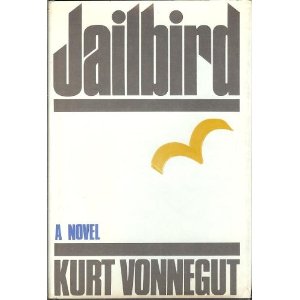
[READ: June 4, 2012] Jailbird

First off I want to say how neat it is that I took this book out of the library and that it’s from 1979.  Thirty-three years old!  Books are cool.

Anyhow, I have a stack of dozens of books I want to read, and yet somehow Vonnegut said, no, read me now.  In addition to Vonnegut books being relatively short, they are also very quick to read.  I read this in a couple of days, which is very satisfying.

My old boss at the library told me that she thought Vonnegut more or less stopped writing good books after Breakfast of Champions.  I disagree, but that has certainly colored the way I look at his later books before I read them–which one had she read that turned her off?  I kind of suspect it was this one.

In some ways this is a minor novel.  It’s fairly brief (240 pages, although there’s  30 page Prologue which I gather is from Vonnegut himself (you never know, he has so many layers going on)).  He explains some of the details that are in the book and several other interesting preface-type things.  I enjoyed the bit about the fan who wrote to Vonnegut and (Vonnegut claims) summed up all of his works in just seven words: “Love may fail, but courtesy will prevail.”  And that is the basic plot of this book. (more…)

Read Full Post »

SOUNDTRACK: DEATH CAB FOR CUTIE-“Kicked In” from Score! 20 Years of Merge Records: The Covers (2009).

Death Cab for Cutie are immediately recognizable here.  And they take this Superchunk song and make it sound like a Death Cab for Cutie song.

This cover is the rare cover in which the band takes a song and makes it clearly their own, and yet they don’t alter it all that much from the original.  The Superchunk version is slow (for Superchunk), with buzzing, distorted guitars and Mac’s vocals riding over the top.  The DCFC version features Ben Gibbard’s voice riding over the top as well.  But DCFC make the song a bit cleaner.  Rather than distorted guitars, we get chiming guitars and simple notes.  Instead of being a kind of grungy anthem, it feels somewhat uplifting.  And in true DCFC style, the uplifting sounding song really disguises something darker.

Even though the DCFC version feels slower, it’s not any longer than the original, and I think the pacing is pretty much the same.  It’s a neat trick.  I like both versions equally.

[READ: May, 2, 2012] “Men Against Violence”

This story came in third place in the Narrative Magazine Fall 2011 short story content.  It had a very different feel from second place winner.  It is set in college.  It feels contemporary and it reads young.  This, of course, means that I liked the style immediately.  I admit I was a little confused by the opening—I felt the exposition was  little convoluted and relationships were not established effectively.  But once it got moving, the story was really engrossing.

This is a reasonably simple story.  Kyle has a Hennessey scholarship—he received hundreds of thousands of dollars over his four years of college.  As the story opens he is attending the dinner which announces the newest scholarship grant, and introduces Kyle to the latest scholarship winner, whose name is (in all lower case letters) madison pepper.

The guest speaker at the banquet is Brooke Hennessey.  She is the granddaughter of Dorothy Hennessey and is currently is Kyle’s class at the college.  She speaks eloquently about her family’s donation (of the Hennessey Art Museum).   What she doesn’t say is that she ran away at 15, spent two years living in a car in Portland and that she accepts no money from her family (and has a mountain of debt).  She also doesn’t say that she is currently dating Kyle.

Kyle has problems of his own.  He recently got into a fight with a Trevor, a fairly important person on campus and he is now on a kind of probation—if he fights again, he loses the scholarship and has to back all the money.  This is why he joined Men Against Violence.  There’s a funny (but not really) insight into the existence of MAV on the campus, which leads to many unanswered questions about gender relations.  And the subject of gender relations is all over this story.  That delicate subject is handled very well. (more…)

Read Full Post »

SOUNDTRACK: CALLA-Calla (1999).

I got this album when a patron donated it to the library.  I had never heard of this band, but the other CDs he donated were really cool so I grabbed this one, too.  This is an almost entirely instrumental album (vocals are whispered when present) that feels like a soundtrack to a futuristic Western.  “Tarantula” opens with some creepy, ghostly sounds and then what sounds like spurs walking across the landscape.  When the guitar comes in it sounds like an old Western.  In many ways this album reminds me of a great band called Scenic, although this one makes more use of electronics, which gives it a more eerie feeling.

“Custom Car Crash” has a very Western feel.  Over creepy scraping sounds, a clean guitar plays very simple guitar lines and chords.  When the keyboard lilts over the noise, it’s quite eerie.  This song has vocals; deep, almost whispered vocals, and I can’t really make them out,  There’s also a live bonus version at the end which really captures the studio version, but which I think is better.  “June” has a slow droney sound: more atmospheric than anything else–it seems maybe ten years ahead of its time).  The 8 minute “Only Drowning Men:” introduces more guitars and a lit of tension.   From the noise a delicate guitar pattern emerges for the last minute of the song.

“Elsewhere” is full of buzzy guitars; there’s a live version at the end of the disc as well.  “Truth About Robots” is my favorite track, a real melody over the noise.  Despite its length (just over 2:30), it tells a full story.

“Trinidad” comes a surprise because it opens with bass (you don’t hear much bass on this album).  But “Keyes” is so quiet as to be almost not there.  “Awake and Under” on the other hand has a great guitar and bass sequence with spoken lyrics (reminiscent of many indie bands of the 90s) but which is very effective here.  There’s a live version as a bonus track and it is a highlight.

This is more interesting music for creating atmosphere, but not something I’d listen to a lot.  I was surprised to find out how many albums they had out.

[READ: March 2, 2012] “A Prairie Girl”

I’ve enjoyed Thomas McGuane stories before, but I wasn’t sure if I’d like this one as it opens with a brothel.  Since I’m thinking about the implications of sex in Gravity’s Rainbow, the last thing I needed was a hooker-with-a-heart-of-gold story.  But this isn’t that.  And it has a brothel with a very funny name: The Butt Hut .  The Butt Hut closes down when the madam dies.  Most of the women moved away (either with local men (to the dismay of many) or on their own).  But one girl who stayed was Mary Elizabeth Foley.

Mary Elizabeth attended church weekly, but most of the people gave her a wide berth—literally an empty pew.  It was finally decided that someone should speak to her since she wasn’t going away.  And so Mrs Gladstone Chandler, wife of the town’s bank owner and all around respected individual, sat near her during the mass.  Afterward, she asked Mary Elizabeth: “Where are you from?”  Mary Elizabeth answered “What business is it of yours?”  And she soon had her pew back. (more…)

Read Full Post »

I have been getting The Washington Spectator for years and years.  I was delighted with it in the beginning when the editor had the wonderful name of Ben Franklin.  I am delighted now that publisher’s name is Hamilton Fish.  But aside from these two fascinating details, I have always enjoyed the content.  It was thoroughly researched and detailed.  And the little 4 page leaflet always looked like a newspaper in design and style, and it gave it a kind of gravitas–no flashy colors or pictures.

Well, here it is, Vol 37, Issue No 21 and they have finally changed the format.  And not only that, they have created a website and have a Facebook presence!  Welcome to the 20th century!

I say that jokingly because despite these changes (which look great by the way), The Spectator has not abandoned its old school journalism practice.  21st century news is pretty much all flash and brash–style over substance–quick reporting with no concern for accuracy and very little attention brought to retractions (can anyone say “climategate” (I wish they wouldn’t call it that)).  But The Spectator is exactly the opposite, and I am delighted to say that although they are now a lot more accessible, they have not lost any of their tenacity or thoroughness.

The redesign is quite nice.  There’s an image on the front page and now there are pull quotes in red, which stand out nicely on the pale paper.  Although I always liked the pull quote box in the middle off the front page, this new format allows for a couple of different pull quotes as well as an opportunity to mix things up a bit.  (more…)

Read Full Post »

SOUNDTRACK: SEMISONIC-The Great Divide (1996).

Before Semisonic took over the world (and irritated everyone) with “Closing Time,” they were a band that formed out of the ashes of Trip Shakespeare.  Dan Wilson created Semisonic evidently because he wanted to be more poppy (which he perfected in “Closing Time,” obviously).

This album came out two years before “Closing Time” and it is a wonderful collection of alternapop.  There’s nothing terribly aggressive or weird in this collection, but neither is there anything so commercial that you want to scream.

The highlight for me is “Down in Flames.”  It goes in a few unexpected directions (especially with that screechy solo).  It’s a little dark, but it’s really catchy without ever pandering to Top 40 sensibilities.  It’s a really great song.

Some other highlights are the first three songs on the disc: “F.N.T.” is a poppy delight, “If I Run” has some great hooks and “Delicious” is a slinky sexy song with some unexpected moments.

Even a song like “Across the Great Divide” which isn’t the best on the disc has some nice surprises-when the vocals suddenly go falsetto.

There’s a couple of clunkers in the middle.  “Temptation” is a little too pop ballady for my liking and “No One Else” is a little bland.  I think their more uptempo songs are their strongest.

But “The Prize” is a satisfying pop rocker.  And “Brand New Baby” has some surprising pop vocals and a wonderful third part that is worth getting to the end of the album for.  While “Falling” is a surprisingly dark but catchy number (a Semisonic trait it seems).

The end of the album is rather unremarkable, but it’s still a solid collection of songs with nothing overplayable.  Sometimes one hit wonders are unfairly labelled as such.

[READ: November 8, 2011] “Sun City”

This was a fascinating story because it went in directions that I never anticipated.

I found the opening a little confusing as there were several women mentioned and no real relationship is given among them.  But it turns out that Vera and Bev are “roommates” and Rose is Vera’s granddaughter.  Vera just died (unexpectedly at 87) and Rose has travelled out to Arizona to go through her things.  Rose’s mom (Vera’s daughter) had a falling out with Vera years ago and won’t be going to the house.

Vera loved Rose but was somewhat disappointed in her–she was single and a bartender.  But Vera was not disappointed that Rose is a lesbian.  And Vera’s acceptance of that led Rose to believe that Vera and Bev were more than “roommates” as well. (more…)

Read Full Post »

SOUNDTRACK: TOM WAITS-Blue Valentine (1978).

Waits begins to morph into his later stage persona with this album,  although you wouldn’t know it from the opener, “Somewhere,” yes from West Side Story.   It’s a pretty straightforward Louis Armstrong-style cover, and I wonder what people thought of it.  “Red Shoes by the Drugstore” on the other hand foreshadows some of his crazier songs from later on–it’s kind of a like his beatniky work, but it’s a bit scarier and has less of a jazz feel.  Of course, he hasn’t completed eschewed melody and songwriting with the wonderful “Christmas Card from a Hooker in Minneapolis”–a slow piano ballad.

There’s also the amazing “Romeo is Bleeding” (the inspiration for the title of the movie).  There’s some more wild bluesy songs like “$29.00.”  In fact, Waits seems a bit looser overall (if that’s possible)–his voice is less clipped and beatniky, he’s more wild and perhaps even off beat

“Wrong Side of the Road” merges into later territory although he’s got enough scat style vocals to keep it sounding cool instead of crazy.  “Whistling Past the Graveyard” is one of his most uptempo bluesy songs;  it’s fun and a little crazy.

And yet for all of these forays into the unusual, he still stays firmly footed in what you expect from 1970s Waits: “A Sweet Little Bullet from a Pretty Blue Gun” and “Blue Valentines” are jazzy, smoky, lounge songs, keeping us on solid Waits ground.  He hasn’t stepped far enough away from his original style to alienate listeners yet, but he’s definitely pushing the boundaries of what might be comfortable.

[READ: September 25, 2011] “Starve a Rat”

This story is a sad and lonesome tale (not unlike Torres’ other story that was recently published in the New Yorker–it’s like these two magazines are linked by some kind of fictional umbilicus).

In this one, a 19-year-old boy hooks up with an older man.  The man asks the boy to wear a diaper on their first encounter.  The boy doesn’t but rather, he tries to satisfy him in other ways.  This pickup becomes something more when the man, who initially asked the boy to leave, relents and talks with him through the night.  The boy finds himself being more honest with the man than with anyone else ever.

The leads to some flashbacks about the boy’s history.  Back when he had a girlfriend, what his girlfriend’s parents were like (her mother knew that he was gay) and how much he loved the girl, even though he always knew she was just a beard.

The strange thing about this story is that I couldn’t decide when it was set.  It has a kind of dark tone that makes me think it is a 1970s story, although there is talk of clinics, so maybe it’s the 80s?  He mentions something about albums being not so out of date that they’d be making a statement–so that could be early 90s? (more…)

Read Full Post »

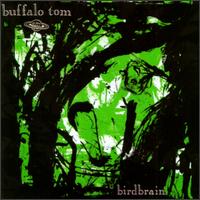
SOUNDTRACK: BUFFALO TOM-Birdbrain (1990).

If Buffalo Tom’s first album was a kind of punky Hüsker Dü album (which I contend it was), their second album switches gears towards the Afghan Whigs.  In other words, they still have a raw punky feel, but they’ve added more textures and melodies to the proceedings.

And while Janovitz’ voice is still loud and bold, rather than the screamy sound of say Bob Mould, he’s got a more nuanced sound like Greg Dulli (for some of the disc, anyway).  I notice this especially on the second track “Skeleton Key” which sounds like it could be an outtake from an Afghan Whigs session (it’s not as a good as a typical Whigs song, however).  You can hear more of those Dulli-notes on “The Guy Who is Me.”

The songwriting is somewhat more comlex overall.  The title track “Birdbrain” is catchy not only in the verse, but the chorus is a wonderful surpise–really redirecting the momentum of the song.  Despite some variants in texture and pacing, the disc still retains that raw punk sound of the first.

The album feels kind of long to me, though (and not because there are two acoustic songs tacked on at the end).  At almost 5 minutes, “Enemy” is way too long.  And by the end of the album, some of the sameiness that was eveident on the debut has crept into this disc as well.  The last few songs in particualr seem to have a lot of that screaming voice over a fairly simple riff thing going on.

The cover of the Psyhedeclic Furs’ “Heaven” in a live aocustic setting is a nice change, but really should have been laced around track 7 or 8 to minimize redundancy.  The last track is a live acoustic version of the tenth song off their first album.  How odd to resurrect a very deep album cut in this way.  But, again, at almost 5 minutes (two minutes longer than the original), it just doesn’t hold up.

There are signs of change here, but they won’t become fully evident until their next album, Let Me Come Over.

[READ: July 29, 2011] “Reverting to a Wild State”

This story plays around with a timeline, but not in a crazy way–in other words, the story is out of sequence, but it’s not a gimmick.

In Part 3, we see the narrator “cleaning” a rich man’s apartment, in his underwear.  We have no real context for him or what he’s doing, but it’s an amusing little section, and ends with him seeming content.

In Part 2, we see the narrator fighting with Justin, the man who we learn was his boyfiorned.  They broke up, but are in a diner having what seems like a final hash-out. (more…)

Read Full Post »

« Newer Posts - Older Posts »