Feeds:
Posts
Comments

Archive for the ‘Language’ Category

SOUNDTRACK: MITCHMATIC-“Why Don’t You Know” (2012).

This song reminds me in spirit of the old Fresh Prince songs–buoyant and fun, funny and a little silly.  And although it doesn’t sample I Dream of Jeannie, the mood is the same.

The track opens with a great sound of an old rotary phone.  When the music comes it, it’s completely loungey: strings and easy music propel this song to the heights of Cool.

The delivery style is gentle but fast and the lyrics are funny “I’m gonna tell you some reasons that you wanna date me.”

Mitchmatic is a Canadian rapper and his record is coming out soon on Old Ugly records.  Listen to the track at NPR and explore his stuff at his bandcamp site.

Darling I would like you so much more if you loved me back…

[READ: December 31, 2011 and January 24, 2012] “Wolves at the Door” and “Comment”

This is a blog post from Barry that deals with politics.  Although it was written in 2004 it is completely relevant to the current state of affairs in American politics.  I suppose it was ever thus, but it sure seems worse now.

He opens, “Stop me if I ‘m getting too cynical, but I think elections are won by the guy with the stupidest policies.”  He explains that it’s not because people are dumb; rather, it’s because when you are marketing to an entire country, “your best strategy is to scramble straight to the bottom of the barrel and start groping around in the muck there for the lowest common denominator.”  This is very true.

But I think the perfect summary for politics is (as Barry writes): “smart is complicated, but dumb is catchy.” (more…)

Read Full Post »

[LISTENED TO: January 12, 2012] Girl with Curious Hair

I saw a placeholder on Amazon for this audio book in early 2011.  And then I promptly forgot all about it.  My friend George just asked if anyone had heard it yet, so I decided to check it out.  I downloaded it through Audible.com.

And here’s my two cents about Audible.  Although it was free (for a 30 day trial), it was a lot of work.  The entire book (14 hours) downloaded in two files.  Each was about 7 hours with no breaks or chapters of any kind–just two huge 7 hour files.  Okay, I often download stuff and bring it into Audacity to make my own chapter breaks.  But you can’t import this file into Audacity because it is its own proprietary format and doesn’t want you to put it in MP3 format.  So, I had to burn it to CD (but not in MP3, only in WAV) and then put the CDs back in to iTunes to import them as MP3.  From there I could import them into Audacity and put tracks where I wanted.  That’s a lot of work to save $29.

I’m also going to say that I didn’t want a membership to Audacity because it costs $15/mo and the savings aren’t really that good anyhow.  Even kids books are about $10 each.  Oh, and just see how many hoops they have you go through to try and cancel.   Heavens to Betsy.

And but so on to the actual audiobook.

The book was read by Robert Petkoff (who is Reader A below) and Joshua Swanson (who is reader B below).  I don’t know anything about them, but their websites will give you more info about them.

I found the readings to be simply wonderful.  They were impassioned and articulate and dealt with some of DFW’s tongue twisting word choices with ease.  They also handle DFW’s dialect and accents with ease.  And while Swanson has a much much broader range of voices to play around with (his women voices are far superior to Petkoff’s), Petkoff also pulls of some amazing voices, especially in “John Billy.”  I never questioned what was happening.

Some of these stories are challenging and I admit I found them difficult to read.  But the audio versions seemed to really clarify things.  (There are all kinds of reasons why this could be so, but I’m not going to delve into that, for there lies madness).  Nevertheless, this was a great way to hear these stories.  Especially the ones that had heavy dialect.

“Little Expressionless Animals” [Petkoff] (90 minutes)
Petkoff sounds uncannily like Kyle McLachlan–no bad thing.  Although Petkoff doesn’t work too hard trying to do different voices, he puts in enough distinction to make the characters distinguishable.  (We have been listening to a lot of kid’s audio books, and the narrators of those are amazing with the kind of vocal acrobatics they can do!).  Petkoff is more subtle, but it is also effective–it’s not just a straight voice, which I think might get confusing especially in the dialogue scenes.

There is a hint of Alex Trebek’s voice when doing Alex Trebek, but he’s definitely not trying to mimic the voices of the celebrities.  For the most part, the voices are slight variations of the main narrator.  Indeed, during the later Faye and Julie dialogue section, he does slight differences between their voices to help distinguish the characters.  Which is quite helpful in the story.

This story works very well in audio book format.

One of the things that I loved about this story this time was really piecing together all of the various compnents.  Inclduing things like the revealtion of why Julie does poorly on the subject of animals.  It’s quite obvious when the story ends, but through the whole story you keep wondering, what is it about the animals?  I’m aslo intrigued at the number of gay characters in the book.

And, of course, this story has a major obsession with pop culture, especially TV.  And knowing (from interviews) that DFW sais he would just get sucked in to watching TV all day if it wa svailable, his tone (as is Petkoff’s) is perfect when dealing with the TV issues.

“Luckily the Account Representative Knew CPR” [Petkoff] (18 minutes)
Petkoff sounds slightly differnt than in “LEA.”  Since thist story has no dialogue, there’s not a lot of differentiation in the story.  His deadpan delivery is perfect for all of the details in the story. Although at the end, his “Help”s are quite empassioned, letting you know there’s a little bit more going on.

“Girl with Curious Hair” [Swanson] (50 minutes)
Swanson’s voice is of a much higher timbre, and it’s kind of fun to have two different voices in this book.  This story benefits quite well from an audio format.

The story is deliebrately flat and, I have to admit, is not terribly easy to read.  Swanson handles the flatness very well, he reads it incredibly deadpan and yet he puts enough inflection in it to keep it from being monotone.  I have to assume it wasn’t easy to read this.  I think that he has really made this disturbing character quite real.

Obsevrations about the story.  Hearing this story out loud was more shocking than reading it.  The explicit sex is pretty shocking for DFW and the revelation about what happened to Sick Puppy when he was a kid is prodoundly distrubing, especially when it is read in this non-inflected voice.  It was uncomforatble and very effetcive.

There were times when I wondered about the believability of the charcter.  The use of the word negro, the utter flatness of him. I realize that he is quite damaged, but at times it seemed like maybe this story was too much.  Which is a bit of a surprise, as I find DFW’s charcatersto be very real.

“Lyndon”  [Swanson] [1 hr 45 min]
I didn’t really enjoy “Lyndon” when I read the story.  It’s a little long and had many different things going on.  I kept wondering about Lyndon himself.  About what made DFW write a story based around Lyndon Johnson, around jhis life and politics.

But hearing this story read aloud, with the Swanson’s various voices and accents and newspaper stories all differentiated really brought this to life.  I felt like it was so much more vibrant and alive and passionate in this audio version.  I read in my post that i found the ending quite moving when I read the story, but it felt even more so, with Lady Bird’s quiet, dignified delivery, here.

Observations on the story.  How odd that he chose to make this story that is about a real, and quite famous and well studied person.  I don’t know a thing about Lyndon, so I have no idea how much of this is true (the few LBJ quiotes I looked up seem faked).  I don’t think I spent enough time thinking about the main character when I read the story.  Boyd is so fully realized and amazing that Lyndon is really superflous.  This is awonderfully emotive story.  And Swanson really does an amazing job.

“John Billy” [Petkoff] (1hr 10 min)
I thought “John Billy” was a real challenge to read.  The dialect is pretty crazy.  And the story is not exactly easy to begin with.  But much like Swanson in “Lyndon,” Petkoff’s voices are outstanding here.  The main voice of John Billy is great–he handles the accent and the crazy word choices that John Billy has with ease.  The story flows perfectly.  It’s really impressive.

And while the voice of Glory Joy isn’t wonderful (Petkoff’s women are just softer versions of his voice), he more than makes up for it with the amazing transformation of Simple Ranger.  In the reading, it is clear that Simple Ranger “grows younger” from a quiet, hard to hear older to a youthful loud charcater.  And Petkoff takes that literally so you can really hear him change into a man with a “curious plus haunting voice that was not…of his gravelly, gray-lunged voice somehow, his own, somehow.”  And then, later in the story Ranger’s voice changes again when he “whispered, the big sharp clear new Ranger in a smooth new clear young voice.”   But nothing prepared me for the voice of T Rex Minogue. It is stunning.  It’s an amazingly processed voice that is as malevolent as it is “mechanical.”  It’ s masterful.

As for the story itself, the whole saga of C.Nunn Jr is bizarre and wonderful, a crazy hyperbole of a story.  It also seems crazily over the top hearing it aloud (like in “GwCH”).  The whole story’s end with C Nunn’s eyes is preposterous (what is it with people’s eyes in this book?).  And yet it feels like the nonsense is there as a balance for the heaviness.

The story is funny and silly but by the end it gets incredibly dark and thoughtful.  It’s a challenge to listen to, especially the end, but I think it benefits from an audio version.

“Here and There” [Swanson] (55 min)
I found this story somehow more confusing while listening than when reading.  There’s so much back and forth with voices and the whole conceit that this is some kind of fiction therpay doesn’t really translate easily here.  I also found some of the more academic sections to be kind of dull in his reading.  It’s a challenge to read aloud and keep interesting, I’m sure, but I found this story to be the least successful of the collection.

“My Appearnce” [Petkoff] (58 minutes)
This is written in frist person from a woman.  Petkoff, who has quite a deep voice conveys a woman very well.  This is a great reading for this story.  He does “versions” of David Letterman and Paul Schaffer.  They are not impersonantions by any means, but he has the tone down perfectly.   The male voices whispering in her ear are done in a very simple whisepred voice.  Very effective.

This is a great story and the audio is also wonderful.

“Say Never” [Petkoff and Swanson] (42 minutes)
Petkoff does a very good job with the accents in this story.  Labov’s heavy Jewish accent is very impressive.  And although Mrs Tebof is not very different from Labov, it is different enough to convey the accent and the tone.   He also does Lenny’s voice, which is the bulk of the story.

Swanson also comes in this story as well, doing the voices of Mikey and Louis (two very distinct voices, even if they are both a little Hollywood Gangster from the 40s).  I would have been interesting to hear them interact more in the book somehow.

I was struck by this story more in the listening than the reading.  There’s something about hearing people say these things that makes them more shocking.  Especially the note that he sends to his family (talking about his wife’s lack of sex drive–gasp!).  This is another one of DFW’s stories that ends before something big happens.  It’s funny how many of his stories seem like preludes.

“Everything is Green” [Petkoff] (3 minutes)
It’s also amazing that this whole story is only 3 minutes and thirty seconds long.  Petkoff reads this story in a perfect DFW deadpan style.  He even does May Flys voice with a (slight) accent.

“Westward the Course of Empire Takes it Way”  [Swanson] (6 hours)
Swanson does an amazing job with this difficult story.  There are nearly a dozen charaters in here and he manages to keep them all separate and distinct.  It’s really great.  This is especially true late in the story, when they are in the car on the way to Collison.  He has six people in the car and he manages to make sthem all unique:  J.D. is dark and gravelly while DeHaven has a kind of Midwestern Stoner tone.  Tom Sternberg is neurotic and aggressive at the same time.  D.L. is snotty and presumptuous (although it may be Swanson’s weakest voice, it really conveys the character well).  Magda is exhausted.  And Mark is a solid late teenager.

Let’s not froget the pissed off Fertilizer salesman, the Avis clerk and the bartender.  And the narrator of course.

This story is also fairly complex and hard to follow (when reading).  There so much going on what with the narrator’s interruptions and the metafiction.

What I really noticed this time is how the parts that are not metafictional, the actual narrative of the story is really good, really strong and emotional.  Not to say that the more meta- sections of it are bad, they just don’t have the same kind of impact.  Of course, the whole point of the story is to play around with meta-fiction, so I’m not entirely sure how successful it is in that regard.

Nevertheless, it’s a fascinting look at youth in America.  And I have to say that it really works as a foreshdaowing of issues that he would explore more in his later stories and IJ.

Some things I notice din this listen.  DFW uses the word “plus” instead of “and” a lot.  It’s a fascinating word choice, and one that I think virtually no one uses.  Sometimes it’s effective and other times it’s very clunky.  I never noticed it while reading but it’s very obvious when listening.

I just read my review of the short story collection, which I think was kind of brief.  I feel like I got a lot more out of the book this time around. Of course this is my second reading so that makes sense as well.  It’s also interesting how I enjoyed some stories more and other stories less.

Overall though, this is an excellent audio book.

Read Full Post »

SOUNDTRACK: TEENAGE FANCLUB-Shadows (2010).

Back in the 90s, Teenage Fanclub released a few noisy, feedbacky records that were quintessential 90s alt rock.

Since then they have mellowed considerably, and this album is one of their most mellow to date. Usually for me this kind of mellowing is a sign that I’m done with a band; however, Teenage Fanclub’s songwriting gets better with every disc.  And these folky tracks are all fantastic.

What’s neat about the arrangement of the album is that each of the three members of the band writes four songs.  They are collated so that you cycle through each singer before repeating. You get maximum diversity–and it’s easy to tell which songwriter is your favorite.

The opening two songs, “Sometimes I Don’t Need to Believe in Anything” and “Baby Lee” are two wonderful upbeat pop confections.  They sound very different and yet both are infused with wonderful pop chops.

It seems that Blake is my favorite songwriter on this disc. He did “Baby Lee”, “Dark Clouds” (a pretty piano based number) and by far the prettiest song on the disc “When I Still Have Thee.”  It’s an amazingly catchy folk song that sounds timeless (and even has the great couplet: “The Rolling Stones wrote a song for me/It’s a minor song in a major key.”

That’s not to dismiss the other songwriters at all.  In fact, hearing their different takes on pop music is really pretty amazing.  It’s a shame that it takes them so long to put albums out (about 5 years these days).

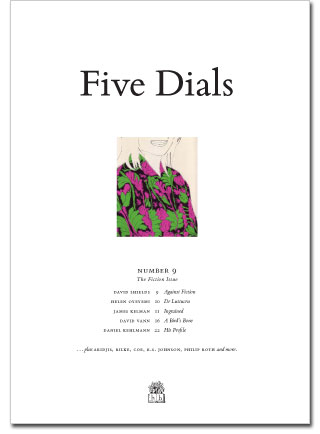
[READ: June 10, 2011] Five Dials Number 9

Five Dials Number 8, The Paris Issue, was pretty big (45 pages), but it had a lot of pictures.  Five Dials Number 9 is also pretty big (41 pages) and it’s (almost) all text.  For this is the Fiction Issue, and there are a lot of short stories in here.

CRAIG TAYLOR-A Letter from the Editor: On ‘Summer Reading’ and Fiction Issues.
Since most of what I talk about in the introduction to these posts is covered in Taylor’s Letter from the Editor, I figured I’d switch formats and start talking about his letter right away.  In this letter, Taylor talks about the serious pitfalls of  ‘Summer Reading’: We pledge to read mammoth books over the summer, but really we never finish War and Peace over the summer, do we? (except those of us who finished Infinite Summer, am I right?).  And so, this Fiction Issue was released in December (finally, a date is given to a Five Dials!).  Taylor briefly talks about all of the authors who contributed (including a pat on the back to Five Dials for securing the rights to a Philip Roth contribution in its first year of publication).  He also talks about the essay from David Shields that is decidedly anti-fiction.   And the final note is that Taylor’s own father has a piece in this issue (nepotism is alive and well!) (more…)

Read Full Post »

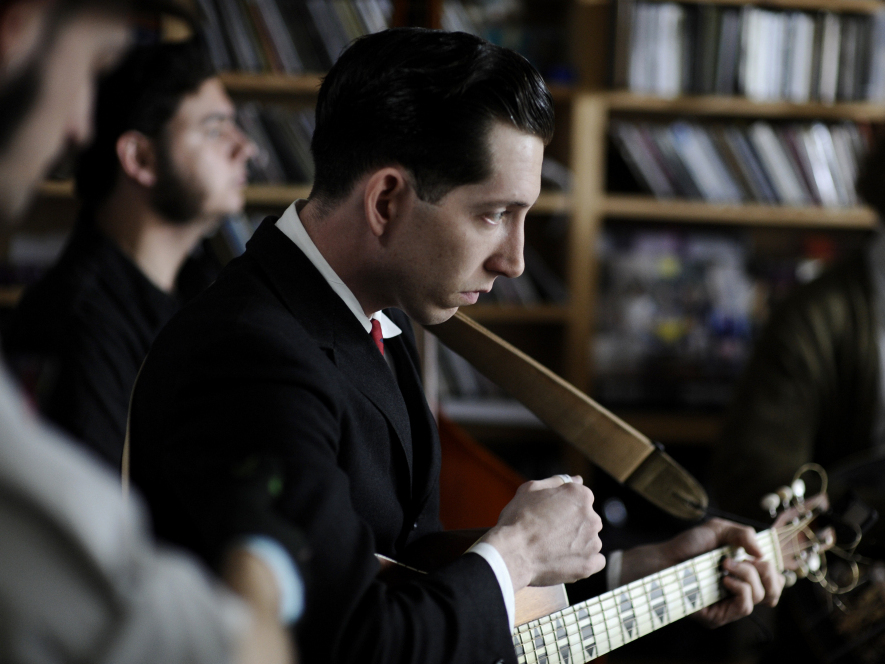
SOUNDTRACK: POKEY LaFARGE-Tiny Desk Concert #122 (April 20, 2011).

I had never heard of Pokey LaFarge before this Tiny Desk concert was sitting in my download folder.  In fact, the notes on the page say that they had never heard of him before they saw him wandering around SXSW.  And then he climbed onstage and played a great set.

LaFarge plays an old-timey style of music.  It’s a kind of Squirrel Nut Zippers retro sound.  As with the Zippers, I love their music in small doses.  And so, this Tiny Desk set is a perfect little sample of LaFarge’s music: happy, bouncy, jazzy.  There’s an upright bass solo, songs about being happy and singing “La La La” and other upbeat stuff.  It’s quite satisfying.

Especially if, as the notes say, you use it as a kind of antidote to the raucous music that you generally listen to.  A Pokey LaFarge song will perk you out of any self-inflicted gloom.  I just don’t need to hear more than three.

[READ: April 15, 2011] 2 book reviews

It looks like Zadie Smith has become a regular fixture at Harper’s.  I’m undecided if I’m going to review all of her book reviews from now on (perhaps I’ll lump some together in one post).  But in the meantime, I’m mentioning this one primarily because she reviews the story that I mentioned in yesterday’s post: Edouard Levé’s Suicide. (more…)

Read Full Post »

SOUNDTRACK: MOGWAI-My Father My King (2001).

Yet another EP release from Mogwai, this is a twenty-minute song that is everything that Mogwai does best.  It’s a slow builder that grows into a loud, epic track; it’s not only noisy and chaotic, but features some really catchy parts as well.

This song was produced by Steve Albini (which makes the Mogwai noise crispy and sharp and modifies their brand of waves of noise).  It’s a kind of companion to Rock Action.

It opens with a kind of middle eastern flair–Wikipedia says it was based on the melody of the Jewish prayer Avinu Malkeinu. Hear the original here.  [Man Wikipedia loves Mogwai, there are lengthy writes ups about nearly every song they’ve done.]

Even without knowing where the melody comes from, it’s a great song with wonderful structure, building and receding (in what is by now a kind of Mogwai pattern).   Twenty minutes rarely sound this good.

[READ: March 13, 2011] “Going for a Beer”

I’m currently reading Robert Coover’s A Child Again, which is a collection of short stories.  For the most part I haven’t really enjoyed it that much.  Nevertheless, I really enjoyed this one page story.  Part of me wonders, simply, if Coover works much better in much much shorter pieces.

So this story is a time-bending crazy quilt of reality.  And, indeed, the story is a lot more style over substance (which is kind of the point).

It opens in third person present with this mind-shredding sentence: “He finds himself sitting in the neighborhood bar drinking a beer at about the same time that he began to think about going there for one.” I admit I read this sentence three times before I gave up and accepted that he was fucking with me.

And, indeed he is. (more…)

Read Full Post »

SOUNDTRACK: MOGWAI-Come on Die Young (1999).

Mogwai’s second full length record goes in a slightly different direction than Young Team. Although it is still full of somewhat lengthy instrumentals, for the most part, the loud and quiet dynamic that they’ve been mastering over their EPs and Young Team is dismissed for a more atmospheric quality.  There’s also a few vocal aspects that comprise some tracks.  One in particular is very puzzling.

The disc opens with “Punk Rock.”  The music is actually not punk at all; rather, it’s a pretty melody that plays behind a rant about punk rock spoken by Iggy Pop. It’s followed by “Cody,” a kind of  sweet slow song.  This one surprises even more because it has gentle vocals which are actually audible.  The track is surprisingly soporific for Mogwai.

And then comes the real puzzler, “Helps Both Ways” is another slow track. But this time in the background is a broadcast of an American football game.  The announcers begin by telling us about an 89 yard run that was called back due to a penalty, but the game stays on throughout the track.  And I have to admit I get more absorbed in the game than the music. After these few quiet tracks,”Year 2000 Non-Compliant Cardia” is a little louder (with odd effects).  It’s also much more angular than songs past.

“Kappa” is the song in which I realized that much of the songs here are more guitar note based rather than the washes of sounds and noise.  “Waltz for Aidan” is indeed a waltz, another slow track.  It’s followed by “May Nothing” an 8 minute track which, despite its length, never gets heavy or loud or noisy.

“Oh! How the Dogs Stack Up” changes things.  It features a distorted piano which creates a very eerie 2 1/2 minutes.  And it leads into the 9 minute “Ex Cowboy.”  Although the general feeling of “Ex Cowboy” is mellow, there are some squealing guitars and noises as well.  By about 6-minutes the song turns really chaotic, its “Chocky” is another 9-minute song (the disc is very backheavy), there’s noise faintly in the background as a simple piano melody is plucked out.  It’s probably the prettiest melody on the disc, and the noisy background keep its unexpected.  The disc more or less ends with “Christmas steps.”  This is a rerecording of the awesome track from the No Education = No Future (Fuck the Curfew) EP.  It is shorter but slower and it sounds a little more polished than the EP. I actually prefer the EP version, but  this one is very good as well (it’s honestly not that different).

“Punk Rock/Puff Daddy/Antichrist” ends the disc with a fun track sounds like a drunken Chinese western  It’s two minutes of backwards sounds and is actually less interesting than its title.

This is definitely their album I listen to least.

[READ: March 15, 2011] Icelander

It’s hard to even know where to begin when talking about this story.  So I’ll begin by saying that even though it was confusing for so many reasons, I really enjoyed it (and the confusions were cleared up over time).  This story has so many levels of intrigue and obfuscation, that it’s clear that Long thought quite hard about it (and had some wonderful inspirations).

The book opens with a Prefatory note from John Treeburg, Editor (who lives in New Uruk City).  The note informs us that the author of Icelander assumes that you, the reader, will be at least a little familiar with Magnus Valison’s series The Memoirs of Emily Bean.  As such, he has included notes for clarification.  He has also included a Dramatis Personae.  The characters in the Dramatis Personae are the characters from Valison’s series (not necessarily Icelander), and are included here for context.  He also notes that his afterward will comment on the disputed authorship of this very novel.

The Dramatis Personae lists the fourteen people who Valison wrote about inThe Memoirs of Emily Bean.  Except, we learn pretty early on that the The Memoirs were based directly on the actual diaries of the actual woman Emily Bean Ymirson.  Emily Bean died in 1985, but before she died she was an extraordinary anthropologist and criminologist.  She kept meticulous journals of all of her exploits, and Valison fictionalized it (to some people’s chagrin, but to general acclaim).

Emily Bean was also the mother of Our Heroine.  Our Heroine is, indeed, the heroine of Icelander, although her real name is never given.  We learn pretty early on is that Our Heroine’s friend Shirley MacGuffin has been killed.  MacGuffin was an aspiring author (whose only published work appears on a bathroom wall).  Her final text was meant to be a recreation of Hamlet.  Not Shakespeare’s Hamlet, but Hamlet as written by Thomas Kyd.  And, indeed, Kyd’s Hamlet predated Shakespeare’s.

There’s also a lot of excitement with The Vanatru.  The Vanatru lived underground, and had a serious quarrel with surface dwellers who worked hard at keeping them down. The Queen of the Vanatru is Gerd.  She controls the Refurserkir, an inhuman race of fox-shirted spirit warriors who appear literally out of nowhere.

Okay, so how confused are you now? (more…)

Read Full Post »

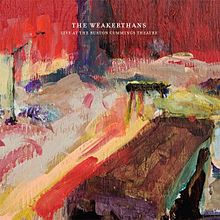
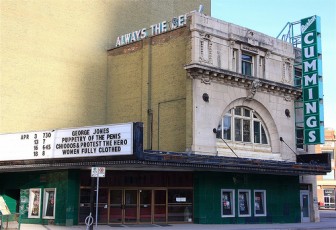
SOUNDTRACK: THE WEAKERTHANS-Live at the Burton Cummings Theatre (2010).

I’ve enjoyed The Weakerthans for a few years now, so I was pretty excited to see they had a live album out.

This live album works like a greatest hits.  All of the songs are great catchy pop songs–why aren’t The Weakerthans huge?  Maybe because their songs are literate and clever (and have weird titles (like “Our Retired Explorer (Dines with Michel Foucault in Paris, 1961)”).  In fact that song is one of only two songs that I know of that mention Jacques Derrida (the second being Scritti Politti’s “Jacques Derrida”).

Admittedly, The Weakerthan’s songs are simple and catchy and these live versions aren’t radically different from the originals.  There’s no extended jams or maniacal freak outs or anything.  But the album is very charming (John Samson is unfailingly polite) and the one big surprise is quite a surprise!

On the track “Wellington’s Wednesdays” Samson introduces a guy: “This is Ernesto.  He’s from Mexico.  He’s going to play a guitar solo.”  While listening to the disc I couldn’t imagine this peculiar introduction for a band member.  My version of the disc comes with a concert DVD of the show.  I didn’t get to watch the DVD until recently and… mystery solved:  Ernesto is a fan in the front row.  Samson talks to him mid-song, pulls him up on stage, introduces him and gives him his guitar to play the solo!  Then Samson jumps into the front row to watch.   How cool is that?

The video doesn’t deviate from the audio, except for leaving in a few moments of patter from Samson. In fact, I found the video to be somewhat choppily edited.  When Samson plays “One Great City!” (solo…which wasn’t obvious from the audio.  I mean, you can tell he’s solo, but it’s much more dramatic in the video) at the finish of the song, it immediately cuts to the next full band song, rather diminishing the return of the band.  (Although I do like the jump cuts to the audience which reveal what appears to be a room full of teenagers–it’s adorable!)

The other confusing thing is that the recording notes say that it was recorded over two days, and yet the video appears to be one night’s show. And the audio matches it, so who knows.

But those are little quibbles.  The music is great, the sound quality is fantastic and the song choices are great.  There are some cool surprises on the disc (like the horns and violin), but mostly what you get is an enjoyable evening at a small hometown concert with fans who love to sing along to the chorus of “One Great City:” “I hate Winnipeg!”

[READ: December 18, 2010] Stephen Leacock

What I’ve really been enjoying about this series of Extraordinary Canadians is how the writers of the books (at least the three I’ve read so far) are writing in such very different styles.  Obviously Coupland did his own thing.  Vissanji is a novelist, and he wrote his in a more novelistic way (its not like a novel at all, but it’s constructed in a kind of narrative style).  Macmillian is a historian, and I suppose for that reason, this biography feels more like a history (of Leacock, but also of economics) than a simple biography.

The strangest thing about this book is that although MacMillan obviously likes and respects Leacock, a surprising amount of the book is taken up with her talking about things he either said or did wrong or about his books that really aren’t that funny.  This is surprising because Leacock is a noted humorist. (In 1947, the Stephen Leacock Award was created to recognize the best in Canadian literary humour).

This biography looks at his life, but mostly it focuses on his academic and humorous works.  Leacock was an economist although he seems to generally disapprove of economists.  He had begun by teaching high school but found it incredibly stifling.  Eventually he found his niche at McGill University where he was well-respected and highly regarded by students and faculty alike. (more…)

Read Full Post »

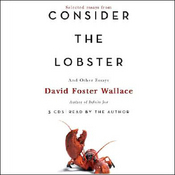
[LISTENED TO: November 18, 2010] Consider the Lobster

This was the final audio book that DFW read.  As with Brief Interviews, this is a collection of selected, unedited essays [actually it says “Text slightly edited for audio, with changes approved by the author.”  I don’t know these essays verbatim, but it seems like the changes simply acknowledge that this an audio essay and not a written one].

The only problem with the entire package is how few essays were selected.

I don’t know if it’s because this collection was recorded later and DFW felt more comfortable reading or because DFW had more fun reading these essays or that these essays lend themselves to more animated reading, but this collection is absolutely stellar.

The audio book includes

  • Consider the Lobster
  • The View from Mrs. Thompson’s
  • Big Red Son
  • How Tracy Austin Broke My Heart

and, sadly, that’s it.

Not included are (more…)

Read Full Post »

SOUNDTRACK: fIREHOSE-Live Totem Pole EP (1992).

Listening to Superchunk’s “Slack Motherfucker” reminded me that I knew a live version from somewhere else.  And, with a little help from the web, I remembered it was here.

fIREHOSE is Mike Watt’s post-Minutemen band, and they are a lot of fun (and even managed to get a major label deal before breaking up.  This (apparently really hard to find) EP is a great, weird collection of covers: Blue Oyster Cult’s “The Red and the Black”; Public Enemy’s “Sophisticated Bitch” (yes you read that right); The Butthole Surfer’s “Revolution (Part 2)” (with the repeated coda of “Garry Shandling, Garry Shandling”; Superchunk’s “Slack Motherfucker” and Wire’s “Mannequin”.  There’s two Watt-written songs, “What Gets Heard” (from fROMOHIO) and “Makin’ the Freeway” (from if’n).

The covers are universally solid.  The band sounds punky and kind of sloppy and fun (not so terribly virtuosic on the solos), and they bring an amazing vitality to these songs.  The Public Enemy song is probably the biggest surprise as it sounds fantastic in this rocking band set up (although the original rocks pretty hard too, frankly).  And “Slack” is possibly even faster and punkier than the original (it sounds awesome here).  Interestingly to me, “Mannequin” sounds completely like an SST track (which if you know the label will make sense and if you don’t, it won’t) even though it’s a Wire song (and not released on SST).

I’d always known that Watt was a mean bassist, but man, he is wild on this disc.  The runs and fills he puts in all over the disc are great.  “What Gets Heard” has some great slap bass and “Freeway” is one of Watt’s weird and delightful spoken rants with fantastic bass fills.

fIREHOSE may not have always been brilliant, but they had moments of awesomeness.

[READ: October 16, 2010] “The Failure”

This story is part of the 1999 New Yorkers‘ 20 Under 40 collection (it’s the first story that was not included in that issue).  Its also the first story by Franzen that I have read.

It’s tempting, since I’m in a David Foster Wallace mood, to think that DFW was some kind of inspiration for Franzen (they were friends, after all).  The opening of the story talks a bit about cruise ships.  And Wallace’s “Shipping Out” was published in Harper’s just a couple of years before this.  Having said that, aside from the fact that the protagonist’s parents are taking a cruise (and there’s some cruise-mocking), the story doesn’t have much else in common with the piece, so we’ll get past that.

The story was excerpted in the main 20 Under 40 issue (the first few paragraphs), and I was intrigued, although the excerpt didn’t really indicate where the story would go at all.

Chip is a midwestern guy who has moved to New York City. He has lost a teaching job (for a very bad reason) and is now trying to survive as a writer.  His parents are in town briefly because they are taking a cruise out of New York.  And as he updates his mother and father on what he’s been up to, the list of minor failures (the ones he admits to and doesn’t) grows and grows.  And it’s clear from his mother’s talk that she’s more than a little disappointed in his reality. (more…)

Read Full Post »

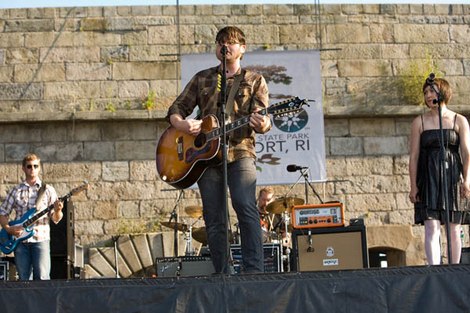
SOUNDTRACK: THE DECEMBERISTS-Live at the Newport Folk Festival [excerpts] (downloaded from NPR) (2010).

The Decemberists played at the Newport Folk Festival this year. NPR audio has an excerpt for free listen/download on their audio site.

They say that they were not going to play the entire Hazards of Love album at this show, as had been their wont on this tour.  I’m not sure what their entire set consisted of, but the three excerpts here include: “The Crane Wife Pt 3,” “Yankee Bayonet” and a very extended “Sons and Daughters.”

It surprises me how well The Decemberists work in a live setting.  I think of their music as  complex and convoluted with strange instrumentation, and yet, perhaps because of the theatricality of it all, it all sounds great in a live setting.

I can’t really imagine them releasing a proper live album, so for those of us who don’t get to concerts much, this is the next best thing (the recording quality is excellent–I only wish it was their whole set).

[READ: October 12, 2010] “Otravida, Otravez”

Junot Díaz is the next writer in the 1999 New Yorker 20 Under 4o issue.

I didn’t like this story in the beginning because I couldn’t tell for quite some time the gender of the narrator.  Normally this doesn’t make a difference, but when the narrator climbs into bed with the man in the room, I had a hard time deciding if this was a subversive act or just a straight act of romance.  [I admit that since the author was male, I assumed the narrator was male, too].

It turns out the narrator is a woman (there is a clue when he says “Yasmin,” but in the first read I was unclear if he was saying her name or just a name in general).

In fact, to me, the entire beginning was very strangely set up and it took a few paragraphs (when she describes her job) before I felt the flow really took off.  However, once it did I found this story fascinating and convoluted in a very good and clever way. (more…)

Read Full Post »

« Newer Posts - Older Posts »