 SOUNDTRACK: THE DEAD MILKMEN-Bucky Fellini (1987).
 C’mon, I’m the walrus, damnit.
Bucky Fellini ups the ante from Eat Your Paisley in that the band sounds really accomplished at this point. The songs are still silly, but they’re not quite as jokey (except for the hit single, but more on that in a second). There’s even lap steel guitar, violin and backing vocals!
Dave Blood’s bass is really something of a force at this point, propelling songs with interesting riffs. Rodney “Cosloy” Anonymous sounds great. And, Joe Jack Talcum gets quite a number of songs to sing: the mellow (and very twisted) “Watching Scotty Die” and the more rocking “Rocketship.”
“Big Time Operator” is a supremely silly song based on a very simple blues riff. It features the first (utterly wretched) DM guitar solo (look out Stevie Ray Vaughn!) and even showcases a “humming” solo from Rodney (just me!). While on the other end of the spectrum, “Surfin’ Cow” is mostly instrumental which is catchy and full of surprising intricacy.
“Instant Club Hit (You’ll Dance to Anything)” was indeed a club hit. It’s snarky and silly (complete with a drum machine) and it name-checks some of the most prominent college radio bands of the time. You could easily have built a good collection of British college rock from their list of who you’ll dance to. (instead of giving your money to a decent American artist like himself).
The Dead Milkmen keep getting better and better. They’re still funny, but they’ve proven themselves to be far more than a novelty act. Blow it out your hairdoo cause you work at Hardees.
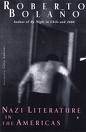
[READ: April 1, 2010] Nazi Literature in America
I’ve read a lot of books that are, shall I say, weird. But this one is definitely the most unusual when I think: what would possess a person to write it?
Nazi Literature in the Americas is written as an encyclopedia of Nazis writers who have lived in North, Central and South America. Except that all of the writers are fake. So, essentially Bolaño has invented 30 characters, and created rich, fully detailed biographies about all of them.
Some of them are very short (a couple of pages) while a few are over ten pages long, with details of books/poems published, critical reception and even untimely deaths. The biographies are grouped according to categories (The Mendiluce Clan; Itinerant Heroes or the Fragility of Mirrors, Forerunners and Figures of the Anti-Enlightenment; Poètes Maudis; Wandering Women of Letters; Two Germans at the End of the earth; Speculative and Science Fiction; Magicians, Mercenaries and Miserable Creatures; The Many Masks of Max Mirebalais; North American Poets; The Aryan Brotherhood; The Fabulous Schiaffino Boys; The Infamous Ramírez Hoffman).
And although they are not chronological, Luz Mendiluce (whose bio I read separately) features prominently as a constant “reference point” and creator of one of the prominent Nazi publishing houses. She had created a publishing empire where Nazi works were spread throughout the continent, and it seems that everyone had a title published by her company Fourth Reich.
What’s so weird about the book is that the people are fake, everything about them is fake (although they are placed firmly within history) and yet their stories are still compelling. Bolaño has employed a mildly sympathetic tone to these people. Not sympathizing with the Nazi aspect, but sympathizing with them as humans.
There were one or two who I didn’t really enjoy. And I admit that I enjoyed the North Americans more; since I know more about North than South America, the facts surrounding these authors resonated more. But I thoroughly enjoyed most of these biographies.
Of course, just when you think the book is all the same, the final biography changes everything. In this one, Bolaño himself appears as the writer of the book. He writes about Ramírez Hoffman in the first person, mentioning himself by name and getting personally involved in the story of this final, skywriting author. It completely subverts the work before it and leaves you more confused than when you started (although a lot happier for having read it).
The final section of the book is an Epilogue foe Monsters. It provides a brief biography for all of the secondary characters mentioned in the main body. It also details the publishing houses and magazines, and finally lists a bibliography of all books published. The amount of detail that Bolaño created here is staggering.
But aside from all the Nazism, the book can be quite funny. Like the conclusion for Luz Mendiluce Thompson, which ends with her driving a car into a gas station. The final line: “The explosion was considerable.”
It’s tempting to say that this “novel” is not representative of Bolaño’s writing, but I think that’s false. From what I’ve read so far, Bolaño doesn’t conform to any style in his books: each book is designed differently. But like this one, they all deal with South America, with violence, with politics and are filled with humor. So, yes, I guess this is pretty representative.
Oh, and the translation by Chris Andrews is, once again, fantastic.
For ease of searching I include: Bolano

 SOUNDTRACK: THE DEAD MILKMEN-Eat Your Paisley (1986).
 Who has angered the volcano gods?
 SOUNDTRACK: RUSH-Permanent Waves (1979).
 When my friend Doug and I were hanging out back in the 80s, we both were getting into Rush at the same time. And because this album was in black and white this was the last Rush LP we bought. Imagine our surprise when it turned out to contain “The Spirit of Radio” one of the best hard rock anthems ever.
 SOUNDTRACK: KISS-KISSology: The Ultimate Kiss Collection, Vol. 2: 1978-1991 DVD (2007).
 In addition to containing Kiss Meets the Phantom, this DVD contains concert footage, music videos and some interviews. We see Peter Criss being interviewed on CNN (!) by a woman in a tank top (ah, the early days of 24 hour news) about leaving the band. Of course, this doesn’t hold a candle to the actual music video for “Shandi” one of the cheesiest of cheesy Kiss videos.
 SOUNDTRACK: BLUE ÖYSTER CULT-Imaginos (1988).
 I think of this as the last BOC album (although they have released two since this one) because it was the last one that I was really aware of when it came out. My roommate Glen was super excited about it and we listened to it all the time. And even though I’ve said that Fire of Unknown Origin is my favorite BOC disc, I think this one may be better.
 SOUNDTRACK: TORI AMOS-“Juarez” (from To Venus and Back) (1999).
 This song was the first that I had heard of what was happening in Juarez, Mexico. In AP Magazine (Oct 99) Tori Amos said:
 SOUNDTRACK: MARTHA WAINWRIGHT-I Know You’re Married But I’ve Got Feelings Too (2008).
 I’ve been a fan of Loudon for years. I also rather enjoy Rufus. So why not check out Rufus’ sister Martha and see how she stacks up in the family canon. Actually, it’s not fair to compare because she is an entity all to herself. And indeed, I feel that she sounds nothing like her family (maybe a weeeeee bit like Rufus, but not really).
 SOUNDTRACK: BLUE ÖYSTER CULT-Tyranny and Mvtation (1973).
 The album cover is similar to the first disc (a simple black and white), but this one adds a touch of red. Similarly, the music adds a touch of something that makes this disc leap beyond the foundation of their first.
 SOUNDTRACK: Make the Load Lighter: Indie Rock for Haiti (2010).
 I mentioned this disc a few days ago because it’s a benefit disc for the people of Haiti. I had encouraged people to order it ($10 to a good cause, eh?) but hadn’t fully listened to it yet.
 SOUNDTRACK: SAM COOKE-Portrait of a Legend 1951-1964 (2003).
 After reviewing Colin Meloy Sings Sam Cooke, I decided to check out Sam Cooke himself, since I said I didn’t know anything about him. Well, it turns out that I was totally wrong about that. I checked out this disc from the library and was rather surprised to realize that I knew at least a dozen songs by Cooke. And not just that he sang songs which I knew–they were his versions that I knew.
 I Just Read About That...
