Feeds:
Posts
Comments

Archive for the ‘Humiliation’ Category

SOUNDTRACK: PJ HARVEY-Let England Shake (2011).
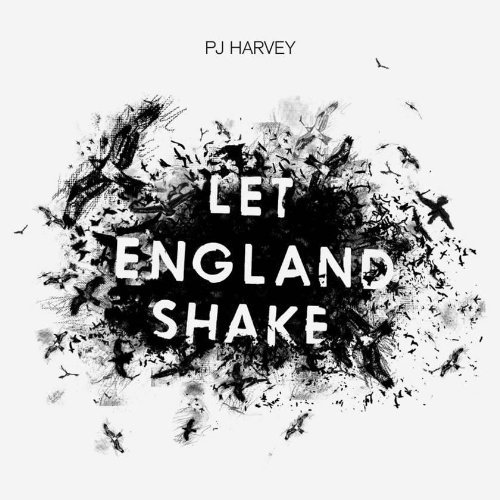
I’ve listened to this disc several times online; I have no details about the recording.  There’s samples, but I don’t know what they are and I can’t really tell what all the lyrics are (it’s obvious she’s pretty angry, but the details are lost to me).

The first question for me on hearing this disc is what happened to PJ Harvey’s voice?  It comes as such a shock when you compare it to Dry.  But once I accepted that this is not the PJ Harvey of Rid of Me, I listened to it as a new artist and I really like it.  But it’s a weird record to be sure.

The title track is played on an autoharp (!).  In fact the autoharp is a dominant instrument here.  It’s got a cool melody and, once you accept that she sounds like the singer from Rasputina, you can really appreciate what’s going on.

The second track, “The Last Living Rose,” returns somewhat to the PJ of old (the opening “God damn” sounds like she’s about to bust out some good-ol’ invective).  And there are guitars, but the music is upbeat (as are the vocal melodies) and there’s even a horn!  “The Glorious Land” has samples from the cavalry (I can see the horses riding across the plains) and a cool, slinky guitar (or is that the autoharp?).  There’s male vocals in the middle of the song, and it makes for disconcerting harmonizing (especially when PJ,’s voice ratchets up the weirdness and sounds more like Kate Bush).  But musically this song is great, it’s got a wonderful 80’s alt-rock feel.

“The Words That Maketh Murder” also has horns and some interesting male vocals chanting the lyrics.  This has one of the least subtle lyrics I’ve heard in a long time, although the re-imagining of the “Summertime Blues” refrain is pretty genius.

“All and Everyone” opens with more autoharp, and I think I’m realizing that the autoharp is what I think of as the interesting guitar sound (this song opens like a Smiths’ ballad.)  There’s more horns on this track which adds a weird dimension of sadness to it.  “On Battleship Hill” is a fast but delicate track in which PJ pulls out an astonishing falsetto–completely unexpected.  After the first verses, the rest of the song has, again, a kind of slinky 60s vibe.  “England” brings out the Kate Bush voice in PJ again.  This is a very delicate song, the music is mixed so low in the background that it feels like acapella–I guess Harvey has grown much more confident in her voiuce.  The music builds and builds though and there’s an unexpected middle eastern sounding vocal in the background.

“In the Dark Places” brings out Harvey’s guitar (in this case the Harvey is Mick Harvey, I believe) and her lower register vocals. While “Bitter Branches” is probably the loudest song on the disc, with a bunch of screamed vocals.  It’s rather startling considering the rest of the disc, but it’s nice to know just how much fire PJ still has.

“Hanging in the Wire” is another delicate song, with quiet pianos and Harvey’s sedate voice.  “Written on the Forehead” returns to that middle eastern vibe (“people throwing dinars at the belly dancers”) and that Kate Bush vocal–the backing vocals remind me of Peter Gabriel.  The album ends with “The Colour of the Earth.”  It’s the most disconcerting song of the bunch becuase it opens with a male singer (John Parrish?) singing what sounds like an old trad song (the melody is very traditional).  Then PJ joins in and makes the song her own.

It’s obvious that the lyrics are the main aspect of this disc, and I know that I’m missing something by not having them. I’m also missing a lot by not knowing all that much about England’s history.  It sounds like she has a lot of gripes with Eng-a-lund, and I’m curious to know what she’s on about.  But more than that, I’m totally hooked by the music.  It’s a great reinvention of a great artist.

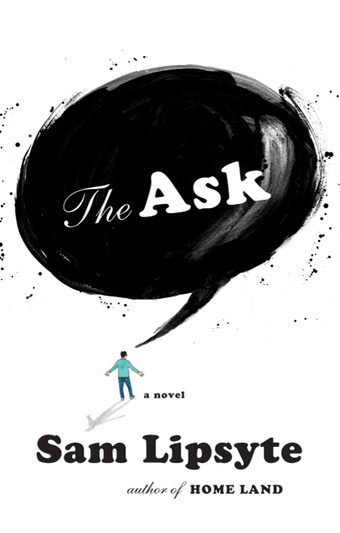
[READ: February 9, 2011] The Ask

I was planning to read nothing except books from the pile by my bed for the foreseeable future.  And then, as if calling to me, I saw this book, which I was planning to read eventually, on a display right in front of me called Booklist Editor’s Choice (a new display for our library).  I stared at it for three hours and just had to check it out.

And I’m glad I did.  For the most part I really enjoyed this book, it was quite funny and the main character, kind of a schlub, was completely relatable.  I say for the most part because I felt like it dragged a bit about 2/3 of the way through (more on that later).  But its possible that it dragged because the first half of the book was just fantastic–fast paced and clever with lots of wonderfully funny lines (more on that later too).  And a setting that I found very entertaining.

The story is about Milo Burke. He is married to Maura and they have a going-on-four-year-old boy Bernie who is nothing if not precocious.  The titular ask concerns Bernie’s job.  He works for a small arts college in New York (which he called Mediocre University).  His job is to basically ask (hence the title) rich people for money for the college. We see him in his office as the book opens and we meet the rest of the staff: the surprisingly unslacker slacker Hubert (with whom Milo shares space and ribald jokes…this section is the funniest; many paragraphs end with sentences that hilariously undermine what he just described.

We often called it, with what we considered a certain amount of panache, the Mediocre University at NewYork City.  By we, I mean Horace and I.  By often, I mean once (4).

His supervisor is Vargina.  (This name, which is obviously over the top and childish and which I absolutely laughed at and then felt was maybe too easy of a laugh, has a great origin story and is really never not funny no matter how often you see it).  Milo has obscene fantasies about Vargina, but he is a (somewhat) happily married man and would not cheat on his wife.

He’s not very good at his job, but the other askers do alright so his job is safe.  Until, that is, he insults the daughter of one of the university’s biggest donors and he is summarily let go, without severance.  And then we get to see a lot about his home life. (more…)

Read Full Post »

SOUNDTRACK: PJ HARVEY-“Let England Shake” [Live on the Andrew Marr Show] (2011).

PJ Harvey has a new album out.  I’ve listened to it free on NPR, and in the introduction, they mention this live version on the Andrew Carr show.  Harvey (solo) plays an autoharp, and the melody is provided by a sample of the original version of “Istanbul (Not Constantinople)”  (done by The Four Lads).

The album version doesn’t use the sample, although the melody is the same.

I loved PJ Harvey back on her first few albums, but I didn’t even get White Chalk.  Harvey has undergone a bizarre transmogrification, where not only is she no longer a rocking guitar woman, her voice has lost its growling edge and his been replaced by an amazing falsetto.

This version also differs from the official release in that this one is shorter (probably time constraints on the show) and has fewer verses.  It also has Harvey singing the “Istanbul” chorus which isn’t on the disc.  So, this is a unique interpretation of the song, one that likely won’t be available anywhere else.

I wasn’t expecting to like this as much as I did.  It’s not the PJ I know, but this new PJ is certainly interesting.

[READ: January 31, 2010] Lemon

Krauser hand-scribbled the covers of all 10,000 extant copies of this book.  So if nothing else, the covers are all unique!  (Click here for a larger scan).

This is one of the first half-dozen or so books that McSweeney’s published and to me it speaks volumes about the kind of absurdist books that they initially released.  Those early titles were weird and possibly ironic and maybe post modern and were kind of interesting but not necessarily enjoyable.  Thankfully, they have since published very very readable books, but everyone has growing pains, right?

That sounds like I didn’t like this book, which is not exactly true.  I was bemused by it, but mostly I kept thinking I can’t believe that this guy did this much research about lemons, he was practically as obsessed about lemons as his main character.  For indeed, that is what this book is about: a man’s obsession with lemons.  Or, specifically, one lemon. (more…)

Read Full Post »

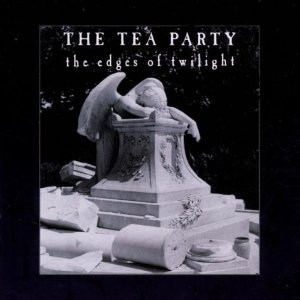
SOUNDTRACK: THE TEA PARTY-The Edge of Twilight (1995).

In the way that Ian Astbury of The Cult reminded everyone of Jim Morrison, so does Jeff Martin, singer of The Tea Party.  He looks a bit like him and he sings in a baritone voice that, while all his own, sounds like perhaps a 1990s Jim Morrison.

This, their third album, is full of what I think of as their trademark sound: all manner of exotic instrumentation laid over heavy Zeppelinesque riffs.  Opener “Fire in the Head’ is not unlike “Kashmir” in its riff, and what’s funny is that the exotic instrumentation makes it sound even more like “Kashmir” than “Kashmir” does.  Zep didn’t use instruments like the sitar and sarod to make their sound more authentic.  Indeed, authenticity seems to be what the band is going for, as later albums describe them spending time in the middle east where they learned to play these instruments more proficiently.

“The Grand Bazaar” takes that concept further with some really Eastern sounding music within a very heavy rocking track.  And “Ianna,” although not my favorite track, really showcases the Middle Eastern instrumentation in this cool, twisty track.  There’s also a more traditional rock number, “Drawing Down the Moon” which features lengthy blues-guitar solos over a fairly conventional track.

It’s not all heaviness though, as “Correspondences” is a seven minute piano based ballad in which Martin’s voice is right in your ears.  It’s on this track that you decide whether you love his voice or think he’s preposterous.  If the latter, well, then there’s the beautiful instrumental “The Badger.”  And “Shadows on the Mountainside” is a quieter acoustic number in which Martin sings in his much more delicate range.

But perhaps the most over-the-top, and consequently, best track on the disc is “Sister Awake” which features 12-string guitar, sitar, sarod, harmonium and goblet drums.  It starts slowly and quietly and builds into multiple climaxes (complete with loudly whispered “Sister!”).

Whether or not this confers any kind of approval on The Tea Party or not, Roy Harper (as in “Hats Off to Roy”) does a spoken word bonus track at the end of the disc.  I don’t know much about Roy Harper or what he was up to in 1995 (perhaps he’d do anything for a buck?) but it give an air of legitimacy, no?

The Tea Party is a band that splits people into love it or hate it groups.  They have sold millions of copies and yet there are those who despise them.  Their next album Transmission found some success in the U.S. because it was a bit more industrial sounding (with samples and loops), but they never really broke through down here.

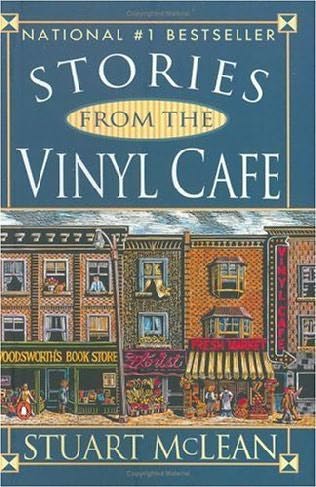
[READ: February 4, 2011] Stories from the Vinyl Cafe

I’m not sure how I found out about this book.  I know I bought it in a Chapters in Toronto.  I wonder if it was on a display and I was intrigued by the title.  Or, more likely, I had heard a bit about him in my preparations for my trip and decided to buy his book.   Whatever the case, I didn’t read it until now.

McLean is described in one of the (practically a dozen) pages of praise and advertisements for his other books as a Canadian Garrison Keillor.  And, as lazy as that seems, it’s fairly accurate.  Especially because although McLean is a humorist (he won the Stephen Leacock Memorial Medal for Humor), like Keillor, who is mostly funny, McLean also deals a lot with serious matters.  Indeed, some of the stories in this collection are utterly unfunny: ending with a dead dog or a dead grandmother.

And here’s the thing.  These stories are slices of people’s lives.  They are incidents that impact them and are worth recollecting, but that don’t cause anyone to change.  They’re like perfect little anecdotes, and I imagine they are excellent to hear aloud. (more…)

Read Full Post »

SOUNDTRACK: THE TRAGICALLY HIP-Up To Here (1989).

Up to Here is a pretty big leap from their first EP.  There’s more guitar soloing (not grandiose solos, just little guitar noodling in the songs “Blow at High Dough,” which was used wonderfully for the show Made in Canada (also known as The Industry).

Downie’s voice is more in keeping with what we’d come to know later, and lyrically the songs are esoteric and interesting.

“Blow at High Dough” opens the disc with a very cool guitar intro (“They shot a movie once, in my hometown”) “I Believe in You (Or I’ll Be Leaving You Tonight)” a not terribly good song has some proto-Downieisms: spoken passages, stories in a breakdown of the song, but the subject matter is not that exciting.  Of course, it’s hard to sound good when you’re followed by “New Orleans is Sinking” another fantastic song that still sounds great today (especially in their live versions).

“38 Years Old” is a surprisingly moving song with some slides guitars…a nod to their country/folk roots that they tend to bury under raw rock guitars.

But even some of the less memorable, less exciting songs have great aspects to them.  Songs like “She Didn’t Know” are pretty standard rock songs.  Better than average, but not exceptional.  But the band puts little things into them that bring them up from the mundane: the guitar licks, the backing vocals (slightly R.E.M.-ish).

Even “Boots to Hears” which sounds a bit too much like John Mellencamp in the intro really wins you over by the end (the lyrics are great).  For what really is a debut album, it’s solid and shows great songwriting skills and promise.

They still haven’t quite gotten the hang of cover art yet, though.

[READ: January 26, 2011] “You Go First”

This was the first of four flash fictions in this issue.  Flash fiction doesn’t really have a definition per se (except that it is very short).  There are some masters of flash fiction who can write very compelling stories with astonishing brevity.  These stories are all short (one magazine page a piece), but they feel kind of bloated compared to the writers like Lydia Davis.

Gibb’s story actually feels a lot longer than it is.  It opens with us meeting the narrator’s next door neighbors, Carl the cremator, his obese wife Brenda and their son Jason.  The narrator doesn’t really like Jason, but he’s the only person who will hang out her because he wasn’t around for her birthday party last year.  At that party, her hippie parents encouraged everyone to play a game called Getting to Know Our Bodies. (more…)

Read Full Post »

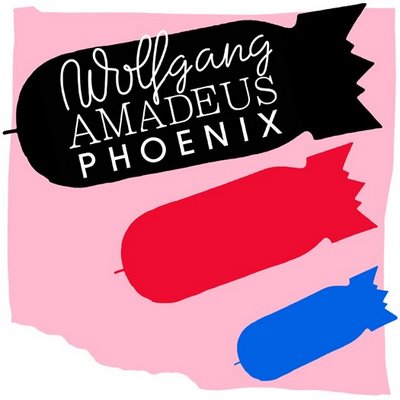
SOUNDTRACK: PHOENIX–Wolfgang Amadeus Phoenix (2009).

It will soon be unsurprising to say that a great album has come from a French band (no offense to the French, but you never used to hear cool music coming from there).  Then we had Air and Daft Punk and now Phoenix.

The first single and leadoff track, the preposterously catchy “Lisztomania” features guitars and keyboards (just so we know they’re not another techno band).  It has a simple but infectious riff as it opens , and it never lets up in catchiness.  “1901” has a chorus that ends with some ayayayayayays that I dare you not to sing along with.

“Fences” has a pretty classic disco feel to it.  It’s followed by “Love Like a Sunset.” Part 1 is a five-minute atmospheric instrumental, and Part 2 follows along similarly.

“Lasso” follows with some more simple background keyboards topped with grinding guitars.  Like “Countdown,” it’s simple and hard not to like.  “Girlfriend” opens with great swaths of keyboards and lots of repeated words in the verses and chorus, making for yet another great single.   In fact, all of the songs are super catchy.

Despite the simplicity of the melodies, the songs are always interesting.  And that’s hard to beat.  There’s no surprise that this album was on many lists as one of the best of 2009.

[READ: October 28, 2010] “The Dungeon Master”

Reading this short story reminded me that I really want to read Lipsyte’s new book The Ask, which is supposed to be very good indeed.

The title of the story immediately made me think it would be about Dungeons & Dragons, and I was pleased to see that it was.   The story concerns a group of boys who have their own D&D club after school (as opposed to the school sanctioned D&D club).  Their game meets at the Dungeon Master’s house and there is no, repeat, no touching of the DM’s manual.

We quickly learn that the DM is a sadistic bastard.  He has killed off his younger brother’s character at least 30 times (and the brother keeps making a new character in his place: Valentine the 19th, Valentine the 20th etc).  But unlike in real D&D where you die from ogres and dragons, Valentine has died from, for instance, rectal cancer (how do you roll for that?).

There’s a lot of speculation about just how crazy their DM really is (rumors abound: he flashes some girls at the ice rink, he set his own feces on fire).  And, of course there’s talk that he spent some time in Bergen Pines.  And just where is his mother anyway? (more…)

Read Full Post »

[LISTENED TO: End of October 2010] Brief Interviews with Hideous Men

There are three options for listening to Brief Interviews.

The first version is the original audio cassette which is read entirely by DFW (1999).  It’s out of print but you can download the audio for free at the David Foster Wallace Audio Project. The second version is the newly released audio book that coincides with John Krasinski’s film (2009).  This CD features some of the readings by DFW although most of the actual interviews are read by the actors from the film (see below for all details).  The third option is a collection of staged readings which were created by The Howling Fantods Brief Interviews Project.  They are available at the site and at the David Foster Wallace Audio Project.  [UPDATE Nov. 8: For the sake of accuracy, I wanted to state that George Carr is responsible for all of the work down for these recordings.  The Howling Fantods site simply hosted the results].

None of these recordings include all of the stories from the book.  Although the stories that they do include are unedited (this is officially listed as “unedited selections from the book”).  The stories that are not included in any of these recordings are:  creepy organ music

  • “The Depressed Person”  [this would have been a tour de force to read]
  • “The Devil Is a Busy Man”
  • “Think”
  • “Signifying Nothing”
  • Datum Centurio” [I can’t imagine trying to read this out loud]
  • “Octet”
  • “Adult World (I)”
  • “Adult World (II)” [I would have liked to hear how these were handled]
  • “The Devil Is a Busy Man”
  • “Church Not Made with Hands”
  • “Yet Another Example of the Porousness of Certain Borders (XI)”
  • “Tri-Stan: I Sold Sissee Nar to Ecko” [this is my least favorite bit of DFW work and I would have really liked to have heard it read aloud to see if I could get anything more out of it].
  • “On His Deathbed, Holding Your Hand, the Acclaimed New Young Off-Broadway Playwright’s Father Begs a Boon” (more…)

Read Full Post »

SOUNDTRACK: THE DUCKWORTH-LEWIS METHOD-The Duckworth Lewis Method (2009).

This is a CD released by the combined forces of Neil Hannon of The Divine Comedy and Thomas Walsh of Pugwash.  And if that weren’t enough of a sales pitch, the title of the band is a method of calculating cricket scores!  And even more…in concordance with that, this CD is largely about cricket.  Huzzah!  Buncha sellouts.

I don’t know a thing about cricket, but I know about great orchestral pop, and this disc has it in spades.  Some of the more obvious cricket songs are even understandable to non cricketers (the themes of “Jiggery Pokery” are familiar to anyone who has failed in a sport–and musically it sounds like a silent film soundtrack).

“The Age of Revolution” begins with an olde-fashioned soundtrack as well (jazz swing, including tap dancing) but quickly jumps into a dancey discoey verse (the two soundtracks blend surprisingly well in the chorus).  And the revolution?  Well, it has something to do with cricket.  Next, “Gentlemen and Players” is a wonderfully Divine Comedy-esque track complete with harpsichords.

“The Sweet Spot” is another discoey dancey track with some funky bass work (and innuendo whispered vocals).  And “Rain Stops Play” is a fun musical interlude.

“Mason on the Boundary” is the first track that seems distinctly Pugwash-y.  Hannon and Walsh have similar singing styles, and I find it hard to know who is who sometimes.  But this track is clearly Walsh’s and it’s very nice indeed.  Similarly, “Flatten the Hay” has that distinct Pugwash XTC/Beach Boys vibe and it’s quite good.

“The Nighwatchman” is also a very DC type song (it even sounds a bit like “The Frog Princess” but pulls away before being a repeat of that great single by introducing some very 70s sounding strings).  The rest of the disc follows in this same wonderfully orchestrated pop feel.  This a great record that, as far as obscure bands that get no statewide attention go, is top notch.

Oh, an it’s even more fun with headphones!

[READ: October 9, 2010] Skippy Dies

Wow, there’s a lot going on in this book.  It’s exhausting just trying to think of all the topics covered: boarding school life, failed romance (two big ones), life as a teacher, the appeal of pop singer Bethani, the Catholic priest sex scandal, drugs of all kinds, sneaking into a girls’ school, World War I, institutional cover ups, M-theory–which is pretty much the entire universe, and donuts.

But let’s start at the beginning.  Yes.  Skippy dies.  In the first couple of pages.  And what’s fascinating about this is that we don’t care.  I mean, in the scene where he dies, he’s not even the major character.  But then Skippy turns out to be more or less the glue of the book once the story proper begins.

Skippy resides at Seabrook school in Dublin (the best, most prestigious Christian academy in the country–sorry Gonzaga).   His roommate is Ruprecht (perhaps the strangest major character name I’ve read in a long time).  Ruprecht is a large boy who is incredibly smart (he will single-handedly raise the school’s average on the year’s final exams).  He is a computer geek who is obsessed with aliens and SETI.  And he hopes to be able to communicate with the other world by using techniques suggested in M-Theory.  The book does an admirable job explaining M-theory and string theory.  I’m not going to take up space here, but there’s a fine description at Wikipedia (or, if you don’t like Wikipedia, here’s an academic explanation that is written for the lay person).

Anyhow, Skippy and Ruprecht are two of a few dozen boys who reside full time at the school.  (Most of the other kids are day students).  And they have a cadre of half a dozen friends that they hang out with who make jokes at each other’s expense.  It’s a very realistically written entourage.  Mario is Italian and claims to have had sex with many many women (thanks to his lucky condom which he has had for three years).  Dennis is the ballbreaker.  He’s the abusive one (but by most standards, he’s not a bad guy).  And a few other hangers on.

This story of dorm life is a good one.  The boys are funny, their stories believable, even if they are all eccentric in their own way.  And then, one day, Skippy sees a girl playing frisbee at the girls’ school across the way (Ruprecht has a telescope which he uses for the stars, while eveyrone else uses it for the girls’ school).  And Skippy winds up becoming rather obsessed with the unknown “frisbee girl.”

This girls’ school plays a part in the story in another way too.  Carl and Barry are the Seabrook’s thugs.  When Barry hits upon the idea of selling ADD meds to the locals (as diet pills), it’s the girls’ school that he mostly preys on.  For yes, this story is also about drugs. (more…)

Read Full Post »

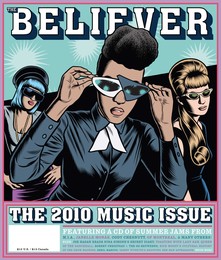
SOUNDTRACK: The Believer July/August 2010 Music Issue Compilation CD: “We Bumped Our Heads Against the Clouds” (2010).

Of all the Believer music compilations, this is by far my least favorite.  It would be oversimplifying things to say that the music is not for me, but in many respects it is not.  Chuck Lightning, the curator of the project states that this compilation is more or less a look into the state of the union for black artists.  And that invariably means a lot of R&B and songs that might be heard on Glee (I like the show, but I never know any of the music).

Deep Cotton’s “Self!” reminds me of novelty dance hit from the late 80s.  Of Montreal, who I thought sounded totally different from this, offer “Hydra Fancies” which is as catchy a disco anthem as any disco anthem can be.  Roman GianArthur’s “Depraved Valet” is an amazingly falsettoed Prince knock off.  Cody Chestnutt’s “”Come Back Like Spring” is a simple almost acapella ode to spring.  Saul Williams’ oddly titled “B.S. in a Tampon” is a spoken word with acoustic guitar that reminds me of Gil Scot-Heron.  Janelle Monáe’s “Cold War” is the first really catchy song (the la las remind me of Carole King), although  I could do without the overstated “Calinda” part and the extended fade.

The first song I really liked was BLK JCKs “Iietys” which sounded enough like TV on the Radio to be really interesting.  Spree Wilson’s “Chaos” also sounds like TV on the Radio (the more R&B side of the band, although the guitar solo is a dead ringer for “Hotel California.”  Scar’s “Rewind” is the song that should be on Glee.  I want to hate it but it is so damned catchy, I can’t.  Again, those Oh Oh Ohs are too perfect (and the auto0tune of course is unassailable).

Rob Roy’s “Velvet Rope Blues” is my favorite song on the disc by a large distance. It’s a weird rap that reminds me of The Streets, with an awesome sung chorus ala OutKast.  Hollyweed’s “Have You Ever Made Love to a Weirdo” is a trippy, juvenile space rap that is really silly.  Sarah hates it but I kind of like it, as it’s in the spirit of Frank Zappa, (although I hate the sax solo).  Fear & Fancy’ s “Off the Grid” sounds also not unlike OutKast.  And George 2.0′ s “Turn Off the TV” is a anti-TV rap rant (with the somewhat ironic conclusion that you yourself might end up ON the TV).

M.I.A. is probably the biggest name on the disc. “Born Free” is a weird little track of highly distorted vocals over a punk guitar buzzsaw sound.  But her vocals are mixed so loud in the mix that they sound unrelated.  It sounds not unlike a Go! Team track.  This track makes me wonder how she became such a sensation.

Hot Heavy & Bad’s “One” returns to that disco sound in the vocals with some contemporary bass sounds.  It wears out its welcome pretty quickly.  Tendaberry’s “Cold Boy” sounds like a less horn-y Fishbone.  Mother Novella offers one of the few all guitar songs, “Closer 9 1/2” and it’s an okay mid tempo rocker.

The final song is pretty awesome in theory: Nina Simone covering Alice Cooper.  That’s right, Nina Simone covering Alice Cooper.  Sadly I don’t know the Alice Cooper song, so it’s a bit lost on me.

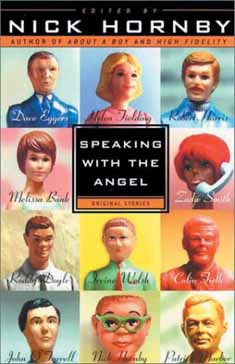
[READ: September 16, 2010] Speaking with the Angel

I bought this volume when it came out (and apparently donated $1 to TreeHouse at the same time).  It’s a collection edited by Nick Hornby (and the cover is designed similarly to the way High Fidelity and even About a Boy were at the time (“the Hornby look,” I suppose).

I didn’t buy it for Hornby alone, although he does have a story in it, but because it looked like a really promising collection of stories from authors I liked.  And for some reason I didn’t read it until now.  It includes 12 stories, and as the introduction notes, $1 was donated to TreeHouse.org.uk (in the US $1 goes to TreeHouse and another $1 goes to New York Child Learning Institute).  I don’t know if the money still goes there, but you can donate with a form at the back of the book.  (more…)

Read Full Post »

SOUNDTRACK: STUYVESANT-Jihad Me at Hello (2010).

Stuyvesant (one of the hardest band names to spell) is an amalgam of the defunct New Jersey bands Footstone and Friends, Romans, Countrymen.  And so, as you might expect if you know these other bands, they play noisy rock with a healthy dose of pop.

The opener, “Bi-Polar Bears” is a great example of their punky pop (complete with an unexpected horn section).  The second track, “Tape Hiss” sounds like Footstone (Ralphie’s voice is very distinct here) although the “do-do-do” harmonies are something new to the sound.

There’s more surprise from a major break in “Ode to Bish” which features a “waka jawacka” guitar and a horn solo.  “Liars Poker” also features some cool bass vocal harmonies (something of a rare treat in rock music).

Perhaps the biggest surprise is the slow opening of “Broken Red Wing.”  I was pleasantly surprised that after the slow opening, it did not jump quickly into a song that sounded like the rest on the disc.  Guitars kick in but they are not the same crunchy style.  The track shows an unexpected diversity on the disc.

While I have enjoyed both the Footstone and FRC releases, I think this conflation of the two makes for the best overall package.  It’s a great EP, and I’m looking forward to the full length.  This EP is available for free.  That’s right, for free.  So even if you hate it, you can still download it for free.  In any format, and then you can burn it to a CD, in the format that music is meant to be enjoyed.

[READ: September 8, 2010] “The Landlord”

Wells Tower is another 20 Under 40.  I’ve enjoyed the few short stories(although I haven’t read his collection yet) and the non-fiction he’s written for Outside magazine.

This story feels like an excerpt from a longer piece because there are a lot of different characters who seem like there’s more to them.

The main character is the landlord, Mr Pruitt.  He owns a lot of properties, but in the current market he has had to sell a number of them.  And, of course, his tenants are paying him less and less frequently.  As the story opens we meet one of those tenants, Armando Colón, who is three months overdue.  Armando has a solution to his problem which he presents to Mr Pruitt.  When Armando leaves, Mr Pruitt’s worker, Todd Toole mocks him for letting people fuck him over. (more…)

Read Full Post »

[LISTENED TO: Week of September 6] Ulysses

This week I almost finished Episode 15.  I’ve just finished where Bella turns into Bello and things get really weird.  And I have to say that this Episode, for all of its craziness, is masterfully handled by Donal Donnelly.  I’ve already raved about his vocal stylings in the earlier chapters, dealing with so many different men.  But in this chapter he proves to be very dextrous at male and female voices, with a very delicate voice for some and an incredibly masculine woman’s voice for Bello (very well done indeed).  He has also proven himself to be a treat with sound effects (of which there are many here).  I won’t say for certain that it makes this insane Episode a lot clearer, but it certainly makes it easier to follow.

Back to Episode 13. The Gertie section is written in a style that is supposed to be romantic, very quick and flowy.  And Donal really nails it.   After the business of Episode 12, the lightness of 13 is wonderful, and it really brings to life the scene, especially when the rockets go off.

One thing I picked up this time is that Bloom assumes that he knows exactly when Blazes and Molly consummated their affair.  Even re-reading it now, it wasn’t quite as clear as the way he read it aloud:

Funny my watch stopped at half past four. Dust. Shark liver oil they use to clean could do it myself. Save. Was that just when he, she?
O, he did. Into her. She did. Done.
Ah!

So, yes I suppose it’s obvious, but sometimes reading along you just don’t pick things up.  And it took the way he read it for me to realize just what those short sentences meant. (more…)

Read Full Post »

« Newer Posts - Older Posts »