Feeds:
Posts
Comments

Archive for the ‘History’ Category

SOUNDTRACK: BLUE ÖYSTER CULT-compilations and live releases (1978-2010).

For a band that had basically two hits (“Don’t Fear the Reaper” and “Burnin’ for You”) and maybe a half a dozen other songs that people might have heard of, BOC has an astonishing number of “greatest hits” collections.

Starting in 1987 we got Career of Evil: The Metal Years (1987), Don’t Fear the Reaper (1989), On Flame with Rock n’ Roll (1990), Cult Classic (which is actually the band re-recording their old tracks (!)) (1994), and the two cd collection Workshop of the Telescopes (1995).  There’s even Singles Collection, (2005) which is a collection of their European singles & Bsides.

This doesn’t include any of the “budget price” collections: E.T.I. Revisited, Tattoo Vampire, Super Hits, Then and Now, The Essential, Are You Ready To Rock?, Shooting Shark, Best of, and the 2010 release: Playlist: The Very Best of).

The lesson is that you evidently won’t lose money making a BOC collection.

I don’t know that any of these collections are any better than the others.

The 2 CD one is for completists, but for the most part you’re going to get the same basic tracks on all of them.

And, although none of them have “Monsters” for the average person looking for some BOC, any disc is a good one.

Regardless of the number of hits they had, BOC was tremendous live.  And, as a result, there have also been a ton of live records released.  Initially the band (like Rush) released a live album after every three studio albums. On Your Feet or On Your Knees (1975) Some Enchanted Evening (1978) and Extraterrestrial Live (1982) were the “real releases.”

Then, in 1994 we got Live 1976 as both CD and DVD (which spares us nothing, including Eric Bloom’s lengthy harangue about the unfairness of…the speed limit).  It’s the most raw and unpolished on live sets.  2002 saw the release of A Long Day’s Night, a recording of a 2002 concert (also on DVD) which had Eric Bloom, Buck Dharma an Allan Lanier reunited.

They also have a number of might-be real live releases (fans debate the legitimacy of many of these).  Picking a concert disc is tough if only because it depends on the era you like.  ETLive is regarded as the best “real” live disc, although the reissued double disc set of Some Enchanted Evening is hard to pass up.  Likewise, the 2002 recording is a good overview of their career, and includes some of their more recent work.

If you consider live albums best of’s (which many people do) I think it’s far to say that BOC has more best of’s than original discs.  Fascinating.  Many BOC fans believe that if they buy all the best of discs, it will convince Columbia to finally reissue the rest of the original discs (and there are a number of worthy contenders!) in deluxe packages.  I don’t know if it will work, but I applaud the effort.

[READ: October 2009-February 2010] State By State

This is a big book. And, since it’s a collection essays, it’s not really the kind of big book that you read straight through.  It’s a perfect dip in book.  And that’s why it took me so long to get through.

I would love to spend a huge amount of time devoting a post to each essay in the book.  But, well, there’s 51 (including D.C.) and quite a few of them I read so long ago I couldn’t say anything meaningful about.  But I will summarize or at least give a sentence about each essay, because they’re all so different.

I’ll also say that I read the Introduction and Preface last (which may have been a mistake, but whatever).  The Preface reveals that what I took to be a flaw in the book was actually intentional.  But let me back up and set up the book better.

The catalyst for the book is the WPA American Guide Series and sort of Steinbeck’s Travels with Charley.  The WPA Guides were written in the 1930s as part of the Works Progress Administration.  48 guide books were written, one for each state.  Some famous writers wrote the books, but they were ultimately edited (and many say watered down) by a committee.  I haven’t read any of them, but am quite interested in them (and am looking to get the New Jersey one).  Each guide was multiple hundreds of pages (the New Jersey one is over 800).

State By State is written in the spirit of that series, except the whole book is 500 pages (which is about 10 pages per state, give or take).  And, once again, famous writers were asked to contribute (no committee edited this book, though).  I’ve included the entire list of authors at the end of the post, for quick access.

So I started the book with New Jersey, of course.  I didn’t realize who Anthony Bourdain was until I looked him up in the contributor’s list (I’m sure he is thrilled to hear that).  And his contribution was simultaneously exciting and disappointing,.  Exciting because he and I had quite similar upbringings: he grew up in North Jersey (although in the wealitheir county next to mine) and had similar (although, again, more wealthy) experiences. The disappointing thing for me was that Bourdain fled the state  for New York City (and, as I now know, untold wealth and fame (except by me))  I felt that his fleeing the state, while something many people aspire to, is not really representative of the residents of the state as a whole.

And that dissatisfaction is what I thought of as the flaw of the book (until I read the Preface).  In the Preface, Matt Weiland explains that they asked all different authors to write about states.  They asked some natives, they asked some moved-ins, they asked some temporary residents and they asked a couple of people to go to a state for the first time.  In reality, this decision makes for a very diverse and highly entertaining reading.  In my idealized world, I feel like it’s disingenuous to have people who just stop in to give their impression of an area.  But hey, that’s not the kind of book they wanted to compile, and I did enjoy what they gave us, so idealism be damned.

For most of the book, whenever I read an essay by someone who wasn’t a native or a resident of a state, I assumed that there weren’t any famous writers from that state.  I’ve no idea if that played into anything or not.  From what I gather, they had a list of authors, and a list of states (I was delighted to read that three people wanted to write about New Jersey-if the other two writers ever decided to put 1,000 words  to paper, I’d love to read them (hey editors, how about State by State Bonus Features online, including any extra essays that people may have wanted to write).

From New Jersey, I proceeded alphabetically.  And, I have to say that I’m a little glad I did.  I say this because the first few states in the book come across as rather negative and kind of unpleasant.  Alabama (written by George Packer) comes across as downtrodden, like a place you’d really have to love to live there.  Even Alaska, which ended up being a very cool story, felt like a veil of oppression resided over the state (or at  least the part of the state that Paul Greenberg wrote bout.)  But what I liked about this essay and the book in general was that the authors often focused on unexpected or little known aspects of each state.  So the Alaska essay focused on Native fisherman and the salmon industry.  Obviously it doesn’t do justice to the rest of that enormous state,  but that’s not what the book is about.

The book is meant to be a personal account of the author’s experiences in the state. (more…)

Read Full Post »

SOUNDTRACK: TORI AMOS-“Juarez” (from To Venus and Back) (1999).

This song was the first that I had heard of what was happening in Juarez, Mexico.  In AP Magazine (Oct 99) Tori Amos said:

“I read an article about several hundred women in Juarez, Mexico, who had been taken out to the desert and brutally raped and murdered. When they didn’t come home, their brothers would go and look for them, and many times they’d find nothing. Sometimes they’d find a hair barrette or a sock or something they knew was their sister’s. The authorities haven’t really done anything about it…they get into this serial-killer theory. I mean, how much serial can one man indulge in? So as the song started to develop, I really began taking the voice of the desert, singing in that perspective.”

The song is very abstract, with references to Juarez, but overall the meaning is oblique (in typical Tori Amos fashion).  Sonically it is claustrophobic and creepy, and the repeated line “No angel came” adds to the intensity of it.  It has never been a favorite song, although I think as a commentary on the situation it is delightfully eerie.  It doesn’t really add anything to 2666, but at least it provided me with some context.

[READ: Week of March 8, 2010] 2666 [pg 404-465]

Week 6 picks up much where Week 7 left off.  There are a lot more deaths (Nicole at bolanobolano has the dubious honor of tallying them)in this reading.  And you’ll have to look at bolnobolano for the details, as I’m not up to keeping the records straight.

Juan de Dios Martínez is ordered to stop working on The Pentitent, so that his officers can be freed up for other duties.

And the first dead woman of this section is an American, Lucy Anne Sander.  She and a friend came down from Huntsville, Arizona.  While her friend, Erica, was parking the car, Lucy got out to walk in the wet grass.  She was not seen again for three days when her body turned up, raped and murdered.  This was the first instance in the book where someone aggressively looks for a missing woman.  Erica befriends a local nurse (and they from an intense bond in the short time they know each other) and has an Arizona sheriff come down to investigate on her behalf. (more…)

Read Full Post »

SOUNDTRACK: BLUE ÖYSTER CULT-Fire of Unknown Origin (1981).

This was the first BOC album that I bought.  The video for “Burnin’ for You” was all over MTV (although I don’t remember it at all, now).  And I was an instant convert to BOC.  I listened to this disc constantly.
It took going to college and meeting my roommate before I got any other BOC discs (he was a diehard fan).  And while I like most of their releases, this one still ranks as number one for me.  BOC had been getting poppier and lighter over the years, there’s no question.  But this album perfected this mix, making for a supremely catchy recording that still exhibited all of their metal trademarks: wild guitar solos, bizarro futuristic lyrics (although there’s no weirdo titles on this one) and heavy heavy chords.

The opener, “Fire of Unknown Origin” is a wonderful rocking song.  It sets the tone for the disc: keyboards, yes, but of the atmospheric/spooky variety, not the poppy/hit single variety.  “Burnin’ for You” seems like an obvious single, and so it was. It also screams early 80s to me, which I guess isn’t necessarily a bad thing.

But the album’s wonderful weirdness kicks in with “Veteran of the psychic Wars” written by Michael Moorcock. It was featured in the movie Heavy Metal, and is weird and creepy, propelled by thunderous drums and a great guitar riff: a sci-fi masterpiece.  “Sole Survivor” is in the same vein, Eric Blooms ragged voice and the awesome bass line really sell the song.

The middle track is “Heavy Metal (Black and Silver)”  It is heavy heavy heavy and it rocks like all get out with a screaming feedback solo.  It’s an awesome song that seems more than a little out of place on this rather light sounding disc (although even on their later discs, they have included an occasional heavy track).

“Vengeance (The Pact)” is a keyboard-fueled track.  But the greatness is that it’s Lanier’s spooky keyboards.  It also features an awesome middle section with heavy heavy guitars and dark lyrics.  “After Dark” is another wonderfully creepy keyboard song.  The underlying riff is sinister and cool, and the lyrics (and harmonies) meld the “band vocals” on some of their more “hit single” songs, with the oddness that keeps BOC interesting.

But by far the creepiest, most sinister and flat out weird song is “Joan Crawford.”  When I first heard this song back in 1982, I had no idea who Joan Crawford was.  Finding out later that she was a real person has messed with my head for my entire life.  I have never seen a film with her in it and am just convinced that she’s a scary, scary woman (the whispered “Christina…mother’s home” really did me in).  Interestingly, I don’t find the song spooky (although I do get chills if I’m paying attention), but I still find her spooky.  It opens with a pseudo-classical piano riff and then bursts out with menacing metal chords.  The chorus “Joan Crawford has risen from the grave!” complete with squeaky violins proceeds until and the break with sound effects that imply Crawford’s life, I assume: car crashes, race tracks, telephones, babies crying and the whispered “No.”   And it’s all catchy as hell.

“Don’t Turn You Back” ends the disc as something of a mellowing out after Joan Crawford.  It features a great solo and rather soothing choruses (despite the warning that you shouldn’t turn your back).  And it features the ever confusing line: “You use that special option in your car”  (what could that BE?).

Why on earth hasn’t this disc gotten a deluxe reissue from Columbia>?

[READ: March 3, 2010] Abraham Lincoln: Vampire Hunter

I received this book as a prepub Advanced Readers Copy and hoped to have it finished before the book actually came out, but I was shy of it by a couple of days (rats).

So Grahame-Smith wrote Pride and Prejudice and Zombies.  His was pretty much the first in what has become an ever increasing series of literary mash-ups: using “classic” texts as a basis and inserting a seemingly random (usually horror) element.  The genre is already close to jumping the shark, although realistically, you never know when a combination is going to work wonders.

I wasn’t really that interested in the follow up to P&P&Z: Sense & Sensibility & Sea Monsters.  When I first heard of it I was intrigued, but watching the promotional video for the book actually turned me off of it.  I’m intrigued that a new title: Pride and Prejudice and Zombies: Dawn of the Dreadfuls is written by a different author, but I have to assume that it will be all original as there’s no prequel to P&P itself.  And I have to admit I like the title of the upcoming Jane Slayre (for Jane Eyre).

But the things about P&P&Z were that it kept the original text (mostly) intact, and there were a number of things in the original that actually led to inserting zombies into the text.

Plus, Grahame-Smith matched the tone of the original perfectly.  The forthcoming mashups will have a lot to prove but I think some cream will definitely rise to the top.

So, Grahame-Smith’s new book Abraham Lincoln: Vampire Hunter is sort of a mashup.  Unlike P&P&Z, there is no source text to blend.  Rather, Seth Grahame-Smith, who is a character in the introduction of the book is given the “secret” diary of Abraham Lincoln, under provision that he write up the real story of our 16th president.  The secret diary reveals not only that our country was plagued by vampires but that Lincoln himself was personally impacted by them. (more…)

Read Full Post »

SOUNDTRACK: BLUE ÖYSTER CULT-Agents of Fortune (1976).

After the release of their first official live album On Your Feet or On Your Knees, it’s unsurprising that the band would put a concert photo on the back cover of this disc (On Your Feet…was their first Top 40 disc).

What is surprising is the piano fueled second track “True Confessions” which is as delicate as the title suggests  (Eric Bloom even hits a falsetto note AND there’s a saxophone solo(!)).  Combine this with  “Debbie Denise” a tender (!) song about lost love (!) and you have quite a tender an un-heavy metal album.

Of course, the disc opens with “This Ain’t the Summer of Love” which is certainly a strong heavy track.  But that’s mostly it.  There’s a lot more piano/keyboard on “E.T.I. (Extra Terrestrial Intelligence)” although the guitars definitely come to the fore during the wailing solos.  And then, frequent contributor Patti Smith gets a vocal inclusion “The Revenge of Vera Gemini” (her voice works quite well with the spooky psychedelia of the band).  “Sinful Love” is an almost disco-ey dance track (the falsetto backing vocals are weird, to say the least!).

The later songs on the disc sound like 70s rock.  There’s rather little heavy metal involved at all.  In fact, “Tenderloin” comes close to sounding like Kansas.  That’s not necessarily a bad thing, it’s just kind of a shock coming from these heavy metal pioneers.

Oh, and I almost forgot, it also contains the biggest BOC song in the universe, “(Don’t Fear) The Reaper.”  [When my friend Lar saw a BOC Greatest Hits disc he asked if it was just this song 12 times).  Of course, you probably know the song, but if you haven’t heard in a long time, it sounds even better than you remember.  I have to assume that that track alone absolved the band of all the mellow tracks on this disc.

The bonus tracks on the remastered edition include a truly bizarro version of “Fire of Unknown Origin” and a demo of “Reaper.”

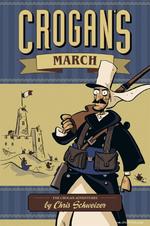
[READ: February 22, 2010] Crogan’s March

I enjoyed the first book in this series so much that I couldn’t wait for number two.  And how lucky for me that it was already available!

The premise of this series is that the Crogan family (who live in contemporary America) are a fairly normal family: happily married, two young kids who squabble a lot, etc.  This family aspect of the story bookends the main body of action (their father tells them a story about one of their ancestors to prove a point or make an argument).

In this case, a fight between the boys is summed up by their dad: “Some people believe that everyone should be given the freedom to make their own choice and others that everyone should be held to the same moral standards.”  So, let’s hear the story of Peter Crogan, member of the French Foreign Legion circa 1912.

When I was a kid, the foreign legion was this sort of mythical entity.  The phrase, “run away and join the foreign legion” seemed to be bandied about a lot as a means of escape.  I don’t know why it was, or why it seems to no longer be, but suffice it to say that I haven’t thought about the foreign legion in twenty years.

So, this story about a legionnaire was a welcome surprise from the get go. (more…)

Read Full Post »

[READ: February 18, 2010] “Vagabonds”

After reading Infinite Jest, I got totally het up about reading all of David Foster Wallace’s works. Of course, I discovered that he had an awful lot of uncollected works (which were all conveniently gathered in one location by a much bigger DFW fan than I). Since I’m reading 2666 as part of an online group, I wondered if I would be similarly obsessed with Bolaño’s output.

Well first, I’m not loving 2666 as much as I did Infinite Jest (but I’m only 1/3 of the way through, so that may change).  But, on a more literal note, there seems to be very few short stories literred around the place. A very cursory search revealed a couple things in Harper’s and a couple things in the New Yorker, but very little else.  Now, I assume that’s primarily because his stories need to be translated first, so there’s possibly a bunch of uncollected Spanish stories, but as for English ones?  Well, let’s just say that scouring the globe for a complete list of short stories in English that are not part of a previously released collections is something of a dificult task.

In fact, further investigation into the stories from The New Yorker and Harper’s shows that these stories are either already released or soon to be published in translated collections.

One of the things I found in my search was this article which is more or less a review of Bolano’s, The Savage Detectives.  However, in true New Yorker fashion, it is also a detailed overview of Bolaño’s life as well. (more…)

Read Full Post »

SOUNDTRACK: THE ZOLAS (3 Tracks on CBC 3 Radio) (2009).

I must have heard “The Great Collapse” on CBC 3 a few weeks ago because I heard it today and it was so catchy I was sure that I knew the band.  And yet, when I saw the artist, I’d never heard of them before.

But it was so catchy I had to investigate.

The Zolas are from Vancouver, BC and must be the least self-promoting band ever.  They have a Myspace and a Facebook site, but man it was hard to find anything about their CD. It’s available at Amazon (.ca and .com) but it’s for sale at a much more reasonable price here. (Ah, except that it’s $11 shipping to the States, which is more than the disc itself.)

The band list says there’s only two member and that they were previously (or concurrently) in a band called Lotus Children.  But that this incarnation of their songwriting chops is a bit more dramatic, baroque even.

And these three songs have instantly made me want to get their disc.  They are poppy, with wonderful choruses, and yet there are tempo changes and falsettos and surprise twists and turns.

“You’re Too Cool” has about three completely different songs in it, starting as a rollicking rock song, having a rousing chorus, and then, in the middle rather than a bridge we get almost a completely new, mellow song.  “The Great Collapse” is a piano fueled romper with the real catch being the unexpected minor chord at the end of the verses.  The third song “Marlaina Kamikaze” alters the style from the other two with a magnificent guitar intro.  Although it also shifts at the midpoint to include more piano marching type music.  And another killer chorus.  The bridge then comes from out of nowhere (or perhaps from the circus) with a great piano breakdown section, slowly building up to the chanting chorus once more.

Thanks, CBC, for this band.

[READ: January-February 2010] Anonyponymous

This is the third book that Sarah gave me for Christmas.  I thought I’d read it more quickly, but I got caught up in other books.

So, we’d read a summary of this book in The Week.  This book is a collection of word origins that come from a person’s name (eponymous).  The twist is that for the most part, the people are forgotten or unknown (hence anonymous).  Anon-eponymous, aha!

There are tons of etymological books out there, but this one is very deliberately designed as a casual reader’s book.  In fact, when a book lists itself in the definition of “crapper” then you can tell the tone of th ebook?  What?  Yes:

Crapper: A toilet; also, in phr. “crapper material,” a book or magazine meant to be read in the bathroom, e.g., this one. (more…)

Read Full Post »

SOUNDTRACK: COLIN MELOY-Sings Sam Cooke (2008).

I ordered this CD from the Decemberists website.  (Sadly Colin singing Morrissey is no longer available).   This is, as the title states, Colin Meloy singing Sam Cooke songs.

I don’t know much about Sam Cooke (although I knew a few tunes from this disc).  And, in my head, Sam Cooke doesn’t have a “catalog” of songs, like, say, Morrissey does. So, this came across as a disc of standards.  And as such it’s very good.

If you like Meloy, you’ll like this.  If you don’t, this isn’t going to covert you.  It’s basically just him and his acoustic guitar (and an occasional backing vocal) singing these songs.

I have always liked “Cupid” so it’s nice to have a rendition of it.  As for “Summertime,” I’m not sure why that’s considered a Sam Cooke song since it comes from Porgy and Bess.  I didn’t know the other three songs, but they’re all quite good, uptempo jazzy numbers.

This EP makes me want to investigate a Sam Cooke Greatest Hits, to see what I’ve been missing.  And maybe that was Meloy’s point all along.

[READ: January-February 2010] Shite’s Unoriginal Miscellany

I had ordered a couple of Schott’s Almanacs from the UK, because I thought it would be fun to see what was different about them from the U.S. versions (quite a lot actually).  And while browsing for them, I found this parody of the series.  So, for a few dollars used, I ordered it too.

Now any book that bills itself as “extensively researched, eccentrically compiled and irresponsibly written” pretty much lets you know what you’re getting.   And it does conclude its summary by saying, “more than 250 pieces of useless, misleading and possibly dangerous information.”  So, what might you expect?

This is a very strange parody of the series because it does three things at the same time:  1) It provides actual lists of actual things (which are, indeed, useless and silly).  2) It provides nonsensical/hypothetical questions (more on that shortly).  And 3) It has stuff that is clearly made up and intended to be funny (but often isn’t) (more…)

Read Full Post »

SOUNDTRACK: LES CLAYPOOL-Of Fungi and Foe (2009).

Claypool was asked to score a video game called The Spore Wars and, at around the same time, to score a movie called Pig Hunt.  According to the liner notes of the disc, he used the templates that he made for the scores and fleshed them out to make this album.

This was the first Claypool solo album I’d bought in several years (since 2002’s Purple Onion).  I’d heard “Mushroom Men” on the radio and really liked it, so I decided to get the disc.  And I have to say overall I’m a little disappointed.

Now, I’ve been a Primus fan for years (I even saw them right after Suck on This) so I know what I’m getting with Les.  And yet, maybe I don’t anymore.  The disc is very percussion heavy, with lots of rather long songs.  And although I love long songs, I love long songs that aren’t the same thing for 6 or so minutes.  I also rather miss Claypool’s voice.  He doesn’t sing a lot of these songs in his typical falsetto.  There’s a lot of very deep voiced, rather processed sounding voices here (it works great on the muh muh muh muhshroom men, but not so great elsewhere).  Because when you combine that with the bass and percussion, it’ really hard to hear what he’s on about (and Claypool lyrics are half the fun).

Plus, we know that with Primus’ own brand of weirdness, a little goes a long way.  So, hearing the same bizarro riff for 4 minutes can be trying.

Despite the criticisms, the disc is good in small doses.  The first 4 tracks are all really solid.  But that 5th track, “What would George Martin Do?” just sucks all the life out of the disc.  The same goofy riff for 6 minutes with completely unintelligible lyrics.  Ouch.   But “You Can’t Tell Errol Anything” picks up the pace somewhat with a wonderful Tom Waits-ian soundtrack.  The addition of Eugene Hutz on insane wailing vocals brings a wonderful new level of dementia to the disc.

Throughout the disc there some amazing bass riffs (of course) and some really cool effects thrown onto the bass (and other instruments).  But the overall feel of the disc is just too samey.  I think the music would probably work really well as soundtrack music, but it lacks a little something by itself.

I’m not suggesting that Claypool needs to be more poppy, because that’s hardly it (although he does have an amazing gift for clever hooks), but it’s possible that he needs an editor.  Was that the role Ler played in Primus?  Who will ever know?

[READ: February 5, 2010] Diario de Oaxaca

Wa-HA-Ca (that’s how you pronounce Oaxaca (the first question I had)).

I ordered this book for our Spanish collection without really knowing what it was about.  When it arrived I had a hard time deciding where to catalog it…is it a graphic novel?  a biography?  It’s bilingual so does it even go in the Spanish collection, which has much less circulation than our English collection?  As I flipped though the book, it looked really cool, so I decided to just read it and figure it out for myself.

Peter Kuper is, among other things, the drawer of Mad Magazine’s Spy vs Spy since about 1997.  Sometime in 2006, Kuper decided to go on sabbatical from the politics of George W. Bush.  He and his family packed up and moved to Oaxaca, Mexico for two years.  While he was there, the city experienced a semi-annual teacher’s strike.  However, this particular strike turned bloody when the President of Oaxaca turned his soldiers against the strikers. (more…)

Read Full Post »

Howard Zinn [1922- 2010]

The death of J.D. Salinger totally overshdowed the death of Howard Zinn (which I just found out about today while reading a tribute to Salinger).

Howard Zinn was one of my favorite political writers, and I would have to say the one who has influenced me the most.  I first learned about him through You Can’t Be Neutral on a Moving Train, and have read most of his works since then.

His People’s History of the United States is an amazing read, and will make you rethink what you learned (or didn’t) about American history.    Zinn always spoke up for the underdog, and he tried to get people to see history (and current events) through the eyes of the average worker, not just the people who make and write history.

He was also a very outspoken anti-war activist.  He even spoke publicly against “popular” wars; railing against the military industrial complex and the inevitable injustices that war creates.

And in all of his writings and speeches, he was never stodgy or dull.

I’m not sure who will pick up the torch that he has now dropped.  But he will surely be missed.

Read Full Post »

SOUNDTRACK: THE TRAGICALLY HIP-Live from the Vault-Volume 4 (2009).

Faithful reader will recall that this disc got trapped in my car’s CD changer.  When I had it the player replaced, they sent the old one back to mysterious Toyota offices far away.  And, about a month or so after sending it out, I received a package from Toyota with my three lost discs (this one, a Black Sabbath disc and, a promo disc I took from the library to try and wedge into the player to get it to eject the other discs (that doesn’t work, by the way) which was, embarrassingly, Ozzy & Kelly Osbourne doing a duet of something or other).

Thank you random Toyota person for keeping this disc, which is not easily replaced, in good condition.

So this concert is from 1994 and was recorded in Brussels on the Day for Night Tour.  I think many fans feel that this is a high point in The Hip’s recording career, and this concert attests to it.  The band sounds fantastic, energetic and really tight.  And the music from this era is just great: dynamic and dramatic.

This disc also adds to speculation that lead singer Gord Downie is a weird guy.  His between song banter is quite peculiar, to say the least (apropos of nothing: “Do you think of your pet as a pet or a member of the family?”).  Which also leads me to wonder if fans in non-English speaking countries (and yes, I know that many people in Brussels do speak English) think or care or even mind when lead singers babble in English to them.  Just curious.

I don’t have any other Vault discs from The Hip, but this one is certainly great.

[READ: During an ∞ of minutes during December 2009 & January 2010] Everything and More

As part of my pledge to read all of DFW’s works, I skipped the fiction and moved straight to this.  I hadn’t heard all that much about this book, except that it was pretty dense.  And, yup it is.

I’m going to give a comparison for any other DFW fans who are thinking about reading this.  If you have read Infinite Jest (and if you’re interested in DFW you should certainly read that before this book), and if you recall Endnote 123: Pemulis’ high tech math formula for calculating Mean Value w/r/t Eschaton, then you will have a fair idea of what you’re in for with Everything and More.  So, if your eyes glazed when you started to read that endnote, you’ll likely want to skip this book altogether.  However, if you plugged through with that endnote and you didn’t care that you didn’t get it, but you kind of enjoyed it because despite the math, it is very funny, well, then you might enjoy this book too.

If you’re a hard core math dude and you understand what things like: ∃ and ∈ and ∉ and ∏ and ℜ and even ∀ then you’ll have no problem with this book.

But math aside, there’s a lot of funny things in this book.  And DFW is in full conversational tone, with several places where he says things like “not sure if this has been mentioned in the book yet” implying that he never proofread the thing, which we know he did.  There’s even a funny observation as to the placement of a picture (“it’s not entirely clear to me why they put [this pencil sketch] here”).  There’s also tons of footnotes.  And most of them are labeled IYI (meaning If You’re Interested), and he totally lets you off the hook if you don’t feel compelled to read these.  Although as with most things DFW does, the footnotes are always tons of fun.

He also shows his great undying affection for his math professor, Dr. Goris (Dr. G).  He quotes liberally from Dr G’s classes, citing examples, funny quotes and the amusing joke that Irrational Numbers are called ‘surds.  There’s also great joke about schnitt (which I’ll explain later).  It even opens with a hilarious (or maybe not) section about the inability to get out of bed in the morning when you think about infinity.

As in for example in the early morning, especially if you wake up slightly before your alarm goes off, when it can suddenly and for no reason occur to you that you’ve been getting out of bed every morning without the slightest doubt that the floor would support you. Lying there now considering the matter, it appears at least theoretically possible that some flaw in the floor’s construction or its molecular integrity could make it buckle, or that even some aberrant bit of quantum flux or something could cause you to melt right through. Meaning it doesn’t seem logically impossible or anything. It’s not like you’re actually scared that the floor might give way in a moment when you really do get out of bed. It’s just that certain moods and lines of thinking are more abstract, not just focused on whatever needs or obligations you’re going to get out of bed to attend to.

And but so, what is this thing about?

Okay, so it’s about ∞ and the history of ∞.  It begins with a great section about the ancient Greeks (Zeno’s Paradox and all that) and slowly moves up through to Aristotle.  I myself have always been a Platonist (yes, in fact, I have made that distinction in my life, which may say more about me than many people know), and have always been kind of anti-Aristotle.  And, for the purposes of this book, that’s a great position to take.  Aristotle turns out to be like the arch-nemesis of ∞. (more…)

Read Full Post »

« Newer Posts - Older Posts »