Feeds:
Posts
Comments

Archive for the ‘Graphic Novel’ Category

SOUNDTRACK: AND THE KIDS-When This Life Is Over (2019).

I’ve seen And the Kids twice and they put on a fantastic live show.  I highly recommend seeing them when live shows start again. 

The core of the band is Hannah Mohan on guitar and vocals and Rebecca Lasaponaro on (fantastic) drums.  For this record they were a four piece (although no names are included on the disc).

“No Way Sit Back” starts the record with a slow swinging song that features the wonderful wordless hook of Mohan singing “oooh oh oh no.” Midway through, the song shifts gears to a kind of glockenspiel melody over the lyrics “the world is never made for us.”  Even though lyrically this album is dark, musically it is really lovely.

“Butterfingers” lopes along at an unusual pace before a really catchy guitar melody kicks in midway through.  There’s some more catchy melodies as the two vocals line intertwine with each other.  Then comes “Champagne Ladies” a remarkably catchy song right from the get go.  The quietly rumbling guitar and the great vocal melody is nicely mimicked by the bass.  It’s a really fantastic song and should have been a big hit, even with the uplifting chorus: “life is a bastard, it wants to kill you don’t let go.”  But if the lyrics are too dark, there’s another fun wordless “ah ah ah” melody near the end.    

“2003” opens with a penny whistle introduction (when I saw them live, Mohan played the whistle and then just tossed it aside before she started singing).  There’s some excellent unusual and complex drumming at the top of this song. 

“The Final Free” has grooving guitars and a cool part in the middle where the guitar follows the vocal line in a quiet but catchy melody.  “When This Life Is Over” has a kind of hawaiian feel to it with guitars and choral vocals.   “Special For Nothing” is a quieter song that builds into a gorgeous soaring chorus. When the song shifts to the middle part and the music all falls back except for the vocals, it’s really quite lovely.  I love when the backing vocals do counterpoint over the refrain

“Get To That Place” is a short song, less than two minutes and sounds like a bedroom recording (lots of hiss) but as the song gets bigger there’s some cool vocal tricks (so much soaring highs) and glockenspiel.  It’s followed by another short song.  The mellow “Somethings (Are) Good” is just over two minutes with more overlapping vocals and a dynamite melody. 

“White Comforters” sounds bigger and more full sized.  It’s much slower with a bouncy guitar melody and a lot of spare playing. It starts a little too quietly but it builds very nicely.  “Religion” brings back the rocking guitars with a loud opening and a simple but catchy guitar melody, the joyous vocals with two layers of oh ho ho s really makes this song soar to glorious heights.

The disc ends with “Basically We Are Dead” a longer song that opens with a quieter guitar melody and vocal.  Atmospheric keys fill in the backing moments along with a bouncy synth melody and some joyful bah bah bahdahs.  But before the song ends, some familiar chugging guitar chords enter the song and they sing the chorus to “Champagne Ladies” one last time before it’s all over.

And the Kids play wonderful indie pop with plenty of unexpected twists.  And they are terrific live, too.

[READ: November 5, 2020] The Divided Earth

This is the final book in the The Nameless City trilogy.

The book opens with the leaders of the city agreeing that their sacred fire, Napatha, must be destroyed, lest it be used by one of the splintering factions.  But one copy of the recipe spared–given to the monks to hide for as long as was necessary.

Then we flash forward.

Kaidu is sitting with Rat and the others, resting up for what’s to come.

We see Mura, the woman who was abandoned by the monks as a little girl, receiving that copy of the book from the monks (they are hesitant).  She has every intention of learning the formula and creating the Napatha again. She imagines giving the formula to all of the other Dao generals for maximum production against the Yisun.  But Ezri, who has forcibly put himself in charge of the Dao people, wants to keep it under wraps.  Being a treacherous person, he anticipates treachery from everyone else as well.

The Yisun army is marching on the city.  Ezri hopes to have the Napataha ready to use against them.  He has just enough to show how powerful it is.  And it has the desired effect.

When Rat and Kaidu see what happened, Kaidu announces that he is going to steal the book from Mura’s clutches.  How?  Well, that’s where most of this book’;s adventure comes in.  It’s clever and stealthy and very exciting with switches and crosses and trouble everywhere.  They even get help from their minstrek friends (it’s always nice to see minor characters come back). 

At the same time, Kaidu’s parents (Kata and Andren) are (unbeknownst to Kadi and Rat) planning to negotiate with the Yisun army to save the city  Kata explains that she is in charge of the Dao tribe Liuvedao and she is no friend to the Dao regime currently ruling.

The soldier in charge of the Yisun army scoffs at this idea.  Until Kata’s secret weapon (which she didn’t know she had) steps forward and explains why the Yisun leader might want to hear them out. Kata proposes an dambush on the city, using an equal amount of Kata’s forces and the Yisum army. 

None of the attacking plans go smoothly.  Rat and Kaidu face very difficult odds (and many soldiers) and the ambush team literally walks into a dead end and needs to be rerouted through a sewer tunnel (ew).

There is a terrific showdown between Rat and Mura, two women whose lives began in a similar way but who took very different paths. And there are many many pages of battle scenes.  Hicks does a great job of keeping the action exciting and clear, with lots of one one one combat as well as an army of warriors.

The story has an epilogue set three years later, which is fun. It’s neat to see Kadi and Rat grows up some, although I could have used a dozen more pages of epilogue to see what things are like now.  And to see them catch up (there’s no Facetime back then). 

But even so, this was a great series, full of excitement and very emotional moments,.

Read Full Post »

  SOUNDTRACK: PRIMUS-“The Devil Went Down to Georgia” (1996).

I’m not sure who the first band to cover this fantastic  Charlie Daniels Band song was, but Primus probably had the largest profile when they released it–even if they credited themselves as Festus Clamrod and The El Sobrante Twangers.

The song came with an excellent animated video.  Unfortunately, it was only ever available with the video.  It was eventually released on the vinyl reissue of Rhinoplasty, but you still can’t stream it on Spotify.

Which is a shame because it’s a real hoot.

Les Claypool excels at the story-song, so him narrating the story works perfectly (it’s just him and the drums for the verses).  Mark “Merv” haggard does a perfect young Johnny voice and Brian Kehoe is the great growly devil.

There’s some excellent fiddle work throughout the song (nothing deviating too much from the original,but played perfectly).  The violin is credited to Violina Mysteriosa (um thanks?).

It’s got some slide guitar (from Merv), but when the middle bridge come in it’s got lots of Primus-oddball guitar but the melody is spot on and Les’ voice has a delightful country twang to it.

When the band of demons joins in, the song goes bonkers with some weirdo guitar twanging from Ler and some noisy distorted bass from Les.  It sounds great, although I do miss the actual band of demons song which I’ve always thought totally kicked butt.

When Johnny starts playing, it’s all violin and Les stompin’ until the band joins in compete with a one-two bass and some slightly improv violin (in addition to the actual melody).

It’s a fun version of the song–not deviating too much from the original, but clearly Primus’ own.

[READ: November 3, 2020] The Big Break

I have really enjoyed everything that Mark Tatulli has written.  He’s a bit off my radar though, so I wasn’t aware of this full length graphic novel (or his previous one Short & Skinny).

This book is about two seventh grade boys, Andrew and Russ.  They have been friends for years and have done everything together.  Right now their project is to make a short film for The New Jersey Middle Grade Movie Viral Video Contest.

They have the perfect concept: The Jersey Devil!

Now, being from New Jersey, I found this concept to be wonderful.  I grew up hearing rumors about the Jersey Devil (even though I am hours from its haunting grounds).  Tatulli grew up in NJ as well, and he was obsessed with the devil (he lived closer to the PIne Barrens, I believe).

Their movie is a half-true / half-fictionalized account of their attempts to find the Jersey Devil.  It’s a kind of Blair Witch Project for middle schoolers.  Of course, they don’t have a Jersey Devil to film and their Play Doh monster is pretty lame.  But the rest of the film is really good.  They just need a good ending and they are on their way to becoming filmmakers–this will be their big break! (more…)

Read Full Post »

SOUNDTRACK: MAGIC SWORD-Endless (2020).

Not long after the release of the Awakening EP, Magic Sword is back to conclude the story arc that the previous albums have created.

The Keeper (red, keyboard, audio-visual), The Seer (blue, guitar), and The Weaver (yellow, drums) are Immortal and they have seen a story like this one unfold many times.  So they are not surprised by the direction it goes in.

“Depths of Power” opens this chapter with a slow pulsing matched with occasional power chords.  “Invincible” adds a new sound palette to the band’s music.  This song sounds a bit more like Tangerine Dream but with some more contemporary techno type sounds.

“Aftermath” adds some swirling uneasy sounds to the album.  It contains curlicues of sound that wiggle around and segue into “Empress” which has a low rumble underneath the propulsive synths.

“Shores of Oblivion” is a more eerie soundscape of wind and slow pulsing waves of emptiness. When the fast melody comes from out of the waves it feels like something sinister heading right for you.

“rophecy” adds some light to the proceedings with an uplifting melody which is eventually corrupted by “Corruption” and turns into a more threatening tone.

“Ritual” introduces a fairly heavy bassline and some more modern sounding synths.  Then “A New Quest” returns to the pulsing sound of old.  “Hope” starts quietly but brings am uplifting melody that continues throughout the song.

“Endless” ends the disc with strings–ominous at first but which move into a more stately melody that fades out slowly over a long time–continuing endlessly

The band also released a single of “Invincible” with a remix by Waveshaper.  I don’t typically like remixes, because mostly they just dump a new drum beat over an old melody, but this one plays around with the song in interesting ways.  It turns it into something different without losing the original.  I rather like the new bass line they add to the song.

In the comic book, Magic Sword says that this ends the cycle.  Does that mean the end of Magic Sword … or the beginning of a new cycle?

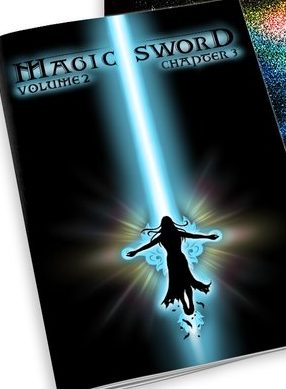
[READ: October 29, 2020] Magic Sword Volume 2, Chapter 3

Chapter 3 concludes this cycle somewhat unexpectedly for me (although it makes perfect sense once it is explained).

When Chapter 2 ended, Nayia came face to face (or more like face to big toe) with The Colossus.  It was the size of a mountain and seemed to be covered in bark.  It quickly grabbed hold of her with its tendrils, trying to burrow into her orifices.

But the power of the Magic Sword was still within her and it fought back where she couldn’t.  With its help she was easily able to best this beast.

But the story doesn’t end there. (more…)

Read Full Post »

SOUNDTRACK: MAGIC SWORD-Awakening EP (2019).

It took three years for Magic Sword, the instrumental band from Boise Idaho, to release chapter two of the second volume of their saga.  In that time, they had released individual songs, but for this entire seven song EP (and comic book), the year of the sword took much longer than expected.

The Keeper (red, keyboard, audio-visual), The Seer (blue, guitar), and The Weaver (yellow, drums) have continued the saga but have expanded their sound a bit.  They still sound like a 1980s movie soundtrack, but it’s a bigger budget movie.

“Herald” opens the EP with a deep-voiced narration of the opening page of volume one, the paragraph that sets up the story of the Magic Sword.  It segues into “Awakening” which sounds bigger than anything they’ve done while still retaining the recognizable retro Magic Sword sound.  Midway through the guitar comes in with a quiet solo that introduces a funky element to the song–there’s even the a kind of bass guitar element.  It is a slow opening that sets the tone of the album as we await “The Harbinger.”

“The Harbinger” is under three minutes and projects an ominous low tone as a distant, distorted voice recites a passage that I can’t make out.  It segues into “Lady of Light” which follows a pretty synth melody that mutates into a middle with a distinctly funky/disco bass.  “Reborn” bursts forth like a big 1980’s synth anthem.  But it quickly changes tone with a pulsing soundtrack and a ripping guitar solo.  It all resolves into the anthemic conclusion.

“Shadow” introduces a more sinister sound–both the harsh higher notes and the menacing low growling synth that works as a perfect segue to the album ending “Colossus.”  It continues like the rest of the album with just a hint more menace in the crashing drums and delays of the loud synths and an absolutely roaring guitar solo to close out the disc.

Magic Sword still sounds like the same trio, but they sound even more assured.

[READ: October 29, 2020] Magic Sword Volume 2, Chapter 2

Chapter 1 introduced us to Tayia, the chosen one.  She is pure of heart and is therefore eligible to wield the Magic Sword and restore balance.

But as The Keeper explained, the Magic Sword will take control of her body–she will become death.

As Chapter 1 ended, The Keeper stopped time and Tayia grabbed the Magic Sword.  As Chapter 2 opens, time resumes and the creature who was about to attack her, a member of the Kihlhi tribe, realizes she is no longer where she was (time did not stop for her).

He crashes to the ground.

Continuing with the parallels between this story and present reality, the Kihlhi was

Spouting vile hatred through slurred speech.

One can only hope that in reality the vile creatures also

had no idea of the mighty change that had overtaken and transformed his prey.

Tayia’s power and will merged with the will of the sword creating beautiful arcs of pink.  She fights effortlessly, including a full page scene of her dance/kick. (more…)

Read Full Post »

SOUNDTRACK: MAGIC SWORD-Legend EP (2016).

Magic Sword, the instrumental band from Boise Idaho, is back, following their epic Volume 1 with a 15 minute EP and a new angle to their story.

The three members of the band remain: The Keeper (red, keyboard, audio-visual), The Seer (blue, guitar), and The Weaver (yellow, drums).

This EP has three songs.

“Legend of the Keeper” begins slowly, like something building from primordial ooze.  Steam escapes as the music builds and turns into a kind of 1980’s montage soundtrack introducing the hero.  There were guitars on the first album, but they are more prominent here with a lengthy solo.

“Uprising” begins with a menacing pulse that resolves into a tense series of overlapping melodies.  It continues into some laser-sounding pulses that set the tone for the uprising to come.    “The Curse” has a simple keyboard melody, but underneath it, the low distorted notes sound like an animal, a demon, whispering words into your head.  But a soaring guitar solo pushes through the distortion.

There is a Deluxe Edition of the EP with three remixes: “Legend Of The Keeper (F.O.O.L. Remix),” “Uprising (The Indicator Remix)” and “The Curse (The Toxic Avenger Remix).”  I’m not keen on remixes so these don’t do much for me.

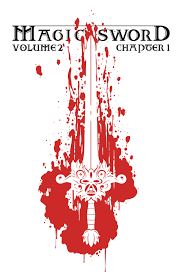
[READ: October 29, 2020] Magic Sword Volume 2, Chapter 1

Volume 1 set up the origins of the Magic Sword.  In Volume 2, we see it come to the aid of the desperate.

The Nierhi Valley people were a peaceful tribe, who knew no threats.

But the neighboring Kihlhi tribe had recently crossed the mountain that separated them.  The Kihlhi has been overtaken by a mysterious stranger who slowly sucked their humanity from them.  They soon thought only of murder and defilement.

The Niehri were easily overwhelmed until a thunderous crack on the top of the mountain meant only one thing: the arrival of the Magic Sword. (more…)

Read Full Post »

SOUNDTRACK: MAGIC SWORD-Vol. 1 (2015).

Magic Sword is an instrumental band from Boise Idaho.

There are three members of the band: The Keeper (red, keyboard, audio-visual), The Seer (blue, guitar), and The Weaver (yellow, drums).

Magic Sword makes 1980’s-sounding sci-fi movie soundscapes.  Meaning there are a lot of synths, a lot of retro sound effects, and a lot of pulsing music.

The music feels like a soundtrack and that’s because it actually is. Magic Sword includes a comic book with each release (read about it below).

“The Beginning” sets the stage with a catchy synth melody before the intensity of “Sword Of Truth.”  After setting the stage, the lighter (but with a still menacing underbelly) “The Way Home” propels the story forward.

“Kill Them All” has words.  A quiet, whispered voice states

They came in the night
They killed everyone
I hid in the shadows
And then it came to me
The Magic Sword
And I killed them all

Dramatic chords rise as the music swells.  “In The Face Of Evil” presents a sinister bass melody as a lead melody wanders along it until it turns into a lengthy solo.

“Only Way In” is slower and more intense with a looping synth keeping the tension high as what sounds like birds echo in the background.  After a build up of intensity (can you see a hero making their way through a small passage) the tempo picks up.  This song has the most modern sounding music (almost an EDM kind of distorted beat) letting you know its not all retro.

“Reflection” allows for a moment to rest as gentle music falls down. But an ominous undertone is always present.  “Retrogram” feels like an opportunity to start anew as “Discover” ups the intensity with a far more retro pulsing synth sound.

“Memories In Shadow” slows things down as sprinklings of notes poke out of the ominous lower chords that sustain the song until it begins to rebuild as it heads toward the “Battlefield.”  “Battlefield” does not feel violent as expected–it’s more passionate but not scary.  There’s even a slow, quiet middle for a moment of reckoning.

“Infinite” feels uplifting, but there’s no time for rest as the abyss stares back at out hero.  “Journey’s End” feels solitary.  There is still work to do as our hero soars into the distant sky.

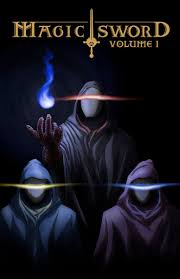
[READ: October 29, 2020] Magic Sword Volume 1

Volume 1 is the first graphic novel from the band Magic Sword.  There are presently four books in the series. The story follows The Keeper (red, keyboard, audio-visual), The Seer (blue, guitar), and The Weaver (yellow, drums) as they prepare for the necessary return of the Magic Sword.

This first book opens

In the beginning there was light

and Darkness.

But soon evil spread over the land like a plague.  [sounds familiar]. (more…)

Read Full Post »

SOUNDTRACK: RHEOSTATICS-Mowat Collegiate Late (1982).

This Rheostatics show dates all the way back to 1982, when the band was very very different.

This is the second oldest show I have been provided with to date… (based on the fact that Chemical World is introduced as a new song and it isn’t played on the other Mowat show on the site). From Mowat Collegiate in Scarborough it is slightly later in the year and has much clearer sound.

These old shows confuse me because I can’t tell who is singing.  To me it sounds like Tim singing lead on all the songs, but I didn’t think he was the main singer back then.  Or is it that Dave Bidini’s voice is so much different because they were all just babies?  I assume it’s Bidini doing the talking, and his voice is sure different (not Tom Waits different, but still).  I’m also not sure who is playing what.  I assume Tim is on bass, but he doesn’t usually play bass when he sings.  Dave Clark is also very quiet (he is usually full of jokes and poetry and whatnot).  I’m assuming that’s David Crosby (not that David Crosby) on lead guitar.

And somebody is playing with a high pitched oscillator type sound for the first few songs.  I wonder who is doing that while apparently playing their actual instruments. 

This set starts out with “National Pride.”  A funky, bass-slapping, bass-sliding song that shows that the early Rheos were far more into funk than anything else. 

The set (actually I guess it is two sets) is full of covers.  But each one is done in their new wave-ish ska-ish, not sounding anything like the original, style

The Kinks’ “Well Respected Man About Town” is almost unrecognizable with the bouncy bass in the verses and the entirely un-Kinks-like quality to the rest of the song.

“Chemical World” is described as new song (it’s one of the few from this era that has survived a little).  It starts out with Dave Clark on drums. It’s all new wave guitar and a lolloping bass.

“Girl in My Magazine” is a full-on ska song with bouncy guitars and a big fat bass.

Then they run through “Louie Louie” which sounds like the original in some ways–melodically–but it’s still got that big funky bass sound going on. 

Dave (or Tim) keeps encouraging everyone to come up and dance.

Up next is the “single which we’ll be handing out after our next set (we’re playing twice) called “Satellite dancing.”  It’s got the same basic sound but with a kind of blues riff underpinning the ska guitars.

As the song ends, someone says, stay tuned for Mark Malibu & the funky Wasagas.  Interestingly Mark Malibu & the Wasagas broke up in 1982, but reformed with all the original members in 2014 and have released three albums.

Presumably after a break and they are back with a new set of different songs.

This set opens with a lengthy bass intro and echoing reggae guitars which turns into a lengthy drum solo.  It’s called “Reggae Trenchtown Jam” and it’s basically just a nine minute jam.  In the middle of the song while encouraging people to dance, someone says, In Missouri and Kentucky they’ve outlawed… [can’t hear the rest].

Up next is “My Generation,” which is “on that record.”  This is , like The Kinks’ cover, a very unusual new wave version of the song–again almost unrecognizable.  Despite the prominent bass in this set, there’s no wailing bass solos like ion the original.  There is a wailing guitar solo though and the song jams out about five minutes.   

Up next is the shortest song of the night.  “Man of Action” is under three minutes with more of those reggae guitars.

Then comes a song by Sly and the Family Stone.  “Thank You (Falettinme Be Mice Elf Agin)” sounds like one of their own songs, they have so taken it over.  Surprisingly, given their funk, this sounds nothing at all like the original.  Even the super catchy chorus is done in a very different way.  They are indeed being Mice Elf.  There’s a jamming section at the end with some serious slap bass.

Up next is “an old ska song” called “The Suburb Shuffle.”  I can’t find anything about this song.  Although the introduction says “I’m sure everyone in Scarborough can relate to it.  It’s about green houses and black driveways and well-cut lawns and flowers in the sidewalks.   It has nothing to do with Martha and the Muffins.”  It is indeed a suburban ska song.

They end the set with “Shake Your Body Thang” and “we want everyone up on stage, especially Mark Malibu.”  I think this one musty be Tim singing.  The jam this one out for nearly nine minutes.  Mid way through, they invite people on stage.  There’s a break down when it’s just drums and vocals.  It’s got everything a 1982 collegiate rock band should have.

It’s impossible to believe that these are the same guys.

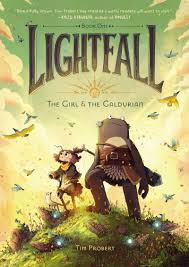
[READ: October 22, 2020] Lightfall Book 1

This is an enchanting first book in a new series. Tim Probert’s illustrations are wonderful–a fantastic soft palette and delightfully unusual characters.

Set in the land if Irpa, we first meet Bea and her cat Nimm. Bea is somewhat nervous by nature. Especially when it comes to a small jar with a flame in it which she is meant to be guarding.

Bea lives with her adoptive grandfather named Alfrid the Pig Wizard. Alfrid is, as the name suggests, a pig and a wizard and he makes potions for people. But he is also very forgetful. He leaves reminders for himself, but they don’t always help.

Bea ventures out to get some ingredients for a potion. She is in a tree, when the branch breaks. As she hangs on for dear life, a tall froglike creature walks past (on two legs), and as she falls out of the tree he catches her. The creature is Cadwaller, known as Cad. (more…)

Read Full Post »

SOUNDTRACK: GERMS-GI (1979).

In the middle of this graphic novel, the main character Bina says she is listening to the Germs.  Her friend Darcy says “classic.” 

Germs were a seminal LA punk band.  They released one album before their singer Darby Crash killed himself.  Their guitarist Pat Smear has since played with Niravana, Foo Fighters and many other bands.  Belinda Carlisle (yes of the Go-Gos) was briefly their drummer (she went by Dottie Danger).  She was replaced by Don Bolles.  And their bassist Lorna Doom, was one of the first women in the punk scene.

This album is 38 minutes long but that’s with a 9 minute live improvised song tacked on at the end.  Otherwise these songs are short and fast.

“What We Do Is Secret” opens the album with a statement of purpose.  It’s less than a minute of fast drumming roared vocals and the title repeated twice.  “Communist Eyes” plays a standard punk melody in the verses and an even faster chorus.  Pat Smear plays around with some scratchy noises but it’s mostly just fast fast fast.   “Land Of Treason” also has a simple catchy melody in the verses.  Even though Crash’s vocals aren’t always clear, they are mixed very well so if you listened, you could probably make out most of the words.

“Richie Dagger’s Crime” is the first song where Smear’s guitars really stand out.  He plays lead riff and then in the middle of the song, it’s only Lorna Doom’s bass holding the melody together while Smear plays some leads through the verses.

“Strange Notes” has some ringing guitars notes and quick little improv solos that keep this pummeling song nicely off kilter.  “American Leather” is just over a minute and Don Bolles’ galloping drums pretty much never stop.

“Lexicon Devil” was the name of their first EP.  The verses have a fun Ramonesy beat verse that feels especially punk.  “Manimal” is a slower more menacing song with a nasty lead guitar line.  This song even takes a breath before launching into the faster part full of Darby Crash’s snarls.

“Our Way” is another slower, more mancing song with a the bass sounding more prominent over smears chords.  “We Must Bleed” has a really fast descending guitar melody that introduces the song and serves as the chorus. It also hangs around at the end of the song. The song is 2 and a half minutes in total but the end is one minute of the band racing through that four note melody, sometimes falling  apart a little but plugging on.

“Media Blitz” starts side two abruptly has an abrupt opening with vocals and a brief pause before the song takes off nonstop for a minute and a half.  There’s some samples from TV in the song

“The Other Newest One” This chorus features a four notes and a pause as Darby’s voice rings out over the brief silence: “you’re not the first / you’re not the last”

“Let’s Pretend” is a bit more staccato in the bassline in and reminds me of a conga from the cartoons.  Five notes and a thump.  Once again darby stops singing early to let he band jam out the riffs for another 40 seconds to the end.

“Dragon Lady” has a short drum solo from Bolles as the intro.  It leads to one of the poppier melodies on the album. Then “The Slave” ends the disc (sort of) with a one-minute rumbling that’s all bass and jagged chords on top.  When Darby stops singing briefly, Smear’s guitar bursts forth as if Crash was in the way. Then it abruptly ends.

The disc ends properly with “Shut Down” a 9-minute live song that I have read was typical of how they ended their shows.  Lorna Doom plays a simple, slow bluesy riff on the bass. The drums follow along and Pat Smear makes all kinds of lead noises –solos, feedback, crashing chords while Darby mumbles, screams and rants about wanting your soul and wanting control and being an Annihilation Man.

Who knows what the Germs would have done next, but with one album, their legacy is secure..

[READ: October 21, 2020] All Together Now

This is a follow up to Larson’s book All Summer Long.  That book was a fun story about friendship, distance and guitar playing.

As this story opens, Bina and Darcy have been practicing with their band Fast Fashion [which is basically what Depeche Mode means], but they decide they need a drummer.  They meet up with a boy in their calls called Enzo.  He’s a drummer and very robotic.  He’s very good and he likes their songs, so they agree to be a band. But he hates the name Fast Fashion, so they change it to The Candids.

After a few practices, Darcy and Enzo start dating.  Then Enzo starts making some suggestions for changing Bina’s songs.  And Darcy agrees with him.  Now Bina’s losing her best friend to a boy, just like she lost her previous best friend Austin to a girl.

Then Darcy texts her that the band is moving on without her (even though it was her band!).  This new band gets the best band name yet: AC/Darcy.  But that means that Darcy and Bina have basically broken up and are not speaking to each other. (more…)

Read Full Post »

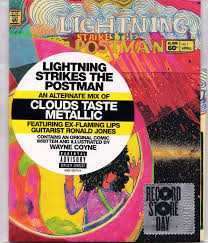
SOUNDTRACK: THE FLAMING LIPS-Lighting Strikes the Postman: The Flaming Lips Remix (2016).

This release came out on Record Store Day 2016.  It is, simply put, the Lips’ album Clouds Taste Metallic but remixed to remove all of the vocals and to highlight all of Ronald Jones’ guitar playing.  This was Jones’ last album with the band and he has become pretty reclusive since then.

You can hear the very basic structure of all of the songs–drums, bass and rhythm guitar are all there, but mixed low.  The rest of the CD is Jones’ rather unique style of playing–noisy, feedbacky, almost improv-y, but never out of control.

The release also comes with a comic book penned by Wayne Coyne.  The comic pretty much explains Jones’ guitar playing.

You see, after the band released the album, Ronald was abducted by aliens. Why would they take him? Because back then he had one of the most elaborate homemade pedal boards on earth.   He would hook together an endless amount of gadgets, some that were not meant to go together.  One night he connected to a giant antenna.  Then while searching for a sound to enhance the ending of “Placebo Head Wound,” he found the sound of the dreaded Zorgodrites’ freaky 2 way radio and boy were they mad.

They came down and took him away and he was never seen from again.

And so that’s what you get.  Around 55 minutes of guitar freakouts.  But unlike an album of just noisy, weird stuff, this collection is based around songs.  Some of the songs are the same length as the final product.  Others are a bit longer.  The opening track “The Abandoned Hospital Ship” is about three minutes longer than the album version–mostly for Jones’ noodling. 

I tried to sync up the disc to the original via Spotfiy with varying degrees of success.

If you know the album pretty well, you’ll recognize the songs–the verses and choruses are in tact, it’s just that you get to hear some wild guitar around those melodies instead of the melodies themselves.

It can be a disconcerting listen if you are expecting to hear the songs, but if you put that aside and just listen to the kind of things Jones is doing it’s a pretty cool exploration of the guitar.  But definitely not for everyone.

[READ: October 1, 2020] Cycling: The Craze of the Hour

I love books like this.  This is a collection of pamphlets from around the turn of the 20th century, both pro and con for bicycles.  The first item is an instruction manual about how to ride a modern bicycle.  The second talks about the dangers (to your heart) of riding a bicycle.  The third and fourth are humorous stories in which bicycles feature prominently.

The first bicycle was invented at the turn of the nineteenth century but the craze really took of in the 1890s. And so you get:

“The Modern Bicycle (with Practical Illustrations)” (1877) by Charles Spencer

Spencer was an early proponent of the bicycle.  In 1869, he rode from Trafalgar Square to Brighton in fifteen hours (Google maps says it should now take you a little over five on a bicycle, so that’s pretty impressive for 1896.)

This instruction manual is fascinating.  Now, the bicycle they are talking about is more or less a penny-farthing.  The “modern bicycle” may be slightly shorter than a pennyfarthing.  And yet, as a person who can ride a bike today, I can”t imagine riding one of these death traps. (more…)

Read Full Post »

SOUNDTRACK: ANGEL OLSEN-Tiny Desk (Home) Concert #92 (October 7, 2020).

Angel Olsen is a favorite of many critics. I rather enjoyed her new album–but I think more for the sound of the production than the songs themselves.

I had the chance to see her recently but didn’t go and later heard the show was amazing.

This is a super-stripped down set (just her and her guitar on a balcony in North Carolina).

She opens with “Whole New Mess.”

The song is actually about addictions, defining her “home” amidst a life of touring that kept her on the road for large chunks of time. Much like this Tiny Desk performance, the original recording is just her stunning voice and guitar (minus the birds and the trees), recorded in a church-turned-studio a few years ago.

Up next is “Iota”

a song that wishes “that all the world could see something for what it is at the same time.”

“What It Is” is the only song I knew.  It was played on the radio a bunch and I grew to really like it.  This spare version is less interesting to me, but the melody is still lovely.

Angel leaves us with “Waving, Smiling,” a farewell song. She says goodbye to the sounds around her, the birds, the chainsaws, and leaves us with a theme of acceptance, bittersweet but without regret.

The whole set is gentle and lovely–it’s hard to believe she put on a dynamic and exciting live show.

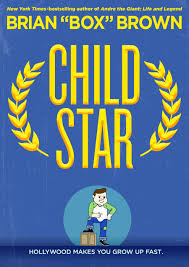
[READ: October 1, 2020] Child Star

I am only mildly upset to learn that Box is not Box Brown’s real name (it seemed unlikely but amusing, nonetheless). But I am in no way upset about how great this book is.

In the author’s note, Brown says that he grew up watching TV in the 80s–he especially enjoyed the shows that had child actors in them.  He learned that the lives of child actors tend to follow a particular, tragic arc.

So for this “biography,” he created a child star, Owen Eugene, as an example of the kind of life.  If you grew up watching the same shows, you’ll recognize the children that he is drawing from.

You’ll recognize some of the notable episodes from shows.  Like the “very special episodes,” about drugs, or pedophilia or smoking or whatever; or the one where Nancy Reagan came on set; or when the younger, cuter kid came on to take over being the cute one.  And of course, the inevitable catch phrase.

The book is written like a Behind the Scenes kind of TV show.  There’s interviews with all kinds of people–his parents, his costars, washed up actors and ex-wives.

Owen Eugene had a hormone issue so he didn’t grow very tall–which meant he stayed adorable for a long time.  He was also a lot older than he looked.  So he could try out for roles and get them because he was the most talented 5 year old (because he was ten). (more…)

Read Full Post »

« Newer Posts - Older Posts »