Feeds:
Posts
Comments

Archive for the ‘Funny (strange)’ Category

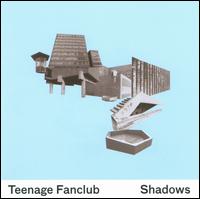
SOUNDTRACK: TEENAGE FANCLUB-Shadows (2010).

Back in the 90s, Teenage Fanclub released a few noisy, feedbacky records that were quintessential 90s alt rock.

Since then they have mellowed considerably, and this album is one of their most mellow to date. Usually for me this kind of mellowing is a sign that I’m done with a band; however, Teenage Fanclub’s songwriting gets better with every disc.  And these folky tracks are all fantastic.

What’s neat about the arrangement of the album is that each of the three members of the band writes four songs.  They are collated so that you cycle through each singer before repeating. You get maximum diversity–and it’s easy to tell which songwriter is your favorite.

The opening two songs, “Sometimes I Don’t Need to Believe in Anything” and “Baby Lee” are two wonderful upbeat pop confections.  They sound very different and yet both are infused with wonderful pop chops.

It seems that Blake is my favorite songwriter on this disc. He did “Baby Lee”, “Dark Clouds” (a pretty piano based number) and by far the prettiest song on the disc “When I Still Have Thee.”  It’s an amazingly catchy folk song that sounds timeless (and even has the great couplet: “The Rolling Stones wrote a song for me/It’s a minor song in a major key.”

That’s not to dismiss the other songwriters at all.  In fact, hearing their different takes on pop music is really pretty amazing.  It’s a shame that it takes them so long to put albums out (about 5 years these days).

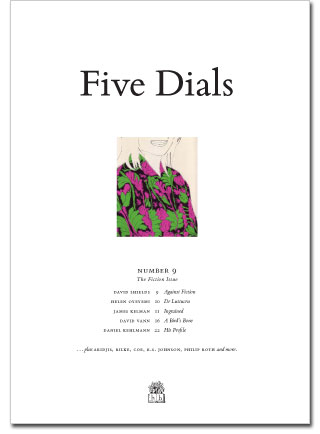
[READ: June 10, 2011] Five Dials Number 9

Five Dials Number 8, The Paris Issue, was pretty big (45 pages), but it had a lot of pictures.  Five Dials Number 9 is also pretty big (41 pages) and it’s (almost) all text.  For this is the Fiction Issue, and there are a lot of short stories in here.

CRAIG TAYLOR-A Letter from the Editor: On ‘Summer Reading’ and Fiction Issues.
Since most of what I talk about in the introduction to these posts is covered in Taylor’s Letter from the Editor, I figured I’d switch formats and start talking about his letter right away.  In this letter, Taylor talks about the serious pitfalls of  ‘Summer Reading’: We pledge to read mammoth books over the summer, but really we never finish War and Peace over the summer, do we? (except those of us who finished Infinite Summer, am I right?).  And so, this Fiction Issue was released in December (finally, a date is given to a Five Dials!).  Taylor briefly talks about all of the authors who contributed (including a pat on the back to Five Dials for securing the rights to a Philip Roth contribution in its first year of publication).  He also talks about the essay from David Shields that is decidedly anti-fiction.   And the final note is that Taylor’s own father has a piece in this issue (nepotism is alive and well!) (more…)

Read Full Post »

SOUNDTRACK: AUDIOSLAVE-Audioslave (2002).

Despite the pedigree of this band: Rage Against the Machine + Chris Cornell, I wasn’t all that interested in the band when they came out.  I was over Rage and was bored by Cornell’s solo stuff.  But then recently, someone donated a copy of this album to th elibrary, so I thought I’d see what all of the fuss was about (nine years ago).

There are times when this album is really superb.  The Rage guys get an amazingly full sound out of their instruments (the choruses of “Show Me How to Live” are so full).  And when it works, and Cornell’s amazing voice is in full force, this seems like a genius pairing.

But there’s a lot that feels kind of clunky here (and there’s some really bad choices of guitar solo work by Tom Morello–the weird noises that compriose he solo of “What You Are”–in Rage the noises were weird but exciting and inflammatory, these are just kind of dull.  Worse yet, is the, well, stupid solo in “Like a Stone”–boring and ponderous at the same time).  Although he redeems himself somewhat with the cool solo on the otherwise dull “Intuition”.

The biggest surpise comes in “Like a Stone” which is insanely catchy and mellow–something one assumed Rage didn’t know how to do).  Lyrically the song is pretty stupid (as are most of the songs), but the combination of melody and Cornell’s great vocal lines really raise this song high–shame about the solo).  Also, a song like “Shadow of the Sun” seems to highlight Cornell’s more mellow moments (and shows that the Rage guys can actually play that slow), and they all seem to be in synch.

And there are several songs that rock really hard, sounding at times like Rage and at time like Soundgarden, but working on all cylinders together.  “Cochise” and “Set It Off” are simply great riff rock songs.

But ten or so years later, and twenty years since Badmotorfinger (my favorite Soundgarden album), it’s nice to hear Cornell rocking again.  Although man, the record is too long!

[READ: June 1, 2011] Five Dials Number 8

For Issue Number 8, Five Dials went to Paris.  And so the whole issue is given over to French concerns and ideas.  For a magazine that didn’t need a change of pace, it’s a delightful change of pace.  The feel of the magazine is different, and there’s an air of vacation about it (which is not to suggest that it is slacking off in any way), and it feels really vibrant.

I don’t know a lot about France in general.  I mean, I’ve been there, and I keep up with things, but I am not a Francophile by any means. So a lot of this stuff was simply new to me, which is always fun.  What I especially liked about the issue was that they were not afraid to show some of France’s uglier sides as well–it’s not just a tourism booster.

It even starts out differently than the other issues. (more…)

Read Full Post »

SOUNDTRACK: PEARL JAM-East Rutherford, NJ 6.3.06 (2006).

This concert was a free download with the purchase of Backspacer. I chose this because this is the show that I should have gone to.  [How many concerts have I seen at the Meadowlands–or whatever it is called now?].  Not to mention, this is the last concert date of the first leg of the tour, and the last concerts are usually a little longer, a little wilder, a little more fun.

And there’s a number of reasons why this is true during this show.

The first is the technical flaw.  Midway through their fifth song, “Animal” there is some kind of power failure (the flaw with audio from concerts is that you have no idea what’s really going on).  The song shuts down, there’s some crowd chanting and then the power comes back on.  This gives Eddie Vedder a chance to make a Springsteen joke (did he leave for tour without paying the electric bill) and the band resumes, even more intense than before.

There are a number of Springsteen moments during the show.  They thank him for introducing them to the Community Food Bank of New Jersey–where proceeds from this night’s show go).  Later, Eddie’s explains that his failure to figure out the chords to Springsteen’s “Atlantic City” led to his creating the song “Gone”.  And Eddie’s “Pre-Opener” (sadly not on the download, but you can hear it here) is a cover of Springsteen’s “No Surrender.”

Springsteen aside, this is a great show.  The download is three discs long (the first disc is 25 minutes or so and comprises the audio from up to the power failure).  But even with the confusion, the band sounds wonderful.  They run through all kinds of songs from throughout their career, “Even Flow,” “Alive,” “Why Go,” “Black,” “Porch,” and “Garden” from Ten.  “Animal,” “Rats” and “Leash” from Vs. “Last Exit,” “Whipping” and “Corduroy” from Vitalogy, “Habit” and “Lukin” from No Code, “In Hiding” from Yield. “Love Boat Captain” and “I am Mine” from Riot Act, and about half of the songs from Pearl Jam.  There’s also a whole bunch of songs from Lost Dogs: “Hard to Imagine,” “Yellow Ledbetter,” “Last Kiss” and “Don’t Gimme No Lip” and even “State of Love and Trust” and “Crazy Mary.”

The show is a pretty rocking show overall.  In fact, as you can see above they don’t even play their more crowd pleasing ballads (“Betterman,” “Daughter”).  And the set in no way suffers from it.

This show also has a special guest and a special announcement.  Vedder explains that June 3 is West Memphis 3 Recognition Day.  Wikipedia says The WM3 are three teenagers who were tried and convicted of the murders of three little boys in West Memphis, Arkansas in 1993 by a prosecution team that put forth the idea that the only purported motive in the case was that the slayings were part of a Satanic ritual. In July 2007, new forensic evidence was presented in the case, including evidence that none of the DNA collected at the crime scene matched the defendants, but did match Terry Hobbs, the stepfather of one of the victims, along with DNA from a friend of Hobbs’ whom he had been with on the day of the murders.

The WM3.org site shows that many musicians are behind them, offering support and free music.   A new trial date has been tentatively set for October 2011.  If they are found not guilty they would have spent eighteen years in jail for nothing.  Damien Echols (who was sentenced to death) co wrote “Army Reserve” with Vedder, and Echols’ wife says a few words on stage.

Another great moment comes in “Crazy Mary” when Boom Gaspar and Mike McCready have a kind of dueling organ vs guitar solo.   It goes on for several minutes and Gaspar’s Hammond sounds great.  Later in the show, Vedder toasts the crowd for being great.  It may also be the only toast to incorporate the phrase “fucking assholes” (as in if people don’t think you were amazing, they’re fucking assholes).

One of the great things about Pearl Jam shows is that they pack a lot of music into them.  I was especially mindful that when they came out for their second encore, they played nine more songs for about 30 minutes.  Not a bad encore at all.

This is a great set if you’re looking for live Pearl Jam.

[READ: May 24, 2011] Breakfast of Champions

I read this whole book during my trip to BEA.  I read it while on the bus (two and a half hours total) and then while waiting on line for various author signings.  I don’t know that I’ve ever read a book in such a short period before.  It’s not a long book by any means and it is full of illustrations (more on that later).  It was an ideal book to choose for a day of book reading.

So the novel is actually set up as a story within a story.  The Preface explains that the story is written by Philboyd Stuge (Vonnegut has a lot of fun with names).  It explains that “Breakfast of Champions” is a trademark of General Mills and he is neither  associated with GM nor disparaging them by using the phrase so much (it doesn’t occur frequently until much later in the book).  Stuge explains some of the background information about ideas in the book (that people are actually robots and how Armistice Day was a better name for the holiday than Veterans’ Day).  He also explains that he is writing this book as a 50th birthday present to himself (Vonnegut was born in 1922).  And for his 50th birthday, he is going to act childishly and draw illustrations in the book.  So I found this picture from the novel
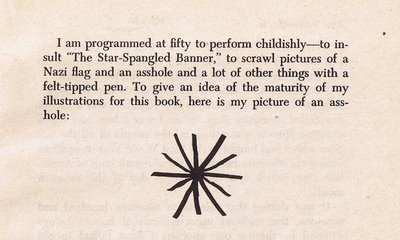
That may give you an idea of what to expect inside (although most of the illustrations are “better” than that one).

What is especially helpful about the story is that it tells you what will happen as it goes along.  So the novel starts:

This is a tale of a meeting of two lonesome, skinny, fairly old white men on a planet which was dying fast.

One of them was a science fiction writer named Kilgore Trout.  He was a nobody at the time, and he supposed his life was over.  He was mistaken.  As a consequence of the meeting, he became one of the most beloved and respected human beings in history.

The man he met was an automobile dealer, a Pontiac dealer named Dwayne Hoover.  Dwayne Hoover was on the brink of going insane.

And that is literally the story.  So why is the book 297 pages long then?  Vonnegut is really out to talk about contemporary society:  America mostly, but not exclusively.  And does he ever. (more…)

Read Full Post »
SOUNDTRACK: BROKEN BELLS Live at SXSW, March 17, 2010 (2010).

The only disappointing thing about this download from NPR’s All Songs Considered is that it consists of only three songs now.  I guess the band (or more likely the label) didn’t want the whole show streaming or downloadable, so they let us have three songs (the original show was ten).

But three is better than nothing.  The excerpt includes “The High Road,” “The Ghost Inside” and “October.”

The band sounds great in this setting.  I’m unclear just who all is playing live, but the page says that the live band is a six piece (with Danger Mouse jumping from drums to keyboards and back again).  They reproduce the songs very well, but at the same time they’re not just mimicking the album.

It’s a nice teaser to want to see them live.

[READ: April 4, 2011] “Bob Dylan Goes Tubing”

Today is Bob Dylan’s 70th birthday.  It’s not often that I get a story that coincides with a day quite so nicely.  Happy birthday, Bob.

This begins as a delightfully weird little story and develops into a strangely profound story about family and celebrity.

A family is renting a vacation home by Lake Sturgeon for the summer.  The mother notices a man on a raft who is floating towards them.  And she says that from a distance the guy looks like Bob Dylan, only older.  (He is older, her husband ponts out).

When the man gets closer, he reveals himself to indeed be Bob Dylan.  Well, he doesn’t reveal himself to be Dylan, he just is Dylan. And he accepts their hospitality and doesn’t make a fuss.  He thinks that he’s on a different lake (Lake Kashagawigamog), but he seems content where he is.

And that’s when their son Ryan, introduces him to the fun of tubing.

There is a lot of humor to the story (it was a National Magazine Award Nominee in the humor category), but it’s not a very funny story.  Obviously the premise of Bob Dylan tubing s quite funny, but as the story continues its proves itself to be not so funny.

For Dylan won’t leave. He stays in their house, and the family is basically paying for his food and cigarettes.  (Okay, that is quite funny).  He’s a good companion for the family (especially Ryan, whom he is teaching to play guitar), but he has never once offered to pay for anything.  (No even a cheque when he leaves?)

As the story and the summer draw to a close, some of Dylan’s loneliness is revealed.  And the story ends on a poignant yet positive note.

It’s really quite a nice story.  I wonder what won the Award that year.

It’s available here.

Read Full Post »

SOUNDTRACK: BROKEN SOCIAL SCENE-World Cafe March 2, 2006 (2006).

Broken Social Scene played at the World Cafe not long after their release of Broken Social Scene (their 3rd album).  This download is primarily an interview between World Cafe’s David Dye and BSS’s Kevin Drew & Brendan Canning, but there’s also three songs that the band played for the session (it’s impossible to know how many songs they played in total, because the songs were recorded prior to the interview–I’m not even sure how many members played live as they were never introduced.)

The songs sound interesting in this recording.  I haven’t listened to the album in a long time, so I don’t recall if these versions sound like the disc; however, these three tracks are fascinating for how quiet they seem to be, despite the fact that there are so many people in the session.  “Something for the Holidays” has at least one violin, a horn section, guitars and several vocalists, and yet it’s rather quiet.  Not mixed quiet mind you, but like everybody is whispering (even the horns).  It makes for an amazingly intimate session.

“Major Label Debut” is a bit more stripped down, but there are clearly a lot of people playing.  The final track, “Ibi Dreams of Pavement” really sounds like a Pavement song in the beginning.  The slightly out of tune violins work perfectly, and whoever is singing has a Stephen Malkmus thing down quite well.

The interview is fascinating (and quite lengthy).  They discuss the origins of the band, how fifteen people can play and tour together and the amazing success that so many of the individuals of the band have had (Feist, Metric etc).  There’s also an explanation about the origin of the title and the sounds of “Ibi Dreams of Pavement.”

It’s a good session and is certainly going to get me to listen to their discs again.

[READ: April 4, 2011] “The Counterpart”

This bizarre story can certainly be called Kafkaesque, if for no other reason than that the narrator, Aleksey, wakes up from a night of drinking to find out that his nose is gone.  Not torn off, not bloody, not broken, just gone.  His face is now flat with two holes for breathing.

This bizarre incident no doubt stems from his childhood hatred of his large Semitic nose (despite his being a Christian) and the years of abuse he received about it.  First he thinks his lover, Tatiana, is somehow responsible.  But when she comes over she is just as surprised as he.  Nevertheless, she is insistent that he must carry on as normal, for he must improve his lot (and thereby hers).

Because Aleksey is not faring so well (nose aside).  He has not been given tenure, his wife and child have left him and he is stuck translating poor Russian works into English.  Tatiana has set up a job interview for him and the interview is today.  But how can he go with no nose? (more…)

Read Full Post »

SOUNDTRACK: RICHARD THOMPSON-Tiny Desk Concert #107 (February 1, 2011).

This Tiny Desk concert sees Richard Thompson playing three songs from his most recent disc Dream Attic.  I really enjoyed this album, but because it was recorded live, and there’s lots of instrumentation on it, I wasn’t sure how well these songs would translate to a simple acoustic guitar.

I needn’t have worried.  RT is a master songsmith and even stripped down to just him and his guitar the songs swell where they should and haunt when they ought.  “The Money Shuffle” doesn’t need the horns that accompany the original (he supplies the power with his voice), and “Stumble On,” a gorgeous ballad, works fine solo.  I appreciated the introduction he gives to the final song “Demons in Her Dancing Shoes” as I didn’t realize it was about something specific.  He plays all the fast bits (including a brief solo) wonderfully on that acoustic guitar, too.

This is not to say that I think these songs are better solo than with the band.  It’s just to say that RT can play anything and make it sound great.  It’s an excellent (if not brief) set.

[READ: April 4, 2011] “Atria”

I hated this story as I read it.  I felt like it was deliberately trying to manipulate me.  I felt like it was playing some very obvious cards and leading to an obvious conclusion.  By the end I wanted to scream at it, yet it kept surprising me.

The story is about Hazel, a sophomore in high school.  She has not had any kind of experience with sex until one afternoon when circumstances conspire for her to have sex behind a 7-11.  She doesn’t really enjoy it but she didn’t really protest it either.  She was just sort of there.

Soon afterward, she is raped (I know), by a man who is clearly not all there.  The rape occurs behind the church (I know), and once again, she probably could have gotten away, but she was just sort of there.

Now, of course she’s pregnant (I know).  She doesn’t know who the father is obviously, but now she has a scapegoat.  The man is vilified but never found (the police artist was a joke).  The town puts up a bunch of Hazel-inspired alert phones all over town (fat lot of good they do her now).

She is treated with kid gloves in school.  Even the religious girl doesn’t blame her for being raped (I know).  All the time she is pregnant she imagines the kind of animal that will come out of her.  It’s never a baby, just different kinds of animals: birds with beaks pecking at her and having multiple babies themselves–which are crushing each other, even a four-legged beast.  It’s very trippy, and she seems to be as well.

When the baby is finally born she determines that it is a seal.  And she realizes that it needs to be kept wet.

The ending of the story was very, VERY disturbing and I simply couldn’t believe what I was reading.  And yet for all of the obvious (and by contrast highly disturbing) stuff that happened, I didn’t want to stop.  There’s was something strangely compelling about this story.  I will keep an eye out for her in the future.

Read Full Post »

SOUNDTRACK: PJ HARVEY-Uh Huh Her (2004).

After the sort of mellow, almost commercial release of Stories from the Sea, PJ Harvey throws the fans a left turn once again with Uh Huh Her.  It’s a heavy, raw album although not raw like Dry was.  It seems  simpler, somehow.  And I think it’s with this disc that you realize that every PJ Harvey record is going to be different.  It was apparent that she had a trajectory on those first few discs, but this one changes everything, and she proves that you’ll never know what’s going to come from her.

“The Life and Death of Mr Badmouth” has a very simple blues riff with kind of chanting (and occasional creepy backing vocals) by PJ.  While “Shame” adds more texture (melodica?) and some more washes of sound.  “Who the Fuck?” is a wonderfully vulgar and raw track with brutal guitars and overly loud vocals.  “Pocket Knife” is a buzzy but quiet track which feels like a demo (the guitar even seems out of tune), while “The Letter” has a great fuzzy guitar sound and a cool melody.

“The Slow Drug” is one of several slower pieces.  As with many of her quieter stuff this does nothing for me, although it’s a nice change on the disc.  “No Child of Mine” is a brief acoustic number.  It feels more like an excerpt or a transitional song than any actual song (being only a minute long).  It leads to the rocking “Cat on a Wall.”  “You Came Through”  mixes things up very nicely with a heavy percussion.  The effects in the song are really captivating.

“It’s You” is a slow piano-based song, while “The End” is a brief instrumental (more melodica).  And “The Desperate Kingdom of Love” is a dark ballad.  The oddest track is “Seagulls” which is a minute of actual seagulls squawking…an unusual addition for any disc.  The album ends with “The Darker Days of Me & Him.” It’s a quiet acoustic song which shows just how many different style she’s willing to experiment with even on one disc.  Even though to me this is a raw rocking disc, there are still a number of acoustic tracks as well.

This album feels like some kind of psychic purge.

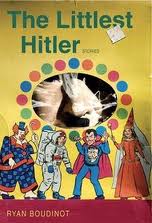
[READ: March 31, 2011] The Littlest Hitler

I picked up this collection of stories because I enjoyed Boudinot’s story in the BlackBook collection very much.  I didn’t realize that that story was in fact part one of a two-part story (although part two bore no relation to part one, as you’ll see).  The story in BlackBook was funny and dark, but it didn’t prepare me for just how dark these stories would get.  And for the most part, it seemed like the darkness came at the very end; a surprise, a shock.   I admit i grew a little weary of the device by the end of the collection, although not all of the stories employed it, so there was some diversity. (more…)

Read Full Post »

SOUNDTRACK: WEAKERTHANS-World Cafe Live, December 5, 2007 (2007).

I really like the Weakerthans, and they are surprisingly unknown here in the States.  I say surprisingly because they write exceptionally catchy (almost absurdly poppy) songs which would fit on many radio stations’ playlists.  But what sets them apart is John K. Samson’s lyrics which are clever and interesting and about people and loss (maybe that’s why they never made it down here).

This World Cafe set came about shortly after the release of their last studio album, Reunion Tour.  David Dye asks some great questions (I’ve never really seen/heard any interviews with them, so it’s all new to me) and the band plays three songs from the album.

We learn that Reunion Tour was initially inspired by Edward Hopper paintings (and the whole album was going to be devoted to Hopper until Samson grew sensible again).  We also learn the official pronunciation of the recurring cat on the Weakerthans albums is Virtute (Vir-too-tay) which comes from the city of Winnipeg’s crest.

They play “Night Windows,” “Civil Twilight” (and talk about the video, which I watched and it’s very cool), and “Virtute the Cat Explains Her Departure.”  The interesting things about the Weakerthans is that they don’t sound all that different live than on record.  So, these songs aren’t terribly revelatory.  There are some effects that are changed, and the tempos feel slightly different as well.  But nevertheless, the songs sound great.  The only problem is that the set seems mixed rather loudly, so there’s distortion (unintended, I assume) on some of the tracks.

Nevertheless, this is a great introduction to a relatively unknown band.

[READ: April 19, 2011] Five Dials Number 2

After just one issue, Five Dials has already lied to us.  In Number One, they said that all of the artwork would be black and white, but here is Number 2, and we have a host of beautiful color pictures (perhaps they only meant that Number 1 would be in black and white).   Of course, I’m only teasing them because the color pictures are really nice, and they really bring a new aspect to the magazine.

Number Two is a bit larger than Number 1 (twenty pages).  This issue has a vague sort of theme as well (it’s unclear if the issues will be thematic in the future), but this one has a general theme of adventure/nature/environmentalism. (more…)

Read Full Post »

SOUNDTRACK: SONIC YOUTH on World Cafe, August 21, 2006 (2006).

Travelling back even further on the NPR timeline, Sonic Youth appeared on World Cafe in 2006 to promote Rather Ripped.

This is a brief session (only three songs) but as with the interview with Thurston Moore, David Dye does another great interviewing the band here.  Although it must be said that saying the band is once again a four piece (when clearly there are five people in the picture and in the studio and when he later says two guitars, two basses and drums–which I also think is incorrect, as I’m pretty sure Kim switched to guitars at this point, although I don’t know if she did during this set) is not a great way to start the interview.

Facts aside, the interview is informative and interesting and provides a glimpse into the band’s psyche all these years into their career.

The set is also good (although Thurston’s voice sounds a little off on the opener “Incinerate”).  The surprising thing about the set is that even with the five of them, the feeling is one of restraint. True, the songs on Rather Ripped are not as noisy as previous records, but this feels like they are trying not to wake anybody up the NPR folks.  It’s a weird feeling for a Sonic Youth set, but the plus side to it is that you can really hear everything clearly.

The other two songs are sung by Kim: “Jams Run Free” and “What a Waste” (why do they never promote any of Lee’s songs??).  And there’s the very amusing comment that the first time they played “What a Waste” Thurston and Kim’s daughter said it sounded like the theme from Friends.  Ha!

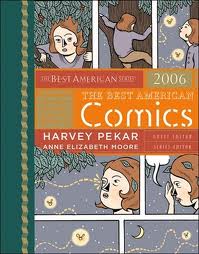
[READ: April 15, 2011] The Best American Comics 2006

I just recently learned about this series from The Best American line of books.  I had known about the Best American Short Stories and Essays and even Non-Required Reading (which I have not yet read).  But once I found out about the best comics, I knew I had to check it out.

The first issue came out in 2006.  The series editor is Anne Elizabeth Moore and the Guest Editor for this volume was Harvey Pekar.  Each of them has an introductory essay in the book.  To me the amazing thing about Pekar”s essay is how aggressively defensive he sounds (a sort of, “you may not like this one, but try this one” attitude) about these comics and comics in general.  I don’t know much about Pekar’s work.  I know he’s a kind of underground icon, but I seem to have missed him.  My impression of him is that this sort of antagonistic/defensive attitude seems to go along quite well with his comics, so I guess that makes sense, but I didn’t find it very welcoming.

But that’s okay, because I really enjoyed the comics.  And quite a few were by artists that I had never read before, which is even better! (more…)

Read Full Post »

SOUNDTRACK: WAVVES-Live at the 9:30 Club (2010).

Wavves opened for Best Coast (what a great double bill).  Wavves play a raucous, rowdy set of bratty punk.  Unlike Best Coast, the lead singer seems like he might be something of a jerk.  But it played pretty well into the personality of the music (sloppy, abrasive).  And I wonder just how many times he said he was drunk?

Personalities aside, the was a really fun set.  I have the newest Wavves album, but I think their live show was more engaging.  For all of their sloppiness, the band was always together, with no missed notes (except when the drummer was apparently not paying attention).

They play 16 songs, including a cover of Black Flag’s “Nervous Breakdown” (which the play very well).  And even if you’re not won over by the singer’s personality (which is kind of funny), you’ll be won over by the simple, punky music.  You can listen here.

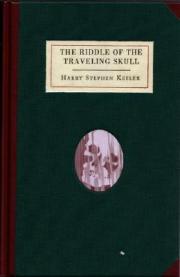
[READ: March 29, 2011] The Riddle of the Traveling Skull

This is the 4th book in McSweeney’s Collins Library Series.  It’s the final book in the series that I’ve read and I have to say that once again, Paul Collins has blown me away with this selection.  Collins apparently stopped his library after 6 volumes.  I wondered if there were more coming, but the Collins Library website is rather confusing.  There’s an almanac with updates as recent as March 1st, and yet the Biography of Paul Collins says: Paul Collins is currently on tour in support of his memoir, Sixpence House, which recounts his time spent living in the Welsh town of Hay-on-Wye, known as the “Town of Books.”  But Sixpence House came out in 2003 (and it sounds awesome!).

Anyhow, back to this book, which was my favorite of the bunch.  It is a genuine mystery from 1939.  Indeed, Harry Stephen Keeler was even more prolific than Agatha Christie (they were born in the same year).  The thing about Keeler though is that his stories are, well, crazy.  Many of his stories were just his attempts to meld disparate ideas into one story.  He includes crazy dialect.  He seems to have no concern for conventional storytelling.  Indeed, he has little concern for conventional mystery storytelling (in one of his stories, he introduced the murderer on the last page).

And this story has similar improbable elements.

In sum: Clay Calthorpe, a salesman returning from the Philipines picks up the wrong bag on the trolley.  When he gets home he finds a skull inside it.  The skull has a name plate affixed to it, a bullet inside it and, in the wads of paper that are keeping the bullet from rattling around, he finds the carbon copy of a poem. (more…)

Read Full Post »

« Newer Posts - Older Posts »