Feeds:
Posts
Comments

Archive for the ‘Funny (strange)’ Category

SOUNDTRACK: MERCURY REV-Deserter’s Songs (1998).

Mercury Rev has changed a lot as a band over the years.  They began as a noisy punk outfit who was getting kicked off of airplanes, and by this album (seven years after their debut), they’ve turned into a kind of sweet orchestral pop band (a transformation not unlike The Flaming Lips).  I got into them with their album before this See You on the Other Side with the seriously rocking song “Young Man’s Stride.”  This album came as something of a shock, it is often so delicate.

I used to really love this album a lot and then one day I thought that it was a little irritating sounding, and that has stuck with me ever since.  The irritation comes from a combination of the really high-pitched vocals and the musical saw that seems to accompany most songs.  However, I hadn’t listened to it in quite some time and hearing it now, I found it enjoyable once again.

It opens with “Holes” a five-minute song that layers many different instruments (musical saw, of course, and horns) over Jonathan Donohue’s timid and wavery voice and gentle keyboard washes.   “Tonite It Shows” continues in the pretty vein–a beautiful song that name checks Cole Porter.  “Endlessly” features more unearthly soprano singing (there’s a lot of high-pitched music on this disc).  It has a lovely melody and references “Silent Night” on the flute.

The first highlight has to be “Opus 40” which tempers all of the potential irritants but maximizes the beauty and wondrous songwriting.  It soars to the heavens but stays grounded with a cool retro organ solo.  The other major highlight is “Goddess on a Hiway.”  “Hiway” is even better than opus 40 at blending the wonderful elements of this album.

“Hudson Line” is an anomaly on the disc–raw saxophone solo and low vocals change the pace of the album quite a bit.  “The Funny Bird” actually sounds like a Flaming Lips song circa 2008.  The Flaming Lips comparisons aren’t all that surprising since Donahue played with the Lips back in the early 90s.  And “Delta Sun Bottleneck Stomp” is a pretty raucous song (“stomp” is correct).  It has a traditional feel and ends the disc on an upbeat note.

So, yes, although some of the effects on the disc veer into annoying, it’s still a great disc overall.

[READ: Week of April 16] Gravity’s Rainbow 3.25-3.32

We have finally exited The Zone this week.  The lengthy Section 3 has come to a close with an unceremonious send off to Slothrop, who I assume we’ll see in Section 4, with the reintroduction of old characters and with a chance meeting that made me go wow!

I’m really amazed at the interconnectedness of the book.  While I didn’t think that things would be unrelated, the number of unexpected connections is really tremendous.  And while I missed many of the other characters, seeing the occasional one pop up is pretty exciting.

I’m happy to leave the Zone, not because I didn’t like it (although I admit I Slothrop’s slog from one place to another was getting a little tiring), but because I really want to see how he wraps all this stuff up.  Connections are popping up everywhere, and I feel like he’s doing a whole lot more than I initially thought. (more…)

Read Full Post »

SOUNDTRACKMOLOTOV-¿Dónde Jugarán las Niñas? (1998).

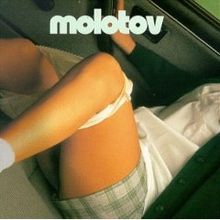
Molotov was the last Rock en Español band that I really bothered to check out.  They were probably most notorious for the cover of the album.  Interestingly, the cover is actually a four sided cover which you can flip to three other far less sexist scenes, so yes, that was pretty much a sales gimmick.  And it certainly attracted attention (and a law suit!).  So they reissued the title with the far less offensive, but very different cover below.

My Spanish is poor at best, but this album is a mix of Spanish and English.  And, of course, I know some bad Spanish words, so I get a sense of what this album is about. But here’s the thing–it rocks really hard and has some really great elements of the metal/rap/funk hybrid genre, regardless of whether you know what they’re talking about (although don’t go singing “Chinga Tu Madre” around the office, capiche?).

The opening song  “Que no te haga bobo Jacobo” has a very Rage Against the Machine vibe–heavy guitars and sound effects with militant rapped lyrics.  The riff is great and the vocals are smoother than Rage’s Zach–“Tito” Fuentes has great flow.  There’s also some good funky bass in the middle section.  “Molotov Cocktail Party” is a mix of English and Spanish, a pretty straightforward rap, not unlike Kid Rock.

“Voto Latino” has a more alt rock vibe in the guitars, although the vocals are pretty straightforward rap style.  The song title means Latino Vote, so perhaps there’s a politics context to it.  And “Gimme Tha Power” is a political song, too.  A rap (in Spanish) over some nice acoustic guitars.

There definitely isn’t in “Chinga Tu Madre” which has more of those cool guitar effects and group chanting, although it’ probably not worth investigating the lyrics much more.  But the chorus is catchy as anything.  “Matata Tete” and “Mas Vale Cholo” return to that Rage Against the Machine style, with vocals that are a bit more cookie monster-y (I’m not sure who sings lead on which songs, actually) although “Mas Vale Cholo” has some fun with the vocal delivery.  And there’s a spirit of early Red Hot Chili Peppers at work, too.

“Use It or Lose It” is rapped in mostly English.  It has a very cool acoutsic-feeling chorus (and a quote of the line, “what cha gonna do rap is not afraid of you.”).  “Puto” is presumably an anti-gay song (I suppose I should find that out before I say so).  “Porque No Te Haces Para Alla?…Al Mas Alla!” has a fun chorus and cool guitar effects once again.  “Cerdo” has a cool 70s vibe, with funky bass and scratchy guitars–it’s got a sexy feel, although the title means “pig,” so who knows.

The final track also rocks very well.  According to Wikipedia, the translated title of “Quitate Que Ma’sturbas (Perro Arrabalera)” is “Stay Away Because You Masturbate (Suburban Bitch)” which seems weird .  But maybe they had nothing better to write about.  Sometimes ignorance of a subject is not a bad thing.

¿Dónde Jugarán las Niñas? is not the classiest album around, but it’s got some really interesting sonics.  And I’m led to believe their later albums are even better.

[READ: Week of April 9] Gravity’s Rainbow 3.16-3.24

Last week ended with sex and this week opens with the way I felt–like a voyeur who can’t look away.  The exhausting orgy was exhausting to read about as well.  And I’m starting to wonder if Pynchon is making a point about sex rather than just enjoying writing about it.

This week’s read also brings back two characters from way way ago.  Well, one from not too long ago, but another from what seems like an eternity.  I assumed we’d see Pirate Prentice again, but I assumed that it wouldn’t be until Section 4. So that was a nice treat, even if it’s a less than happy return for him. (more…)

Read Full Post »

SOUNDTRACK: ROCKET 00000-What Women Want (2010).

This is the second band that I have discovered because of this novel.  I was looking for images to paste in last week’s post for Rocket 00000, and I came across this EP.

Rocket 00000 are a trio from Cincinnati and this is their first (and only) release.   It’s got a kind of 80s punk vibe–I can’t really make out the words, but I like the feel.

There’s something very raw and almost amateurish about the record–but that seems deliberate, because the album sounds very professional–it’s recorded well and the band is very tight.  And since I like the bandcamp site quite alot, I’m going to provide the link with extras here so you can listen to the album, too.

There’s four songs–two are 5 minutes and two are around 3 minutes.  The two longer ones have intros and outros that extend the music to those long (for punk songs) times.  And I really like these instrumental sections. In fact, when I first listened, I thought maybe the whole first track was an instrumental.  Since  I liked the tone of the album I was okay with that.

The “Summer City” part of “Summer City/Conspiracy Theory” has a simple but effective guitar solo as an instrumental.  After about a minute and a half “Conspiracy Theory” kicks in, the vocals bring a new texture and a punk element into the song.  “Lethal Weapon 2 & 4” has a great title, but it doesn’t sound all that different from the other songs (although the lyrics, “We’re not perfect…but neither are you” are pretty clear).

“Signs” has some cool drum breaks and fills, and the end of the song is musically interesting.    “Braveheart: Forever Young” probably combines the music and vocals  best–I like the  upbeat music with the dark words.  The song ends with about 2 and a half minutes of instrumental (with interesting feedback) that works really well together.

It’s not the best punk EP, but it’s got some good qualities and the band has a good name.  I wonder how they “say” it?

[READ: Week of April 2] Gravity’s Rainbow 3.11-3.15

After last week’s breezy read, I figured that this week’s would be a bit rougher.  But for the most part, it wasn’t–aside from the very end which was a little hard to stomach.  There was a lot of technical discussion in this section–which was a  bit hard to comprehend.  There was a also a return of Franz Pökler–where we learned his story and what happened to him.  We assumed that he was killed by a police truncheon, but that turns out to be untrue.  His story is pretty dark and sad.  Sorry, as Marco points out below, it was Peter Sachsa who was killed by truncheon.  My conspiracy has been called out!

Section 3.11 opens uncomfortably with Franz Pökler… copulating with Leni in an aggressive and rough manner.  He has just come back from showing of Alpdrücken and imagines that it’s Margherita underneath him.  He assumes that men all over the country are doing the same thing because of the movie.  He calculates that it was that night that Ilse was conceived–they’d barely had sex around that time.  This flashback brings us forward to the scene of Franz waiting for Ilse to return to Zwölfkinder—a kind of children’s fantasy playground which would prove to be a very significant location for them. (more…)

Read Full Post »

SOUNDTRACK: BROKEN SOCIAL SCENE-“Complications” from Score! 20 Years of Merge Records: The Covers (2009).

I liked Broken Social Scene’s first album quite a lot.  This is their cover of a song by The Clean.  I know of The Clean from the Topless Women Talk about Their Lives soundtrack although not this particular song.  (What’s with all these New Zealand bands being on Merge?)  I found the original song online.  Interestingly, the original version is only 2 minutes long.  But Broken Social Scene always does things by double, so their version is 4 minutes long.

The cover version opens with a young person saying “This song was written before ‘Born to Run,'” although as far as I can tell “Complications” was written in 2001. So who knows.

The cover is a fuzzy, ramshackle mess of a song, which is not to say that it isn’t good (the original is kind of ramshackle, too).  The prominent melody doesn’t exactly remind me of “Born to Run” but I can see the connection.  The big question is, what does BSS do with the extra two minutes?  Well, mostly they jam, with some wild soloing–but it’s all mixed just under the fuzz of the noise.

This is another strangely faithful cover (5 in a row so far) for this covers album.  And once again, I think I like the cover a little better.

[READ: April 1, 2012] “Once an Empire”

Clearly I wasn’t reading every story that came in Harper’s back in 2010, because I know I skipped this one.  But now that I’m quite fond of Rivka Galchen, I decided it was time to go back and check it out.

How can you not like a story that starts out: “I’m a pretty normal woman, maybe even an extremely normal one.”  You know that normal things will not be afoot by the end of the story, right?  And so it is, by the second paragraph: “I never thought I’d be the victim of an especially unusual crime.  Or of any crime, really.”

You’re totally hooked, right? Me too!

The narrator takes her wonderfully sweet time getting to the crime: dithering over whether or not it was Tuesday night (“Every Tuesday night I go and see whatever is playing at the movie theater nearby.  I’m not choosy.  I’m happy to see what everyone else is going to see.”) or Wednesday morning. Talking about the giant clock/thermometer on the Jehovah’s Witness Watchtower that keeps her company.  And then describing her walk home.

She notices that her windows are dark–she always leaves her lights on.  And then, she notices that some thing–not something, some thing–is emerging from one of her windows.  And as she focuses, she realizes it is her ironing board. (more…)

Read Full Post »

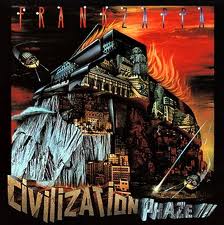
SOUNDTRACK: FRANK ZAPPA-Civilization Phaze III (1994).

There were a number of choices for soundtracks for this week’s read.  I could have chosen the Andrew Sisters (and their wonderful “Don’t Sit Under the Apple Tree”) who get a mention in the book.  And, of course, I could have chosen Elton John’s “Rocket Man.”  But, when I read Trudi tell Magda about her boyfriend Gustav who wants to live inside a piano, well, it was hard not to think of this, Frank Zappa’s final work.

Civilization Phaze III is an opera-pantomime.  According to the libretto, “The speaking characters all wear oversized masks, gloves and shoes.  They live in an abstracted grand piano….”  And musically opens with this introductory spoken passage:

FZ: The audience sits inside of a big piano and they listen to it grow.
Spider: People are going to sit inside of a piano. They’re going to listen to this piano grow.
John: They’re going to listen to the piano grow?

Civilization Phaze III was released posthumously in 1994.  But here’s the weird thing.  Most of the sessions of “piano people” dialogue were recorded in 1967.  Zappa had a bunch of people come into the studio, sit under a piano that was miked and improvise dialogue (sounds like the 60s to me).  He released some of this dialogue on his  late 60s albums, but as far as I can tell, the parts about the piano were never included (in Lumpy Gravy someone talks about wanting to live in a drum).  I’m also not sure how well-known the “piano sessions” were at the time.

So, here’s the question…did Zappa influence Pynchon or did these two people come up with the same idea at roughly  the same time.  The reason Zappa put off using the material recorded in 1966 was because technologies were simply not advanced enough to let him manipulate the dialogue so it would sound decent, much less coherent.  So Civilization Phaze III became his exploration of the past with contemporary technology.

He also recorded new spoken dialogue in 1991 and merged the two.  It’s an interesting idea, but I fear that the new dialogue absolutely misses the vibe of the earlier dialogue.  In the early dialogue, they all sounds like they’re stoned and are talking crazy nonsense about horses, smoke and music.  The later dialogue is much more abrasive (especially Michael Rappaport, the only person who has since gone on to renown).  At the time, Rappaport had been on one TV show as a guest, but by now he is too famous for this.  I find him a distraction (not Zappa’s fault obviously), even more so because he talks as if he is black (he says “Nobody said nothin’ when y’all bought my people, right?”) while he is demonstrably not.  And then ruins it contextually by mentioning Yo MTV Raps, the only thing that places the story in time.  It’s weird that Frank wouldn’t have a black person say these lines, especially since he has so many other races and nationalities represented in his music.  But maybe that’s me intellectualizing that I just don’t like Rappaport.

So, what’s this monstrosity about?  I have no idea.  Improvised stoner dialogue from the 60s is pieced together into a kind of story.  Occasionally Frank’s voice chimes in and prompts them to talk about certain things (which is quite  disorienting).  And the whole “plot” well, I’m not even sure if it can be called a plot, but Frank tries to cobble something together–again, the 1991 dialogue seems to be more pointed, more about conflict, possibly something about overcrowding and racism, and there’s certainly some social criticism at work, but as for a story, well, not so much.

The music, on the other hand, is the culmination of Zappa’s more experimental, atonal “classical” music.  Most of the first disc is performed on the synclavier while most of the second disc contains more actual musicians.  The music is difficult and not to everyone’s tastes, for sure.

Atonal music is far more intellectual than visceral, so it’s hard to “enjoy” this music.   Zappa obviously knew how to write catchy poppy friendly music, so this is a deliberate attempt to write something more challenging.  I like Zappa’s crazy music in small dozes, so listening to this entire thing (over 2 hours) can be a tough in one sitting.  But each piece (especially the two really long pieces “N-Lite” (18 minutes) and “Beat the Reaper” (15 minutes) ) showcases something interesting or satisfying.

The libretto that Zappa includes with the discs explains the story in far more detail and shape than one would ever get from listening to the music.  Without the book, you would know that this is a dark and moody piece, but with the book, you can actually see what the music is showing.  That may be a flaw, or that may be the way of a staged performance.  I have no idea if it was ever staged.

There are certainly easier introductions to Zappa’s music.

[READ: Week of March 26] Gravity’s Rainbow 3.6-3.10

Last week was a bear of a read for me, but this week was so fast (and short) that I just kept going because I was so into the Slothrop story (I won’t go past the spoiler line, I promise).  And yes, it’s (almost) all Slothrop this week.

Section 3.6 begins with Slothrop violently ill.  [I admit I don’t think of novel characters as getting ill very much–unless it’s a plot point–but surely characters get colds and tummy aches just like everyone else, right?].  He drank out of an ornamental pond in the Tiergarten–but, duh, everyone knows to boil water before drinking these days.  This also introduces Slothrop as Rocketman, something we won’t get more details on until later. (more…)

Read Full Post »

SOUNDTRACK: FRANK ZAPPA AND THE MOTHERS OF INVENTION-Over-nite Sensation (1973).

When I saw Marvy’s Mothers, it was hard not to pass up the connection to Zappa and his band.  But oh, what album to pick?  (He released like 40). I chose the one released in the same year as Gravity’s Rainbow.

It also happens to be full of all kinds of sex (imagine that).

It opens with “Camarillo Brillo” the kind of simple, catchy song that Zappa seems to whip out very easily.  I assumed that the title was some kind of sexual slang (not a bad assumption), but Wikipedia suggests it has something to do with an insane asylum (Camarillo) and the crazy hair they often had, which makes sense given the crazy lyrics.  It starts kind of trippy with inscrutable lyrics.  And then the bridge, “she was breeding a dwarf” is pretty insane.  It also features a very funny sequence that was oft-quoted in MST3K–“Is that a real poncho or a Sears poncho.”

“I Am the Slime” is a funky (a great Zappa riff) diatribe against TV (because it makes you buy crap you don’t need and makes you listen to the government).  “Dirty Love” is a perverse song with lots of guitar solos.  There’s some kind of bestiality in this song (which also ties in with parts of this section).

“Fifty-Fifty” features the vocals of Ricky Lancelotti (in a screaming style that would later be used a lot by Terry Bozzio).  It’s about an ugly guy who is crazy enough to sing to us.  The songs seem to be more about solos though, as there’s a keyboard solo an electric violin solo (from Jean-Luc Ponty) and some crazy guitar solos.

I don’t know what “Zomby Woof” is about, but it has some wicked guitar soloing and horns playing Zappa’s staccato riffs up and down the scale.

“Dinah-Moe Humm” is a song perfectly suited to this book–it’s a song in which a woman bets the narrator that he can’t make her have an orgasm.  The melody is twinkly and silly.  It’s shockingly explicit. But it’s even funnier to know that the backing vocals are supplied by The Ikettes (Ike and Tina were recording in the next room).  They got paid almost nothing and when Ike heard the song he called it “shit” and asked that their name be removed from the credits.

It also plays around with hippy slang.  “Kiss my aura Dora/It’s real angora/Would you all like some more-a/right here on the floor-a/and how about you fauna/You wanna?”

He also starts talking about Zircon encrusted tweezers, which come back in “Montana.”  “Montana” is about moving to Montana to raise dental floss (really).  It features some wonderful fast pizzicato notes that are more or less Zappa’s signature.  The middle section is  hugely difficult and very impressive for the backing vocalists (Tina apparently was really impressed that one of her girls could do it).

Zappa packs a lot of music into 35 minutes, and this album seems to be a turning point in his desire to cram sex and craziness into his commercial music.  Just about every song on this disc was played a lot live and this album has become something of a classic.

[READ: Week of March 19] Gravity’s Rainbow [3.1-3.5]

This week’s read has been the most challenging for me so far.  I enjoyed Section 2 very much.  The Slothrop scenes were funny and wild and even advanced the plot.  I never expected that Section 3 would introduce a ton of new characters, more or less ignore the old charterers and stay with these new characters so that by not paying close attention to them in the beginning I was just confused by the end.

I do admit that while skimming again for this post, I was able to focus on the new characters more and found it far less confusing.  It’s just that on a first read, suddenly there’s this whole new sequence of people and their histories to deal with!  Wow.

It was especially surprising because Section 3 begins with Slothrop (so it’s not like in 2666 where a new section means a new cast).  But he meets new characters and then we flash all the way back through each person’s life.  And yes, it was quite interesting once I actually paid attention, and the connections were pretty awesome.  But it was still pretty surprising on the first read through.

Section 3 is called In the Zone.  And the Zone is mentioned quite a lot, although I never figured out where it is meant to be exactly. (more…)

Read Full Post »

SOUNDTRACK: YOU SAY PARTY! WE SAY DIE!-“Monster (RAC Remix)” and “Like I Give a Care (Octopus Project Remix)” from Viva Piñata! (2008).

Viva Piñata is a free CD compilation that I received I think when I ordered a Tokyo Police Cub CD.  It celebrates “5 years of ass-whippin’ at Paper Bag Records.”  It came out in 2008, so presumably, Paper Bag Records has now been whippin’ ass for 9 years.

You Say Party! We Day Die! (that’s a name that seems to be trying too hard) is from British Columbia, Canada and they seem to be a noisy keyboard band.  “Monster” is a keyboard-heavy poppy song.  Of course, since this is a remix I have no idea what the original sounds like.  The lead singer has a cool deep voice (a more poppy Kim Gordon, perhaps?).  But this song is dominated by the propulsive synths.

“Like I Give a Care” has a remix that is even more intense, overeffected, noisy and chaotic with a great propulsive bass.  It also seems like most of the song has been stripped, leaving just a chorus repeated.  As a remix it works fine.

I’ve often complained about remixes–if I like a song, why would I want to hear a remix of it?  This is the opposite.  I’ve never heard the song before and the remix is kind of fun. I’m intrigued to hear what they actually sound like.

[READ: March 22, 2012] “I Can’t Read”

Another month, another excerpt from a new posthumous Bolaño release.  This latest book is called The Secret of Evil which Harper’s says will be out this month (we’ll see about that).  The Secret of Evil is evidently a collection of unfinished pieces that Bolaño was working on when he died.

This particular story certainly seems finished, so who knows what the rest of the book will be like.

I am particularly fond of this kind of story from Bolaño–it reads like nonfiction (and maybe it is).  It seems to be a true account from his life (written in first person and about his family)–it’s a personal, relaxed style in which he muses about things and events.  It is also set during his first trip back to Chile since leaving in 1974 (a subject he mines quite well).

This one starts with the line: “This is a story about four people.”  The first two people he talks about are his son Lautaro and a new friend that his son made named Pascual.  Lautaro was eight and Pascual was four, but since Lautaro was desperate for someone to play with, he overlooked the age difference and made a holiday friend. (more…)

Read Full Post »

SOUNDTRACK: NICK CAVE AND WARREN ELLIS-The Road: Original Film Score (2009).

I haven’t seen The Road, and I probably never will.  Nor have I read it.  The only reason I was listening to the soundtrack was because I like Nick Cave.  So this is a contextless review.  Of course, I know what the book is about and I rather assume that the film is equally harrowing.  I expected the soundtrack to be full of desolation and horror.

So I was quite surprised that most of the main themes are played on a piano with gentle strings or simply violins.  True there is a sense of emptiness and loss in these songs (they’re not jaunty piano pieces or anything) but they are still unexpectedly pretty.

Of course,a song like “The Cannibals” is bound to be more disconcerting, which it is.  It starts with creepy scratchy violins and then tribal drums take over–all set over a buzzing background.  This is more of what I expected the whole score to be like.   Similarly, “The House” must be a very frightening scene, as the music is threatening, loud, intense and quite scary with, again, more creepy percussion.  Unsurprisingly, a track called “The Cellar” is also spooky; it is only a minute long.

But then songs like “The Church” are so delicate and beautiful and not even all that sad–it actually makes me wonder what the scene in the film is showing.  The end of the score feels like the end of a movie, which I know it is, but it feels like a conventional movie, with closure, something I’m led to believe the book doesn’t have a lot of.

Taken away from the movie, this soundtrack is quite nice.  Aside from the three scarier tracks, this would make for some nice listening on a sad, rainy Sunday.

[READ: February 28, 2012] “The Longest Destroyed Poem”

I enjoyed Kuitenbrouwer’s “Corpse” so much that I decided to see what else she had written.  It comes to three books and four uncollected short stories.  There’s “Corpse” from The Walrus, this one here, another one called “Laikas” (which has a different title on the site where it lives) and a fourth with a broken link.  Boo.

But that’s okay because I’ll certainly investigate her books too.

Like “Corpse,” this story explores women’s sexuality, but it explores it in a very different way.  In fact, I loved the way it was introduced–especially because of the wonderfully convoluted way the sentence reveals it (and how it’s not even the main point of the sentence):

She looked fabulous. Better than back then, when she’d thought she wanted to be an artist, and Victor had made a point — she realized this as she realized many many things, that is she realized it in retrospect — of dropping into the conversation — the one she hadn’t actually been having with him, because she was instead focused almost solely on the fact his much younger roommate had a hand under the blanket her crotch also happened to be under — that he was off to bed early so he could work on a poem he’d been having trouble with.

I had to read it twice because I thought it was funny the first time, and when I fully parsed it, it was even funnier.

So yes, sex.  But as the story opens, years after the above event, Rosa sees Victor and decides to crash into him with her car.  It’s shocking and it’s shockingly well told.

I love the way Kuitenbrouwer uses language.  I could probably quote from this story six or seven times, but I love this sentence that forecasts the trouble ahead:  “Victor noticed her in that split second, too, and he knew what Rosa was up to, for his face changed, channel surfing from neutral smug — well, this was his everyday face — to impending doom.”

As she’s about to ram him (with a Prius, no less), we flash back to their spirited relationship. (more…)

Read Full Post »

SOUNDTRACK: WILD FLAG-SXSW April 1, 2011 (2011).

Wild Flag has released one of the best albums of 2011.  I can’t stop listening to it.  So, it’s funny that this show has been sitting on NPR’s download page for months without me checking it out because I didn’t know who the band was until the album came out.  Wild Flag is Carrie Brownstein, Mary Timony and Janet Weiss (and a keyboardist who I will never remember because I never heard of the band she was originally in). 

This show at SXSW is one of their earlier shows.  It’s so early that one of the songs in the setlist appears on the album with a different title.  And the band is full of raw energy and passion. 

Although research shows that they’d been touring since November, Mary Timony seems somewhat hesitant in a few songs.  But Carrie Brownstein seems fired up to be playing again, and she rages and jumps around the stage, her voice as aggressive and fun as it was in Sleater-Kinney.  Janet Weiss, as ever, kicks massive ass on the drum kit.  man can she wail–she is a vastly underrated drummer. 

The band has great cohesion and they seem like they’re really enjoying themselves. 

 In many respects this band sounds like Sleater-Kinney (2/3 of the band are here).  But the addition of Timony’s lyrics and more gentle voice bring a cool change.  And the keyboards flesh out the songs in wonderful ways as well–for a band with no bassist, it’s funny that the most pronounced keyboards riffs are at the high end of the register.

There’s a few flubs during the set, in one of the more pronounced keyboard riffs, there’s a pretty major gaffe.  And sometimes it seems like they don’t know exactly how they should be harmonizing with each other (not true on the record at all).  And during the extended soloing of “Glass Tambourine” (6 minutes), I’m not really sure what Mary is up to.  But that’s okay.  The band is all about rawness, so that can be forgiven. 

While the album is better, this live show is a good introduction to the band. 

Since Carrie Brownstein worked for NPR I almost expect all of their shows to be available here.  But for now, watch the whole show here.

[READ: January 17, 2012] “Old Mrs. J”

Stephen Snyder translated this story that was originally written in Japanese.  It’s interesting to me when a work is translated from another culture.  Does the translator intend to keep the other culture obvious or does the translator try to make the story, in this case, more European or American.  There’s some inevitability in that, since the language is changed, and yet the sensibility of the original often remains.

I bring this up because I tend to think of Japanese writing as being very distinctive.  And yet this story didn’t really “read” very Japanese to me (Kiwi fruit aside).  It did read a little bizarre, but that was the fun part.

The story starts out simply enough: a young writer (who is a woman, although you don’t find that out until very late in the story unless, unlike me, you assume the main character is a woman because the author’s name is Yoko).  The author works late and sleeps in til noon or so.  It’s a quiet, peaceful place.  The landlady is older and somewhat feeble.  Until, that is, she gets into her garden and then she seems possessed by a fire. 

The landlady hasn’t really talked to the writer.  Then one day the writer hears the landlady in the garden cursing at a stray cat.  The landlady hates cats and curses them up and down.  Finally the writer tells her to put pine needles down, that cats hate prickly things on their feet.  This I did not know.

And they strike up a friendship.  The landlady reveals that her husband was no good and that he left her.  She also reveals that she gives massages.  And she begins leaving the writer vegetables from her garden.  Then one day, the landlady brings her a strange carrot with 5 “fingers” coming off of the central stalk.  The carrots are quite special.  And she keeps them a secret until sure enough, she begins growing lots and lots of them.  Even the newspaper comes to take a picture.

This idyllic story is interrupted in the last few paragraphs.  First by what seems like metaphorical scariness and then, ultimately, with reality.  It is a wonderfully realized story, wonderfully told and with enough hints of magical realism throughout that the ending isn’t totally unbelievable–even if it is quite unexpected.

Read Full Post »

[LISTENED TO: January 12, 2012] Girl with Curious Hair
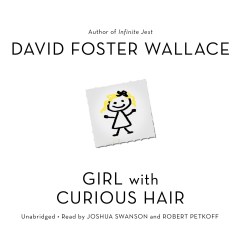
I saw a placeholder on Amazon for this audio book in early 2011.  And then I promptly forgot all about it.  My friend George just asked if anyone had heard it yet, so I decided to check it out.  I downloaded it through Audible.com.

And here’s my two cents about Audible.  Although it was free (for a 30 day trial), it was a lot of work.  The entire book (14 hours) downloaded in two files.  Each was about 7 hours with no breaks or chapters of any kind–just two huge 7 hour files.  Okay, I often download stuff and bring it into Audacity to make my own chapter breaks.  But you can’t import this file into Audacity because it is its own proprietary format and doesn’t want you to put it in MP3 format.  So, I had to burn it to CD (but not in MP3, only in WAV) and then put the CDs back in to iTunes to import them as MP3.  From there I could import them into Audacity and put tracks where I wanted.  That’s a lot of work to save $29.

I’m also going to say that I didn’t want a membership to Audacity because it costs $15/mo and the savings aren’t really that good anyhow.  Even kids books are about $10 each.  Oh, and just see how many hoops they have you go through to try and cancel.   Heavens to Betsy.

And but so on to the actual audiobook.

The book was read by Robert Petkoff (who is Reader A below) and Joshua Swanson (who is reader B below).  I don’t know anything about them, but their websites will give you more info about them.

I found the readings to be simply wonderful.  They were impassioned and articulate and dealt with some of DFW’s tongue twisting word choices with ease.  They also handle DFW’s dialect and accents with ease.  And while Swanson has a much much broader range of voices to play around with (his women voices are far superior to Petkoff’s), Petkoff also pulls of some amazing voices, especially in “John Billy.”  I never questioned what was happening.

Some of these stories are challenging and I admit I found them difficult to read.  But the audio versions seemed to really clarify things.  (There are all kinds of reasons why this could be so, but I’m not going to delve into that, for there lies madness).  Nevertheless, this was a great way to hear these stories.  Especially the ones that had heavy dialect.

“Little Expressionless Animals” [Petkoff] (90 minutes)
Petkoff sounds uncannily like Kyle McLachlan–no bad thing.  Although Petkoff doesn’t work too hard trying to do different voices, he puts in enough distinction to make the characters distinguishable.  (We have been listening to a lot of kid’s audio books, and the narrators of those are amazing with the kind of vocal acrobatics they can do!).  Petkoff is more subtle, but it is also effective–it’s not just a straight voice, which I think might get confusing especially in the dialogue scenes.

There is a hint of Alex Trebek’s voice when doing Alex Trebek, but he’s definitely not trying to mimic the voices of the celebrities.  For the most part, the voices are slight variations of the main narrator.  Indeed, during the later Faye and Julie dialogue section, he does slight differences between their voices to help distinguish the characters.  Which is quite helpful in the story.

This story works very well in audio book format.

One of the things that I loved about this story this time was really piecing together all of the various compnents.  Inclduing things like the revealtion of why Julie does poorly on the subject of animals.  It’s quite obvious when the story ends, but through the whole story you keep wondering, what is it about the animals?  I’m aslo intrigued at the number of gay characters in the book.

And, of course, this story has a major obsession with pop culture, especially TV.  And knowing (from interviews) that DFW sais he would just get sucked in to watching TV all day if it wa svailable, his tone (as is Petkoff’s) is perfect when dealing with the TV issues.

“Luckily the Account Representative Knew CPR” [Petkoff] (18 minutes)
Petkoff sounds slightly differnt than in “LEA.”  Since thist story has no dialogue, there’s not a lot of differentiation in the story.  His deadpan delivery is perfect for all of the details in the story. Although at the end, his “Help”s are quite empassioned, letting you know there’s a little bit more going on.

“Girl with Curious Hair” [Swanson] (50 minutes)
Swanson’s voice is of a much higher timbre, and it’s kind of fun to have two different voices in this book.  This story benefits quite well from an audio format.

The story is deliebrately flat and, I have to admit, is not terribly easy to read.  Swanson handles the flatness very well, he reads it incredibly deadpan and yet he puts enough inflection in it to keep it from being monotone.  I have to assume it wasn’t easy to read this.  I think that he has really made this disturbing character quite real.

Obsevrations about the story.  Hearing this story out loud was more shocking than reading it.  The explicit sex is pretty shocking for DFW and the revelation about what happened to Sick Puppy when he was a kid is prodoundly distrubing, especially when it is read in this non-inflected voice.  It was uncomforatble and very effetcive.

There were times when I wondered about the believability of the charcter.  The use of the word negro, the utter flatness of him. I realize that he is quite damaged, but at times it seemed like maybe this story was too much.  Which is a bit of a surprise, as I find DFW’s charcatersto be very real.

“Lyndon”  [Swanson] [1 hr 45 min]
I didn’t really enjoy “Lyndon” when I read the story.  It’s a little long and had many different things going on.  I kept wondering about Lyndon himself.  About what made DFW write a story based around Lyndon Johnson, around jhis life and politics.

But hearing this story read aloud, with the Swanson’s various voices and accents and newspaper stories all differentiated really brought this to life.  I felt like it was so much more vibrant and alive and passionate in this audio version.  I read in my post that i found the ending quite moving when I read the story, but it felt even more so, with Lady Bird’s quiet, dignified delivery, here.

Observations on the story.  How odd that he chose to make this story that is about a real, and quite famous and well studied person.  I don’t know a thing about Lyndon, so I have no idea how much of this is true (the few LBJ quiotes I looked up seem faked).  I don’t think I spent enough time thinking about the main character when I read the story.  Boyd is so fully realized and amazing that Lyndon is really superflous.  This is awonderfully emotive story.  And Swanson really does an amazing job.

“John Billy” [Petkoff] (1hr 10 min)
I thought “John Billy” was a real challenge to read.  The dialect is pretty crazy.  And the story is not exactly easy to begin with.  But much like Swanson in “Lyndon,” Petkoff’s voices are outstanding here.  The main voice of John Billy is great–he handles the accent and the crazy word choices that John Billy has with ease.  The story flows perfectly.  It’s really impressive.

And while the voice of Glory Joy isn’t wonderful (Petkoff’s women are just softer versions of his voice), he more than makes up for it with the amazing transformation of Simple Ranger.  In the reading, it is clear that Simple Ranger “grows younger” from a quiet, hard to hear older to a youthful loud charcater.  And Petkoff takes that literally so you can really hear him change into a man with a “curious plus haunting voice that was not…of his gravelly, gray-lunged voice somehow, his own, somehow.”  And then, later in the story Ranger’s voice changes again when he “whispered, the big sharp clear new Ranger in a smooth new clear young voice.”   But nothing prepared me for the voice of T Rex Minogue. It is stunning.  It’s an amazingly processed voice that is as malevolent as it is “mechanical.”  It’ s masterful.

As for the story itself, the whole saga of C.Nunn Jr is bizarre and wonderful, a crazy hyperbole of a story.  It also seems crazily over the top hearing it aloud (like in “GwCH”).  The whole story’s end with C Nunn’s eyes is preposterous (what is it with people’s eyes in this book?).  And yet it feels like the nonsense is there as a balance for the heaviness.

The story is funny and silly but by the end it gets incredibly dark and thoughtful.  It’s a challenge to listen to, especially the end, but I think it benefits from an audio version.

“Here and There” [Swanson] (55 min)
I found this story somehow more confusing while listening than when reading.  There’s so much back and forth with voices and the whole conceit that this is some kind of fiction therpay doesn’t really translate easily here.  I also found some of the more academic sections to be kind of dull in his reading.  It’s a challenge to read aloud and keep interesting, I’m sure, but I found this story to be the least successful of the collection.

“My Appearnce” [Petkoff] (58 minutes)
This is written in frist person from a woman.  Petkoff, who has quite a deep voice conveys a woman very well.  This is a great reading for this story.  He does “versions” of David Letterman and Paul Schaffer.  They are not impersonantions by any means, but he has the tone down perfectly.   The male voices whispering in her ear are done in a very simple whisepred voice.  Very effective.

This is a great story and the audio is also wonderful.

“Say Never” [Petkoff and Swanson] (42 minutes)
Petkoff does a very good job with the accents in this story.  Labov’s heavy Jewish accent is very impressive.  And although Mrs Tebof is not very different from Labov, it is different enough to convey the accent and the tone.   He also does Lenny’s voice, which is the bulk of the story.

Swanson also comes in this story as well, doing the voices of Mikey and Louis (two very distinct voices, even if they are both a little Hollywood Gangster from the 40s).  I would have been interesting to hear them interact more in the book somehow.

I was struck by this story more in the listening than the reading.  There’s something about hearing people say these things that makes them more shocking.  Especially the note that he sends to his family (talking about his wife’s lack of sex drive–gasp!).  This is another one of DFW’s stories that ends before something big happens.  It’s funny how many of his stories seem like preludes.

“Everything is Green” [Petkoff] (3 minutes)
It’s also amazing that this whole story is only 3 minutes and thirty seconds long.  Petkoff reads this story in a perfect DFW deadpan style.  He even does May Flys voice with a (slight) accent.

“Westward the Course of Empire Takes it Way”  [Swanson] (6 hours)
Swanson does an amazing job with this difficult story.  There are nearly a dozen charaters in here and he manages to keep them all separate and distinct.  It’s really great.  This is especially true late in the story, when they are in the car on the way to Collison.  He has six people in the car and he manages to make sthem all unique:  J.D. is dark and gravelly while DeHaven has a kind of Midwestern Stoner tone.  Tom Sternberg is neurotic and aggressive at the same time.  D.L. is snotty and presumptuous (although it may be Swanson’s weakest voice, it really conveys the character well).  Magda is exhausted.  And Mark is a solid late teenager.

Let’s not froget the pissed off Fertilizer salesman, the Avis clerk and the bartender.  And the narrator of course.

This story is also fairly complex and hard to follow (when reading).  There so much going on what with the narrator’s interruptions and the metafiction.

What I really noticed this time is how the parts that are not metafictional, the actual narrative of the story is really good, really strong and emotional.  Not to say that the more meta- sections of it are bad, they just don’t have the same kind of impact.  Of course, the whole point of the story is to play around with meta-fiction, so I’m not entirely sure how successful it is in that regard.

Nevertheless, it’s a fascinting look at youth in America.  And I have to say that it really works as a foreshdaowing of issues that he would explore more in his later stories and IJ.

Some things I notice din this listen.  DFW uses the word “plus” instead of “and” a lot.  It’s a fascinating word choice, and one that I think virtually no one uses.  Sometimes it’s effective and other times it’s very clunky.  I never noticed it while reading but it’s very obvious when listening.

I just read my review of the short story collection, which I think was kind of brief.  I feel like I got a lot more out of the book this time around. Of course this is my second reading so that makes sense as well.  It’s also interesting how I enjoyed some stories more and other stories less.

Overall though, this is an excellent audio book.

Read Full Post »

« Newer Posts - Older Posts »