Feeds:
Posts
Comments

Archive for the ‘Foreign Books’ Category

tintinSOUNDTRACK: BECK-Stereopathic Soulmanure (1994).

soulmanureDepending on who you believe, this was Beck’s first or second or even third album.  Certainly it was recorded earlier than the other records but who knows what the actual release date was, or if it even matters (it doesn’t).  This album plays like a demo tape of home recordings of a talented folksinger who doesn’t want to be labelled as a folk singer ans is experimenting with all kinds of other sounds, including tape manipulation, home recording and utter noise (there’s a Sonic Youth sound connection here, before they ever did anything together).

But anyway, that’s got nothing to do with this album.  My version has 23 listed tracks and two bonus tracks.  And since I’ve no intention of doing a track by track analysis of the album, I’m going to group some tracks together.

There are a few styles of music on the record.  There are about a half-dozen noise/nonsense tracks–distorted guitar, distorted voices, sometimes sheer noise–like the “bonus” track which is some ten minutes of just nonsense.  There are about a half a dozen tracks that are basically just talk–old home recordings from when he was a kid, and other spoken tracks.  There are even a few tracks from a guy named Ken who is apparently an older guy singing what sounds like hobo songs (which I suspect Beck does not play on at all).

There are also a number of different instruments which (I assume) Beck is playing. He plays banjo very well, there’s an accordion track, and of course guitar.

What sets this apart from being a simple nonsense album is that there are nearly a dozen “real” songs.  There are a couple of well sung country tracks, with a slide guitar. There’s also some anti-folk, rap and live numbers.  These are fleshed out, proper songs–musically complete.  It’s in the lyrics that you can hear Beck fighting the folk/country pigeonhole.  He has three songs that are more or less rapping (like “Loser”).  There’s a couple of songs that were recorded live (in a club with half a dozen people), and are mostly silly.  And then there’s a series of anti-folk songs.  These are pretty traditional sounding songs, but with layers of noise or weirdness that keeps them from being traditional folk.  Like “Satan Gave me a Taco” which is complete song but is obviously quite silly.  And yet, Johnny Cash covered the song “Rowboat” on one of his Americana albums.

None of the recordings sound more than lo-fi, but the good songs all sound good.   It honestly sounds like a guy trying desperately to show off what he can do–and hoping desperately to get accepted by just about any genre.  Except that he clearly has his own identity (as varied as it may be).  This record is certainly not for everybody (as suggested by the incredibly low sales), but if you like Beck’s early experimental stuff, there’s enough really good stuff here that’s worth checking out.

[READ: March 9, 2014] Tintin: The Art of Hergé

Sarah bought me this book for our tenth anniversary (which is “tin”, get it?).  We’ve both enjoyed Tintin over the years, more as an icon than as a collection of stories (which I believe she has not read and which I’ve read about 1/3 of).  The Spielberg film and subsequent video game are both really cool too.  This book is an amazing look at Hergé as an artist and at the Hergé museum, which looks amazing.

When Sarah and I were in Belgium, we went to an animation museum which featured Hergé heavily.  Since it was a decade ago, I actually thought that this book was about that museum, but no, the Musée Hergé opened in 2009 and was designed by French architect Christian de Portzamparc.  The first chapter of the book is dedicated to the Museum, and do de Portzamparc’s designs and execution in the spirit of Tintin.  And I have to say the building looks amazing.  The facade alone is beautiful, and his explorations light and dark and shape look really awesome. (more…)

Read Full Post »

nola1SOUNDTRACK: BECK-“Loser” singles (1994).

loserBeck has a new album out so I decided to listen through his back catalog for some context.  Which meant going back to “Loser” and beyond.  The first few things he put out all came around the same time.  So even though there are dates for when things were recorded, it’s not always clear what really came first.  Since the three full lengths all came out in 1994 and this single came out before Mellow Gold, I have arbitrarily decided to start here.

I own two “Loser” singles.  They both have the same cover, although one was an import.  The first one was the obligatory “this song is huge” single.  The second was because it had the delicious B-side “MTV Makes Me Want To Smoke Crack.”

The US CD features 4 B sides, which really demonstrated the variety of styles that he would bring to the album.  They don’t quite span the gamut of the things he had recorded on his other records, but you hear the catchiness and the weirdness as well as the utter chaos (at the end of “Fume”).

All of the songs are well-produced but not glossy.  “Corvette Bummer” seems like it should have been on the album.  “Soul Sucking Jerk (Reject)” is a different version than the album version.  It’s less interesting musically (it’s quite stripped down) and the chorus is really quite different.  I prefer the album version, but it’s interesting to hear this variant.  “Fume” is a funny song about huffing fumes (I thought Scientologists were anti-drugs).  It’s a silly song that is kind of anti-folk until the screaming noise that takes up the large portion of the end.

My UK single also has “Corvette Bummer” but it includes the mellow folky song “Totally Confused” which really shows the more folky side of him that he demonstrated before releasing Mellow Gold (and later on subsequent albums).  “MTV” is a bizarrely wonderful song. It starts off as a kind of spontaneous (so many of his early lyrics seem spontaneous) dis of MTV.  After a verse, the song stops, the engineer asks, what’s the matter, and then the song morphs into a lounge piano song also called “MTV Makes Me Want To Smoke Crack.”  Beck totally morphs his singing voice into a lounge lizard style and the song just gets goofier and weirder  It’s a wonderful B-side.  And these two singles really show what early Beck would be all about.

[READ: March 9, 2014] Nolas’ Worlds #1

Nola’s World is a three-part graphic novel series. I never would have guessed it was originally French (true, author Mathieu Mariolle’s name should have clued me in, but you never really know).  Anyhow, it was translated very naturally by Erica Olson Jeffrey.

The book is set in Alta Donna, a beautiful peaceful paradise on the water.  Which is utterly boring.  Nola’s parents are divorced and Nola’s mom works so much that Nola barely sees her.  (her parents are peripheral to the story but essential to Nola).  No unrelated, she also tends to be late for school a lot.

There’s a new boy at school named Damiano.  He’s a good-looking and interesting guy.  He also has a sister Ines, who seems to get away with whatever she wants–in school, out of school, everywhere.  And Nola makes it her mission to find out what is going on with them. (more…)

Read Full Post »

zombieSOUNDTRACK: RHEOSTATICS-Record Runner, In Store Acoustic, Ottawa, ON (November 29 1996).

I haverecord already posted about this show before.  And I concur with my assessment of what I said last time.

But I wanted to add a few things.  This was recorded by someone in the audience, I assume.  The sound is good (you don’t hear the audience at all, which strangely almost makes it seem like there is no one there).  But it’s not perfectly clean.

This is an acoustic set done on the morning of their second night opening for The Tragically Hip.  (Dave says that you shouldn’t buy their new shirts at the show that night because they had to charge the same amount as the Hip and you will be able to get their stuff cheaper when they come by again in a few months).

In addition to some interesting renditions of fan favorites, we have a fan singing “The Ballad of Wendell Clark.”  It’s notable not only because of the fan singing it but because they doesn’t really play that song live, at least not circa 1996/1997.  They also throw in some Stomping Tom Connors during the song.

As an intro to “Four Little Songs” Dave says that they were planning on writing a bunch of different little songs so that you might never know which ones they would play on any given night.  He says it’s very easy to write little songs like that and it would be fun.  That seems to have never happened though.  You don’t hear too many acoustic Rheostatics shows.  You can download it here.

[READ: February 11, 2014] Zombillenium No 1

The cover of this book was so arresting I had to check it out.  I don’t know Arthur de Pins.  He’s a French artist and this is his first book to get distribution in America, I believe.  You can tell he’s European from the artwork–I wonder why that is.

Well, I loved this story.  It is very very funny and extremely twisted.  And there is something about the main character Gretchen that is so appealing (I love that her nose is so strangely bulbous, which makes her even cuter, somehow).

As the story opens, we see a man hitchhiking.  After a few panels, it is revealed that he is a mummy. One car speeds away from him, but another soon pulls up.  It is driven by a vampire and there’s a skeleton in the passenger seat. They know who he is, and they’re bringing him back where he belongs.  Which is to Zombillenium: “The Family Amusement Park for Chills and Thrills.” (more…)

Read Full Post »

43SOUNDTRACK: IRON MAIDEN-Killers (1981).

killersKillers picks up right where Iron Maiden left off–indeed many of these songs were written at the same time as the first album.  The difference is new guitarist Adrian Smith.

It opens with the great (but simple) instrumental “Ides of March” which segues into the blistering “Wrathchild.”  And it’s on this song that you can tell some of the rawness has been removed from the recording.  The guitars sound a wee bit more polished.

And you can tell the band are getting a bit more symphonic with the bass harmonics that intro the wonderful “Murders in the Rue Morgue” a song that feels long but actually isn’t.  It has several parts that all seem to signal the end until Clive Burrs drums come pounding in to restart the song.  Very cool.  “Another Life” is another fast punky song, and while I like it, it is probably one of the weaker songs on the album.  But that’s okay because it is followed by one of Maidens greatest instrumentals–“Genghis Khan” which has beautiful symphonic soaring solos over a cool propulsive beat.

“Innocent Exile” opens with another great noisy slappy bass riff that only Harris was doing at the time.  “Killers” is a classic track: fast and yet complex, with a very cool riff.   “Twilight Zone” sees Di’Anno reaching for higher more operatic notes.  He makes it, but you can just tell that the band needs more from their vocalist.  “Prodigal Son” opens with a pretty acoustic guitar intro.  I used to like this song quite a bit (whatever Lamia is), but I can see that it’s actually quite long and meandering (maybe this one is more like “War Pigs”).  It’s pretty but could probably be a bit shorter.  “Purgatory” sounds like track off the first album–fast raw and punky with screaming riffs.  “Drifter” ends the disc with a cool bass line and some more thrashing.  It’s a solid ending for an album that overall works pretty well, but which kind of shows that the band had to either do something big on the next album or get stuck in a rut.

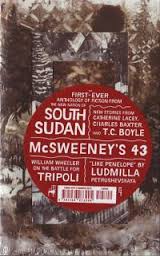
[READ: June 1, 2013] McSweeney’s #43

And with this issue I am almost all caught up with my McSweeney’s.  More impressively, I read this one only a few days after receiving it!

This issues comes with two small books.  And each book has a very cool fold-out/die cut cover (which is rather hard to close and which I was sure would get caught and therefore ripped on something but which hasn’t yet).  The first is a standard collection of letters and stories and the second is a collection of fiction from South Sudan.  Jointly they are a great collection of fiction and nonfiction, another solid effort from McSweeney’s.

Letters (more…)

Read Full Post »

mystrugglSOUNDTRACK: TRICKY-“Christiansands” (1996).

christiansandsThis book is set in Kristiansands, and so naturally this song was ringing through my head the whole while I was reading it.  I’ve known this song for ages, but had no idea that Chirstiansands was an actual place in Norway.

This song is dark and tense.  Over a slinky beat, a spare guitar riff introduces Tricky’s voice as he rasps (his voice is slightly modified to give him a weird echo).  And while he’s reciting his verses, the gorgeous voice of Martina Topley-Bird, repeats what he’s saying in a whispered voice until she sings out the chorus “I met a Christian in Christiansands.”

The verses repeat with Tricky emphasizing, “master your language and in the meantime I create my own.  It means we’ll manage.”

I honestly don’t know what the song is about, and it feels like it never properly ends–that riff, at once menacing and gripping never seems to conclude.  It’s a masterful track and hard to forget once you’ve heard it.

[READ: May 11, 2013] My Struggle Book One

I read an excerpt of Book Two from this series in Harper’s.  And despite the fact that nothing really happened in it, I was drawn in by the writing style.  This first novel is very similar in that not a lot happens but the voice is very captivating.  The translation is by Don Bartlett and it is fantastic–I can only assume the original Norwegian is just as compelling.  So, despite the fact that this autobiographical series contain six books (six!) and totals over 4,000 pages (how could this be if Book one is a mere 400?  Books 4-6 are over 1,000 pages each), I decided to give it a try.  (Incidentally, Book Two has just been translated into English this month).

This series has caused some controversy because it is given the same title as Hitler’s Mein Kampf (Min Kamp in Norwegian), and also because he says some pretty means stuff about people who are still alive (like his ex-wife).  Although there isn’t much of that in Book One.

death in the familyIndeed, Book One basically talks about two things–a New Year’s Eve party when Karl Ove was youngish and, as the bracketed title indicates, the death of his father.  (The title A Death in the Family is the same book as My Struggle Book One–from a different publisher.  It has a totally different cover but is the same translation.  I don’t quite get that).  But indeed, these two events take 430 pages to write about.

How is this possible?  Because Karl Ove writes about every single detail.  (I assume this why the books are considered novels, because there is no way he could remember so much detail about every event).  I’m going to quote a lengthy section from a New Yorker review (by James Wood) because he really captures the feeling of reading the book:

There is a flatness and a prolixity to the prose; the long sentences have about them an almost careless avant-gardism, with their conversational additions and splayed run-ons. The writer seems not to be selecting or shaping anything, or even pausing to draw breath….  There is something ceaselessly compelling about Knausgaard’s book: even when I was bored, I was interested. This striking readability has something to do with the unconventionality of “My Struggle.” It looks, at first sight, familiar enough: one of those highly personal modern or postmodern works, narrated by a writer, usually having the form if not the veracity of memoir and thus plotted somewhat accidentally, concerned with the writing of a book that turns out to be the text we are reading.  But there is also a simplicity, an openness, and an innocence in his relation to life, and thus in his relation to the reader. Where many contemporary writers would reflexively turn to irony, Knausgaard is intense and utterly honest, unafraid to voice universal anxieties, unafraid to appear naïve or awkward. Although his sentences are long and loose, they are not cutely or aimlessly digressive: truth is repeatedly being struck at, not chatted up.

That idea of being bored but interested is really right on–and it may sound like a bad thing, but it’s not.  You can read along thinking that there’s no way he is going to give so much unimportant detail.  But you get this description of drinking a cup of tea: (more…)

Read Full Post »

CV1_TNY_04_22_13Pearson.inddSOUNDTRACK: MIKAL CRONIN-MCII (2013).

mciiMikal Cronin has a very pleasant middle range voice—conventionally good.  Indeed, there’s nothing especially unique about this record.  But it is a great summer pop album.  Lots of great big choruses that are fun to sing along to.  And, Cronin is a talented multi-instumentalist.  I believe he plays everything on the record, although I’m not sure about that.

The album is 37 minutes.  The first song, “Weight” has a simple melody and is incredibly catchy. There’s a nice falsetto before the big loud guitar chorus kicks  in.  “Shout It Out” is another great pop song—big fuzzy guitars and a wonderfully catchy melody.   And I love how it gets mildly chaotic at the end.  “Am I Wrong” is a straightforward rocker, with more big crunchy guitars.  There’s a fun fiddly keyboard solo (with lots of flubs, which is kind of endearing).  This song (and several others) remind me of Sloan.

“See It My Way” has a shambolic feel to it, I can do without the oddball sax solo, but there’s something so oddball about it that I think it works in the end.  “Peace of Mind” has a nice harmony vocal on it that gives this simple song a fuller sound.    There’s an unexpected violin solo in here.  “Change” opens with a real grungy loud guitar which is quickly replaced by a  speedy drum over a simple, catchy verse.  And a speedy chorus.  There’s an interesting middle section with another violin solo (and some unusual squeaky violin noises as well).  “I’m Done Running From You” is a fun fast bit of pop with a rocking guitar solo.  And “Don’t Let Me Go” is a slow ballady type song (as much as one can be on a rocking record like this).  “Turn Away” brings the rock back, although “Piano Mantra” ends the disc with a solo piano intro.  But the song builds and builds into a rollicking violin-fueled conclusion.

I’d never heard of Mikal Cronin before, and when i first started listening to the disc I thought it was an okay pop punk album.  But the more I listened to it, the more I enjoyed it.  It’s still as simple pop punk album but it’s done so very well.  I’m going to have to check out his debut as well.

[READ: May 2, 2013] “Mexican Manifesto”

I love that stories from Roberto Bolaño keep popping up.  I realize that most of these have been published in Spanish somewhere, but it seems like even if we know that his next book is going to be all poetry (Unknown  University coming out in June), somehow there’s at least one short story in it (I assume it comes from here, where else would it have come from?).  So, since it seems like there’s a new Bolaño book out every six months, I assume that barrage will come to an end now.

Unknown University is, as far as I can tell, the last thing that will be translated by Bolaño.  Wikipedia suggests that there are four other titles that could be translated: A Lumpen Novella (which he completed but which has not been translated), Diorama, an unfinished novel, something being called Part 6 of 2666 (who knows what that means) and an early book that he cowrote Advice from a Morrison Disciple to a Joyce Fanatic which I would really like to read–the title is so intriguing–but who knows is it will ever find a translator.

But that’s got nothing to do with this short story.  This short story is about a couple who frequent steam baths. The narrator is the man, and the woman, Laura, I the more adventurous of the two.  She is the one who encourages them to go to the baths in the first place and, while he also thinks it is wonderful, it is she who wants them to explore as many different baths in the city as possible. (more…)

Read Full Post »

cousinkSOUNDTRACK: FOALS-“Inhaler” (2013).

foalsinhalerI really really liked Foals debut album.  It was weird and off-kilter and was one of my favorite albums of that year.  I had heard that their follow-up was very different, less weird, more conventional, and I have yet to hear it (narrow-minded, I know).  But then I heard that their new album was really great.  “Inhaler” was the first song I heard.

Man, do I love it. The song opens kind of funky with some noisy echoed guitars.  After a few verses the bridge comes in and the big excitement of the song comes when he gets to the chorus, “I can’t get enough SPACE!”  It’s not so much that he yells “space,” which he does, it’s more the way the whole song explodes with a new exciting riff and it just seems to get bigger and bigger. It blows me away every time.

After the first chorus we drop right back to that falsettoed slow verse delivery.  And the song slowly builds back up again.  The length of the bridge as you anticipate the big chorus is just excruciatingly wonderful.

[READ: April 5, 2013] Cousin K

I found this book when I was cataloging it at my job.  I don’t know what grabbed me about it (there’s nothing special about the cover).  I think it may have been the French Voices label in the corner (and its brevity).  I thought, hey why not read a contemporary French novella for something different.

Well, to my surprise, that is not what I got.  Indeed, nothing in this book is as it seems.

Yasminia Khadra is a pseudonym for Mohammed Moulesshoul.  He chose the name to avoid military censorship (that’s all the book says, I don’t really understand what that means).  Moulesshoul was born in the Algerian Sahara.  He is now retired from the military and is living in France.

But so, instead of this being a story from a French woman, the story is actually from a Male Algerian.  Which doesn’t really matter in the long run, but I assumed that the narrator was a girl (based on the “author = narrator” theory that is an easy shortcut in fiction.  This was really only confusing because the narrator is unnamed for quite a while in the book.

But what a book.  In just 80 some pages, Khadra turns in a  fascinating psychological picture of neglect and psychological abuse.  But it is such an elliptical book that there are almost as many questions as there are answers.  It is this elliptical style which provides some of the confusion, but a lot of the interesting structure of the story. (more…)

Read Full Post »

HarpersaprilSOUNDTRACK: THE AFGHAN WHIGS-“I’m Her Slave” (Live at the Bowery Ballroom 2012).

whigs

 I really liked some of The Afghan Whigs’s songs back in the 90s.  There was other stuff I didn’t love by them–when they were on, they were amazing.  Of course, I feel like the Whigs were pretty much all the work of Greg Dulli–charismatic frontman with the intriguing voice.

When they disbanded or broke up or whatever, I didn’t mind so much.  But they have reunited recently and my friend Joe posted this video from last year’s tour.  I don’t really know this song that well (although I do have the Congregation album i was more of a Gentlemen fan), but it sounds great.  And apparently this is one of the songs they were trotting out (they played it on Fallon, but the video has been taken down).

Dulli’s voice still has that wonderful quality and the band sounds tight and loud here.  Seems like a good reunion.

[READ: March 19, 2013] “Limhansfältet”

This excerpt comes from Knausgaard’s (also spelled Knausgård’s) second volume of his six-volume autobiographical novel (wow!).  I have no idea who the guy is or why we’d want to read it.  Evidently Knausgård is quite famous in his native Norway.  Don Bartlett translated this from the Norwegian.

So this excerpt shows a very short time in the writer’s life (knowing it’ autobiographical makes it different somehow).  The writer is married, a father of four three (although evidently now, he is divorced and his first wife is mad to her portrayal in the books).  The first few paragraphs just kind of talk about what’s going on around him (but it is more compelling than that sounds somehow).  I liked the scene where he is sitting so still in the garden that a hedgehog crept past him (but then I like hedgehogs).  But the crux of the action occurs at Limhansfältet, a grassy area outside of town where men gather every Sunday to play football.  They have gathered since the 60s and the men range from 18 to 80.

On this one occasion his family came with him. They watched for a bit but then wandered off.  And they missed him get injured.  Injured so badly that he had to go to the hospital. (more…)

Read Full Post »

mister orangeSOUNDTRACK: MUSE-The 2nd Law (2012).

2ndlawMuse are over the top.  No question about it.  And that’s why I like them so much.

So when the new album opens with crunchy guitars that give way to keyboards that sounds not unlike a Bond movie, it’s not really surprising.  The first verse is fairly mellow, building until Matt Bellamy hits some crazy high notes and the heavy bass guitar kicks in.  But unlike some previous albums, this one is not all heavy heavy guitar rock.  There’s some electronic elements as well.  Especially on the single “Madness” (which was debated about on the alt rock station I listen to, wondering if it was too dance-oriented).  The song uses a dub format for repeating the Muhmuhmuhmuhmuh madness, but the verses are so catchy it’s hard to resist.  It also has a major Queen feel (a common complaint about them, although it’s not like Queen are still making music).  For Muse, this song is kind of understated until the big verse at the end when Bellamy can really soar.  “Panic Station  has a big thumping bass and drum along with some screams that sound out of an 80s metal band but there are horns that give it a dancey feel–always a contradictory outfit, Muse.

“Prelude” sounds indeed like a prelude to what proves to be “Survival” it is big and anthemic (as Muse tends to be).  It is uplifting and, as one may recall, it was the official song of the 2012 London Olympic Games (which is fitting it’s all about winning).

“Follow Me” slows things down a bit in the beginning, but it of course comes back with lots of bombast (this is Muse after all) but there’s also elements of electronica (is that  dubstep sound?) and backing vocals that remind me a lot of U2.  “Animals” has a kind of slinky bass line that wends its way through the song’s guitar solos.  By the end of the song it has grown much heavier with shouting crowds and a furious double bass drums.

“Explorers” is a ballad that grows and retracts.  “Big Freeze” has another big chorus. It’s followed by “Save Me,” a gentle ballad with harmonies.  Then “Liquid Freeze” picks up the pace a bit.  This is all leading to “The 2nd Law: Unsustainable” which is my favorite weirdo song in ages.  It is so crazy over the top and audacious that I love it.  It opens with crazy strings and a fast talking jittery computer voice.  And when she reaches the word “unsustainable,” the song goes absolutely bonkers, with crazy sound effects–I would assume most people hate this track, but I think it is very cool.  The final track “The 2nd Law: Isolated System” is a kind of denouement for the whole album–a piano ballad of 5 minutes that has a bit of a dance feel to it.

I can’t get over how much I enjoy this record.  It’s definitely not as heavy as past muse records, but it has some great experimentation and Bellamy absolutely knows a great melody.

[READ: March 8, 2013] Mister Orange

I was walking past the New shelves in the library and this book caught my eye (who says placement isn’t important?).  Something about the title and the cover design was really appealing.  I looked at the blurb–it’s about an American kid during WWII.  I wasn’t really sure I wanted to read that, but then there was a line about an artist and comic books.  I immediately thought about The Adventures of Kavalier and Clay which is also about comics in the 1940s (although this book is NOTHING like that one at all), and I decided to grab it.  Besides it was only 150 pages.

Well, I never would have guessed that the book is a historical fiction novel about Piet Mondrian, one of my favorite artists of all time.

So the story is about a boy, Linus, and his family living in New York City in 1943.  His oldest brother, Albie has volunteered for the war.  His mother is disappointed in him as she believes that all war is wrong and that nothing good every comes from war.  She is so disappointed, in fact, that she does not hang the blue star that all families with soldiers are given to hang in their windows.  Linus wonders if she is not proud of her son for fighting for what he believes in, but his mother says “Flags are for celebrating, and there is nothing to celebrate about war.”  She doesn’t even let him go to the parade for the departing soldiers.

When Albie leaves, the rest of the family is stuck waiting for word from him.  But life goes on at home and with Albie gone, that means that everyone moves up in responsibility (and shoes get handed down).  Simon (now the oldest at home and a sullen teenager) takes on Albie’s work at the newspaper, Linus picks up Simon’s grocery delivery route (their family owns a grocer’s shop) as well as Simon’s shoes, which are way too big, and Max takes over looking after the youngest children: Sis and Willy.  For the most part we follow Linus as he learns the new route and learns a bit more about the city. (more…)

Read Full Post »

seamSOUNDTRACKELFIN SADDLE-Devastates [CST087] (2012).

elfinElfin Saddle continues their streak of oddly juxtaposed music that works very well.   The band specializes in a kind of Middle Eastern folk music (there’s a lot of Jewish-style singing), but with Emi Honda singing Japanese-style vocals it really alters the overall sound.  They also use a lot of raw sounding “instruments” many of which are found or quite simply, junk.  Check out the instrumentation list: Jordan McKenzie: voice, guitar, half-accordion, drums, varied percussion, membrane pipes, organs, piano, pvc processing, tapes, phonographs, speakers, etc.  Emi Honda: voice, ukulele, drums, half-accordion, musical saw, extra percussion.  It’s that extra percussion and etc. that you hear a lot, rattling around in the background of these songs.

They play complex rhythms (with lots of low end drumming) underneath ethereal noises (music boxes and the like).  And all the while, Honda and McKenzie trade off their unusual vocals.  It’s mesmerizing.  When the band really starts rocking, like in “The Changing Wind” you hear how well it all works together, and how well the two play off each other.  The slower pieces, like “Boats” are very cinematic, probably because everything sounds so real–you can see the items that are making these odd sounds.

The music is definitely not pop, but with just a listen or two, you can really appreciate what they’re doing.  If you like your folk a little noisy or your rock a little experimental, this is a great record to check out.

[READ: January 13, 2013] The Seamstress and the Wind

Things that I have said about every book of Aira’s that I have read: they are all short, he writes a lot of books (according to Wikipedia he has written at least 45 books since this one came out about twenty years ago), and they are all nonlinear.

And so it is with this 130 page book.

As the book opens, a young boy named César Aira is playing with his friend in the back of their neighbor Chiquito’s truck.  They are playing a game of ghosts when suddenly, César finds himself walking in a trance back to his house.  Turns out his friend Omar couldn’t find him for hours (and when César snaps out of it, indeed hours have passed).  And yet, despite this story, it turns out that really Omar is missing (what? who knows?).  Omar is the son of the local seamstress, Delia Siffoni.  She is sewing a wedding dress for the art teacher, Silvia, who is (scandalously) pregnant.  When she hears that her son is missing, she freaks out and calls out a search party.

She concludes that Omar was hiding in Chiquito’s truck when he left for Patagonia.  So she takes a taxi to chase after Chiquito.  Since the dress is due to be finished right away, she takes it and her supplies with her in hopes of finishing it on the road.  When Ramón, Delia’s husband realizes what she has done, he chases after her.  And when Silvia realizes that her dress is driving away in a taxi she follows Ramón.  And so it becomes a road novel in which none of the characters are together.

By the end of the story there has been a terrible accident with a taxi crashing into a truck.  There has been a poker game where one of the two women has been lost in a bet (unbeknownst to her) and we have met The Wind (Sir Ventarrón) who helps the seamstress with her problems.  Indeed, Sir Ventarrón becomes an integral part of the story, including a flashback when Sir Ventarrón assisted a snowman in his quest for eternal life (yes). (more…)

Read Full Post »

« Newer Posts - Older Posts »