Feeds:
Posts
Comments

Archive for the ‘Film & TV’ Category

SOUNDTRACK: DAVE BIDINI-“The List” (2007).

This song appears as a bonus track on the Bidiniband album.  But I’ve been aware of it since 2007 when he played it on his solo tours.  It is essentially a list of 4 Canadians who are “killing us, killing us now.”  The list includes Tim Horton’s (purveyor of delicious donuts), Chad Krueger (from Nickelback), Zack Werner (a judge on Canadian Idol), and Stephen Harper (I shouldn’t have to tell you).

But the key to the song is the chorus: “where are the angry young ones….”  This song should become the unofficial song from Occupy Wall Street.  It would be very easy to modify.  Hey Dave, if you’re free you should head on down and serenade these angry young ones.

Here’s a great live version done in a record store in which he is close enough to have a casual chat about the very song he is singing in the middle of the song.

He also ends it a little differently than the original.  It’s catchy and easily adaptable.  Good on ya, Dave.

[READ: November 19, 2011] “Who Wrote Shakespeare?”

No one has traded off of his Monty Python fame as much as Eric Idle.  All of the other Pythons have moved on in one direction or another, but Eric keeps the torch alive (see Eric Idle Sings Monty Python and Spamalot).  He even has a little nod to MP in this essay with the asterisk next to his name which leads to (*Most likely Michael Palin, really).  This refusal to let go of Python has at least kept his wit sharp, as we see in this Shouts & Murmurs.

My main problem (as I’ve said before) with the Shouts & Murmurs is that they are usually too long.  But, as Python knew, keep it short and funny and you’ll succeed.  So this two-column piece never really flags in its simple premise.

Which is that everyone knows that Ben Jonson really wrote all of Shakespeare.  Idle presents a list of all of the famous books that were really written by someone else.  For example, “Simone de Beauvoir wrote all of Balzac and a good deal of ‘Les Misérables,’ despite the fact that she was not born yet when she did so.”   And my favorite: “‘Moby Dick’ was written not by Herman Melville but by Hermann Melbrooks, who wrote most of it in Yiddish on the boat from Coney island.”  The joke about Henry James is very funny and too good to spoil. (more…)

Read Full Post »

I was planning to write this post early in the TV Season.  I found out that the TiVo website rather helpfully includes a page of all the premiere dates of shows, which in addition to telling us when shows started, has also turned out to be a good way to keep track of the shows that were cancelled already.  Our goal is basically to get every good show cancelled so that we can watch our poor Netflix DVDs (which now that we had to change our policy we have mercifully fewer discs that we are not watching).  Um, thanks for the hike Netflix?

Anyhow, it’s now  about seven weeks into the season and we’ve already lost a number of shows–some as quickly as two weeks in…which, really?  I mean why bother.  Surprisingly, none of the FOX shows were cancelled yet.  That’s probably because FOX didn’t pick anything cool or interesting enough for me to want to watch–that’s actually not true, they have some good new shows this season, but nothing like Arrested Development.

So, this time I’m breaking it down by day of the week (which is silly since we TiVo everything and watch it whenever).  And this time red shows are shows we have given up on and Green ones are ones that we’re still enjoying. (more…)

Read Full Post »

SOUNDTRACK: ARCADE FIRE-“We Used to Wait” (Saturday Night Live, November 13, 2010) (2010).

I know they played two songs that night but I just watched the rerun and they only showed one song.

I’ve always thought that Arcade Fire were pretty cool live.  And this set from SNL proves me right.  “We Used to Wait” comes from The Suburbs and it’s a pretty mild song on the record.  But live, the band plays with really weird sounds and explores different types of cacophony.

This is especially true from guitarist Richard Reed Perry (who plays all kinds of other instruments too).   He plays some of the more riff-based notes in the song, but he also plays some really loud, unusual chords as well.  Some of them are quite dissonant and they really bring a dramatic noise to the song.

The string section (three violins on this show) in addition to playing the strings also added some really cool dissonance.  In fact, the first time the strings came in, the sound was quite surprising.

I also love the percussive nature of the band.  By the end of the song it seems like half the band are banging on drums (while playing other things as well, no doubt). 

Win Butler is an intimidating frontman–I find his face to be open, almost blank.  He’s kind of hard to read.  He’s also very tall.  When he walks out into the audience in the middle of the song, it’s a little unnerving. 

One thing that I have liked about Arcade Fire from the beginning was their intensity, and this song certainly displays it.

[READ: November 7, 2011] “The Stain”

This is another Tessa Hadley story about a woman who cleans up.  It’s nothing at all like “Friendly Fire,” but I still think it’s interesting that she has another character who opts to do cleaning work.

In this one, Marina is a mother of a young boy, Liam.  To makes extra money she takes on a job as a house cleaner and “companion” to an elderly man.  He’s 89 and from South Africa.  He has recently come to Britain after his daughter (who has lived here for a long time) moved him here.  And the house where he lives is a house not far from where Marina lives.  Indeed, it’s one that she grew up looking at and wondering what it looked like inside (it’s a very big house).

The old man is notorious for making cleaning women go away–he is cantankerous and crotchety.  But Marina soothes him right away and they form a kind of bond.  Marina even brings Liam over a few times and he gets along quite well with the old man. (more…)

Read Full Post »

SOUNDTRACK: OKX: A Tribute to Ok Computer (2010).

OK Computer is one of the best records of the 90s.  Every time I listen to it I hear something new and interesting.  So, why on earth would anyone want to cover the whole thing?  And how could you possibly do justice to this multi-layered masterpiece?

I can’t answer the first question, but the second question is more or less answered by this tribute which was orchestrated by Stereogum.

The answer is by stripping down the music to its bare essentials.  When I first listened to the songs I was really puzzled by how you could take a such a complex album and make Doveman’s version of “Airbag,” which is sort of drums and pianos.  Or gosh, where would you even begin to tackle “Paranoid Android?”  Well Slaraffenland create a bizarre symphonic version that excises many things–in fact half of the lyrics are missing–and yet keeps elements that touch on the original.  But it’s an interesting version of the song and shows  a bizarre sense of creativity.  And that is more or less what this tribute does–it makes new versions of these songs.

Mobius Band make a kind of Police-sounding version of “Subterranean Homesick Alien.”  Again, it radically changes the song, making it a fast and driving song (although I don’t care for the repeated “Uptights” and “Outsides” during the verses).

Vampire Weekend, one of the few bands that I actually knew in this collection (and whom I really like) do a very interesting, stripped down version of “Exit Music, for a Film.  The “film” they make is a haunted one, with eerie keyboards.  Again, it is clearly that song, but it sounds very different (and quite different from what Vampire Weekend usually sound like).

“Let Down” (by David Bazan’s Black Cloud) and “Karma Police” (by John Vanderslice) work on a similar principle: more vocals and less music.  The music is very stripped down, but the vocals harmonize interestingly.  Perhaps the only track that is more interesting than the original is “Fitter Happier” by Samson Delonga.  The original is a processed computer voice, but this version is a real person, intoning the directives in a fun, impassioned way.  There’s also good sound effects.

Cold War Kids take the riotous “Electioneering” and simplify it, with drums and vocals only to start.  It’s hard to listen to this song without the utter noise of the original.  “Climbing Up the Walls” is one of the more manic songs on this collection, with some interesting vocals from The Twilight Sad.

There are two versions of “No Surprises” in this collection.  Interestingly, they are both by women-fronted bands, and both treat the song as a very delicate ballad.  Both versions are rather successful.  Marissa Nadler’s version (the one included in sequence) is a little slower and more yearning, while Northern State’s version (which is listed as a B-Side) is a little fuller and I think better for it.  My Brightest Diamond cover “Lucky.”  They do an interesting orchestral version–very spooky.

Flash Hawk Parlor Ensemble (a side project of Chris Funk from The Decemberists) do a very weird electronic version of the song (with almost no lyrics).  It’s very processed and rather creepy (and the accompanying notes make it even more intriguing when you know what’s he doing).

The final B-side is “Polyethylene (Part 1 & 2),”  It’s a track from the Airbag single and it’s done by Chris Walla.  I don’t know this song very well (since it’s not on OK Computer), but it’s a weird one, that’s for sure.  This version is probably the most traditional sounding song of this collection: full guitars, normal sounding drums and only a slightly clipped singing voice (I don’t know what Walla normally sounds like).

So, In many ways this is a successful tribute album.  Nobody tries to duplicate the original and really no one tries to out-do it either.  These are all new versions taking aspects of the songs and running with them.  Obviously, I like the original better, but these are interesting covers.

[READ: November 5, 2011]  McSweeney’s #8

I had been reading all of the McSweeney’s issue starting from the beginning, but I had to take a breather.  I just resumed (and I have about ten left to go before I’ve read all of them).  This issue feels, retroactively like the final issue before McSweeney’s changed–one is tempted to say it has something to do with September 11th, but again, this is all retroactive speculation.  Of course, the introduction states that most of the work on this Issue was done between April and June of 2001, so  even though the publication date is 2002, it does stand as a pre 9/11 document.

But this issue is a wild creation–full of hoaxes and fakery and discussions of hoaxes and fakery but also with some seriousness thrown in–which makes for a fairly confusing issue and one that is rife with a kind of insider humor.

But there’s also a lot of non-fiction and interviews.  (The Believer’s first issue came out in March 2003, so it seems like maybe this was the last time they wanted to really inundate their books with anything other than fiction (Issue #9 has some non-fiction, but it’s by fiction writers).

This issue was also guest edited by Paul Maliszewski.  He offers a brief(ish) note to open the book, talking about his editing process and selection and about his black polydactyl cat.  Then he mentions finding a coupon in the phonebook for a painting class  which advertised “Learn to Paint Like the Old Masters” and he wonders which Old Masters people ask to be able to paint like–and there’s a fun little internal monologue about that.

The introduction then goes on to list the 100 stores that are the best places to find McSweeney’s.  There are many stores that I have heard of (I wonder what percentage still exist).  Sadly none were in New Jersey.

This issue also features lots of little cartoons from Marcel Dzama, of Canada. (more…)

Read Full Post »

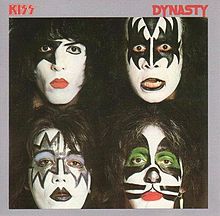
SOUNDTRACK: KISS-Dynasty (1979).

I was pretty excited to buy this album when it came out–a new Kiss album that wasn’t solo albums!  Woo hoo!  And the fact that it was disco?  Well, even though I said I “hated disco,” I didn’t really know what disco sounded like then (and really, aside from the middle “I Was Made for Lovin’ You” it’s not really a disco record) and plus my other favorite band was the Village People (and really, that makes a lot of sense–tw0 bands in over-the-top costumes talking about sexuality that I totally didn’t understand).

So, this album is hard for me to be critical about because it was such an essential part of my childhood, especially “I Was Made for Lovin’ You.”  I love it, and yet I can listen critically and appreciate that it’s really not that good.

But I’ll move on to the other songs.  “Sure Know Something” and “Magic Touch” really don’t seem that out of place chronologically with, say, the Kiss solo albums–they sound an awful lot like something off of Paul’s album.  So, despite the sort of slinky 70’s bass on “Sure Know Something”, they can’t have been that much of a surprise.  The guitar solos are short but have some interesting Ace sounds (I like the harmonics on “Magic Touch”).  It seems that while the other guys were embracing disco, Paul was keeping the Kiss sound alive.

Then there’s the Ace songs.  “2,000 Man” made total sense as an Ace song. I had no idea it was a Rolling Stones cover until fairly recently (and I like Ace’s version much better).  “Hard Times” feels like the sequel to “New York Groove.”  Not the music so much although maybe a little, but the lyrics–now that he’s in the city here’s what happened–the gritty reality. It’s one of Ace’s great, lost songs.  And check it out, Ace sings on three songs here!  (Guess having a #1 hit wasn’t lost on the Kiss powers).  “Save Your Love” has a cool descending chorus and a nice bass feel to it.  Ace certainly wins on this record.

Peter got only one song, “Dirty Livin'”.  In fact, this is the only song that Peter had anything to do with (his drums were re-recorded by Anton Fig).  It reminds me (in retrospect) of the Rolling Stones disco era even more than “2,000 Man,” the backing vocals remind me of something like “Shattered.”  I always liked this guitar solos on this (cool feedback).  Although I liked the song (along with the rest of the album), I don’t think it holds up very well.

Gene only gets two songs.  It amuses me how little he has to do with these late 70s albums even though he is always the leader of the band.  I always liked “Charisma” (I had to look the word up back then) even though it is, admittedly, rather discoey and really not very good.  It is fun to ask “What is my…charisma?”  But “X-Ray Eyes is the better Gene song on this record.  It harkens back to earlier Kiss songs and even has a bit of menace in it.

So, Dynasty was a huge hit for the band.  And they even got to mock it in Detroit Rock City the movie.  Cynical marketing ploy or genuine fondness for disco?  Who would ever know.

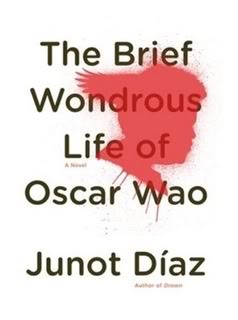
[READ: November 1, 2011] “The Brief Wondrous Life of Oscar Wao”

Readers of this blog know that after finding an author I like, I will try to read everything that he or she has written.  Close readers will know that if a writer is reasonably young and reasonably unpublished, I will try to read his or her uncollected work as well.  Well, I really enjoyed Oscar Wao the novel, so I decided to see what else Díaz had written. There’s really not a lot, to be perfectly frank.  There’s his short story collection Drown and a few fiction pieces published here and there (mostly in the New Yorker) and a few non-fiction pieces as well.

So this “short story” from the New Yorker (with the same title as the novel) is in fact an early, mostly the same, version of the Oscar story in the novel.  The thing here is to note the date: 2000(!).  The novel came out in 2007.  So, Junot had been working with this character for easily five years (giving time for the publishing industry to get a book out and all). The remarkable thing the is just how accomplished and polished this piece is and how much of it was used in the novel.

I’m curious to know whether this was written as a short story (it’s quite a long short story) or if it was always intended as a part of a novel.  Interestingly, when you read this story by itself and you realize that it is pretty much all of Oscar’s story in the novel, you realize just how little of Oscar is actually in the novel.  The novel is about Oscar, obviously, but it is really about his family and the fukú that was placed on them by the Trujillo clan.  Oscar is sort of the touchstone for the fukú, and the person whom the narrator knows most intimately but his story is also brief. (more…)

Read Full Post »

SOUNDTRACK: COLIN STETSON-Live at All Tomorrow’s Parties, October 4, 2011 (2011).

In addition to playing SXSW, Colin Stetson also played All Tomorrow’s Parties, and NPR was there.  Unlike with SXSW, this set appears to be full length (about 50 minutes–which is a pretty amazing amount of time for him to blow that horn).  Like SXSW (and the album) Stetston starts with “Awake on Foreign Shores” and “Judges.”  What I love about this recording is that after Stetson finishes “Judges” a guy in the audience shouts (in a voice of total amazement) “That shit was off the hook!”  And he is right.  It’s not even worth me going into how amazing Steston is once again (check previous posts for  that), but man, just look at the size of that horn he’s playing (seriously, click on the link to see it bigger).

Stetson plays a few more songs from New History Warfare, Vol. 2: Judges like “The Righteous Wrath of an Honorable Man” (which is outstanding) and “A Dream of Water” (which works without Laurie Anderson, although he does say he’s sorry she’s not there).  He also introduces two news songs “Hunted 1” and “Hunted 2” which show new levels and new styles that Stetson employs.

This is a remarkable set, and Steston is clearly in his element (and the crowd is rapt).  The only problem I have is the recording level.  It must be very difficult to maintain recording levels for Stetson’s brand of noise–his louds are really loud–but you can’t hear him talk at all.  And most of the time, the introductions to his songs are worth hearing.  I’m sure if they tried to get the speaking level a little louder the music would have sacrificed though, so I think they made the right choice–I only wish there was a transcript available.

[READ: October 31, 2011] The Brief Wondrous Life of Oscar Wao

Apparently it’s pronounced, “Wow”, by the way.

Because of my new job, I don’t have a  full hour of lunch-time reading like I used to.  And so this book took considerably longer than I intended.  However, once I set aside some time to read it, I flew through the book.

I’m going to get this part out of the way because I was thinking about it throughout the book and I want to mention it without having it bog down the post.  This story reminded me a lot of Roberto Bolaño.  On the surface, sure this is because they are both writers from “Central America” (Diaz is originally from the Dominican Republic but moved to the US, while Bolaño is originally from Chile but moved to Mexico and then Spain).   But I’m not really talking about their origins so much as the style of storytelling.

Without going into a lot of Bolaño here, I’ll just say that Bolaño tends to write very detailed character studies–stories that follow one person throughout his whole life on something of a fruitless quest.  And the details of that person’s life include information about family members and distant relatives.  Further, Bolaño has written about the brutalities of both Chile and Mexico and how a person can survive in such a place.  Similarly, Díaz follows the life of Oscar and his extended family and he talks about the brutalities of the Dominican Republic.

This is in no way to suggest that there is any connection between the two writers. I mean, The Savage Detectives came out in the States in 2007 (same years as Oscar Wao) and while he certainly could have read it in Spanish, I have no evidence that he did (and as I recently found out, the first draft of the Oscar story was written in 2000).  Again, the parallels are only from my reading and have nothing to do with Díaz himself.

Okay, now that that’s out of my system…

This is the story of Oscar de Leon.  But more than that, this is the story of a fukú–a curse that befalls the de Leon family and follows them through several generations.  Oscar is the youngest member of the family and the person whom the narrator knows best.  So we see this fukú as it impacts Oscar.  And although the book is ostensibly about Oscar, it is about much more.

Oscar was born in Paterson, NJ (the town next to where I grew up!) and went to Don Bosco Tech High School (where many of my friends went).  Oscar is Dominican (his mother is from the DR, but he and his sister were born in NJ), but unlike every other Dominican male, Oscar is totally uncool, into geeky sci-fi and D&D and is clearly destined to be a virgin because he is fat with terrible hair and no social skills.

And, (no spoiler), as the title states, his life will be short. (more…)

Read Full Post »

SOUNDTRACK: LONELY ISLAND-Incredibad (2008).

Since I enjoyed the second Lonely Island album, I figured I’d check out the first one as well.  I mean it had “Lazy Sunday” on it after all.  But in this case my initial instincts we pretty correct. There are a  few songs on here that are funny and worth the time–and you’ve heard them all already.  The rest are filler–mildly funny songs that are too long by half (even when they are under two minutes).

The opening song, “Who Said We’re Wack” is only a minute and change and it overstays its welcome after about fifteen seconds.  Although, as I’m finding with a lot of the tracks, there are little bits that are funny, like the “raise your hands in the air” bit of this song.  “Santana DVX” is an amusing little skit about Carlos Santana making his own champagne.  Again, kind of funny, but not that funny.  And worse yet is that they keep reusing the joke throughout the disc.  “I’m on a Boat” is like the demo version of “I Just had Sex.”  It’s the same premise, with the same repeated joke, but you can get a lot more mileage out of having sex than about riding a boat.  At this point I have to wonder how many of these songs were skits (I don’t watch SNL as a rule) and I wonder if they are funnier with visuals added.

“Jizz in My Pants” is the first really funny thing on the disc.  The best part is that it starts out so seriously and then the absurdity gets faster and faster.  It’s very clever.  Although musically it sounds like The Flight of the Conchords might do it better.  “Sax Man” features the mighty Jack Black, and it’s funny, but I have to say that having the sax man play more bad notes (and not synthesized ones) as opposed to all that silence, and maybe having Black get even angrier would have been much funnier.

“Lazy Sunday” is still a highlight, a funny track with, and I think this is the key, new lyrics in every verse, not simple repetitiveness as humor (the old SNL standby).  And of course, “Dick in a Box” is still hilarious (oh, Timberlake, I can’t hate you).

However, that repetitiveness is a problem on “Like a Boss” (although parts of it are very funny) or “Boombox” (is boiled goose supposed to be funny?) although at least the chorus is catchy.  “We Like Sportz” is amusing but I feel like they aren’t dorky enough.  

Then, why does “Dreamgirl” turn into an ad for Chex Mix?   I know it is “sponsored by Chex Mix” but why?  It seems lazy.   And I simply don’t understand “Punch You in the Jeans” or “The Old Saloon” they just seem like stupid filler or in the case of “Jeans,” an attempt at at catchphrase generator or something.   

As on their follow-up, the skits are lame: “Normal Guy” is awful and “Shrooms” is boring.  But at least there’s only two skits.

Finally “Space Olympics” seems like a funny concept but what happens to the song?  It has potential to be a really amusing concept about actual space olympics, but it drifts off into a completely different direction.  Where’d the focus go? 

“Natalie’s Rap” on the other hand is focused, brutal and unexpected.  It is really, really funny.

All in all, this is an excellent place to hear a few good tracks and a whole lot of filler. I’m really happy that the sequel was so much better as it speaks to the possibility of even better stuff in the future.

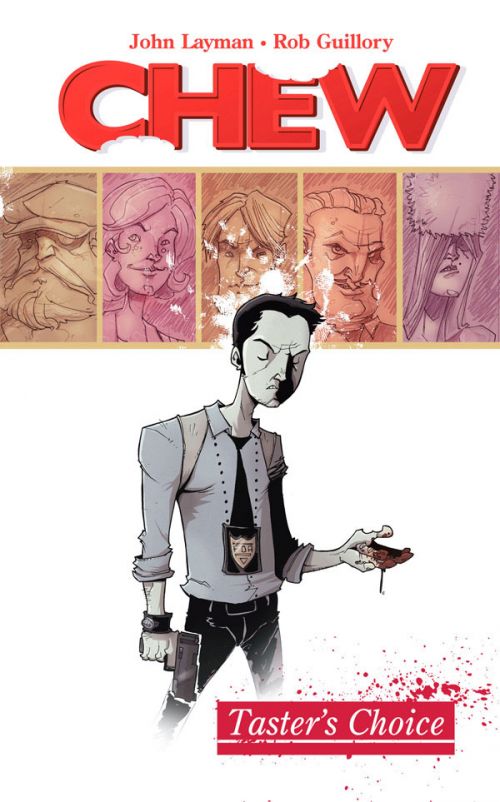
[READ: October 30, 2011] Chew: Volume Two

As Sarah wrote in her post, I was pretty happy to have Volume Two of Chew in the house after finishing up Volume One (I’m only bummed that I don’t have Volume Three!!).

Volume Two continues the adventures of our favorite cibopath (see the previous entry for the explanations of all of these awesome ideas).  As the book opens we see that Tony Chu’s former partner, John Colby is back.  We knew he was still alive, but we didn’t know how alive he might be–after all, he had a cleaver in his face last time we saw him.  But he has been repaired, with the latest in technology, by the FDA.  And now Chu and Colby are back together, bickering as ever with new superpowers (the scene where Colby shows off what he can do is awesome). 

Chapter Two (Issue Seven if you’re keeping track), introduces Lin Sae Woo.  When I mentioned last time that Guillory draws grotesque characters, I had her in mind.  Lin Sae Woo is an aggressive, angry woman and she is drawn to reflect that. But she also has an absurd body shape.  Her breasts are preposterous–not even superhero large, stupidly large and the rest of her can barely keep up.  I can’t even decide if she’s supposed to be sexy, she is so ridiculous.  But she makes a formidable foe (even if she’s on the same side as Chu). (more…)

Read Full Post »

SOUNDTRACK: LONELY ISLAND-Turtleneck & Chain (2011).

I liked “Lazy Sunday” quite a lot, but I didn’t feel compelled to get the album.  Then, when I heard Samberg on NPR, it made quite a compelling case for this second album.  So I decided to check it out.

Most comedy albums are juvenile, so let’s get that out of the way.  This is juvenile.  And, as with most SNL-derived humor, it’s a one note joke that gets stretched out.  The good news is that very few of the songs stretch too long (only one is more than three minutes) and the music itself is quite good–which allows for repeatedly listens.

The opening, “We’re Back!” is really quite funny.  It’s all about how the three guys have really tiny penises.  Ha ha, but it’s delivered with such great gangsta rap style that it is very, very funny.  “Mama” is a wonderful tribute to the singers’ Moms.  The song is interrupted by said mother over and over.  On this one, the joke might go on too much, but overall, it’s very funny.

The longest song is “Jack Sparrow” and it is one of the best ones on the disc.  It features Michael Bolton (!) singing his heart out about his love for the Pirates of the Caribbean movies–which is funny enough, but the guys are rapping behind him about something else entirely.  They keep trying to stop Bolton from hijacking the song.  It’s very well done (and man, say what you will, Bolton can belt out a song).

“Attracted to Us” goes on a bit too long (and at less than 2 minutes that’s a bad sign) and “Rocky” in which one of the dorky guys talks about fighting Rocky (ala The Fresh Prince) is a super long SNL skit (which is not a compliment).

“Turtleneck & Chain” features Snoop Dog and is just fantastic–I love hearing Snoop Dog rap this geek shit.  “Shy Ronnie 2: Ronnie & Clyde” also works very well with Rihanna on vocals.  The song itself is catchy and the joke, when it finally comes, is really good.

“Motherlover” is a sequel to “Dick in a Box” (“this is the second best idea we ever had”) and Justin Timberlake continues to impress me in his new role as a funny guy.  This is a gross song but it’s really crazy catchy (Timberlake must have written the chorus).

One of my favorite songs on the disc is “Threw It on the Ground.”  Musically, I think it’s fantastic and lyrically it is pretty funny.  I wish that they had had some better examples of things to throw on the ground (the cell phone joke is lame and they get kind of lazy by the end), but I get this song stuck in my head a lot.  Another song guaranteed to stay in your head forever is “I Just Had Sex,” a childish and silly song that is outrageously catchy.  And if it’s in your head it won’t leave.  (And yes it’s funny).

“Japan” is a crazy and funny look at Japanese culture while “After Party” is a bit one note.  “No Homo” on the other hand brings in a full circle hardcore joke that is at once offensive and hilarious. 

“The Creep” is pretty unsuccessful even with the help of Nicki Minaj–the video helps a little, but not enough.  As with most rap albums, the skits are the weakest link.  Without a song behind them the skits are good for one or two listens and some not even that (“Falcor vs Atreyu”?  “My Mic”? these wouldn’t even be funny if they were improvised, and yet they seem very deliberately planned–boy I hope there wasn’t more than one take).

Overall, this is a funny rap parody/tribute album.  It’s obvious that the guys love rap and they are quite successful in their stylings.  None of it works as well as “Weird Al”‘s “White and Nerdy” but honestly whatever could?  But “Weird Al” is PG, and Lonely Island fills in as the adult pranksters.

[READ: October 28, 2011] Chew: Volume One

Sarah gave me this book after reading the recommendation on The Hub.  She said it was really good but it was really gross.  And that’s quite an accurate assessment.

One thing that I liked about this book was that it had not one but two really cool ideas that run through the series.  Either one would be a compelling-enough premise, but putting them together makes for an excellent story with lots of possibilities.

The story is about Tony Chu, who is a policeman.  He is also cibopathic, which means that when he eats anything (except beets for some reason), he instantly knows the history of that food: eating fruits and vegetables shows him the tree it grew on and how it was harvested;  eating meat, well, just let your imagination go on that one.  That’s a pretty great premise.  But when he gets a murderer’s blood on his lips and he instantly knows the names and locations of all of his victims, well, that ups the intensity (and the grossness).

The second great premise is that the government has outlawed chicken because of the avian flu.  Millions of people died from the flu and now only chicken-substitutes are used.  There is now a black market for real chicken, including speakeasys, and the FDA is hot on the heels of all traffickers.  And yet, there is a small group of rebels who believe that the whole avian flu thing is a sham (including Tony’s brother Chow).  They don’t postulate why the sham was created, but they are out to set the record straight. 

Put these two ideas together and you get a hell of a story. (more…)

Read Full Post »

SOUNDTRACK: QUEENSRŸCHE-The Warning (1984).

Queensrÿche fulfilled the promise of their debut EP with this album.  It takes the blueprint of the EP and expands it wonderfully.  They introduce some cool low vocal chants to compliment Tate’s soaring alto (like on “En Force”), they also introduce some wonderful effects and riffs and scales (also on “En Force”).

There’s also some really great, odd “keyboard” bits thrown in as kind of sound effects or jarring moments (“Deliverance”).  “Deliverance” also has great backing vocals, and I love the way the “Deliver Us” part of the song is quite different from the soaring of the rest of the vocals.  The back and forth of “No Sanctuary” also showcases the bands skills very well.

The band even shows signs that they’re not sticking to standard heavy metal.  On “N.M. 156” there’s some sci-fi chanting and the really cool section of the song in which Tate sings “Forgotten…Lost…Memories” and the “Lost” part is a completely unexpected note.   They were taking chances from the beginning.

“The Lady Wore Black” is updated with the stunning “Take Hold of the Flame,” a slightly more progressive version of that first song.  “Before the Storm” was the first song I heard from this album and it has always been my favorite on the record (this is one of those few albums where the better songs aren’t front loaded).  “We watch the sun rise and hope it won’t be our last” (they were always happy guys).

“Child of Fire” opens with a wonderful riff and the compelling, “the souls that are damned by the pain that you bring send you higher.”  The song settles down into a slow part and Tate growls “Damn you and the pain they must feel” and you can tell he means it (whatever else the song is about).

All this time I don’t think I ever realized that “Roads to Madness” was nine minutes long.  It is definitely foreshadowing the kind of epic work they would do later.  And it closes out the album in a cathartic blast.  It’s wonderfully pure metal from the mid-80s.

[READ: October 20, 2011] Celebrations of Curious Characters

I had never heard of Ricky Jay before getting this book, but apparently he is a reasonably well know radio personality (on KCRW), he is also an actor on Deadwood, and he’s a magician.  This book is a collection of his KCRW radio show broadcasts along with accompanying pictures from his vast collection of obscure ephemera.

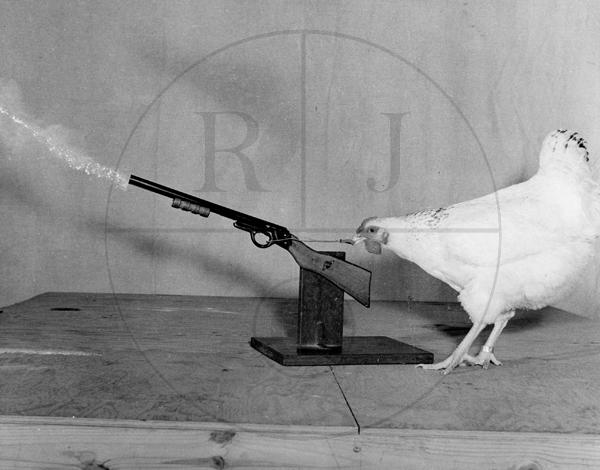
There are forty-five entries in the book–each one is a page long (it’s an oversized book and they are two columns each).  Each essay is Jay’s take on a particular subject or, as the title says, curious character.  Jay is a collector of esoteric information, especially that related to magic and, for lack of a better word, freakish behavior.   One of the most enjoyable parts of the book are the pictures that accompany each entry.  The pictures come from Jay’s collection and each picture’s provenance is given in the back of the book.  So we get pictures like “The little Count Boruwlaski, engraving by A. van Assed ([London]) Borowlaski [sic], 1788). or Lithograph of Chung Ling Soo (Birmingham: J. Upton, c. 1912) or Frontispiece portrait from George Devol, Forty Years a Gambler on the Mississippi (Cincinnati: Devol & Haines, 1887).  Some of these photos you can see on his website.  Or you can enjoy this picture of a chicken firing a gun that is not in the book (it comes from his site). (more…)

Read Full Post »

SOUNDTRACK: PUBLIC ENEMY-Fear of a Black Planet (1990).

NPR recently broadcast a PE show from the All Tomorrow’s Parties Festival.  I didn’t know that PE was still touring, so that was a surprise to me.  The show was largely a celebration of Fear of a Black Planet, which meant that I had to go back and listen to the original.

Man, is this a solid album.  The lyrics pack a punch even twenty years later and what is perhaps more amazing is that the sound collages that Terminator X created, which were something of an oppressive sonic assault are now fairly mainstream-sounding (forward thinking or what?).

What I like about this (and most PE) albums, is that  they have little skits between songs, but unlike most rap skits they’re not one-not jokes that you listen to once and then skip every future time.  A wonderful skit (for lack of a better word) is “Incident at 66.6 FM” in which we hear an amazing amount of racist epithets thrown at PE apparently on the radio.  Or the rather disturbing “Meet the G That Killed Me.”  “Anti-Nigger Machine” is a great collage of samples like “Think” and James Brown and a dozen more songs.

“Can’t Do Nuttin for Ya, Man!” is a (sort of) comic song from Flav that is catchy as anything. While “Reggie Jax” is a confusingly titled song that has nothing to do with baseball, but everything to do with funk.

Of course, this disc has some of PE’s best songs as well.  From the awesome “911 is a Joke” to one of the best rap songs ever, “Welcome to the Terrordome” (my favorite story of this song is when I was wearing a  Welcome to the Terrordome shirt and my philosophy professor asked me quite pointedly, “What in the hell is a terrordome.”  That was a fun conversation).  “Terrordome” is still amazing–powerful, musically intense and for all of its lyrical acuity, it still has funny moments….boing.

And of course, “Burn Hollywood Burn” is an amazing critique of the movie industry (and it’s catchy too).  I got Black Caesar back at the crib, right Lar?

I’ve always been a little confused by “Pollywannacracker.”  Not lyrically, but vocally, as Chuck’s (is it really Chuck?) voice is treated in a surprisingly tinny way.  I liked the song more on this listen than any other, I guess in the past it just kind of snuck by me.

The album is a little front loaded with greatness.   “Power to the People” is another powerful song, but it’s not quite as memorable as the other tracks.  “Fear of a Black Planet” has some really cool sounds on it (where did they get that “black man, black woman, black baby” sample?).   “Revolutionary Generation” is a great track in which Chuck and Flav stand up for black women: “R-E-S-P-E-C-T, my sister’s not my enemy.”  Not your average rap subject.

And the last couple of proper songs, “B Side Wins Again” and “War at 33 1/3” are fast paced and furious, but they don’t really have much in the way of a hook.  Nevertheless, lyrically they are really great, and I love to hear Chuck D flow that quickly.

The biggest surprise for me is the censored version of “Fight the Power” (the song that got me into PE in the first place, thanks Spike).  It’s really surprising to me that PE allowed their music to be bleeped–unless it was just for a deliberate radio play (which I can accept).  Although they also list a title as “Leave This Off You Fu*Kin Charts” (did I buy a Columbia House version or something?)

This is an amazing album, one that still sounds fresh and sadly, is still relevant.

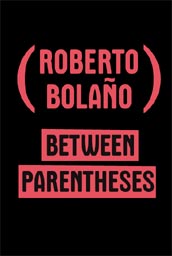
[READ: October 15, 2011] Between Parentheses

I never expected to get so addicted to Roberto Bolaño.  And despite his death, there is no shortage of works coming out in English (that is one of the advantages to reading a translated author–even death doesn’t cease the available materials).  Indeed, this year alone, New Directions is publishing Between Parentheses, and Tres and FSG is publishing The Third Reich (a collection of non fiction, a collection of poetry and a novel respectively).

When I really get into an author, I fall for his or her works, not necessarily him or her as a person (heck, some author are downright jerks).  But there are some authors that I want to know about, personally.  Bolaño is a pretty polarizing figure–he seems obnoxious, his works don’t shy away from very specific opinions, and sometimes it’s unclear what kind of views Bolaño himself has in his works (or if he’s even telling the truth about his so-called truths).  One thing in particular is the constant use of the word “faggot.”  It is used often in 2666 (and I know that is a translator’s choice, but still) and used derogatorily.  Now, clearly the context is everything for something like that.  But it seems to speak badly of Bolaño.  And yet, when reading these essays he is not homophobic in the least.  He is obviously well aware of institutionalized homophobia in Latin America, and he is obviously not supportive of it.

But that’s just one interesting thing about this book.  So let me back up. (more…)

Read Full Post »

« Newer Posts - Older Posts »