Feeds:
Posts
Comments

Archive for the ‘Film & TV’ Category

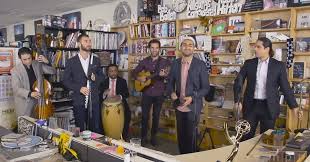
1993-1994 SOUNDTRACK: LEON BRIDGES-Tiny Desk Concert #469 (September 8, 2015).

leonLeon Bridges has a great old soul voice.  Indeed, I had no idea he was so young until he started speaking after the third song and all manner of young person chat came out of his mouth: “Thanks to my main man, you all looking beautiful man.”  His voice is pure and clean and hearkens back to 1960s soul singers like Sam Cooke.

The way he sings “baby baby baby” in “Coming Home” is classic soul.  And his enunciation of “mouth” is just gorgeous.  This song features the backing vocals of his sister Jesse.

“Smooth Sailin'” features a sax solo and Bridges on guitar.  Since there are 2 guitarists already Bridges’ guitar doesn’t  add much, but for me it’s all about his voice anyhow.

“Twistin’ & Groovin'” is about how his grandparents met.  He says the first time he saw her at a party the thing he noticed first about her was her long legs.

“River” is just him on acoustic guitar with Jesse singing backing vocals.

It’s a solid set and Bridges’ star has continued to rise since this show.

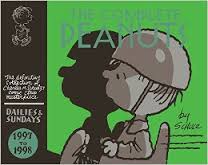
[READ: September 18, 2016]  The Complete Peanuts: 1993-1994

I didn’t like the previous book all that much, but this one picked things up a bit.

The year starts with Snoopy taking a test in school and acing the true false part–the only one to do so!

1993 has Schulz’ first celebration of MLK day.  Patty mentions the “I have a dream speech” but I love that she just mentions it without making it a big deal, it quickly changes to an unfair lunch swap between a carrot stick and french fry.  Speaking of old words, Lucy begins insulting Linus with: blockhead airhead, noodleneck but then finds that these older words work better: puzzlewit, dimbulb.

In pop culture notes, April 1993 sees Snoopy as Joe Grunge and in May 1993 Sally asks why is Barney purple? (more…)

Read Full Post »

varmintsSOUNDTRACK: HANGEDUP & TONY CONRAD-Transit of Venus [091] (2016).

conradHangedUp & Tony Conrad have the third of three discs released as part of Constellation’s Musique Fragile 02 set. From the Constellation site: Transit Of Venus documents this fertile collaboration and includes some enormous slabs of drone rock alongside more decomposed pieces and gorgeously gritty string duos.  [[The performers] recently plunged back into the archives and started shaping an album from the various 2-track and live-mixed [improvisations and] multi-track source material.

“Flying Fast n Furious” has clattering percussion and squeaky violins.  There’s some fast drumming and violin playing in the middle with a great wobbly low bass around.   About 4 minutes in the sounds are almost otherworldly/underwatery.  “Transit Of Venus” has the return of that low wobbly bass—big round fat bass notes that just seem to linger as the drums clatter away.  The sawing violin is a little less interesting than I’d like, however.  “Principles” features a buzzy violin that scratches over the interesting drum pattern.  After a minute or so some strange sounds percolate under the drone.  The sounds are mechanical, organic, (balloons?) digital—unclear.  It’s 8 minutes long and there’s a few moments when the big bass notes come in that are very cool.  In the last minute or so a new violin solo comes out of the din but it doesn’t alter the tone of the song all that much

“Bright Arc Of Light” is 4 minutes of slow bowed and plucked violins.  It’s quite minimal.  “Gentil The Unlucky Astronomer ” is 11 minutes long and it starts with multi layered violins.  It sounds a bit like The Velvet Underground’s “Heroin” and after 2 minute the slow drums come in.  Once the drums enter, the song stays mostly the same—sawing violins and a steady drums with some other occasional percussion.  It’s very droney.  Around 6 minutes things change slightly and the song becomes more insistent.  It continues like this for most of the rest of the song and then ends with some solo violins.  The final track is “Panorama From Maxwell Montes” which opens with some dissonant scratchy violins.  The drums come in and start playing an intersection complex rhythm making this a good album closer.

fragileMusique Fragile Volume 02 is the second in our series of limited-edition, artwork-intensive box sets featuring three full-length albums by three different artists, available on heavyweight vinyl and as a digital bundle. The vinyl set will be limited to 500 hand-numbered copies, lovingly designed and hand-assembled.

[READ: November 1, 2016] Varmints

I really enjoyed the drawing style in this book.  The main characters were cute and cartoony and yet the backgrounds were reasonably realistic looking.  It really conveyed the setting (the old west, I guess) effectively.

However, I had a huge problem with the story.  The book felt like it was part 2, but to the best of my knowledge it isn’t.  There just seemed to be huge gaps in the story that were never filled in.  Not to mention, this is supposed to be a children’s story, but we find out (very late in the story) that the childrens’ mother was killed in cold blood–more or less on a whim.  It’s a shocking piece of violence which I suppose little kids can handle but, woah, what the hell, dude?

The story begins with Opie and Ned in a saloon.  They are young kids, Opie is Ned’s older sister–a joke is made about Opie being a weird name for a girl, but sadly, nothing more comes of that.  Opie is holding her own in a game of cards but Ned is bored and keeps interrupting the game as annoying little brother will do.

Ned says he wants a hat, and since no one will give him one, he climbs a mountain of a man (he’s so tall we can’t see his face and he is wearing a full-sized bear as a cloak of some sort) and takes the hat off of him.  Chaos ensues, the hat flies off (and gets two holes in it) and the kids wind up stealing the giant man’s horse and taking off. (more…)

Read Full Post »

 quirkSOUNDTRACK: PACHA: Affaires Étrangères [CST090] (2012).

pachaPacha has the second of three discs released as part of Constellation’s Musique Fragile 02 set.  Pacha is the solo work of percussionist Pierre-Guy Blanchard and this disc is made of rhythm-heavy instrumentals, propelled by Middle-Eastern synth lines and sprinkled with guitar, bass and oud along with the odd looped field recording. It’s like electronic music with an Arabic pop fixation.  And the instrumentation is really interesting:

“L’Aeroport De Charlo” is mostly thumping drums and a buzzy synth.  There are some synth solos with distinctively Middle Eastern tones.  I like the way the basic rhythm alters throughout the nearly 5 minute track.  About half way through it turns to nearly all percussion a great rumbling drumming with one middle eastern instrument playing over the top (it sounds like a buzzy clarinet).   “Macedonian Mind” has some great, complex drumming behind a simple synth riff.  The music feels slightly menacing as the synths are quite buzzy, but the drums are just a lot of fun.   The middle of the song uses that Middle Eastern sound with a melody line (I can’t tell if its voice or instrument or what) that works perfectly with the main Rockies riff.

“Modern Malaise” opens with a vocal choir, singing while there’s a simultaneous, seemingly unrelated bass line.  And then a very cool funky section with more great drums and a kind of sneaky sounding riff.  As the song progresses some spacey synths enter the song amid a clatter of echoing drums before it all resolves to that initial cool riff.  In “La Gare De Podgorica” slow synths play over some complex drumming with a bunch of what sounds like hand drums.  “Tunel” has some great hand drumming and low droning synths.   And then comes the most middle eastern sounding riff of the disc.  This track is my favorite–catchy and funky with some great hand drumming.  The keys sound very later 60s.

“Ankara” is a fast song with complex hand drumming and an almost drone with vocals samplings, and a lot of the instrument listed below (Omar Dewachi plays saz and oud) and a warbly synth line.   It is one of the longest songs on the disc and has the most going on it.  “Starcevo” opens with some deep hand drums and what sounds like violins or maybe sampled voices or both.  It’s kind of a disconcerting track with the drums the only thing keeping things steady.  “Le Soviet” is played on a bunch of synths with a kind of carnivalesque feel to the sound.  There’s a Middle Eastern riff and some interesting solos that sound almost classical.

From the Constellation site:

Blanchard received a BA in music in 2003, majoring in percussion performance, and then escaped the ‘new music’ trajectory by traveling extensively and immersing himself in Middle Eastern and Balkan traditions, studying under various masters and playing with a wide range of regional groups. During his periods back in Canada he performed as guest percussionist for Black Ox Orkestar … has also performed regularly with Sam Shalabi’s jazz/psych/arabic orchestra Land Of Kush.  … Constellation re-sequenced and remastered the Affaires Étrangères CD-R for vinyl and is proud to be giving this album a more substantial life. It marks Blanchard’ first attempt at a definitive musical statement of his own and we think it succeeds wildly.

.

fragileMusique Fragile Volume 02 is the second in our series of limited-edition, artwork-intensive box sets featuring three full-length albums by three different artists, available on heavyweight vinyl and as a digital bundle. The vinyl set will be limited to 500 hand-numbered copies, lovingly designed and hand-assembled:

[READ: October 31, 2016] Quirk’s Quest 1

This story threw out so much disconnect for me that I never really determined if I liked it.

The artwork is adorable–the characters look like Fraggle Rock creatures–soft and furry with big round ping pong ball eyes.  Even the bad guys (much taller with four eyes) don’t look all that fierce.

And yet.

In the first 30 pages, these monsters kill and eat some of the cute Fraggle Rock creatures. What?!

This book looks ostensibly like a children’s book.  It is really cute.  But the diary entries of the Captain are written in a cursive that even I had a hard time reading (particularly because the captain’s named is Quenterindy Quirk and he is sailing on the H.M.S. Gwaniimander (hard enough to read that, imagine trying to figure it out in cursive!).

So just what’s it about? (more…)

Read Full Post »

bibSOUNDTRACK: THE BEATLES-Live at the Hollywood Bowl (2016).

beatlesThis disc was released this year.  It is technically the soundtrack to the film Eight Days a Week: The Touring Years.  But regardless of the film, these are newly mastered recordings from two Beatles concerts at the Hollywood Bowl in 1964 and 1965 (which were released in 1977).  This disc has 7 songs from 1965 and 6 from 1964 (not including the four bonus songs).

The concerts were legendary for the shrill screams that the audience made during these shows–so loud that the recordings were practically inaudible and, apparently, even the band members had a hard time hearing each other.  Sounds like a nightmare, frankly.

Well, George Martin’s son has used some technology to make these recordings listenable.  They have reduced the shrill screams to a kind of low-level, high-pitched sound and, even better, they have fleshed out the band so they don’t sound like they are playing in a tin can.

Here’s some fascinating things about that Hollywood Bowl Concerts. Tickets cost $5.50 in 1964 and $3 in 1965.  WHAT?  In 1965, the band played for 33 minutes.  That’s it–not sure how long they played in 1964.

The band had no monitors on stage–those things that musician are always pointing at and asking the mixer to turn up.  So on many shows they couldn’t even hear themselves.  The fact that their harmonies are so good is really impressive.  The notes suggest that the open roof of this show meant that the shrill crowd noise was somewhat dissipated allowing them to hear each other a little better for these shows.

Evidently the track listing for this disc consists of the best original recordings from the two shows.  I’m not sure why they’re not played in sequential order, but whatever.  Perhaps the energy of the opening “Twist and Shout” (all 90 seconds of it) is a pretty great way to start.  While the band is spot on in their playing (sometimes it’s easy to forget that they are laying instruments as well as singing, since the voices are the big thing) you can hear Paul’s voice straining on “Can’t Buy Me Love” (which is cool).  Or John saying he thinks the next song “Things She Said Today” is on the new album over here.  This song–quieter and less dancey sounds pretty great and you can kind of hear the audience paying attention to it, so that when the band gets to the loud part the crowd really erupts.

I’m surprised at how many covers the band plays.  I realize these songs are picked from two set lists, but there are dozens of serious hits that they could have played instead of say “Roll Over Beethoven” or, and this is the most surprising thing to me, ending their 1964 set with “Long Tall Sally” rather than one of their huge hits.

It’s funny how crazy the crowd goes for Ringo when he sings lead on “Boys.”

I enjoy hearing them talk about their films–one we made in black and white, the other in color.  “Hard Days Night” sounds great but even more impressive is “Help!”.  John intros the song by saying, “we’d like to do another film song from a different film–coz we’ve made two.”  “Help!” is really impressive the way the band launches right into their harmonies on that first note–it sounds incredible all the way through the song.  Even when John strains hard at the end.

There’s not a lot of stage banter, but I did enjoy this one from 1964: “This next song is an oldie, some of you older people might remember it.  It’s from last year.  It’s called “She Loves you.”  I like hearing the rocking guitar line more prominently and the fact that they don’t go “ooooh” during the first time it’s supposed to appear, but when they do the next time, the crowd goes nuts.

As the disc ends, Paul asks, “We all hope you enjoyed the show.  Have you enjoyed the show?”  Apparently they have.

I’m not sure why the final four songs are listed as “bonus tracks.”  The inclusion of “I Want to Hold Your Hand” can’t be a bonus!  But the four songs (two from 1964 and two from 1965) also sound great.  The harmonies on “Baby’s in Black” are fantastic.

John Lennon said the fans didn’t come to listen, they came to love.  Regardless, the band played wonderfully and gave a great performance.  It’s nice to be able to hear it.

[READ: March 10, 2016] Baby’s in Black

This story is about The Beatles before they became THE BEATLES.

I didn’t know all that much about the early Beatles.  I knew that they were in Germany (although I don’t really know why, and I still don’t). But I didn’t know about all of the trials and excitements that happened to them there.

What I loved about this story is that while it is about The Beatles, it’s actually about Stuart Sutcliffe and his girlfriend Astrid Kirchherr and their impact on the nascent Beatles.

The story begins with Astrid’s ex boyfriend Klaus Voormann running to Astrid to tell her about this band that he just heard down at the Reeperbahn.  He said they all dressed the same and they really rocked (or whatever they would have called it back then).

The Reeperbahn was sketchy place at the best of times, so it was unlikely that anyone other than sailors and thugs would have seen this band iinitially.  But Klaus was so insistent that Astrid agreed to go.  And she was mesmerized by them.  She was especially taken with bassist Stuart Sutcliffe (although none of the fans knows their names at this point).  The band consisted of John, Paul, George, Pete Best on guitar and Stuart on bass. (more…)

Read Full Post »

sardine6SOUNDTRACK0 Tonne Seize [CST bonus] (2016).

tonne0 Tonne Seize is a bonus compilation of three tracks each from Off World, Automatiste and Jason Sharp.  The collection is 41 minutes of music (not too shabby) and came with a pre-order of the three records (and is available on Soundcloud as well).

The first three songs are by Off World and the first two of those are remixes.  The original “Wonder Farm” is dominated by popping drum sounds.  There are some other sounds that go through the track but the base is mostly a kind of slow Asian melody.  The “Wonder Farm (Summer Crop)” mix removes those snaps and percussion entirely.  It focuses just on the music, which I have to say is far more enjoyable without the bangs.  “Primitive Streak” is a slow droning piece, while this compilation’s “Primitive Streak (Silver Mix)” doesn’t sound all that different.  It also removes the drums, and highlights the squeaky synth sounds and the overall drone tone.  It seems to emphasize and de-emphasize different instruments but otherwise sounds pretty similar. The final track  “Lost Meadow” is a pretty, delicate piano based piece with some twinkling of spacey synth notes.  It’s easily the prettiest piece.

The three Automatiste tracks do not quite follow the same naming convention as the actual disc, although the first track is called “Simultanéité 5.” It has slow beats and is basically two-note washes building on top of each other.  “Fragments continus” is a noisy piece with layered thudding drums (like heartbeats especially around the 1 minute mark) and drone noises that wash in and out.   About half way through what sounds like a melody appears amid the din, but it feels like it formed organically around the synths and drums which is pretty cool.   “Le Silence 3” opens with some jackhammer sounding drums and then almost easy listening synths.  The juxtaposition is interesting and by the end the song feels nicely dancey.

The final three songs are from Jason Sharp.  These three are quite different from his album because they really feature the saxophone to a larger degree.  “Plummeting Veins” opens with a heartbeat and some rumbling sax (that sounds like the opening of the Speed Racer TV show).   This track is under 2 minutes, the shortest he’s done by far, and the way the heartbeat speeds up as the sax plays some low rumbling notes is pretty cool. “Hear a Fading Cry” is a much longer number.  The heartbeat is quieter but the sax is much louder.  It sounds a lot like Colin Stetson in the low rumbling and noisy barking that the bass sax can produce.  It ends with some rather high-pitched squeaky sounds that I assume come from the sax, but which I can’t imagine coming from such a bass instrument.  It’s 7 minutes long although it takes almost 2 minutes to really get going.  And it swerves between loud and rumbling and then sort of menacing by the end,  “Ride On Into the Sweetening Dark” is perhaps the most conventional of Sharp’s songs.  It is a series of sax solo lines over a gentle tinkling backing drone.  Some of the solos lead to noisy wailing, but for the most part the line are pretty and jazzy.

It’s interesting how different these bonus tracks tend to be from the actual releases.  I enjoyed listening to these variants to see what else these artists are capable of.

[READ: April 9, 2016] Sardine in Outer Space 6

Sardine is a children’s book published by First Second.  It was originally published in France (and in French) and was translated by Sasha Watson.  There are six Sardine books out.

The inner flap says “No Grownups Allowed (Unless they’re pirates or space adventurers).”  This is the final Sardine book.  And while I didn’t enjoy the first book much, by now I’m sorry to see the series end.

This book also has the fewest stories in it (only 9). (more…)

Read Full Post »

sardine5SOUNDTRACK: JASON SHARP-A Boat Upon Its Blood [CST119] (2016).

Layout 1Constellation records had been rather quiet this year in terms of new releases.  And then back in August they announced three new discs with this intriguing blurb:

Constellation’s three new fall releases by Off World, Automatisme and Jason Sharp are dropping on September 30th…  These new releases are wildly different yet satisfyingly leftfield albums that share an electric thread of sorts.  Electronic music strategies, technologies, histories and sensibilities come into play, in very diverse ways, with each of these debut records – making them stand out a little differently in the context of the Constellation catalogue perhaps, but also informing one another and making a lot of sense to our ears as an album trio (somewhat in the spirit of our Musique Fragile series).

This is the third of those three.

Jason Sharp has written this disc as “music written for amplified heart & breath,” and Sharp is credited with “playing” amplified heart, feedback, synthesizers and bass saxophone.  Other instruments listed are Pedal Steel Guitar, Violin and various percussive instruments.

From the Constellation site: “Using custom-built equipment to translate breath and heart rate into variegated sonic triggers, along with other modes of signal processing and in tandem with traditional instrumentation…[the album] deploys the human metronome of amplified pulse as a recurring undercurrent, with compositions that incorporate electro-acoustic and musique concrète strategies, drone, noise, electronics, methodical dissonance, tone poem, layered rhythmic and melodic figures, and improvisation.”

The disc opens with a trio of songs: “A Boat Upon Its Blood Pt.s 1, 2 & 3”  Part 1 begins with some quiet drones and pulses and what sounds (if you think about it) like water running through pipes or blood through veins.  It also like plectrum hitting strings or a musical rain stick.  The songs build in intensity until a pulse that sounds a lot like a heart beat (which it should) ends the track. This heart beat segues into Part 2 which is dominated by violins.  The violins seem to alternate between drones and dissonance with the pulses seeming to beat a bit faster in parts.  As this track ends, a martial beat takes over the drums, and that segues into Part 3 which has more drone sounds.   About midway through, new percussive sounds come in, changing the tone of the piece entirely.

Track 4 is “In the construction of the chest, there is a heart” is the most interesting of the bunch.  It has what I assume are several different heart beat sounds modified to create different percussion under various droning sounds. It really exemplifies the “heartbeat” aspect of the piece, which I thought would be more prominent in the disc overall.  The second half of the song is full of swishes and scratchy sounds which I certainly hope are the sounds of his blood pulsing through his veins.

“A blast at best” is a noise piece which sounds almost like the heart beats have been put through an autotune.  Midway through the song comes the bass sax playing some farting and pulsing sounds that add an interesting  melody to the sloshy noises.

Tracks 6 and 7 are another multi-part song “Still I sit
with you inside me Parts 1 and 2.”  Part 1 opens with a much more pleasant, albeit somber violin.  Slowly the heartbeats grow louder and more prominent.  The pulses increase and decrease although not necessarily with the intensity of the music.  The violins swirl and ebb, growing louder and more intense and then fading and seguing into the last track which opens with pretty guitars and accompanying violin.  About halfway through the song, the heartbeat resumes.  It come pulsing into the song louder and louder, dominating the whole thing.  And then with a few seconds left it builds a wall of feedback and noise that gives way to a cathartic echo.

This would be another string candidate for NPR’s Echoes.  Have you heard this, John Diliberto?

The disc notes that the piece was inspired by the Robert Creeley poem, “The Heart,” which I have included at the end of the post.

[READ: April 9, 2016] Sardine in Outer Space 5

Sardine is a children’s book published by First Second.  It was originally published in France (and in French) and was translated by Sasha Watson.  There are six Sardine books out.

The inner flap says “No Grownups Allowed (Unless they’re pirates or space adventurers).”  For the first time, Sardine was created without the help of Joann Sfar.  And I found this one to be my favorite one yet!

It seems like Sardine has really hits its stride with Book 5.  The author is having a ton of fun playing around with pop culture and with the idea that the characters know that there are books about them. It’s still a little weird that Supermuscleman is really the only bad guy and that he is always coincidentally where they show up, but that’s clearly not the point of the comic, right? (more…)

Read Full Post »

sardine4 SOUNDTRACK: AUTOMATISME-Momentform Accumulations [CST118] (2016).

Layout 1Constellation records had been rather quiet this year in terms of new releases.  And then back in August they announced three new discs with this intriguing blurb:

Constellation’s three new fall releases by Off World, Automatisme and Jason Sharp are dropping on September 30th…  These new releases are wildly different yet satisfyingly leftfield albums that share an electric thread of sorts.  Electronic music strategies, technologies, histories and sensibilities come into play, in very diverse ways, with each of these debut records – making them stand out a little differently in the context of the Constellation catalogue perhaps, but also informing one another and making a lot of sense to our ears as an album trio (somewhat in the spirit of our Musique Fragile series).

This is the second of those three.

From the Constellation site: “Automatisme is the electronic music project of Quebec-based producer William Jourdain, who has been self-releasing a brilliant series of albums and tracks under this moniker since 2013, exploring various intersections of drone, dub techno, electronica, ambient, electro-acoustic, and noise.”

This album is, indeed, very drone, dub techno, electronica, ambient, electro-acoustic, and noise.  There are six tracks: Transport 1, 2, and 3 and Simultanéité 3, 1, and 4.  The Transport tracks are all about 5 minutes and the Simultanéité tracks are all about 9 and they are interfiled on the record.

“Transport 1” seems to be all about the thumping drums. The synth lines are fairly simple and serve to propel the song along as almost an ambient dance track.  “Simultanéité 3” opens with some mechanical drone sounds and a beeping almost like a heart monitor.  The beeps change and then a new drum beat is added while fiddling synths tickle along the top of the song.  Things slow down and speed up and the track reminds me a lot of something you’d heard on NPRs awesome Echoes program.

“Transport 2” is more about drums. There are several different percussion themes going on–fat repeated drums, the main steady beat and then some low synth that runs through pretty much the whole thing.  “Simultanéité 1” is a drone song with a drum sound that is like a heart beat.  About a minute in the note changes and 30 second later the song takes on a different texture and pulse.  It remains largely ambient for most of the song.

“Transport 3” has more percussive sounds that make this track much faster than the others. The final track “Simultanéité 4” has what sounds like voices (although I assume they are not) echoing underneath the slow pulsing rhythms.

While the track listing alternates between drum heavy tracks and more mellow tracks, the whole disc has a very chill vibe.

[READ: December 5, 2014] Sardine in Outer Space 4

Sardine is a children’s book published by First Second.  It was originally published in France (and in French) and was translated by Sasha Watson.  There are six Sardine books out.

This time the inner flap says “No Grownups Allowed (Unless they’re pirates or space adventurers),” and this book had some of my favorite cartoons yet.

“Under the Bed” has the kids getting lost under Little Louie’s bed and finding all the monsters that hide there.  But Sardine’s adventures are so scary that the monsters don’t stand a chance trying to frighten him–they’re even a little afraid of Sardine, too.  Of course the kids have someone who they can go frighten. (more…)

Read Full Post »

dfwreadSOUNDTRACK: CHRISTIAN SCOTT aTUNDE ADJUAH-Tiny Desk Concert #477 (October 9, 2015).

aacsChristian Scott aTunde Adjuah and his septet play what he calls stretch music: “the particular type of jazz fusion he’s up to: something more seamless than a simple collision of genre signifiers.”

They note that even his appearance stretches traditional jazz: “You may note that he showed up in a Joy Division sleeveless T-shirt and gold chain.” It’s sleek and clearly modern, awash in guitar riffs, but also bold and emotionally naked.

Christian Scott aTunde Adjuah (not sure how to abbreviate that) is a trumpeter and he can hit some loud powerful and long –held notes.   It’s funny that when he bends over the trumpet grows quieter—those ic really are direction-based.

For the first song “TWIN” he does some impressive soloing over a simple and cool beat—piano and delicate guitar riffs (there’s also an upright bass and drummer).   After his lengthy solo there’s a flute solo that also works perfectly (if less dramatically) with the background music.  (Christian plays tambourine during her solo).  He says that this song is about being a twin.  His brother, Kyle Scott is a film director and for whom Christians scores the music.  Christian also explains that he comes from an African-American and Native-American background and that this song has rhythms as a sort of history of his family that touches on Mali, Senegal Gambia and The Ivory Coast and makes its way to the Caribbean, Cuba and into New Orleans.

He’s pleased to play the Tiny Desk Concert for an audience that appreciates “Music that has nutritional value.”

For the second song, “West of the West” he brings on a young alto-saxophonist who plays with his drummer in a different band. The song opens with a rocking electric guitar solo and then the jazzy band kicks in behind it.  The instrumental features a couple of solos by the saxophonist, the pianist and the bassist.

“K.K.P.D.” is a dramatic song for which he gives a lengthy back story.  Many years ago in his home of New Orleans, he was stopped by New Orleans police late at night for no reason other than to harass and intimidate him.  he was coming back from a gig.  He resisted and was in a serious situation and was seriously threatened—the story is long and very affecting, especially given how articulate (I know, terrible word, but true) and calm he is about retelling this horrifying story.  His pride almost made him do something ill-advised, but instead he channeled that pent-up frustration into a piece of music whose long-form title is “Ku Klux Police Department.”

He adds that we see things on TV about inner cities or the ninth ward and we believe them to be true.  Like that the neighborhood is happy that the police are clearing out the youth there.  We begin to think that the narrative is true, although the people who live there can tell you otherwise.  Despite the title and the origin, the is song is designed to reach a consensus to move forward –not to build derision or hate.  He says that we have to start working on that now, because if it doesn’t start now then our children will continue to inherit this situation.

It opens with a noisy guitar wash and fast drums.  It’s quite noisy and chaotic although it resolves very nicely into an almost sweet piano-based song with slow horns.  The middle of the song ramps up with some intense soloing from Christian.  I love how that segues into a very different section with an electronic drum and delicate piano.  Chritsian’s next solo is much more optimistic.  The final section is just wonderfully catchy.

When he introduces the band, he points out just how young some of his newest members are: Drummer Corey Fonville (another new member) used a djembe as a bass drum, and also brought a MIDI pad so he could emulate the sound of a drum machine; Lawrence Fields, piano; Kris Funn, bass; Dominic Minix , guitar (21 years old); Braxton Cook, saxophone (24 years-old) and Elena Pinderhughes, flute: 20 years old!

I don’t listen to a ton of jazz, but I really liked this Tiny Desk Concert a lot.

[READ: July-October 2016] The David Foster Wallace Reader

I’ve had this book since Sarah bought it for me for Christmas in 2014.  I haven’t been in a huge hurry to read it because I have read almost everything in it already.  And some of that I have even read recently.  But this summer I decided to read some of my bigger books, so this was a good time as any.

One of the fascinating things about reading this book is the excerpting in the fiction section.  I have never really read excerpts from DFWs longer books before.  And once you decontextualize the parts, you can really appreciate them for themselves rather than as a means to the end of the story.  This is especially true of the excerpts from Broom of the System and Infinite Jest.  But also just reading some of these sections as a short story makes for an interesting experience.

It was also very interesting to read the non-fiction all together like that.  These pieces come from difference anthologies, but they have thematic similarities  So, placing them together like that allows for really comparing the stories.

And of course, the selling point for most DFW fans is the teaching materials in the center of the book–an opportunity to look into the man’s mind at work shaping younger minds.

I have written about virtually everything in this book already (title links refer back to previous posts), so mostly these are thoughts about the pieces themselves and not a part of a whole. (more…)

Read Full Post »

SOUNDTRACK: action LIANNE LA HAVAS-Tiny Desk Concert #475 (October 2, 2015).

lianneLianne La Havas has a lovely, soulful voice. I didn’t think I knew her at all, although her song “What You Don’t Do” sounds really familiar. The chorus is a bouncy “It’s what you don’t do…it’s what you don’t say.”  But it’s the fast pre-chorus “I know what I got / and I know where were going / You don’t need to show it / I already know it all” that is really catchy.

I feel like the original is big and orchestrated.  But for this Tiny Desk it’s just her and a backing singer accompanied by a pianist who also sings backing vocals.

For song two “Unstoppable,” Lianne straps on a guitar and when she finally speaks–she has British accent!  “Unstoppable” is a gentle song with a cyclical guitar riff playing through the gentle pianos while all three voices soar.

It’s amazing how British she sounds after the second song–remarkable because of how unaccented her singing voice is.

On “Forget,” she plays guitar and there’s no other instrumentation.  This song sounds quite different from the others–the scratchy guitar isn’t really louder than the other songs, just much faster and more intense.  The real hook though comes in the chorus when all three sing a big loud “Forget!” in a memorable melody.

La Havas’ music veers towards R&B but never falls into the trappings of the genre.  She has some rock elements sand soul elements and her delivery is just charming.

[READ: July 8, 2016] Adventures in Cartooning Characters in Action

This is the fourth and (presumably) final book in the AIC series is called Characters in Action!  And as you see on the cover, the man screaming Action is a film director.  So this book is gong to take us on flights of (even more) fancy.

The book starts with the knight riding his faithful horse, Edward.  A fly goes by.  Sigh, it’s boring.

But as he rides off, he runs into a band of scoundrels–a viking, a wicked wizard an evil owl and an evil king and they are all there to do… evil!  And as they are talking about how evil they are, the real king (in rags) comes and says that he is the king.  The fake king says he looks like a beggar, then a real beggar says that the king is not a real beggar.  And then a big strong-looking knight looks at our favorite knight and says the he is no knight, either.  Egads, what is happening? (more…)

Read Full Post »

1987  SOUNDTRACK: GINA CHAVEZ-Tiny Desk Concert #472 (September 22, 2015 ).

ginaChavez’ voice is poppy but a little deep, almost muscular which I rather like. Or perhaps its just confidence, the blurb notes “the intense openness and warmth of her performances.”

“Fire Water” is primarily a capella and percussion (with interesting clicks and shakers and even a guy whispering “ahhh” ). A few bass notes enter near the end, but other wise it is a very stark song.

“Miles Da Millas” is dedicated to a fiend of a friend who died recently.  He loved Tiny Desk Concerts.  Whenever someone mentioned a new band he would say “But do they have a Tiny Desk?”  So this makes Gina feel like she’s made it  This song, a cumbia, is bilingual with the chorus in Spanish.  And her voice is just as strong if not more so in Spanish.   It’s fun when the percussionist yells and whoops and overall it’s a nice groovy song.  It’s a little weird that she hums a trumpet (quite well, admittedly) when there is an actual trumpet player in the band.  They take turns so I guess it’s kind of duet.

When introducing the final song, she says spent 8 months in El Salvador doing mission work teaching English in an all girls’ school.  Things are really bad down there, so she started a college scholarship fund called Niñas Arriba.  This song “Siete-D” is about a wild ride on the 7D bus from Soyapongo to San Salvador.  Soyapongo is the home of the MS13 gang, the place where guide books tell you not to go.

It’s a fun song (sung entirely in Spanish) with a cool “Sube! Hey! ho!” chant.  It’s a bouncy song with some great trumpet work.  There’s even a rap in Spanish

[READ: September 9, 2016] The Complete Peanuts 1987-1988

I felt like after the major highs of the last few books, this one fell into a bit of a repetitive pattern.  This is not to say there weren’t memorable moments in the book, but there were a lot of variations on a similar jokes (especially with Spike in the desert–how many different ways can you make a joke about a cactus looking like a person with his arms up?  About fifty, I guess).

But perhaps it seems like things have changed because On 1-11 1987, that heading that has been there for so long–the hand-drawn looking “Peanuts featuring Good Ol’ Charlie Brown” had been replaced by a computer-generated font that just says “Peanuts.”  It also felt like the drawings looked different somehow–thicker lines, somewhat less polished?  And in July of 1988 it seems like Snoopy looks rather different. His ears are much smaller for one thing.  That seems to go away though.  But it’s some time round here or maybe even in a previous book that Schulz started drawing circles for eyes on Snoopy from time to time–mostly to express distress or angry.  But Snoopy is meant to have dots or sixes for eyes–the circles always look weird.  And sometime they look poorly drawn, if I may say so.   Especially on October 12 1988 (he’s supposed to look aggrieved, but they still look sloppy for Schulz).

And then, a huge shock to the system!  The daily strips go from 4 panels to 3.  Three panels!  What gives?  Is it because many of his fourth panels didn’t really have a punchline so much as a commentary on the punchline?  It’s mind blowing!  After thirty some years, he is finally messing with the format! (more…)

Read Full Post »

« Newer Posts - Older Posts »