Feeds:
Posts
Comments

Archive for the ‘Excerpt’ Category

12SOUNDTRACK: FRANK OCEAN-“Bad Religion” (2012).

frankoI didn’t know anything about Frank Ocean until I started looking at all of the  Best Albums of 2012 lists.  He was on everyone’s list and was pretty near the top of all of them.  So it was time to check him out.

It  turns out that he’s affiliated with the Odd Future collective, whom I’ve talked about in the past.  But he’s also been on a lot of big name records.  Channel Orange is his debut album (that’s not a mixtape) and the big surprise seems to be that this song (which he sang live on Jimmy Fallon) is about a male lover.  And I guess that’s progress.

So Ocean sings a slow R&B style, and I have to say his voice reminds me of Prince a lot.  Which is a good thing.  I really like this song.    It has gospelly keyboards (but in that Purple Rain kinda way).  And a really aching vocal line.  It’s really effective and it’s really simple.  And I think that’s what I liked best about this song and others that I’ve heard–he’s really understated.  Crazy, I know.

Now I do not like R&B, it’s one of the few genres that I just don;t get.  And yet there’s something about this album (the tracks I’ve listened to) that is really compelling.  It’s not awash in over the top R&B trappings, and it doesn’t try too hard.  It’s just Frank  (not his real name) and his voice over some simple beats.  A friend of mine recently said that all of a sudden she “got” this album, and  I think I may have to get it as well.

[READ: December 30, 2012] McSweeney’s #12

At the beginning of 2012, I said I’d read all of my old McSweeney’s issues this year.  I didn’t.  Indeed, I put it off for quite a while for no especial reason.  Now as the year draws to an end, I’m annoyed that I didn’t read them all, but it’s not like I read nothing.  Nevertheless, I managed to read a few in the last month and am delighted that I finished this one just under the wire.  For those keeping track, the only issues left are 13, 14, 15, 16, 20, 10, 38, (which I misplaced but have found again) and 42, which just arrived today.  My new plan in to have those first four read by Easter.  We’ll see.

So Issue #12 returns to a number of different fun ideas.  The cover:  It’s a paperback, but you can manipulate the front and back covers to make a very cool 3-D effect (by looking through two eyeholes) with a hippo.  The colophon/editor’s note is also back.  Someone had complained that he missed the small print ramble in the beginning of the book and so it is back, with the writer (Eggers? Horowitz?) sitting in Wales, in a B&B, and hating it.  It’s very funny and a welcome return.

As the title suggests, all of the stories here are from unpublished authors.  They debate about what exactly unpublished means, and come down on the side of not well known.  And so that’s what we have here, first time (for the mos part) stories.  And Roddy Doyle.

There are some other interesting things in this issue.  The pages come in four colors–each for a different section.  The Letters/Intro page [white], the main stories [pink], the Roddy Doyle piece (he’s not unpublished after all so he gets his own section) [gray] and the twenty minute stories [yellow].  There’s also photographs (with captions) of Yuri Gagarin.  And a series of drawing that introduce each story called “Dancewriting”–a stick figure on a five-lined staff.  They’re interesting but hard to fathom fully.

LETTERS (more…)

Read Full Post »

[WATCHED: December 16, 2012] McSweeney’s #11

11

THE DVD that came with Issue #11 was listed as a “Deleted Scenes” bonus feature for this issue.  The colophon of the book explains in great detail what they wanted to do and how they went about doing it all.  And that’s all quite amusing in itself.

Now, of course, there are no “deleted scenes” up front.  The DVD is, at first glance, authors reading from the works in the book.  But as you scroll down the menu, there are some deleted scenes, as well as behind the scenes features and audio commentary.  All in all there’s about two hours worth of stuff crammed in here and some of it is quite interesting.

DELETED SCENES

This is where the authors read from their works.  They each read between 3 and 6 minutes, with some of them reading different sections (Samantha Hunt), but most of them reading a chunk.   (more…)

Read Full Post »

11SOUNDTRACK: THE ANTLERS-Live at the Black Cat, Washington DC, May 11, 2009 (2009).

antlersI mentioned that I was uncertain about my appreciation of this band.  And I wondered how they would hold up to a longer show.  The answer is surprisingly well.  The sound quality of this set isn’t great–the levels seem way too loud (not sure if that’s the band or the recording) and I really can’t understand the words, but the music is very moody and evocative and I like it quite a lot.

This set comes from the album Hospice, which is a concept album about a person dying of bone cancer (with lyrics like “they told me that there was no saving you” and song titles like “Kettering”).  Earlier descriptions made me think the album was a major drag to listen to– I mean the subject alone is exhausting–but musically it’s a different story.  There’s lush strings and interesting guitars.  And, at least live, the band can make a holy racket.

I’m a little surprised by the number of keyboard errors in “Atrophy.”  I mean an occasional bum note is fine, but there’s a bunch in that track.  It’s very weird.  But that is made up for by the vocals which are angsty and impassioned, especially on the final song “Cold War.”  The NPR site has three tracks available for viewing and I must say that watching the band is more exciting than just listening to them.  But I have really gained an appreciation for The Antlers.

Check out the show here.

[READ: December 16, 2012] McSweeney’s #11

This crazy title for this Issue/Post comes because the cover and spine of the book are all text.  Indeed, the book is gorgeously bound in black leather(ish) with shiny gold print.  Each author gets a summary of his or her work and a note that he or she is free (see each story below).

I did not read Issue #10 yet because it came out as a thrilling paperback, and I’ve been putting it off for a reason even I can’t quite fathom.  I anticipate reading that one last.  Again, no idea why.  In some ways, Issue #11 picks up where Issue #9 left off.  There’s lots of text on the cover, there’s letters and everything else that makes it look like McSweeney’s.  But as I said this one seems more somehow.  It’s the hardcover.  And, it’s also the DVD that accompanies the book.  I have a hard time believing I’ve owned this book for almost ten years and never watched the DVD but I finally got around to it.  More on that soon.

This issue contains letters, fiction, non-fiction and a play that picks up from Issue #9 (more…)

Read Full Post »

41

SOUNDTRACK: SWANS-Live at All Tomorrow’s Parties, October 2, 2011 (2011).

swansatpBefore Swans released this year’s amazing The Seer, they toured supporting their previous album (with a number of songs from The Seer included). This set has two songs from The Seer, “The Apostate” and “The Seer, Pt 1” together they comprise 50 minutes of the nearly two hour show.  The set also includes “No Words No Thoughts” (24 minutes) and “Jim” (a teeny 6 minutes) from 2010’s My Father Will Guide Me Up a Rope to the Sky.  The final track is an eleven minute version of “I Crawled” which goes all the way back to 1984’s Young God EP.

I would never have thought of Swans as a jam band, and yet here they are, with 5 songs in 2 hours.  Although unlike jam bands, they aren’t showing off their musical chops or noodling solos, they are created expressive and moody soundscapes–not as scary as in days of old, but very intense nonetheless.

The set sounds great, although I imagine this would be more enjoyable to watch than to listen to (there a great swaths of music where there’ s not a lot happening).  I wonder what Gira is doing during these stretches.  My friend Phil (or Phillipe Puleo as Gira calls him here) plays drums on the album and on this tour, and I have to say he must be exhausted–man he hits the drums hard.

I listened to this show before I heard The Seer, but it didn’t prepare me for what the album would contain.  Now having heard that album, I appreciate this live show even more–they really master these long songs.  I am going to have to try to see them the next time they swing by.  I admit I used to be afraid at the thought of seeing them because their early music was so intense, but this seems to be a different Swans now, one that an old man like myself could even handle.

The set is no longer available on NPR.

[READ: December 10, 2012] McSweeney’s #41

The cover of this issue has a series of overlapping photographs of lightning.  I didn’t really look at it that closely at first and thought it was an interesting collage.  Indeed, Sarah said it looked like a science textbook of some kind.  But when I read the colophon, I learned that Cassandra C. Jones finds photographs of lightning and (without manipulating them digitally) places them together so that the lightning bolts create shapes.  And indeed, that is what is going on.  And it’s amazing!

The cover’s pictures create a greyhound running (front and back covers show different stages of the run).  There’s also circles and a rabbit running.  It’s incredibly creative and very cool.  You can see some of her work at her site.

The feature of this issue is that there are four stories from Australian Aboriginal Writers, a group that I can honestly say I have never read anything from before.  There’s also beautiful art work accompanying most of the longer stories, three gritty non-fiction pieces and some letters, most of which aren’t very silly at all.

LETTERS (more…)

Read Full Post »

SOUNDTRACK: PHISH-Live Bait Vol 6 (2011).

Yesterday was my coworker Jay’s last day here, so I’m writing about this Phish bootleg set in his honor.

So these Live Bootleg Series are fun in that they’re a free sample of live songs–warts and all–from various shows in the band’s touring history.  These shows are primarily 1993-1996, with a 1988 song and two from 2003 thrown in for good measure.  The opening of “The Curtain” into “Tweezer” is from Red Rocks.  In fact, the first 8 songs are from Red Rocks at different times in their career (I like that they meld the shows together like this).  From 1996, “The Curtain” sounds amazing, so it’s really surprising how badly Trey messes up the opening guitar riff of “Tweezer.”  It’s so bad I would have thought he might have considered starting over!  But after an ugly beginning the band settles in for a 17 minute version.  “Split Open and Melt” also comes 1994.  The band sounds great on this song.  This is one of my favorite jam sections–it goes in a really weird direction.  And, there’s great bass and a guitar solo.  “It’s Ice” and “The Wedge” are from 1993 (touring their 4th official release!).  They sound really on for these songs.

Next comes a trio of songs from 1995 that always go together: “Mike’s Song” (everybody’s favorite), “I am Hydrogen” and “Weekapaug Groove.”  The middle of the “Mike’s Song” jam gets a little weird (some of their slow sections can sound very strange especially if people overhear them out of context), but they bring it back very nicely.

“The MOMA Dance’ and “Limb by Limb” are from 2003.  And they are fantastic.  “McGrupp and the Watchful Hosemasters” actually comes from the Colorado ’88 CD, but it’s a fun addition within this set.  It certainly sounds older than the others, but not radically out of place.  It’s followed by “Ghost” from 1997.   “David Bowie” has a lot of fun in the intro–the begin playing several different songs, including “Mike’s Song” and several other intros before finally settling into “DB.”  The jam also gets pretty dark, but I love at the end when the conventional shredding solo keeps getting interrupted by a strange minor key riff.  Similarly, “Wilson” takes a really long time to get going, including a nice little nod to “The Simpsons” in the intro.  And then there’s a really long pause before the “blap boom” part comes in.  It’s a fun version of the song.  The disc ends with a wild version of “Run Like an Antelope” from 1993.

It’s a pretty great set, and not bad for free.  You can download it here.

[READ: May 25, 2012] “The Bank Robbery”

I’ve never read Richard Ford.  I have a copy of Independence Day but I never read it. I hear it’s great.

So, here’s this excerpt from Ford’ new novel called Canada.  As has been said before, you can’t really write a review of  an excerpt.  However, a excerpt can get you excited about a book.

And that’s what this did.  It doesn’t make me want to pre-order Canada or anything, indeed, I’m not even sure how this excerpt can relate to the rest of the story as it’s pretty self-contained, but I loved the way it was written and the tone and pacing that Ford employs.

This excerpt opens with the narrator recollecting what he knows about the bank robbery.  The one that his parents committed.  His parents are pretty normal people, except for one thing—they actually thought they could pull of a bank robbery.  I love this section:

Conceivably many of us think of robbing a bank the same way we lie in bed at night and delicately plot to murder our lifelong enemy….  [details excised].  After which we conclude that though it’s satisfying to think we could murder our enemy in ambush…only a deranged person would carry out such a plan.  That is because the world is set against such acts…At which point we forget about our plan and go to sleep….  But for my parents this kind of thinking didn’t occur. (more…)

Read Full Post »

SOUNDTRACK: TED LEO & PHARMACISTS-“The Numbered Head” from Score! 20 Years of Merge Records: The Covers (2009).

 I really like the guitar sound that Leo creates for this song—angular and reminiscent of late 80s alt rock.  It’s not that different from the original, but it really grabs you.  By the time the big chorus kicks in, there are big vocals and big guitars,  It’s a nice pairing with the noisy solo and more aggressive verses.

Once I realized it was a Robert Pollard cover it made complete sense—it sounds exactly like a Guided By Voices song. Pollard’s version is about thirty seconds longer and I think that makes the difference.  I’ve always been kind of eh about Pollard.  I think some of his songs are awesome and some are just okay—he needs a serious editor (which is a funny thing to say about someone who has so many songs that are about a minute long).  I’ve also never really gotten into Ted Leo, although everything I’ve heard by him I like.  And this is no exception.

I prefer the Ted Leo version, and maybe it’s time to see what else he and Pharmacists have done.

[READ: April 4, 2012] “Hand on the Shoulder”

Its funny how different writers handle pacing so differently.  It’s kind of amazing in general how writing can have such different pacing.  Typically, Ian McEwan’s pacing is slow.  Not dull, but slow.  His stories evolve, they don’t just happen.

And that’s why it takes a little while to read this story.  It’s not especially long, but the pacing is very detailed (as befits who the main character becomes).  It also turns out that this is an excerpt from a novel (New Yorker, you fooled me again—although I kind of assumed this was an excerpt because I don’t think of McEwan as being a short story writer).  Knowing it’s an excerpt means the pacing makes even more sense.  This is a story that will unfold—there’s no hurry.

Serena Frome was recruited by the British security service forty years ago in 1972.  She was attending Cambridge and had just started dating a boy named Jeremy Mott.  Jeremy was an amazingly selfless lover—lasting for hours but never seeming  to reach orgasm himself.  We twenty-first century types know what this probably means about Jeremy, but Serena (and presumably Jeremy) didn’t find out until after they had broken up and he was then dating a man. (more…)

Read Full Post »

SOUNDTRACK: KISS-Unmasked (1980).

It was hard to like Unmasked, but, being an 11-year-old boy, who loved Kiss, I never doubted its awesomeness.  Despite kids in school telling me Kiss sucked and, peculiarly, even the cover of this album telling me they stink (whose idea was that?) I knew in my heart of hearts that Kiss was the best.

In a stroke of marketing genius, this album teased the audience with the idea of finally seeing who was under these “masks” (which is weird since everyone knew they weren’t wearing masks, but whatever).  There’s even a poster that came with my vinyl copy!  Yahoo.

I just recently found out that “Is That You?” is a cover.  I always liked the high-pitched part of the song (“you always get the boys you like”), although in retrospect it’s really not very good–simplistic in a way that Kiss songs weren’t but then became.   I always joke about Kiss doing a tour and playing “Shandi.”  It’s such a cheesy ballad and yet I think it’s really good (for a cheesy ballad–Paul sings this type of song so well).  I constantly have the “there’s another mess I’ve got myself in” line in my head all the time.

I liked “What makes the World Go ‘Round” but even I can acknowledge that the song is pretty poor.  “Tomorrow” sounds like another song off of Paul’s solo album and probably should have been a huge hit.  In fact, they could have re-released it in the 80s and it would have fit right in with their non-makeup success–Paul’s soaring choruses are always a hit.  “Easy as it Seems” is kind of the album encapsulated in one song–very sleek, very soft, lots of choruses vocals and really kind of bland.   There’s even a wimpy keyboard solo (gasp!).

Ace was the star of Dynasty, and he gets three more songs on Unmasked.  “Talk to Me” is one of his repetitive songs that drives me a bit nutty (never liked that “talk to me-e” part).  It’s interesting how much Ace moved into prominence on these albums, especially since he was headed for the door soon.  “Two Sides of the Coin,” is a decent rocker, but listen to those crazy synth drums during the instrumental break.  “Torpedo Girl” is the most interesting track on the disc.  It has the cool opening “man battle stations torpedo,” a really funky (!!) bass line from Gene (who knew he had that in him) and a cool weird riff at the opening.  It’s then got a very catchy chorus (although honestly, “c’mon get your feet wet”?).

Gene has a bit more prominence here.  “Naked City” has a pretty menacing riff to open with, but Gene turns in one of his more melodic turns (with some pretty high notes in the chorus)!  The solo, while not blistering, is pretty great (as with Dynasty, the solos are too short).  “She’s So European” aside from being a really stupid title and lyric is the song that really puts this album over the edge–the twinkly keyboards, the “you ought to see her” falsetto, and, basically the same chord structure as “Living in Sin” on the verses.  Gene ends the disc with “You’re All That I Want,” a rather uninspired song that reminds me of the songs on side 4 of Alive II.

You’ll notice that Peter doesn’t get a vocal turn on this album.  In fact, he didn’t play anything on it at all (Anton Fig on drums again), but he was contractually obligated to appear on the cover (perhaps that’s why they did a cartoon).

No matter how much I listened to it back then, I can still admit that this album isn’t really very good.  Although interestingly, some of the songs and sonmg styles foreshadow the kind of music they’d play on Lick It Up: simple songs without a lot of substance, and that album was huge!

[READ: November 2, 2011] “Wildwood”

After reading “The Brief Wondrous Life of Oscar Wao” in the New Yorker, I saw that they had also published Lola’s “Wildwood” adventure as an excerpt from Oscar Wao the novel.

As you can see, this excerpt came out around the same time as the novel.  And as far as I can tell, this excerpt is exactly the same as the novel except for one line that was in the excerpt but not in the novel (the part in italics):

Hija de Liborio she called you after you picked your tia’s winning numbers for her and when you guessed correctly how old to the day she’d been when she left home for the U.S. (a fact she’d never told anyone).  You assumed….

The only other noticeable difference is that the first section of this excerpt is not really separated from the rest of it.  The first section is told in the second person, while the rest is in the first person.  In the novel, the second person section is set off by itself, so it’s a little less jarring when you jump to first person, but I think any reader could cope with that pretty well. (more…)

Read Full Post »

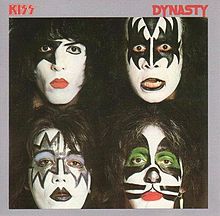
SOUNDTRACK: KISS-Dynasty (1979).

I was pretty excited to buy this album when it came out–a new Kiss album that wasn’t solo albums!  Woo hoo!  And the fact that it was disco?  Well, even though I said I “hated disco,” I didn’t really know what disco sounded like then (and really, aside from the middle “I Was Made for Lovin’ You” it’s not really a disco record) and plus my other favorite band was the Village People (and really, that makes a lot of sense–tw0 bands in over-the-top costumes talking about sexuality that I totally didn’t understand).

So, this album is hard for me to be critical about because it was such an essential part of my childhood, especially “I Was Made for Lovin’ You.”  I love it, and yet I can listen critically and appreciate that it’s really not that good.

But I’ll move on to the other songs.  “Sure Know Something” and “Magic Touch” really don’t seem that out of place chronologically with, say, the Kiss solo albums–they sound an awful lot like something off of Paul’s album.  So, despite the sort of slinky 70’s bass on “Sure Know Something”, they can’t have been that much of a surprise.  The guitar solos are short but have some interesting Ace sounds (I like the harmonics on “Magic Touch”).  It seems that while the other guys were embracing disco, Paul was keeping the Kiss sound alive.

Then there’s the Ace songs.  “2,000 Man” made total sense as an Ace song. I had no idea it was a Rolling Stones cover until fairly recently (and I like Ace’s version much better).  “Hard Times” feels like the sequel to “New York Groove.”  Not the music so much although maybe a little, but the lyrics–now that he’s in the city here’s what happened–the gritty reality. It’s one of Ace’s great, lost songs.  And check it out, Ace sings on three songs here!  (Guess having a #1 hit wasn’t lost on the Kiss powers).  “Save Your Love” has a cool descending chorus and a nice bass feel to it.  Ace certainly wins on this record.

Peter got only one song, “Dirty Livin'”.  In fact, this is the only song that Peter had anything to do with (his drums were re-recorded by Anton Fig).  It reminds me (in retrospect) of the Rolling Stones disco era even more than “2,000 Man,” the backing vocals remind me of something like “Shattered.”  I always liked this guitar solos on this (cool feedback).  Although I liked the song (along with the rest of the album), I don’t think it holds up very well.

Gene only gets two songs.  It amuses me how little he has to do with these late 70s albums even though he is always the leader of the band.  I always liked “Charisma” (I had to look the word up back then) even though it is, admittedly, rather discoey and really not very good.  It is fun to ask “What is my…charisma?”  But “X-Ray Eyes is the better Gene song on this record.  It harkens back to earlier Kiss songs and even has a bit of menace in it.

So, Dynasty was a huge hit for the band.  And they even got to mock it in Detroit Rock City the movie.  Cynical marketing ploy or genuine fondness for disco?  Who would ever know.

[READ: November 1, 2011] “The Brief Wondrous Life of Oscar Wao”

Readers of this blog know that after finding an author I like, I will try to read everything that he or she has written.  Close readers will know that if a writer is reasonably young and reasonably unpublished, I will try to read his or her uncollected work as well.  Well, I really enjoyed Oscar Wao the novel, so I decided to see what else Díaz had written. There’s really not a lot, to be perfectly frank.  There’s his short story collection Drown and a few fiction pieces published here and there (mostly in the New Yorker) and a few non-fiction pieces as well.

So this “short story” from the New Yorker (with the same title as the novel) is in fact an early, mostly the same, version of the Oscar story in the novel.  The thing here is to note the date: 2000(!).  The novel came out in 2007.  So, Junot had been working with this character for easily five years (giving time for the publishing industry to get a book out and all). The remarkable thing the is just how accomplished and polished this piece is and how much of it was used in the novel.

I’m curious to know whether this was written as a short story (it’s quite a long short story) or if it was always intended as a part of a novel.  Interestingly, when you read this story by itself and you realize that it is pretty much all of Oscar’s story in the novel, you realize just how little of Oscar is actually in the novel.  The novel is about Oscar, obviously, but it is really about his family and the fukú that was placed on them by the Trujillo clan.  Oscar is sort of the touchstone for the fukú, and the person whom the narrator knows most intimately but his story is also brief. (more…)

Read Full Post »

SOUNDTRACK: TOM WAITS- Foreign Affairs (1977).

This album is kind of a split between Waits’ bluesy songs and his “poetic rants.”  The only problem with the album per se is that he’s been doing this kind of stuff for five albums now and while he’s still good at it (great at it, actually), it’s probably time for a change (which he does on the next album).  This is not to say that the songs themselves are weaker than others, or that they are not at least slightly unexpected (the eight minute “Potter’s Field” is quite unexpected), just that when you know what he’s going to be doing,  this album feels like a pre-transition, one might even say a rut.

The disc opens with a pretty piano waltz (“Cinny’s Waltz”) that segues right into his jazzy nightclub sounding (ie. piano and sax) track “Muriel.”  The third track, “I Never Talk to Strangers” is a duet with Bette Midler (which I think makes sense given her persona, but I have simply never liked her–maybe that’s why I don’t like this album as much as I could).

“The Medley of Jack & Neal (about Kerouac and Cassidy) is a long rambling story about the two beats, it ends with a riff on “California Here I Come.”  In a similar vein–alluding to appropriate music–“A Sight for Sore Eyes” opens with the music from “Auld Lang Syne” before turning into one of Waits’ weepy ballads.

The second half of the disc is more storytelling as song.  “Potter’s Field” tells a lengthy story with occasional blasts of saxophone.  About midway through, it begins to sound like more of a musical–with the music adding dramatic effects to the lyrics–this may be a kind of foretelling of his more operatic music from Swordfishtrombones.  “Burma-Shave” is another long story (over 6 minutes).  This one is much darker (a fairly straightforward story of meeting a bad guy and going for a drive), but it’s a pretty good story for all of its noirishness.  “Barbershop” has a great bassline, but it is indeed about getting a haircut.  The album ends with the title cut, a sung ballad.

His next album, Blue Valentine, features electric guitars and keyboards and will change the sound of his songs quite a bit.

[READ: September 25, 2011] “Beatrixpark: An Illumination”

I don’t think I have read too many contemporary Italian authors (Italo Calvino is the only one who springs to mind).  Realistically, this shouldn’t make any difference to anything but this story seemed so off to me that I have to wonder if it’s something about Italian authors or if it is Voltolini is particular.  This story was translated by Anne Milano Appel.

The story begins by explaining that the main character is a man from the south.  Being very conscious of the fact that the author is Italian, not American, I worked hard to think of the bottom of the boot as opposed to Alabama.  Of course, being from Southern Italy doesn’t mean anything to me really, but I kept it in mind.   Then I find out the story is set in Amsterdam.  And then several paragraphs in, we learn that he is from Southern Europe somewhere.  Sigh.  To quote the story, “Gimme a break, provincial middle-aged man from the south!  Fuck off, why don’t you?” (more…)

Read Full Post »

SOUNDTRACK: DINOSAUR JR.-Live at the 9:30 Club, Washington D.C. October 8, 2009 (2009).

This was one of the first shows I downloaded from NPR.  I’ve been a fan of Dinosaur Jr. since my friend Al turned me on to Green Mind back in college.

This is an amazing show created by the original Dino Jr. members.  This tour is in support of their second album since reuniting, Farm. This set-list is an outstanding mix of old songs, new songs, Barlow-sung songs and even some songs from when Barlow and Murph weren’t in the band.  (Green Mind is still my favorite album by them).

When the band reunited there was much joy, and I’ve said in reviews of the newer albums, I’m not entirely sure why.  I mean, Dino Jr has always been about Mascis, and it’s not like Barlow is such an unusual bassist (although Murph’s drumming is always solid).  I’ve nothing against Barlow (I love Sebadoh and Folk Implosion) or Murph, it just seems odd to get excited about having them back in the band aside from nostalgic reasons.

Having said that, the band sounds amazing (and yes, Barlow does get to sing on “Imagination Blind”).  What never really came across to me until hearing all of these great songs live was that Mascis has always been a great pop song writer.  These songs are catchy as hell. But Mascis buries them under loud squalling guitars and a voice that is almost whiny, almost off-key, a total slacker voice.  (But you’ll notice it is never actually off-key.  He must work very hard at that.)

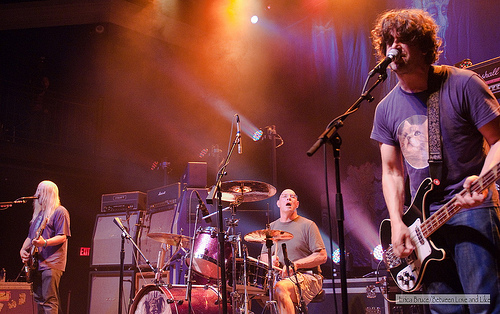
By the nd of the show Mascis chastises the audience for not moving (we obviously can’t see what they’re doing), saying he forgets that people don’t move in Washington, D.C.  But during the encore break, NPR host, Bob Boilen, points out that Mascis himself doesn’t move either–he just stands in front of that wall of Marshall stacks (Boilen wonders how he can hear anything anymore).  And looking at the pictures it’s comical the way he looks, surrounded by amps.  The picture above doesn’t fully do it justice, but check out the extra photos at the NPR page.  And while you’re there, listen to this show. It is amazing.  For a total slacker, Mascis can rock a guitar solo like nobody’s business.

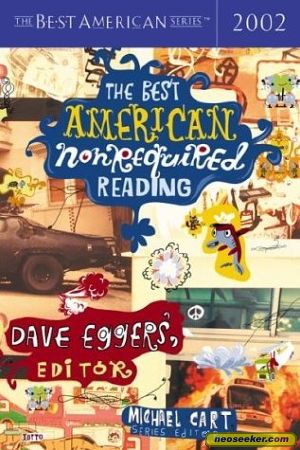
[READ: July 20, 2011] The Best American Non Required Reading

I’d been meaning to read this series for years (yup, Eggers fan), But I have a hard time starting “collections” because I feel like I’d rather be reading a novel.  Nevertheless, I have most of these Nonrequired books, so it seemed like I should dive into one and see what it was like (I don’t think the year really matters all that much–some of the articles are topical but most are not exactly).  Then Sarah said this would be a great book to read on vacation because it’s all short essays, and she was right.  It was perfect for late nights when I wanted something to read but didn’t feel like getting involved in the novel I was reading.

DAVE EGGERS-Introduction
Eggers’ introduction is actually a partial short story about kids who go swimming in pools around town. It reminded me of the opening of Life After God by Douglas Coupland, but of course, lots of kids did that so I’m not saying it was “lifted” from DC.  The story “ends” (it doesn’t really end so much as stop) with an interesting scene between two unlikely kids who get caught.

After this story Eggers includes these three notes about the collection: It’s not scientific, It’s alphabetical, and We had a lot of help with this.  Of the three, it’s the middle one that’s most useful because Eggers says that you shouldn’t necessarily read them in order just because they are printed this way: “In the first half of this collection, you get a good deal of hard journalism, primarily about war and refugees, from Afghanistan to the Sudan, followed immediately by a number of less serious pieces, about malls and Marilyn Manson.  We didn’t group anything by theme , and won’t be offended if you skip around.”  This was good to know (not that we needed the permission of course), but yes, the beginning of the book is pretty heavy. (more…)

Read Full Post »

« Newer Posts - Older Posts »