Feeds:
Posts
Comments

Archive for the ‘Etiquette’ Category

skin SOUNDTRACK: LOS LOBOS-Tiny Desk Concert #90 (November 10, 2010).

loslobosI don’t really know all that much about Los Lobos.  I frankly got sick of them because of “La Bamba” (which came out 20 years ago!) and I don’t think I’d ever heard much else by them.  So I wound up enjoying this Tiny Desk much more than I anticipated.

The one big problem with this tiny desk is that the drummer is playing one of those plastic mail bins and it sounds awful.  Especially on the first song.  I think anything would have had a better drum sound than that.

I really enjoyed the first song “Burn It Down.”  It has a propulsive minor key structure and an excellent bass line.  I would never have guessed it was Los Lobos, but that may be because it’s not the singer I most associate with them (he sings on the next two songs).

“Yo Canto” is a cumbia, sung by a different guy (in Spanish) who also plays lead guitar.  The mail bin sounds better on this song because of the placement (and use of) a cowbell.  The singer sounds amazing.  I rather like the riff that underlines the song.

Those two songs are from their then latest album.  And the band sounds really good all these years on.

The final song is “Don’t Worry Baby.”  It has the same singer as the middle song (this time in English) although it is a pretty standard blues song that I found just okay.  It also features a bunch of saxophone.  I didn’t realize that it was from their major label debut in 1984! and is something of a classic.

So three songs, all of them enjoyable, from a band I didn’t really think I’d enjoy.  The funniest part is just before the show stops and someone asks, “Okay, where’s the beer?”

[READ: October 1, 2015] How to Skin a Lion

This book sounded awesome–I love outdated things that we can laugh about now (because I’m a superior git, of course).

But this book proved to be not all that funny.  The outmoded advice wasn’t treated comically exactly (well, some was), rather it was looked at rather seriously–some as good advice that still stands, some as crazy advice that is way outmoded and a few things that are, yes, just comical.

Cock-Starkey (insert joke here) says that this is a collection of materials from the vast archives of the British Library.  It culls from medieval manuscripts, Victorian manuals and self-help guides from the early 20th century.  She explains that the book aims to reveal the secrets of lost arts, remind us of how modern conveniences have changed our lives, recall the complexities of etiquette, highlight changing attitudes and beliefs and furnish us with still useful tips and guidance.

Although she also points out that readers should be advised that some pieces of advice contained herein have stood the test of time better than others. (more…)

Read Full Post »

peasSOUNDTRACK: VILLAGERS-Tiny Desk Concert #69 (July 19, 2010).

villagersVillagers is the work of Conor O’Brien. On their debut album he played all the instruments and created the cover art.  Live, he has a full band, but in this Tiny Desk show it’s just him and his guitar.

He looks incredibly young (that haircut), but when he sings, he sounds sophisticated and mature.  And his guitar playing is equally sophisticated (with some really interesting chords on the high notes of his strings).

His playing is crisp and clean and his voice is really lovely.  He doesn’t do anything fancy, he just sings and plays, but he has a lot of power and honesty in what he does.

And lyrically, he is quite clever.  He surpasses many singer-songwriters.

His three songs “Ship of Promises,” “Becoming a Jackal” and “Twenty Seven Strangers” are all on his debut album Becoming a Jackal.  He hits an amazing series of high notes in “Ship of Promises,” and the way the song takes some unexpected (albeit brief) pauses is quite dramatic.

I like the way he slowly and confidently states the title “Becoming a Jackal.”  This song is a bt faster and more dramatic, especially the quiet ending.

“Twenty Seven Strangers” is a story song about taking the bus.  It is an unexpected perspective and quite an interesting look at a mundane event.

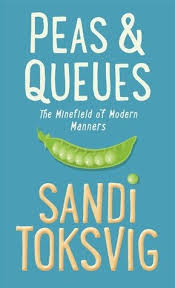
[READ: August 2, 2015] Peas & Queues

I was disappointed with the previous etiquette book, which was supposed to be funny and I think wasn’t all that serious.  But this one, which is indeed serious, was also really funny, and was a real delight to read.

According to her bio on the book, Sandi Toksvig is “a well-known broadcaster for both television and radio.”  But I’d never heard of her.  It seems that she is big in Britain, but I believe is unknown here.  Nevertheless she has written over twenty books, including fiction, non-fiction and children’s.  So maybe I’m just out of touch.

Anyhow, I grabbed this book because it sounded interesting (and I liked the jokey spelling of the title).

Toksvig explains in her introduction that in 1520 when Erasmus wrote his book on manners it was dedicated to an 11 year old boy (a son of a prince).  This book is dedicated to “a delightful child in my life” called Mary who is currently 8.  But it is not a book for children, it is meant for Mary as she grows up.  And you can tell right from the start that Sandi is pretty funny as she says “I hope it will prove useful to anyone not planning to live as a hermit.  [Unlike Erasmus] I have made it easier for her (and you) by not using Latin (very much).”

And then Toksvig explores good manners from birth through death.  She even starts with “Why do we need good manners” (a question my kids currently ask).  The first thing to say is that basic manners apply no matter where you are or what you are doing.  They are even a good idea when no one is watching.  Having a code of behaviour will help you know how to react to the unexpected.

But it’s also important to know that rules about manners are not laws or rules, they are suggestions–propositions for behaviour to help grease the wheel of the great social machine. (more…)

Read Full Post »

mannersmillionSOUNDTRACK: THE MYNABIRDS-Tiny Desk Concert #64 (June 21, 2010).

mynabrodI wish I liked The Mynabirds a bit more than I do, especially after hearing the origin story of the band’s name.  Laura Burhenn says she wanted to create a band that was sort of like Neil Young playing Motown.  She toyed with the name Myna and came up with The Mynabirds and then found out that in the 1960s Neil Young and Rick James had made music together for Motown under the name The Mynah Birds.  Cool.

Burnhenn has a sultry kind of voice, which is nice.  But I don’t really like Motown, so the “ooh la la” in the verses and the whole sound of the chorus of “Numbers Don’t Lie” is not my thing.

I prefer the second song “Let the Record Go” which is a bit faster and more rocking (and I like the oh’s at the end of each verse much more).  The final song is by request from Bob.  It’s the lead off track from the album “What We Gained in the Fire.”  It’s a slow broody opener with interesting lyrics.  It has a R&B feel and is a fine song.

It’s possible that I am confusing them with someone else, but I thought the band was more folky, so this was a little disappointing to me (although they are clearly very good).

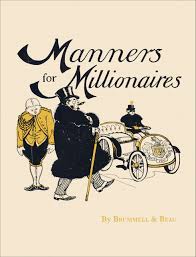
[READ: June 19, 2015] Manners for Millionaires

I saw this book at work and thought it sounded really funny.  A 1900 British book about millionaires?  With that obvious pseudonym?

The opening prefatory note says that “the coloured plates specially prepared for this volume had at the last moment to be omitted owing to the unfortunate indisposition of the Academician employed, but rather than disappoint the Public we have inserted instead a few specimen woodcuts from a forthcoming treatise on British Fishes.”

Great, so, silly, nonsensical fun, right?

Well, the problem for me with this book is that it supposes you know a lot about wealth and the aristocracy of England circa 1900.  Gah.  I’m not even exactly sure who the intended audience was for this book. (more…)

Read Full Post »

gulpSOUNDTRACK: PET SHOP BOYS-Elysium (2012).

220px-PSB_ElysiumPet Shop Boys are known for big dancey singles.  And so perhaps it’s something of a surprise to get this album which is pretty but certainly low key.   It’s not like they haven’t written low key songs before, but there’s very little to get up and sing about here.

Which is not to say the album is bad.  It’s actually very good once you accept the lack of big songs.

Of course, having said that, there are one or two anthemic tracks, but the album overall is more introspective (unlike their album Introspective).  The title, Elysium refers to the afterlife where those chosen by the gods would live a happy (after)life, indulging in whatever they had enjoyed in life.  Yes, mortality is on Tennant’s mind.

“Leaving” opens the disc with a great chorus, which leads to this somber opening verse: “Our love is dead but the dead don’t go away.”  And that certainly sets the tone–nice synth rock, but nothing to loud and frenetic.  “Invisible” is a similarly low key song.   This is one of their quiet ballads, with just touches of synth melody: “I’m here but you can’t see me, I’m invisible.”  It’s a definite downer of a song but it’s very pretty.

Of course all that I said about mellow low key albums is belied by the third track: “Winner.”  This was written in time for the 2012 Olympics in London and it is very much an anthem about, well, winning.  It’s kind of obvious (although lyrically it is more in depth than many similar songs), but the melody is just simple and uplifting–(just what you’d want for Olympic documentaries).

“Your Early Stuff” is a much darker song–it is a song written to a “washed up” performer: “you’ve been around but you don’t look too rough and I still quite like some of your early stuff.”  It’s funny but also tender.  “A Face Like That” is the closest thing to a dance single on the album–it’s fast and synthy and the vocals are echoed and repeated.  But even the verses are more low-key than you might expect from the chorus.  “Breathing Space” is another pretty ballad.

“Ego Music” is another faster song, with a very funny premise: “ego music–it’s all about me.”  It’s a slight song but good for a laugh.

“Hold On” also aspires to anthemicness, but it is slower than a typical PSB anthem.  It also has a synth line that is vaguely classical.  Although of all the songs, this one is lyrically the most tautological:  “Hold on, there’s got to be a future or the world will end today.”  “Give it a Go” is a slower, simpler track. Not too memorable, although the chorus is bouncy and catchy h.

“Memory of the Future” has a great synth line and Tennant’s cool accompanying vocals–it’s a classic PSB song and one of my favorites on the disc.  Although I don’t love “Everything Means Something,” the final song, “Requiem in Denim and Leopardskin” is a great ending–slow but very catchy and rather wry and funny.

So this album overall is certainly more, dare I say it, “mature” for the Pet Shop Boys, but they haven’t lost any lustre in songwriting.

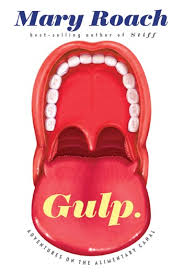
[READ: Summer 2013] Gulp

Yes, that date is correct, I read this book over a year and a half ago.  I meant to write about it then, but I loaned it out to someone and I like to have the book nearby when I write about it.  So I put it off and put it off and now that I have the book back, I will do my best to remember whatever I can about it.

But the thing about this book is that it was so memorable, I won’t have much trouble writing about it anyhow.

Mary Roach investigates the physical properties of eating from pre-digestion through to the end.  And she does it with thorough research and a boatload of humor (sometimes gross out humor, although she warns that that is not her intent–“I want you to say, ‘I thought this would be gross, but it’s really interesting.’  Okay, and maybe a little gross.” (19).

She begins with the nose.  Most people know that the nose contributes tremendously to your sense of taste.  But Roach really explicates how much.  She speaks to a woman, Langstaff, who is a professional sniffer and who is currently staffing the Olive Oil taste Panel at the Olive Center.  She is training novices to be be better at tasting flavors.  But Langstaff herself for instance rarely drinks beer for pleasure even though she is an expert at tasting it.

The most amusing (or not, depending) information here is that there are people who were paid to taste cat food.  Yes.  And that humans prefer cat food with a tuna or herbal flavor over those that taste “rancid,” “offaly,” “cereal” or “burnt.”

Fortunately, the second chapter shows that it is actually dogs who test the dog food.  It turns out that dogs and cats really shouldn’t enjoy dry dog food (cats and dogs are not grain eaters by choice).  Dry dog food was created as a means of convenience for people (and as a way to stop tinning food during the war).  As for your pets, “pet foods come in a variety of flavors because that’s what we humans like, and we assume our pets like what we like.  We have that wrong.  ‘For cats especially…change is often more difficult than monotony.'” (43).  Some other pet observations: cat’s can’t taste sweet (although dogs can and rodents are slaves to it).   (more…)

Read Full Post »

CV1_TNY_12_09_13Banyai.inddSOUNDTRACK: THE REPLACEMENTS-“Alex Chilton” (live on the Tonight Show) (2014).

matsI was pretty surprised to hear that the Replacements were going to be on the Tonight Show (and even more surprised to hear that they were going to play “Alex Chilton.”  I didn’t realize they were touring (or reunited or whatever they are), and I knew that at least one of the former members had died.  So, really this version of The Replacements is just Paul Westerberg singing and Tommy Stinson on bass.  The other two guys Dave Minehan on guitars and Josh Freese on drums are new as of 2012 (but have a history of working with Westerberg).

It was great to hear this song.  I never saw them in their heyday, when I understand the odds of them being drunk were 100% and the odds of a great show or a disastrous show were 50/50.

I’ve no idea how sober the guys were, but this version of the song was super sloppy (in a good way) and made it seem like they were channeling the ‘Mats of old.  Guitarist Minehan has played on Westerberg’s solo albums, so there is a connection, and he seemed to get that “can’t be bothered to hit every note” vibe.  Even Westerberg was skimpy with all of the words (was he having fun or annoyed at being there?  who knows).  But they weren’t sloppy bad, especially when the song ended and they added on a coda–they were all super tight and right on tempo.

It was good to hear, but I have to admit I like the album version better.

[READ: June 26, 2014] “The Late Novels of Gene Hackman”

Rivka Galchen had two short stories in the New Yorker in 2013, one in January and now one in December.

The story is about J, a young woman who makes presentations to older people, in this case in Key West, Florida.  She had accepted the invitation to the writers conference because it was going to be in February in Florida, and that seemed like a good time to be warm.  J was allowed to bring a guest, and she decided to invite her stepmother, Q, rather than her husband.  She felt a little sorry for Q, whose latest business venture had failed and whose hair was turning gray.  J is under the impression that Q is having financial troubles, she keeps talking about things that make it seem like she does, but J can never get a straight answer out of her.

They were picked up by M (this initial thing was a little confusing but ultimately more comical, I decided) who had organized the convention.  M had married a much younger woman, but she had recently died.  “Of something.”  M also had an eye patch, and J told Q not to stare at it, “‘I would never stare at an eye patch,’ Q said.”  (more…)

Read Full Post »

[LISTENED TO: August 2014] Horton Halfpott

hortonLast summer we listened to Angleberger’s book Fake Mustache, which was one of my favorite audio books ever (until the League of Princes series).  In fact we just re-listened to fake Mustache and enjoyed it even more the second time! I was pretty excited to listen to Horton Halfpott as well because it has two subtitles.  Since we had a long drive ahead of us, it seemed the ideal time to bust out Horton.

And while I did enjoy the book by the end (quite a lot in fact), I found it a little slow going in the beginning.  This book was narrated by Ron Keith, who is British.  There is nothing weird about that because the book is set in Britain.  It is just such a stark change from Fake Mustache (which was so very American) that I think it took a while for us to adjust to the rather stiff and formal (but funny) reading that this book had (compared to the wild and crazy reading of Mustache).  Since the book is a kind of spoof on Dickensian class stories, the narration makes perfect sense.

This entire adventure begins on the day that M’Lady Luggertuck loosens her corset (the narrator apologizes for even talking about an old lady’s underwear, but it is crucial to the story):

There are so many exciting things in this book — a Stolen Diamond, snooping stable boys, a famous detective, the disappearance of a Valuable Wig, love, pickle éclairs, unbridled Evil, and the Black Deeds of the Shipless Pirates — that it really does seem a shame to begin with ladies’ underwear.

M’Lady Luggertuck usually wears her corset very very tight, and she acts like she has on a very very tight corset–there is no happiness to be found in Smugwick manor. But on the day that she asks her maid to loosen the corset a little bit, a kind of shock wave floods through the castle, which seems to encourage everyone to loosen up just a bit.

Everyone, that is except for Horton’s superior, Miss Neversly.  Miss Neversly is a mean mean woman, always ready to hit someone (especially Horton) over the head with a wooden spoon (ouch), always ready to doubt someone, always looking for and never receiving praise from M’Lady Luggertuck.

Horton, by the way is a kitchen boy.  He is not a bad boy at all, just an unlucky boy in a bad situation (see, the set up is very Dickensian, and Angleberger thanks Dickens in his acknowledgments).  Horton’s best friend is a stable boy named Bump. They are also friends with the other stable boys Blight and Blemish.  And the story is certainly sympathetic to these poor lower class individuals. (more…)

Read Full Post »

nycSOUNDTRACK: TOM BROUSSEAU-Tiny Desk Concert #347 (April 12, 2014)

brousseauI only know of Tom Brousseau from NPR–both All Songs Considered and WNYC’s Soundcheck have played him a lot.  Of course, I had no idea what he looked like (an didn’t expect what he does look like either).  His voice is a little high-pitched (the Tiny Desk site says people think he’s a woman, although I don’t really hear that), but it’s very compelling.  Mostly you listen to Brousseau for the storytelling lyrics.

“Cradle Your Device” is a very funny song about how technology can interfere with your romantic life.  The second song “Stuck on the Roof Again,” tells a true story about the octogenarian newspaper columnist Marilyn Hagerty, who got stuck on the roof of her home in Grand Forks, N.D., after a heavy snowstorm.  He introduces the song with a lengthy story about Hagerty and her food critic reviews (of The Olive Garden of all things) which have suddenly gained her fame.  There are some pretty harmonies by his accompanist Sean Watkins

Brousseau is a charming and earnest storyteller, and it’s fun to hear what he has to say as much as what he has to sing.  The third song is “Today is a Bright New Day.”  He says it’s early in the morning for him to hit the high notes, and he does struggle some.  But he gives a great performance nonetheless of this pretty, earnest song.

I’m not sure if I’d want to hear a lot more of him, but I enjoyed this set quite a lot–maybe a live record is the way to go.

[READ: June 18, 2014] NYC Basic Tips and Etiquette

I found this book at work and couldn’t pass up reading it.  The fact that it’s small and has few words meant I read it in about 20 minutes.  But don’t let the brevity fool you, there’s a lot of useful information for novice New Yorkers, tourists and maybe even some old school New Yorkers (although they won’t admit it).  The audience seems to be primarily those who have just moved to the City, although as I say, tourists will find it useful, too.

There are two components to this book: Tips and Etiquette. I have worked in NYC so I am certainly familiar with the City, but I found some of the tips (especially subway tips about unfamiliar areas) to be very helpful.  Even simple things like mnemonic devices for streets in the Village or recognizing buildings or bridges (Manhattan made of metal; Brooklyn built from bricks) were quick and easy devices.  And he lets us know that even if NYC is much safer than in days of old, we should still be aware of some common scams.

But the bulk of the book is about etiquette.  It is designed for people n New York, but at least 80% of the etiquette is useful anywhere.

The more specifically New York based items are things that remind you that New Yorkers are often in a hurry–oftentimes they are not being rude, they are simply commuting and need to get where they are going.  So, you should a) be decisive and b) be assertive.  People are probably waiting behind you and they will certainly try to go around you if you are too slow.  So order your food quickly and move up a line quickly.  The one etiquette thing I liked best was his comments about not looking at your phone while you are on the streets. Not only are you distracted and might bump into someone, but you might miss your soulmate. (more…)

Read Full Post »

« Newer Posts