Feeds:
Posts
Comments

Archive for the ‘Essays’ Category

SOUNDTRACK: LETTERS TO CLEO-“Cruel to be Kind” (1999).
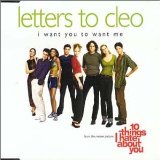
I’ve liked Letters to Cleo since I first heard them back on WFNX radio in Boston.  And since I had a dog named Cleo and their album was called Aurora Gory Alice, how could I not love them?

This cover of Nick Lowe’s song comes pretty close to the end of their career when they were poppier and slightly less indie.  In fairness, they were always a poppy band and their hooks were irresistible, but they had a bit more of an edge in the beginning.

This cover is pretty spot on.  There’s not a lot of “Cleo” put into it.  It sounds a lot like the original, only sung by the wonderfully voiced Kay Hanley (she sang Josie’s parts in the (terrible) Josie and the Pussycats movie, the title song for My Friends Tigger & Pooh and (gasp) as a backing singer for a Miley Cyrus tour (that’s the sound of my indie heart breaking).  I love her voice (she has a strange pronunciation/accent of some words that I find endearing), so I find the LTC version better than the original, but it’s honestly not all that different.

[READ: Week of November 16, 2010] Consider David Foster Wallace [essays 4-6]

These three essays cover the novella “Westward…” and Infinite Jest.  I was pleased to begin the essays about IJ because I know that novel far better than I know the short stories or Broom of the System.

As I mentioned in the previous entry:  because I don’t have a lot to say about the pieces, I’m only going to mention things that I found puzzling/confusing.  But be assured that if I don’t mention the vast majority of the article it’s because I found it interesting/compelling/believable.  I don’t feel comfortable paraphrasing the articles’ argument.  Besides, what would be the point of that? (more…)

Read Full Post »

SOUNDTRACK: fIREHOSE-“fROMOHIO” (1989).

After the punk of The Minutemen, you wouldn’t expect the sound of fROMOHIO to come from Mike Watt and friends.  The opening song, “Riddle of the Eighties” is quite poppy, but with a countryish flair.  In fact, much of the beginning of the disc sounds not unlike the Meat Puppets–southwestern punk.  Track two, “In My Mind,” has a wonderful latin/Mexican feel to it (singer Ed Crawford has that whole southwestern vibe down quite well, even if they are from Pedro).

The disc also has what I’ve learned is that peculiar SST Records sound–almost nonexistent bass, despite what Watt is accomplishing.  Actually the bass is there, and it’s mixed fine but it’s much lower than you might expect for what they’re playing.

Even track three “Whisperin’ While Hollerin'” which is all about the bass (with cool blasts of guitar over the top) doesn’t have a lot of low end in it.  The bass sounds crisp and clear (which is good), just not very deep.  “Mas Cojones” is a weird one.  Funk bass with disco guitars over the top and some odd spoken word from Watt.

The highlight is “What Gets Heard,” a great funky fast bassline with angular guitars and vocals by Watt.  Near the end of the disc, “Some Things” is another solid song, really typical of this period: great bass, great guitar work and yet still a lot of punk.  And “Liberty for Our Friend” is a great folk singalong, and I dare you not to singalong by the end.

There’s also some fun, unexpected bits.  There’s a pretty acoustic guitar solo called, “Vastopol” and two (!) drum solos “Let the Drummer Have Some,” and the wonderfully titled, “‘Nuf That Shit, George.”

And its all packaged as really short songs (most around 2 minutes, with late songs running longer).  It’s a fun disc and a worthy addition to the SST catalog.

[READ: October 25, 2010] “Caught”

After the seriousness of “My Father’s Brain,” this true story about Franzen’s wicked days in high school was tremendously enjoyable, possibly one of my favorite pieces that I’ve read by him.

The piece opens with the incredibly tempting story about students successfully pranked their high school by managing to get a tire over the top of a 34-foot flagpole.  This sets in motion Franzen and friends’ attempts to do the same to their school’s 40 foot flagpole (there’s even a diagram or three!).  The story is exciting and filled with secretive plotting as they try so many different ways to get that tire over the top of the flagpole.

There’s a great bit of self-deprecation from Franzen.  He admits that although one of his friends was far more architecturally-minded, he himself was far more persuasive.  Ultimately, their gang put his “Devices” to work, which are universally decried as pieces of shit.

Although I assumed that the tale would focus only on their attempts at flag pole ringing, in fact the group undertook many pranks.  At first they called themselves U.N.C.L.E., but then they changed their name to the far more amusing (with an incredibly involved explanation) DIOTI.  DIOTI undertake several delicious pranks including removing the clappers from all of the bells in the school (and leaving a series of poems as  clues for where they are) and piling all of the classroom desks into one room.  (The “centrally located” comment and its resultant embrace by the school is simply wonderful). (more…)

Read Full Post »

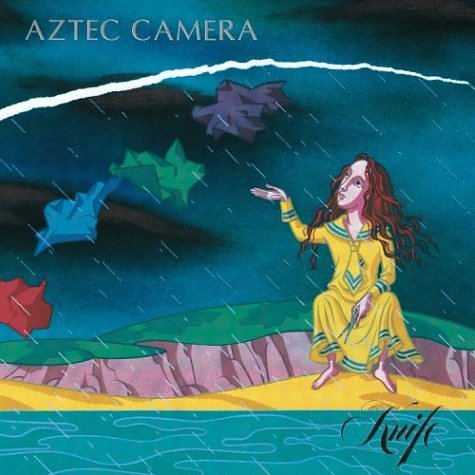
SOUNDTRACK: AZTEC CAMERA-“Jump” (1984).

This is a wonderfully twisted covered of Van Halen’s “Jump.”  VH’s version of “Jump” is bouncy, lively, fun, it makes you want to yes, Jump!  It was many years after the release of VH’s “Jump” that I heard the Aztec Camera version (even though it was released the same year).  The first time I heard it I assumed it was a joke.

I didn’t know much about Aztec Camera (and actually still don’t–looking at their Wikipedia page I don’t recognize the names of any of their singles).   But I have grown to love this cover of “Jump.”  In fact I prefer it to the original.

The opening chord structure makes me think it’s going to be the Rolling Stone’s “Waiting on a Friend” but instead of Jagger’s ooh oohs we get Roddy Frame’s deep voice practically whispering the lyrics that David Lee Roth made famous.  And it stays with this delightfully mellow acoustic style and pacing throughout.  The guitar work in the bridge is actually much more interesting than the bridge in the Van Halen version (ouch).

The chorus seems kind of odd with his very mellowly saying “jump” (although David Lee Roth doesn’t scream “jump” either, it’s the backing vocals that do the exciting part).  I feel like the original VH version hasn’t held up that well, but the Aztec Camera version shows that it’s quite a good song.

Check it out here.

[READ: Week of November 8] Consider David Foster Wallace [first three essays]

I lied.

I said that I wouldn’t feel up to writing posts about all of the articles in this book on a regular basis.  As it turns out, I don’t have a lot to say about these essays, but I had a few thoughts about each one.  Since there’s a group reading going on, I thought it might be fun to post these thoughts now while people were still speaking about the articles instead of waiting until the end.

Before I say anything about this articles, I want to preface that I’m not going to repeat things that were said in the group read (for a couple of reasons).  Everything here is going to be things that I felt about the article and maybe, if something another reader says really sticks with me, I’ll mention it as an influence on me.

Having said that, in one of the comments, author Clare Hayes-Brady says that her article is a part of a longer thesis.  I found this to be a very useful thing to know, and I assume that she is not the only one who had to compress her article because of size and time constraints.  With that in mind, I’m going to accept that if it seems like the author could/should say more about a certain thing within the article that there is probably a larger version of the piece.

And finally, because I don’t have a lot to say about the pieces, I’m only going to mention things that I found puzzling/confusing.  But be assured that if I don’t mention the vast majority of the article it’s because I found it interesting/compelling/believable.  I don’t feel comfortable paraphrasing the articles’ argument.  Besides, what would be the point of that?

(more…)

Read Full Post »

SOUNDTRACK: FUN BOY THREE-“Our Lips Are Sealed” (1983).

In an interview with David Foster Wallace’s sister, she says that David spent an entire summer listening to this song.  Most of us know the Go-Go’s version which is bubbly and playful (even though the lyrics–which are the same–are quite dark).

I’ve had this song on some compilation or other for years and I’ve alway thought of it as a kind of novelty.  And yet the more I listened to it, the more I liked it (and the more I liked it more than the Go-Go’s version).

Terry Hall, the singer of Fun Boy Three (and The Specials), co-wrote the song with Jane Wiedlin.  And it’s funny to hear how very different the two cowriters made their versions.

There’s definitely a new romantics vibe to the Fun Boy Three version, but the great bass backing vocals bring a coolly mysterious element to the song.  And if you check out the live version, you can see the polar opposite stage manner from Belinda Carlisle.  Terry Hall makes Robert Smith seems gregarious and silly.  And yet, for all of the darkness of the song, it’s still hard not to bop along to.  It’s pretty wonderful.

[READ: November 7, 2010] Consider David Foster Wallace

A group read of Consider David Foster Wallace is currently underway.  I had planned to read along and contribute weekly posts here.  I read the first two articles and, as it turns out, I have literally nothing useful to say about them.  And I certainly don’t have enough to contribute a weekly opinion about them.

It’s not that they are bad, not at all.  The onus is mine.  I am out of academia for something like a decade now.  I am totally out of practice for coming up with clever arguments and rebuttals to well researched pieces.  I have also seen a few people’s comments and critiques of these pieces and I realize that I am just not in the right mindset to be a productive member of the academic community.

But that doesn’t mean that I’m not going to read it and write a post when I’m done (I’ll likely follow along with the discussions, so this book won’t get posted for quite some time).

In the meantime, I wanted to say a few words about the preface and introduction.  (more…)

Read Full Post »

[LISTENED TO: October 20, 2010] Readings

This (all too brief) collection of readings by David Foster Wallace includes several excerpts and a few shorter pieces.  I’ve noticed that there seem to be more and more videos (audios) of DFW reading on YouTube.  If I had time I would try to gather all of these videos (or even just try to watch them), but for now, I’ll stick with what’s at the David Foster Wallace Audio Project.

The Consider the Lobster reading is an excerpt from”The View from Mrs. Thompson’s”.  I’d never heard him read this piece before and it is a fascinating look at the events of 9/11/01 from Bloomington, Indiana.  I haven’t read the piece in a few years and it was quite affecting to hear him read it aloud.  The introduction was also interesting because he mentions that this is the quickest piece he has ever written (I wonder how many drafts he was able to do in that short period). (more…)

Read Full Post »

[LISTENED TO: Week of October 10, 2010] David Foster Wallace interviews

There will soon be a group read of Consider David Foster Wallace, a book of essays about, yes, David Foster Wallace.  In a sort of preparation for the group read, I decided to immerse myself in the available audio files online.

The David Foster Wallace Audio Project hosts quite a vast collection of audio files, including interviews, readings and eulogies.  Even the Howling Fantods points to it.

I started with the interviews.  They cover the period from Infinite Jest to Consider the Lobster.  For the most part, the interviews took place on various NPR stations.  There are not a lot of details given about the items on the site (which is the only flaw that I can see with the site), but you can more or less tell from the titles given what book is the cause for the interview.

I know that DFW was not a fan of interviews, yet I can’t help but be surprised at how few interviews actually seem to be extant (or at least preserved online).  You can see a list of all of the interviews on the site.  I’m listing and giving very brief notations for some of the longer interviews, but I just don’t have the time/inclination to go into great detail. (more…)

Read Full Post »

SOUNDTRACK: THE VIOLET ARCHERS-Sunshine at Night (2008).

This is the second Violet Archers CD.  It’s a fantastic collection of mellow songs.   “You and I” is a delightful acoustic guitar and vocals song (and Vesely’s voice sounds great: soft and delicate without being whiny).  “Insecure” features the vocals of Ida Nilsen (a great voice which works wonderfully with Vesely’s songs).  It also has a wonderful trumpet solo (!) (which consists of only a few notes repeated but which is totally great).  It sounds a bit too similar to Siberry’s “The Speckless Sky” but it wins out with its own identity by the end.

“Transporter” is an electric track (still mellow though).  Vesely’s delivery is great on this, with unexpected delays making it just off the beat.  Although “Tired” (we can tell by the titles that Vesely is not a “Party On” kind of guy) rocks much harder than you’d expect for the title, it’s still nothing like a hard rock song.  “Sunshine at Night” continues in this louder vein, but again, Vesely’s voice is soft, so even a louder song doesn’t rock hard.  This has some great harmony vocals.

“Suffocates” returns to the upbeat acoustic style while “Truth” is its cool minor chord downbeat companion.  “Themesong” is a cute, more upbeat track that finally mentions a violet archer.  “Don’t Talk” is the only song that builds from a standstill (as opposed to just starting) and the drums and power chords make it feel like it’s a bid for commercial viability.  And the disc ends with “Listening,” a quiet lullaby of a song that showcases’s Vesely’s falsetto.

The Violet Archers still tour and there are some downloadable shows available on the Rheostatics live website.  And, of course, Tim was super nice, so let’s hope for a left field smash hit on their next disc.

[READ: September 29, 2010] “Anti-Climax”

This piece is from The Critic at Large section of the New Yorker and it seems to be a kind of Books redux section.

I enjoyed this piece more than I had a right to enjoy a thirteen year old article about sex books.  Strangely enough it begins with a comment about televisions in airports (which I agree with JF that they are the devil and are unavoidable and make it really hard to read).  And I cannot even imagine that 89% of air travelers believe that the TVs make “time spent in an airport more worthwhile” (although you know that is one of the more nebulous survey questions)

But this topic segues into the matter at hand: sex books.  He notes how he is also at odds with the norm when Men’s Health says that lingerie is the US male’s favorite erotic aid.  And I can’t believe how in tune I am with JF Franzen’s comment:

What I feel when I hear that the mainstream actually buys this stuff is the same garden-variety alienation I feel on learning that Hootie & the Blowfish sold 13 million copies of their first record, or that the American male’s dream date is Cindy Crawford. (more…)

Read Full Post »

SOUNDTRACK: VIOLET ARCHERS-End of Part One (2005).

The Violet Archers are the new(ish) band for Tim Vesely from the Rheostatics.  I’ve conveniently waited until The Rheos completely broke up before really really getting into them.  And it took me some time before deciding that I needed to get The two Violet Arhcers discs.  And then I discovered they were pretty much unavailable.

But the nice folks who used to sell their discs got me in touch with Tim himself, and he very nicely sent me the two CDs (for a most reasonable price).

When a band breaks up it’s always interesting to see what the solo members do…if they try to go very different from the original band or if they stay the same.  Well, the Rheos were a pretty unusual band, and if these two discs are any indication, it seems like Tim may have been the pop song writer.

“End of Part One” starts with a guitar and cool organ opening before the song kicks into a mellow rocker.  “Coordinates” has more interesting keyboard sounds (these sound strange to me because the The Rheos weren’t very keyboardy).  Lyrically, it’s a great collection of rhymed verses that lead to a wonderful na na na chorus.

The middle songs are a nice mixture of slightly fast rockers and almost folky ballads.   Vesely has a great knack for sing along choruses, but he’s also been alt-enough to know when to throw in an unexpected twist, or an interesting sound (the guitar sound in “Saved Me” is great) and the simple melody of “Simple” makes for a beautiful campfire song.

“Time to Kill” is a delightful gentle rock song with a great chorus and instrumentation.  It sounds like an outtake from a fantastic 1960s compilation.  It’s followed by “All that’s Good” which sounds like an awesome long-lost Neil Young song.  The guitar is spot on and the vocals work wonderfully.

“Fools Gold Rope” is a nice ballad with vocals by Ida Nilsen.  And the last four tracks are all shorter pieces.  “Life and Then” features keyboards prominently, while the oddly titled “Track Display” has some nice guitar work.

This is overlooked pop gem. Nothing is overly commercial, and yet it’s all fun and an enjoyable listen.  I’m glad Vesely is still writing great tunes.

[READ: September 28, 2010] “Sifting the Ashes”

This Dept. of Disputation piece is about cigarettes.  I’ve never smoked and I’ve never been much of a fan of cancer sticks.  However, I find myself siding with Franzen on a few points ion this article.

Franzen has evidently quit smoking several times (it’s even unclear from the way this is written if he’s actually smoking now (1996) or not).  But he never blames Philip Morris or RJ Reynolds for his addiction.  He argues correctly that marketing to kids reserves you a place in hell, but that really, parents and pop culture probably got more kids to smoke than Joe Camel ever did.

He makes some funny observations about smoking (getting freaked out about getting lung cancer?  Why not light up to calm down).  But mostly he notes how all of the attempts in the past to curb smoking have resulted in more hegemony for the big players: The ban on TV advertising saved the industry millions of dollars and froze out new competitors.  Even tax increases on smokes in 1982 were a way for the industry to also raise prices (and make more money) all the while blaming the tax.  And what we wind up with is that no plaintiff can realistically claim ignorance of tobacco’s hazards, therefore the companies will never be deemed negligent for selling cigarettes.

(more…)

Read Full Post »

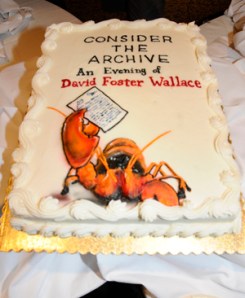
[LISTENED TO: September 27, 2010] Consider the Archive

On September 14, 2010, The Harry Ransom Center at the University of Texas commemorated David Foster Wallace through an evening of his readings and (I love this) Wallace-themed refreshments.  It was also the opening of the Wallace archives at the Center.

[UPDATE: November 8, 2010: The research archives have gone online, details are available here.]

There was a live videocast of the evening, which included excerpts from several of his books. I didn’t get to watch it, but I was able to get an audio copy of the event.

The evening’s readers were:

  • Molly Schwartzburg –Introduction
  • Wayne Allen Brenner, L.B. Deyo, Kurt Hildebrand, Shannon McCormack–The Broom of the System (Grand Ohio Dessert excerpt)
  • Doug Dorst, L.B. Deyo–Correspondence with Don DeLillo
  • Owen Egerton —Infinite Jest (1960, Jim’s Dad)
  • Jake Silvertstein and Kurt Hildebrand–A Supposedly Fun Thing (skeet shooting excerpt)
  • Elizabeth Crane–Infinite Jest: (Avril & Mario)
  • Chris Gibson–Commencement Speech (This is Water) (more…)

Read Full Post »

SOUNDTRACK: PAVEMENT-Slanted and Enchanted (1992).

I decided to go back and give a good listen to Pavement since I’ve always liked them but never loved them And, yes, they were in Central Park the other night).  So I started at the beginning.

I listened to the disc about a half-dozen time at work and I really started enjoying it a lot more by the end. It’s a difficult album, one that doesn’t actively embrace its listeners.  It’ a noisy, sloppy album (and that’s one reason why I like it), but there are hints of melody within.

Because I’m not in the moment, I can’t decide just how revolutionary this album was.  Nearly twenty years later it sounds like any number of noisy distortion fueled, lo-fi recordings of the period.  You can hear all kinds of influences on the band, Sonic Youth, The Fall, even The Replacements.  So, it’s not like they created something out of the blue.

Perhaps they were the first band to consolidate these influences into this particular stew.  No songs really stand out for me, as this seems more of an album of sounds that a collection of songs.  I rather enjoyed some of the oddball instrumentals and the use of keyboards, (which seem too polished for their sound: out of tune guitars and scratchy vocals).

It’s a fun record, and it certainly sets a tone and an agenda for the band.  I’m just not blown away by it.

[READ: September, 22, 2010] “Meet Me in St. Louis”

As I mentioned in the Franzen article the other day, I missed the whole brouhaha with Oprah and Franzen.  This article, which touches on that somewhat, gives Franzen’s perspective on what happened.  But primarily it shows (his take on) the videorecording that happened for his big Oprah TV show.

Mostly it involves Franzen driving around St. Louis.  Franzen grew up in St. Louis but spent most of his adult life in New York City–which is where he considers his home.  However on the book tour for The Corrections, he stopped in St. Louis.

The producers of Oprah wanted to film his great homecoming, even though he never felt it was one.  About two years before this event he and his brothers sold their family house after his widowed mother died.  That was the last time he had been to the house, and he had planned to never return. (more…)

Read Full Post »

« Newer Posts - Older Posts »