Feeds:
Posts
Comments

Archive for the ‘Essays’ Category

SOUNDTRACK: RICHARD THOMPSON-Dream Attic (2010).

I was a little disconcerted by this CD when I first listened to it.  The opening song, “Money Shuffle” has a really long sax solo.  I’m not a big fan of sax solos in general, and the fact that this was so prominent was really confusing to me.  It was only more confusing when later in the disc I noticed some clapping.  Was this a live album?  Made of songs I’d never heard before? What the hell was going on?

Well, this is an album of all news songs.  They were all recorded live in California on West Coast tour.  It’s unclear why you can occasionally hear the crowd noise.   RT’s live records have always been a place where he really shines.  He lets loose with amazing solos and just seems so less constrained than he does by his studio work.  This is  logical way for him to record an album.  And I think it’s one of his best.

So anyhow, “Money Shuffle” is one of RT’s great indignant songs about the banking industry. It rocks hard (I can get into the sax solo at this point) and it features some great angry (but intelligent vocals).  It’s also got a nice wailing guitar solo (and an electric violin solo, too!).

As with many RT discs, this one is sequenced beautifully.  The second track is the beautiful melancholy ballad “Among the Gorse, Among the Grey.”  It’s a quite track with minimal accompaniment and the melody is haunting.  It’s followed by the shuffling rocker “Haul Me Up” complete with all kinds of deep backing vocals.  It’s the perfect place for RT to put in a long guitar solo.

“Burning Man” is a slow, quiet track with a great melody line.  It’s followed by the upbeat, hugely sarcastic “Here Comes Gordie” about a puffed up guy.  It’s rather funny and has a great violin solo.  “Demons in Her Dancing Shoes” has an unexpected chorus, with a rhyme scheme that is unusual in a rock song.  I wind up singing this song all day after I hear it.  The horns play fantastic accents and the guitar solo is brief but fiery.  It ends with a great jig that feels like a different song altogether.

“Crimscene” is one of RT’s fantastic stories.  It is a slow building affair about a crime, obviously.  It opens with slow violins as the scene is set.  But it quickly reveals itself to be the kind of angry RT song that is going to feature a scorching guitar solo. And does it ever!  The only surprise is when the raging solo is over that he can get back to that earlier mellowness so seamlessly.  “Big Sun Falling in the River” is another great singalong.  The chorus is just so darn catchy (even if it’s hard to remember the words exactly).

“Stumble On” is another classic RT type of song.  It’s a slow mournful song of failure, something he does with incredible beauty.  And “Sidney Wells” is a vicious story about a serial killer. It’s 7 minutes long with dozens of verses and a solo after each verse (sax, violin, guitar–which is brutally great).  It’s a wonderfully told murder ballad (and also features an interesting jig at the end).

It’s followed by “A Brother Slips Away.”  This is a sad mournful song that RT also does very well.  I don’t really care for these songs in his catalog (I prefer the faster songs), although this one is really pretty.  After many listens, I have started to rather enjoy this song too.  He follows this ballad with “Bad Again” a stomping rocker about losing in love (if he ever had a successful relationship, he’d have no more songs!).  It’s a fun old-timey rocker, that even sounds like it might be from the fifties.

The disc ends with the amazing “If Love Whispers Your Name.”  This 7 minute song can easily sit alongside his other majestic epic tracks.  It opens with great minor chords and a dejected but not bowed RT standing up for Love.  And by the end, everyone in the house should be moved to tears.  The lyrics are simple but powerful:

If love whispers your name
Breathes in your ear
Sighs in the rain
Love is worth every fall
Even to beg, even to crawl

‘Cause I once had it all and
I once lost it all and
I won’t miss again
If the chance should come my way
If love should look my way

You can hear the aching in his voice as the song builds through several verses.  And then he lets his guitar speak for him–an amazingly aching solo if ever there was.  And how do you come out of a soul-wrenching three-minute guitar solo?  You don’t.  You let the disc end with nothing but applause.  Amen.

RT has made a really stunning album–unmistakably RT, and yet original and wholly enjoyable.  It’s never easy to say where to start when advising someone to gt into RT, and I would definitely say that this is as good a place as any.  He covers all the bases in terms of style, and the playing is simply wonderful.

[READ: December 22, 2010] “A Year of Birds”

After reading several Jonathan Franzen birding articles in a row, I wasn’t sure if I was up for another one.  But Proulx–whom I’ve never read before even though I’ve planned on reading The Accordion Crimes for years–takes a very different approach to our avian friends.

This piece is a memoir of her stay in Bird Cloud, near the Medicine Bow ranch in Wyoming.  The house that she is living in overlooks a vast gorge with a river and mountains on either side.  From her dining room window she can see a family of bald eagles who swoop around and dive for fish.  They chase away other birds of prey and, despite what the books say, they do not seem to overtly fear Proulx when she wanders around.  (The books say they will never nest within a 1/2 mile of a house).

Most of the story is taken up with her trying to figure out what the dark birds circling another area of the mountains could be.  After several months of fruitless binocular searching, she finally realizes that they are golden eagles.  Again, the books suggest that golden eagles would never nest so close to bald eagles, and yet there they are. (more…)


Read Full Post »

SOUNDTRACK: All Songs Considered Year End Music Roundup (2010).

Every year, I like to check various sources to see if there were any albums that I missed.  My definition of good resources: allmusic, amazon, pitchfork.  (There’s another fascinating list available here at Best Albums Ever, a site I’ve never seen before, and I have a large portion of the Top 50 albums.  I didn’t buy a lot of music this year, but evidently I chose wisely!).  I don’t necessarily agree with these lists, but if I see the same album on a few lists, I know it’s worth at least listening to.

This year, since I spent so much time on All Songs Considered, I thought I’d see their Best of Lists.  What’s awesome about the site is that you can hear not only selected songs in their entirety, you can also download the audio of the original show…where the DJs talk about their selections and play excerpts from them.   There are many different lists to investigate.

The most obvious one to star with is 50 Favorite Albums of 2010.  This shows the staff’s 50 favorite albums in all genres.  I admit that there’s going to be a lot on this list that I won’t bother exploring (I’m not really that interested in new classical or jazz and I’m not too excited by most pop music, although I was pleasantly surprised by how much I enjoyed the Kanye West songs here).

But some albums did stand out that I hadn’t heard, and I will investigate them further in 2011:

Buke And Gass, ‘Riposte’
Deerhunter, ‘Halcyon Digest’ (I know, this is on many best of lists)
The National, ‘High Violet’ (This is also on everyone’s list)

Bob Boilen, All Songs Considered’s most awesome host, picks his Top 9 of the year.  I’m on board with about 1/2 of his list (haven’t heard the other half).  Sufjan Stevens is his #1.

Robin Hilton, Boilen’s partner in crime, has a Top Ten which is remarkably similar to Boilen’s.  It has most of the same albums just appearing in a slightly different order.  Lower Dens is #1. (I’ve never heard of them).

Carrie Brownstein (of beloved Sleater-Kinney and now evidently a permanent member of the NPR team) has a Top Ten (Plus One)–funny that she liked more than ten when Boilen liked less than ten.  I’m really surprised by her selection of albums because her own music is so punk and abrasive, but her top ten features R&B and some folky bands.  Her top album is by Royal Baths, a band I’ve never heard of.

Stephen Thompson also picked his Top Ten.  He has an interesting mix of alt rock and jazz.  His number one is by Jonsi from Sigur Rós. (A great album).

Perhaps the best list comes from 5 Artists You Should Have Known in 2010.  I didn’t know any of the 5.  Sarah bought me two CDs for Christmas (and she was pleased to have gotten me good music that I hadn’t heard of!).  The Head and the Heart hasn’t arrived yet, but The Capstan Shafts is great.  I’m also really excited by Tame Impala.

Another great list is Viking’s Choice: Best Metal and Outer Sound (stay tuned for much more from this list).  It is dominated by black metal, but there are a few surprises in there as well.

Even the All Songs Considered Top 25 Listener’s List was great.  I had most of the list (except for The Black Keys who I simply cannot get into).

Although I enjoyed a lot of new music this year, it’s always nice to see that there is some new (to me) stuff to investigate.  Who knows maybe some day I’ll even have listened to enough new music in a year to make my own Top Ten.

[READ: December 31, 2010] McSweeney’s #36

With McSweeney’s #36, it’s like they made my conceptual ideal.  Its weird packaging is fantastic and the contents are simply wonderful.  But let’s start with the obvious: this issue comes in a box.  And the box is drawn to look like a head.  You open up the man’s head to get to the contents.  Brilliant.  The head is drawn by Matt Furie (with interior from Jules de Balincourt’s Power Flower.

Inside the box are eleven items.  The largest are smallish books (postcard sized) running between 32 and 144 pages.  The smaller items are a 12 page comic strip, a nineteenth century mediation (8 pages) and 4 postcards that create a whole picture.  The final item is a scroll of fortune cookie papers.   The scroll is forty inches long with cut lines for inserting them into your own fortunes (I wonder if they will sell this item separately?)

Aside from the bizarre head/box gimmick (and the fact that there is ample room in the box for more items), the contents are really top-notch.  For while many of the books included are individual titles, there is also an actual “issue” of McSweeney’s (with letter column and shorter stories) as well.  So let’s begin there

ISSUE #36: New Stories and Letters.  The resurrected letters page continues with more nonsense.  I’ve often wondered if these are really written like letters or if they are just short pieces that have no other place to reside.  (Oh, and the back of this booklet contains the bios for everyone in here as well as assorted other folks who don’t have room for a bio on their items).

LETTERS (more…)

Read Full Post »

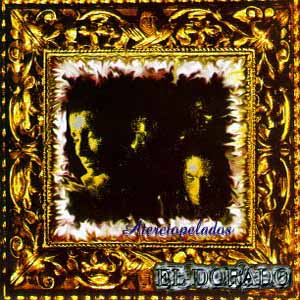
SOUNDTRACKATERCIOPELADOS-El Dorado (1995).

One of the other Rock en Español bands I bought in the 90s was Aterciopelados (the hardest to pronounce).  Aterciopelados come from Colombia and they play a variety of styles of music.  They also feature a female vocalist (Andrea Echeverri) who has a great voice in a variety of styles.

The opening song “Florecita Rockera” is a heavy blast of punk.  “Suenos del 95” is a kind of a lite pop song.  “Candela” is a latin-infused song that sounds not unlike a more psychedelic Santana track.  And “Bolero Falaz” is a winning acoustic ballad.  Meanwhile “Las Estaca” is a sort of county/cowboy song that breaks into a fun rocking chorus.

“No Futuro” starts as a slow balald and builds and builds to a heavy rocker.  I would have liked this song to go a bout a minute longer to get really crazy.  The rest of the disc works within this broad framework: ballads that turn into heavy rockers (“De Tripas Corazón”), hints of punk and latin accents.  And then there’s a song like “Colombia Conexión” which reminds me a bit of The Dead Milkmen: simple sparse verses with heavy punk choruses.  Meanwhile “Pilas!” is straight ahead punk.  The final song “Mujer Gala” has some ska-lite aspects as well (and I have to say that it seems like No Doubt may have been inspired by them).

Although for all of the different styles of music, the disc is really a venue for Echeverri’s voice.  She’s not a rocker or a screamer and she could easily sing pop ballads, but because she chooses to sing over so many styles, she really showcases the multifacted nature of her voice.  She can hold a note for quite a while and although she never really shows off, it’s clear that she’s got a powerful voice.  She even sings beautifully over the punkier tracks, never devolving into a scream, but never losing her edge either.

Aterciopelados is a hard band to pin down (especially with this one disc).  Of the rock en Español bands, Aterciopelados had one of the longer lifespans.  They released several albums with very different styles.

El Dorado suffers from weak production, some more highs and lows would really makes the listening experience better, but it’s a solid disc overall.

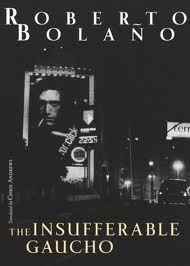
[READ: December 10, 2010] The Insufferable Gaucho

This is a collection of five short stories and two essays.  Two of the short stories appeared elsewhere (which I read previously).  This is the first time I’ve seen the essays translated into English.  The fabulous translation is once again by Chris Andrews, who really brings Bolaño’s shorter books to life.  They are vibrant and (in light of The Savage Detectives, this is funny) visceral.

“Jim” is a four page story which focuses very specifically on a man named Jim.  As the story ends, we see Jim locked in an existential struggle.  For such a short work, it’s very powerful.

“The Insufferable Gaucho” (which I had read in The New Yorker) was even better after a second read.  I find this to be true for much of Bolaño’s work.  He tends to write in a nontraditional, nonlinear fashion so you can’t always anticipate what is going to happen (quite often, nothing happens).  In this story, a man in Buenos Aires, feeling that the city is sinking, heads out to his long neglected ranch in the country.  He spends several years there, slowly morphing from a cosmopolitan man to a weather-beaten gaucho who doesn’t shave and carries a knife.  But there is much more to the story.  The countryside is virtually dead: barren, wasted and overrun by feral rabbits.  The rabbits offer an interesting metaphor for the wilderness as well.  His interactions with the few other people he encounters are wonderfully weird, and the ending is thought-provoking.  It’s a wonderfully realized world he has created.

“Police Rat,” is that strangest of Bolaño stories: a straight ahead narrative that works like a police procedural.  I assumed from the title that it would be something about a metaphorical rat in the police force.  Rather, this is a story about an actual rat who works on the rat police force.  Bolaño spends a lot of time setting up the story (details are abundant) making it seem like perhaps there would be no plot.  But soon enough, a plot unfurls itself.  And although the story is basically a police story, the underlying reality behind it is fantastic and quite profound.  The story is beyond metaphor.

“Álvaro Rousselot’s Journey” was published in The New Yorker.  This story was also better on a second reading.  In many ways this story is a microcosm of Bolaño’s stories: a man goes on a quest for an elusive man.  Unlike the other stories, he actually catches up to the elusive guy.  But, as if Bolaño were commenting on his other stories, actually catching the guy doesn’t really solve the crisis.

This basic premise is that a writer believes that a filmmaker is stealing his ideas for his films (even though he is from a different country).  But more than just the simple plot, when Álvaro Rousselot leaves the comfort of his homeland things change fundamentally within him.

“Two Catholic Tales” is, indeed, two tales.  I had to read this piece twice before I really “got” the whole thing.  There are two separate stories (each story is a solid block of text but there are 30 numbered sections (which don’t seem to correspond to anything so I’m not sure why they are there).  The first tale is of a young boy who desires to be like St. Vincent, with designs for the priesthood.  As the story ends, he is inspired by a monk who he sees walking barefoot in the snow.  The second tale (we don’t realize until later) is about the monk himself.  It rather undermines the piousness that the boy sees.  On the second reading I realized just how dark of a tale this turned out to be.  It’s very good.

“Literature + Illness = Illness”
This is the first non-fiction by Bolaño that I have read.  It is a meditation about his terminal illness.  The essay is broken down into 12 sections about Illness. They range in attitude from the realization that when you are gravely ill you simply want to fuck everything to the fear that grips you when you finally accept your illness.  Despite the concreteness of the subject, the essay retains Bolaño’s metaphorical style.  Each subdivision is “about” an aspect of illness.  “Illness and Freedom,” “Illness and Height,” “Illness and Apollo,” “Illness and French Poetry.”  But it’s when he nears the end and he’s in a tiny elevator with a tiny Japanese doctor (who he wants to fuck right there on the gurney but can’t bring himself to say anything), and she runs him through his tests showing how far advanced his liver failure is, that the reality of his illness really sinks in.

“The Myths of Cthulhu” is the other essay in the book and I have to say it’s the only thing in the book that I’m a little frustrated by.  About midway through, he reveals that this is a speech and I wish that an introductory note would have given context for this speech, or indeed, indicated whether it was really a speech or not.

One of things that struck me about it (and also about “Literature +Illness=Illness” is how frequently he is unspecific about his research (and just never bothered to go back and fix it).  For instance:

For books about theology, there’s no one to match Sánchez Dragó.  For books about popular science, there’s no one to match some guy whose name escapes me for the moment, a specialist in UFOs.

Because I don’t know his non-fiction and I don’t have context (and I’ve no idea who Sánchez Dragó is) I don’t know what to make of that unspecific recommendation.  As for Sánchez Dragó, in the speech he’s noted as a TV presenter (Wikipedia confirms this).  But why the uncertainty in a written piece?  Laziness or deliberate commentary?

This essay has many elements of local information that are completely lost on me.  However, by the end, he brings it back to folklore and literature.  He also makes some biting criticisms of George Bush, Fidel Castro, Penelope Cruz (!) and Mother Teresa. Actually, I’m not sure if he’s mocking Penelope Cruz, although he is definitely mocking Mother Teresa.

The ending is general moaning about the state of Latin American fiction.  Even though I didn’t follow all of what he was talking about, there’s something about his delivery which is so different from his fiction. It’s honest and fast and kind of funny and enjoyable to read.

——

This may be something of a minor work, and yet the stories are really wonderful and are certainly a treat to read.  The essays definitely need more context, but it is interesting to finally have a chance to read the “real” Bolaño.

Read Full Post »

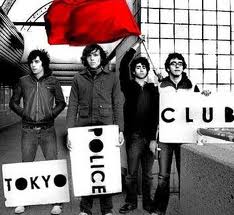
SOUNDTRACK: TOKYO POLICE CLUB-“Bambi” (2010).

I loved the first couple of Tokyo Police Club albums, but I missed this one when it came out.  My friend Al said it was one of his favorite albums of the year and that this song was one of his favorite songs.

I was disconcerted when I started listening to this because TPC is all about short, heavy, punk blasts of music.  And this song starts with…keyboards.

But it’s clear that this is still TPC, just with new bits and pieces added.  The keyboards are strangely out of pitch–they sound off somehow–and they add these bizarre little accents to this super catchy song.  The aggressive punk guitars are gone, but the attitude remains and this is a fantastic tune. One that I’ll listen to a lot more.

[READ: December 8, 2010] “Emptying the Skies”

I didn’t think it would happen, but I reached my Franzen saturation point with this article.  This is his third article about the disappearance of birds.  Originally, these articles came several years apart, so they wouldn’t seem so overwhelming.  But reading them all within a few days of each other, I’ve about had it with the doom and gloom.

These articles are devoid of Franzen’s usually charm and wit.  Obviously, a story about the disappearance of the earth’s birds should not have charm and wit, so he did his job well.  But man, I’m overwhelmed by the devastation of Europe’s migration paths.

The essay looks at three Mediterranean countries and their (reprehensible) attitudes towards birds: Cyprus, Malta and Italy. (more…)

Read Full Post »

SOUNDTRACK:BELLE AND SEBASTIAN-Live in Glasgow, TODAY! December 21 at 4PM eastern: NPR simulcast (2010).

It’s very rare that I have news before it happens, especially on this blog. But I do. Today at 4PM Eastern time, NPR is simulcasting Belle and Sebastian’s live show from Glasgow.

I don’t know if it will be downloadable (I do know that I am at work…boo!).  But I have to assume it will be pretty great.

Get details here.

[READ: December 6, 2010] “The Way of the Puffin”

After a few years away from lengthy New Yorker articles, Franzen returns with this 13 page (!) article about China.  The last article that we saw from Franzen was about his birding passion.  That passion has not subsided at all, and his co-passion of environmentalism is what sends him across the globe to the Yangtze Delta.

Franzen receives a Puffin-shaped golf club head cover, which he finds quite adorable.  But when he sees that it’s made in China, he wonders about the environmental impact of this adorable item.  He calls the company that makes the puffins (Daphne’s Headcovers), and is told that they use environmentally conscientious Chinese labor.  She also tells a (heartwarming) story about karma and how a good deed will get repaid manifold.  She tells Franzen about the workers in China and invites him to go check them out.  This leads to Franzen’s most “reporter”-like piece, and probably his least personal.

At first I wasn’t that interested in the piece.  I feared it was going to be a long slog through environmental degradation and depression.  And while it was that, Franzen also humanizes the story through the efforts of that rarest of birds: the Chinese environmentalist. (more…)

Read Full Post »

SOUNDTRACK: BAD BRAINS-I Against I (1983).

I don’t remember buying this album, but I remember getting it because of the connection to SST records (not because Bad Brains were an amazing hardcore band–I didn’t know that yet).

All of these years later, this album is still pretty astonishing.  The heavy punk blends so well with the reggae-inspired jams.  Perhaps the biggest band where Bad Brains influence is evident is Fishbone (especially their later metal songs).  But you can hear t hem in Faith No More and many other mid 90’s bands as well.

The disc opens with a great off-beat instrumental (“Intro”) which leads into the amazing yell-along “I Against I.”  “House of Suffering” follows with some more speedy hardcore.  Then it all slows down with “Re-Ignition,” the first indication that this is an album unafraid to take risks.  Although the thumpy riff and heavy beats are still there, the vocals are more of a reggae style (especially towards the end).  “Secret 77” follows with a kind of funk experiment (but those drums are still loud and stark–Earl is a maniac!).

Darryl’s bass work is tremendous throughout the disc, and Dr. Know’s guitar is amazing–speeding fast soloing, heavy punk riffs and delicate intricate reggae sections intermingle with ease.  And, of course, we can’t forget about H.R.’s vocals.  He has several different delivery styles from the speedy punk to the reggae deliveries and the all over the place (including high-pitched shrieks on “Return to Heaven”).

The second half of the disc experiments with more diversity, and it is somewhat less punk sounding (although not by much).

Historically, it’s hard (for me) to place exactly how influential they were.  Listening to  the disc today (which doesn’t sound dated in any way) it sounds utterly contemporary in stylistic choices.  Did they come up with the mosh break?  They certainly are the first punk band the embrace Jah (that’s a trend that never really took off though, eh?), but their funk metal sound predates the popular Faith No More style by over a decade.

[READ: November 21, 2010] “The Kids Are Far-Right”

I know I subscribed to Harper’s when this article was published (I distinctly remember the jelly bean portraits of Reagan), but I’m pretty sure I didn’t read it then because the whole idea of it sounded depressing (the subtitle: “Hippie hunting, bunny bashing, and the new conservatism”) was just too much for me in 2006 (and was almost too much for me in 2010).

And so our correspondent (not long after his trip through the Bush/Cheney volunteer minefield) heads out to the twenty-eighth National Conservative Student Conference.  He meets exactly what you would expect: right-wing campus types (several from ultra-religious schools) who are there to learn to hate liberals even more than they already do (and boy do they).

Wells’ article is full of details about all of the speeches and programs, as well as biographical information about some of the attendees.  Most of them just want to get rid of liberals on campus, but some want to go into politics themselves someday (they are viewed with suspicion here).  Many also hate George W. Bush because he raised taxes.  In hindsight what we have here is the origins of the tea party.

The only comforting news to come from the article is that only 400 people attended (but they were willing to spend a few hundred dollars and give up a week of their summer vacation, so it’s still a pretty high number). (more…)

Read Full Post »

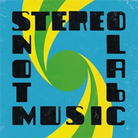
SOUNDTRACK: STEREOLAB-“Everybody’s Weird Except Me” (2010).

I was able to listen to another track from the upcoming Stereolab album Not Music.  This song is just fantastic.  It’s a faster, uptempo track.   Laetitia’s voice is backed by some other female singers (I wonder who they are, is it just Laetitia multitracked?).  And the propulsive beat is infectious.  The backing track of the music sounds like their earlier experiments with “space age” sounds.  Yet the guitar over the top is warm and inviting.

The song drops out at about the 90 second mark and offers a very cool respite from the bopping around that the song is doing.  After the break, the song seems to jump back and forth between this new mellow bit and the bouncy earlier part.  It’s a great track and a welcome opening to their last CD before going on hiatus.  Because, yes, according to the information on the NPR page, Stereolab is going on hiatus.

This CD is full of songs that were created around the time of their previous disc Chemical Chords, and it’s also packed with mixes, remixes and seemingly alternate version of some of those songs.  I haven’t heard the whole disc but it sounds like they’re going out with a winner.

[READ: November 15, 2010] “A Good Death: Exit Strategies”

I’ve mentioned before about my reader-relationship with Vollmann–I feel that I ought to read a lot more of him, yet I haven’t brought myself to do it (those books are huge!).  Nevertheless, I’ll keep reading the new pieces that I stumble upon.

So this piece is a nonfiction essay.  I’m tempted to say it’s more personal than the other pieces that I’ve read because it concerns the death of his father.  Yet from the little Vollmann I have read, it feels like he takes all of his writings very personally and invests himself pretty much bodily into them.

So, this piece, as I said, is sort of about the death of his father.  He died just a few months ago and Vollmann wants to find out a number of answers about death: should he be afraid of it, will he suffer, what should he expect?  So he interviews several “experts” in different fields:  coroners, funeral directors and many religious people of different faiths (Vollmann and his companion/translator are agnostic).  He’s given a vast array of answers, some of which are comforting to him and others just kind of piss him off. (more…)

Read Full Post »

SOUNDTRACK: NPR Live Concerts from All Songs Considered (Podcasts).

For a couple of months now I have been exploring the All Songs Considered Podcasts.  I recently stumbled upon a link to a whole slew of Live Recordings that are available for free.  All of them are available for listening and most of them are available for downloading.

Some of the recordings seem to be acoustic in-studio sessions that last about 15 minutes (called the Tiny Desk Concerts), but there are many which are full concerts recorded from the soundboard.  I happened upon this site because of a 2008 Radiohead show which runs just over 2 hours.  Some other full concerts (most of which are recorded at the 9:30 club in Washington D.C. include: Superchunk, Dinosaur Jr., New Pornographers, Public Image Ltd., Tom Waits, and a whole bunch of shows from SXSW.  The Tiny Desk shows include “Weird Al” Yankovic, Phoenix and my new discovery Sharon Van Etten.  And there’s even videos of many of the shows, too.

I’m pretty excited to have discovered this, as there are a surprising number of great shows available here (as I’m scrolling to the bottom of the list, I keep finding more and more bands that I like).  And all you need is to download iTunes to hear them (and if you’re a geek like me, you download Audacity and insert track numbers for ease of cataloging).

[READ: November 21, 2010] “My Bird Problem”

Of all of the Franzen non-fiction pieces that I’ve read, this one has been my least favorite.  And one of the reasons for that is that it made me feel kind of uncomfortable.   Not because of the main content of the article (bird watching) but because of some of the personal information that he (as per usual) included in the article.

The first uncomfortable part concerns his at-the-time-wife.  It feels the like he is including information that seems like he would have needed her permission to write (especially since we know who he is and therefore know who she is,  I can’t believe she would give it).

The second thing was just how misanthropic Franzen is.  When he goes out into the woods to look for birds, he finds that the mere awareness of other people sends him into a fury.  (“Oh no, were those human voices coming up behind us?”).  And while I’ve certainly felt like that, to see it in print and to see it so often is more than a little unsettling. (more…)

Read Full Post »

SOUNDTRACK: BUILT TO SPILL-There is No Ememy (2009).

I’ve liked Built to Spill for quite a few years (I first encountered them on Perfect from Now On), but they always hang just below my radar when I think about great albums.  Nevertheless, many of their songs have landed on compilations I’ve made.

I listened to this disc a few times when it came out and when I popped it in again today I couldn’t believe how well I knew the whole album and how much I really, really liked everything on it.

This may in fact turn out to be my favorite BtS disc.  It isn’t radically different from other releases of theirs, but there’s some ineffable quality that seems to raise the whole disc above the fray.  The total package is fantastic.  The first few songs are quite short, just over three minutes each (which is surprising after the release of the live album which had so many extended songs and solos (a 20 minute cover of Neil Young’s “Cortez the Killer”).

Of course there are a few extended jams as well.  Four songs are over six minutes long (and three of them make up the last four tracks, so the disc does to tend feel a little heavy at the end–although “Things Fall Apart” has a horn solo (!) and “Tomorrow” has some unexpected time changes).  But the first long song, “Good Ol’ Boredom” has a great chugging riff that hold ups to the six minutes very well.  The nearly seven minute “Done” has a wonderfully effects-laden end section. The solo is pretty lengthy, but the backing music/sounds keep the whole thing interesting.  Of course, there’s also “Pat” a two and a half-minute blast of punk abandon.

Doug Marsch has a pretty high voice, but it never grows whiny or annoying, and in fact, it has a kind of gravitas to it.  And it is more than matched by the full band sound on the disc.  Martsch’s lyrics are also wonderfully unexpected [“Is the grass just greener because it’s fake?”].

BTS has made a great album and I’m going to have to revisit their back catalog too.

[READ: November 14, 2010] “Twilight of the Vampires”

This was a banner issue of Harper’s (I’ve felt kind of down on the magazine lately, but it made up for itself this month).  We have the Lydia Davis/Flaubert stories, a lengthy piece by William T. Vollmann and the cover story about Rupert Murdoch (which I won’t be posting about).  In fact, normally I don’t post too much about non-fiction (recent obsessions notwithstanding), but this particular piece was by Téa Obreht, one of this year’s New Yorker 20 Under 40.  Obreht had barely had anything published when they selected her, and so I figured it would be easy to keep tabs on her.  So here’s a nonfiction to add to her two stories.  (And it’s about vampires!)

Obreht is originally from Russia (her family is apparently still there).  As the essay opens, she is going to meet her mother in Belgrade for their trip to Serbia.  Their ostensible reason to travel to the Balkans is to find out about vampires.   (But when her mother injuries herself before the trip is about to commence, it convinces her mother that the whole trip is possessed by devils).

But why travel to the Balkans in search of vampires when her adopted homeland of America is overrun by vampires right now?  Because as she relates, our vampires are rather different from theirs. (more…)

Read Full Post »

SOUNDTRACK: DAR WILLIAMS-“Teen for God” (2005).

Dar Wiliams has a new disc in which she revisits her old songs (by herself and with guests) and which includes a bonus Greatest Hits disc.  I have listened only once to the disc, but it includes this song which fits perfectly with this story.

Williams has always been an excellent lyricist.  Her rhymes are strong and her descriptions and ideas are first-rate.  Normally, her songs are emotional and intimate, although this one is less so.  It’s serious and funny at the same time.

It begins with a teen at the Peach Branch Horse and Bible Camp where she’ll “pray for the sinners and their drunken car wrecks and vow that I’ll never get high or have sex.”  It’s interesting to compare this song and the implications of the teens for God circa 2005 vs what Franzen is talking about circa the early 1970s.  And it’s fascinating, and rather depressing frankly, how much more conservative times have gotten since then.

What really sells “Teen for God” are the final few verses, where we realize that we shouldn’t take too much of what the teens pledge to be long-lasting (like so many things that teens believe). “You gotta help me, God. Help me know four years from now I won’t believe in you anyhow and I’ll mope around the campus and I’ll feel betrayed all those guilty summers I stayed”

And all of this existential religiousness is set to a perky folk rock song.  The “Teen for God” chorus hits a perfect delayed chord, and is a wonderful singalong.  Perhaps even at a campfire.  On a retreat.

[READ: November 18, 2010] “The Retreat”

This essay is about Franzen’s childhood (always a good source for his stories) when he joined the hippie “Fellowship” at First Congregational Church.  Franzen is older than I am by a  few years, so a lot of things that he writes about from his childhood are things that I knew a little about or caught the tail end of.  So, in this case, I recall my church having Saturday night folk masses, where everyone played acoustic guitars.  I loved it and my parents hated it; when I recently asked a neighbor if they still do that she laughed at me and said they’d stopped it like 25 years ago.  Which explains a lot.

Anyhow, the article discusses an upcoming retreat that the ninth graders would be taking with the other older Fellowship students.  Franzen was a big fish in the 8th grade Fellowship but was a little nervous about the older group.  He loved retreats and wanted to go but didn’t think his parents would approve.  Luckily for him, his parents were in Europe at the time.  [This seems to be some kind of thing that parents did in the 70s–go to Europe for an extended period while the kids stayed home.  My parents never did, mind you, but some seemed to.] (more…)

Read Full Post »

« Newer Posts - Older Posts »