Feeds:
Posts
Comments

Archive for the ‘Environmentalism’ Category

SOUNDTRACK: CHIKA-Tiny Desk Concert #959 (March 13, 2020).

I’ve never heard of Chika, but she proves to be really fun and funny (while rapping some serious topics).

Her band is jazzy and stripped back:

Chika was also the first hip-hop act to anchor her set with just a Peruvian cajón instead of a full, hard-hitting kit. The surprisingly stripped-down performance allowed her lyrics, with all their nuance, to take center stage — and the result was remarkable.

In addition to the band, were her terrific backing vocalists

The impressive harmonies from Chika’s four backup singers brought all the feels right out of the gate.

She starts with “Industry Games.”  Lovely ooohs from the backing vocalists then David Levitan plays an echoing guitar (“both catchy and eerily haunting” that I found reminiscent of the Close Encounters melody).  Up comes that cajon with gentle thumps from Dominic Missana.  Then she starts rapping.

Moving seamlessly between rap verse and melodic hooks, Chika showcased her unusual tonality, multi-cadence delivery and vocal range, with an effortless, double-time lyrical bounce.

She has a fantastic fast flow (smiling as she goes).  It’s interesting hearing the gentle backing vocals that repeat her (sometime harsh) final lines.

She even starts giggling in the middle.  She explains later “I say ‘tightest around’ and they sing ‘hottest around’ and it is hysterical to me.”

Before the next song she says, “Everyone brings nice things to the Tiny Desk, like lights…  I didn’t bring anything, or so you thought.  I brought this Chapstick and I’m gonna place that right here.  Fuck anyone who underestimated me.”

She says that “Songs About You.”  No shade to anyone.  It’s not about y’all. its about you.  The song features more nice backing vocals and then a grooving bass line from Chris McClenny.

Before the third song she sends a shout out to her sister who is there.  “Shout out to our parents… genetics!”  She asks, “What kind of shows are you wearing?”  “Puma…”  “You should have been wearing ‘Balencies,’ which is the name of the next song. She pauses and waits for the laughter.  Then says, “I’m funny.  We’re not gonna argue about that.  You all didn’t want to laugh… something about that felt racist.”

The backing vocals are wild and weird as it starts, Danielle Withers sounds like a perfect loop of an eccentric vocal line.  It’s pretty magnificent–I really hope she goes somewhere with a distinctive voice like that (I see that she has sung with some pretty big names already).

The other singers are (l-r) Jabri Rayford; Darius Dixson and Rachel Robinson (she’s standing on a box).

“Crown” has some great lyrics

I got a habit of rapping ’bout tragic sh-
I think I’m just passionate
Tryna steer the way while in the dark
Hope I ain’t crashin’ it (Woah)
Now my little hobby turned to cashin’ out
Thinking ’bout who I’d be if I listened to doubt
Said I’d never do it, well look at me now

Okay
This is for the kids with depression
The one’s whose parental expectations got them stressin’ (Woah)
The one’s who would rather persevere, bust they ass, tryna make it ’cause-
They ain’t really livin’ in the present

The set ends, oddly enough with “Intro” which is a very quiet song.  Gentle guitars and  a quiet rap.

This was a really satisfying set.  her songs were short and to the point.  The lyrics were powerful and affecting and the music was a nice accompaniment.

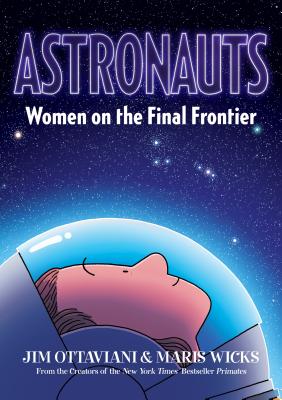
[READ: April 2, 2020] Astronauts: Women on the Final Frontier

Jim Ottaviani & Maris Wicks worked together on the awesome book Primates.  Now they are back sending some primates into space.

I just love Wicks’ artwork.  She manages to do such amazing things with such simple-seeming drawings.  Her eyes are (mostly) dots, the faces are almost all simple shapes and yet everything she draws is so expressive and conveys exactly what she wants.  It is a pleasure to look at anything she draws.

Ottaviani did a lot of research for this book (obviously) and the end is chock full of resources that you can look at to learn more.

As for the book itself, it is “told” by astronaut Mary Cleave.  It starts with young Mary being told (by the President) that she was too young for the Astronaut Corp.  The letter (from President Eisenhower) did not go on to say that no women were accepted into the Corp, she had to find that out herself.

She was already a practicing pilot at age 14, but that wasn’t good enough.  She then jumps over to another girl her own age over in the Soviet Union.  Valentina Tereshkova was jumping out of planes and training to be a pilot, because the Soviet Union did not have a sexist component in their system.

But in 1959, even though women like Jerrie Cobb were certainly (physically) capable of becoming astronauts, women simply weren’t chosen.  Jerrie Cobb and Janey Hart testified before Congress where sexism (and simple, painful examples are provided) ruled the day.  They were even shut down by Jacqueline Cochran, a director at an airline, who said women should not even be pilots because they get married and leave after two years. (more…)

Read Full Post »

SOUNDTRACK: KOKOKO!-Tiny Desk Concert #911 (November 15, 2019).

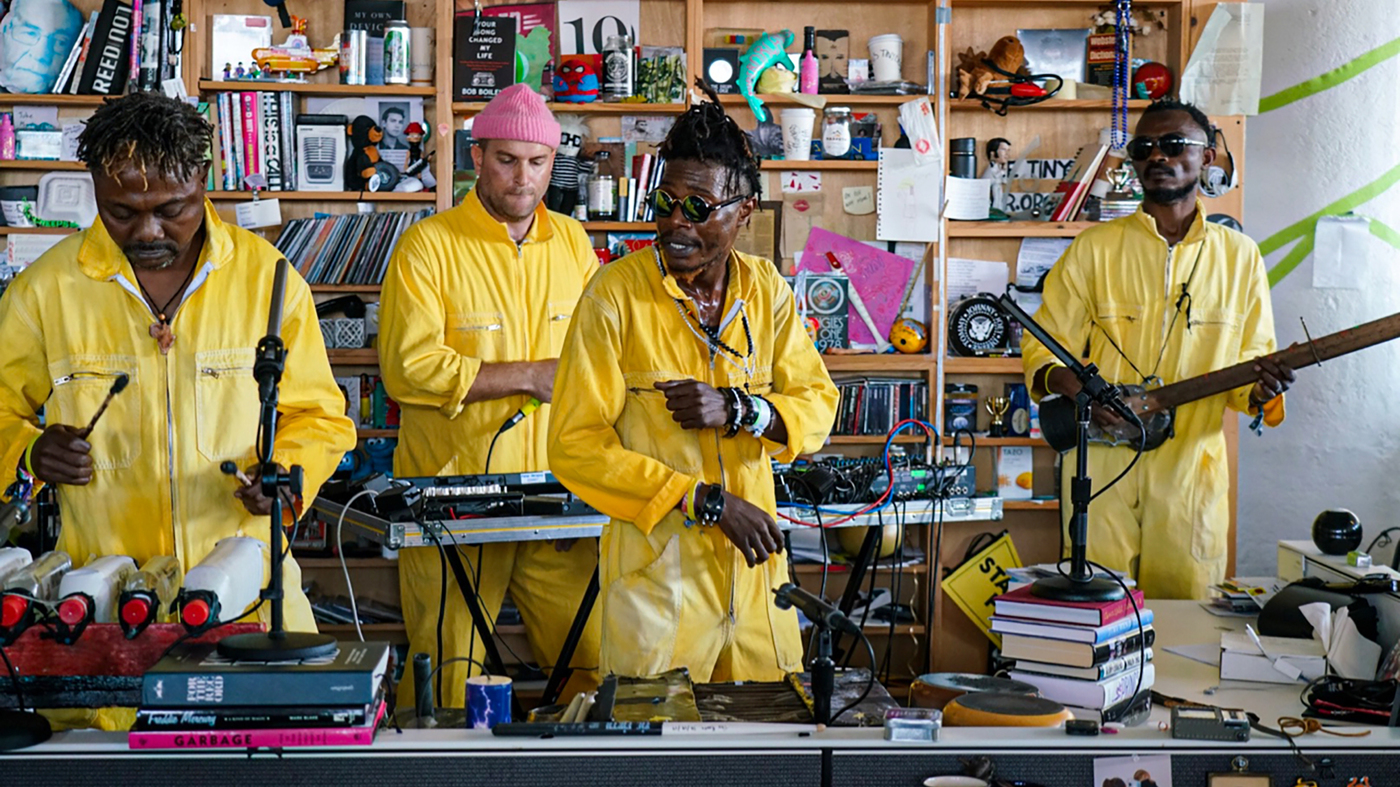
KOKOKO! are a visually arresting band.  The band dresses entirely in yellow jumpsuits and they play…garbage.

KOKOKO! are sonic warriors. They seized control of the Tiny Desk, shouting their arrival through a megaphone, while electronic sirens begin to blare. There’s a sense of danger in their sonic presence that left no doubt that something momentous was about to happen. And it did!

Makara Bianko was the guy shouting through the megaphone, walking all around the room.  Then after the siren, he sat at the drums (which are held together with duct tape and electrical tape) and started singing lead vocals on “Likolo”

Dido Oweke on the “guitar” starts the simple riff.  It’s possible that it has one string and the bottom of the guitar is definitely an old can.

Backed by a bank of electronics, including a drum machine, this band from the Democratic Republic of the Congo redefines the norm of what music is and how music is made. Wearing yellow jumpsuits that are both utilitarian and resemble Congolese worker attire, this band from Kinshasa feel as though they’re venting frustrations through rhythm. And all the while they’re making dance music, all from their debut LP, Fongola, that feels unifying — more party than politics.

“Tongos’a” starts with an electronic drum pattern from Débruit on the synth (he’s making a lot of the noise and twisting knobs and chanting along) and a simple bass line from Boms Bomolo.  Everybody chants along to the chorus.

Starting “Malembe” Débruit sings an echoing opening call as he starts electronic drums and Love Lokombe plays some analog drums.

Each song is arresting and catchy as the next (although “Malembe” feels a little long.

The only bad thing about this Tiny Desk is that you can’t really get a good look at the instruments.  I mean, it’s clear that Love Lokombe is playing a rack of glass bottles.  But he’s also hitting some kind of metal scraps.  And at the end of “Malembe” Makara Bianko picks up a board with a can attached to it  There’s a guitar string, I guess, which he strums rapidly.  I guess he can change the pitch by moving the ca,  He gets a pretty cool melody sound out of it.  It’s such a cool instrument and I want to see more!

There’s a nice story about the band in this NPR piece at Goats and Soda.

[READ: March 1, 2020] “Waiting for the End of the World”

In the great tradition of authors I like writing long form non-fiction for Harper’s, Lauren Groff heads to a Prepper’s Camp to learn how to deal with TEOTWAWKI.

The camp was started in 2014 by Rick and “Prepper Jane” Austin.

Groff acknowledges that she is not he usual prepper.

I am a vegetarian agnostic feminist in a creative field who sits to the left of most American socialists: I want immediate and radial action to halt climate change, free Medicare and free public higher education for all, abortion pills offered for pennies in pharmacies and gas stations, the eradication of billionaires; the destruction capitalism; and the rocketing of all the planet’s firearms into the sun.

Amen. (more…)

Read Full Post »

SOUNDTRACK: JONATHAN SCALES FOURCHESTRA-Tiny Desk Concert #943 (February 7, 2020).

I assumed that by this name, that this band would be contemporary classical.  I didn’t really consider that they would be jazzy (or that there would be three of them).  I certainly didn’t expect to hear steel drums!

Here’s a first: Steelpans at the Tiny Desk. It’s true. Nearly a thousand performances into the series and the instrument has never been featured, until now. While the two bowls look shiny and new in this Jonathan Scales Fourchestra set, they were once authentic oil barrels, pounded, finished and tuned for bandleader, Jonathan Scales. But instrumentation and singularity aside, Scales’ virtuosity, energy and connection to his bandmates wowed the NPR crowd, many of whom had never heard this music before.

The first song “Focus Poem” opens with spectacular bass from E’Lon JD and complicated drums from Maison Guidry.  Then the huge surprise comes when Scales plays the steel pan drums.

Scales’ musical hero, Béla Fleck, happened to be performing in the Washington, D.C. area on the same day as this performance, with just enough time to stop in for one song,”Focus Poem.” It’s a cut Fleck originally played banjo on for the band’s 2018 album Pillar. While the tune is a regular on the trio’s setlist, this performance marks the first time they’ve played it live with Fleck. Scales later revealed that it was a little risky to open with such a technically complicated piece, but the execution was still superb.

Fleck is, of course, fantastic too and he plays a fantastic solo at the end.

So it’s like jazz but with banjo and steel pans.

I assumed that the band was fairly new but

Jonathan Scales Fourchestra has been performing for 13 years, now, redefining the steelpans as a signature jazz instrument. The first iteration of the band was a trio-plus-guitar, hence the “four” in the name. But when drummer Maison Guidry and bassist E’Lon JD joined Scales later, it was clear the trio’s sound was complete. JD grounds the music with powerful bass lines, combined with guitar-like melodic and harmonic embellishments.

The other two songs in this set are also from Pillar. While it’s not his most recent album, Scales calls it his most potent work to date, a quintessential representation of his music.

Introducing “We Came Through The Storm,” he says he’s always wanted to compose for cinema, so for this song he pretended he was writing music for a movie.  There’s a repeating four-beat rhythm (with complex drumming on top, of course) and great lead steel pans and wild bass.

With its heavy arrangement, is one of their most popular tunes, partly because of the dazzling drum riffs Guidry nails with playful proficiency.

The final song they play is “Fake Buddha’s Inner Child” is a lullaby to your inner child.  We have an outer shell he calls the Fake Buddha which says “we can handle this, I’m cool.”  Meanwhile, the inner child is exposed, full of anxiety and depression.  He considers this song to be a “Lullaby to the inner spirit.”  It’s a quieter song with high notes on the bass and a lot of cymbals.

It’s a great quiet ending to a wild set.

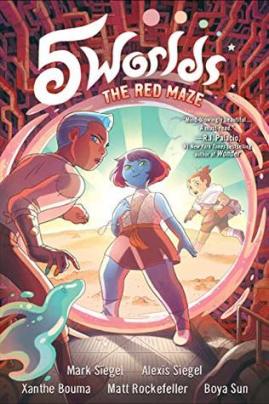
[READ: February 10, 2020] 5 Worlds Book 3

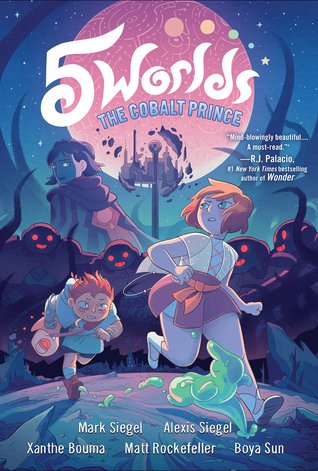
The story is magical and fairly complicated with a lot of parts.  But the crux is the dire situation on the five worlds.  Moon Yatta is a desert; Salassandra’s animals are all dying; Grimbo(e) is covered in ocean moss and there are water riots on Toki, where the plant people are dying.  The Mon Domani Elder says that they need to light the beacons on the roof.  The other leaders are less convinced of the need for beacons and some are hostile to the idea.

Behind all of the trouble is a creature known as The Mimic–a super nasty fellow that is able to possess people.

At the end of book two our hero, Oona Lee and her friends An Tzu and Jax Amboy were unable to light the second beacon.  It turns out they have to be lit in a certain order and so they are off to Moon Yatta and the red beacon.

The opening of book 3 is a flashback to what happened to Jax when the escape pod crashed at the beginning of book two.  He was rescued by the Salassi Devoti and one of them put its spirit inside of Jax.  They never thought it would be possible to put a spirit in an android but Uncle Jep had left a space inside of Jax–a space that is perfect for this creature to infuse Jax with life.  Noe Jax is more than he was before.

An Tzu is very excited to go to Moon Yatta because it is the land of the free where they elect their leaders, where hopes and dreams come true.   The citizens hate to break it to him but things are not perfect there–the mimic is there, too.

When they arrive the beautiful lush moon (from An Tzu’s postcard) is now desert wasteland.  It turns out that Stan Moon bought all of the crops.  All water has been diverted to irrigate the Stan Moon fields. Stan Moon also bought the Mon Domani lands which is why Sao Sablo is a slum and why An Tzu’s life has been miserable.

The Red Beacon is in the center of Moon Yatta under a maze of tubes and tunnels.  The beacon is powering everything on the moon. How will they ever get to the beacon through the maze?  An Tzu says an old joke: “The best way to get there is to not start from here.”  Nobody gets it.

When they land on the moon, Oona is a celebrity–the beacon lighter–and they are preparing to introduce them to the Head Citizen.

Felizia is the Head Citizen and she is charming and delightful.  She has a feast for them which makes An Tzu pretty excited.  But she admits that the feast would be even more special if the shapeshifters were allowed to do their transforming dances.  The transforming dances are now illegal–they must wear collars that prevent them from changing shape.  Those who refuse are sent to the ruby desert.

When Oona says she wants to light the red beacon Felizia says, its an election season, they cant go changing things right now.

Felizia’s second in command Brightley whispers that Oona should talk to Eldridge and Derrick Stoak, heads of Nanotex Corporation–they have a bit more sway with the beacons.

The next morning the first order of businesses is getting An Tzu’s disappearing disease looked at.  They find the best doctor in the city and she insists on a large payment before even looking at him.  Moon Yatta is not the land of dreams that An Tzu imagined.

Oona has a similar problem with Derrick Stoak.  He wants to know what she will do for him if he lets her light the beacon–he is a businessman not an idealist.  What he wants most is for Jax A,boy to return to the Starball field–playing for Stoak’s Leaterheads team, of course.  Oon says she will ask Jax but she doesn’t think he’ll agree (and hopes he doesn’t).

An Tzu has started having vision. He comes out of one and believes that Stan Moon is the mimic.

Even Derrick Stoak is concerned is about Stan Moon, but his brother Eldridge thinks that Stan Moon is a great fit for Nanotex.

In order to assist Oona, Jax agrees to play one special Starball game.  But when Jax asks about the beacon, Derrick says too bad.  So Jax refuses to play but Derrick seems to know how to override and control Jax.  Dax still has that spirit in him but Derrick believes his doctors can reset Jax to his original Starball playing self.

Meanwhile, Oona, An Tzu an Ram Sam Sam are in the red maze looking for a way to the beacon and also looking for Etta Zelle, a Yattan Sand Master and shapeshifter.  While they are looking around they meet some street urchins. The urchins recognize Oona as the person who lit the beacons.  Thet tell her that they are rebels although they are all wearing the form-lock collars to prevent them from shapeshifting.

When they try to blast through the maze, they are arrested and sent out to the dessert.  Although it turns out Brightley had them sent to the desert rather than prison so that they could meet Zelle.  Oona confesses to a man there that she needs to find Zelle.  She also weeps a bit that she was in the red maze and couldn’t even summon the fire needed to light the beacon.  The stranger says “perhaps you were too busy–carrying the weight of the world on your shoulders.”  Then the man transforms into Etta Zelle.

Etta Zelle is great, comforting and instructive.  She also confirms that Stan Moon is the Mimic, but even if they kill Stan Moon, the mimic will live on.

Then Etta Zelle shows Oona how to make a portal (it’s pretty amazing).  Oona can’t actually control the portal yet–to rather amusing results.

Back at Nanotex headquarters, the board are talking about the situation on Moon Yatta and Eldridge reveals that they are basically going to be rigging the election in favor of Stan Moon.  The leaders are outraged and don’t want to undermine Yattan democracy.  Mr Tarney says he quits, but as he does so, Stan shapeshifts into a fearsome creature to frighten Mr Tarney into going along with them.   The only one having any misgivings now is Derrick, but he keeps his mouth shut.

Part of the propaganda for Stan Moon comes in the form of Peet Bowl a fat , sweating outraged TV person–this character is so clearly any one of a number of Fox news anchors–hysterical, unhinged and strangely persuasive.    He shouts things like

Our very way of life, our own Yattan way is under siege.

If only he said they would make Yatta great again.

Meanwhile the police track Oona and her crew to he desert  They storm in with the intent on grabbing them all but Etta Zelle and Oona make portals and everyone escapes except Zelle.

Although Derrick is upset about what happened, he still wants to ensure that Jax Amboy is back on board with him.  Soon we see Jax in a commercial urging criminals and rebels to quit and to turn in the beacon lighter.  But before Oona and An Tzu can get too upset, the person who actually reprogrammed Jax finds An Tzu and says that he an be deprogrammed if he says “Do it for Laaniel.”   And so, during the important Starball game, when Jax collapses, An Tzu is able to shout those magic words to him.

As the book comes to an end we see that Stan Moon and Eldridge have created an army of Jax Amboy look-alikes.

When Stan Moon walks away, Derrick asks Eldridge to try out the cryotech pod.  Which he closes up and sends off to the Y-26 System.

He then apologizes to Jax Amboy and sets a bomb amid all the fake Jaxes.

Oona, An Tzu, JAx and Ram Sam Sam are reunited, but before they celebration the election results are in and Stan Moon has won

And this surely has to do with the 2016 election

An Tzu looks at the screen on Stan Moon talking and shouts “Liar! It’s the Mimic!  They elected the Mimic!”  And Oona says “Most wont believe it. Some won’t even care.”

The security forces close in on Oona and her group but she uses some advice that An Tzu gave her earlier to get to the beacon.

The book end with An Tzu’s eyes glowing in a strange way and when they they ask him what he sees, he says Home!

Continued in the next book!

The illustration style continues to be excellent and very trippy–soft and delicate with fine lines and gentle coloring. It looks very anime and yet it’s not.  It’s hard to know which artist’s style dominates.  I feel like Boya Sun, but they all have a similar aesthetic.  I really like the character design as well.  I found it very refreshing that none of the characters look like superheroes (well except for Jax the athlete).  Oona is a short girl who has wide hips and thighs and An Tzu is a chubby boy.  Even the other creatures are all interesting and uniquely designed.

Read Full Post »
SOUNDTRACK: ANOTHER SKY-Tiny Desk Concert #942 (February 5, 2020).

I have watched this video many times because I love everything about this band.  I love the unexpectedly intricate guitar, the adventurous bass and complex rhythms, and I love singer Catrin Vincent’s voice.

Drummer Max Doohan open “Brave Face” with really fast hi-hats.  Some very high bass notes (from Naomi Le Dune) and a smooth, slinky guitar (Jack Gilbert) makes the melody as Katrin sings in her unique, deep and clearly accented voice.

After a verse or so, Katrin plays a piano chord while the guitar opens a clean catchy melody.  The  song stops musically for a moment before it kicks back in with some rocking guitars and fast drums.  Despite the rhythmic changes, all the while her vocal style remains unchanged–a great contrast.

There’s so much dynamism in this song.  It builds and builds to a dramatic ending.

There’s intensity and clear intention to the music of Another Sky. I knew that from having seen this London band perform at SXSW. But in the confines of an office, hearing Catrin Vincent’s unique voice, raw and un-amplified, brought it to another level. They came to NPR back in December to perform, opening their Tiny Desk set with a new song, released just this week. “Brave Face” is a window into the uncompromising sound and message of Another Sky, as Catrin sings in her impassioned voice:

“You must put yourself first
believe you will be loved
only you can demand all you deserve
You put on your brave face, now girl.”

This isn’t a message that is easy to punctuate with music, but matching message with music is the strength of Another Sky. You can hear it in the way Jack Gilbert weaves his guitar lines around the haunting vocals, the way the rhythm section sets up a tension with the melody.

“Avalanche” “another song that deals with toxic masculinity, there’s such ferocity, such commitment to the message.”   It opens with guitar harmonics and Katrin singing along on a slow piano melody.  A complex bass line adds some lower notes to the song which teases quiet moments before getting loud again with a nifty guitar solo.  The song once again gets huge before the music cuts out for just some piano and voice.

Before the final song,

Catrin brought some levity in the form of thanks. “I used to work in an infamous thrift shop in London,” she said, “that paid me to sit and watch NPR Tiny Desks on loop, and I used to think, ‘Oh we’ll never get here,’ and we did, so thank you.”

“All Ends” opens with a quiet introduction and more great guitar work.  Once again I love the bass work–chords played at the high end of the neck, along with ringing guitars and Katrin’s voice.

This band is so interesting, I can’t wait to hear more from them.

[READ: February 10, 2020] 5 Worlds Book 2

The story is magical and fairly complicated with a lot of parts.  But the crux is the dire situation on the five worlds.  Moon Yatta is a desert; Salassandra’s animals are all dying; Grimbo(e) is covered in ocean moss and there are water riots on Toki, where the plant people are dying.  The Mon Domani Elder says that they need to light the beacons on the roof.  The other leaders are less convinced of the need for beacons and some are hostile to the idea.

Behind all of the trouble is a creature known as The Mimic–a super nasty fellow that is able to possess people.

At the end of book one our hero, Oona Lee and her friends An Tzu and Jax Amboy were able to light the first beacon.  Lighting the beacon made it rain on Mon Domani for the first time in years.

This book opens with a flashback.  In book one we knew of Oona’s sister, and how she fled just before it was her time to light the beacons.  By the end of the book we saw that she was actively trying to prevent Oona from lighting the beacon.

Master Elon pulls aside a young Jessa Lee and tells her about the Mimic–he is not a legend, he is real and a real threat.  He tells her that the Cobalt Prince wants to destroy the Mimic and only a great sand dancer (and Jessa is the best) can defeat the Mimic.  But just before the lighting is to commence, Elon tells her the true consequence of lighting the beacons (which we don’t hear). (more…)

Read Full Post »

SOUNDTRACK: OHMME-“Kicking Television” (from WILCOvered, UNCUT Magazine November 2019).

The November 2019 issue of UNCUT magazine had a cover story about Wilco.  It included a 17 track CD of bands covering Wilco (called WILcovered or WILCOvered).  I really enjoyed this collection and knew most of the artists on it already, so I’m going through the songs one at a time.

I will always associate OHMME with Wilco because they opened for Jeff Tweedy when I saw him.

This song sounds immediately like OHMME–their guitars and voices up front and very distinctive.  There’s some intense backing vocals (ahhhhs that sound like The B-52’s) over a spare bass and drum.  They add some of their now patented hocketing for the middle of the chorus (which sounds fantastic) and then come together to harmonize or the “television” part.

The song is manic and wild with some great weird guitar sounds (that are very apt for latter-day Wilco).  But it’s also really catchy.

I love the original of this song.  This version is so different and it’s also fantastic.

[READ: February 10, 2020] 5 Worlds Book 1

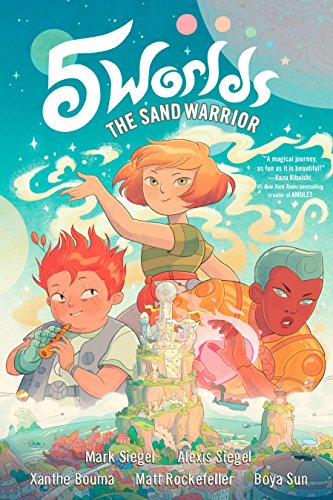
This is an ongoing series that is something of an indie supergroup of creators.  Mark and Alexis Siegel wrote the amazing Sailor Twain, Xanthe Bouma draws for The Amazing World of Gumball, Matt Rockefeller illustrated the children’s book Pop, and Boya Sun created the quirky Chasma Knights.  So this was very promising indeed.

The illustration style of this book is very trippy–soft and delicate with fine lines and gentle coloring. It looks very anime and yet it’s not.  It’s hard to know which artist’s style dominates.  I feel like Boya Sun, but they all have a similar aesthetic.  I really like the character design as well.  I found it very refreshing that none of the characters look like superheroes (well except for Jax the athlete).  Oona is a short girl who has wide hips and thighs and An Tzu is a chubby boy.  Even the other creatures are all interesting and uniquely designed.

The story is magical and fairly complicated with a lot of parts.

On the land of Mon Domani, we see a young girl, Oona, with a halo (which turns out to be sand, I think) sitting alone.  Elders pass and say she looks a lot like her sister, but they shall not speak of her.  Oona is in school learning how to do the summoning dance (which has to do with the sand), but she’s not very good at it because she can’t control the sand.  She and her friend practice but when it goes wrong the bratty boys in class call her Oona Oopsa.  When her sand dancer runs off she chases it and overhears something important. (more…)

Read Full Post »

SOUNDTRACK: JANN ARDEN-“Leave the Light On” (2018).

Jann Arden is a Canadian singer-songwriter who I know pretty much exclusively from her 1994 song “Insensitive.”  Arden has also made numerous media appearances over the years, including showing up on Corner Gas, Robson Arms and other shows that I haven’t seen.  She also appeared extensively on Rick Mercer Report (I found out by reading the book).

“Insensitive” is a slow song with a bit of mid-90s production.  The melody is catchy and the lyrics are great:

Oh, I really should have known
By the time you drove me home
By the vagueness in your eyes, your casual goodbyes
By the chill in your embrace
The expression on your face, told me
Maybe, you might have some advice to give
On how to be insensitive, insensitive, ooh, insensitive

Now, nearly 25 years later, Arden has other things on her mind.  I don’t know much about Arden, but evidently both of her parents suffered significant health problems in the last decade.  Her father passed and shortly after that her mother began a battle with Alzheimer’s as well.

“Leave the Light On” is a beautiful song about her mother.

A slow piano opens before Arden starts singing–her voice sounds wonderful–powerful and exposed.

I never pictured life
Alone in a house
Surrounded by trees
That you’d forget yourself
Lose track of time
Not recognize me

The bridge comes in with a harmony voice that shows even more pain.

Then the chorus kicks in and a song that could be maudlin or easily schmaltzy goes in exactly the right place to prevent that.  It shouts a sense of optimism that’s the only way people can keep going sometimes

A four note melody picks up the pace and uses a perfect parenthetical voice (the first voice is quieter, almost internal)

(Out of the dark)
I leave the light on
(In through the cold)
I leave the light on now
(Safe from the night)
I keep my eye on the road
(Good for the soul)
For when you come home to me

What is so compelling about the song is how musically understated it is.  While it could go big and heartbreaky with strings and over the tops effects, it stays quiet with the piano and a quiet electric guitar playing a melody deep in the background.  And really once the drums kick in, it’s almost like the drums are the only instrument–like Arden’s voice is the melody and the piano and guitar are there purely as support.

There’s a short bit near the end of the song that is a real gut punch though.  After a short guitar solo, she sings following the guitar, “do you know my name, do you know my name?”

Dang.  It’s a starkly beautiful song.

It also showcases what a great songwriter she is because she is apparently a truly fun person to hang out (according to Rick Mercer).

[READ: December 2019] Rick Mercer Final Report

I read The Mercer Report: The Book over ten years ago.  I had been a fan of Rick Mercer Report on Canadian TV (we used to be able to get Canadian satellite down here).  As an introduction to that book I wrote

Rick Mercer is a great political comedian.  He puts all American political commentators to shame. I’m sure that much of this difference is the way Canada is structured. There seems to be so much more access to politicians there than in our system.  While politicians do appear on our TV shows, on the Mercer Report, Rick goes white-water rafting with the head of the Liberal party. Rick has a sleepover at the Prime Minister’s house.  For reasons I can’t fathom, all of these politicians agree to hang out with Rick even though in the next segment he will rant about their incompetence.

It’s these rants that were a highlight of his show.  Every episode, he would stand in an alley and go off for 90 some seconds about the issue of the week.  His rants are astute, funny, and right on the mark.  He takes aim at all sides by ranting against incompetence and hypocrisy.  The only disappointing thing is that since this book covers the lifetime of the show and some of the topics have appeared multiple times, I guess it shows that his rants didn’t accomplish their goals.  But they made us feel better, anyhow.

The book is organized in reverse chronological order, with the final rants (April 3, 2018) coming first.

Topics in the final year included how run down the Prime Minister’s residence is.  Justin Trudeau said “The place is filled with mould and lead–I’m not raising my children there.  Typical Liberal.”  Also payday loan sharks; the Paralympics (Mercer was a huge supporter) and technology. (more…)

Read Full Post »

SOUNDTRACK: FALHA COMUM-“Film Do Mundo” (2019).

Every year Lars Gotrich publishes his list of favorite music in an NPR podcast called Viking’s Choice: The Year In The Loud And The Weird.  I always listen to these songs because I’ll never hear them anywhere else (he mostly seems to scour bandcamp for unknown music.

One that he especially liked was by this band Falha Comum, a duo from Brazil.

He says:

The Brazilian post-punks scaled down to a duo, but opened a festering third eye. The psychedelic noise receptors of a previous decade (think Raccoo-oo-oon and Gowns) run throughout Rakta’s Falha Comum, but in levels below, the sinister grooves and cackled reverb inhabit a life all their own with primal incantations to spirits unknown.

The album is like a few things and nothing else that I’ve heard.  There’s elements of krautrock–but not sterile and efficient, more groovy and cool, with a warm bass and seemingly wild, improvised vocals.

This particular song is 7 minutes long and opens with a spoken word section (presumably in Portuguese).  There are synths and screams behind the speaking and then everything starts pulsing as the vocals echo and echo.   The music–a simple repetitive drum and bass (I guess) line, keep a terrific groove going while on top, the high notes (vocals and other synths) skitter and flit about.

Midway through, the song goes through a phase shift–it sounds like it’s been transported somewhere else, and that’s when the bass gets cleaner and the vocals grow a bit more intense.  But the groove remains.

Somewhere around 6 minutes, the groove changes slightly–a brief shift in notes suddenly gives the song a brief moment of extra melody.  The following keyboard frenzy keeps it from getting too comfortably melodic though.

It’s an unexpectedly interesting and cool record.

[READ: Summer 2019] The Long Utopia

This was the fourth book in the Long Earth series.  I brought it along on vacation thinking it would be a fairly slow and leisurely read like the others—something I didn’t mind putting down and picking up a few days later.  But this book changed that pattern entirely.  It was fast paced and quite exciting and my favorite book of the series so far.

The previous book about the Long Mars seemed to be more than anything else, a distraction.  Not a lot happened, although there were some cool ideas in it.  The one big thing that book 3 did that effects book 4 is the cable/elevator thing—which I still don’t understand [see yesterday’s post about book 3].

This book also introduces a new concept in Stepping.  Typically Stepping is described as moving left or right, east or west through the Earths.  But suddenly, in this one world, it seemed like a person could move…north.  Into an entirely different world—night instead of day:  “No stars exactly, it was like he could see the whole galaxy…from outside.”

This book is set in 2052.  Protagonist Joshua Valiente:

will be 50 years old. He has been stepping for 35 years and has been all over the Long Earth.  But some things are still unsettling—things that he can feel in his bones or his head.

The reason for his feelings date back to 2036 in New Springfield.  Cassie Poulson had been digging a basement for her house when she hit some kind of opening.  Not a cave or anything natural, but some kind of manufactured tunnel or the like.  When she poked her head in,  what poked back was a humanoid metal beetle.  Obviously she freaked out and covered up the hole. (more…)

Read Full Post »

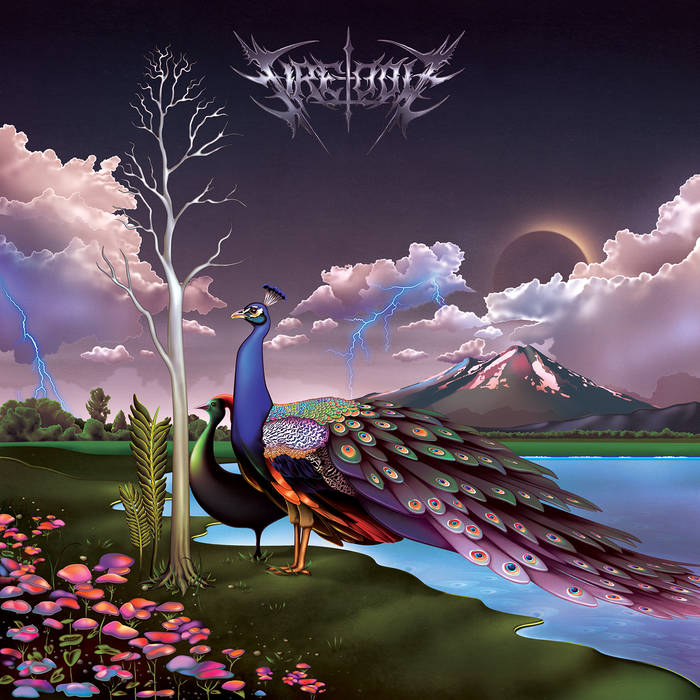
SOUNDTRACK: FIRE-TOOLZ-“mailto:spasm@swamp.god?subject=Mind-Body Parallels” (2019).

Every year Lars Gotrich publishes his list of favorite music in an NPR podcast called Viking’s Choice: The Year In The Loud And The Weird.  I always listen to these songs because I’ll never hear them anywhere else (he mostly seems to scour bandcamp for unknown music.

One that he especially liked was by this band Fire-Toolz.  He says:

When I try to describe the simultaneously fantastical and obliterating sounds of Fire-Toolz to folks, I usually throw my hands up — not out of frustration, but from awe. Angel Marcloid has clashed New Age synthscapes, clubby raves, jazz fusion and metal shrieks for a few years now, but Field Whispers (Into the Crystal Palace) goes beyond the mash-up, into an idiosyncratic master’s pure creation.

The album credits indicate: Angel Marcloid: voice, drums, electric & acoustic guitar, fretless bass, virtual studio technology, field recordings, circuit-bent junk, composition, lyrics, recording, production, mixing, mastering.

The only other musician is Ian Smith: who plays what can only be described as a smooth-jazz saxophone solo.  Oh, and her cat, Breakfast, gets a vocal turn.

I have listened to some of the whole record, (a lot of tape manipulation on track 2), but nothing sums up the project like the first song, “mailto:spasm@swamp.god?subject=Mind-Body Parallels” (yes, that’s the title).  In 2 minutes and 11 seconds, she includes more genres than I can name.  And the amazing thing is that unlike other artists who squeeze many genres into one song (there are those who do this well and those who do not), these shifts feel at once hairpin but also natural. 

The song starts with a skittery electric melody that almost sounds like digital pipe organ.  It’s very new-agey, but with heavier drums than you might expect.  The quiet death metal growling is certainly unexpected, but somehow it doesn’t feel out of place (and is low enough in the mix to feel more like another sound than vocals–I have no idea what she’s saying).

After the first verse the music shifts to a kind of jazzy new age followed by a punishingly fast electronic drum and a scorching heavy metal solo and the song devolves or crescendos with inhuman growls.

Welcome to 2020!

[READ: May 2019] The Long Mars

I found the first book in this series rather compelling–almost surprisingly so given that it’s not a fast-paced book and, to be honest, not a lot happens.

But it was really well written and the things that do happen are compelling and fascinating.  And I couldn’t wait to read more.

In the first book:

A man creates an invention (The Stepper) which allows one to step into a parallel world that is next to ours.  There are a possibly infinite numbers of parallel worlds in each direction (East or West).  The worlds that are closer to ours are almost identical to our Earth (known as Datum Earth).  The further you go, the greater the differences.  But none of them have experienced humanity before Step Day (aside from earlier hominids).

The main character is Joshua Valienté.  Joshua is a natural “Stepper.”  He doesn’t need the device to Step from one word to the next, nor does he feel the nausea and other side effects that most people feel as they travel.  Most of the book follows his exploits.

The Black corporate has a ship with an entity known as Lobsang who claims that he was a human reincarnated as artificial intelligence.  Joshua is sure that Lobsang is a computer, but Lobsang’s human skills are uncanny.  This ship has managed to Step as an entity, meaning everything in the ship can go with them.  Normally you can only bring what you can carry (aside from metal).

The novel more or less is an exploratory one with Joshua and Lobsang Stepping through millions of Earths.  Not a lot happens, but the novel never grows boring.  The interactions between Joshua and Lobsang are often funny.  And the writers have infused the Earths that they stop in with just enough differences to make each stop strangely compelling (this must be Baxter’s hard science leanings).

I found the second book less compelling on a story level, but no less compelling on a conceptual level.  There was still some cool stuff going on.

Joshua Valienté has settled down in a town called Hell-Knows-Where.  He has a wife, Helen, and a child, Daniel, and lots of regrets about what happened at the end of book one.  He is embedded with the rest of the community.  They show off what a successful community can be way out in the Long Earth.  It is more or less cut off from Datum Earth, which means that everyone needs to work for the community to survive.  Since trust and companionship are key to survival, people don’t really try to take advantage of others and crime is pretty much nonexistent.

This independence is a major concern for the governments of Datum Earth.  In fact, some of the more thriving distant communities (like Valhalla) want to declare independence from Datum Earth altogether.

Another issue is human (or alien) rights.  The trolls from the first book have become a part of most communities at this point.  And yet, the way they are treated seems largely dependent on who they are with.  Some are welcomed like family members, other are treated like animals, slaves or worse.   And the mistreatment of a mother and son troll are what set a series of events in motion.   Maggie Kauffman is a new character introduced to speak on behalf of the trolls.  Before their otherwise peaceful nature gets pushed too far.

Another plot line (and there are quite a few) concerns Roberta Golding, a young genius who goes on an exploratory mission with the Chinese.  The Chinese are exploring the “East Earths” (most of the other travelers went West).  Roberta is an odd child, who anticipated jokes and therefore finds nothing funny. She is cold and emotionless.  Her story remains unresolved by the end of the book.  But her crew managed to get to Earth East 20,000,000 with the crew.

When Sally tries to get Joshua involved in an adventure once again, he is reluctant, but Helen is the one who spurs him on–as long as she and Dan go with him. This adventure is a bit of backtracking, though–an attempt to use Joshua’s name and status back on Datum Earth–where he is not welcomed by everyone.  He tries to prevent the government from harming trolls–because he knows what is at stake if the trolls grow angry.

In their adventure, they also encounter a race of beings known as Beagles.  It is a pretty dark and disturbing world, with Joshua getting tortured and Sally and Monica being the only things keeping him from a brutal death.   There’s a lot of brutality now, which is not unexpected given the reality of the situation, but it does often seem rather harsh

That’s a lot of summary to prepare for Book Three.  But book three does continue the saga, just another twenty years or so later.

(more…)

Read Full Post »

SOUNDTRACK: FIONA APPLE-“The Whole of the Moon” (2019).

I’m rather a fan of a good cover song.  I don’t really like when bands play covers live–I’m here for your music not someone else’s–but a studio recording is usually welcome.

It’s especially helpful if it’s an artist I like doing a song I like.  Such as with this one.

I learned about The Waterboys back in college.  I hung out with Irish musicians and they introduced me to Irish bands.  Although we were more Fisherman’s Blues than This is the Sea, I still really enjoyed “The Whole of the Moon.”

Lyrically the song is simple but very clever.  It works through many comparisons about how “I” see things less completely than “you” do.

I was grounded
While you filled the skies
I was dumbfounded by truth
You cut through lies
I saw the rain dirty valley
You saw Brigadoon
I saw the crescent
You saw the whole of the moon

I also always like the part where the line “you came like a comet” is followed by an explosion–satisfyingly over the top.

The occasion of Fiona Apple covering it has to do with the show The Affair which I’d never heard of.  Evidently the season finale opens with The Waterboys’ version and ends with this new Fiona Apple version.  Fiona Apple’s song “Container” is used in the opening credits, so she already has ties to the show.

I can remember “discovering” Fiona Apple through an issue of New Music Monthly about two months before her debut came out.  I really liked “Shadowboxer” and then the whole album.  It was quite a surprise to me when she became a huge star soon thereafter.  And by the time she toured where I lived, the crowd was full of screaming girls.

Nevertheless, I have stuck with her because her music is always terrific.

Her voice has always been kind of raspy and deep–with a quirky range.  But she really pushes herself on this version.  She sounds worn out and it really works for these lyrics.

It stars with gentle synths and a drum pattern.  After the first verse, a full band comes in, with a trippy slide guitar (rather than the 80’s synths of the original).  But it stays pretty simple–this song is about the lyrics.  The middle instrumental section is similarly horn-based, but with a bit of piano and more slide guitar tossed in.

As the song goes on, Apple’s voice gets more and more intense.  The way she sings: “I sighed / but you swooned” will give you chills.

The Waterboys version has a cute musical ending which Apple removes. She also refrains from the comet explosion.

It’s stripped down and really fantastic.

[READ: September 23, 2019] Herbert’s Wormhole Book 3

I accidentally read Book 3 before Book 2.  I am embarrassed that that happened because I am a librarian and I should know better, but I double checked to see which came out first, but I must have read a paperback reprint with a later publishing date and though that book 3 was in fact book 2.

So I read book three and on many occasions I thought “How daring and surprising and hilarious that the Peter Nelson is referencing things that we did not see.”  I assumed that between book 1 and this one, the kids had had many adventures that we didn’t know anything about.  They would just casually refer to them.  This does happen in TV shows all the time, but I guess not in children’s books.  So I should have known better, but I was excited about the prospect of this rather author twist.  I do admit by the end that there were a number of things where I thought…hmmm…. this is referencing something that I think I should know about.  But I was far enough along at that point not to stop.

Turns out, at the end of Book 2 (I found out later), we see that GOR-DON’s plan for destroying the AlienSlayers is not his own.  It is actually  the plan of an evil mastermind.  An evil mastermind who we learn is called Aerostar.

But the real crisis is in the Filby household.  Because Alex’s dad is going to knock down the jungle gym (that they put up for Alex just last year) to make room for a huge playhouse for his bratty little sister, Ellie (“some serious assembly required”).  This will effectively destroy the wormhole!  What will they do now? (more…)

Read Full Post »

SOUNDTRACK: ALEJANDRO ESCOVEDO-Tiny Desk Concert #834 (March 20, 2019).

I feel like I’ve been hearing Alejandro Escovedo’s name for years, and yet I know very little about him.

I assumed he was a kind of folkie guy.  So I was pretty surprised by the loud sound he brought to the Tiny Desk.  And even more surprised to read

The musician, who once opened for the Sex Pistols … seemed to appreciate the difference between being pelted with spit and debris by punk rock fans and being showered with loving appreciation in the NPR Music office.

Escovedo came  in a leather jacket and a large band.  And even though I thought they were loud, apparently they intended to be louder.  They even started the show with “one for the money, two for the show, three to get ready and four Go Alejandro!”

Escovedo and his backing band known as Don Antonio set up behind the Tiny Desk, their first sounds were blistering loud. That’s when we broke the news: We wouldn’t amplify Alejandro’s voice. We got a slightly sullen look from the band; but despite the toned-down volume, they were all still amped up.

A little research into Escovedo, though shows that he has, indeed, played folkie/alt-country music.  But that his sound has evolved over the years.

Escovedo pulled the three-song set from The Crossing, the most recent chapter in his ongoing odyssey and a typically hard-rocking, literate saga about two teenagers looking for their American Dream of rock and roll and beat poetry.

“Teenage Luggage” opens kind of quiet with one guitar and quiet drums, but soon enough a sax and keyboards are added, then comes some bass and the second saxophone and the roaring lead guitar.  As Escovedo sing/speaks his story.  Then comes the catchy chorus:

You think you know me, you’ll never know me you’re just a bigot with a bad guitar.

By the end, everyone is rocking out with mini solos from Perinelli on saxophone and a raucous guitar solo from Gramentieri

The close quarters of the Tiny Desk allows for a kind of backstage insight into the musical and visual interplay between Escovedo and the veteran Italian band Don Antonio [Antonio Gramentieri: vocals, guitar; Denis Valentini: bass; Matteo Monti: drums; Nicola Peruch: keyboard; Gianni Perinelli: tenor sax; Franz Valtieri: baritone sax]. Lead guitarist Antonio Gramentieri is the perfect foil for Escovedo, who adds a heavy dose of edginess to the sound with his power strumming.

“Something Blue” is slow with a dominant organ sound (reminiscent of Bob Dylan).  It sounds like an old-school rock song and his delivery sounds more than a little like Warren Zevon.

He says that “Sonica USA” goes out to Don since Wayne Kramer from the MC5 played on this.  It has a great raw rock feel with Escovedo’s punky vocals and the chanted chorus of “Sonica USA.”  The soloing section is great with the two saxophones playing on top of Gramentier’s wailing solo.

It’s a really fun garage rocking set.

[READ: Summer 2018] The Long War

I found the first book in this series rather compelling–almost surprisingly so given that it’s not a fast-paced book and, to be honest, not a lot happens.

But it was really well written and the things that do happen are compelling and fascinating.  And I couldn’t wait to read more.

In the first book:

A man creates an invention (The Stepper) which allows one to step into a parallel world that is next to ours.  There are a possibly infinite numbers of parallel worlds in each direction (East or West).  The worlds that are closer to ours are almost identical to our Earth (known as Datum Earth).  The further you go, the greater the differences.  But none of them have experienced humanity before Step Day (aside from earlier hominids).

The main character is Joshua Valienté.  Joshua is a natural “Stepper.”  He doesn’t need the device to Step from one word to the next, nor does he feel the nausea and other side effects that most people feel as they travel.  Most of the book follows his exploits.

The Black corporate has a ship with an entity known as Lobsang who claims that he was a human reincarnated as artificial intelligence.  Joshua is sure that Lobsang is a computer, but Lobsang’s human skills are uncanny.  This ship has managed to Step as an entity, meaning everything in the ship can go with them.  Normally you can only bring what you can carry (aside from metal).

The novel more or less is an exploratory one with Joshua and Lobsang Stepping through millions of Earths.  Not a lot happens, but the novel never grows boring.  The interactions between Joshua and Lobsang are often funny.  And the writers have infused the Earths that they stop in with just enough differences to make each stop strangely compelling (this must be Baxter’s hard science leanings).

At the end of the book, the anti-steppers attempt a massive, deadly protest.

(more…)

Read Full Post »

« Newer Posts - Older Posts »