Feeds:
Posts
Comments

Archive for the ‘End of the World’ Category

witmis3SOUNDTRACK: TOULOUSE LAUTREC-“Yesman” (2013).

heroesToulouse Lautrec are an alternative rock band from Romania.  Once again, I would not have ever heard of them had I not looked fora song about Lautrec (since he is mentioned in this section of the reading).

Toulouse Lautrec have two albums out, Heroes and their new one Extraordinar. They sing in both Romanian and English and this song (which is the first thing that came up on my search) is entirely in English.

It starts out with some very cool guitar riffs (very math rock–I actually considered it might be an instrumental).  Even the bass is doing something interesting behind the guitars.  Then about 50 seconds in the vocals begin.  And the singer has an almost American twang to him.

The chorus is a simple one, with ooh hoo hoo hoos.  But the real fun is at the end of each verse–the I say no I Say no and I say yes I say yes.

I listened to this song a few times and really liked it a lot.  It’s simple but solid alt-rock.  Then I found their website and watched a few more of their videos.  I really like the sound that they get–kind of buzzy guitars but otherwise very clean.

Check out the video for Yesman

and their site (which is in Romanian, but Google Translate will help you navigate)

[READ: October 20, 2013] Wittgenstein’s Mistress p. 61-120

This book is proving to be far less daunting and far more loose and fun than I anticipated.  As you can see by my “read” date, I finished this almost two weeks ahead of time.  In part it’s easy because unless I am gravely mistaken, there’s nothing really to “remember” about the story.  There are details and I think they are ponderable, but there’s nothing that seems to really impact the story. It’s more a series of ideas.

It’s really quite an audacious piece of writing.

Wittgenstein gets his first mention on page 61

“Once Bertrand Russell took his pupil Ludwig Wittgenstein to watch Alfred North Whitehead row, at Cambridge.  Wittgenstein became very angry with Bertrand Russell for having wasted his day” [61].

There are some meaty existential issues brought up like

“Surely one cannot type a sentence saying that one is not thinking about something without thinking about he very thing that one says one in not thinking about” [63]. (more…)

Read Full Post »

witmis2SOUNDTRACK: CÓDIGA DE GUERRA-“Wittgenstein Song” (2013).

codigoCódiga de Guerra is from Hidalgo in Mexico.  They have one album out (called Peyote).  I am having a devil of a time finding anything out about them.  You can stream the album on YouTube and you can even buy it from iTunes, but I can’t get any kind of band home page.

It should be apparent that I’d never heard of them before I saw they had a song called “Wittgenstein” and so here they are.

They sing entirely in Spanish, so I don’t really know what this song is about, but i really like it.  Indeed I like the whole album.  They have an indie rock feel–buzzy guitars and good melodies.  Some of the early songs on the album are even kind of mellow which made me think of R.E.M. for some reason.

“Wittgenstein” is the heaviest song on the album.  It opens with some echoed guitars (not unlike Kiss’ “Black Diamond”) but when the other guitars kick in, it is much louder (not heavy heavy, but louder).  The chorus gets kind of heavy again, but the song fades out entirely at around two minutes.  Then a buzzy bass comes back in and the echoed guitar plays the intro and the song starts again.  I heard the word logico in there so it may indeed be all about Wittgenstein.

Check out the song

or the whole album

[READ: October 16, 2013] Wittgenstein’s Mistress p. 1-60

Typically for a group read like this (especially the longer, harder books) I like to be a kind of touchstone–noting significant things that happen and trying to wrap my head around the book by summarizing it, without really speculating wildly about what will happen.  Well, Wittgenstein’s Mistress seems to studiously resist that sort of approach.  I am not typically a “solve it” kind of reader.  I don’t usually try to figure things out ahead of time.  If the book is well written, I just like to let it flow over me so I can think about it afterwards.

But this book more or less demands you to try to figure out what is going on right from the get go.

The cover image above shows the opening sentence:

“In the beginning sometimes I left messages in the streets.  Somebody is living in the Louvre, certain of the messages would say. Or in the National Gallery.”

followed soon by

“Nobody came , of course.  Eventually I stopped leaving the messages.”

Weird, right?  And then comes:

“I have no idea how long ago it was when I was doing that. If I was forced to guess, I believe I would guess ten years.”

Whoa.  And then the kicker:

“And of course, I was quite out of my mind for a certain period too, back then.” (more…)

Read Full Post »

corin SOUNDTRACK: THE DISMEMBERMENT PLAN-“No One’s Saying Nothing” (2013).

IDismembermentPlan_CVR-a71cdf7d3b8dde6270c3a01bb56278949eddb5fa-s1 thought I knew The Dismemberment Plan, but I must have them confused with someone else, because this song doesn’t sound anything like what a band called The Dismemberment Plan ought to sound like (which is noisy and chaotic and probably death metal).  This song has big vocals, organ and piano.  Nevertheless, it is rather raucous and is quite fun (and has what sounds like a drill sound effect in the beginning and middle).

Lyrically, the song is odd–“If you press the space bar enough, cocaine comes out.  I really like this computer.”

But it has a very fun devil-may-care, throw in everything attitude that I really like it.  The entire album was streaming on NPR, and I’m looking forward to hearing more from them–including their back catalog work, to see if they ever sounded like what I thought they sounded like.

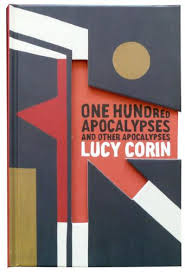
[READ: October 1, 2013] One Hundred Apocalypses and Other Apocalypses

I was excited to get this book because I thought the title was quite intriguing (and the crazy way the cover is cut out was also interesting).

There are four “stories” in the book.  The first three are about twenty pages each while the fourth is over 100 and is comprised of the titular 100 apocalypses (I didn’t count them).

“Eyes of Dogs”
This story contained marginalia (which is sort of like footnotes but not attached to anything specific). In this story a solider meets a witch and she tells him how to get money—climb down a hole and encounter three dogs.  He must wink at the first, blink at the second and hold his eyes closed for the third.  The story seems to be going along sensibly like a fairy tale but then it grows introspective and stops.  I was disappointed in this one.

“Madmen”
This story was utterly bizarre and yet by the middle of the story the bizarreness was explained and by the end I enjoyed it very much.  The premise of this story is that when children grow old they are given a madman to take care of (it is told matter of factly which makes you have to wonder if madman is code for something else.  When boys reach a certain age and when girl;s have their first period (which is an unfair division of genders) they get to go to the asylum and pick which madman (or woman) they want to bring home and care for.  The bulk of the story is at the asylum with the girl “interviewing” the candidates and her mother being mad at her choices.  Ultimately the story turns onto a nice moment between the girl and her dad, who may or may not have married his own madman.  As I said very weird, but satisfying.

“Godzilla versus the Smog Monster”
This was the most “real” of the four stories and it was my favorite.  A fourteen year old boy is watching “Godzilla vs the Smog Monster.”  He found the unlabelled video of it in his father’s sweatshirt drawer and assumed it was porn.  He’s bummed that it turns out to be this Godzilla movie.  In a parallel story, when the boy goes to school his class is watching live footage of California burning—and this burning is uncontainable.  The whole state is slowly engulfed in flames.  This fire, which seems to be some kind of attack obviously changes the minds of everyone in the story, including Sara, a girl who Peter thinks is pretty but who never talks to him.  But when she crashes her car in front of his house, he helps her and they go for a ride to a cave.  Images of the smog monster crop up in interesting ways.  Things get weird and less tangible, but because the beginning was so real it made the ending okay.

“A Hundred Apocalypses”
So this selection disappointed me because it proved to be 100 (I assume) flash fiction pieces.  And I have more or less come down against flash fiction these days.  Especially the kinds of stories that make an interesting “sketch” but aren’t really stories The other problem is that all 100 seemed to be about “apocalypses” which is a useless words when tossed around so much and which loses all meaning when there are 100 that seem to be about actual apocalypses.  Or something.  I also just learned that apocalypse means un-covering or revelation, not really the end of the world, but whatever.

There were probably 6 out of the hundred that I really enjoyed.  Sadly, I didn’t mark them and I don’t remember which ones they were.  The rest were okay or worse.

I am ready for flash fiction to go away.  And I fear that my beloved McSweeney’s is one of the prime generators of the genre, so perhaps they could knock it off for a bit.

Read Full Post »

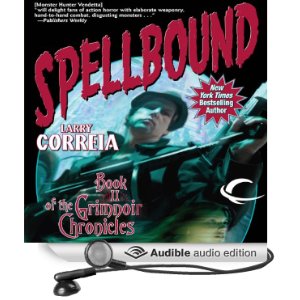
[LISTENED TO: July 27, 2013] Spellboundspellbound

I enjoyed Book I of The Grimnoir Chronicles immensely.  I wasn’t really sure what Correia could do to top it.  There’s the inevitable dread for sequels that everything has to be bigger bigger bigger with the cost to the heart of the story.  (That’s more true in movies, but books can suffer as well).

And indeed, Correia does go bigger, but he loses nothing.  Indeed, the higher stakes make this story all the more exciting without sacrificing the characters in any way.

As the story opens, we learn that it is a few months after the events of Book I.  The Grimnoir are dispersed somewhat, with things falling into a somewhat logical place.  Francis Stuyvesant is the head of United Blimp.  Faye and Francis are more or less dating and Heinrich is more or less his bodyguard. The other team members are up to assorted states of resting and recuperating.  And Jake Sullivan is lying low.

But no matter how low he thinks he is lying, he’s still very big.  And he is soon found by a woman named Hammer.  Of course, at first the story maintains the trappings of noir, with Hammer being a (beautiful) woman in distress.  Surprisingly, she is in distress at the library and she asks Jake for help (he is there studying magic and, well, lying low).  He tells her to ask the librarian.  But later when he is leaving, he sees her being robbed by some thugs.  He goes to rescue her (and easy job for a big guy like him), and Hammer uses her power to determine that he is indeed Heavy Jake Sullivan.  And he can still do what he can do.

Hammer wrangles him into a government facility where he accepts a phone call from the dead Chairman.  This whole section is lovingly described and far too cool to try to summarize.  So let’s just say that Alexander Graham Bell created a phone that could talk to the dead–but only if they wanted to talk to us.  The Chairman found the phone and, of all people, he wanted to speak to Jake.  (I’m skipping so much stuff here that it hurts me, but I don’t want to spoil the story or the humor). (more…)

Read Full Post »

SlexOUNDTRACK: FRANK TURNER & THE SLEEPING SOULS Live at the Newport Folk Festival (2013).

frakWhenever NPR streams and saves festivals shows, I like to check out the bands I love (of course), but I also check out some of the bands I’d never heard of before.  And sometimes it leads to a fantastic discovery.  Like Frank Turner.  I had no idea who he was, but he was described as folk-punk which is quite accurate.  He reminds me of Billy Bragg in his younger, harder days.  Turner is British, he has a very thick accent when he sings and while he is nowhere near as political as Bragg, he treads in that same line of folkiness.

His lead off track, “Four Simple Words” (the words are “I Want to Dance”) begins as a folkie song, but it quickly morphs into a rollicking stomper (louder than most bands at Newport, he theorizes).  But a song like “Try This at Home” seems to speak to his overall ethos—music for the people by the people:

Because there’s no such thing as rock stars There’s just people who play music
And some of them are just like us And some of them are dicks
So quick, turn off your stereo Pick up that pen and paper
Yeah, you could do much better Than some skinny half-arsed English country singer

There are a few more specifically pointed messages like “Glory Hallelujah,” whose chorus goes “There is no-o-o God, so clap your hands together.”  As well as a funny (but not really) song which he introduces as being written because he read Gene Simmons’ autobiography.  Simmons says he slept with 4,600 some women which he knows because he has taken a Polaroid of each one.  Turner is appalled “what an ass” and wrote “Wherefore Art Thou, Gene Simmons” as a response.

But the majority of songs are about love and life, going home again and playing music.  And, in this live setting Turner is fantastic—getting the crowd to sing along, having great banter and being a wonderful showman.

The final song is a great sing-along with the simple but effective chorus of: “I won’t sit down and I won’t shut up.  And most of all I will not grow up.”  I’m totally enjoying Turner’s music and now I’m going to have to check out his actual releases (he has four or five).  See more about him at his website.

[READ: July 20, 2013] Lexicon.

Virginia Woolf has gotten a hold of a word which has caused untold destruction in a small town in Australia.  W.B. Yeats has sent T.S. Eliot and a non-poet named Wil to get the word back and, if possible to kill Virginia Woolf.

Intrigued?  Yeah me too.

I saw this book in Barnes & Noble and was really excited that Barry had a new book out.  And when I pointed it out to Sarah she said , “I already have a hold on it.”  So, when it came in I took it from her pile and now it has to go back before she gets a chance to read it.

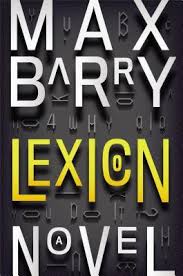
Imprinted in the crazy cover image are a series of odd characters and amid them it says 4 why did you do it.  I was trying to figure out if there was more to this secret message, but there isn’t.  However, it is a clue to what lies inside.

I guess in the grand scheme of things, the story is pretty simple (if not a little confusing).  What I laid out above is the skeletal outline; however, Barry interweaves the story with past and future (and a whole lot of mind control) and he begins the book right in the middle of utter chaos. (more…)

Read Full Post »

jetpackSOUNDTRACK: WE WERE PROMISED JETPACKS-“Quiet Little Voices” (2009).

jetpacksWhen you have a book with “Jetpack” in the title, the appropriate band is We Were Promised Jetpacks, no?  I’ve heard a lot of good things these guys.  But all I knew for certain was that they were Scottish.

I listened to their debut EP, The Last Place You’ll Look, which I liked a little.  But I didn’t care for the sound of the EP itself, it was rather flat.  A few listens got me enjoying the melodies and such but it never grabbed me.  Especially when I compared it to “Quiet Little Voices,” the lead single from their debut full length, These Four Walls.

The vocals are a bit stronger, the guitars and bass are both more clear.  The overall feeling is just brighter.  Now this may be a sign of selling out (is that something bands still do?), but really I think it’s just a better production for this song.  Which has a big chorus (and good backing vocals).

I listened to a few more tracks from These Four Walls and they are all good too.  I guess start with the albums and save the EP until after you’ve absorbed the band.

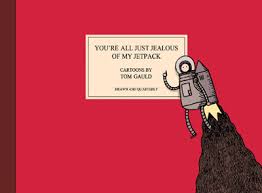
[READ: July 5, 2013] You’re All Just Jealous of My Jetpack

Gauld makes comics like no one else I know.  Most of his people are silhouetted or are the most rudimentary designs–simple triangle-shaped clothes, circle heads with dots for eyes and little else–maybe a nose if it’s profile. (Okay, there’s a bit of Chris Ware, but more like a much more relaxed Chris Ware).  And the wonderful thing is just how much he can convey with these painstakingly simple drawings.

The content of his comics is usually quite clever and often literary.  While I admit there were some I didn’t get (Like the Eric Gill cartoon–shame on me?–Aha: “[Gill’s] personal diaries describe his sexual activity in great detail including the fact that he sexually abused his own children, had an incestuous relationship with his sister and performed sexual acts on his dog.”  Geez, now the comic is very funny.).  There were some in which I liked the set up but would have preferred something funnier (like the Tom Waits comic–shame on him?)

But overall this collection was really enjoyable.  And I laughed a lot. (more…)

Read Full Post »

zitaSOUNDTRACK: “WEIRD AL” YANKOVIC-Running with Scissors (1999).

Running_with_Scissors_(Weird_Al_Yankovic_album_-_cover_art)This is the first album Al released with is new look—LASIK surgery and long hair.  He looked quite different, but it didn’t diminish his song writing skills.  Running with Scissors is a pretty great collection of songs.

“The Saga Begins” is a genius parody taking the music of “American Pie” and merging it with the plot from Star Wars Episode I.  The way he retells the story is snarky and funny.  “My Baby’s in Love with Eddie Vedder” is a weird song—an accordion-based zydeco song about, well, a guy whose girl loves Eddie Vedder.  Vedder is kind of a weird person to pick (since he does make fun of him), although I guess it’s pretty mild abuse.  “Pretty Fly for a Rabbi” opens with a joke on a Def Leppard song (in Hebrew) but then moves on to “Pretty Fly for a White Guy.”  The original is pretty goofy and there’s not much Al could have done to it except this—changing it to being all about a rabbi. I like this version better than the original now.

The next track is the theme for The Weird Al Show.  It’s utter nonsense, but very funny.  And it packs a lot in to the 75 seconds that it lasts.  “Jerry Springer” is a parody of Barenaked Ladies’ “One Week.”  The original is pretty weird/funny, so this seems an odd choice, and yet Al’s specifics to the Jerry Springer show is pretty funny.  Of course I hate shows like that so I don’t love this song.

“Germs” is a style parody of Nine Inch nails (the song opens a like “Terrible Lie”, and then moves through some other songs).  The sound is uncanny in its soundalikeness (except perhaps the “microscopic bacteria” section which is a little too goofy sounding even for NIN.

“Polka Power” is one of the first medleys where the parodied songs seem utterly dated.  Like The Spice Girls, Harvey Danger, Backstreet Boys (which I only know because he says “Backstreet’s Back.” Smash Mouth.  Chumbawamba, Marchy Playground, and Semisonic.  Of course, there is also a Beastie Boys line (“Intergalactic”), but it’s a very era specific song.  “Your Horoscope for Today” is a ska song of horoscopes inspired by The Onion (which is hilarious).

Of course, nothing comes close to “Its All About the Pentiums,” Al’s first rap song about being a total dork  It is amazing—heavy guitars and lots of screaming.  It’s even more bad ass than the original.  And the smack talk is hilarious Asking about his computer: “You think your Commodore 64 is really neato.  What kind of chip you got in there, a Dorito?”).  I can listen to this song over and over.  It’s a wonderful precursor to “White and Nerdy.”  “Truck Drivin’ Song” has a remarkably deep voice for Al. It’s about driving a truck (as a transvestite).  The humor is childish but funny and with that voice it’s particularly so.  “Grapefruit Diet” is another series of jokes about being fat, but it works very well as a parody of “Zoot Suit Riot” with the jazzy horns and all.

That leaves “Albuquerque” an eleven, yes eleven, minute story song.  It’s a style parody of a song by The Rugburns which I didn’t know until recently (called Dick’s Automotive, but that song is much more “adult” than Al’s. The song is simple enough but the lyrics are wondrously absurd and very very funny.  And as it goes on and on and on you just marvel at the mind that created it.  And it’s catchy too.

Scissors is a great album which holds up quite well after 14 years.

[READ: June 23, 2013] Zita the Space Girl

I’d actually read the sequel to this book first, but I quickly found this first book and the family devoured it, too.

This is a charming and sweetly drawn series about a girl, Zita, who winds up in outer space.  As it opens, Zita is being a bit of a bully to her friend Joseph.  Not horrible but teasing in the way friends can do.  And when they find a giant meteor hole and a space-type gadget with a big red button on it, of course she threatens to push it in front to him,  He freaks out, but she does it anyhow.  And when she does, another dimension opens up and sucks Joseph away.  Oops.

So she pushes it again and winds up in the same place which she realizes is very very different from her own.  The thing that has Joseph is all tentacles in a diver’s helmet.  But that’s just one of the weird creatures here (as seen in Gilliam’s Guide to Sentient Species–which I take as a tribute to Terry Gilliam).  Like Strong-Strong, a large lumbering biped (who helps Zita), and a group of chicken creatures (who do not).  There’s also a man who plays a flute (called Piper) who may or may not be a friend.  She also meets a giant mouse named Pizzicato, but which Zita just calls Mouse.  Mouse is very sweet and communicates through a printer around its neck. (more…)

Read Full Post »
[LISTENED TO: June 7, 2013] Hard Magichardmagic

My sister-in-law Karen raved about this book and then gave it to me for Christmas.  And holy cow.  I.  LOVED.  IT.

And before I even get into the story I have to say that a major reason why I loved it is because of the reader–Bronson Pinchot.  Yes, Balki from Perfect Strangers.  Yes, that goofy “foreigner” from the show has an utterly mesmerizing speaking voice.  It is amazingly deep–when he first started speaking the menacing drawl of Jake Sullivan, I was blown away.  And then he pulled out a couple dozen more characters, women and men–German, Japanese, Okies, military men, New Yorkers.  He brought this story to absolutely real life.

I have made a point of looking for anything else that he reads (although I see that he mostly reads books about war (which is not my thing))–but I see a Flannery O’Connor in there and–YES–he reads book two of the Grimnoir series (called Spellbound) and it’s already out!

Okay enough about Pinchot.  No, not enough.  He was stellar!

Okay, now enough.  What’s the story about?  Well, the best thing is that the story itself is also amazing.  It is set in the 1930s, in an alternate reality Untied States.  And in this reality, random people have been gifted with magic.  And there’s all kinds of magic–fades (people who can walk through walls); torches (people who can make and stop fires), mouths (people who can put thoughts in your head); brutes (people who are crazy strong and who can actually bend gravity to their will) and movers (people who can jump from place to place).  There’s also healers and cursers and cogs–really smart people–and other with more mysterious powers.

Each chapter opens with a quote from a real (in our world) person talking about how the magic or the people with magic–the Actives–impacted society.  So Einstein was a cog, and military leaders used brutes to fight in wars, etc. (more…)

Read Full Post »

PlayerOne_Coupland

SOUNDTRACK: THE TRAGICALLY HIP-Now for Plan A (2012).

hip man

This is the latest Tragically Hip record and it bounces back from the more country feel of We Are the Same and provides eleven solid rocking songs (two of which are actually ballads and not rocking at all but are still good).  “At Transformation” starts with a big bass notes and some feedback, like an alternative indie rocker, but as soon as Gord Downie’s voice comes in it is unmistakably Hip.  This is one of their rockier songs and shows that they are back in fine form.

I recently wrote about “Man Machine” and “Now for Plan A” but I think they both work better in the context of the record.  “Man Machine” contrasts nicely with “At Transformation” and “Plan A” gives the album a chance to relax before the more rocking second half.  “The Lookahead” is the other duet with Sarah Harmer, although I fear she may be a little underutilized here.  It’s a great big chorused song that The Hip do so well.

“We Want To Be It” has a recurring “drip drip” section that I find mesmerizing.  I like the way drip drip turns into click click and then cricket and how it is alternately whispered and screamed.  I’ve never really heard a song where words were used in this way before.

I love the way “About This Map” starts slow but adds a great bridge/chorus that adds a lot of tension.  Take Forever” is a straightforward rocker which along with “The Modern Spirit” and “Streets Ahead” really exemplify the modern sound of the Tragically Hip–simple rockers with big choruses and thoughtful lyrics.  On the other end of the spectrum, “Done and Done” is a simple ballad that works nicely as the song before the closer.  “Goodnight Attawapiskat” (an aboriginal settlement in Northern Ontario) is the kind of amazing minor key, could-be-an epic that Hip fans always love.  It’s scaled down to 4 minutes, but it lets us know that they still have this kind of song in them.

The Hip will never release another record like Fully Completely or Day for Night and while there is something sad about that, it’s nice to see a band evolving and modifying their sound.  This album isn’t going to blow anyone away, but it is a solid collection of great songs.

[READ: May 15, 2013] Player One

I didn’t really understand what a CBC Massey Lecture was.  It was kind of explained, but I was confused how his lecture would have been a full length novel.  And while it is described as a novel in five hours, I doubt his lecture lasted five hours (the story takes place in real time over five hours, but surely no one would have listened to him read for five hours).  Well, thanks to Wikipedia: Each of the book’s five chapters was delivered as a one hour lecture in a different Canadian city: Vancouver on October 12, Regina on October 14, Charlottetown on October 19, Ottawa on October 25 and ending in Toronto on October 29. The lectures were broadcast on CBC Radio One’s Ideas, November 8–12.   Coupland felt that “a narrative seemed like the most efficient and accessible way of putting forth a large number of propositions about life in the year 2010.”

So this turns out to be a story that takes place over five hours, although like many stories with this conceit there are flashbacks (how could there not be).  There are five main characters: Karen, Luke, Rick, Rachel, and Player One.  Although Player One is a confusing character who may or may not really exist.

Karen is a divorced mom and has decided to travel across the country (from Winnipeg to Toronto) to meet a man in an airport bar for a possible fling.  She’s not proud of it but she thinks, why the hell not–she still feels good about herself.  In fact, on the airplane a boy takes some pictures of her with his phone, because she looks pretty hot.  And in the last one she gives him the finger.  (The whole reality of that–that someone may take a picture of you anywhere for any reason is pretty bizarre).  She arrives in the airport bar where she meets Rick, the bartender. (more…)

Read Full Post »

vormSOUNDTRACK: DEAD CAN DANCE-“Children of the Sun” (Live at KCRW, April 24, 2013).

deadcandanceDead Can Dance are timeless.  Their music sounds ancient and modern at the same time.  And Brendan Perry’s voice has an unearthly majesty to it that never seems to age.

I’ve known the band for decades (during which time they have broken up and reunited and broken up and reunited).  And in all that time, while their sound has changed in subtle ways, the band is instantly recognizable.  I’ve never really thought of them as a live entity–they just seem like such a creation of the studio that it would be impossible to do justice to their wash of music live.  Of course that was truer three decades ago before it was easy to fit an entire orchestra on an iPod.

You can watch this song on NPR.  It’s fun to watch a band with two keyboardists (and Lisa Gerrard on…autoharp?) and see all of them making very different sounds.  The only disappointing thing about watching this is that they have so many cool instruments strewn about which do not get used on this song (you can see the whole show here and watch him bust out that bouzouki).

This song is a new one and it doesn’t have quite the ponderous nature as their older material.  Which is a bit of a shame, as they were so over the top it was fabulous, but maybe they’re just settling into New Old Age.

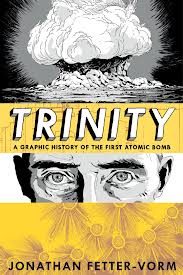
[READ: April 20, 2013] Trinity

Sarah brought this book home because it was on YALSA Hub Reading Challenge for 2013. I’m unlikely to do the challenge as I have so many other books to read, but I have already read 5 of the required 25.  Not too bad, although since the challenge is from Feb to June and I read a couple last year, I don’t even qualify for some of the ones I DID read.  Anyhow, she told me I’d like this and she was right (as usual).

Trinity is the story of the development of the atomic bomb done as a graphic novel.

It outlines how we came to develop and test the bomb and of course, the aftermath of its use.  What I liked about the story is that leading up to the detonation of the bomb, the quest for its discovery is presented in a fairly neutral way.  Essentially, once it was discovered that we could split the atom, it was deemed inevitable that someone would make a bomb out of it.  It stood to reason that if Hitler or the Japanese figured it out before us they would use it on us (since we were at war with them).  The intention was that America would be decent and not use it with impunity (which is not to say we wouldn’t use it at all).  The book presents that American can do spirit that the forties seem to be all about–a sort of gee whiz, let’s figure this out mentality.

I knew some of the history of the bomb, but there was a lot here that I didn’t know: that thousands of people moved to New Mexico to work on the bomb—housing was put up and families moved in, some 80,000 people in all.  And most of the people had no idea what they were working on.  It’s hard to fathom that there were thousands of people whose work helped to create a nuclear bomb and yet they can feel neither pride nor shame because they had no idea that’s what they were doing.  Weird. (more…)

Read Full Post »

« Newer Posts - Older Posts »