Feeds:
Posts
Comments

Archive for the ‘Drugs’ Category

SOUNDTRACK: PJ HARVEY-Let England Shake (2011).
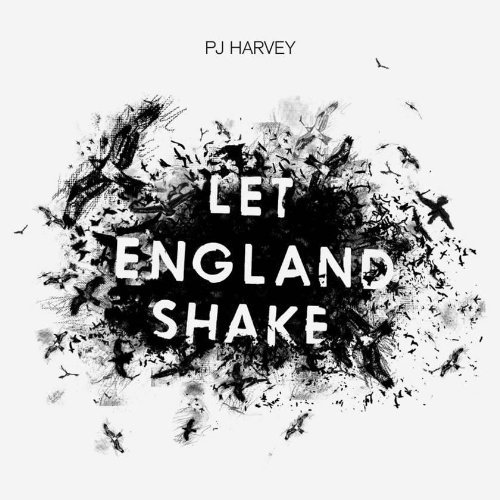
I’ve listened to this disc several times online; I have no details about the recording.  There’s samples, but I don’t know what they are and I can’t really tell what all the lyrics are (it’s obvious she’s pretty angry, but the details are lost to me).

The first question for me on hearing this disc is what happened to PJ Harvey’s voice?  It comes as such a shock when you compare it to Dry.  But once I accepted that this is not the PJ Harvey of Rid of Me, I listened to it as a new artist and I really like it.  But it’s a weird record to be sure.

The title track is played on an autoharp (!).  In fact the autoharp is a dominant instrument here.  It’s got a cool melody and, once you accept that she sounds like the singer from Rasputina, you can really appreciate what’s going on.

The second track, “The Last Living Rose,” returns somewhat to the PJ of old (the opening “God damn” sounds like she’s about to bust out some good-ol’ invective).  And there are guitars, but the music is upbeat (as are the vocal melodies) and there’s even a horn!  “The Glorious Land” has samples from the cavalry (I can see the horses riding across the plains) and a cool, slinky guitar (or is that the autoharp?).  There’s male vocals in the middle of the song, and it makes for disconcerting harmonizing (especially when PJ,’s voice ratchets up the weirdness and sounds more like Kate Bush).  But musically this song is great, it’s got a wonderful 80’s alt-rock feel.

“The Words That Maketh Murder” also has horns and some interesting male vocals chanting the lyrics.  This has one of the least subtle lyrics I’ve heard in a long time, although the re-imagining of the “Summertime Blues” refrain is pretty genius.

“All and Everyone” opens with more autoharp, and I think I’m realizing that the autoharp is what I think of as the interesting guitar sound (this song opens like a Smiths’ ballad.)  There’s more horns on this track which adds a weird dimension of sadness to it.  “On Battleship Hill” is a fast but delicate track in which PJ pulls out an astonishing falsetto–completely unexpected.  After the first verses, the rest of the song has, again, a kind of slinky 60s vibe.  “England” brings out the Kate Bush voice in PJ again.  This is a very delicate song, the music is mixed so low in the background that it feels like acapella–I guess Harvey has grown much more confident in her voiuce.  The music builds and builds though and there’s an unexpected middle eastern sounding vocal in the background.

“In the Dark Places” brings out Harvey’s guitar (in this case the Harvey is Mick Harvey, I believe) and her lower register vocals. While “Bitter Branches” is probably the loudest song on the disc, with a bunch of screamed vocals.  It’s rather startling considering the rest of the disc, but it’s nice to know just how much fire PJ still has.

“Hanging in the Wire” is another delicate song, with quiet pianos and Harvey’s sedate voice.  “Written on the Forehead” returns to that middle eastern vibe (“people throwing dinars at the belly dancers”) and that Kate Bush vocal–the backing vocals remind me of Peter Gabriel.  The album ends with “The Colour of the Earth.”  It’s the most disconcerting song of the bunch becuase it opens with a male singer (John Parrish?) singing what sounds like an old trad song (the melody is very traditional).  Then PJ joins in and makes the song her own.

It’s obvious that the lyrics are the main aspect of this disc, and I know that I’m missing something by not having them. I’m also missing a lot by not knowing all that much about England’s history.  It sounds like she has a lot of gripes with Eng-a-lund, and I’m curious to know what she’s on about.  But more than that, I’m totally hooked by the music.  It’s a great reinvention of a great artist.

[READ: February 9, 2011] The Ask

I was planning to read nothing except books from the pile by my bed for the foreseeable future.  And then, as if calling to me, I saw this book, which I was planning to read eventually, on a display right in front of me called Booklist Editor’s Choice (a new display for our library).  I stared at it for three hours and just had to check it out.

And I’m glad I did.  For the most part I really enjoyed this book, it was quite funny and the main character, kind of a schlub, was completely relatable.  I say for the most part because I felt like it dragged a bit about 2/3 of the way through (more on that later).  But its possible that it dragged because the first half of the book was just fantastic–fast paced and clever with lots of wonderfully funny lines (more on that later too).  And a setting that I found very entertaining.

The story is about Milo Burke. He is married to Maura and they have a going-on-four-year-old boy Bernie who is nothing if not precocious.  The titular ask concerns Bernie’s job.  He works for a small arts college in New York (which he called Mediocre University).  His job is to basically ask (hence the title) rich people for money for the college. We see him in his office as the book opens and we meet the rest of the staff: the surprisingly unslacker slacker Hubert (with whom Milo shares space and ribald jokes…this section is the funniest; many paragraphs end with sentences that hilariously undermine what he just described.

We often called it, with what we considered a certain amount of panache, the Mediocre University at NewYork City.  By we, I mean Horace and I.  By often, I mean once (4).

His supervisor is Vargina.  (This name, which is obviously over the top and childish and which I absolutely laughed at and then felt was maybe too easy of a laugh, has a great origin story and is really never not funny no matter how often you see it).  Milo has obscene fantasies about Vargina, but he is a (somewhat) happily married man and would not cheat on his wife.

He’s not very good at his job, but the other askers do alright so his job is safe.  Until, that is, he insults the daughter of one of the university’s biggest donors and he is summarily let go, without severance.  And then we get to see a lot about his home life. (more…)

Read Full Post »

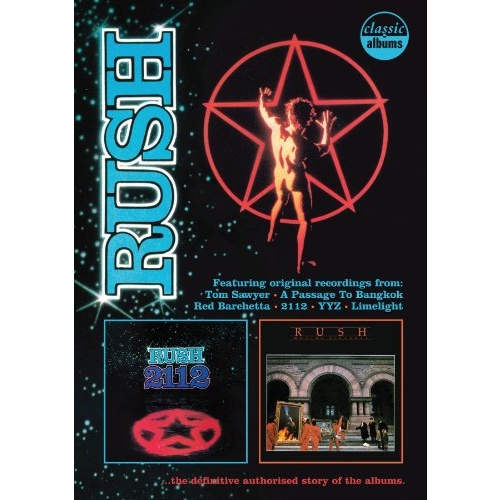
[WATCHED: January 3, 2011] Classic Albums: Rush–2112 • Moving Pictures

Sarah got me this disc for Christmas.  Thank you, Sarah!

This DVD is from the Classic Albums series.  The series is shown on VH1 in the states and BBC (and other places) elsewhere).  There’s been about 35 episodes of the series, with Rush being one of the few bands to have two albums for the show (which is an honor, but which also cuts down on the content for each album by half…boo!).

The show is an hour, and there’s almost an hour of bonus footage on the DVD  (which die-hard fans will enjoy more than the actual show).

The main show itself looks at the creation of these two classic albums.  There are interviews with the band members as well as many people associated with the band (and a couple completely random musicians).  We get their manager Ray Daniels and the producer for these albums Terry Brown (his segments are my favorite because he gets behind the mixing console and plays around with the songs).  We also get Cliff Burnstein (the guy with the crazy hair) who was instrumental in getting Rush publicity. (more…)

Read Full Post »

SOUNDTRACK: MONEEN-The World That I Want to Leave Behind (2010).

I’ve liked Moneen’s discs; they played an interesting mix of grungey noisey rock and incredibly poppy emo.  And their song titles were really long and often funny (“The Frightening Reality Of The Fact That We Will All Have To Grow Up And Settle Down One Day,” “There Are A Million Reasons For Why This May Not Work… And Just One Good One For Why It Will”).

The first sign that The World I Want to Leave Behind is different is that their song titles are all really short.  The longest one is the title of the album–which is the shortest song: a 2 minute quiet intro that features some noisy guitars at the end.   The rest are 1-3 words long.  Now, perhaps you can’t judge a band by that; however, their music, like thier song titles, has eschewed complexity and embraced pop.  (“Believe,” “Waterfalls,” “Lighters”).

Okay Moneen always had this component to it.  So it’s not like suddenly the band is all pop.  Take “Are We Really Happy with Who We are Right Now?” from the album of the same name .  The song is all emo vocals (including harmonies) but the music is punky and noisy.  It’s also got a lot of dissonance.  Similarly, “The Start to this May be the End to Another” (from their debut), opens with really blasting noise and then turns into a heavy emo track with loud and quiet sections.  They are certainly poppy, but there’s at least nods to noise.

This album removes all of that noise and chaos and settles into to some tried and true emo.  If you hate emo, you will hate this album.  There’s virtually no dissonance on the disc at all.

Okay, that’s not entirely true.  The second song, “Hold That Sound” opens with some noiy aggressive guitars (and interesting noisy effects) and “The Long Count” has some noisy heavy opening chords which propel through the track.  But unlike earlier records, the noise gets pushed to the background pretty quickly.  “The Monument” also shows some remnants of heaviness–there’s even screaming vocals at one point.

And yet, the aforementioned “Wateralls” and “Lighters” sound like Guster-lite (and I like Guster quit a bit).

The final song, “The Glasshouse” does rock pretty hard (although the harmonies are all still there and the emo certainly seeps in by the end with a piano break and the final 2 minutes being all gang vocals).

Okay so in fairnes to the band, they haven’t smoothed off all the rough edged, but the polished bits are really polished now.  The thing is, I kind of like emo, so despite my tone, I don’t really dislike this record.  I’m always diasppointed when a band moves more commerical, especially if they cut off their more interesting bits, but Moneen make good emo (if you allow that such a thing exists).  I don’t like all emo bands, but there’s still enough interesting stuff here to keep me coming back to it.  In fact, for all of its poppiness, “Believe” is a really fantastically catchy alt rock song which should be in heavy rotation somewhere, if it’s not already.

[READ: February 13, 2011] A Place So Foreign and 8 More

When I saw that Cory Doctorow had a book of short stories out, I was intrigued. I’ve enjoyed two of his books quite a bit, so what could he do with short fiction?

This is some of his earliest work and I found it a mixed bag.

The first story “Craphound” was great (and the origin of his website name).  It concerns going to flea markets and buying all kinds of crap.  When you do it a lot, you become a craphound.  But when you take a fellow craphound’s crap of choice for yourself, you break the unwritten rule.  That’s all well and good.  But in this story one of the craphounds is an alien, like from another planet.  And what he trades for his crap is pretty wild.  But why would he break the unwritten rule?  The story is a fun look at what happens when extra-terrestrials are a part of your life.

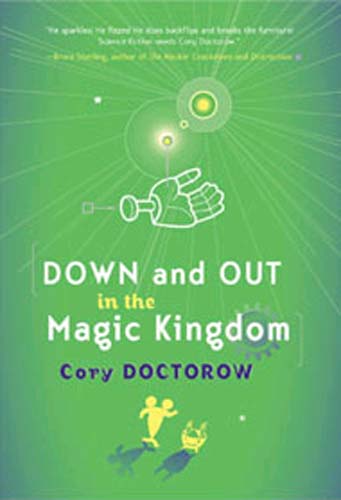
“A Place So Foreign” was my absolute favorite story in the book, and one of my favorite short stories in quite some time.  I’m happy to say that I read it last, so it totally ended the book on a high note. Despite the cover picture with an “alien” hand holding a suitcase, the story has nothing to do with that at all. (more…)

Read Full Post »

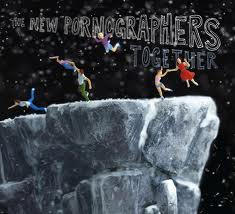
SOUNDTRACK: NEW PORNOGRAPHERS-Together (2010).

I enjoyed The New Pornographers’ debut album Mass Romantic, but I didn’t bother getting their later discs.  In the ensuing years, I’ve grown appreciative of both Neko Case solo and Dan Bejar’s Destroyer.  And, while I intend to get the NP’s middle discs, in the meantime, I am totally enamored of this one.

Their first disc sounded like a group of great songwriters doing their own thing.  This disc (their fifth) sounds like a group of great songwriters working together.  The album sounds cohesive and, frankly, wonderful.  It’s hard for me to pick a favorite song, because when the disc is over I find myself singing bits and pieces from so many of them.

The songs work well together, with different vocalists coming to the fore.  But there’s an overall cohesiveness to the disc.  Even the Dan Bejar songs (three on this disc), which sound very distinctly Bejar, act like a change of pace but retain the album’s style, rather than sounding like Bejar solo songs.

And I like the Bejar songs quite a lot (“Silver Jenny Dollar” is always in my head), but it’s the Newman songs (those sung by Neko Case and otherwise) which rise into the pop stratosphere.  The gorgeous delayed chorus of “Up in the Dark,” the beautiful cello of “Moves.”  Even a song like “Valkyrie in the Roller Disco” which opens a little quietly compared to the rest of the disc, pulls out a stunning chorus.

“A Bite Out of My Bed” is weird and wonderful and, of course, those first 6 songs are amazing.  “My Shepherd” is a stunning song and “Your Hands (Together)” is a catchy rocker which should have been a huge single.  Just when you think that “As a Rule” couldn’t possibly get any catchier, along comes a whistle solo.  Fabulous. And the album closer, “We End Up Together” has great group vocals and a nice return to those catchy strings from the opening.  It’s a great release from start to finish.

[READ: January 24, 2011] Down and Out in the Magic Kingdom

I loved Doctorow’s Little Brother.  And when I recently said I would be going to Disney, an astute reader said I should read Down and Out in the Magic Kingdom (which I’d never heard of).

Knowing what I know about Doctorow (this and all of his books are published under a Creative Commons license and if you go to his site, you can download the entire book for free), I expected that this book might bash Disney (the main source for our current copyright extension laws–see The Copyright Extension Act also known as The Mickey Mouse Protection Act).  The title also hinted at is as well.  But in fact, this book does not bash Disney World in any way.

Rather, it embraces the Magic Kingdom as a sort of traditional refuge, something that should be immune to technological update.  Of course, since it is a science fiction novel, it is also futuristic, full of bizarre technologies and lots and lots of behavior control.

The book opens in the undetermined future (although later in the book we learn that it’s probably sometime around 2069).  The Prologue is full of words that won’t be defined until later in the book (if at all):  “Deadhead” as a verb, “Bitchun Society,” and this whole sentence: “I took a moment to conjure a HUD with his Whuffie score on it.”

So, we know that this is not a typical story.  And it stays atypical.  Chapter One opens:

My girlfriend was 15 percent of my age, and I was old-fashioned enough that it bugged me. Her name was Lil, and she was second-generation Disney World, her parents being among the original ad-hocracy that took over the management of Liberty Square and Tom Sawyer Island. She was, quite literally, raised in Walt Disney World and it showed.

The story is set in Disney World.  Julius, the narrator who is 100+ years old but has been rebooted several times and appears 40, is dating Lil, who was 19 or so when they met.  And despite her youth and apparent airheadedness, they really hit it off.

As stated, her parents were more in less in charge of portions of Disney.  So, when they decide to deadhead, it puts Lil (and by proxy Julius) in charge.  Lil’s domain is the Hall of Presidents (and there’s fun insider knowledge about the Hall, and Lil is often seen with her head inside Abraham Lincoln).  Julius, meanwhile, loves loves loves The Haunted Mansion (and the story of his first time(s) there is really great).  And he works behind the scenes there now, constantly trying to make it better (shave a few seconds off here, make this part a little scarier, etc).

And all is great until Julius is killed. (more…)

Read Full Post »

SOUNDTRACK: RADIOHEAD-OK Computer (1998).

The Bends showed amazing maturation for Radiohead, but OK Computer was like going from black and white to color.  It opens with “Airbag” a blast of music, oddly off kilter and unsettling but which immediately brings you into a great riff.  About midway through, the song splits in stereo with two competing solos vying for attention.   It ends with a loud stretched out chord.  And then comes one of the most bizarre singles around.  A nearly 7 minute multi-segmented song which, the first time I heard it, I couldn’t even find a melody.  I rather wish I could go back to that naive time, because my mind was blown away by the outlandishness of the song.  Now I know all the melodies and I think it’s just brilliant.

The minor chords of “Subterranean Homesick Alien” are accented with outer space sounds and yet despite its subject (alien abduction), the song is pretty well grounded: a simple, easy rocking track.  It’s followed by “Exit Music (for a Film)”, a gorgeous building minor chord song that opens with simple acoustic guitars and slowly builds to a scorching rocker (when the drums kick in at nearly 3 minutes, it’s like a wake up call).

“Let Down” is another slow builder, although it features a much more singable verse and chorus structure (it’s incredibly catchy).  It’s followed by “Karma Police” another catchy monster of a song.  It starts with a pleasant enough piano riff and features the politely sung threat: “this is what you get when you mess with us” and the beautiful falsettoed apology: “for a minute there I lost myself.”

It segues into the odd 2 minute computer-voice-recited (and barely listed as a track) “Fitter, Happier.”  This song foreshadows future Radiohead experiments.  It seems like a blow-off track, a filler, and yet like so many of the newer Radiohead songs, it works like glue holding the big hits together.  Check out how weird, wild and intricate the music behind the voice is.

“Electioneering” is one of the noisiest, most raucous songs in the Radiohead catalog.  It opens with this steel guitar sounding riff and crashes in with loud, distorted guitars and all kinds of drums.  Thom Yorke’s vocals are really loud in the mix, so when he gets to the bridge it’s practically a wall of noise, but listen to the great ascending and descending guitar riffs behind his vocals.  They’re really intriguing.  As is the skronking noisy guitar solo.

“Climbing Up the Walls” has all kinds of insane sound effects going on in the background of one ear (as befitting the title).  It’s a drum-heavy track with eerie almost unadorned vocals (until the very end when Yorke goes berserk).  It segues into the most delicate track on the disc, “No Surprises.”  The chorus of “no alarms and no surprises, please,” has always been very affecting.  And the delicate bells that adorn the verses are a very nice touch.  The penultimate track, “Lucky” is a sort of optimistic track, despite its mellow music and, I suspect, really not very optimistic ending. But the utterly uplifting scream of “it’s going to be a glorious day, I feel my luck could change” is spine tingling.

I feel like “Lucky” is such a great ending song that I tend to forget the final track, “The Tourist”.  It’s a slow, drawn out  track…”idiot, slow down.”  It’s probably my least favorite song on the disc, but it’s kind of a good ending after all of the high points of the disc.

And with the final bell of the final song, Radiohead became untouchable.

[READ: December 29, 2010] “Escape from Spiderhead”

George Saunders must live in a dark, dark world.  His comedy is dark (but very funny) yet I feel he is often quite under-served when people refer to his as a funny storyteller.  This story, which actually has many funny elements, is incredibly dark.  And even though I laughed out loud at a few things, no one comes away from this story happy.

One of the great things about Saunders is his almost obsessive mockery of corporate/medical culture.  He has more trademarks in his story than anyone I’ve ever read (even if they are all for things he has made up).  Now to me, that’s funny in itself (especially the names he gives them), but it serves a much more telling purpose: a portent of a very dark future.

This story is set in a lab, where the main character, Jeff, is being communicated with by Mr Abnesti (a very hard name to keep straight).  Jeff is in a room with Heather, and both are being fed the experimental drug ED556, a shame inhibitor.  And so they rip off their clothes and have at it (he was obviously given some Visistif™ because they do it three times).  They are also given some Verbaluce™ which helps them elucidate their experience (from more than just grunts and moans).  This Verbaluce™ is essential to all of their experiments because without their comments, the proceedings are undocumented. (more…)

Read Full Post »

SOUNDTRACK: STEREOLAB-“Everybody’s Weird Except Me” (2010).

I was able to listen to another track from the upcoming Stereolab album Not Music.  This song is just fantastic.  It’s a faster, uptempo track.   Laetitia’s voice is backed by some other female singers (I wonder who they are, is it just Laetitia multitracked?).  And the propulsive beat is infectious.  The backing track of the music sounds like their earlier experiments with “space age” sounds.  Yet the guitar over the top is warm and inviting.

The song drops out at about the 90 second mark and offers a very cool respite from the bopping around that the song is doing.  After the break, the song seems to jump back and forth between this new mellow bit and the bouncy earlier part.  It’s a great track and a welcome opening to their last CD before going on hiatus.  Because, yes, according to the information on the NPR page, Stereolab is going on hiatus.

This CD is full of songs that were created around the time of their previous disc Chemical Chords, and it’s also packed with mixes, remixes and seemingly alternate version of some of those songs.  I haven’t heard the whole disc but it sounds like they’re going out with a winner.

[READ: November 15, 2010] “A Good Death: Exit Strategies”

I’ve mentioned before about my reader-relationship with Vollmann–I feel that I ought to read a lot more of him, yet I haven’t brought myself to do it (those books are huge!).  Nevertheless, I’ll keep reading the new pieces that I stumble upon.

So this piece is a nonfiction essay.  I’m tempted to say it’s more personal than the other pieces that I’ve read because it concerns the death of his father.  Yet from the little Vollmann I have read, it feels like he takes all of his writings very personally and invests himself pretty much bodily into them.

So, this piece, as I said, is sort of about the death of his father.  He died just a few months ago and Vollmann wants to find out a number of answers about death: should he be afraid of it, will he suffer, what should he expect?  So he interviews several “experts” in different fields:  coroners, funeral directors and many religious people of different faiths (Vollmann and his companion/translator are agnostic).  He’s given a vast array of answers, some of which are comforting to him and others just kind of piss him off. (more…)

Read Full Post »

SOUNDTRACK: DAVID CROSS-Bigger and Blackerer (2010).

I’ve liked David Cross for years, both in Mr. Show and everywhere else he’s been (I love comparing his nebbish character in Arrested Development to his obnoxious hippie in Running Wilde). And his standup is just fantastic.

This new(ish) CD (which has the same name but different content as the DVD) is wonderfully obscene and profane and all around hilarious.  What’s particularly fun is the nonsensical “titles” he gives to his bits (although these are more accurate than on his previous disc): “REALLY Silly Religious Crazies, I mean, Double, Triple Crazy!!” and “Random Goofabouts”

The disc opens with a song(!), a swinging song ala Tom Jones which Cross sings (his voice isn’t very good, but he’s never off key, which is something) which actually features some cool time changes and a bit of pathos.  But the jokes are very funny.  He opens with an extended bit about drugs (mostly about drugs he has taken).  It’s a bit long, but the details are hilarious and the payoffs at the end are wonderful.  I also enjoyed that the drug bits are a cautionary tale, yet he never turns preachy, in fact, he inverts expectations throughout.

The race jokes are really great too, especially the MLK license plate bit.  But indeed, Cross really shines when it comes to religion.  I’ve never really heard a riff on Orthodox Jews before, and his dismissal of Catholicism is brutal and short, but it’s the Mormons who get the bulk of his abuse (mostly because of the awesome power they wield), especially since the religion is a sham.

He’s also not afraid to make observations that will offend some (although no one who listens to him) but are spot on.  There’s an excellent bit about Obama haters who bemoan the state of the country but who will immediately fight any “elitist” who bemoans other aspects of the country.  And it very funny, indeed.

Cross has spent some time in England (filming The Increasingly Poor Decisions of Todd Margaret) and his British accent is quite good now (it’s used to excellent effect in heaven).  He also has great rapport with the crowd, who are exuberantly noisy.

This CD is an excellent introduction to Cross’ standup.  The jokes aren’t really timely (although the health care yelling bit will date it somewhat, except that the debate itself will go one for years to come, so maybe it won’t), so even if it’s five years from now, the jokes will still be funny.

Cross is not a delicate comedian and his jokes are not for the faint of heart, but, man, is he funny.

[READ: November 9, 2010] It is Right to Draw Their Fur

Polymath Dave Eggers is back with another fascinating (and fascinatingly bound) title.  This time, the collection contains a series of drawings.  Most of the drawings are of animals and they all feature words on them.  (This sort of thing: Picture + words + humor (from many different artists) is presented in a book that I am currently enjoying called More Things Like This).  Similar items also appeared in McSweeney’s 27 (you can see my Post about that issue here)).

Eggers explains in the introduction that he went to art school.  He was an aspiring painter and then a cartoonist and illustrator.  And in his down time, he spent a lot of time drawing animals.  And they are quite good.  Eggers’ art has an odd quality to it that I can’t quite put my finger on.  All of his pictures seem off in a small way.  It doesn’t make them bad at all, in fact, it actually makes you want to look at them more to see what is off about them.  (I think some people call that “compelling”).

The project comes in a hugely oversized cardboard sleeve (14 inches x 19 inches).  There are 26 large sized posters (they are folded and their unfolded size reaches something like 27″ x 37″).  There’s also a booklet which features even more of these drawings.  The booklet has an appendix with some drawings that are not animals (well, they are humans, so yes, they are animals).  And, the most peculiar part, there’s a bibliography.  The bibliography goes on for four pages and includes all manner of things from Sartre’s Being and Nothingness to Auel’s Clan of the Cave Bear to Gara’s The Presidency of Franklin Pierce to The Collected Poems of William Carlos Williams to Saint-Saens’ Le carnaval des animaux.

You can see two examples here.  In my opinion these are not the best combination art/words in the book (although the drawings are very good).  There are some other ones where the juxtaposition appealed to me much more.

The package is quite expensive (and justified–it is a lot of stuff and beautifully put together), but I have a hard time believing someone would spend $42 on it.  (I received mine as part of the McSweeney’s book club, so that’s nice.)

Read Full Post »

SOUNDTRACK: DAR WILLIAMS-“Teen for God” (2005).

Dar Wiliams has a new disc in which she revisits her old songs (by herself and with guests) and which includes a bonus Greatest Hits disc.  I have listened only once to the disc, but it includes this song which fits perfectly with this story.

Williams has always been an excellent lyricist.  Her rhymes are strong and her descriptions and ideas are first-rate.  Normally, her songs are emotional and intimate, although this one is less so.  It’s serious and funny at the same time.

It begins with a teen at the Peach Branch Horse and Bible Camp where she’ll “pray for the sinners and their drunken car wrecks and vow that I’ll never get high or have sex.”  It’s interesting to compare this song and the implications of the teens for God circa 2005 vs what Franzen is talking about circa the early 1970s.  And it’s fascinating, and rather depressing frankly, how much more conservative times have gotten since then.

What really sells “Teen for God” are the final few verses, where we realize that we shouldn’t take too much of what the teens pledge to be long-lasting (like so many things that teens believe). “You gotta help me, God. Help me know four years from now I won’t believe in you anyhow and I’ll mope around the campus and I’ll feel betrayed all those guilty summers I stayed”

And all of this existential religiousness is set to a perky folk rock song.  The “Teen for God” chorus hits a perfect delayed chord, and is a wonderful singalong.  Perhaps even at a campfire.  On a retreat.

[READ: November 18, 2010] “The Retreat”

This essay is about Franzen’s childhood (always a good source for his stories) when he joined the hippie “Fellowship” at First Congregational Church.  Franzen is older than I am by a  few years, so a lot of things that he writes about from his childhood are things that I knew a little about or caught the tail end of.  So, in this case, I recall my church having Saturday night folk masses, where everyone played acoustic guitars.  I loved it and my parents hated it; when I recently asked a neighbor if they still do that she laughed at me and said they’d stopped it like 25 years ago.  Which explains a lot.

Anyhow, the article discusses an upcoming retreat that the ninth graders would be taking with the other older Fellowship students.  Franzen was a big fish in the 8th grade Fellowship but was a little nervous about the older group.  He loved retreats and wanted to go but didn’t think his parents would approve.  Luckily for him, his parents were in Europe at the time.  [This seems to be some kind of thing that parents did in the 70s–go to Europe for an extended period while the kids stayed home.  My parents never did, mind you, but some seemed to.] (more…)

Read Full Post »

SOUNDTRACK: SUPERCHUNK-Late Century Dream (2001).

A Superchunk song that opens with keyboards, “Late-Century Dream” is one of the most mellow singles that they’ve recorded (even more mellow than some of the acoustic songs they’ve done).

It’s followed by “The Length of Las Ramblas” an even more mellow track.  This one is also full of keyboards (sort of tinny, high pitched keyboards) and acoustic guitars.

Rocking guitars return on “Becoming a Speck” which reminds me of “1,000 Pounds.”  It’s a fast-paced, punchy song with a guitar solo that sounds like it might collapse on itself any minute.

“Florida’s on Fire” is an acoustic rendition of the song from Here’s to Shutting Up. Initially, when Superchunk was a punky bratty band, these acoustic numbers were kind of a novelty.  Now they showcase the extent of musicianship that the band possesses, and this one is no exception.

It’s a good EP, and the last one that I bought prior to their return this year.  They have a couple other ones that I’m going to try to track down.  But in the meantime, it’s all Majesty Shredding.

[READ: October 10, 2010] “An Actor Prepares”

Donald Antrim is the next writer in the 1999 New Yorker 20 Under 40 issue.

This story is a funny look at college theater.  The subject is not terribly new, and yet there are so many wonderful details and the theater teacher is so over the top that this story was completely enjoyable.

The narrator is Reginald Barry, Dean of Student Life and Wm. T. Barry Professor of Speech and Drama at Barry College (ha!) and this semester his students will be performing A Midsummer Night’s Dream.   I had to look up some of the quotes in the story to make sure they were actually from the play (I didn’t know the line “Use me but as your spaniel, spurn me, strike me” was in Shakespeare), but they are, and Antrim takes lines like this and runs with them.

Barry has wonderful plans for this production which he envisions outside on the grounds of the campus, with a culminating orgy occurring just as the fireflies come out. (more…)

Read Full Post »

SOUNDTRACK: BROKEN BELLS-Broken Bells (2010).

When I first played this disc I was really disappointed by it.  I’ve grown to expect crazy magic from Danger Mouse, and I assumed that this collaboration with James Mercer of The Shins would be crazy awesome.  But it seemed very mellow to me.  Mellow in a way that just kind of sat there.  So I put it aside for a while.

Then I listened to it again a little later and I found that I really liked it this time.  In fact, it rapidly grew into one of my favorite releases of 2010.

The disc is a wonderfully paced mixture of acoustic guitars, interesting keyboard sounds and, often, downright bizarre electronic choices (subtle, yet bizarre).  The weird sounds that open the disc, a kind of backwards keyboard, are disorienting but also very catchy.  And the song itself is instantly familiar.  It’s followed by “Vaporize” a simple acoustic number that bursts out with some great organ and (very) distorted drums.  It also features a fascinating horn solo!

“Your Head is on Fire” settles things down a bit with a mellow track which, after some cool introduction, sounds like a  pretty typical sounding Shins track (ie, very nice indeed–and more on this in a moment).

“The Ghost Inside” feels like a ubiquitous single.  I’m not sure if it is or if it’s just so catchy (with dancey bits and hand claps and a great falsetto) that it should be everywhere.  “Sailing to Nowhere” reminds me, I think, of Air.  And the great weird drums/cymbals that punctuate each verse are weird and cool.

One of the best songs is “Mongrel Heart” it opens with a western-inspired sound, but quickly shifts to a quiet verse.  The bridge picks up the electronics to add a sinister air (and all of this is accompanied by nice backing vocals, too).  But it’s the mid section of the song that’s really a surprise: it suddenly breaks into a Western movie soundtrack (ala Morricone) with a lone trumpet playing a melancholy solo.  And this surprise is, paradoxically, somewhat typical of the disc: lots of songs have quirky surprises in them, which is pretty cool.

Having said all this, there are a few tracks where it feels like the two aren’t so much collaborating as just playing with each other.  And that may have been my initial disappointment.  I was expecting a great work from a combined powerhouse, and I think what we get is two artists writing great stuff while seemingly respecting each other too much to step on each others toes.

There is another Broken Bells disc in the works.  And I have to assume that they’ll feel more comfortable with each other and simply knock our socks off next time.  But in the meantime we have this really wonderful disc to enjoy.

[READ: October 21, 2010] The Broom of the System

It dawned on me sometime last summer that I had never read DFW’s first novel.  I bought it not long after reading Infinite Jest and then for some reason, never read it.  And by around this time I had a not very convincing reason for not reading it.  DFW seemed to dismiss his “earlier work” as not very good.  I now assume that he’s referring to his pre-Broom writings, but I was a little nervous that maybe this book was just not very good.

Well I need not have worried.

It’s hard not to talk about this book in the context of his other books, but I’m going to try.  Broom is set in the (then) future of 1990.  But the past of the book is not the same past that we inhabited.  While the world that we know is not radically different, there is one huge difference in the United States: the Great Ohio Desert.  The scene in which the desert comes about (in 1972) is one of the many outstanding set pieces of the book, so I’ll refrain from revealing the details of it.  Suffice it to say that the desert is important for many reasons in the book, and its origin is fascinating and rather funny. (more…)

Read Full Post »

« Newer Posts - Older Posts »