Feeds:
Posts
Comments

Archive for the ‘Doctors’ Category

[LISTENED TO: August 2017] Adventures with Waffles

I saw this book in the library and the title sounded interesting. The blurb on the back when enticing as well, so I grabbed it for our family road trip.

I had no idea that the book was a translation of a Norwegian story (Vafflehjarte) nor that it had already been translated into English as Waffle Hearts (a much more accurate, and frankly much more satisfying title).  I gather from a little research that Waffle Hearts is a British translation and Adventures with Waffles is an American one (although they both have the same translator, Guy Puzey).

The story is about Trille and Lena, two kids who live next door to each other in the village of Mathildawick Cove in Norway.  Their village is small and there are only 9 kids in their grade.  Lena is the only girl. The bully Kai-Tommy wishes she weren’t in their class.  But Trille feels that Lena is his best friend (he hopes it is reciprocated, but is unsure).  She is wild, she is spontaneous, she is dangerous.  And she is a lot of fun. (more…)

Read Full Post »

overpoSOUNDTRACK: J. MASCIS-Tiny Desk Concert #406 (November 22, 2014).

mascisJ. Mascis is best known as a wailing guitarist who plays in front of a wall of speakers with Dinosaur Jr.  But for this Tiny Desk Concert he busts out an acoustic guitar and plays some songs from his solo album (as well as an old Dino classic).

“Stumble” is sung in Mascis’ delicate falsetto.  They zoom in on him singing and its amazing how he doesn’t seem to be straining in any way doing this really high voice.  After all the falsetto, his saying “Thanks” in a deep voice is really kind of funny.

For the second song, he busts out the classic “Little Fury Thing.”  This acoustic version sounds really good–so simple and clean.  The original is great burst of loud rocking and it’s amazing that the song can sound so good stripped down. His voice is much deeper for this song .  I love at the end how he plays the strings really really fast but continues to swing in his most languid style.

The third song is actually two songs.  He switches guitars (and is apparently using sheet music) to play “Drifter/Heal the Star.”  The first part is a lengthy, really pretty instrumental.  For all of Mascis’ noise and rocking out, he knows how to write beautiful, lovely melodies.  The main melody is played on the high strings alternating some great strumming on the low strings for the “chorus.”   I could listen to this for ages.

The song segues into “Heal the Star” which sounds very Mascis–his most Mascis voice and strumming style.  Although for the chorus he’s back to the falsetto vocals again.  The solo a the end is great as he plays chords on the lowers strings while soloing ion the high strings (there must be a different tuning to make this sound so good).

I saw Dinosaur Jr a couple of months ago and I’m going to see them in November again.  I love Mascis’ loudness, but it’s wonderful to hear him play these quiet pieces too.

[READ: April 1, 2016] Overpowered!

I loved the premise of this book right from the start.  I mean, the cover alone is great, and flipping through it, there are some wonderful images of men with great mustaches in turbans doing all manner of hypnosis to people.  What I didn’t expect (but probably should have if I’d read his bio on the back) is that Green himself is a practicing hypnotherapist (in addition to being an actor and performer who has created such characters as “US Country music star Tina C and pensioner rap star Ida Barr.”

It turns out that Green has been interested in hypnosis for a long time.  He learned how to do it and then wanted to set the record straight for what hypnosis actually is as opposed to what we believe it is.

So this proves to be a thorough (and very funny) history of hypnosis through the years.   He says the book is called “Overpowered” because “I’m fascinated by the delight human beings derive from the idea of being taken over.  Being conscious may be beneficial, but it is also hard work.” (more…)

Read Full Post »

feschukSOUNDTRACK: THE ART OF TIME ENSEMBLE with MARTIN TIELLI–Korngold: Source & Inspiration (Enwave Theatre, Harbourfront Centre, Toronto, ON, January 30, 2009).

aotimeAfter seeing The Art of Time Ensemble yesterday, it was quite serendipitous that I would have a show from them (featuring Martin Tielli) to post about on the following day.

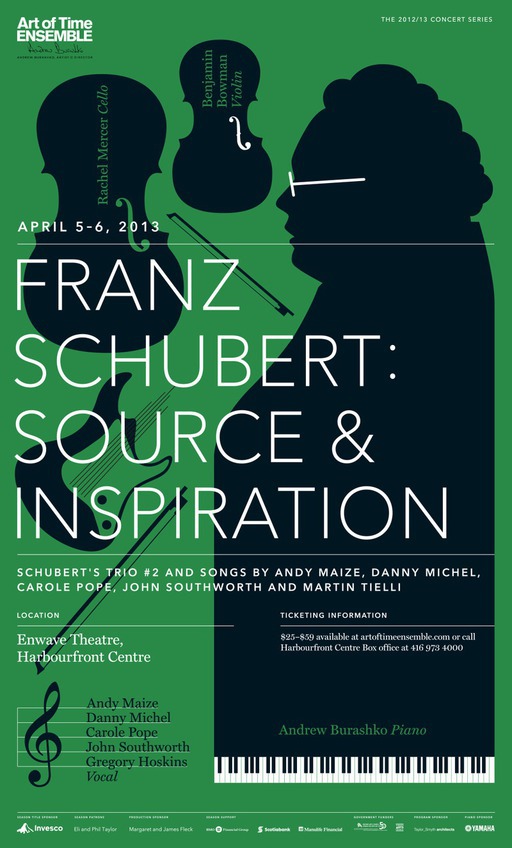
This concert is the third in the Art of Time’s “Source & Inspiration” series. Two years earlier the first concert focused on composer Franz Schubert.  The previous year’s concert focused on Robert Schumann. This time the spotlight was on the 20th century Jewish composer Erich Korngold–a composer of European pedigree who became well known for his wonderful Hollywood film scores.

This concert featured Korngold’s Suite for Two Violins, Cello and Piano as the ‘source’ as well as new songs inspired by this work from Martin Tielli, Danny Michel and John Southworth.

This recording is only 8 minutes long because there’s only two Martin Tielli songs. “Lied Two” (the German word for song is lied (pronounced leed) so Martin called his “Lied Two.” And “Moglich” which translates into “possible.”  Both pieces are played with by the orchestra.  Martins sings.

The more dramatic of the two would be “Moglich” with his loud whispered “Relaxxxxx at the end.”  For more information about the show, you can click on this link.

Full Program & Repertoire:
Suite Op. 23 for 2 Violins, Cello and Piano Left-hand
Erich Korngold
i.Praeludium und Fuge
ii.Walzer
iii.Groteske
iv.Lied
v.Rondo-Finale

INTERMISSION
Athabasca
Adventures of Erich Korngold
—John Southworth
The Sailor Song
Island

—Danny Michel
Lied 2
Moglich
—Martin Tielli

Performers
Andrew Burashko, piano
Danny Michel, singer
Erika Raum, violin
Stephen Sitarski, violin
John Southworth, singer
Martin Tielli, singer
Winona Zelenka, cello

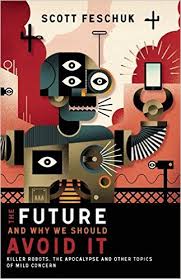
[READ: November 22, 2015] The Future and Why We Should Avoid It

The title of this book made me laugh so I set it aside to read it.  Little did I know that it would be so very funny that I put aside other things so I could finish it.

I hadn’t heard of Feschuk before.  He has written two previous books (How Not to Completely Suck as a New Parent sounds pretty good) and writes mostly for MacLean’s magazine.

As you might guess from the title, this book looks at the future, and Feschuk’s predictions are uncanny.  For instance, I brought the book home and decided to look at it in the bathroom.  And the introduction states quite clearly:

By now, life should be awesome and leisurely and you should be wearing a spacesuit and high-fiving your wisecracking robot sidekick.  Except instead your dishwasher is broken, your god-damn iTunes won’t sync up and right now you’re reading this book on a toilet in your bathroom instead of where you should be reading it–on a toilet in your hover car.

Too right, too right. (more…)

Read Full Post »

Harpers-1404-302x410SOUNDTRACK: BECK-Sea Change (2002).

Aseachnagefter the wild dance of Midnight Vultures, Beck entered the 2000s with Sea Change, a very mellow album.  It is highly regarded by many, although it’s too mellow for my liking, which is unsurprising give my tastes.  (Of course, if you’re in a mellow/sad mood, it’s perfect).  Even though I feel like it is quite samey, a closer listen shows as much diversity within these songs as any of his thematic albums.  And there are some great sounds that he throws on top of these tracks.  Like the Radiohead vibe in “The Golden Age”

“Paper Tiger” has a kind of sleekness to it, with the strings and the bassline that keeps the track interesting.  “Guess I’m Doing Fine” is a mopey song that has the potential to be too much ,but never goes that far.  It winds up being quite beautiful.  “Lonesome Tears” has strings that make it sound a bit like Air (the band).  “Lost Cause” is the poppy side of this mellow album—it’s got a super catchy chorus (although is clearly not a happy song) and would be a great ballad on any other album—here it comes across as the peppiest number.  “End of the Day” introduces sitar, but it falls a little flat in the middle of the disc.

“It’s All in Your Mind” is a pretty and short song.  “Round the Bend” is easily the most depressing song that Beck has ever done.  It’s also quite beautiful but, man what a downer.  Oh wait, that “most depressing” award would go to “Already Dead” a very sad acoustic song which has Beck singing in an aching falsetto.   The darkness is lightened somewhat with the sitar flavored “Sunday Sun” but it still has that aching vocal.  And yet it ends with a total musical freak out at the end—noise and feedback and chaos which makes sense in the song but seems so out of place on the record—and yet it’s kind of a welcome relief.  “Little One” has a more upbeat vibe (with big drums even).  Although it seems to get lost by the end of the disc.  As does “side of the Road” which doesn’t really have a lot going for it.

 Any one of these songs would be a perfect mellow beck song.  But at 52 minutes, the album is a bit relentless.   I think what weighs down a lot of these songs is their length.  The lengthy strings at the end of “Tears” is very pretty but with several songs pushing 5 minutes, overall it gets to be a bit much.   There’s no “bonus” track on this one.

 [READ: March 17, 2014] “Diagnose This”

This article by Heidi Julavits (whose novels I keep intending to read but have yet to so far), really appeared to me because of the conceit of self diagnosis.  Whenever you go to a doctor, if you have searched your symptoms online (which everyone has) you always feel guilty about bringing it up—like you’re not supposed to investigate these free resources.  Now it’s entirely true that looking up your symptoms online is madness—everything leads to cancer.  Everything.  If you are a hypochondriac, you should never ever do this, but if you are a reasonable person, you can use online medical diagnoses and, more importantly, message boards to see what other people have said about similar symptoms.

In this essay, Julavits talks about her own symptoms for what her doctor diagnoses as possible Ménière’s Disease, a rather rare disease that is more or less worst case scenario.  And the doctor tells her not to look it up when she gets home (she looks it up in the parking lot).   She doubts that this is an accurate diagnosis.  But as she learns when she interviews several doctors and medical school teachers—doctors are not taught to learn gray area thinking.  They have to save lives so they may jump to the most serious situation in order to prevent serious damage—even if that conclusion may involve tons of unnecessary and expensive tests. (more…)

Read Full Post »

« Newer Posts