Feeds:
Posts
Comments

Archive for the ‘Death’ Category

SOUNDTRACK: TEENAGE FANCLUB-Shadows (2010).
Back in the 90s, Teenage Fanclub released a few noisy, feedbacky records that were quintessential 90s alt rock.

Since then they have mellowed considerably, and this album is one of their most mellow to date. Usually for me this kind of mellowing is a sign that I’m done with a band; however, Teenage Fanclub’s songwriting gets better with every disc.  And these folky tracks are all fantastic.

What’s neat about the arrangement of the album is that each of the three members of the band writes four songs.  They are collated so that you cycle through each singer before repeating. You get maximum diversity–and it’s easy to tell which songwriter is your favorite.

The opening two songs, “Sometimes I Don’t Need to Believe in Anything” and “Baby Lee” are two wonderful upbeat pop confections.  They sound very different and yet both are infused with wonderful pop chops.

It seems that Blake is my favorite songwriter on this disc. He did “Baby Lee”, “Dark Clouds” (a pretty piano based number) and by far the prettiest song on the disc “When I Still Have Thee.”  It’s an amazingly catchy folk song that sounds timeless (and even has the great couplet: “The Rolling Stones wrote a song for me/It’s a minor song in a major key.”

That’s not to dismiss the other songwriters at all.  In fact, hearing their different takes on pop music is really pretty amazing.  It’s a shame that it takes them so long to put albums out (about 5 years these days).

[READ: June 10, 2011] Five Dials Number 9

Five Dials Number 8, The Paris Issue, was pretty big (45 pages), but it had a lot of pictures.  Five Dials Number 9 is also pretty big (41 pages) and it’s (almost) all text.  For this is the Fiction Issue, and there are a lot of short stories in here.

CRAIG TAYLOR-A Letter from the Editor: On ‘Summer Reading’ and Fiction Issues.
Since most of what I talk about in the introduction to these posts is covered in Taylor’s Letter from the Editor, I figured I’d switch formats and start talking about his letter right away.  In this letter, Taylor talks about the serious pitfalls of  ‘Summer Reading’: We pledge to read mammoth books over the summer, but really we never finish War and Peace over the summer, do we? (except those of us who finished Infinite Summer, am I right?).  And so, this Fiction Issue was released in December (finally, a date is given to a Five Dials!).  Taylor briefly talks about all of the authors who contributed (including a pat on the back to Five Dials for securing the rights to a Philip Roth contribution in its first year of publication).  He also talks about the essay from David Shields that is decidedly anti-fiction.   And the final note is that Taylor’s own father has a piece in this issue (nepotism is alive and well!) (more…)

Read Full Post »

SOUNDTRACK: CHARLOTTE GAINSBOURG-KEXP in studio May 11, 2010 (2010).

Charlotte Gainsbourg is a fascinating individual.  Between her acting and her singing, she’s had quite a life.  And even moreso since she had a near fatal accident.

That accident formed the nexus of her album IRM.  And this interview and performance is done in support of that disc.  IRM was made with Beck.  Beck’s not here, and the songs are more stripped down, but they sound really good in this format.

Gainsbourg sings the Beck-sung-on-IRM “Heaven Can Wait” and really makes it her own.  The other three songs here work very well in this more acoustic setting.  “Me and Jane Doe” is practically acoustic already and “Time of the Assassins” and “Trick Pony” are reworked very well.  And Charlotte is a charming interviewee as well.

It’s another excellent in-studio performance from KEXP.

[READ: March 31, 2011] “The Dead Are More Visible”

I read all of The Walrus stories when I received the magazines.  I wondered when I would completely recognize a story when re-reading them now.  Well, this was the first one that I remembered parts of vividly.  And why not–there’s a search for a missing eye on an ice hockey rink.  That’s hard to forget.  However, I didn’t remember the ending and in fact, my memory added many more details than actually occurred in the story.

The beginning of the story, which is very different from what I just described, was less memorable but perhaps more interesting.  The story opens with a woman reflecting about her graveyard shift job.  In this case the job is literally a graveyard shift, because the park she works in has a graveyard within it. However, her job is not really scary–she is there to make the ice for the upcoming skating season.  It takes several nights of very cold weather and she must go out in all her gear and fill up the rink, several tousand litres of water at a time.

While the ice settles, her time is her own–to listen to music and read. She gets a few hundred pages read a night (dream job!)  She prefers romance and horror novels.  The introduction of horror novels into the story foreshadows a bit about the scene ewith the eye later on, although for this is not a horror story. (more…)

Read Full Post »

SOUNDTRACKDINOSAUR JR-Beyond (2007).

This was Dino Jr’s reunion album of the original line up.  And it sounds like the band had hardly gone away.

The opening tracks showcases the diversity of Dino Jr’s dynamic: a heavy, fast poppy number and then a “ballad” (Mascis style) and then a more heavy chugga chugga song.

By the middle of the album the band loosens up even more.  “Been There All the Time” has that kind of sloppy (but really not sloppy, they are actually very tight) sound of great Dino.  “I Got Lost” is the inevitable falsettoed Mascis track.  It’s slow and unusual for the rest of the disc, but it really showcases the band’s diversity.

The most notable things about Dino are Mascis’ voice (a kind of slacker pseudo-whine) and his wild guitar soloing.  And they are prominent here.  Mascis’ voice sounds great (of course, if you didn’t like it then, you wont like it now), and his songwriting is top notch.

I am actually more partial to the Dino Jr albums after Barlow left (blasphemy!–although even I admit the diminishing returns on the last few discs).  But on this disc, the band sounds totally revitalized and the songs are uniformly great.

Lou Barlow gets two songs.  They sound very Barlow: a bit slower but very catchy.  As I wondered about Farm, I’m not sure what would make Barlow return to Dino since the band still feels like Mascis’ band with Barlow getting a few songs.  I mean, they sound great together on the disc, but it’s clear that Mascis is the star here.  But whatever the reason, it’s a wonderful return to form and one of those rare reunions that really works.

[READ: May 18, 2011] “The Cat’s Table”

The combination of this title and the accompanying picture (a large cruise ship) was very confusing to me.  It turns out that the Cat’s Table is what a passenger on the cruise ship calls the table that they are assigned because it is as far from the Captain’s table as you can get.

The story opens in the third person as it describes a young boy (aged 11) who is seen boarding this large cruise ship which is travelling from Colombo, Ceylon to England (a 21 day journey).  The boy is traveling by himself to meet his mother.

After that brief section, the story switches to first person, from the boy’s point of view.

I was shocked to read that this eleven year old boy was dropped off on a cruise liner with no adult supervision.  But it turns out that there are several boys on board who are his age, and he even knows one from his school.  Coincidentally, his neighbor Emily, the closest thing he has to real family, is also on board. (more…)

Read Full Post »

ATTENDED: WEIRD AL YANKOVIC-Live at the State Theater, New Brunswick, NJ May 19, 2011 (2011).

I’ve seen “Weird Al” live three times now and I have never been disappointed by the show.  The first year my friend Matt and I waited out by the bus and got the bands’ (minus Al’s) autograph.  The second time we waited even longer and Al had an autograph (and picture taking) session in the theater after the show (how cool is that?).

This year, Sarah and I didn’t wait around afterwards (kids at home) but the show was still great.  Al made a joke after the first song thanking his opening act, Technical Difficulties. (There were indeed 45 minutes of technical difficulties before the show, but Al’s joke made us quickly forget it–and, kudos to the State Theater: I ordered my tickets online from their site and the day after the concert, the theater owner sent an email apologizing for the delay. Classy!).

Sarah had never seen him perform before, so she was pleasantly surprised by the set selection.  I was also surprised by the set selection because he pulled out a few older, more obscure tracks (“Frank’s 2000″ TV” (!), “You Don’t Love Me Any More”–complete with Al smashing a guitar!).  But he also dazzled with some new tracks from his forthcoming album.

The set opened with the polka medley (“Polka Face”).  This is the first polka medley that I didn’t know any (well almost any) of the sped up songs, but it’s always a treat to watch them play it live.  The one complaint with the show was that the sound in the theater wasn’t very good (which is surprising given that it’s an old theater) so it was hard to make out a lot of the words, especially to the new songs–and what’s Al without the lyrics?).  But his new song “I Perform This Way” (parody of Lady Gaga’s “I Was Born This Way”) was fantastic (Al was dressed up like a cartoon peacock).

Yes, costume changes.  One of the most entertaining things about Al’s shows is the costume changes.  For all of his big video hits, he comes out dressed like the video (the band does as well, although it’s a bit more subtle).  So, we get the Amish garb in “Amish Paradise,” the Michael Jackson red jacket for “Eat It”–(another surprise) and, my personal favorite, the fat suit from “Fat.”  One of the funniest costume changes was for a song that will sadly not be released on the album (but you can hear and download it here), “You’re Pitiful,” in which he wore multiple T-shirts (about 5) which all expressed some kind of funny comment (anyone know who was the face on one of the shirts?) and finally ended in a Spongebob Squarepants shirts and tutu.

So how does he do all of these costume changes? In between songs, when the band runs offstage, they play wonderful video clips.  Some of the clips are from his TV shows, some are faux documentaries, and the best are interviews that Al splices together (you can see a whole bunch here) which are hilarious and surprisingly mean-spirited.  I wish he would release them (and any other AlTv segments) on DVD, but I imagine that no one would ever give permission for that–check out the Kevin Federline one, for instance.  But they’re all pretty great.

The crowd was also totally into it (including the guy behind us with an Al wig (and a Harvey the Wonder Hamster).  And the age range was fantastic–from kids to grandparents.  My only hope is that my kids are old enough to come to a concert next time he comes around.

Oh and a brief word about his band.  He’s had the same four guys with him for years and years and years.  Rubén Valtierra is the newest member of the band and he’s been with them since 1991.  Jim West (guitar), Steve Jay (Bass) and Jon “Bermuda” Schwartz (drums) have been with Al since 1980.  They are tight as a drum, can play incredibly diverse styles at the drop of a hat (check out “CNR” which sounds exactly like The White Stripes) and they all seem to have a lot of fun on stage (see them jump in the air on “Fat” or the crazy vocal-only solo at the end of “Yoda”

–which I think is longer than ever and totally mind-blowing).

[READ: May 21, 2011] This is a Book

I recently read Martin’s “This is Me” in the New Yorker. “This is Me” is, along with about 100 other things in This is a Book.  I also heard Demetri Martin on NPR a few Sundays ago and he read a few short things from This is a Book.  And they were quite funny.

Indeed, the funny things in this book are really very very funny.  It seems to work that the shorter the item, the bigger the laugh.  Conversely there are a number of longer, extended jokes which just go on and on, like a Saturday Night Live sketch that just won’t end.  Those quickly lose their humorous value.  Fortunately  there aren’t too many of those in here.

What makes me smile a lot about the book are the jokes he plays with book conventions.  So the title page says “This is a book by Demetri Martin called This is a Book by Demetri Martin.”  Or the previous page:

Also by Demetri Martin

*

*Nothing yet.  This is his first book.

The book opens with “How to Read this Book.”

If you’re reading this sentence then you’ve pretty much got it.  Good job.  Just keep going the way you are.

I’m not going to spoil the rest of the book (or talk about each piece).  But I will mention some real highlights: (more…)

Read Full Post »

SOUNDTRACK: BEN FOLDS/NICK HORNBY-Lonely Avenue (2010).

As the cover of this album notes: “Ben Folds adds music and melody to Nick Hornby’s words.”  And that is true. The only surprising thing about this combination is that Folds is quite a good lyricist himself, so it’s surprising that he would sacrifice his words.  But regardless, the fit is a good one.

Sometimes it seems like Hornby is challenging Folds to come up with melodies for some of his more difficult lyrics which Folds lives up to).  But they have such similar sensibilities that (aside from occasional references to British things) the words could have come from Folds himself (although, Hornby’s a better writer, so Folds wouldn’t have written exactly the same things).

The big surprise is the diversity of musical styles on the disc.  Folds of course does play lots of different types of music on his previous discs, but I guess since the cohesion is Hornby’s words so Folds can really let loose.

The opener, “A Working Day” is a keyboard pop confection, a surprisingly 80s sounding synth song with some wry lyrics about being a writer/performer (“some guy on the net thinks I suck and he should know, he’s got his own blog”).  “Picture Window” is a beautiful downer, a string-filled song that seems like a companion to Folds’ “Brick” (“You know what hope is, hope is a bastard”).  It’s just as sad but the melody is gorgeous.

“Levi Johnson’s Blues” is a strangely topical song (in fact, it took me a minute to remember who he was when I first listened to the song.  Anyhow, it’s a silly song about what happened to the father of Sarah Palin’s grandchild.  And yet, despite the novelty of it, it’s actually a somewhat sympathetic portrait of the guy (sure he’s a redneck, but he’s just a normal guy thrust into a ridiculous spotlight–the liner notes say the chorus came from Levis (redacted) Facebook page).

“Doc Pomus” feels like a classic piano song.  While “Young Dogs: is a fast romper (with great vocals) and more keyboards.  “Practical Amanda” is a slow ballad (and Hornby says it’s not autobiographical at all).  While “Claire’s Ninth” is a story about a young girl of divorced parents who hates having two birthdays.  (With sweeping choruses!) Hornby states that this was his first accepted short story (modified for the song, of course) but the magazine that accepted it stopped publishing before his appeared.  D’oh!

“Password” is a wonderful song which only makes sense when you know the name of it (which I didn’t at first, as I usually don’t look at titles right away).  Throughout the song Ben spells words which leads to a cool conclusion–it’s wonderfully clever writing and it’s done in a fascinating R&B-lite style.

“From Above” is a jaunty rocker about people who never meet, although their paths cross quite often.  “Saskia Hamilton” is the “single” from the record.  It’s another great 80’s keyboard fueled romp.  Since I have a friend named Saskia (hi, Saskia) I’m fond of this song–her name is fun to say.  They have a bunch of fun in the recording too.

The final track, “Belinda” is designed like a classic 70s piano ballad (there’s a lengthy email printed in the notes that explains the construction of the song–reading that makes the song even more impressive).

It’s a great Ben Folds album.  It’s not as tidy as some of his other ones–but all of that experimentation leads to some new avenues of melody. It’s a risk that paid off.

[READ: May 10, 2011] Five Dials Number 7

This issue of Five Dials was primarily about Memoir.  Typically, I don’t like memoirs, but I’m finding (and this coincides with what one of the memoirs below states), that I just don’t like celebrity memoirs.  Or perhaps I just like three page accounts of an incident in someone’s life (which these are).

Each of the writers below is given an introduction in which they summarize WHY they write memoirs.  It’s interesting to see that many of them do, in fact, take other people’s feeling into consideration (not as seriously as Mark Twain who waited 100 years for the publication of his), but they try to do something or other to spare people’s feelings.  I was intrigued also that several of the writers also talk about finding themselves through writing.  One or two of them make the exercise of writing memoir sound obnoxiously solipsistic (which of course it is), but it’s nice to read ones that are interesting and not too self-centered.

CRAIG TAYLOR-A Letter from the Editor: “On Audio Detective Work and Memoir”
This letter explains the extent of the audio detective work that went into the interview (presented later) between Raymond Chandler and Ian Fleming.  Since I love playing with audio software, this was of especial interest to me.  And it made me really look forward to the interview. (more…)

Read Full Post »

SOUNDTRACK: FUJIYA AND MIYAGI-Live at the 9:30 Club, Washington, DC April 30, 2007 (2007).

I was turned onto Fujiya & Miyagi through a sampler CD from WXPN (the song “Ankle Injuries” was included).  “Ankle Injuries” has such a simple template.  It’s an electronic song, full of washes and beats–nothing too high or low–with the repeated lyrics (sort of whispered) “Fujiya, Miyagi.”  I kind of forget that there are other lyrics, since that “chorus” is repeated some seventy times during the song.  The rest of the lyrics are also whispered (but mixed loud so they are audible) and are sort of weird, rambling nonsense.

It’s slick and catchy and with the simple lyrics, it’s really easy to sing (or whisper) along.  The problem is that pretty much all of their songs (in this live NPR show, anyhow) sound like this.  That’s dismissive and not entirely true, but they all tend to follow this similar template: smooth, catchy keyboard melodies and whispered vocals.

The thing is that it works quite well, and the show is kind of fun.  And yet, it’s also rather repetitive.  This seems to be the kind of show that I need to be in the mood to enjoy.  It also makes me glad I didn’t buy the album.  I think little doses are enough for me.

This concert (available from )

[READ: April 1, 2011] “Where Are the Men”

This is  another story that, once I was about halfway through, I remembered reading the first time.  This one in particular was quite memorable because of the middle section.  But let’s go back to the beginning.

As the story opens, a woman is talking, out loud, to herself.  Her name is Eye-Dora; she’s in a dark basement and sees searchlights flooding into her room.  But she herself is dark: her skin is dark, her house is dark so she feels safe.

She is from Barbados, a single mother (her husband left many years ago and is now dead) with a son who wears a robe and now goes by a muslim name.  Eye-Dora is pissed.  She is pissed at the state of black men in Toronto.   She is pissed that a black man is going through her garbage and leaving it strewn all around.  She is pissed that a black man was killed for wandering down the street claiming to be Jesus.  She is pissed. (more…)

Read Full Post »

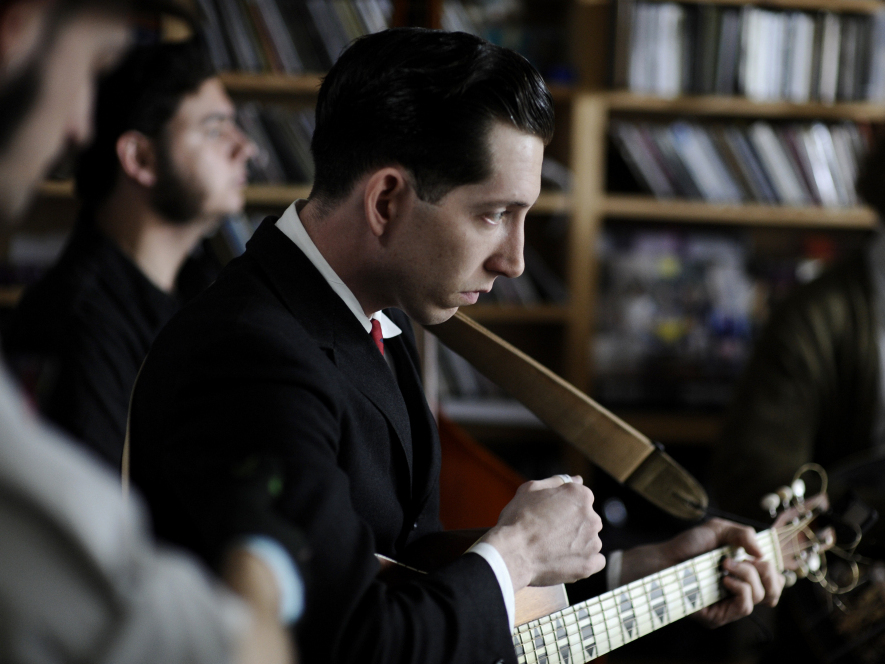
SOUNDTRACK: POKEY LaFARGE-Tiny Desk Concert #122 (April 20, 2011).

I had never heard of Pokey LaFarge before this Tiny Desk concert was sitting in my download folder.  In fact, the notes on the page say that they had never heard of him before they saw him wandering around SXSW.  And then he climbed onstage and played a great set.

LaFarge plays an old-timey style of music.  It’s a kind of Squirrel Nut Zippers retro sound.  As with the Zippers, I love their music in small doses.  And so, this Tiny Desk set is a perfect little sample of LaFarge’s music: happy, bouncy, jazzy.  There’s an upright bass solo, songs about being happy and singing “La La La” and other upbeat stuff.  It’s quite satisfying.

Especially if, as the notes say, you use it as a kind of antidote to the raucous music that you generally listen to.  A Pokey LaFarge song will perk you out of any self-inflicted gloom.  I just don’t need to hear more than three.

[READ: April 15, 2011] 2 book reviews

It looks like Zadie Smith has become a regular fixture at Harper’s.  I’m undecided if I’m going to review all of her book reviews from now on (perhaps I’ll lump some together in one post).  But in the meantime, I’m mentioning this one primarily because she reviews the story that I mentioned in yesterday’s post: Edouard Levé’s Suicide. (more…)

Read Full Post »

SOUNDTRACK: LES CLAYPOOL-5 Gallons of Diesel (DVD) (2005).

I’ve loved Primus for years.  And if you love Primus, chances are you love Les Claypool.  And Les Claypool has created and released music with all manner of bands since Primus broke up (they have since gotten back together and have planned a new release for July).  I don’t love all of his solo releases, but they all have something to commend them, and he’s made some great, unheralded music during those years.

This DVD covers the years from Sausage through to 2005.  At first I was pretty excited by the DVD.  The set opens with the off the wall video for Sausage’s “Riddles Are Abound Tonight” which is followed by a mercifully short “making of” video.

Then things started to go downhill somewhat.  The rest of the DVD is live, which is fine (Les live is a thing of beauty). It’s just that for many of the videos the quality is terrible.  The audio is also not ideal all the way through (that may have been my setup, but there were certainly songs that were much quieter than others).  Now I accept that there weren’t professional film crews out for Les Claypool’s Holy Mackerel tour, and that these videos are basically bootleg, but it  seems like they may have spruced them up a bit for the DVD.

Things change with the switch to Oysterhead.  I could have watched several songs from Oysterhead and I wonder why they chose only one.  This is a professional quality mix (although it is a little dark) and I have to say that the whole song is stolen by Trey Anastasio’s guitar thing.  It’s a guitar (called the MatterHorn) but during the verses of the song it appears to be a kind of theremin on the reverse side (with a full-sized antler sticking out of the bottom) .  He holds the thing upside down and waves at it to generate noise.  It was bewitching.

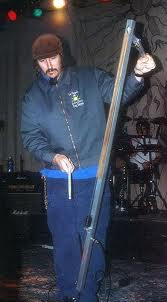
But Trey wasn’t the only one with a weird instrument. For the Frog Brigade set(s) on one of the songs, Les plays a “bass” which is just one string (called the Whamola). He hits it with a stick and changes the notes with a movable handle that he raises and lowers.  I’ve never seen anything like that, either.  Most of the Frog Brigade set is outside at a festival.  The lighting is good but the sound is awful.  In one song, the poor guy on percussion is banging away at various things and you simply cannot hear them.  Les also uses a secondary microphone (the Sandman–which has a great story behind it) but its volume is also quite low, which is a shame as you can’t hear him for quite a bit.

When Colonel Claypool’s Bucket of Bernie Brains the setting is an odd one (they appear to be on a cruise(?)).  It’s basically two lengthy jams, which is fine.  Buckethead amazes with his skills.  But the Bernie on keyboards, I can’t tell if he was screwing up or messing around during his solos.

There’s two more songs attributed to just Les Claypool, and this version of “Riddles Are Abound Tonight” is especially neat because there is a sitar playing the majority of the riff.

The DVD extras are fun.  There’s a weird set from a band called 3 Guys Name Schmo which is 2 bassists and a drummer.  The other bassist is miked very loud and it’s hard to hear Les (imagine outbassing Les Claypool!).  Then there’s the second official video on the disc for “Buzzards of Green Hill” (very low budget).  This comes with a making of the video video and a making of the audio video.  Both are interesting and brief, giving tidbits of info without overwhelming us.

The final two items come from an actual TV show called Fly Fishing the World.  I don’t fish, so I never knew this show existed.  But sure enough, there’s our Les going to two separate locations and fishing on.  The best part is that they play lots of Primus music between fishing (probably the most Primus music ever played on non-music TV), and they interview him as well (I didn’t know he had such cute kids). Despite my not knowing the show or caring about fishing, I found the whole program enjoyable and fascinating (and they catch and release as well).  It’s well worth the time.

So overall, this is a mixed bag.  There’s not a lot of video of Les’ non-Primus music out there, so in that respect this is great.  I just wish the quality was better.

[READ: March 25, 2011] “Life in Three Houses”

This is an excerpt from Suicide.  The introduction states that days after delivering the manuscript of Suicide, Levé killed himself.  I suspect that that is the main reason that this story was published here.

It opens promisingly and very interestingly in the second person.  The story tells us that you set off to play tennis with your wife, but you backtrack and go into the basement where you shoot yourself.  Your wife finds you moments later but misses the clue you set out for her (that was handled very well).

The rest of the story (and there’s quite a lot) gets confusing.  First off because it stays in the second person (even after death) but it also goes into apparent flashbacks.  Even more confusing is the addition of an I as the narrator.  An I who knows “you” but who was not present for the suicide so how could he have all these details?

The book is being published by Dalkey Archive Press.  It’s possible that the excerpts do an injustice to the full book, but I fear that I will not be reading any more by this author.

It was translated by Jan Steyn.

For ease of searching I include: Leve

Read Full Post »

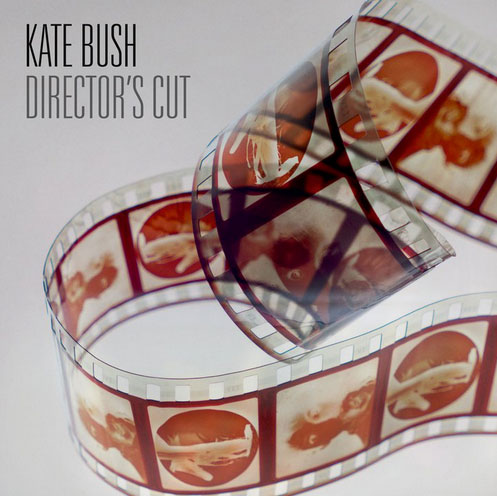
SOUNDTRACK: KATE BUSH-Director’s Cut (2011).

Kate Bush has re-recorded eleven songs from her two least-loved discs, The Sensual World and The Red Shoes.  According to the story at NPR, this seems to have been inspired by the Joyce estate’s granting Kate the right to use part of Ulysses as the lyrics for the song “The Sensual World” (in the original version she paraphrased the book).  So, she decided to re-record a bunch of other songs from those two albums as well.

I admit that neither one of those discs is high on my repeat play list, with The Red Shoes being a particular disappointment.  (Although there are some great songs on each).  When I read that these songs from those two albums I wasn’t terribly excited to hear them.  But I must say that these new versions have really reinvigorated these tracks.

I’m surprised by some of the choices (redoing “This Woman’s Work” is something of a shock, as is redoing her only real hit from The Red Shoes, “Rubberband Girl”), but whether it’s that she chose the best songs, or the new version have more life to them, this is a wonderful collection of songs.

Actually, rechecking the track listing, it does appear to be the best tracks from both discs, but I’m pleasantly surprised to seen how many good songs were actually on The Red Shoes to begin with,

from The Sensual World

  • Sensual World (retitled “Flower of the MOuntain”)
  • Deeper Understanding
  •  This Woman’s Work
  • Never Be Mine

from The Red Shoes

  • The Song of Solomon
  • Lily
  • The Red Shoes
  • Moments of Pleasure
  • Top of the City
  • And So is Love
  • Rubberband Girl

For the most part, the music seems to be the same (although there are some glaring exceptions).  I admit to not remembering the originals for all of them all that well).  But she has mostly rerecorded her voice (and possibly other lyrics, if NPR is accurate).  Her voice is unmistakably Kate, but in some places she sounds noticeably older (which she is, so duh).  She doesn’t seem to be able to hit quite the highs of before, but her voice has a throaty excellence to it now that brings something new to the songs.  It’s not noticeable on every song, although it is most notable on “This Woman’s Work,” which began with high sopranos, and now begins with lower alto notes.  But she can still hit some of the cool screechy notes on “Top of the City”

There are some tracks that are very different, “A Deeper Understanding” (a song about love via modems) replaces the earlier style of singing with a heavily autotuned computer voice.  It’s unsettling but very cool sounding.

The biggest changes come in “This Woman’s Work” and “Rubberband Girl.”

“This Woman’s Work” is a far more sedate track now. It doesn’t have any of the soaring moments of the original.  It seems to have more depth in this version, but I miss the “Oh darling make it go away” moment.  Nevertheless, it sounds really pretty in this more mature version.  It’s simply a very different song now.

As for “Rubberband Girl,” I’ve always had a real fondness for the original, so I don’t know how I feel about the rerecorded version (which is so very different).  The original is very elastic with cool music and weird vocals and is kind of trippy (and may not even be all that good), but I have grown quiet attached to it.  The new version is a simple guitar sound (it reminds me of a sort of unplugged Rolling Stones song now).

Overall, this is an exciting revitalization of Kate’s back catalog, and I hope it inspires her to make another new album in the next few years or so.

[READ: May 14, 2011] Austerlitz

I read about Sebald in Five Dials. And the glowing talk about him made me want to read one of his books (specifically, this one).

Austerlitz is a strange novel which I enjoyed but which I never really got into.  I feel like rather than absorbing me into its words, the book kind of held me aloft on the surface.  As such, I have a general sense of what happened, but I’d be very hard pressed to discuss it at length.

The basic plot summary is that an unnamed narrator runs into a man named Jacques Austerlitz.  Austerlitz talks to him at length about his life. They run into each other at various points over the years, and Austerlitz’ story is continued.  And literally, that is the book.  Now, of course, Austerlitz’ story is multifaceted and complex.  But we will never forget that this is a story within a story (it’s impossible to forget because the phrase “said Austerlitz” appears about 500 times in the book. (more…)

Read Full Post »

SOUNDTRACK: SURFER BLOOD-Astro Coast (2009).

Surfer Blood is a confusing band.  Their music sounds like a whole bunch of different late-80’s alterna-rock bands that I love.  But their vocalist (and the music of the verses) doesn’t really fit that style–I’m not sure what those sound like) and some of it is drenched in a kind of Beach Boys-reverb that befits the Surfer part of their name.

It’s a fascinating amalgam of styles that works very well and which is chock full of catchy choruses.  “Floating Vibes” opens with a big loud guitar note, that quickly morphs into a catchy verse line.  Conversely, “Swim” opens with a strange shouty kind of introduction and then morphs into a crazily catchy chorus (also shouted).

“Harmonix” opens with a “rock n roll” 50s style riff, then jumps to cool guitar harmonics and then turns into a song that sounds unmistakably late 80s to me (although maybe it sounds like a song my friend Garry wrote back in the late 80s).

“Neighbor Riffs” is a rocking 2 minute instrumental, which is followed by “Twin Peaks,” a song that sounds unmistakably late 80s but I can’t decide why (it’s also great because it’s about, you know, Twin Peaks).  I’m confused by the next pair of songs: “Fast Jabroni” and “Slow Jabroni” as they do not seem related and the Fast song is much better.  In fact the combination of “Slow Jabroni” and the next song, “Anchorage” really drag the disc as those two songs are over 12 minutes in total (whereas most of the songs are in the 3-4 minute range).   Neither of the songs is bad (in fact “Anchorage” is pretty cool), they just both last too long.

As I try to process who this band sounds like, I’m going to let Carrie Brownstein provide the best description of them:

Sometimes an album comes from people who you can tell love some of the same music as you. And when they interpret the bands you both love, when they run it through their own brains and hearts and hands and amps, instead of sounding like a watered-down version of the progenitors, it sounds fresh and heartfelt and energized. That’s Surfer Blood for me.

And me too.

[READ: May 16, 2011] “We Come in Peace”

This is one of my favorite short stories that I’ve read in a long time.  It appeals to me for a number of reasons (I love the conceit of angels tinkering with humans), but it’s also very well written and thoroughly engaging.  I think the only disappointment about it is that it’s a short story and not a novel (although the intro to the story says that this is merely an excerpt from the short story which appears in full length in Gartner’s new collection of short stories, Better Living Through Plastic Explosives).

I feared that the story would be daunting at first because it includes a dramatis personae (which can be intimidating for a short story).  But the dramatis personae just tells us which angels are matched to which humans.  For yes, this is a story about five angels who are sent to earth to learn about the five senses.   Amusingly, this is spurred on because humans have discovered the extra taste sensation known as umami.

So, the five angels are sent to a Canadian suburb to inhabit the bodies of 5 students: Bashaar, an athlete and dancer who is beset by local radical muslims to get him to join; Stephan a good student (ie., dork) who is turned cool by his angel, much to his family’s dismay; Leo, a nice dude; Jason, the school bully, who is inhabited by a happy angel; and Jessica, an anorexic girl who suddenly eats, develops a nice body and becomes romantically involved with 16-year-old Cullen.  Each of the angels subsumes the personality of the kids (whose families are, needless to say, freaked out by the changes). (more…)

Read Full Post »

« Newer Posts - Older Posts »