Feeds:
Posts
Comments

Archive for the ‘Death’ Category

mystrugglSOUNDTRACK: TRICKY-“Christiansands” (1996).

christiansandsThis book is set in Kristiansands, and so naturally this song was ringing through my head the whole while I was reading it.  I’ve known this song for ages, but had no idea that Chirstiansands was an actual place in Norway.

This song is dark and tense.  Over a slinky beat, a spare guitar riff introduces Tricky’s voice as he rasps (his voice is slightly modified to give him a weird echo).  And while he’s reciting his verses, the gorgeous voice of Martina Topley-Bird, repeats what he’s saying in a whispered voice until she sings out the chorus “I met a Christian in Christiansands.”

The verses repeat with Tricky emphasizing, “master your language and in the meantime I create my own.  It means we’ll manage.”

I honestly don’t know what the song is about, and it feels like it never properly ends–that riff, at once menacing and gripping never seems to conclude.  It’s a masterful track and hard to forget once you’ve heard it.

[READ: May 11, 2013] My Struggle Book One

I read an excerpt of Book Two from this series in Harper’s.  And despite the fact that nothing really happened in it, I was drawn in by the writing style.  This first novel is very similar in that not a lot happens but the voice is very captivating.  The translation is by Don Bartlett and it is fantastic–I can only assume the original Norwegian is just as compelling.  So, despite the fact that this autobiographical series contain six books (six!) and totals over 4,000 pages (how could this be if Book one is a mere 400?  Books 4-6 are over 1,000 pages each), I decided to give it a try.  (Incidentally, Book Two has just been translated into English this month).

This series has caused some controversy because it is given the same title as Hitler’s Mein Kampf (Min Kamp in Norwegian), and also because he says some pretty means stuff about people who are still alive (like his ex-wife).  Although there isn’t much of that in Book One.

death in the familyIndeed, Book One basically talks about two things–a New Year’s Eve party when Karl Ove was youngish and, as the bracketed title indicates, the death of his father.  (The title A Death in the Family is the same book as My Struggle Book One–from a different publisher.  It has a totally different cover but is the same translation.  I don’t quite get that).  But indeed, these two events take 430 pages to write about.

How is this possible?  Because Karl Ove writes about every single detail.  (I assume this why the books are considered novels, because there is no way he could remember so much detail about every event).  I’m going to quote a lengthy section from a New Yorker review (by James Wood) because he really captures the feeling of reading the book:

There is a flatness and a prolixity to the prose; the long sentences have about them an almost careless avant-gardism, with their conversational additions and splayed run-ons. The writer seems not to be selecting or shaping anything, or even pausing to draw breath….  There is something ceaselessly compelling about Knausgaard’s book: even when I was bored, I was interested. This striking readability has something to do with the unconventionality of “My Struggle.” It looks, at first sight, familiar enough: one of those highly personal modern or postmodern works, narrated by a writer, usually having the form if not the veracity of memoir and thus plotted somewhat accidentally, concerned with the writing of a book that turns out to be the text we are reading.  But there is also a simplicity, an openness, and an innocence in his relation to life, and thus in his relation to the reader. Where many contemporary writers would reflexively turn to irony, Knausgaard is intense and utterly honest, unafraid to voice universal anxieties, unafraid to appear naïve or awkward. Although his sentences are long and loose, they are not cutely or aimlessly digressive: truth is repeatedly being struck at, not chatted up.

That idea of being bored but interested is really right on–and it may sound like a bad thing, but it’s not.  You can read along thinking that there’s no way he is going to give so much unimportant detail.  But you get this description of drinking a cup of tea: (more…)

Read Full Post »

sign4SOUNDTRACK: GOAT-“Run to Your Mama” (2012).

goatI was intrigued to hear this song by Goat (whom I don’t know) because of the picture below.  Now that is a band photo!

Goat are a Swedish band and, like a bunch of Swedish bands recently, their guitar sound is very retro–a big open clean guitar sound.  But the riffs that they play are also very retro, this song sounds incredibly 70s–classic rock/heavy metal 70s.

The lead singer is the female of the trio, and she has a great raspy voice (and I assume she does the backing vocals as well).

The song feels like it could be an epic workout (especially when the solo kicks in and it is lengthy and, apparently, on a xylophone).  But right after the solo (at just under 2 and a half minutes), the song just ends.  It’s fantastic and I’m looking forward to hearing more from the album.

Goat

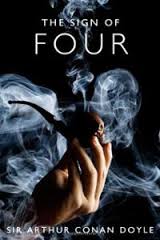
[READ: May 12, 2013] The Sign of (the) Four

I recently found out that the Sherlock Holmes book that I was supposed to have read in high school (from a reading list that I know I read at least some of) was actually not by Sir Arthur Conan Doyle.  Rather The Seven Per Cent Solution was a relatively recent (1974) book by Nicholas Meyer.  The only thing I remember from the book was learning that Holmes was an addict (and passing that news along to my mother with a tone of “see people have always been bad”).

Anyhow, in The Sign of (the) Four, the book opens with Holmes shooting up a seven per cent solution of cocaine.  The reason being that the cocaine kept his brain active when he had nothing else to do.  Holmes is bored, just waiting for something new to come along.  But Doyle doesn’t keep us waiting long.  A young woman, Mary Morstan, calls on Holmes for help with a case.  Or actually more like a series of interesting puzzles.  The first is the disappearance of her father, Captain Arthur Morstan in December 1878.  He came home from the war and then disappeared.  Holmes asks if he could be hiding, but she says no, he was very excited to come home and see her.  Since he has been gone, she has been employed as a governess and the family she assists have more or less taken her in as a member of the family.

The second puzzle is that she has received in the mail one very expensive pearl a year since 1872.  It always comes on the same date and the sender has remained anonymous.  This all started when she answered an anonymous newspaper ad that asked about her.  With the last pearl she received a letter that said she has been wronged and the sender asks to meet her.  He also says that she shouldn’t come alone.  So she asks Holmes and, by extension, Watson to accompany her.

Through a series of vehicles, they meet Thaddeus Sholto, a friend of Captain Morstan, who confirms that the Captain died in 1882.  Sholto’s father and Captain Morgan were in the war together.  Six years ago they had a fight over a treasure.  During their argument, the Captain suffered a heart attack and died.  Sholto’s father totally freaked out and hid both the body and the treasure.  Some time later, in declining health, his father confessed his sins, but on the night he died, he saw a man out the window who later broke into the house and left a note that said The Sign of Four (incidentally, the title of the book is variously The Sign of The Four and The Sign of Four; Doyle himself had written it both ways).  Thaddeus and his brother Bartholomew take over the treasure.  Well, Bartholomew takes it over and allows Thaddeus to send Mary the annual pearl as a payment for what happened to her father.

On the night that the story takes place, they travel to Bartholomew’s because he is in declining health.  But when they arrive, they find him dead–from a poisoned dart.  And the treasure is missing. (more…)

Read Full Post »

dreadSOUNDTRACK: PIÑATA PROTEST-El Valiente (2013).

elvaliente-frontrgbOn the Pogues album If I Should Fall from Grace with God, they sing a song called “Fiesta” that is more or less a punk Spanish song which, while very Spanish sounding, still retains a feeling of Irishness.  Piñata Protest, a band from San Antonio who sing in Spanish and English, sounds like a similar mix of Mexico, Ireland and punk (especially on the second track, “Vato Perron”).  I feel like the Ireland comes from the accordion (one of the primary instruments on the disc), while the punk lasts throughout (the whole album is 9 songs in 20 minutes).

The band plays loud guitars at a fast pace.  And it’s amazing how well the accordion brings it all together.

The band sings a few really fast songs and a couple slower ones.  Interestingly, the slower songs (“Tomorrow Today” and “Guadalupe”) are probably the most conventional and, consequentially, of the least interesting songs on the album.  They sound like pretty typical punk pop, albeit with touches of accordion.  It’s the more fast songs like “Vato Perron” and “Life on the Border” (with the great lead accordion and the fun “Hey!” refrain) which really stand out.

“Volver Volver” is a traditional song which starts out slowly (with big guitars) and after a few verses and a very long held note, the punk can’t be contained any longer and the song ends in a blur.  The title track is a great rocker with some interesting guitar sounds an a cool accordion solo.  Then there;s the rocking (and amusing) cover of “La Cucaracha.”  It starts out as a blistering punk song with no real connection to the original until about mid way through when a lone trumpet begins laying the familiar melody.  It’s only a minute long and so is the final cut “Que Pedo” which is just a blistering punk song with lots of screaming.

And with that album is done.  It’s a fun an unexpected treat of an album, and if you like your punk musically diverse, it’s worth checking out (NPR is streaming it this week).

[READ: May 11, 2013] Dread & Superficiality

Sarah got me this book for my birthday.  If you have ever seen Annie Hall (and if you haven’t, go watch it now), you’ve seen Woody-as-cartoon.  Hample is the person who created the cartoon for the movie.  Around the time that that happened, Hample was pushing Woody to have a comic strip based around him (Hample had a moderately successful strip at the time already) and also convincing newspapers that this was a good idea.  All parties agreed and Inside Woody Allen ran from 1976 to 1984.  1984!  I can’t believe I never saw this in a newspaper.  My parents were daily subscribers to two newspapers and I know I read the comics.  Of course, I didn’t care about Woody Allen until I went to college, so maybe I did see it but ignored it.

Anyhow, this book collects a bunch of those strips (I have no idea how many but I would venture around 200–which is a far cry from the nearly 3,000 that would have been produced over those years.  But hey since there’s no other place to see these strips (there were three books published but they are all long out of print), this is a good place to start and a nice collection.  But more than just the strips, most of the book collects the original proofs of the strips, so you can see Hample’s lines and notes (there are several pieces that deal with his color choices and notes on the same).

The book is broken down into subjects and is in no way chronological.  This makes sense as it’s good to see him dealing with the same topic in different ways, but it makes for weird continuity issues (something that will obviously occur when you only select random strips).  Woody is with various women over the strip and it’s hard to know if he was after Laura for a few months or the duration of the strip.  Of course, the sections aren’t really all that different–they all deal with Allen’s philosophical attitude, his attempts to woo women, his therapist and his parents.  However, the breakdowns, while somewhat arbitrary are enjoyable. (more…)

Read Full Post »

#20SOUNDTRACK: SUGAR-File Under: Easy Listening (1994).

fuelI  always thought File Under: Easy Listening was a very funny title.  But it’s possible that people took it too literally as it didn’t sell all that well. And in Mould’s autobiography he says he didn’t have much time to write songs for this disc and he thinks it suffered.  Of the three Sugar discs, this is definitely the weakest, although there are some great moments on it.

The disc opens with “Gift” which has some ragged distorted guitars. It’s got some noises and grungy sounding solos showing that FU:EL was a joke.  Although, the overall sound is kind of a cleaner version of the angry songs on Beaster.  “Company Book” is kind of a pounder, until the voice comes in and you realize…it’s not Mould!  It’s got a catchy chorus, but after the kind of underwhelming opener, it’s a strange place for a song that’s also not so dynamic.  Especially when it’s followed by “Your Favorite Thing” another great pop song from Mould—not top tier but a really strong second tier (although that bright, simple guitar solo is a real winner).  “What You Want It To Be” is a another decent song (the addition of that extra guitar playing the melody line really makes the song shine.  “Gee Angel” is also a high point.  A catchy song, but which never quite reaches the heights of the previous albums.

“Panama City Hotel” has the same feel as the opening of Beaster: bright acoustic guitars and a similar riff.  But it never really goes anywhere, and the 4 minutes seem.  The “do do do do’s” that open “Can’t Help You Anymore” are certainly the brightest spot on the album, and a big pop song as well.  “Granny Cool” has a nicely abrasive riff although it seems kind of mean spirited.  It’s funny that he tucked “Believe What You’re Saying” at the end of the album.  It’s a minor song but it sounds so bright on this album after the other songs. It’s really quite pretty.

And the closer, “Explode and Make Up” is one of Mould’s great angry songs.  Unlike Beaster, this one has a happy acoustic field—bnright guitars with that raging distorted guitar underneath.  It’s a great slow burner of a song and at five minutes it ends a somewhat lackluster album in a great way.

[READ: March 31, 2013] McSweeney’s #20

McSweeney’s #20 is an issue that I have read before.  At least I think I have.  My recollection is that it was the last one I read before I started writing about them on this blog.  I was hesitant to read it soon again, which is why I waited until now.  And while I remember the issue itself (with all of the art), I didn’t remember the stories.  So who knows if I actually read it six years ago.

Anyhow, this issue comes jam-packed with art.  Every fourth page has full-color artwork on it–many of them are quite famous.  It makes for a very beautiful book.

In between these artworks are a number of stories–ranging in size from 2 pages to 30-some pages.  There are no letters, and the explanatory and copyright information is on the cover of the book–which would be fine, except that it is covered up by a kind of 3-D artwork.  I wonder if the whole text is available anywhere?

The book also comes with a separate pamphlet–an excerpt from Chris Adrian’s Children’s Hospital.  I intend to read the novel eventually so I didn’t read the excerpt–although maybe if I put off the novel for six years I should just read the excerpt now. (more…)

Read Full Post »

#16SOUNDTRACK: SUGAR-Beaster EP (1993).

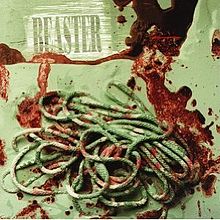
beasterI didn’t know that Beaster, the Sugar EP was recorded at the same time as Copper Blue.  Mould’s biography was very helpful in explaining all the details of the timing and styling behind these two recording.  As well as how the super pop of Copper Blue could be followed right on the heels with the very very dark EP of Beaster.

I have often thought of this disc as being really dark and insular and Mould confirmed as much—he was really airing out some demons with this disc.  But they thought it would be better to put them all in one place rather having them bounce around the poppier full length.  What must fans (like myself) have thought to hear this dark album after the pop of Copper Blue.  I mean just look at the cover!

I hadn’t listened to this in a long time, so I was surprised by how cool “Come Around” sounds—Mould’s acoustic guitar high in the mix with some appropriately grungey guitars in the background.  There are lyrics but for the most part I think of it as just Mould making sounds with his mouth.

It’s followed by the blistering “Tilting.”  It’s got superfast drumming with aggressive guitars, it’s like we’re back to the early Hüsker Dü punk sound (with a little more clarity).  The drumming is great in this track.  The song ends with a preacher being interrupted by dissonance and what sounds like electronic interference. And this song morphs into “Judas Cradle” one of Mould’s darkest songs.  It’s very claustrophobic-feeling with echoed vocals, lots of feedback and lots of compression on the overall sound—quite different from the big open sound of Copper Blue.  And yet for all of that, the chorus, “Have you seen the Judas Cradle, ah”is really quite catchy.

“JC Auto” has some buzzsaw guitars which make it seem like it’s going to be quite an angry song and yet the bridge is quite welcoming (all this talk of holidays) and then the chorus is amazingly fun to sing along to (Mould always finds pop in anger): “Passing judgment on my life you never really got it right/I can’t believe in anything / I don’t believe in / Do you believe in anything / Do you believe me now…  Look like Jesus Christ / act like Jesus Christ I Know I Know I Know Here’s Your Jesus Christ I’m Your Jesus Christ I Know I Know I Know.”  And, as always, I love when Mould repeats his lyrics in the background (the “I Know I Know” surfaces throughout the end of the song).

“Feeling Better” has weird synth blasts that kind of works in the song but sounds out of place on this record.  This song flips between really aggressive guitars and a very bright poppy chorus.   At 6 minutes this song is a little long (because it’s primarily repeating itself by the end), whereas Judas Cradle and JC Autos’ 6 minutes are well justified.

The final song “Walking Away” is a strange one. It is comprised entirely of organs (church organ it sounds like) with Mould delicately singing “I’m walking away back to you”  The end starts to wobble giving a bit of a nauseous feeling but then it’s over.  So even in his most downtrodden and questioning, Mould still has the chops to write some great music.  Down be put off by the cover, Beaster is a great album.

[READ: March 28, 2013] McSweeney’s #16

After the fairly straightforward Issue 15, McSweeney’s was back to fun with Issue #16.  The issue opens up into a kind of quad gatefold which has , in order–a comb, a book, another book and a deck of cards.

The main book contains nine stories, by the typical McSweeney’s roster at the time.  The other booklet contains a lengthy story by Ann Beattie.  The deck of cards is for Robert Coover’s “Heart Suite” and the comb is a comb.  It’s a nice one, although it has never touched my hair.

The MAIN BOOKLET (more…)

Read Full Post »

#15SOUNDTRACK: SUGAR-Copper Blue (1992).

copperblueAfter Bob Mould made some solo albums, he created another band.  Another trio, this one called Sugar.  Sugar seems to take Mould’s poppiest elements and wrap them in a big 90s grunge sound–a sound that Mould pretty much invented in Hüsker Dü.  And in many ways Sugar is not all that different from Hüsker Dü–maybe a bit less experimental and a little more commercial.

One thing I noticed about this album that, once I noticed it I couldn’t avoid it, was that when the drummer plays the cymbal (it might even be a hi hat with a tambourine on it), which he plays a lot, the tinny shimmer of that sound is so pervasive, I find it rather distracting.  Or should I say it adds an almost minute level of static over the proceedings.

The disc opens with “The Act We Act,” where big grungy guitars and a simple chugga chugga riff burst out of the speakers. I love the Pixies feeling of “A Good Idea” both that up front bass and the buggy sounding guitars provide an almost false introduction to the catchy verse and chorus that’s to come.  I also enjoy the unexpected break after the chorus.

It’s followed by the ringing guitars that introduce “Changes” a classic poppy rock song that is unmistakably Mould.  The uneasy almost nauseating sounds at the end of the song are again like a feint in the wrong direction as “Helpless” easily the most pop song Mould has ever written comes out.  Of course, as with Mould, this outrageously poppy song is all about feeling helpless.

Keyboards open the next song, “Hoover Dam” (something of a surprise for this album), which proves to be yet another big Mould single.  The song is so open with multiple acoustic guitars (and that cool synth solo) and a really wild reverse guitar solo.  It’s one of my favorite Mould  songs and yet another example of why this album was such a huge hit.

“The Slim” brings back the darker songs that Mould is also known for.  And just when you think that Mould can’t pull out another huge big single, he gives us “If I Can’t Change Your Mind,” one of his great big bouncy acoustic guitar songs.  It is almost obscene how catchy this song is, right down to the simple scale solo at the end.  Mould has this little technique that I find irresistible where he plays a song normally and then plays two fast chord changes segueing into another section.  It’s so cool.

“Fortune Teller” is a fast rocker with Mould’s trebly guitar taking the lead.  “Slick” is the only song I’m not crazy about. There’s something about it that kind of slows the momentum down, which is odd for a song about a car.  It’s got a real middle-period-Who feel to it, which I do like (and I really like the bridge) it just feels odd in this place in the disc.  The end of the song has some snippets of chatter that could have been edited out but lend an amusing air to the final track, “Man on the Moon” which ends the disc with that same air that the rest of the album has—big guitars and Mould’s slightly distorted vocals.  The solo is weirdly processed and kind of fun.  The end of the track with its repeated half step has a very Beatles feel to it. And the very end of the disc has the sound of tape rewinding, an amusing nod to the digital era.

Copper Blue was Mould’s first huge success and in his book he talks about not realizing quite how huge it was until he was in the middle of it.

[READ: March 20, 2013] McSweeney’s #15

I was a little disappointed with McSweeney’s #14, but #15 was once again fantastic.  This issue is a smallish hardcover (I like when their books are this size).  The bottom half of the cover features a cool 2 color painting by Leif Parsons.  The issue is known as the Icelandic Issue because of a few things.  The first half of the book features stories by the usual suspects.  Each of these stories is accompanied by an illustration of a Scandinavian rune that dates to the Viking era.  The stories in the second half of the book have illustrations that are taken from Icelandic grimoires–magician’s handbooks.  It is these second half stories that are all from Scandinavian authors.  It’s a fascinating peek into a culture few of us probably get to read.

There’s no letters in this book, which removes some of the levity, but that’s okay.  The front page has a brief story that it was being written on November 2, 2004 in New Mexico, hoping to bring some voting power to “the good guys “in this “completely fucking terrifying election.”  (The bad guy eked out a victory 49.8 to 49.1).  They went canvassing door to door with an Iraqi veteran named Joey (who was 21).  He was very pro-Kerry and may have even convinced a young girl to vote (she thought her vote didn’t count because she was poor (!)).  It really evokes the feeling on that dark night in 2004 when the iota of hope was snuffed out. (more…)

Read Full Post »

fivedials_no27b

SOUNDTRACK:  FREEGAL MUSIC (2013).

freegalNot only am I a librarian, I’m also a patron of libraries (we currently use four!).  I’m also a huge advocate of library usage.  Everyone knows you can get free books at the library.  And many people know (but many people don’t) that you can get free CDs and DVDs from the library.  Well, I’m advocating a new service that many libraries have implemented (both the library where I worked and my local library have it).

It’s called Freegal and it allows you to download (and keep) three songs a week.  The selection is quite impressive, as they have made agreements with 10,000 record labels.  That’s 10,000 LABELS, not artists, so huge numbers of songs are available. I did a few random searches and was delighted by how much was there.

Even their genre divisions are impressive.  Just check out this sample selection from the B’s: BeBop Big Band Black Metal Bluegrass Blues Bolero Bollywood Brasil Soul Brazilian Breakbeat BritPop Broadway.

So check out to see if your library subscribes.   You get three free songs every Monday morning!  Not bad for the price of a free library card.

[READ: July 3, 3011] Five Dials Number 27B

I haven’t posted about a Five Dials in a couple of issues, primarily because I find writing about anthologies is very time consuming (I have recently read three McSweeney’s which I haven’t had the time to edit together into posts).  The good news is that I have only missed two issues, but I know that at least one of them is pretty large.  I was a little bummed to see another new one already, but then I saw that this issue was not only short, it was full of poetry.  And, since this is my poetry month, why not end the month with a little more poetry.

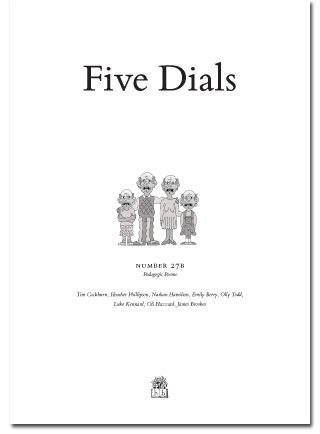
I enjoyed the offputting cartoon on the cover of this issue which is creepy and funny at the same time.  (Illustrations are by Sophia Augusta, Hannah Bagshaw, Kyle Platts, Tom Rees and Joe Prendergast.  I assume Augusta did the cover).

There was no letter from the editor or any of the usual suspects in this issue.  Rather this issue opens with a Letter from the Poetry Editor.  It is shaped like a poem but isn’t one.

SAM BUCHAN-WATTS-On Parenting Poems
Mentioning a 1954 parenting guide (from Elizabeth Longfellow), Buchan-Watts says that they asked eight young poets to choose a chapter heading from Longfellow’s book Points for Parents, and to make a poem starting from that title.

And it’s now that I admit that these poems have set me back terribly in my appreciation of poetry which I have been nurturing all month.  If ever there was a collection of seemingly random words, it is these. (more…)

Read Full Post »

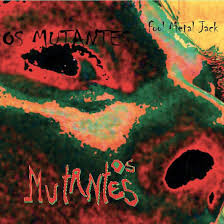
bartelbySOUNDTRACKOS MUTANTES-” Picadilly Willie” (2013).

Iosmut enjoyed this album so much (thanks NPR for the stream) that I had to talk about this song and how radically different it was from yesterday’s track.  “Picadilly Willie” is this wonderful old-sounding rock song.  It’s got a very classic rock riff, but there’s something slightly off-kilter which makes it sounds more like Frank Zappa classic than radio classic.  And when the vocals come in (with a sinister laugh) it sounds more like Mr Bungle than anything else (I wouldn’t be surprised if Mike Patton was a fan of Os Mutantes).

The song ends with what sounds to me like Middle Eastern sitar music and echoed chants of “Bra-zil!”

And these are just two of the styles of music on this wonderfully wild and diverse CD.  I can’t wait for its release.

[READ: April 22, 2013] Bartelby & Co.

I read about this book in the Bolaño interview book.  Vila-Matas was one of many authors that Bolaño highly recommended–this book in particular.  And, it was one of the few books on that extensive list that has been translated into English.

This book follows in the rich tradition of books that are more or less lists about people and not really novels at all. (This seems like a peculiarly Latin American pastime, at least in my experience, as there are nearly a half dozen books that seem to do this, including several by Bolaño).

The key to this book is in the title: Bartelby.  The narrator is a hunchbacked loner, and he decides to catalog all of the instances of writers who have in the grand tradition of Herman Melville’s Bartelby the Scrivener said “no, I would prefer not to” write anymore.  And so this book becomes a series of notes without a text.  The glorious list includes many famous and not so famous writers (the most famous being Salinger) who whether famous or not, decided to write no more.  And thus we have 86 “sections” in which the narrator writes about writers who stopped writing.  For most of the he gives their reason for no longer writing, for others he simply likes talking about how they stopped writing or what their circumstances were before they stopped. (more…)

Read Full Post »

vormSOUNDTRACK: DEAD CAN DANCE-“Children of the Sun” (Live at KCRW, April 24, 2013).

deadcandanceDead Can Dance are timeless.  Their music sounds ancient and modern at the same time.  And Brendan Perry’s voice has an unearthly majesty to it that never seems to age.

I’ve known the band for decades (during which time they have broken up and reunited and broken up and reunited).  And in all that time, while their sound has changed in subtle ways, the band is instantly recognizable.  I’ve never really thought of them as a live entity–they just seem like such a creation of the studio that it would be impossible to do justice to their wash of music live.  Of course that was truer three decades ago before it was easy to fit an entire orchestra on an iPod.

You can watch this song on NPR.  It’s fun to watch a band with two keyboardists (and Lisa Gerrard on…autoharp?) and see all of them making very different sounds.  The only disappointing thing about watching this is that they have so many cool instruments strewn about which do not get used on this song (you can see the whole show here and watch him bust out that bouzouki).

This song is a new one and it doesn’t have quite the ponderous nature as their older material.  Which is a bit of a shame, as they were so over the top it was fabulous, but maybe they’re just settling into New Old Age.

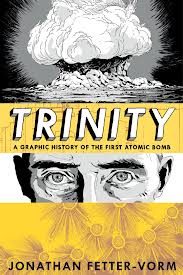
[READ: April 20, 2013] Trinity

Sarah brought this book home because it was on YALSA Hub Reading Challenge for 2013. I’m unlikely to do the challenge as I have so many other books to read, but I have already read 5 of the required 25.  Not too bad, although since the challenge is from Feb to June and I read a couple last year, I don’t even qualify for some of the ones I DID read.  Anyhow, she told me I’d like this and she was right (as usual).

Trinity is the story of the development of the atomic bomb done as a graphic novel.

It outlines how we came to develop and test the bomb and of course, the aftermath of its use.  What I liked about the story is that leading up to the detonation of the bomb, the quest for its discovery is presented in a fairly neutral way.  Essentially, once it was discovered that we could split the atom, it was deemed inevitable that someone would make a bomb out of it.  It stood to reason that if Hitler or the Japanese figured it out before us they would use it on us (since we were at war with them).  The intention was that America would be decent and not use it with impunity (which is not to say we wouldn’t use it at all).  The book presents that American can do spirit that the forties seem to be all about–a sort of gee whiz, let’s figure this out mentality.

I knew some of the history of the bomb, but there was a lot here that I didn’t know: that thousands of people moved to New Mexico to work on the bomb—housing was put up and families moved in, some 80,000 people in all.  And most of the people had no idea what they were working on.  It’s hard to fathom that there were thousands of people whose work helped to create a nuclear bomb and yet they can feel neither pride nor shame because they had no idea that’s what they were doing.  Weird. (more…)

Read Full Post »

SOUNDTRACK: WRECK AND REFERENCE-“Absurdities & Echoes” (2013).peach 5

wreckI followed Lars’ blog on NPR and after listening to yesterday’s Altar of Plague and I wound up here with Wreck and Reference.  Lars describes this song as the band’s “most melodic and mysterious.”  If this is the band being melodic, I can’t imagine what the rest of it is like.

The song opens somewhat conventionally but quickly shows something unexpected with some rapid fire drums.  And then the vocals come in.  The guy sounds like he is drowning–both in his angst and in the recording technique–he’s either under a ton of reverb or just buried in the mix. The lyrics are incomprehensible, although they seem quite impassioned.  After the verse there’s a lot of noise and snare drums–martial without exactly being military-like.

I guess there is a melody in there, but it’s not an obvious one.  The song has an accompanying video which you can watch at the link above.  It’s as peculiar as the song.  Incidentally, this song comes from their 7″ called Content, which is pronounced “No Content.”

[READ: April 18, 2013] “Supreme Cloud Ear”

This issue of Lucky Peach was the China Town Issue.  So all of the contents were about Chinatowns across the country.  I really enjoyed it, as there were so many interesting things to read about.  This short story was set in a Chinatown.  A young couple is planning to meet Beverly.  Well, actually Andrew has met Beverly but the narrator is meeting her for the first time.  There’s an air of power around this meeting, Beverly is practically a mythical figure as far as the narrator is concerned.  We enter the room where she is preparing something and there is stilted and awkward dialogue.  And indeed, for the longest time, we don’t really know why everyone is so secretive (it’s very well done).

Beverly maintains a detached aura no matter how much the narrator tries to talk to her.  After a few minutes, Beverly says she has to go on a delivery.  The narrator says that she has forgotten to get wine for their dinner, so she’ll tag along.  Beverly is clearly not happy about the company, although again, we don’t know why, exactly.

Beverly says that there’s a wine store down the street but the narrator won’t leave her side.  Resigned to the company and making sure that the narrator is prepared for whatever might lie ahead, Beverly invites her along. (more…)

Read Full Post »

« Newer Posts - Older Posts »