Feeds:
Posts
Comments

Archive for the ‘Death’ Category

between heaven SOUNDTRACK: ALTAR OF PLAGUES-“Scald Scar of Water” (2013).

aopI never think of death metal coming from Ireland.  I think of punk and metal and obviously the Pogues, but noise metal?  Unlikely.   And yet here is some.  And why shouldn’t Ireland produce music like this?  There are fans everywhere.

I heard this from good old Lars at NPR.  I’ve come to expect the unexpected from Lars’ picks.  And this is no exception.  The song is six minutes long.  It has some traditional death metal stuff–growling vocals, incessant drumming and lots of noise.  But there’s a lot more going on here.  It opens with electronic noise and thudding drums.  The drums are punctuated by alternating abrasive guitar riffs.  The song meanders along until it settles down to some heavy heavy verses (I have no idea what the man is screaming about).  After returning to the buzzsaw riffs, and repeating the verse, the song suddenly stops.

At 4 minutes the whole thing stops.  There’s some scratchy noises and then some slow pulsing bass and suddenly the whole song turns into  kind of alternative metal song, complete with chanting.  It’s pretty unexpected.  I can’t imagine what the rest of the album is like.

[READ: April 17, 2013] Between Heaven and Here

This was another book that I did not like in the beginning. Well, that’s not exactly true, I enjoyed the beginning but I really didn’t like the middle and really wanted it to end soon.  Not a good way to feel about a book. The reason I didn’t stop is because it was so short.  It turns out that an excerpt from this book was in a McSweeney’s issue that I recently read (and which I haven’t posted yet).  I didn’t “get” the excerpt then, and while it makes more sense in context I still felt the section was really hard to follow.

And so was much of the book.

This is the story of Rio Seco, an area of California, and the citizens who live there.  As the story opens we learn that Glorette Picard is dead.  Glorette was a crack whore, the kind of girl who would get killed and no one would miss her.  Except that people would miss her.  She had a lot of friends and relatives who cared about her.  She even had a son, Victor, who is 17 and studying his ass off to be able to go to college.  When a boy in town finds Glorette’s body dumped in a shopping cart, he feels compelled to move her, to bring her to her Uncle Enrique because he knows that the police won’t care if some crack whore was killed.  So he moves the body and that sets in place the rest of the story.

What was confusing to me was that the novel was constructed like a series of short episodes–different people and how they knew Glorette and how Glorette affected them.  That’s not a problem, except that there’s very little indication that that’s what was happening.  It felt increasingly difficult to know who was the main character was in each section, especially since so many characters overlapped.  Which again wouldn’t have been a problem except that I really couldn’t tell which person was the narrator or at least focus of each section.  Sometimes they were never identified, other times only after several pages.  The chapter that was excerpted in McSweeney’s has virtually no names in it, it is just dialogue.  And sure the dialogue was interesting and with the novel’s context made some sense, but I’m still not sure who was in the conversation. (more…)

Read Full Post »

heartSOUNDTRACK: CHELSEA LIGHT MOVING-“The Ecstasy” (2013).

clmWhen Chelsea Light Moving played at KEXP, they went out for a break before playing live on air.  One of the DJs had a chocolate bar.  And Thurston was inspired.  According to the NPR [page:

The Sonic Youth veteran and his bandmates in Chelsea Light Moving had been jamming off-air in the KEXP studios. When they stepped outside to get some fresh air, KEXP’s DJ Sharlese followed, offering them some of her chocolate bar. At first, Moore politely declined, but as the candy got eaten away, piece by piece, a poem (John Donne’s “The Ecstasy”) was revealed underneath, printed on the candy wrapper.

“Can I have that?” he asked, and the next thing we knew, he was sprinting back into the studio, taping the tattered wrapper to a mic stand, and belting out his own version of the poem against discordant guitar chords.

The music is great.  It works perfectly with the meter of Donne’s poem and, the way Thurston delivers it, it sounds like he could have written it.  There’s some great screaming guitars, a very cool discordant chord or two and wailing solo.  I really enjoyed that Thurston doesn’t play guitar through much of the song (he leaves that to the other guitarist), he just comes in when some wildness is needed.  Awesome.

It’s a great song and hard to believe it was tossed off so easily.

Check it out here.

The lyrics are indeed from Donne’s poem, which begins:

WHERE, like a pillow on a bed,
A pregnant bank swell’d up, to rest
The violet’s reclining head,
Sat we two, one another’s best.

[You can read the rest here].

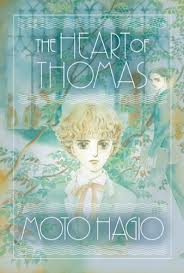
[READ: April 14, 2013] The Heart of Thomas

I brought this home from work because Sarah loves boarding school books.  But this is a manga book, and it is set up to be read right to left.  Sarah admitted that she can’t easily get her mind to work that way.  Which I understand. So I gave it a go.  I found it rough going, but after about 20 pages it became pretty natural.

The Heart of Thomas is an early example of Shōjo manga (少女漫画) which is manga marketed to a female audience roughly between the ages of 10 and 18. The name romanizes the Japanese 少女 (shōjo), literally “little female”. Shōjo manga covers many subjects with a strong focus on human and romantic relationships and emotions.   Shōjo manga does not comprise a style or a genre per se, but rather indicates a target demographic.  shōnen-ai.  The stories were published mostly in magazines targeted at girls–which had a huge audience.  And that is where The Heart of Thomas was originally published in 1974.

The Heart of Thomas is a fascinating story—it’s set in a German boys boarding school (written by a Japanese woman!). The story opens with the death of a character named Thomas.  He falls off a bridge and the story is predicated upon wondering whether he jumped or he fell.  There are a lot of clues that he committed suicide because of his unrequited love for Juli, the prefect of boys at the school.  Juli is quite different from the other boys, he has dark hair and Greek features, he is not golden haired and blue eyed like so many of the other boys.  This makes him stand out.  Indeed, he even stands out in his own home, where he lives with his mother and grandmother.  His grandmother is disgusted by his coloring and believes him to have impure genes (yikes!).  She even tells him as much!  But Juli is a serious student and a hard worker, with no time for nonsense from his grandmother or his classmates.  He also has no time for farce.

The farce refers to a game that Thomas and Ante created in which they would both vie for Juli’s love.  Thomas pursued this heavily but was never successful.  And that may be why he killed himself (if indeed he did). (more…)

Read Full Post »

highlySOUNDTRACK: FAMILY GUY-“Everything is Better with a Bag of Weed” (2009).

familyguyI recently posted about the song “Me Ol’ Bamboo” from Chitty Chitty Bang Bang.  When I was looking it up, I discovered that Family Guy had created a song called “Everything is Better with a Bag of Weed” that is sung to the tune of “Me Ol’ Bamboo.”  And holy crap I nearly busted a gut laughing when I watched it.

Of all the weird songs to parody, this was a brilliant choice.  The song is catchy and fast paced and absurd and just adding these new lyrics has made it funnier and more absurd.  There’s even the same odd instrumental break which they animate as playing glass bottle with drumsticks and as far as I can tell that’s really what it is.

My o my, this is very funny indeed.

I can’t seem to embed the video here which is a shame, but by all means check it out here.

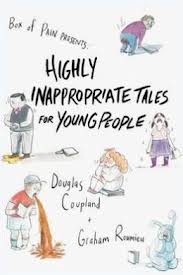
[READ: April 9, 2013] Highly Inappropriate Tales for Young People

I have read most of Douglas Coupland’s work and I like him quite a bit.  But I have discovered from re-reading his books recently that he’s not exactly the author I thought he was.  And one thing is that he’s really not very funny.  Existential? Yes. Comically absurd?  Yes.  Funny?  Not so much.  So I was surprised to see that he made this book with the rather funny title.

I assume this book is supposed to be funny since the inside flap says “Seven pants-peeingly funny stories featuring seven evil characters you can’t help but love.”  And indeed, the premise is funny, the title is funny.  But the stories are really not funny at all.  Here’s the list of the seven stories: Donald the Incredibly Hostile Juice Box; Sandra, the Truly Dreadful Babysitter; Hans, the Weird Exchange Student; Brandon, the Action Figure with Issues; Cindy, the Terrible Role Model; Kevin, the Hobo Minivan with Extremely Low Morals; Mr. Fraser, the Undead Substitute Teacher.  Judging from the titles of the tales you may think there’s humor in them…a juice box as a main character?  But there’s something about them that falls flat. (more…)

Read Full Post »

circleSOUNDTRACK: BOB MOULD-Black Sheets of Rain (1990).

I blacksheetstend to think of this as a very dark and claustrophobic album, which it is.  And yet it is also unavoidably Bob Mould, meaning that there are pop elements all over it.  There’s also some very cool, simple bass lines that tend to spruce up some moments of the album making it a bit more fun than it would be without them.

Even if the title track is over seven minutes long, with some really blistering guitar solos, there are still really poppy elements to the chorus.  As for claustrophobic, the title and cover make this seem like it would be really quiet and insular.  But a song like “Black Guard” is quite inviting.  And the third song, “It’s Too Late” is one of the poppiest songs that Mould has written.  The opening chords are so obvious and recall so many classic rock songs that it’s almost too pop for its own good.

“One Good Reason” is another longer song and it, too, has a catchy chorus.  “Stop Your Crying” is one of Mould’s great songs–a nasty-seeming minor chord structure with Mould’s screamed lyrics.  And yet he still manages to make you want to sing along.

The largely acoustic (with disconcerting organ) “The Last Night” is a breakup song.  A major downer with the odd lyric: “Tonight’s the last night that I will ever spend with you.  Please don’t ask me why cause I don’t know, yea.”  A similar kind of breakup song is “Out of Your Life.”  The difference is that “Out of Your Life” is incredibly poppy.  A major key with bouncy bass and super sing along chorus.  It’s two sides of an idea.  “Disappointed” sounds very much like earlier Hüsker Dü with that buzzy guitar that is unmistakably Mould.  The album ends with “Sacrifice/Let There be Peace” in which the dichotomy of Mould’s sounds are in full evidence.  Mould’s voice sounds completely shot by the end as she screams and growls (it’s amazing he could even speak after recording some of these songs).  The lyrics are practically impossible to understand and yet in the background Mould is chanting/singing a very steady chorus of “Sacrifice” and there’s a very melodic guitar line going on.

It’s an interesting ending to a very schizophrenic album.  It’s nowhere near as dark as I remember, but not exactly a cheery walk in the park either.

[READ: April 10, 2013] The Circle Game

It’s funny that I’m reading so much poetry, as I don’t typically enjoy it.  Well, April is National Poetry Month after all, so why not.  I received this Atwood book at work.  I really like Margaret Atwood a lot and I hope to delve into her oeuvre more.  So why not take the opportunity to scan this brief volume of poetry (which I thought was new, although I now see is from the sixties).

I’ve read a lot of different types of poetry this month and I found that I really enjoyed Atwood’s work a lot.  Could it be because it’s 40 some years old and not “new” poetry?  I don’t know.  Could it be that she uses parentheses a lot (could be).  Or is it just that she is a great writer.

Her poems actually made me think about the nature of poetry itself.  Why does a fiction writer write poetry?  It seems like some of these poems are simply very short stories.  Is that all a poem is?  A very short story (I mentioned how flash fiction has arisen as a genre, and some of these pieces feel like they could be rendered as flash fiction.  I often find flash fiction unsatisfying and I think it’s because poetry is even tighter and more effective than a flash fiction piece.

I’m also intrigued by Atwood’s poetry because she is writing about atypical stuff (as is Atwood’ wont).  So there’s not a lot of “love” here, except under the guise of something else. (more…)

Read Full Post »

xxSOUNDTRACKQUEENS OF THE STONE AGE-“My God is the Sun” (2013)

qotsaAfter a six-year hiatus, QotSA is back with this slinky song.  It has the sleazy feel that Homme does so well (how does he do that?).  This song feels a little more guitar based (meaning it is a bit more trebly–with interesting echoes on the guitars).  It’s not as immediately catchy as their bigger hits, but it’s got all the elements you look for from QotSA.

It opens with some slashing sounds and then the riff kicks in.  The song is propulsive but somehow doesn’t feel as fast as some of their earlier tracks.  Which is not to say it’s mellow at all.  And once Homme starts singing, well, it’s like they never went away.  There’s a lengthy middle instrumental section which is quite interesting and otherworldly, but it never gives up the propulsion, especially as the end gets faster and faster.

[READ: April 8, 2013] The Mays XX

This is another book that I saw at work and wanted to read (this job is wrecking my already long list of books to read).  I had some difficulty cataloging it (for various reasons), which meant I had to pour over contents.  And the more I looked it over the more I realized that I wanted to read it.

So The Mays Anthology publishes the best new student writing and art from Cambridge and Oxford Universities.  Read more about it at their website.  I’d never heard of The Mays before, but when I saw that John Darnielle of the Mountain Goats was a guest editor, I thought it might be a fun collection tread through.

Issue 20 features poetry, a graphic novel, photography and prose.  The other editors are Andrew Griffin (general), Sebastiano Barassi (Visual Arts), Tao Lin and Toby Litt (Prose) and of course, Darnielle (Poetry).

I was really delighted with the prose in this issue.  None of the stories are more than 1,000 words, which I decided is a wonderful length for a story.  I’m going to talk about the stories, but not so much about the poetry or art.

Darnielle’s introduction to the poetry section was excellent and really resonated with me because of my ideas and fears about poetry (how we feel stupid if we don’t get poetry).  He then explained the things that he looked for in this poetry and I imagined that i would love every piece here.  I didn’t, but on the whole I really liked the poetry. (more…)

Read Full Post »

cousinkSOUNDTRACK: FOALS-“Inhaler” (2013).

foalsinhalerI really really liked Foals debut album.  It was weird and off-kilter and was one of my favorite albums of that year.  I had heard that their follow-up was very different, less weird, more conventional, and I have yet to hear it (narrow-minded, I know).  But then I heard that their new album was really great.  “Inhaler” was the first song I heard.

Man, do I love it. The song opens kind of funky with some noisy echoed guitars.  After a few verses the bridge comes in and the big excitement of the song comes when he gets to the chorus, “I can’t get enough SPACE!”  It’s not so much that he yells “space,” which he does, it’s more the way the whole song explodes with a new exciting riff and it just seems to get bigger and bigger. It blows me away every time.

After the first chorus we drop right back to that falsettoed slow verse delivery.  And the song slowly builds back up again.  The length of the bridge as you anticipate the big chorus is just excruciatingly wonderful.

[READ: April 5, 2013] Cousin K

I found this book when I was cataloging it at my job.  I don’t know what grabbed me about it (there’s nothing special about the cover).  I think it may have been the French Voices label in the corner (and its brevity).  I thought, hey why not read a contemporary French novella for something different.

Well, to my surprise, that is not what I got.  Indeed, nothing in this book is as it seems.

Yasminia Khadra is a pseudonym for Mohammed Moulesshoul.  He chose the name to avoid military censorship (that’s all the book says, I don’t really understand what that means).  Moulesshoul was born in the Algerian Sahara.  He is now retired from the military and is living in France.

But so, instead of this being a story from a French woman, the story is actually from a Male Algerian.  Which doesn’t really matter in the long run, but I assumed that the narrator was a girl (based on the “author = narrator” theory that is an easy shortcut in fiction.  This was really only confusing because the narrator is unnamed for quite a while in the book.

But what a book.  In just 80 some pages, Khadra turns in a  fascinating psychological picture of neglect and psychological abuse.  But it is such an elliptical book that there are almost as many questions as there are answers.  It is this elliptical style which provides some of the confusion, but a lot of the interesting structure of the story. (more…)

Read Full Post »

loveindeSOUNDTRACK: KURT VILE-“Wakin on a Pretty Day” (2013).

Kurt Vile_CVR-31981badf76ce6680de293138b7fbf1807fe323f-s1I don’t really know that much about Kurt Vile.  I’ve been hearing about him for a while. I assumed his name was a kind of joke–like he was a comical metal guy, maybe like Alice Cooper.   That appears to be far from the truth.  I also wasn’t sure if he was well-known outside of the Philly area, but I do know that NPR has championed him for a while.

Well, he has a new album out and since NPR was streaming it, what better time to hear what the long- haired dude is all about.

There is much talk bout his voice (NPR says: There’s something about Kurt Vile’s voice that transcends whatever comes out of his mouth.).  But the whole time I listened to this song (which was a while, as it is over 9 minutes long), I kept thinking that he sounds just like the guy from House of Love, an underrated band here in the States. (He sounds even more like him in Kv Crimes”) It’s not necessarily a bad thing to sound like someone else (often times it can’t be helped I suppose), but it is a little distracting to me.

So this song is kind of groovy.  I like it musically more than vocally (there’s so many “Yeah…yeah yeah yeahs” that I lost the point of the song).  But the music is really good, including Vile’s lengthy guitar solos.  Interestingly, I was kind of bored by the song after about 45 seconds, but by 8 minutes I was really grooving it.  Subsequent listens have made me like it more, it has a kind of Neil Young or maybe Meat Puppets vibe.

My head says there’s really nothing special about this guy and yet after more and more listens, there’s something that draws me to him.  Weird.

[READ: April 2, 2013] Love, An Index

The back of Lindenberg’s book explains that the man she loved, poet Craig Arnold, disappeared in a volcano while traveling in Japan.  For such a very specific kind of event, I don’t think I would have gotten anything quite like that from these poems.  Indeed, for a book that is so specifically created about this man, there’s very little sense of the exact nature of the loss.  In some ways that’s good, it could have been a very maudlin, ungraceful collection of poems if she explicitly talked about volcanoes, but at the same time, the feeling of loss that comes across is less about death and more about abandonment (I would have presumed that the guy had left her).

I really enjoyed these poems even though I have a  really hard time accepting the bulk of these, in particular the thirty-four page title poem, as poetry.

“Love, An Index” is thirty-four pages and it is an index.  Literally, she lists words alphabetically and writes a little “definition” for each one.  There are arbitrary line breaks in the definitions but in no way does it feel like a poem.  Even the individual entries are not very poetic.  Like “Compromise, I will get up early with you/so long as you’ve made coffee.”  Okay, so that’s funny/sweet, but it’s not a poem.  But then what it is?  Yes, it is part of a greater whole and removing part of it diminishes that whole.  But again, what is the whole?  Genre defying I suppose.  Which is cool.  And despite my criticism, I really enjoyed this index.  There were personal notes that I would have no idea about, there were commonplace ideas that are familiar to all.  There’s also a ton of quotes from other poets.  And it all works together to create a beautiful portrait of a relationship. (more…)

Read Full Post »

cityofrivers_cover_FINALstickerSOUNDTRACK: SIGUR RÓS-“Brennisteinn” (2013).

Wsigurhat is that sound?  Low end electronic…noise?  Coming from a Sigur Rós song?  Typically you get a band in the ether, but here’s the band with loud pounding drums and almost glitchy music.  Of course, Jonsi’s voice tells you you’ve got Sigur Rós.  And yet, he’s not singing in his otherworldly falsetto–it seems like an almost human voice.

There’s a very distinctive chorus which is actually catchy in an almost poppy way.  And then, after four minutes, the Sigur Rós of old comes in–Jonsi’s voice soars, and the music reaches for the heavens (but with drums and some crazy sound effects) added in.

And then it grows haunting as the song slows down and distant horns come swelling in, keeping that soundtrack feel that the band does so well.  The video is creepy/cool interspersed with the band playing live.  I love watching them make the sounds they make (there’s a bowed guitar at some point).  I really like this a lot, and can’t wait for the rest of the album.

[READ: March 30, 2013] City of Rivers

I have said before that I don’t really like poetry.  It makes me feel stupid.  This is mostly because I have taken poetry classes and I know what good poetry should be, and yet I see so much poetry published which I think is not very good.  And yet, if it has been published, doesn’t that mean it’s good?  Have I missed something?

I’m not a total old school poetry boor, I don’t need my poetry to be in iambic pentameter, nor does it even need to rhyme, and yet sometimes a lot of contemporary poetry seems like a sentence, not really a poem.  I also suspect that the ascendance of flash fiction has made the ascendance of this flash poetry acceptable too.  Don’t get me wrong, I know a haiku is short as well, but there are lots of constrictions to haiku, whereas some free verse short poems really lack in the substance department.

I am also nonobjective about poetry because of all of the poetry slams that I have witnessed in college and since, in which basically anything is  poem if you e-nun-ci-ate it interestingly (something I doubt Keats was doing).

In an attempt to appreciate new poetry more, I decided to get a few books from the McSweeney’s poetry series. (more…)

Read Full Post »

mouldbookSOUNDTRACK: BOB MOULD-Silver Age (2012).

silverage

I was a huge fan of everything Bob Mould put out.  And then he more or less gave up on music.  So I just enjoyed his past and ignored what else he did.  But then I heard great reviews of his new album Silver Age.  So great in fact, that I couldn’t help but listen to it.  And it is amazing.  It’s a major return to his punkier roots.  The guitars are loud and fast but the melodies are still present.  And what’s more important, his voice sounds great and the album is mixed really well–previous Mould records have suffered in production quality.  But this is a great great record.

“Star Machine” opens the disc with loud guitars, a simple melody and lots of attitude.  I love the repeated “Said It” that appears throughout the song.  “Silver Age” is something of a manifesto for Mould.  The guitars are harsh and jagged with lots of distortion and the lyrics tell you everything: “Never too old to contain my rage  This is how I’m gonna spend my days gonna fight gonna fuck gonna feed gonna walk away.”

“The Descent” is classic Mould–big guitars, great catchy vocals and really nice harmonies/backing vocals.  “Briefest Moment” starts with a thudding drum and a sparse fast guitar (which somehow reminds me of Cheap Trick).  The bass comes in with a galloping line rather than playing the same notes and it adds a lot of depth to the album.  “Steam of Hercules” slows things down a bit but “Fugue State” comes crashing back in with more fast thumping drums and sparse but effective guitars.

“Round the City Square” picks up the noise level and includes a wild guitar solo.  “Angels Rearrange” again sounds like classic Mould.  While “Keep Believing” has a great bridge that reminds me a lot of Hüsker Dü (yes I mentioned the band that should not be named).  “First Time Joy” ends the disc on a gentle note.  It’s a ballad (where you can really hear Mould’s voice and how clean and strong it sounds).  There’s keyboards on this song that add some nice dimension.  By the end the song gets bigger and more powerful, ending on a really strong chord.  It’s an awesome return to the rock fold for Mould and I look forward to more from him.

[READ: March 5, 2013] See a Little Light

After getting The Silver Age, I remembered that Mould had written an autobiography and that I’d heard it was quite good.  I don’t really read a lot of autobiographies, but my history with Mould is pretty deep and I was curious to see what had happened in his life to make him abandon his rock roots.  So I tracked it down.  And I really enjoyed it.

The fascinating thing is what a reasonable man Mould presents himself as.  I’m not disputing this–I don’t know really anything else about the guy–but every time someone dumps on him, he accepts partial responsibility for the problem and moves on.  If he’s really like that, that’s very cool.  But he almost seems too nice sometimes.

As I’ve said, I didn’t know much about Mould.  My friend Al got me into Hüsker Dü and I’ve been a fan ever since.  I’ve bought some of his solo records and all of his band records, but I kind of lost interest in him the last decade or so (during his experimental phase).  But I didn’t even really know why Hüsker Dü broke up.

Some interesting things about Bob: he was born numerically gifted–I really enjoyed the section about his childhood and the genius-y stuff he did.  Although he had a pretty rough childhood–his older brother died when Bob was young and so Bob was seen as a golden child (especially after something that happened to him which he didn’t learn about until much later).  And he started drinking at a very young age.

When he got to college he formed Hüsker Dü with Grant Hart (Greg Norton came a little later).  I enjoyed hearing about the early days of Hüsker Dü because I only learned of them much later.  And man were they productive!  They’d release an album and have new material ready to record before they even toured for the album that came out already.  It’s cool reading about the punk scene back in the days before the internet when bands had to rely on each other for support.  There’s also a lot of people who Bob name checks and it’s fun to hear all of the punk names again, especially the names of people who are still active.  (There’s also some bad vibes against SST, but since this is Mould, the bad vibes are pretty mild). (more…)

Read Full Post »

14

SOUNDTRACK: DEFTONES-Diamond Eyes (2010).

diamondBefore releasing Diamond Eyes, Deftones had two band crises. The first was that they didn’t really seem to like each other anymore.  The previous album was fraught with tension and they barely toured.  After deciding that they wanted to remain as a band, they were invigorated and made an album called Eros.  But during the recording, bassist Chi Cheng was in a car accident and was in a coma.  As of yet he has not fully recovered.  So they shelved Eros, hired a temporary bass player Sergio Vega and set about recording Diamond Eyes.  And for whatever reason, it proved to be one of their best releases so far.

“Diamond Eyes” opens with a heavy down-tuned guitar–very abrasive–until the chorus come in and it’s their most beautiful ones yet–with soaring keyboards and  harmonies.  And then the heavy guitars come back–it’s what Deftones do so well–beauty and ugly together.  Stephen Carpenter really shines, as always.  “Royal” is a fast song with a great harmonizing chorus.  “Cmnd/Ctrl” has a shocking low riff that explodes into a  bright chorus.  “You’ve Seen the Butcher” has guitars that seem almost untuned as the song starts.  But it morphs into a kind of sexy butt-shaking chorus.  And Abe Cunningham’s drums are, of course, fantastic.

“Beauty School” is the first that doesn’t really start out heavy, it’s a got a gentle guitar intro and the first song where Vega’s bass is really prominent as a separate instrument and it creates a beautiful alternative song–great vocals throughout.  “Prince” brings in a lot of new textures to the album, including a clanging guitar sound and a great screamed chorus. “Rocket Skates” is one of my favorite songs on the record, it has a classic metal riff and the great screamed-beyond-comprehension chorus of Guns, Razors Knives and a weird little whoooo that ends the chorus.

“Sextape” is a surprisingly gentle song, opening with an echoed guitar riff and one of Chino’s most gentle choruses.  “976-Evil” has an echoey guitar and voices not unlike the Cocteau Twins.  “This Place is Death” has another great alt rock feel–a big song with bright guitars and dark lyrics.  I haven’t really mentioned Frank Delgado on keyboards and samples.  He’s been with the band since White Pony, and I feel like his presence was made notable on a few songs here and there.  But it seems like on this disc he really comes to the fore, adding new textures and sounds to the album which really fill it out.

[READ: March 12, 2013] McSweeney’s #14

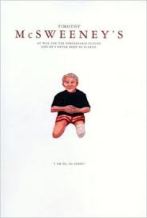
After the colorful extravaganza of the Comics Issue of McSweeney’s #13, this book settles down into something more somber  The book is softcover and all white.  The cover depicts a cartoon of George Bush with both legs blown off and the caption, “I Am So, So Sorry.”  On the spine in small print: “We’re praying as fast as we can.”  It is the most context-full cover they’ve done yet and, nearly a decade away it seems like a rather mean cover, but if I remember correctly at the time it seemed apt and delicious, especially in light of the upcoming election.

Yet despite the overtly political cover, the content inside is not political or even thematic (although it is pretty dark stuff).  Nevertheless, the table of contents gives us a small joke when it says “To help you know which stories to read first, we have indicated with either a * or a † those that deserve special consideration from you, the reader.  If you see either a * or a †, do not miss that story.”  Of course every story has either a * or a † but they cleverly did not put any kind of pattern to the symbols.

The colophon explains that when they were in Ireland, they met an actual Timothy McSweeney.  He had been given a copy of Issue #3 and then promptly forgot about the magazine.  But when McSweeney’s was in Galway to do a reading at the Galway Arts Festival, Timothy (Ted) McSweeney traveled from Dublin to check it out (not a short trip).  This also resulted in a letter from Mr McSweeney which is actually quite funny.

There are also illustrations in the book, although they are small illustrations and are placed on the title of each piece in the book.  All of the illustrations are old, mostly coming from the 1800s, although one dates back to 1670.  They illustrations are all technical scientific ones and don’t have anything to do with the stories. (more…)

Read Full Post »

« Newer Posts - Older Posts »