Feeds:
Posts
Comments

Archive for the ‘Communists’ Category

CV1_TNY_05_06_13Schossow.inddSOUNDTRACK: BOY-“Little Numbers” (Live at The Current, April 6, 2013) (2013).

boyI am totally hooked by this single–a song which sounds like the next huge Feist hit.  It’s got a great piano melody that just grabs on and won’t let go.

So how does the song hold up on acoustic guitars?  In a recent interview the two Swiss/German band members, Valeska Steiner and Sonja Glass, say that the song was originally written in this slower more acoustic vein.  On first listen this version is not very appealing–there’s something so bubbly and bouncy and joyous about the single version.

The immediacy of the song is gone and the “woah-o” section seems more mournful than joyous.  I suppose it is actually more true to the original intent of the song (I read your name on every wall, is there  cure for me at all).  Although this version features Boy’s beautiful harmonies, especially the concluding moments, I still prefer the more upbeat single version.

[READ: May 21, 2013] “The Gray Goose”

When this story started, I was a little concerned that it was going to be another story about a repressed childhood under the thumb of an oppressive Jewish mother.  It begins by telling us that Miraim’s father left in 1948, when she was little.  One of the only presents she had been given was an album by Burl Ives.  And that album could be played on her family’s hi-fi/radio housed in a rosewood cabinet—“the most fantastical item of furniture in their lives.” Her father hated that they gave into consumerism to buy such a thing, but it was revered.  And all vinyl was held very delicately, as if a breath of air might warp it.

“The Gray Goose” was her favorite song and she listened to it often, trying to scrutinize the songs—just what was this gray goose that could not be killed, Lord, Lord, Lord.  (The traditional meaning of the gray goose that could not be killed appears to have something to do that with the hunter went hunting on the Sabbath, so the goose could not be killed). Although in the story, Miriam’s mother, Rose, says that the goose represents the heart of the working class.  For Rose and her husband, Albert were fiercely Communist.  We learn about Rose and Albert’s marriage—they were passionate about their beliefs, and this passion seemed to transmit to each other.  And then Rose got pregnant, so they married.  And then Rose had a miscarriage, but now they were stuck with each other so they decided to have a child—Miriam.  (His parents didn’t approve of any of it, especially Rose).

Then Albert was offered a job back in Germany—the only Jew to return to Germany so soon, and Rose and Miriam were on their own.  Well, Miriam was on her own, Rose had many many suitors, although none could stay the night.

That’s all back story for the evening of the action—the evening that Miriam and some friends have gone to Greenwich Village to a jazz club.  Miriam is precocious, having finished school a year early and started college (and apparently already dropped out).  She is out with some friends, the wonderfully named Rye Gogan, the horn-rimmed glasses-wearing Porter, assorted girlfriends and Miriam’s boyfriend who is referred to hilariously as Forgettable.  As in “of course Forgettable weighed in with, ‘What?’” (more…)

Read Full Post »

SOUNDTRACK: JENS LEKMAN-Tiny Desk Concert #173 (November 7, 2011).

I have enjoyed Jens’ skewed take on pop folk for some time. He plays great folk music and there’s wonderful backing vocals by Addison Rogers.  What’s funny about this Tiny Desk concert is that he talks a lot about the song before singing it.  But he pretty much gives away everything in the song (especially if there is a punch line).  For the first song, “I Want A Pair Of Cowboy Boots,” the explanation is pretty good, he says that if you have the same dream for two years you may want a new one…with cowboy boots.  The song explains that the boots will help him walk back to the girl of his dreams.  Sweet.

What’s cool about the second song, “The End Of The World Is Bigger Than Love”  (in addition to the song) is that you can hear a car driving away before it starts, just showing how intimate the Tiny Desk shows are.

But it’s the final song in which Jens gives away so much about the origin of the story that the song itself is almost redundant (although it’s still great).  When you finally get to the punchline of “Waiting For Kirsten,” you’re charmed and smiling.  Jens explains that Kirsten Dunst once said that she likes his music.  So when she was filming with Lars von Trier in Scotland, he couldn’t help but stalk her day and night.

He’s a charming guy.  You can check it out here.

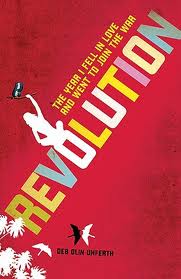
[READ: November 7, 2012] Revolution

Deb Olin Unferth has now published three books and I’ve read them all, even though I’m not a huge huge fan.  I enjoyed her novel Vacation, which was delightfully peculiar.  Her other book was a collection of flash fiction, a genre I’m really on the fence about, although Unferth’s is really quite good.

This book is a memoir.  And, as the subtitle indicates, it’s about the year that Unferth spent looking for a revolution in Central America.  The book proves to be about much more than Central America and revolutions–she talks about religion, family, morality, relationships, youth, idealism and reality.  Not bad for 200 pages.

It’s also about the man she fell in love with, George, who encouraged them to go to Central America and vive the revolution.  George is a Christian, Deb was an atheist Jew.  But she falls for him and his Christian ways and “converts” (much to the detriment of her younger sibling who had the family’s faux Jewishness now thrust upon her to avoid a similar thing happening.  (Poor Deb’s younger sister really is the victim in this saga).  George and Deb flee the comforts of home and all 80s capitalism and head to Central America.

As with Unferth’s short stories, these chapters are almost all very short.  And they often feel as unfinished as some of her flash fiction.  They are also mostly jumbled up in an utterly non-narrative way.  It’s entirely possible that you could shuffle some of these chapters and it wouldn’t matter at all (that’s not entirely true, as some do flow one in to the other, but many are jarringly out of sequence). (more…)

Read Full Post »

SOUNDTRACK: OF MONSTERS AND MEN-Live from Iceland Airwaves (2011).

This brief set was recorded at KEX hostel in Reykjavik, Iceland (how on earth KEXP in Seattle was there I don’t know).  This set was performed before the release of their debut EP, although “Dirty Paws” which they play was not on that EP.  “Little Talks” their (reasonably) huge hit them was on the EP and is on their full length album–it’s a great duet (and reminds me a bit of Stars).

There’s an amusing fail in the horn solo on “Lake House,” which is kind of surprising, but not terribly tragic or anything.  The band sounds great, especially in front of a home country crowd (I love hearing them say “Takk” at the end of the songs).  There’s five songs in all, and by  the final one, they feel  sound like they’re really enjoying themselves.

[READ: September 1, 2012] Wampeters, Foma & Granfaloons

This collection contains essays reviews and speeches.  So it’s non-fiction.  Except that, ever the contrarian, Vonnegut includes one fiction piece–a short play.  The title of this book comes from three words from his novel Cat’s Cradle: “a wampeter is an object around which the lives of many otherwise unrelated people may revolve.  The Holy Grail would be a case in point.  Foma are harmless untruths, intended to comfort simple souls.  An example: ‘Prosperity is just around the corner.’ A granfallooon is a proud and meaningless association of human beings.”

That all comes from the preface.  The preface also says that there are people who have collected everything he has ever written (even stuff he has forgotten about) but he will not let most of that see the light of day.  Here he has whittled down the least embarrassing stuff for publication.  He also explains that at some point (supported by reading this) he decided to stop giving speeches; to stop “talking” and to concentrate on writing.  So he did.

The final straw for this was a comment from the President of the American Academy of Arts and Letters.  Vonnegut had prepared a speech.  The president reread it and hated it, but the president told Vonnegut that nobody would actually listen to the words: “People are seldom interested in the actual content of a speech.  They simply want to learn from your tone and gestures and expressions whether or not you are an honest man.”

While Vonnegut’s essays are powerful and effective, it’s the Preface that really tells it straightg.”Not nearly as many Biafrans were butchered by the Nigerians at the end of the war as I had thought would be.  At a minimum those damaged children at the exact middle of the universe will be more honorable than Richard M Nixon.  [Nixon] is the first president to hate the American people and all they stand for.”

Get ready for a happy collection. (more…)

Read Full Post »

SOUNDTRACK: PINK FLOYD-Alan’s Psychedelic Christmas (1970).

I’ve always loved Pink Floyd’s Atom Heart Mother.  I have no recollection of how I stumbled upon this live bootleg, but when I saw that it contained one of the few live recordings of “Alan’s Psychedelic Breakfast” I had to give it a listen.

So this show is from 1970 and was recorded in Sheffield just before Christmas (Nick Mason evidently introduced the show while wearing a Santa Claus suit).  The sound quality is pretty good given that it is 40 some years old.  There’s a bunch of hiss, and the quieter talking bits are hard to understand, but the music sounds fine.

So the show opens with “Alan’s Psychedelic Breakfast” and what is so silly (and I assume funny to watch (a little less funny on bootleg) is that the band made and ate breakfast on stage.  As Collectors Music reviews writes: “This is the only known live recording of ‘Alan’s Psychedelic Breakfast’ but also hosts an amazing performance by the band which included them making morning tea on stage which is audible. Just like most of their earlier performances, the performance of “Alan’s Psychedelic Breakfast” slightly differs from the album version due to some nice jamming done by the band, especially Gilmour with his delay pedal.” As I said, some of the audio is static and hard to make out in this song–the band is conversing during their tea, but who knows what they are saying.  And who know what is o the radio.

Then the band gets down to business.  One of things I love about this period Floyd which is so different from their later work is that the played really long spacey jams often with very few lyrics.  So we get a 12-minute version of “The Embryo” (the only available studio version is a very short one on Works which is quite a shame as the song is really good).  A 14-minute workout of “Fat Old Sun” which is usually only about 5 minutes.

There’s a great version of “Careful with that Axe Eugene” and “Set the Controls for the Heart of the Sun” (15 and 12 minutes respectively).

Then in a killer version of “Saucerful of Secrets,” just as they get to the end, there’s a power failure (at least according to the song title).  The band is rocking out just hitting the climax when suddenly all you can hear are un-miked drums.  Ha. After a couple of minutes, power comes back and they pick up from just before where they left off.

Then the band launches into a full 31-minute version of “Atom Heart Mother” complete with horns and choir  of voices.  It sounds quite good (the horns seem a little sketchy but that might be expected with such staccato music).

The set ends and the band needs an encore.  Apparently they couldn’t remember anything else because they just re-do the last few minutes of “Atom Heart Mother” again.

One of the things that cracks me up about these shows in the 70s in England, is that the audience is so polite. Their applause sounds like a classical theater rather than a rock show.  And with a bootleg you know they didn’t try to make the audience sound bigger than they are.

The whole package is a fun trip.

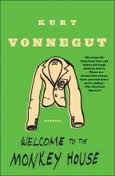
[READ: August 17, 2012] Welcome to the Monkey House

So this book is Vonnegut’s second collection of short stories.  But there’s a twist.  This collection contains all of the short stories from Canary in a Cat House except one. It also contains many of the stories he had written since then as well as stories not collected in Canary.  So you get basically 18 years worth of stories here.  And it’s interesting to see how much he has changed over those years (during which he wrote 5 novels, but not yet Slaughterhouse Five).

Since I read Canary a little while ago (see comments about the stories here), I knew that his 50’s era stories were influenced by WWII.  So it’s interesting to see how his stories from the 690s are not.  They deal more with day to day things and, of course, abstract concepts about humanity, although politics do enter the picture again once Kennedy is elected .

  • Where I Live (1964)

This was a good story to open with because it shows the then-later-period Vonnegut’s mindset and location.  This story is about Barnstable Village on Cape Cod (where I assume Vonnegut lived since there are a number of stories set on the Cape).  This is a very casually written story about an encyclopedia salesman who goes to the local library and sees that their two encyclopedias are from 1910 and 1938.  I enjoyed this line: “He said that many important things had happened since 1938, naming among others, penicillin and Hitler’s invasion of Poland.”  He is told to talk to the library directors who are at the yacht club.  I love the attitude that Vonnegut creates around the village which “has a policy of never accepting anything.  As a happy consequence, it changes about as fast as the rules of chess.” For really, this story is about the Village more than the encyclopedia salesman, and it’s an interesting look at people who move into a new place and want it to never change. (more…)

Read Full Post »

SOUNDTRACK: REGINA SPEKTOR-Soviet Kitsch (2004).

After the poppy, polished joy of Far, I went back and decided to check out the one other Regina Spektor album I knew of–Soviet Kitsch.  This album has always stuck with me as an interesting title.  I ordered it from Amazon and was bummed to get a little cardboard sleeve rather than an entire disc (her artwork is really nice).  So I was a little biased against this disc from the start.  The music also doesn’t have any of the polish and sleekness of Far.  So it took a while for me to see the beauty within.

This album is largely simple piano (with strings and other addition), but it’s a much more raw album (akin to something like Tori Amos’ Little Earthquakes).

“Ode to Divorce” is a quiet piano song with some catchy moments.  “Poor Little Rich Boy” has some interesting percussion to accompany the piano.  And in this song you know that she’s in a slightly different territory than Tori Amos, which is good–the feeling is similar but the end result is unique.  Lyrically the album explores different ideas and on this song the repeated refrain of “you’re so young you’re so god damn young” is a little unsettling.  “Carbon Monoxide” introduces a more full sound (bass and drums).  And Regina shows off yet another side of her personality–playful, flirtatious and now almost childish (“C’mon, daddy.”)

“The Flowers” introduces another new aspect to the disc–more aggressive/borderline classical piano playing (rapid, loud notes).  It suits her style quite well and this song is  a definite highlight.  The end of the song has a very Russian-style nonsense syllable sing along which is very fun.   “Us” adds strings to the song and some great sing along parts.  “Sailor Song” is a funny song from a sailors perspective with the sing-along shanty chorus “Mary Anne’s a bitch” (complete with broken glass sounds).

The next song “****” is a whispered little conversation in which a young girl asks Regina when the next song is coming.  It makes the next song, “Your Honor” even more loud.  It really stands out on this disc because it is a full on punk song with screamed vocals and band work from Kill Kenada (who I don’t know anything about).  The song is about getting in a fight to defend a woman’s honor.  The slow piano middle section features the amusing question “gargle with peroxide a steak for your eye but I’m a vegetarian so it’s a frozen pizza pie…you fight for my honor but I just don’t know why.:”

“Ghost of Corporate Future” has a kind of lullaby feel and some amusing lyrics, ” When he gets to the crowded subway platform/He takes off both of his shoes/He steps right into somebody’s fat loogie/And everyone who sees him says “ew”/Everyone who sees him says “ew”/But he doesn’t care/Cause last night he got a visit/From the ghost of corporate future/The ghost said take off both your shoes/Whatever chances you get/Especially when they’re wet.”  It’s all sung in a manic style over a quiet piano melody.

“Chemo Limo” is certainly the highlight of the disc.  It’s 6 minutes long and is quite dramatic.  The basic premise is that dying from cancer sucks, so she’s going to live instead: “I couldn’t afford chemo like I couldn’t afford a limo/And on any given day I’d rather ride a limousine.”  There are several sections in the song–allowing Regina to show off her dynamic and dramatic vocal range (serious falsettos) and very impassioned sections, “Oh my God Barbara she looks just like my mom”  She even does some (very mild) beatboxing at the end of the song.  “Somedays” is a pretty, simple ballad, with some great vocals although it kind of gets lost at the end of the disc.  Although I was not that into this record when I first got it, repeated listens revealed wonderful surprises inside.

[READ: July 15, 2012] Canary in a Cat House

This is Kurt Vonnegut’s first collection of short stories.  It is currently out of print.  That’s not a big deal because almost all of the stories were later collected in Welcome to the Monkeyhouse.  But I thought it would be fun to read them in the original book.  When it came in from the library I was surprised at how tiny it was.  But what was really surprising was how small the print and how small the margins were.  They really crammed stories into collections back then!

These stories were all written in the 1950s and what was also surprising to me was how serious and unfunny some of those first stories were.  I realize that these were some of his first works, but the Vonnegut voice is so distinctive–a misanthropy tempered by jokes and absurdity, that I was surprised that some of these stories were not only serious but seriously emotional as well.  It’s been clear from all of his stories that WWII impacted his life tremendously (as one would expect), but in these early stories he talks very deliberately about violence and the cold war and the aftermath of WWII.  It’s pretty intense.  By the end of the book the more typical Vonnegut voice surfaces–sci-fi kinds of stories with dark humor involved.  It’s quite a collection. (more…)

Read Full Post »

SOUNDTRACK: RUSH on Archer (2011-2012).

Not really a soundtrack, but I wanted to mention some of the Rush references in Archer.

I was really hoping to use the Rush in Cleveland DVD as my Soundtrack, but I haven’t finished it yet.  And yes, I am padding this out a bit so that the pictures fit nicely.

Cobra Cobra Cobra (that’s a joke to the book below).

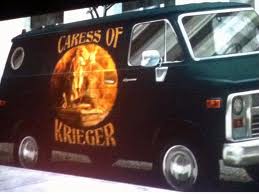
The Archer guys like Rush and they put nods to Rush in occasional episodes–usually through mad-scientist (I want to call him The Professor), Krieger.  Here’s three of Krieger’s vans.

I love the detail that went into “Vanispheres.”  Since Krieger always wears a lab coat, it’s a wonderful detail to have him wearing it as the nude man.  And, of course to have him as both the nude man and the clothed man is perfect.

Since it’s my favorite obscure Rush album, the Caress of Krieger van just cracks me up the most.

And just to add to the fun here’s a video of Krieger’s Neil Peart-like drum set

It’s pronounced “Why Why Zed.”

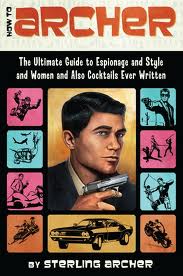
[READ:May 9, 2012] How to Archer

Although the Archie Meets Kiss comic proved to not be the joy I’d hoped, How to Archer easily made up for it.  I love Archer, it is one of my top ten shows ever, I think.  And this book is basically a print version of the show.

It’s designed as a how-to manual written by Sterling Archer himself.  He gives you tips on how to become the world’s best secret agent.  He teaches you how to dress (the details about buying shoes are amazing), how to drink (he provides cocktail recipes and his own opinion of subpar drinks), how to eat (a recipe for Eggs Woodhouse that sounds divine) and even a secret to gambling!

The fact that Archer is an abrasive, cocky, sexist, racist dick only makes the book that much funnier.

If you haven’t seen Archer (on FX), it’s a cartoon about a spy.  His mother, Malory, owns the spy agency and they have a very contentious relationship.  (The fact that his full name is Sterling Malory Archer should be just one clue to that).  Malory gets the introduction to the book, which is pretty darn funny as well. (more…)

Read Full Post »

SOUNDTRACK: SALLY SHAPIRO-“I’ll Be By Your Side” (Extended Mix) & “He Keeps me Alive (Skatebård Mix)” from Viva Piñata! (2008).

These two tracks also came from the Viva Piñata compilation.  “I’ll Be By Your Side” has a very Euro dance-sound to me (updated ABBA, perhaps?).  It sounds so incredibly 80s to me.  Unlike most of the other tracks, this is an extended mix, not a remix, so I assume this is what the real song sounds like, too.  It’s a fine little pop song (catchy chorus) although I don’t need an 8 minute version of it.

“He Keeps Me Alive” feels like  Julie Cruise song–straight out of Twin Peaks–until the bouncy synths come in (I can’t imagine what the remix did as it sounds so much like the other song).  The one possible remix element is the vocals, which get very synthesized near the end.

Both of these songs have that Europop feels that I like much more than American pop.   I had been puzzled by the name of the singer, because her name clearly wasn’t coming from where I though the music came from.  Well, Wikipedia tells me “Sally Shapiro is the pseudonym of a Swedish vocalist and the name of the synthpop duo composed of Shapiro and musician Johan Agebjörn.”  At least I got the Abba connection right!

[READ: March 22, 2012] “The Archduke’s Assassin”

This is an excerpt from Saul’s upcoming novel Dark Diversions (it was also published in Brick, although I read it in Harper’s).  What’s fun about this excerpt is that I have literally no idea what direction the rest of the novel could go.  This appears to be a self-contained incident and while it seems pretty clear who the protagonist is, it’s hard to speculate how much more of the book would be about him or his friends or even the excerpt’s titular assassin.

It begins with a discussion of Yugolslav politics circa 1987–how the official inflation rate of 50% is indeed official, which means mythological.  The setting is the Writers’ Union, a nineteenth century stone palace which housed the best restaurant in Yugoslavia.  The food was great, as was the gossip.

The narrator’s friends were all mixed race (in other words typical Yugoslavs).  But for the moment they were all Serbs.  The discussion moves to the assassination of Archduke Ferdinand and how the narrator should meet the man responsible.  When he replies that Gavrilo Princip died in prison in 1918,  his friend Dana corrects him and says she is talking about Vaso Čubrilović.  Čubrilović was one of several people who conspired to assassinate the archduke.  As of 1987 he was the only one still alive.  [He is a real person.  He got 13 years in prison, eventually became a history professor and died for real in 1990].

The narrator goes to meet the man at the University.  After a brief theoretical discussion of history, Čubrilović says that he believes that technology will save the future, that software will lead the way.  The narrator ponders this later over a meal and wonders if a new mythology is needed to distract people in a time of political emptiness.

There isn’t a lot to the excerpt–it’s not profound or anything, but it does what an excerpt should–it whets your appetite for more.  The writing is excellent and the topic is intriguing.

I enjoyed that the story mentions some Serbian dishes like kesten-pire sa šlagom (chestnut pureé with cream and chocolate) and  žito sa šlagom (crushed wheat, walnuts and dried raisins with cream).

For ease of searching, I include: Skatebard, Johan Agebjorn, kesten-pire sa slagom, zito sa slagom, Vaso Cubrilovic, pinata

Read Full Post »

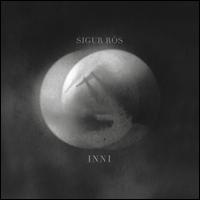
SOUNDTRACK: SIGUR RÓS-Inni (2011).

I’ve said before that Sigur Rós was one of my favorite live shows ever.  They created an amazing atmosphere that went beyond the music and the visuals.  It set the bar very very high.

So here is their first official live album and it does not disappoint.  It clearly cannot live up to the live experience (there is so much to see after all), but it really conveys just how amazing these guys can sound live.

Sigur Rós feels like they should only be a studio band–they are so atmospheric, so ethereal, that it doesn’t seem like it should translate live.  But they do, in fact , it brings a new energy to the music.  And the fact that Jonsi can easily hit those unearthly notes just blows my mind.

I’m not sure whether to say that Sigur Rós have hits or not, but this is like a best of playlist from all of their albums.  From their “debut” Ágætis Byrjun, we get the ten minute opener “Svefn-G-Englar.”  Although the songs all feel long, they run the gamut from two to three minutes through eight and nine up to fifteen.  They also play the awesome “Ný batterí” a few songs later.

There’s a number of songs from Takk… “Glósóli,” “Hoppípolla,” “Með Blóðnasir,” and “Sæglópur.”  There’s a couple of songs from () as well (of course, since they were untitled it takes a bit of work to know that . “E-bow” ends disc one and the concert ends with the glorious 15 minute “Popplagið”

From Með suð í eyrum við spilum endalaust, we don’t get “Gobbeldygook,” their sort of hit, but we do get “Inní Mér Syngur Vitleysingur,” “Fljótavík,” “Festival,” “Við spilum endalaust” and “All Alright”

The set also includes “Hafsól,” a B-side of “Hoppípolla” (which was a remake of a song of their real debut Von).  The best example of how Sigur Rós is not just wispy music comes in “Hafsól.”  After a few minutes of their atmospheric stuff, the drums kick in and the song becomes incredibly loud and chaotic with crashing cymbals and grinding guitars and feedback.  It’s amazing.  That it ends with a tin whistle solo just highlights the what the band is willing to put into just one song.

“Popplagið” closes out the concert with more of that dynamic.  At 15 minutes, it takes a while to get there, but somehow the drums feel more grounded.  And at the 6 and a half-minute mark when the drums really kick in and guitars get noisy and raw, it’s an unbelievable moment.  The song turns tense and intense and doesn’t let up for the rest of the track.

The encore is an unreleased track called “Lúppulagid.”  It is a slow, relaxing kind of track (it plays over the credits of the DVD).  Yes, there’s a DVD that comes with the two disc set.  I have not yet watched the DVD, but I’m pretty psyched to check it out.

This disc can’t convey the magic that is Sigur Rós live, but it really shows what they are capable of.

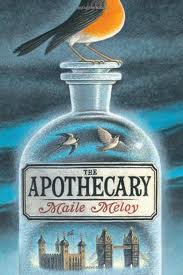
[READ: February 2, 2102] The Apothecary

Maile Meloy has written some of my favorite books (novels and short stories).  She is an excellent writer with a wonderful sense of reality–I’ve described her as unsentimental: her characters are typically downtrodden and not likely to follow flights of fancy.

And that’s just one reason why this book is so surprising–it is about magic!  It’s also surprising because its written as a YA book (the protagonists are fourteen).  And finally, it’s surprising because it is set in England, and previously, Meloy had been a small town America kind of writer (as far as I remember, anyhow).

Although I found the opening a little slow going (more on that in a minute), by about the third or fourth chapter I was totally hooked on this fantastic story.

The book is set just after WWII.  The main character (and narrator) Janie and her family live in Hollywood.  Her mom and dad are both television writers who are being hunted as Communists.  They tell her that they must flee for London.  (This was told briskly, and I wonder if teens know about the Communist trials in the 50s).

They move to London (where they have jobs set up as BBC writers) and learn to cope with the move from warm, sunny, prosperous Hollywood to cold, gray and still-under-rationing London.

One problem I had with the beginning (in addition to the Communist part) was that Janie talks a lot about Katherine Hepburn–walking like her, being strong like her.  Both of these things seemed like they maybe weren’t explained enough for the intended audience.  Perhaps I’m not giving young readers enough credit, but I was very distracted thinking, would a teenager want to read this?  I mean I barely know Katherine Hepburn as a young beauty.  The other problem I had was that the kids felt too modern to me.  Or maybe not modern so much as out of time.  It doesn’t really feel like the 50s.  It’s not really a problem, but every once in a while I had to remind myself that it was set in the 50 at the height of the nuclear scare.

Of course, once Janie gets to school, those concerns evaporate.  Janie goes to a fancy London school–they wear uniforms and learn Latin)–I guess it is timeless.  She is immediately introduced to Sarah Pennington, a very very rich girl (she has a butler).  What I liked is that even though Janie is different and from California and Meloy shows that they are different, she doesn’t exploit these differences.  She doesn’t make it a clique story between Janie and Sarah.

Things are dire in post-war London.  It is cold all the time and you need to put pennies in the wall to get the heat to come on–this is why people from England like hot water bottles so much!  So Janie and her dad go down to the apothecary to get hot water bottles and pennies.  When the apothecary hears that they are American, he offers Janie some homesickness medicine.  Janie and her dad don’t believe it will work but she takes some anyhow.  And she seems to feel a bit better.

Soon after this, Janie learns that the apothecary’s son is a boy in her class named Benjamin.  In school, Benjamin stood up to the lunch lady when she insisted that everyone “duck and cover” when the air raid siren went off.  He’s nobody’s fool, he knows how dangerous the Bomb can be.

Janie is surprised that Benjamin and the apothecary are related.  The apothecary is nice and mild-mannered whereas Benjamin is strong-willed.  And, it turns out that Benjamin wants nothing to do with his father’s business–even though the Society of Apothecaries has paid for his education.  He wants to be a spy. (more…)

Read Full Post »

SOUNDTRACK: MC PAUL BARMAN-It’s Very Stimulating (EP) (2001).

So is this guy a joke? Well, he’s very funny.  Very funny, in fact.  But to my ear, not in a novelty sort of way.  He’s got the kind of rhymes that make you laugh but still work upon multiple hearings.  And, yes, Paul Barman is a squeaky, Jewish boy from Ridgewood, New Jersey (again!) and he really can’t rap on the beat and he really doesn’t have much in the way of rhythm, but got awesome skills in the lyrics department and he has production from Prince Paul (that’s the kind of credentials that anyone would like).

The theme of this EP is Paul’s utter failure to get with women (even in his fantasies).  He’s crass and vulgar and yet he’s also quite smart and rather witty (“I think about all the pube I got while reading the Rubaiyat“) .  The music is more or less inconsequential.  As Prince Paul noted, the craziness comes from the lyrics, so you don’t want to overkill the song.  But there’s some great samples and some solid beat work as well.  Nevertheless, we’re here for the words.  So, sample a few of these rhymes:

“The Joy of Your World”

It was time to copulate but we didn’t want to populate
So my bold groin reached for my gold coin proooophylactic
I unwrapped it, you can’t know how I felt
It wasn’t a gold coin condom, it was chocolate Chanukah gelt
The white part crumbled on her tummy and the rest began to melt
Foiled again…..

“School Anthem” or “Senioritis” (this song was renamed for the reissue of the disc it seems)

Homework is tell major lies or plagiarise encyclopedias, so boring
Fresh-faced teachers want to tickle ’em
but a test-based curriculum excludes exploring

I’ll let a mystery gas out of my blistery ass
Just to disrupt the misery of history class

“Salvation Barmy”

She said, “Go get a haircut”
So I showed her my bare butt
Pulled down my Carhartts put my moon in her star-charts

“I’m Frickin’ Awesome” ( I love this especially for the Lila Acheson bit)

It’s nice to be hypnotized by a man you don’t despise yet
He had a type of flow and I can’t quite label it
All I know it made me want to take off my cableknit
Sweater, Oh he better be hetero
I hope they don’t catch us in the Lila Acheson
Wallace Wing when Paulus brings the mattress in–rudely
He backlashed my booty
like I was Susan Faludi over the Grace Rainey Rogers Room rostrum

“MTV Get Off The Air, Pt 2”  (the first two lines are fantastic, but the whole thing is genius).

Smirkin’ jocks with hackysacks
in Birkenstocks and khaki slacks
I’m the hypest lyricist
while they’re like, “What type of beer is this?”

Just wait until the full length for the utter genius that is “Cock Mobster” (how can be s o smart and so stupid at the same time?)

[READ: October 10, 2011] E Pluribus Venom

Like most people, I learned the name Shepard Fairey because of his iconic prints for Barack Obama.   In addition to supporting Obama, I really liked the design of the prints–simple, bold, an easy iconic style (which has since been lifted, morphed and used everywhere).  I know that many of Fairey’s prints actually come from other people’s original photos.  He has a print of Muhammed Ali in this book, and he clearly didn’t take the original photo (I don’t know where it came from).  But since all art is theft, I’m okay with Fairey taking someone else’s work and making something new from it.  I’ve always felt that attribution should be enough if you modify the original enough to call it different (which I feel this print does).  [The fact that he didn’t acknowledge the source does bug me, of course].  But that’s neither here nor there because this book predates all of that.

This book documents events that occurred in 2007.  The E Pluribus Venom show was based largely around two images that Fairey designed to reflect the two sides of capitalism.  The image to the right really doesn’t do any justice to the work itself, but you can kind of see that he created two-sided faux dollar bills.  The front showed all the good things that capitalism can do.  The back showed all of the evils that capitalism causes.  The images resemble dollars, but the text is straightforward in its message.  As with a lot of what Fairey does, it’s blunt and obvious but pretty cool.

As far as I’m concerned, though, this is the least interesting image in the book.  Although I love that they made dollar bill sized prints of these faux dollars and left them scattered around in cities to promote the show.  They way they were folded made them look at a glance like actual currency.  Very cool. (more…)

Read Full Post »

SOUNDTRACK: RHEOSTATICS-Double Live (1997).

After mentioning the two live shows that comprise the majority of this disc, I figured I’d mention the disc itself.  Rheostatics are a great and engaging live band: Dave Bidini has wonderful repartee with the audience and Martin Tielli’s live guitar work is amazing. The band sounds tight but not stiff and there are a number of tracks here that are goofy (but not throwaway) like the acoustic version of “Bread, Meat, Peas & Rice” and the weird and wonderful “People’s Republic of Dave.”

The songs that were taken from the two Bathurst Street concerts have been professionally mixed and mastered (of course) so even if you’ve listened to the bootleg concerts, you’re going to hear a different quality (and mix, as boots tend to be recorded from one side, usually missing some aspect).

My only gripe is something that they’d never really be able to accomplish live anyway.  It’s in “King of the Past” which is one of my favorite Rheos songs.  On the album, after the break, there’s an electric violin (or something) that plays a really cool dramatic melody.  But live they never play it like that, they rely on Tielli’s guitar.  The guitar sounds fine, but that majestic string section provides such a great contrast that the live version lacks just a little.

On the other hand, the live version of “Horses” is stunning.  As are “A Midwinter Night’s Dream,” “Palomar,” and “Christopher.”

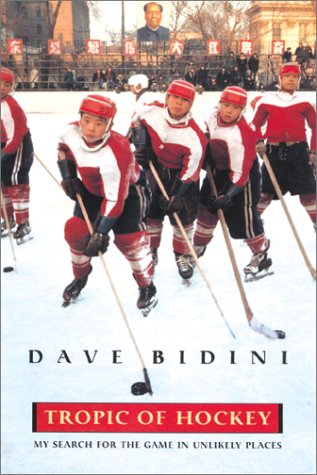
[READ: February 8, 2011] Tropic of Hockey

I bought this book when I was in Toronto sometime in 2001.  I was pretty excited to get another book by Dave Bidini.  And then I proceeded to not read it for a decade.  Hey, these things happen.

But I have to say in many ways I’m glad I waited this long to read it.  The book was written pre 9/11 and as such it has a kind of sweetness about international travel that I miss now.  And I can appreciate it all a lot better with a decade’s distance from everything.  As of 2011, I know that I never want to go to the UAE, but reading Bidini talk about the UAE circa 1999 it sounds like a really fun place to go.

So anyhow, this book, as the subtitle suggests, is Bidini’s attempt to find hockey in weird places around the globe.  Bidini has gotten tired of the NHL: it is bloated, is it full of obnoxious rock anthems during stoppage and the spirit of the game has been overwhelmed by the Almighty dollar (specifically the American dollar).  And so, he wanted to see if he could find people who played hockey the way he and his pickup team play on the weekends: for the love of hockey.  And he was amazed to find hockey fans in these four unexpected places: Hong Kong, China, The United Arab Emirates and Transylvania.

The book is really three things though: it is the story of hockey in different places, it is a chance for Bidini to play hockey in these places and write about the experience and it is a history of Canadian hockey. (more…)

Read Full Post »

« Newer Posts - Older Posts »