Feeds:
Posts
Comments

Archive for the ‘Canadian Music’ Category

SOUNDTRACKART OF TIME ENSEMBLE WITH STEVEN PAGE-A Singer Must Die (2009).

According to their website, “Art of Time Ensemble is one of Canada’s most innovative and artistically accomplished music ensembles. Their mandate is to give classical music the contemporary relevance and context it needs to maintain a broader audience to survive.”

So what you get is a modern orchestra playing contemporary music.  It’s not a unique idea, but in this case, it works very effectively.  And what you also get is Steven Page, former singer of the Barenaked Ladies as the vocalist.  Page has an awesome voice.  I’ve often said I could listen to him sing anything.  And here’s a good example of him singing anything.

The great thing is that the song choices are unusual and wonderful–not immediate pop hits or classic standards–it’s a cool menagerie of songs with great lyrics and equally great compositions.  This is no heavy metal with strings, this is majestic songs with orchestral scoring.  The orchestra includes: piano, sax/clarinet, cello, violin, guitar and bass.

And the song choices are fascinating.  And with Page’s amazing theatrical voice, the songs sound quite different, mostly because the original singers don’t have powerful voices.  They all have interesting and distinctive voices, but not operatic ones.  So this brings a new aspect to these songs (I knew about half of them before hand).

THE MOUNTAIN GOATS-Lion’s Teeth.
This is a very dramatic reading of this dramatic song.  It pushes the boundaries of the original song.

ELVIS COSTELLO-I Want You.
I had never heard this Costello song.  With Costello you never know what the original will sound like–punk pop, orchestral, honky tonk?  It’s a fascinating song, though and Page hits some really striking and I would say uncomfortable notes.

RUFUS WAINWRIGHT-Foolish Love
I don’t know Rufus’ work very well, although I immediately recognized this as one of his songs.  Page plays with Wainwright’s wonderful theatrics and makes this song his own.

BARENAKED LADIES-Running Out of Ink
Covering one of his own songs, this is fascinating change.  The original is a fast, almost punky song, and it seems very upbeat.  This string version brings out the angst that the lyrics really talk about (Page is definitely a drama queen).

LEONARD COHEN-A Singer Must Die
This is one of the great self-pitying songs and the lyrics are tremendous.  Page takes Cohen’s usual gruff delivery and fills it with theater. It’s a great version.

JANE SIBERRY-The Taxi Ride
Coming from her early album The Speckless Sky, this is a wonderfully angsty song with the premise that is summarized: “it’s a long, long, lonely ride to find the perfect lover for your lover.”  Page hits one of the highest notes I’ve heard from him here.  Very dramatic.

THE DIVINE COMEDY-Tonight We Fly
This is one of my favorite Divine Comedy songs.  Of course it is already string filled, so this version isn’t very different.  But its wonderful to hear it in another context.

THE WEAKERTHANS-Virtute the Cat Explains Her Departure
I love this song.  This is a guitar filled pop punk song, so the strings add a new edge to it.

THE MAGNETIC FIELDS-For We Are the King of the Boudoir
I know the Magnetic Fields but not this song.  It’s quite clever and funny (as the Fields tend to be) and Page makes some very dramatic moments.

RADIOHEAD-Paranoid Android
I recently reviewed a covers album of OK Computer, wondering how someone could cover the record.  The same applies to this song.  A string orchestra is a good choice for it, as there is so much swirling and crescendo.  And while nothing could compare to the original (and they don’t try to duplicate it), this is an interetsing choice.  As is Page’s voice.  He has a much better voice than Thom Yorke, but that actually hinders the song somewhat when he gets a little too operatic in parts.  Nevertheless, it is an interetsing and enjoyable cover.

The whole record is full of over the top drama.   It’s perfectly suited for Page and it’s a side of him that has peeked out on various releases but which he really gets to show off here.  As an album, the compositions all work very well–they are, after all, trying to make classical pieces out of them–not just covering them.  And the choices of songs are really inspired.  Dramatic and interesting and when the music slows down, the lyrics lend to a wonderfully over the top performance.

If you like Page or orchestral rock, this is worth tracking down.

[READ: November 28, 2011] “Leaving Maverly”

For some reason I was under the impression that Alice Munro was no longer writing.  I’m glad that’s not true, and really, what else would she do with herself–she has so many more stories to tell.

I think of Munro’s stories as being straightforward, but this one was slightly convoluted and actually had two things going on at once.  It opens by discussing the old town of Maverly.  Like many towns it once had a movie theatre.  The protectionist and owner was a grumpy man who didn’t deal well with the public, and that’s why he hired a young girl to take the tickets and be the face of the theatre.  When she got in the family way, he was annoyed, but immediately set out to hire someone else.  Which he did.  The new girl, Leah, came from a very religious family.  She was permitted to work there under the stipulation that she never see or hear a movie or even know anything about them.  And that she get a ride home.  The owner balked at this second idea–he surely wasn’t going to drive her home.  So instead, he asked the local policeman Ray, to walk her home.  Which he agreed to do.

The next section of the story looks at Ray.  And although the story is ostensibly about Leah, we get a lot more history of Ray.   He was a night policeman only because his wife, Isabel, needed help at home during the day.  We learn about the scandalous way he met his wife and how they managed through the years until she became ill.

Ray talks with Leah on their walks home, something he found terribly awkward because of how cloistered she was.  Then he would get home and talk with Isabel about Leah. This young girl who meant nothing to him was suddenly a significant part of his life.

And then one day the theater owner came to report that Leah was missing.  They went to see her father at the mill, but she wasn’t there.  And there was really no other place where Leah went, so they were at a loss.  It was winter and they feared the worst. (more…)

Read Full Post »

SOUNDTRACK: NEIL YOUNG AND THE INTERNATIONAL HARVESTERS-A Treasure [NY Archives 09] (2011).

Continuing with the randomly numbered Archive releases, Neil Young has released A Treasure, the sixth release (which is labelled #09) in the Performance Series.  This is with the Neil Young band called the International Harvesters.

I had never even heard of this iteration of a Neil Young band–they toured during 1984/5 for the Old Ways album.  This is an album that I barely knew but is one that Sarah loved, so this one is more for her than me.  The band is a very country band–fiddles and slide guitars and all that.  Neil’s even got a twang in his voice.  But even with that, (it’s not my music of choice), this album has a lot of great stuff on it (including five previously unreleased songs).

There are a number of real country songs on this disc–“Amber Jean” and “It Might Have Been” are straight-up country.  Although “Are You Ready for the Country” (which has some major country trappings like that fiddle solo) is actually a bit more of a countrified Neil Young song than a country song per se.  “Nothing is Perfect” is a kind of group sing along.  The kind of song that you might hear at the end of the night at a pub.

Despite this being the Old Ways tour, there are only two songs from that album here.  “Bound for Glory” is the song I knew best from this era.  And it is indeed a very country song (that steel pedal guitar!). “Back to the Country” is the other one, and it, too is a true country song.

“Let Your Fingers Do the Walking” and “Flying on the Ground is Wrong” are different takes on country songs.  The funny thing is that “Flying” (which was originally a Buffalo Springfield song) has a very Neil Young guitar progression built in, during the “I miss you” parts.  He does this very simple chord progression which he uses quite a lot in his songs.

“Motor City” is (another) song about cars.  He may have more songs about cars than Springsteen.  This one is all about his old cars and how “there’s too many Toyotas on the road.”  It’s super catchy, even as I listen to it in my Prius.  “Southern Pacific” is another song that gets a good honky tonk treatment.  It’s seven minutes long with lots of solo.  This is the kind of country-style music I prefer and this one is great with wonderful runs from the fiddles.  Both of these songs appeared on Neil’s Re*Ac*Tor album.

“Soul of a Woman” is more of a blues song, with some country inflections.  And the final song “Grey Riders” is a wonderful stomping track.   It has a great riff and the strings really complement the song.  After all of that country, this song has some awesome screaming guitars on it.  And if you like your Neil rocking, it is absolutely worth it for this song.

The newspaper article that’s included with the set refers to a show during this tour and, not to grouse about a record, but the show it describes sounds awesome–a few old Neil classics at the end of the set which really whetted my appetite for some of those other songs with this band.   But this seems to be a truncated version of that set list.  Nevertheless, as I said, this isn’t my favorite era of Neil’s music, but the band sounds really great.  And these songs shine very nicely.  It’s an enjoyable and unexpected addition to his archives.

[READ: October 20, 2011] Diary of a Wimpy Kid: Cabin Fever

I managed to get on the promotional mailing list for this book and so in addition to the free pencils (awesome!) and posters (3 in my son’s room), I also received an email update about the release almost daily.

I was a little less than 100% happy with the previous Wimpy book.  I liked it, but I didn’t love it as much as the first couple.  But man, this one came roaring back on all cylinders and it is one of the best in the series.

Three things really work to make this one so great:

One:  the return to school and a host of new school-related problems.  Although it’s funnier for me since my son is in school now, the issues are general enough that anyone can really laugh about them.

Two: the return of Rowley.  I feel like he was sorely missed when he and Greg were fighting.  He’s not a great character on his own, but he rubs Greg the wrong way enough to bring out some great humor.

Three: The increasing power of Manny.  I don’t understand Manny at all, I don’t even know how old he is.  He’s like a really really tiny kid, which makes me think that he’s a baby.  And yet he is so smart and totally has the run of the family.  That has been obvious in the past with the tantrums he threw to get what he wanted, but now he is combining his evil genius with a sophisticated mind to really wreak havoc on the Heffley household (he changes passwords all over the house, for instance).

So this book is all about Christmas break and snow (hence the title).  I love that it starts with the Heffley version of Elf on a Shelf (but this one is even more creepy because it’s a homemade doll from Greg’s mom’s childhood). (more…)

Read Full Post »

SOUNDTRACK: DAVE BIDINI-“The List” (2007).

This song appears as a bonus track on the Bidiniband album.  But I’ve been aware of it since 2007 when he played it on his solo tours.  It is essentially a list of 4 Canadians who are “killing us, killing us now.”  The list includes Tim Horton’s (purveyor of delicious donuts), Chad Krueger (from Nickelback), Zack Werner (a judge on Canadian Idol), and Stephen Harper (I shouldn’t have to tell you).

But the key to the song is the chorus: “where are the angry young ones….”  This song should become the unofficial song from Occupy Wall Street.  It would be very easy to modify.  Hey Dave, if you’re free you should head on down and serenade these angry young ones.

Here’s a great live version done in a record store in which he is close enough to have a casual chat about the very song he is singing in the middle of the song.

He also ends it a little differently than the original.  It’s catchy and easily adaptable.  Good on ya, Dave.

[READ: November 19, 2011] “Who Wrote Shakespeare?”

No one has traded off of his Monty Python fame as much as Eric Idle.  All of the other Pythons have moved on in one direction or another, but Eric keeps the torch alive (see Eric Idle Sings Monty Python and Spamalot).  He even has a little nod to MP in this essay with the asterisk next to his name which leads to (*Most likely Michael Palin, really).  This refusal to let go of Python has at least kept his wit sharp, as we see in this Shouts & Murmurs.

My main problem (as I’ve said before) with the Shouts & Murmurs is that they are usually too long.  But, as Python knew, keep it short and funny and you’ll succeed.  So this two-column piece never really flags in its simple premise.

Which is that everyone knows that Ben Jonson really wrote all of Shakespeare.  Idle presents a list of all of the famous books that were really written by someone else.  For example, “Simone de Beauvoir wrote all of Balzac and a good deal of ‘Les Misérables,’ despite the fact that she was not born yet when she did so.”   And my favorite: “‘Moby Dick’ was written not by Herman Melville but by Hermann Melbrooks, who wrote most of it in Yiddish on the boat from Coney island.”  The joke about Henry James is very funny and too good to spoil. (more…)

Read Full Post »

SOUNDTRACK: ARCADE FIRE-“We Used to Wait” (Saturday Night Live, November 13, 2010) (2010).

I know they played two songs that night but I just watched the rerun and they only showed one song.

I’ve always thought that Arcade Fire were pretty cool live.  And this set from SNL proves me right.  “We Used to Wait” comes from The Suburbs and it’s a pretty mild song on the record.  But live, the band plays with really weird sounds and explores different types of cacophony.

This is especially true from guitarist Richard Reed Perry (who plays all kinds of other instruments too).   He plays some of the more riff-based notes in the song, but he also plays some really loud, unusual chords as well.  Some of them are quite dissonant and they really bring a dramatic noise to the song.

The string section (three violins on this show) in addition to playing the strings also added some really cool dissonance.  In fact, the first time the strings came in, the sound was quite surprising.

I also love the percussive nature of the band.  By the end of the song it seems like half the band are banging on drums (while playing other things as well, no doubt). 

Win Butler is an intimidating frontman–I find his face to be open, almost blank.  He’s kind of hard to read.  He’s also very tall.  When he walks out into the audience in the middle of the song, it’s a little unnerving. 

One thing that I have liked about Arcade Fire from the beginning was their intensity, and this song certainly displays it.

[READ: November 7, 2011] “The Stain”

This is another Tessa Hadley story about a woman who cleans up.  It’s nothing at all like “Friendly Fire,” but I still think it’s interesting that she has another character who opts to do cleaning work.

In this one, Marina is a mother of a young boy, Liam.  To makes extra money she takes on a job as a house cleaner and “companion” to an elderly man.  He’s 89 and from South Africa.  He has recently come to Britain after his daughter (who has lived here for a long time) moved him here.  And the house where he lives is a house not far from where Marina lives.  Indeed, it’s one that she grew up looking at and wondering what it looked like inside (it’s a very big house).

The old man is notorious for making cleaning women go away–he is cantankerous and crotchety.  But Marina soothes him right away and they form a kind of bond.  Marina even brings Liam over a few times and he gets along quite well with the old man. (more…)

Read Full Post »

SOUNDTRACK: QUEENSRŸCHE-Rage for Order (1985).

Thinks looked to be very different for Queensrÿche on Rage for Order.  I mean, look at them.  On the back of The Warning they were leather-clad hellions.  On Rage, they are quite the dandys (man, I wanted Geoff Tate’s coat!).   This would be the first of many times that they confounded their fans with a style change.

Yet despite the look of them, the album opens with a scorcher, “Walk in the Shadows.”  It’s not as heavy as their earlier songs, but it has perfected many of the elements of those earlier records: the chanted vocals, the great riffs and the screaming solos.  “I Dream in Infrared” shows their they’ve always been interest in technology.  It’s ballady, but it’s got some really sharp guitars and some more soaring vocals.

The keyboards at the end of the song segue into “The Whisper,” the first indication that things would be different on this record–orchestra keyboards hits (which I have always loved) are used to punctuate verses, and there are cool, whispered words (which would be used prominently on Operation: Mindcrime

Then comes the big shock, “Gonna Get Close to You” a weird synth/metal hybrid with a strikingly catchy and poppy chorus (that seems ever-so-80s to me)–see below for a fun surprise about this song.

Then “The Killing Words” opens with a keyboard riff that sounds not unlike 80s-era Marillion–Tate even whispers words not unlike Fish does on early Marillion albums.  Of course, when the chorus comes in it is pure Queensrÿche .  There’s more orchestral hits and cool effects on “Surgical Strike.”

I love everything about the opening of “Neue Regel,” from the unusual guitar to the “steam” sounds used as percussion to Tate’s processed, minimized voice–it makes for a wonderfully claustrophobic song.  It’s made even more so by the overlapping, intertwining vocals later on. 

“Chemical Youth (We Are Rebellion)” is a cool sparse song (the opening in particular). But it also shows their interest in, if not politics, then at least contemporary society (again, more foreshadowing of Mindcrime).  “London” just builds and builds in intensity, while “Screaming in Digital” takes the technological aspect one step further with all kind of sinister synthesized sounds and the crazy way it ends.

The album ends with “I Will Remember,” an acoustic song complete with mournful whistling from Tate.   But even as a ballad, it’s not your typical lyrical content: “And we wonder how machines can steal each other’s dreams.”  I don’t love it as an album ender, although it does wind things down pretty nicely.

This is my favorite Queensrÿche album, hands down.  I know most people like Mindcrime better, but for me, this one is more progressive and showcases a lot of the risks the band was willing to take.

Incidentally, there’s a wonderful review of Rage here, in which I learn that “Gonna Get Close to You” is actually a cover of a song by the Canadian singer Dalbello (who is really crazy and fun, and whom I’ve never heard of until I just looked her up).  How did I not know it was a cover?  (Or more like, I knew it, but forgot it over the last twenty some years)?  I might actually like the original better.

[READ: October 25, 2011] “This Cake is for the Party”

This was a very short story that crammed a lot of emotion into two pages.

As the story opens, Bonnie is finishing a cake for a party.  The party is to celebrate the engagement of Janey and Milt.  Janey is one of Bonnie’s older friends and she’s happy for Janey.  She likes her fiancée, Milt (even if he did just get a black eye).  The black eye came from a misunderstanding.  Milt was in a pub “lasciviously” twirling the mustache that his high school class dared him to grow.  Someone in the pub thought he was making advances on his woman and punched Milt in the face. 

But Bonnie’s boyfriend, David doesn’t like Milt.  He won’t say why, he just doesn’t.  It could very well have to do with the fact that he and Janey used to date, and it’s possible that Janey dumped David for Milt (that’s a little unclear in the story). (more…)

Read Full Post »

SOUNDTRACK: SISKIYOU-Siskiyou [CST067] (2010).

Siskiyou is a fascinating band whose debut album was released on Constellation last year.  The main guy in Siskiyou is Eric Huebert, who was drummer for the Great Lake Swimmers.  He quit the band and moved to an organic farm in British Columbia. And while farming he created this album (which is named for the California mountain range and is not, as a I imagined, a play of the phrase Sick of You (which I will still think regardless of the truth).

There’s a wonderful article at Paste about this album, where I learned a lot about the disc.  The disc was recorded in stairwells (which seems so cool) and at field recordings on the beach.  It was made on the cheap and very independently.  And I love it.

It feels very much like a small solo project (although he is quick to point out that he had help from another Great Lake Swimmer, Erik Arensen, as well as his wife and some friends.  But really, it feels like a vulnerable man singing in his wavering voice over some stark acoustic songs.

But unlike a poppy folk album, this one feels awkward.  The melodies are beautiful, but the lack of polish and production makes the recordings feel more fragile than they might otherwise be.

Indeed, Huebert’s voice, while always on pitch, threatens to just collapse under the strain of recording that first song, the gorgeous “Funeral Song.”  But it’s the second song that tells you this isn’t just a home recording.  “Everything I Have” feels like a great Lou Barlow/Sentridoh song–recorded on lo-fi equipment, until you hear the gorgeous horns come in a play the simple yet very winning melody over the loud folk guitars.  Again, if this had been over-produced it might have veered in cheesy, but the lo fi sound (and the cool lyrics) make this one of the best folk songs I’ve heard in ages (and it’s only 2 minutes long, too).

This is followed by two delicate songs: simple melodies, on either banjo or piano and shuffle drums.  My favorite song is “It’s All Going to End.”  Horns give it a kind of mariachi feel, but lyrically it’s wonderful: “I don’t like you one little bit, keep that shit up man, you’re gonna get hit.” All sung in his delicate wavery voice (and again, under 2 minutes long).

Another highlight is the “cover” of “This Land is Your Land.”  Called “This Land,” it opens with a slow piano melody that doesn’t sound anything like the original.  And then he begins whispering the lyrics–once again totally unlike the original.  But mid way through he changes the lyrics, to a new type of song about how he is never going home.  It turns the song mournful and rather powerful.

“Never Ever Ever Ever Again” is a wonderful song of repetition.  And the two short (just over a minute) tracks, “Inside of the Ocean,” and “We All Fall Down” are charming interludes before the lengthy “Big Sur.”  “Big Sur” starts with an upbeat banjo riff but then settles down into a slow (slightly out of tune) guitar piece.  The slow pace is particularly amusing given the incredibly slowly sung lyrics “So let’s party.  Let’s party.  Let’s party.  Party all night long.”

The disc ends with “Brevity and Insult” a song of static and banjos.

Typically I don’t like slow music, but this album adds so many interesting aspects that it doesn’t actually feel slow to me, it feels interesting and challenging  and strangely uplifting.  And I’m looking forward to their next release.

[READ: October 19, 2011] “Snake

This (surprisingly short) story packs so many different ideas into it that it really jostles the reader’s emotions.   It opens with a woman in a car. She’s in the parking lot of a supermarket waiting for her boyfriend, when she begins watching two boys.  They are playing with something on the ground, although she can’t quite tell what it is.

After seeing them lifting a stick, she realizes that it is a mostly-dead snake that they are playing with.  They don’t see her and she watches them decide what to do with the creature.  They decide to play a prank.  The boys test all of the cars in the parking lot and when they find an unlocked door they drop the snake in. (more…)

Read Full Post »

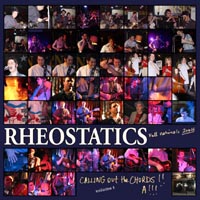
SOUNDTRACK: RHEOSTATICS-Calling Out the Chords Vol 1 (2005).

In addition to the Rheostatics’ main catalog, the cool label Zunior has released a couple of “official” bootlegs.  Calling Out the Chords Vol. 1 (no Vol. 2 has been released as of yet) is a collection of 2004 live recordings from The Legendary Horseshoe Tavern.  The Rheos do multiple nights at the Tavern, and this is a selection of songs from those shows.

It’s an interesting mix of essential live recordings and weird tracks that die-hards will appreciate but that newbies may scratch their heads at.  Some essential recordings are the wonderful version of “California Dreamline” that segues into a blistering version of “Horses.”  The version of “Mumbletypeg” with The Fall National Horns adding brass is also pretty great.

But there’s a number of songs here that are peculiar.  Great for fans, but perhaps hard to explain otherwise: an instrumental version of the 1996 song “Four Little Songs.”  I’m not sure why they went instrumental, as the lyrics are pretty essential, but there ya go.

There’s a crazy song “We’re All Living in a Chemical World” sung by special guest Ford Pier.  The intro says that this was one of Tim Vesely’s first songs, and it’s written in their early synth pop style (Pier is an insane vocalist too).  It’s quite a surprise.  And speaking of guests, there’s a lot of music from special guest Kevin Hearn (who has been with Barenaked Ladies since 1996–Hearn is a touring machine, apparently).  Anyhow, he contributes two songs to this disc “Who is that Man and Why is He Laughing?” and “Kevin’s Waltz” and he helps out on “I am Drummstein” and “Weiners and Beans.”   “I am Drummstein” and “Weiners and Beans” are unusual tracks as they come from their children’s album and their tribute to the Group of 7.

The final track is “Legal Age Life at Variety Store,” one of their staple live songs.  But this one has a twist contest in the middle.  Audience members are invited onstage to twist.  It is quite long (and without the actual visuals, it’s a bit hard to listen to more than once or twice) but it’s a fun way to hear the band interact with the audience and it shows what a fun live show they put on.

This is a great recording and a bargain for $5.55.

[READ: August 31, 2011] “Home”

I read this story twice.  The first  time, I didn’t really like it, I found it to be  kind of jumbled and confused.  I don’t know if that’s a typical reaction to this story or if I was feeling lazy, because the second time through I followed it okay and I enjoyed it quite a bit.

It’s a social commentary from Saunders, although exactly what the comment is is a bit unclear to me (even after the second reading).  The main character is a veteran who has just returned from one of the wars we’re fighting, “…the one that’s still going on.”  When he gets back home, his mother has shacked up with an unemployable guy, his sister won’t let him see her new baby and his wife has taken their son and has shacked up with some asshole he knew in high school.

And every time someone finds out he just got back from the war (like the sheriff who is evicting his mom), they all say, amusingly, as if by rote: Thank you for your service. (more…)

Read Full Post »

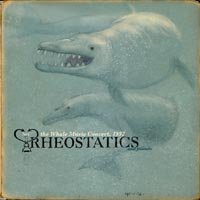
SOUNDTRACK: RHEOSTATICS-The Whale Music Concert, 1992 [Sets 1 and 2] (2005).

This is the second Rheostatics live CD that’s available from ZuniorWhale Music is a simply stellar album, and this concert focuses primarily on that disc, although there are a couple older tracks (and the then-new “Michael Jackson”) as well.  The big surprise about this concert is that they consider it a night of 1,000 stars: there are a ton of guests in this show (the majority of whom are even more obscure than the Rheostatics, I believe–the only two that I knew of before hand were Kevin Hearn and Andy Stochansky (who drummed with Ani Difranco for a while).  But guests like Tannis Slimmon, Doug Feaver, Tim Mech, Kevin Gould, Richard Burgman, Mitch Perkins and The Bird Sisters (and if you like Canadian music, the link for The Bird Sisters is to a cool blog called Raised on Canadian Radio: 1 Song per Day by 1 Uniquely Canadian Artist) add to the party atmosphere.

Anyhow, sometimes guests can really heighten a show.  And that’s the case for some of this show.  Of course, anyone who has read my criticisms of rap knows that I feel that too many guests spoil a good thing. None of these guests are “too much” here, but it does seem odd that there are so many!

The first set of this concert is awesome (the whole show was recorded to DAT and although there are a few weird drop outs, the set sounds great).  It’s like a greatest hits of early Rheos songs; the band sounds tight and they really respond to the audience.  “Rock Death America” is blistering, “Green Sprouts” is a fun little treat and “Palomar” and “King of the Past” sound fantastic.  It’s also funny to me how many great songs Tim Vesely is responsible for.  And they all seem to be featured here.

Set 2 is a little different.  It feels looser, a bit sillier, and is filled with much more Dave Clarke.  I’ve always known that Clarke was the goofball of the band.  He’s the chatty one when they’re onstage–he is full of goofy banter and he introduces most of the guests.  While it’s true that the Rheos aren’t entirely serious, I find Clarke’s goofiness to be a little off-putting.  And by the end of Set 2, he sees to have taken over the show.  He’s an excellent drummer, no doubt, but he hams it up on “Full Moon Over Russia” and I think he rather ruins “Queer” (one of my favorite songs) with his , yes, bad, singing.  And on “When Winter Comes,” the bridge is so beautiful, that his rantings in the verses are just too much for it.  Having said that, while I like the sentiment of “Guns” (although it is oversimplistic), the drum solo bit is quite cool.

The other thing that I kind of dislike in Set 2 is that the songs are really extended, but not in a good way.  I mean, “Queer” is 9 minutes, but it’s a lot of Dave Clarke and Kevin Hearn’ keyboard silliness.  And “Record Body Count” seems really slowed down or something.  However, the band closes strong with a great version of “The Wreck of the Edmund Fitzgerald” and what sounds like an amazing version of “Horses” (the beginning of “Horses” is cut off, which is a shame).

So overall, despite some flaws, this is a really good live release.  And since, it’s only $8.88, it’s totally a bargain.  Plus, there’s some great artwork by Martin Tielli as well.

[READ: August-September 2011] Tree of Codes

I first heard of this book through the Five Dials news feed (and there’s an excerpt of the book in Five Dials Issue 20 which you can see here).  Anyhow, I read about it and decided I wanted a copy for myself.  It’s not cheap, but you can just look at it to see how complicated it was to make (or you can watch this video) .

So this book follows the exact same logic as Of Lamb.  But unlike Harveys’ execution, in which she wrote out the words and made them into her own pages, Safran Foer creates a story out of an extant book.  The way the book is presented, he literally cuts out what he doesn’t want you to read. It’s also fascinating to me that this book came to my house in the same week as Of Lamb did (even though this came out much earlier–but as Foer says, there was no way for him to advertise the book).  They are absolutely similar ideas and yet their execution is so radically different.

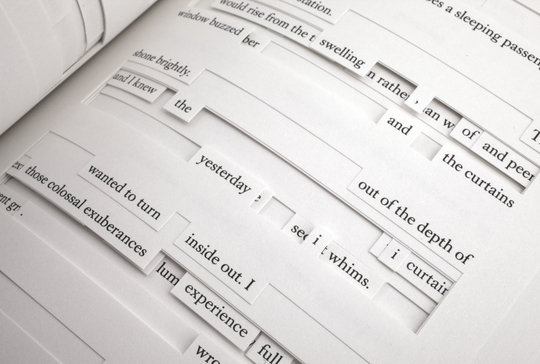
When you open this book, you see holes.  Lots and lots of holes.  The pages have massive squares of text missing.  When you first open it, you can see many layers of text, some penetrating thirty pages down.  So you can read words that comes later in the book (you often read words from the following page if you don’t hold the page up correctly or put a piece of paper under each page).  Don’t believe me?  Here’s a picture:

Safran Foer’s explanation (at the end of the book) is that he loved the book The Street of Crocodiles by Bruno Schulz (which I’ve never heard of and have no idea what it’s about).  And he often saw a story within the story.  So, he decided “to use an existing piece of text and cut a new story out of it,” using only Schulz’s words.  But rather than presenting it in a conventional way (or even in an unusual way like Of Lamb), he wanted to push the boundaries of what a physical book could do. He was “curious to explore and experiment with the die-cut technique.” (more…)

Read Full Post »

SOUNDTRACK: RUSH-“You Can’t Fight It” (1973).

This is the B-Side of the first single Rush ever released (The A Side: a cover of “Not Fade Away”).  It was released briefly but has been long out of print.  Thankfully, people on the internets have access to all kinds of things. It’s pretty clearly Rush–Geddy sounds right, and it sounds like an Alex solo, so I think it’s fair to say that this is genuine.

It’s a pretty decent hard rock song from the 70s.  It sounds like it could be from any of the second tier bands back then.  It’s got some boogie and some swagger and it seems like it’s not about anything important (rock n roll, apparently).

While I’m obviously glad that Rush went on to bigger and better things, it’s fun hearing how confidently they fit into the context of music by their heroes.  This song has a cool riff, it’s quite heavy and it shows promise.

For a band that never releases B-sides or rarities or anything like that, I’ve been pretty surprised to see what is in their internet closet.

Enjoy!

(By the way, I’m not advocating the visuals of the video–I haven’t actually “watched” it–just the audio).

[READ: August 25, 2011] Of Lamb

This book is sort of subtitled: Poems by Matthea Harvey, Painting by Amy Jean Porter.

It’s the “poems” part that I have a hard time with, actually.  But let me get to that in a moment.

This book takes a nifty idea (an idea very similar to one that Jonathan Safran Foer is using in Tree of Codes, which, see tomorrow’s post) and fully realizes it.  But what’s funny is that she doesn’t tell you what this idea is until the afterword of the book.  So while I was reading it I wasn’t really sure what I was seeing.  The afterword made me say Oh, I get it now.  But I don’t feel that I can review it without explaining what she has done.  So, if you don’t want to know anything about the “secret” behind the book, skip the next paragraph.

[Spoiler?  Maybe.]

Okay, so essentially what Matthea has done is, she has taken a book at random (literally one she bought for $3 at a used book store), in this case, A Portrait of Charles Lamb, and she has created her poems out of that book.  In other words, on every page, she would find the words that she wanted to keep and she whited-out everything else (you can see an example in the book).  But rather than presenting the work like that, she had Amy Jean Porter make weird and cool paintings to go with every page’s worth of text (I assume Porter did the lettering as well?).  Since the book is about Charles Lamb, it was very convenient that his sister’s name was Mary.  So there was a Mary and a Lamb on almost every page.  Hence this sort of update of the Mary Had a Little Lamb story.

[end possible spoiler warning] (more…)

Read Full Post »

SOUNDTRACK: RUSH-“Garden Road” (1974).

So the bootleg that I mentioned yesterday was in fact incomplete.  On the Up the Downstair site, the track list includes “What You’re Doing” and “Garden Road.”  When I wrote to the cool host of Up the Downstair, he said that these two songs were available on You Tube and that he’d try to find them and add them to the site.

So in the meantime, I got to listen to the song on YouTube.  This is a song that the band wrote but which they never recorded (same is true for “Fancy Dancer”).  I have to imagine that they wrote these songs for their second album (along with “In the End” which they kept) around the time that Neil Peart joined the band.  Once they realized that Neil could write better lyrics, they scrapped these two heavy rockers.  Both songs have great riffs, even if lyrically they’re pretty poor.

The song rocks pretty well, although the solo seems to have been put to better use in “Working Man.”  I enjoy how the song breaks for the shouts of the Garden Road chorus (kind of like “Bad Boy”–perhaps it was a “thing” for them).  I rather like this song, and I think I like it better than a couple of the songs on Rush.

Check it out.

Maybe it’s time to release these old chestnuts for the fans?

[READ: August 10, 2011] Life After God

After the success of Shampoo Planet, Douglas Coupland wrote several short books (which were really short stories).  They were compiled in Life After God.  To me this book also stands out as another odd one from DC, because it is very tiny.  Not in length, but in height.  It’s a small book, about the size of a mass market paperback.  But it makes sense that it was made this short because it is written with lots of short paragraphs that lead to page breaks (kind of like Vonnegut).

For instance, the first story contains at most two paragraphs per “chapter” about–16 lines of text and then a page break.  At the top of each page is a drawing from DC himself which illustrates to a small degree the information on the page.  It leads to incredibly fast reading and even though the book is 360 pages, you can polish it off pretty quickly.

But what’s it about?  Well, mostly the stories seem autobiographical (even though they are classified as fiction.  And actually, I don’t know anything about DC’s personal life so I don’t know if they are based on anything real, although I do know he doesn’t have any kids, so those can’t be true at any rate).  There are eight stories.  They are all told from the first person and are more or less directed at “you.”  They all seem to deal with existential crises of some sort.  They are honest and emotional.  To my ear, sometimes they seem a little forced, maybe it’s contextual, but it’s hard to write this kind of massively introspective piece and have it sound “real.”  (But maybe I’m not very introspective about things like this myself). (more…)

Read Full Post »

« Newer Posts - Older Posts »