Feeds:
Posts
Comments

Archive for the ‘Books about writers’ Category

fivedials_no27b

SOUNDTRACK:  FREEGAL MUSIC (2013).

freegalNot only am I a librarian, I’m also a patron of libraries (we currently use four!).  I’m also a huge advocate of library usage.  Everyone knows you can get free books at the library.  And many people know (but many people don’t) that you can get free CDs and DVDs from the library.  Well, I’m advocating a new service that many libraries have implemented (both the library where I worked and my local library have it).

It’s called Freegal and it allows you to download (and keep) three songs a week.  The selection is quite impressive, as they have made agreements with 10,000 record labels.  That’s 10,000 LABELS, not artists, so huge numbers of songs are available. I did a few random searches and was delighted by how much was there.

Even their genre divisions are impressive.  Just check out this sample selection from the B’s: BeBop Big Band Black Metal Bluegrass Blues Bolero Bollywood Brasil Soul Brazilian Breakbeat BritPop Broadway.

So check out to see if your library subscribes.   You get three free songs every Monday morning!  Not bad for the price of a free library card.

[READ: July 3, 3011] Five Dials Number 27B

I haven’t posted about a Five Dials in a couple of issues, primarily because I find writing about anthologies is very time consuming (I have recently read three McSweeney’s which I haven’t had the time to edit together into posts).  The good news is that I have only missed two issues, but I know that at least one of them is pretty large.  I was a little bummed to see another new one already, but then I saw that this issue was not only short, it was full of poetry.  And, since this is my poetry month, why not end the month with a little more poetry.

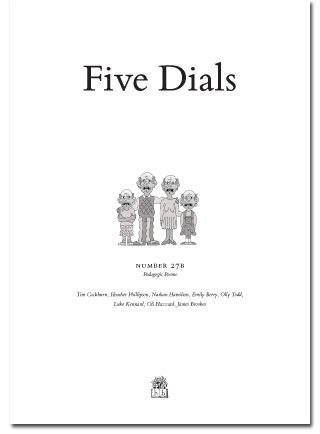
I enjoyed the offputting cartoon on the cover of this issue which is creepy and funny at the same time.  (Illustrations are by Sophia Augusta, Hannah Bagshaw, Kyle Platts, Tom Rees and Joe Prendergast.  I assume Augusta did the cover).

There was no letter from the editor or any of the usual suspects in this issue.  Rather this issue opens with a Letter from the Poetry Editor.  It is shaped like a poem but isn’t one.

SAM BUCHAN-WATTS-On Parenting Poems
Mentioning a 1954 parenting guide (from Elizabeth Longfellow), Buchan-Watts says that they asked eight young poets to choose a chapter heading from Longfellow’s book Points for Parents, and to make a poem starting from that title.

And it’s now that I admit that these poems have set me back terribly in my appreciation of poetry which I have been nurturing all month.  If ever there was a collection of seemingly random words, it is these. (more…)

Read Full Post »

bartelbySOUNDTRACKOS MUTANTES-” Picadilly Willie” (2013).

Iosmut enjoyed this album so much (thanks NPR for the stream) that I had to talk about this song and how radically different it was from yesterday’s track.  “Picadilly Willie” is this wonderful old-sounding rock song.  It’s got a very classic rock riff, but there’s something slightly off-kilter which makes it sounds more like Frank Zappa classic than radio classic.  And when the vocals come in (with a sinister laugh) it sounds more like Mr Bungle than anything else (I wouldn’t be surprised if Mike Patton was a fan of Os Mutantes).

The song ends with what sounds to me like Middle Eastern sitar music and echoed chants of “Bra-zil!”

And these are just two of the styles of music on this wonderfully wild and diverse CD.  I can’t wait for its release.

[READ: April 22, 2013] Bartelby & Co.

I read about this book in the Bolaño interview book.  Vila-Matas was one of many authors that Bolaño highly recommended–this book in particular.  And, it was one of the few books on that extensive list that has been translated into English.

This book follows in the rich tradition of books that are more or less lists about people and not really novels at all. (This seems like a peculiarly Latin American pastime, at least in my experience, as there are nearly a half dozen books that seem to do this, including several by Bolaño).

The key to this book is in the title: Bartelby.  The narrator is a hunchbacked loner, and he decides to catalog all of the instances of writers who have in the grand tradition of Herman Melville’s Bartelby the Scrivener said “no, I would prefer not to” write anymore.  And so this book becomes a series of notes without a text.  The glorious list includes many famous and not so famous writers (the most famous being Salinger) who whether famous or not, decided to write no more.  And thus we have 86 “sections” in which the narrator writes about writers who stopped writing.  For most of the he gives their reason for no longer writing, for others he simply likes talking about how they stopped writing or what their circumstances were before they stopped. (more…)

Read Full Post »

bolano

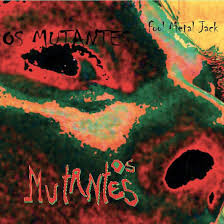
SOUNDTRACK: OS MUTANTES-“Fool Metal Jack” (2013).

Iosmut have known about Os Mutantes for years.  I never knew anything about them (and never really understood their name–although now that I have been working with Brazilian books at work I realize that their name is Portuguese for The Mutants (it was the Os that always threw me off).  I had no idea that a) they’d been around since the 60s and were part of the psychedelic scene or b) that they were still around (after some breakups and with a largely new lineup) or c) that they sang in English (which they do on several songs on this album) or d) that their new album kicked so much ass.

The album is called Fool Metal Jack and it is a fantastic mixture of fast heavy rock, Brazilian traditional sounds, what I assume are Native Brazilian chants and a heavy dose of weirdness.  All wrapped up in an anti-war stance, like on this track “Fool Metal Jack.”

A creepy, distorted  bassline introduces this song which sounds like the guy from Gogol Bordello singing a Tom Waits march.  It’s about a soldier in the middle of a war.  The bridge means more voices come in, bringing in an even more disorienting sound.  And the chorus chanted “Yes.  No More War” completes the song.  By the time the wailing guitar solo comes in the chants of “This is the war of hell” have even more impact.

This stomping song was a great introduction to this band who I now need to explore further.

[READ: April 18. 2013] The Last Interview

I enjoyed Kurt Vonnegut’s “Last Interview” and since I had always intended to read Bolaño’s I was delighted to see that our library had it.  Bolaño is a fascinating interview subject because you never really know what he is going to say.  There are even serious questions about the veracity of his life story which many people believe he fabricated for more dramatic effect.

But the one thing that is absolutely consistent about Bolaño is that he always praises writers whom he respects (and will trash those he doesn’t, although that seems to come more from the interviewer’s  instigation (not that he needs a lot).    So the last interview that he did is the one from Mexican Playboy which has been collected in Between Parentheses.  But the other three are earlier and, it seems, a little more “truthful” or at least less naughty-seeming.

What’s fascinating about this book is that the introduction by Marcela Valdes (“Alone Among the Ghosts”) is over 30 pages long!  The article originally appeared in The Nation on Dec 8, 2008 (read it here).  As such it’s not an introduction to this book, it’s introduction for English readers to Bolaño circa 2666.  And it’s a great read.  It is primarily about 2666, which Valdes has read many times.  She goes into interesting depth about the story but mostly she relates it to Bolaño’s own experiences while writing the book.  It focuses especially on his research about the real murders.  His interest was genuine and he sought help from a reporter who was doing genuinely decent work (ie. not accepting the word of the state about what was going on).

Bolaño has said he wished he was a detective rather than a writer, which explains The Savage Detectives and Woes of the True Policeman.  But Valdes also points out how almost all of his shorter novels have some kind of detective work involved–seeking someone who is lost or hiding.  The article was really great and is worth a read for anyone interested in Bolaño, whether you have read him or not. (more…)

Read Full Post »

[LISTENED TO: March 30, 2013] Knucklehead

knuckleheadWe were looking for a good audio book for the kids and I stumbled upon this, an autobiography from Jon Scieszka.  We love Scieszka’s books (Stinky Cheese Man and the Time Warp Trio among others) and figured that this autobiography had to be good for a few laughs too.  And we were very much correct.

This is a funny book about what it was like to grow up as the second oldest of six brothers in Flint, Michigan.  It’s not really about being an author (although he does talk about where he gets ideas), it’s really about his childhood.  Most of the anecdotes in the book are things that he and his brothers got up to and how his father used to affectionately call all six of them knuckleheads.

The book has almost 40 chapters, all of them very short (as befitting the author of books for reluctant readers).  And each one has a pretty good set up and punchline.  Like how the older brothers used to tease the youngest ones or how Jon and his brother burnt a dry cleaning bag because it dropped little plastic bombs onto a battlefield–in the basement.  Or how he and his brother peed on the space heater because they thought that would put it out (that seems suspect, but it could have happened. (more…)

Read Full Post »

seminarbookSOUNDTRACK: BOBTOWN-“Don’t Fear the Reaper” (2012).

bobtownI heard this song on the radio today.  When it started I didn’t think much of it–a nice acoustic guitar which… suddenly sounded familiar.  And then, no doubt, it was “Don’t Fear the Reaper.”  With banjo!  A good song can be played in any genre, and while I never would have guessed that this song would work in this genre, man, Bobtown knock it out of the park.

Bobtown has five members–two men, on bass and banjo, and three women who sing in gorgeous harmony.  And if you know “Don’t Fear the Reaper” you know that there are various vocal parts, which these woman tackle beautifully.  Their version gave me chills.

Now, befitting a bluegrass band, they did not play the super fast part (in fact they ignored that entire section of the song–the didn’t use cowbell either).  I was initially a little disappointed because I wanted to hear what they would do with it.  But it was truer to their version to leave it out and by removing it, they made the song a little different–more sombre, less wild.  And it was really good.

This version below is not the studio version, it was recorded in a stairwell.  But the band sounds great in this unlikely location.

[READ:April 7, 2013] Seminar

I grabbed this book at work (just like Cousin K).  This book was also short, which was a plus since I knew nothing about it.  It was also a play and it listed the cast from the opening on Broadway.  And I was rather surprised.  Hamish Linklater (the brother on New Adventures of Old Christine), Jerry O’Connell and..Alan Rickman!  I hadn’t heard of either of the women (Lily Rave–she’s been in nothing I’ve seen and Hetienne Park–her first role).

The story is a one act play about four college-aged writing students taking a seminar with a former great writer and current old man.

The four students are Douglas, a cocky writer who has connections and talent and who has been published in Tin House and is soon to be published in The New Yorker.  Martin, a shy writer who is rather insecure, although he proves to be very talented.  Kate is a girl who Martin knew from high school.  She has been writing the same story for six years and is outraged at the way her fellow students and their teacher behave.  And Izzy (who I thought was a man for a few pages) is a sexually adventurous woman who seems to be willing to do anything to succeed. (more…)

Read Full Post »

vonlastintSOUNDTRACKSURFER BLOOD-“Demon Dance” (Live at SXSW, March 27, 2013).

surfer blood

I’ve liked Surfer Blood since I first heard them.  They write catchy, mostly short, poppy songs.  And usually after a few listens, the hooks really grab you.  The strange thing about the band is that the hooks aren’t always readily apparent, which makes their songs sound kind of samey sometimes.

Of course, samey isn’t a bad thing, necessarily.  Surfer Blood is quite distinctive and I tend to enjoy everything they do.  This new song sounds like their other stuff, which is fine.  But the most distinctive thing about the band of probably their singer who sounds like a less-affected Morrissey.

Having also listened to the song from the album I can say that the singer is far harder to understand live, so maybe live is not the best way to hear a new song from them, but for an old favorite, Surfer Blood has a great energy live.

Watch the show here and hear the studio version here.

[READ: March 27, 2013] The Last Interview and Other Conversations

Melville House has published a number of these “Last Interview” books, and as a completist I feel compelled to read them.  I have read criticisms of the series primarily because what the books are are collections of interviews including the last interview that the writer gave.  They don’t have anything new or proprietary.  The last interview just happens to be the last one he gave.   So it seems a little disingenuous, but is not technically wrong.

There’s so far five books in the series, and I figured I’d read at least three (Vonnegut, David Foster Wallace and Roberto Bolaño–the other two turned out to be Jorge Luis Borges–who I would be interested in reading about and Jacques Derrida (!) who I have always loved–I guess this series was tailor made for me).

At any rate, these interviews are from various times and locations in Vonnegut’s career.  There are six in total.  I don’t know if the titles they give here were the titles in the original publications but here’s what’s inside:

  • “Kurt Vonnegut: The Art of Fiction” from The Paris Review, Spring 1977 (by David Hayman, David Michaelis, George Plimpton, Richard Rhodes)
  • “There Must be More to Love Than Death” from The Nation, August 1980 (by Robert K. Musil)
  • “The Joe & Kurt Show” from Playboy, May 1982 (by Joseph Heller and Carole Mallory)
  • “The Melancholia of Everything Completed” from Stop Smiling, August 2006 (by J.C. Gabel)
  • “God Bless You, Mr. Vonnegut” from U.S. Airways Magazine (!!!), June 2007 (by J. Rentilly)
  • “The Last Interview” from In These Times May 9, 2007 (by Heather Augustyn) (more…)

Read Full Post »

stringer SOUNDTRACK: HAIM-“Falling” (Live at SXSW, March 17, 2013).

haim

Haim are three sisters and a drummer.  The sisters play guitar and sing, play bass and percussion and play keyboards.  And yes, they look a lot alike (an a lot like Alanis Morrissette).  But they sound very classic rock–kind of like Heart, with a more modern, noisy twist.

I didn’t really care much for the sound of this song–it seems kind of anemic to me.  The sisters are all quite talented and when the lead singer/guitarist started wailing they were really good.  But the overall feel of the song seemed more high school than rock show–like they couldn’t get the mix right, like the keyboards (which were little bopping notes, rather than waves of music) were the main force behind the song–which I don’t think is true.

Maybe they’d sound better on record, or if they had a better mix on stage.

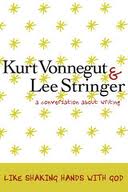
[READ: March 26, 2013] Like Shaking Hands with God

I had been reading a lot of Vonnegut, but I got a little burnt out by him.  However, when I was checking his bibliography all those months ago, I found that Princeton University had a book that I couldn’t find anywhere else.  Well, given my new employment situation, it was time to take advantage of that connection.  So I went to the Firestone library and grabbed this book (and a few others that I didn’t see elsewhere).

It’s a lot of fuss over an 80 page book, but I’m glad I read it and it did get me back in the mood to read more Vonnegut (I have five books of his left to read, although I believe more posthumous stuff seems to come out all the time).

This book is essentially a transcription of two conversations that Vonnegut had (one public and one private) with the author Lee Stringer and the moderator Ross Klavan.  The first conversation occurred on October 1, 1998 at a bookstore in Manhattan.  The second was a private affair in January 1999  (which was of course, recorded), in which they followed up on some of the same ideas.

Stringer had written one book (Grand Central Winter) when the first conversation took place (he has written two more since).  Stringer says he always admired Vonnegut and Vonnegut talks about how much he liked Grand Central Winter (which Vonnegut wrote a forward to).  GCW is nothing like Vonnegut’s books, it is a serious book about being homeless (Stringer himself was homeless for a long time) and it is real and gritty.  It sounds good, although maybe a little too gritty and real for me. (more…)

Read Full Post »

fiddleblack-issue-8SOUNDTRACK: DEFTONES-Adrenaline (1995).

adrenalineMy friend Cindy recently told me that the Deftones were playing nearby. I hadn’t realized that they were still together–there was some personnel issues a few years back.  But indeed they are and even released a new album last year.  So I got their latest album and really liked it.  This made me go back and listen to their earlier stuff too.

I came to Deftones with Around the Fur, so this debut album is less well known to me.  And yet, there are two songs that I absolutely love on this disc and which easily put Deftones above so many other heavy bands of the era (I’m not willing to say nu-metal because it’s stupid and Deftones transcended the genre from their first album).  “Bored” and “7 Words” are masterpieces of controlled rage and tension.  “Bored” opens the album with this aggressive guitar noise, letting you know what you’re in for, but the chorus shows how Chino Moreno is a master of his diverse use of vocal styles.  Especially after a few soaring choruses (he has a great singing voice) when he whispers the final verse.

The way “7 Words” open is practically like Jane’s Addiction–an noisy aggressive guitar with a big bouncy bassline and some intricate drumming.  Chino’s voice comes in like an impatient whisper.  It’s a great start.  Then when the chorus comes in (basically just the word Suck repeated over and over), the guitars bring in a Soundgarden vibe.  It’s really a great track, wonderful to crank loud.  And there’s no long ending.  It’s just done.

The rest of the album plays some interesting textures and sounds.  They are a very riff heavy band with a lot of screaming (that would change over the years), but they are never ordinary.  Some of the tracks aren’t as memorable, but it’s a consistently interesting album.  And, for the time, it was quite original.  The way the riff plays against the vocals on “Minus Blindfold” is very challenging.  The opening guitar riff of “Root” is very punk but the discordant guitars are really very metal.  There’s some great moshing riffs on the album (“Nosebleed”) along with some really interesting guitar sounds (see “Engine No. 9”).  And the drums really stand out for all of their intricacy.  Not all of the songs pack the same punch, and, after knowing their later stuff, the album is a little samey, but it’s a good start and a great opening salvo.

[READ: February 20, 2013] “Hideous Interview with Brief Man” 

My friend Andrew sent me this and described it as a mash up and David Foster Wallace and H.P. Lovecraft.  And indeed it is.  Although I admit my Lovecraftian knowledge is there, it’s not very deep, so I’m not exactly sure how Lovecraftian this is, but it is definitely Wallaceian, as you can tell by the title.

And indeed, the story is constructed like a story from DFW’s Brief Interviews with Hideous Men: there’s a series of answers and a series of questions posed just as the letter Q.

It took me a couple of questions to realize that the Brief Man being questioned is Wallace himself and as the story comes to an end, it becomes apparent that this is an interview with Death.  It’s a fascinating idea, one that will likely ruffle the feathers of Wallace fans.  And yet Mamatas has done some of his homework about Wallace.

There’s some obvious parts, like titles from his books being used in the answers, although they do work very well in context and flow naturally.  The less obvious sections seem very true to the spirit of Wallace.  The writing style doesn’t really ape Wallace or his interviewing style which I think is addressed by the comment: “there could be no worse fate than being known for exactly the sort of person you actually are.” (more…)

Read Full Post »

CV1_TNY_02_04_13Schossow.inddSOUNDTRACK: GARBAGE-Bleed Like Me (2005).
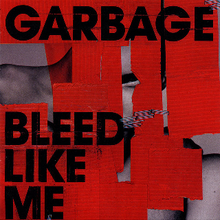
Wbleedhat happens when you take something slick and shiny and remove the shine?  You get something slick and dull.  And that’s the overall feel of Garbage’s fourth album.  After the dance pop of Beautiful Garbage, Bleed Like Me was d described as a return to the rock roots of Garbage.  And it’s true that there’s a lot more guitar.  But as in the production of Beautiful, the guitars feel really anemic–again, coming from Bitch Vig who made Nirvana’s guitars roar, this is a major surprise.

Worse than the production though s the utterly generic feel of the songs and the lyrics.  Manson was most powerful when she was personal.  Even if the songs were oblique, you knew they were about something.  But these songs just feel like words, and she sings them as if they were just words.

The single was “Why Do You Love Me” and it opens with a powerful heavy metal guitar riff.  But the verses quiet down and the chorus is fast but without any oomph.  It’s quickly forgotten and even the lyrics: “Why do you love me it’s driving me crazy” don’t really make you want to learn more about it.  “Run Baby Run” had potential for a radio friendly hit but it’s also quickly forgotten.

Then there’s the songs that seem to be about something.  “Sex is Not the Enemy” seems like it could be transgressive but it’s really not–it feels like a last stand from a beaten person rather than a rocking anthem.  Musically it’s mediocre and even lyrically it’s not that shocking/surprising.

“Boys Wanna Fight” brings some of that electronic feel back and it injects some life into the disc, but again the song isn’t that inspiring.

I wonder how much I would have liked this album without the history behind it.  I know that bands need to experiment and try different things, but it felt like Garbage fell especially far from the heights that I held them.  Garbage tool a pretty lengthy hiatus after this album–Shirley went into acting (catch her on Terminator: The Sarah Connor Chronicles) and it seemed like the band was finished.

[READ: February 7, 2010] “Zusya on the Roof”

I read a story with a very similar setup recently (not implying that Krauss read it or anything).  In Russell Banks’ story “Christmas Party” a divorced man goes to his ex-wife’s new house and takes her newborn baby and…  the story ends.  [Spoiler, sort of].  This story has a similar arc.  And I guess I don’t understand this arc.  Or maybe, although I’m usually okay with endings that are vague, when you have a person with a baby, there are so many different possible endings that not leaning in one way or the other is just unfair–yes we can get clues from the story, but one never fully knows what a person’s intentions are.

This story also relies a lit on Jewish tradition.  And I find a lot of Orthodox behavior inscrutable (as Zusya seems to).  So I tend to get lost in the traditions.  Especially when, as in this story, names are used to indicate a tradition that I simply don;t know (and yes, this is my fault, not the author’s, unless she wanted to appeal to a goyish crowd).

So in this story, Zusya is about to become a grandfather.  But he falls ill just as his grandson is about to be born.  In his haze of hospital care, the grandson is born and he imagines that he gave birth to the boy–a kind of my life for his deal.  And when the grandfather recovers, he has strong emotional ties to the boy. (more…)

Read Full Post »

McSweeney’s #13 (2006)

13SOUNDTRACKPARTS & LABOR-Stay Afraid (2006).

partslaborParts & Labor have changed t heir style over the years going from noisemakers who have a melody to being melodious noisemakers.  This album is one of their earlier releases when noise dominated.  Right from the opening you know the album is going to be a challenge.  The first song has pounding drums (electronics that sound like bagpipes) and heavy distorted shouty vocals.  By the end of the songs there is squealing feedback, punk speed drums and screaming distorted vocals (complete with space sound effects).  It’s an aggressive opening for sure.  Song two opens with a long low rumbling and then “Drastic Measures” proves to be another fast-paced song.

“A Pleasant Stay” is 5 minutes long (most of the rest of the album’s songs are about 3 minutes).  It continues in this fast framework, although it has a bit more open moments of just drums or just vocals.  The way the band plays with feedback in the last minute or so of the song  very cool.

“New Buildings” has a hardcore beat with a guitar part that sounds sped up.  “Death” is a thumping song (the drums are very loud on this disc), while “Timeline” is two minutes of squealing guitars.  “Stay Afraid” has a false start (although who knows why–how do these guys know if the feedback sounds are what  they wanted anyhow?).  The song ends with 30 seconds of sheer noise).  The album ends with the 5 minute “Changing of the Guard” a song not unlike the rest of the album–noisy with loud drumming and more noise.

The album is certainly challenging, it’s abrasive and off putting, but there;s surprising pleasures and melodies amidst the chaos.   Indeed, after a listen or two you start to really look forward to the hooks.  If you like this sort of thing, this album s a joy.  It’s also quite brief, so it never overstays its welcome.

[READ: April 15, 2011] McSweeney’s #13

I have been looking forward to reading this issue for quite some time.  Indeed, as soon as I received it I wanted to put aside time for it.  It only took eight years.  For this is the fabled comics issue.  Or as the cover puts it: Included with this paper: a free 264 page hardcover.  Because the cover is a fold-out poster–a gorgeous broadside done by Chris Ware called “God.”  And as with all Chris Ware stories, this is about life, the universe and everything.  On the flip side of the (seriously, really beautiful with gold foil and everything) Ware comic are the contributors’ list and a large drawing that is credited to LHOOQ which is the name of Marcel Duchamp’s art piece in which he put a mustache on the Mona Lisa.  It’s a kind of composite of the history of famous faces in art all done in a series of concentric squares.  It’s quite cool.

So, yes, this issue is all about comics.  There are a couple of essays, a couple of biographical sketches by Ware of artists that I assume many people don’t know and there’s a few unpublished pieces by famous mainstream artists.  But the bulk of the book is comprised of underground (and some who are not so underground anymore) artists showing of their goods.  It’s amazing how divergent the styles are for subject matter that is (for the most part) pretty similar: woe is me!  Angst fills these pages.  Whether it is the biographical angst of famous artists by Brunetti or the angst of not getting the girl (most of the others) or the angst of life (the remaining ones), there’s not a lot of joy here. Although there is a lot of humor.  A couple of these comics made it into the Best American Comics 2006.

There’s no letters this issue, which makes sense as the whole thing is Chris Ware’s baby.  But there are two special tiny books that fit nearly into the fold that the oversized cover makes.  There’s also two introductions.  One by Ira Glass (and yes I’d rather hear him say it but what can you do).  And the other by Ware.  Ware has advocated for underground comics forever and it’s cool that he has a forum for his ideas here.  I’m not sure I’ve ever read prose from him before. (more…)

Read Full Post »

« Newer Posts - Older Posts »