Feeds:
Posts
Comments

Archive for the ‘Books about writers’ Category

clowns SOUNDTRACK: LE FLY PAN AM: N’écoutez pas [CST031] (2004).
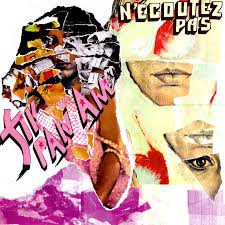
flypanam31N’écoutez pas (Do Not Listen) was the third and final full length album from Constellation’s Fly Pan Am (or in this case Le Fly Pan Am).  There are several short tracks on the disc as well as two 11 minutes songs

“Brûlez suivant, suivante!” (Burn Next, Next!) Opens the disc and hints that it’s going to be a standard rock album—4×4 drums and a dense buzzy electric guitar.  And even when the song proper starts, there’s chanted worded in French and some noisy guitar—its very far from the bass and funky glitchy stuff of previous albums.  The song has very conventional element—a drum break where one might clap along and what sounds like people singing lalalalalala, but all under a veneer of noise and decay that makes it anything but poppy.  There’s a deep voice speaking insistently in French and way in the background a person screaming.  So, really it’s rather unconventional, but within a relatively “normal” framework.  “Ex éleveurs de renards argentés” (Ex breeders silver foxes) is the noise of completely detuned guitars getting plucked and strummed for 30 seconds until a piano plays a chord and all else stops.  It seems like a song will begin but, no, more noises—industrial waves and cars honking takes over.  And then a cacophony of voices begins talking all over each other (including a couple in English).  It’s all over after about 2 minutes.

“Autant zig-zag” (As much zig-zag) is a totally apt name for this song.  This is the first 11 minute track.  After a minute or so introduction, the song comes in with a propulsive bass (not funky at all like the last album) and the song feels like it’s ready to rock.  And it does.  It keeps up this rhythm for a bit and then shifts to a new part with wordless vocals.  There’s even a call and response section with sung words and ooh ooohs as response.  The song shifts to a kind of pummeling section that continues for several minutes until the end.  It contains pretty much everything the band does.  “Buvez nos larmes de métal” (Drink our metal tears) is a noise collage with dramatic movie soundtrack type music played behind the static and distant voices and noises.

“Pas à pas step until” (Step by Step until) has a commanding one, two, three, pause, four, riff going on that is at once catchy and noisy.  The song proper comes in with whispered singing and a wild bass line.  Alexandre St-Onge contributes his wonderful chaos to this song which has some really catchy backing vocals in it

“…” opens side two with what sounds like a voice repeating Fly Pan Am over an over amidst the sound of someone else chewing.  It segues into “Très très ‘retro'” “Very Very ‘Retro’” is the other 11 minute song.  It has two guests, Dominique Petrin on vocals and Tim Heck on electronics.  The song opens with a high-pitched bass and some great counterpoint rhythms.   There’s more hidden vocals throughout the song  Around three minutes in, the bass gets funky.  This runs on for several minutes with some interesting sound effects thrown in until there’s a loud pop and silence.   And then another pop and organ music takes over.  At about 9 minute the song resumes the funky bass line. Again, the band has crammed a lot of stuff into this song.

“Vos rêves revers” (Your dreams setback) has a nice bass sound with some ringing guitar notes.  There’s whispered vocals that sing a melody of sorts.  It’s a fairly conventional song—catchy and bouncy with vocals and everything (true they are whispered and hushed vocals but they do follow a melody line).  At about 4 minutes (of 6), the songs crashes unto itself with the drums and the guitars seeming to fall apart

“Ce sale désir éfilé qui sortant de ma bouche” (This dirty tapered desire coming out of my mouth) has a deep echoing drum kick which keeps a beat.  In the distant background a keening voice kind of follows the melody.  The disc ends with “Le faux pas aimer vous souhaite d’être follement ami” (The false not love you madly want to be friend).  It’s a one minute song with sliding guitars and rock drums which propel this to as close to punk as the band has gotten.  There’s chanting and excitement and fun and then the whole song unravels after about 40 seconds at the end with a sloppy piano denouement.

And that was it from this avant-garde band. The members went on to make lots of other music, Jonathan Parant went on to form Feu Thérèse. Felix Morel has played drums with all kind of interesting bands including Et Sans.  Roger Tellier-Craig has been in Et Sans and Set Fire to Flames among others.  And Jean-Sebastian Truchy has played in several bands including Avec le soleil sortant de sa bouche.

[READ: February 6, 2016] City of Clowns

In the afterword to this book, Alarcón explains how it as written.  He lived in Lima, Peru for a year, teaching.  But while he was there, he had writer’s block.  So he moved to a farmhouse in the middle of America–pure solitude.  And there he wrote the story “City of Clowns” (which I read back in 2013 in the New Yorker) in English.  Sheila Alvarado talked to him about turning the book into a graphic novel.  And so it was completed (after much labor, he says) in a slightly condensed Spanish edition to be released in Spain.  And then, eventually, it was translated into English again, from the Spanish graphic novel.

Since the story really doesn’t change from the short story version, I’m going to put my original comments here:

It opens with Oscarcito going to the hospital because his father died the night before.  He finds his mother mopping floors because his father’s bill was unpaid.  And in that very first paragraph, she introduces her son to Carmela—the woman whom his father left them for.  She was mopping the floor with Oscarcito’s  mother.  He is confused and enraged by this.

His half brothers are also there.  He had never met them before, preferring to stay away from his father’s other life.  But he saw them in front of him and clearly saw that they were related to him.  But the most galling thing was that although he was the oldest of all the children, they were clearly the chosen children—after all, his father stayed with them.

Then we learn about his father’s life.  He was born in Cerro de Pasco and moved to Lima when his young family was still young.  He worked hard in semi-legitimate businesses and then brought his family to the city.  Young Oscarcito, age 8, loved it.  But his mother hated missing her family in Cerro de Pasco.  And now they were living with his father who was practically a stranger. His father worked hard and succeeded, but he was rarely home.

Between flashbacks to his father’s story we see that Oscarcito is now a reporter for the local newspaper and he has been asked to write about the clowns that are prevalent around the city.  Oscarcito is on a bus when a clown approaches.  The clown is pelted by water balloons but still manages to climb aboard the bus and peddle his wares—gaining a few coins for his “act.”  Oscarcito is not interested in the subject and puts it off.

So he travels to his mother’s house to see how she is doing, but a neighbor there tells him she has been living with Carmela since his father got sick.  His mother was embarrassed by this and asked the neighbor not to say anything to him.

His mother had been a cleaning lady since they moved to Lima.  She worked for the Azcártes, a wealthy local family who treated her very well and treated Oscarcito practically like their own son.  Oscar was even sent to a nice school where he was welcomed until they realized where he was from.  Gangs would steal anything from anyone, and were called Piranhas.  And that became Oscar’s nickname at school.  And soon he was made fun of by just about everyone, but especially by one boy.

A flashback then shows that Oscarcito went to work with his father doing construction on a few occasions—they worked very hard on expansions of people’s houses—working hard and working well and making good improvements.  But all the while, they were waiting patiently until they could rob them of all of their fine things.

So when he found his father was working for the father of the boy who made fun of him, he wanted in, and he stole the boy’s suit.

Finally, after putting off his article for ages, Oscarcito meets and interviews a clown.  And that clown tells him how he started and invites him along.  And Oscarcito does.  He finds that he likes the anonymity of the job.

All of the threads come to a head as the story reaches its close—where Oscar will confront his mother and deal with his newfound joy at being a clown.

The ending was very powerful and I enjoyed this story immensely.

There are few details from the original story that have been changed (and I amended my comments accordingly).

There is also an extra scene added of him dating a girl named Carla who walked on stilts.  There’s an erotic moment which is really interesting and which brings a whole new level of fascination to Oscar’s clown life.

Obviously the biggest change is Alvarado’s illustrations.  She does an excellent job recreating these scenes much as I imagined them.  I really  enjoyed the way she worked within the mens’ professions–putting words on bricks as his father was laying them, hanging papers up to dry with text on them, and using excellent distinctions of black and white to show the different settings in Oscar’s life.

The biggest change I think is the depiction of Oscar in his clown suit.  It’s nothing like I imagined and is all the better for it.  Alarcón says that now this is “its true and definitive form” of the book, and I imagine that this is what I will think of when I think of the story.

For ease of searching, I include: Daniel Alarcon.


Read Full Post »

corpseSOUNDTRACK: STEVE KIMOCK-Tiny Desk Concert #532 (May 16, 2016).

kimockI’d never heard of Steve Kimock before.  He is a guitar player, evidently known for his improvisational playing.

Based on that, I was doubly surprised that the first song not only had vocals, but that they were by someone else in the band (the unnamed female pianist).  “Careless Love” sounds incredibly familiar.  Even on the first listen, it sounded like I’d heard it before–the vocal melody and her voice, the bass riff, everything seemed familiar, although I’m still not sure if I actually know it.

Kimock’s guitar is metal (or aluminum).  It’s quite unusual looking–all shiny and silver.  It’s a hollow body but it sounds unlike an acoustic guitar.  He’s joined by Bobby Vega on bass–and his bass is so smooth (even on this acoustic).

For the second song, he switches to a hollow bodied electric guitar.  He says that “Tongue N’ Groove” is an oldie for himself and Vega (for whom it is also very early in the morning).  The singer switches to piano for this instrumental that has a light jazzy feel.  It’s quite a lovely song.

For the final song, “Surely This Day,” he switches to an acoustic guitar which he plays across his lap (and uses a slide).  This is beautiful solo song with some wonderful moments.

[READ: February 15, 2016] Exquisite Corpse

I really enjoyed this First Second comic.  It was translated by Alexis Siegel and it doesn’t feel translated at all.

This is the first book by Bagieu that I have read and I immediately loved her style which has simple lines but also subtle shading.  It feels at time realistic and at times cartoony.

The story focuses on Zoe.  She is working as a kind of model–a pretty girl who stands near things like cars or boats or whatever.  She doesn’t love the job (who would) and on the second day we see a guy honks her ass.   The other models are doing the work part-time to put their way through school, but Zoe is the only one with no other options.  They tell her she should change jobs or stop complaining. (more…)

Read Full Post »

592016 SOUNDTRACK: PETER FRAMPTON-Tiny Desk Concert #526 (April 27, 2016).

framptonI’ve never been a big fan of Frampton.  Never disliked him, just never got into him.  It always made me laugh that Frampton Comes Alive was so huge and yet I only ever knew two songs from it.  And in my head the only thing he was known for was that voice guitar thing.

So it’s interesting to see him now, considerably older with much less hair. Indeed he changes the lyrics to the first song “All I Want To Be (Is By Your Side)” to “I don’t care now that I’ve…lost some hair.”  For this song it’s just him playing an acoustic guitar and singing–no effects.  (This is all in tour of his new Acoustic Classics album).  It’s interesting to hear him playing such a folkie song (which sounds a bit like Eric Clapton).  But the more important thing is that his voice sounds great.  Many singers his age simply don’t have the voice anymore, but he certainly does.  He hasn’t lost anything.

For the second song, “Lines On My Face,” he is joined by Gordon Kennedy.  Kennedy has been his writing partner for decades.  Together they wrote some of Frampton’s classics as well as a song for Eric Clapton and Bonnie Raitts’ new single “Gypsy in Me.”  He says that this song is something he wrote a long time ago and it’s still a favorite.  While Kenendy plays acoustic backing chords, Frampton plays some good solos on that acoustic guitar.

For being Peter Frampton, he was actually very humble and self-effacing and rather funny.  There’s a good moment when he says he didn’t expect quite this many people.  “You hear like “clap clap clap….”

Of course, I know “Baby, I Love Your Way.”  I’m not exactly sick of it, but I don’t go out of my way to listen to it.  However, in this new acoustic format I really got to listen to the song anew.  It’s really quite a nice song.  And when the crowd spontaneously chimes in and sings along he seems genuinely pleased and it makes the song t hat much better.

This Tiny Desk made me appreciate Peter Frampton in a way I never thought I would.

[READ: June 10, 2016] “Three Short Moments in a Long Life”

I enjoy when a story has Parts.  This one has three and they all connect, which is even better than three discrete parts.  But this story, which covers a man’s life from childhood to old age is really quite a downer.  It speaks volumes about the futility of life without actually ever saying anything about it.

Part 1 is called The Spy (although I’m not entirely sure why).  In it, the narrator talks about Beverly LaPlante.  He and Beverly were in second grade together.  She was very shy and cried a lot.  They both hated recess and he was afraid to get lumped in with–the kids made fun of her a lot.  Midway through the year she left the school and that was that.

Third grade meant a new teacher and he had a crush on her.  Then one day during dodge ball he noticed that there was a new girl.  And her name was Beverly LaPlante.  But there was no way she was the same girl, right?  She wasn’t shy at all, in fact, she ended the dodgeball game by cursing out some of the losers.  He was upset that he sweet teacher didn’t yell at her.  When she finally said something to the girl, Beverly shouted “Jesus Christ and shit, piss, fuck!”

The narrator prayed that night–he prayed that Beverly would die.  He immediately took it back but it was too late.

Part 2 is called The Writer.

In this brief part the boy is grown up.  He is a writer, and has written several books which no one cared about.  While he was thinking about writing, there was a knock at the door.  He opened it and there was Jesus: “he had long blond hair and those eyes that follow you around the room.”  Except of course it wasn’t Jesus, right?  It was a just a guy looking for work or change.

Part 3 is called The Substance of Things Hoped For.

As the section opens the man is now eighty–lying on his bed unable to move.  We learn that he has Parkinson’s and is being taken to the hospital for pneumonia.

He has felt like a burden to his wife and some time ago tried to kill himself. It failed obviously but she told him if he ever did that again she’d kill him herself: “She’s a genuine saint, the real thing, without any pious crap, so she’s not always easy to live with.”

He is in the hospital for a while, marveling at the attendants and how young they seem.  He wonders if and when he is going to die.

This last part seemed really extraneous and not very meaningful.  I realize that it was meant to wrap everything up but I would have preferred to have the two parts together and let me imagine the third.

Read Full Post »

418SOUNDTRACK: BENJAMIN CLEMENTINE-Tiny Desk Concert #523 (April 18, 2016).

benjI have literally never seen or heard anyone like Benjamin Clementine.  He sits very tall with the piano keys quite low for him.  And he has such an effortless almost careless way of playing and yet his notes are precise and perfect.  He also faces away from the piano and sings more or less to the audience–as if his voice and hands were two different creatures.  And what a voice!

As the first song, “Condolence,” opens he plays the melody with his left hand, leaving his right hand on his lap as he sings with an intense operatic style.  But not operatic exactly, it’s more like a theatrical voice—like he is performing a dramatic recitation. But also singing these intense, powerful notes (with a vibrato that almost seems comical but is definitely not).  He sprinkles in some high piano notes almost as an afterthought, the way he casually places his hands on the keys.  And all this time, he is sitting on a stool and more or less facing the audience.  The song is five minutes long.  It doesn’t exactly seem to have a chorus–there are lyrical parts that are repeated, but it feels less like a conventional song and more like a story set to music.

When the song is over and he speaks.  He seems so shy and quiet, “Hello America.”  He has a very thick British accent (but now lives in France).

For “Gone” his hands seem to dwarf the piano.  The melody is simple and pretty and then he begins singing with just one word, a low “I” held for five seconds with vibrato.  After that, the lyrics are more or less spoken with his thick middle class accent.  He sings the middle section (with the higher piano notes) and seems to be singing in an upper class accent.  After hitting a long note, he speaks a few lines before singing the last word: “gone” with some beautiful piano notes to accompany.

“Adios” is a much more frenetic musically, but it also feels theatrical.  It is 7 minutes long.

After an intense first section about regrets and bad decisions, there is a spoken section in which he talks of angels and then he switches to a high tenor voice singing an operatic section (like the angels).  As the angelic section ends, he says, “I don’t understand them but as always, they come, they sing to me and they leave eventually.”  The intro music is so catchy and the angelic part so unexpected.  The song is unique.  Definitely not for everyone, but really impressive.

[READ: June 6, 2016] “Anhedonia, Here I Come”

This is the second or third story of Barrett’s that I’ve read.  And like previous stories it took me a while to realize it was set in Ireland.  This is of course my own bias as if I lived in Ireland I’d probably assume it was set there.  But I didn’t.

And frankly the location is irrelevant because this story is about a poet and his attempts at coping with the un-understanding world.

Bobby Tallis is a skinny twenty-something.  He lives in an old housing estate that is populated mostly by old people.  He had nothing to do with them.  Really all he does is walk six miles every day so he can buy weed from a schoolgirl (see, this could be anywhere). (more…)

Read Full Post »

41116 SOUNDTRACK: SERATONES-Tiny Desk Concert #522 (April 15, 2016).

seraThis Seratones show totally rocked!  And it was a nice change of pace from the slower bands who have been on the Tiny Desk lately.

The lead singer and guitarist is A.J. Haynes.  She plays guitar with a pick on her thumb and has a very clean guitar sound.  Her voice is really lovely—powerful and strong and covering multiple styles from Grace Slick to PJ Harvey.  The blurb says

Haynes grew up singing in the Brownsville Baptist Church, learning to sing out to and hit that back wall without a microphone.

And that’s apparent from the ease she has at singing.  The rest of her band is really great too.  Continuing the blurb:

bassist Adam Davis heard a lot of American rock’s greatest guitarist, Jimi Hendrix, as well as the amazing voice of Janis Joplin. The rest of the band is rounded out by the drumming of Jesse Gabriel, who is spare but there with a sharp backbeat, while guitarist Connor Davis rocks with lyrical grit.

Although I had to laugh because Haynes seems to be having so much fun while her bandmates are rather stonefaced.

They play three songs and they are all great.  “Don’t Need It” rocks out like nobody’s business.  Haynes is a charismatic (and adorable) lead singer with a big afro and a great smile.  “Get Gone” has a much more bluesy sound.  I like the way she delivers the line: “Suns coming out like you knew it would.”  After each verse she gives a big high-pitched “ooh oooh.” And then comes back with a growly low voice.  I love that she’s alternately belting out notes and then singing falsetto.

“Chandelier” has a great funky groove.  When the song sorta stops and just the drums kick in she gives a delightful giggle.

I was really delighted with this band whom I’d never heard of before and I definitely want to check out their recently released debut album.

[READ: April 11, 2016] “The Burglar”

I enjoyed the way that this story was structured.  One paragraph at a time with a dot in between them.  This allowed for a strange juxtaposition of time, with some things happening simultaneously and others possibly out of sequence.

There are several characters in the story.  There is a the burglar (known primarily as “he”); there is the wife who is waiting for exterminators to come to the house–she’s out and hopes to get home before they do).  There is the husband, who is off at work.  His job is fascinating, he’s writing his first script for a TV pilot.  The producers of the show want it to be edgy and different.  The character he is working on (the only person named in the story) is Emmet Byron Diggs, who is falsely accused of killing his wife.  Emmet is black, but the producers don’t want him to think about that as he develops the character.

The story rotates through these characters.  We see the scriptwriter and the producers talking about the show: a time travel show in which Emmet is going to start killing people.

The burglar encounters a dog in the house and tries to figure out how to deal with it.

The wife is racing to get home.

And Emmett is also walking down a street checking out the twenty-first century world he’s in.

Okay so the burglar is in the woman’s house.  But she hears him upstairs and assumes he is the exterminator.

And then the burglar hears her and tries to figure out what he’s going to do.  He calls out, “Just the cleaning crew.”  he berates himself for saying such a weird thing and she thinks its weird that the exterminator would call himself the cleaning crew.

And that’s when the phone rings and it’s the exterminators calling to say they’ll be late.

How does this real-life scenario play out at home while her husband is trying to create a similarly fictionalized setting on the page?

The stories even began to overlap somewhat with action in both stories taking place in a kitchen.  By the end of the story it’s not entirely clear what’s even happening, at least to me.  And yet despite or because of this confusion, I really loved the story.  It was intense and strangely funny at the same time.

Read Full Post »

328SOUNDTRACK: MOTHERS-Tiny Desk Concert #520 (April 8, 2016).

mothersMothers is an unusual band.  There are four members (which isn’t that unusual) but their music has a number of elements that makes them hard to classify.  Their songs are slow and somewhat meandering, with a lot of ethereal qualities. There’s no drums and the bass is spare.

On “Too Small For Eyes,” lead singer and guitarist Kristine Leschper sings in a very high, delicate voice and she plays vibratoed guitar lines high on the neck of her guitar (she even holds the guitar very high on her body).  There’s another guitarist who plays similarly high notes and a keyboardist who is playing single notes that sound almost like a steel drum—in the most nontropical way ever.  The music is pretty and feel  like it could float away at any second.  But Leschper’s voice veers towards the harsh from time to time which comes as a surprise.  And as the song nears the end (it’s unclear just how long this song is going to be since there’s no conventional structure—the song could go for 20 minutes longer), the guitars start playing a slightly more dissonant sound.

“Burden Of Proof” is similarly slow with washes of spooky keyboards growing louder.  If they didn’t pause between songs I would have thought it was the same song.  The second guitarist is on the floor playing with effects pedals.

As the song ends, the music continues as the bass player thumbs some notes to keep the sound going.  The second guitarist and keyboardist switch places.  When I first listened to the show without watching I thought they only played two songs.

The third song sounds a little different from the other two (it is a newer song not on their debut album).  The guitar line is a little deeper.  Like the first song, this one turns a little unsettling in the middle with notes that don’t quite seem t go with the music.  It feels like things are slightly awry as they play.  The song returns to normal and then as it reaches the end there is that slightly seasick-sounding wave of keyboards that bring the song to its conclusion.

The blurb says that, kind of like with Ane Brun, the band chose to play their most mellow songs for this show.  In some ways that makes sense, but it also lost me as an audience member because I felt like their music was too samey.

[READ: April 6, 2016] “My Purple Scented Novel”

I’ve enjoyed just about everything I’ve read from McEwan, but this is by far my favorite story from him.

It is about two writers–Jocelyn Tarbet and the narrator, Parker Sparrow.  Forty years ago, they went to school together and were the best of friends.  They took holidays together, made love to each others’ girlfriends and even tried a homosexual relationship.  That last attempt didn’t work–they were repelled by each other’s penises.

But that was fine, because they were each successful in their own way.  Parker had his story published first.  But soon after Jocelyn had his story published.  And things were great.

Until Jocelyn wrote a TV play and made a fortune.  (more…)

Read Full Post »

henrySOUNDTRACK: THEE SILVER MT. ZION MEMORIAL ORCHESTRA-Fuck Off Get Free We Pour Light on Everything [CST099] (2014).

99Aside from the dance remix single of “Hang on to Each Other,” this is the latest Silver Mt. Zion record to be released.  For those keeping score, GYBE has released an album more recently than SMtZ.  This album is full of punk piss and vinegar (as if the title didn’t give it away).  It’s mostly represented by a heavily fuzzed out guitar that runs underneath nearly all of the songs.

The album begins with a child saying, “We live on the island of Montreal … and we make a lot of noise … because we love each other.”

This first song is called “Fuck Off Get Free (For the Island of Montreal)” and the music starts with scratching noisy guitars and everyone else playing a simple ascending and descending riff.  The vocals kick in right away and it feels like the whole group is singing along too–everyone is involved in this noisy song.  It works great.  Even when the song shifts to a more singable part it retains the intensity of the pacing.  Around 4 minutes we get a return to the chanted vocals that lead into a kind of hurricane of a solo section.  And when they come out of that the chorus sings the chanted title.  The biggest change comes at 6 and a half minutes when the whole song shifts and a slower, heavier and deeper guitar chord (unlike any they have played before–it feels unearthly) drives the remainder of the song.  As I’ve noted in other songs, I love when the choir sings by itself (the female singers in this case singing “pull me under”), and they all sound much more “professional” than the kind of loose choir they were a few albums ago.  This choir sings to the end of the song as the instruments all drop off leaving only voices.  It’s pretty fantastic.

“Austerity Blues” is 14 minutes long and opens with a flat sounding scratched acoustic guitar and sing along vocals.  While the scratching  guitar is going on a cool bass line begins.  Things quiet down which leads to a noisy one-note distorted guitar that adds a layer of noise to the melody line.  The song shifts to a louder section with scratchy violins and big pounding drums (David Payant has really added a lot to these songs with his powerful drumming).  Around 6 minutes in, a distorted echoing guitar plays a kind of Middle Eastern-sounding guitar solo.  When the solo settles down a new faster section begins–lots of drums and group singing.  By ten minutes, the song feels like it’s fading out as the music gets quieter.  But a new set of vocals resume more quietly this time, and they sing their melodies quietly until the end.

“Take Away These Early Grave Blues” opens with a girl with a very thick British accent wondering why “people think like that” as a noisy violin kicks in with a see-saw riff and shouted vocals.  This song sounds like a pretty standard SMtZ song with the big exception being the really noisy drums that dominate the track (Payant again).  At around 2 minutes, the music drops away leaving just a buzzy bass introducing a noisy drum and guitar solo.  When the vocals resume the music becomes a fast pounding drum fill and more distorted violins and guitars.  The song is intense and while only about 7 minutes long, it really packs a lot in.  It ends with a fast riff (that’s almost an Irish jig) followed by crashing drums and chanting lyrics: “Love each other that’s all.”

“Little Ones Run” is only two and half minutes long.  That’s unusual in itself for the band.  But even more unusual is that the song is like a lullaby.  It’s a quiet piano melody and lyrics sung by the female members of the band.  It hearkens back to their first albums which were all piano, but this is a much updated version of that early sound.

“What We Loved Was Not Enough” opens with quiet violins and deep bass notes.  The relative quiet is shattered by Efrim singing (this is the first instance on this album where his polarizing voice stands out–on the rest of the album it’s pretty well mixed in with everything else.  But I think he’s won us over by this time and we can accept it, especially since the musical melody is so pretty.  There’s also a lovely violin solo that runs through the middle of the song.  In fact, the whole song would be really quite pretty except for the distortion that permeates it–a noisy guitar underpins the whole thing.  But at 6 minutes, everything drops out except for the pretty violin and the vocals,  “And the day has come when we no longer feel.”  That refrain is picked up by the beautiful choir voices (they really sound great).  As they repeat this section, Efrim sings a harsh lead vocal (he sounds a bit like Larry Kirwan from Black 47).  There’s an instrumental section that scorches with noisy guitars for about a minute and then at 9 minutes the song returns to that beautiful chorus (with male voices added) and that delicate violin.  It goes on like this until the end.  It’s really lovely.

The final song “Rains Thru the Roof at Thee Grande Ballroom (For Capital Steez)” is also rather different for the band.  It is “introduced” by an interview (in English and translated into French) from an unnamed musician who is talking about how being in a band is more than a part time gig … it’s what you devote your life to.  When the music comes in it’s floor toms and an unsettling distorted and scratchy strings or keyboards or sampled voices and keyboard which slowly growing louder.  There’s stabs of piano and vocals which are far back in the mix.  The melody is nice but mournful and it continues for all of the four minutes.  [Capital Steez was a rapper from Brooklyn who committed suicide in 2012.  I honestly can’t tell what this song has to do with him].

I’m not sure which band we can expect to hear from next, but both GYBE and SMtZ have released really strong records in the last few years.

For this album, the lineup stays the same as on the previous album (and the band name has remained the same, too).

Thierry Amar: Upright bass, electric bass, plucked piano, vocals
Efrim Menuck: Electric guitar, acoustic guitar, mellotron, vocals
Jessica Moss: Violin, plucked piano, vocals
Sophie Trudeau: Violin, plucked piano, vocals
and David Payant has taken over for Eric Craven on drums, organ, piano and vocals

[READ: March 15, 2016] “Confessions of a Humorist”

I only found out about this story from reading The Fate of the Artist.  I have always vaguely liked O. Henry, but can’t say that I’ve read much by him.  I found this story to be simple and fairly obvious, although perhaps it was obvious because he introduced this style of storytelling to the world one hundred years ago.

The narrator is a bookkeeper in a hardware firm.  We learn a bit more about him and his family.  This line delighted me for some reason, “Naturally, we lived in a vine-covered cottage.”

On the occasion of the senior partner’s 50th birthday, he was selected to give a speech.  And it was a hit.  People laughed and suddenly his reputation as humorist was established. (more…)

Read Full Post »

  karlove5SOUNDTRACK: RAGA ROCKERS-“Slakt” [“Slaughter”] (1988), “Hun er Fri” [“She is Free”] (1988) and “Noen å hate” [“Someone to hate”] (1990).

ragaKarl Ove mentions many bands in his books.  Raga Rockers appeared twice in this one.  I can’t find a ton about them online, because they never really made it beyond Norway, but the Google translated version of their website says:

Raga Rockers is an ingenious rock ‘n roll band that has existed since 1982.

Today the band consists of: Michael Krohn (vocals, lyrics), Hugo Alvar Stein (keyboards / guitar), Eivind Staxrud (guitar), Arne Sæther (keys), Livio Aiello (bass) and Jan Kristiansen (drums).

The band came out of the punk community in the early eighties, but became such a “poppy” large parts of the Norwegian people have founded acquaintance with them.  Songs like “She is free” and “Someone to hate” is almost singalong classics! Their greatest triumph came perhaps in 1999 when they played for thousands of ecstatic Norwegians at the yellow stage at Roskilde Festival. (Reviews of the show by Dagbladet (which Karl Ove wrote for) and Dagsavisen–both are in English.

Despite their punk roots and the rather violent song titles, the songs are almost poppy–heavy guitars but simple chords and a singer who doesn’t sound angry at all.  In fact, if I didn’t read about their punk roots, I’d swear these songs are kinda goofy.

“Slakt” is a simple song, opening with a 4/4 drum and splashes of guitar.  The middle is a bluesy riff with a chorus of “ah ha ha”  The lead singer’s voice is mostly kind of deep–not quite what I expected from the heavy guitars.

“Hun Er Fri” is quite different from the others songs.  It’s only 90 seconds long and features a piano.  The chords are still simple the piano may be playing single notes in fact).  The lyrics are pretty much nonstop and kind of fast.  It seems like a silly pop trifle and I can see why it’s popular among their fans.  The first time I listened to it, I was surprised it ended when it did.  This bootleg live version is certainly fun.

rocknrollThese two songs came from their 1988 album Forbudte følelser [Prohibited feelings]

“Noen å hate” has a bit more of a metal sound, but is essentially the same kind of heavy rock with simple chord progressions.  There’s a good solo at the end.  A black metal band called Vreid has done a cover of this song (which really only sounds different because the Vreid singer is more growly).

This song comes from their 1990 album Rock n’ Roll Party.

And yes, they are still around.  They took a hiatus in the 2000s but came back with three albums 2007’s Übermensch, 2010’s Shit Happens and 2013’s Faktor X.

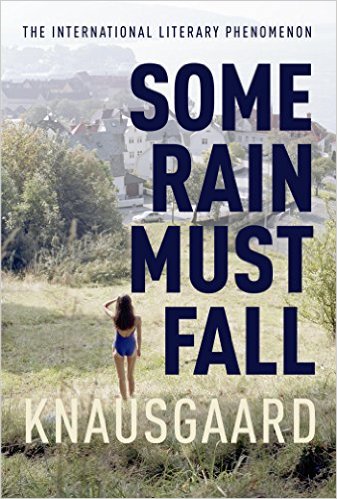
[READ: May 1, 2016] My Struggle Book Five

karlove 5ukI realized as I read this fifth book that I should have been keeping a vague sense of the timeline of these books.  Specifically, because he opens this book with this: “The fourteen years I lived in Bergen from 1988 to 2002 are long gone.”  So if he was born in 1968, this book covers roughly ages 19-33.

So my general outline for the other volumes:
Book Five: 1988-2002 (19-33)
Book Four: 1987 (18)
Book Three: 1968-1981  (1-13)
Book Two: 2008 (40) (with flashbacks to meeting his second wife in 2003 or so)
Book One: 2008 (40) (with flashbacks to his father’s death in 1998 or so)

What era could Book Six possibly be about?

We’ll find out next year in what is said to be the 1,200 page final volume.

So as I mentioned above, Karl Ove talks about the fourteen years he lived in Bergen.  And it made me laugh that he says:

The fourteen years I lived in Bergen, from 1988 to 2002, are long gone, no traces of them are left, other than as incidents a few people might remember, a flash of recollection here, a flash of recollection there, and of course whatever exists in my own memory of that time.  But there is surprisingly little.

And then he proceeds to write 600+ pages about that time. (more…)

Read Full Post »

nov2014SOUNDTRACK: CHRIS BATHGATE-Tiny Desk Concert #167 (October 14, 2011).

bathgateI’d never heard of Chris Bathgate before this Tiny Desk Concert.  Bathgate is a singer and guitarist.  For this show he has a band of five—another guitarist, bassist, violinist and drummer.

The first song, “Everything (Overture),” opens with a lovely slow echoing guitar sound.  And then Bathgate and the violinist sing a lovely, slow duet—their voices play off each other very nicely and the lovely repetitive guitar riff is perfect background.  The song picks up a bit for the chorus (which is mostly them singing do do dos) and the rousing chorus is a nice contrast to the quieter verses.  I really like at the end when the second guitarist switches to the floor tom and adds to the intensity of the song.

He says that “No Silver” is “about living in Michigan and being broke.”  The song is faster and a little heavier.  There more good harmonies and a nice play between the loud acoustic guitar and the fiddle (this song is much more bluegrassy sounding).  When the music drops off and its only drums and fiddle—the song booms.

He introduces “Salt Year” with “Think about the first person you ever had a crush on. so maybe not first crushes but…first lustses”

The slide guitarist messes up on the opening of the song and asks if they can do trainwrecks—his mother will never forgive him.  Bathgate says they should leave it in. So they begin again, with that mournful slide guitar and Bathgate’s delicate vocals.

He tells a lengthy story about the final song “Levee.”  He was in Maine (he had lobster ice cream for the first time–don’t try it, it’s terrible) and he was on an all night drive with a crying friend.  She was inconsolable until the turned a corner and saw a gigantic harvest moon the filled the windshield.  What’s odd about the story telling is that he seems to be telling the violinist rather than the audience.  But that doesn’t matter because this song is fantastic.  It begins with some more great harmony vocals (the violinist has a really great, slightly unusual voice.  I loved that after each line, the violinist and the second guitarist play the floor tom with a great pounding rhythm.  And the bass/guitar riff between verses is great too.

As the show ends, they reveal that they band brought pie for everyone!

[READ: February 5, 2016] “Climbers”

This story is about writers and the publishing world.  But it comes from a wholly unusual angle that I liked a lot

The story begins with Gil raving about the world of Peter Dijkstra.  Peter Dijkstra is a Dutch author who spent some time in an asylum.  He wrote five novels in Dutch and recently had a novella and some short stories translated into English.

Gil works in publishing and says he would do anything–anything–to get Dijkstra published in the States. (more…)

Read Full Post »

augSOUNDTRACK: HOLLY MACVE-“Sycamore Tree” NPR’S SOUTH X LULLABY (March 16, 2016).

macveHolly Macve (pronounced Mac-vee) is a 20-year-old songwriter from County Galway. At the time of SXSW she only had some demos available.

For this Lullaby, it’s just her and her acoustic guitar.  Her low notes seem surprisingly low somehow (I ‘m guessing she plays very cleanly so her notes stand out).

But the thing that stands out most is her voice.  The song’s melody is pretty standard, but she often jumps octaves and nearly creaks her voice while getting there–it’s unsettling and charming at the same time.  She sounds very old school country to me.

Also notable is the length of this song.  It seems like a simple folk song with a pretty standard verse structure.  In good Irish tradition, it also tells a story.  But the slow pace seems to really stretch out the music.  The chorus seems a few lines longer than one might expect (I do love the past and future mixed together in the lyrics).  When she gets to a third part, which takes the song in a rather unexpected direction with very high notes, it’s unclear how long this song might just wind up being.

Macve has a lovely sound, and I enjoyed this song as a lullaby, but I think she’s too far into the country realm for my liking.

[READ: February 10, 2016] “Notes on Some Twentieth-Century Writers”

The August 2015 Harper’s had a “forum” called How to Be a Parent.  Sometimes these forums are dialogues between unlikely participants and sometimes, like in this case, each author contributes an essay on the topic.  There are ten contributors to this Forum: A. Balkan, Emma Donoghue, Pamela Druckerman, Rivka Galchen, Karl Taro Greenfeld, Ben Lerner, Sarah Manguso, Claire Messud, Ellen Rosenbush and Michelle Tea.  Since I have read pieces from most of these authors I’ll write about each person’s contribution.

I have enjoyed Rivka Galchen’s works.  Indeed, I have tried to write about everything she’s written.  One of the things I especially like about her is that she always defies expectations.  So, in this Forum, while everyone else is writing about being a parent, Galchen writes about writers who were or were not parents.

She lists dozens of writers and states their parental status.  I will not go through them all because it would be exhausting (and would basically just duplicate what she wrote). (more…)

Read Full Post »

« Newer Posts - Older Posts »