Feeds:
Posts
Comments

Archive for the ‘Biography’ Category

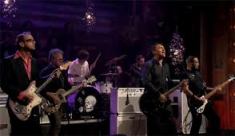
HarpersaprilSOUNDTRACK: THE AFGHAN WHIGS-“I’m Her Slave” (Live at the Bowery Ballroom 2012).

whigs

 I really liked some of The Afghan Whigs’s songs back in the 90s.  There was other stuff I didn’t love by them–when they were on, they were amazing.  Of course, I feel like the Whigs were pretty much all the work of Greg Dulli–charismatic frontman with the intriguing voice.

When they disbanded or broke up or whatever, I didn’t mind so much.  But they have reunited recently and my friend Joe posted this video from last year’s tour.  I don’t really know this song that well (although I do have the Congregation album i was more of a Gentlemen fan), but it sounds great.  And apparently this is one of the songs they were trotting out (they played it on Fallon, but the video has been taken down).

Dulli’s voice still has that wonderful quality and the band sounds tight and loud here.  Seems like a good reunion.

[READ: March 19, 2013] “Limhansfältet”

This excerpt comes from Knausgaard’s (also spelled Knausgård’s) second volume of his six-volume autobiographical novel (wow!).  I have no idea who the guy is or why we’d want to read it.  Evidently Knausgård is quite famous in his native Norway.  Don Bartlett translated this from the Norwegian.

So this excerpt shows a very short time in the writer’s life (knowing it’ autobiographical makes it different somehow).  The writer is married, a father of four three (although evidently now, he is divorced and his first wife is mad to her portrayal in the books).  The first few paragraphs just kind of talk about what’s going on around him (but it is more compelling than that sounds somehow).  I liked the scene where he is sitting so still in the garden that a hedgehog crept past him (but then I like hedgehogs).  But the crux of the action occurs at Limhansfältet, a grassy area outside of town where men gather every Sunday to play football.  They have gathered since the 60s and the men range from 18 to 80.

On this one occasion his family came with him. They watched for a bit but then wandered off.  And they missed him get injured.  Injured so badly that he had to go to the hospital. (more…)

Read Full Post »

mouldbookSOUNDTRACK: BOB MOULD-Silver Age (2012).

silverage

I was a huge fan of everything Bob Mould put out.  And then he more or less gave up on music.  So I just enjoyed his past and ignored what else he did.  But then I heard great reviews of his new album Silver Age.  So great in fact, that I couldn’t help but listen to it.  And it is amazing.  It’s a major return to his punkier roots.  The guitars are loud and fast but the melodies are still present.  And what’s more important, his voice sounds great and the album is mixed really well–previous Mould records have suffered in production quality.  But this is a great great record.

“Star Machine” opens the disc with loud guitars, a simple melody and lots of attitude.  I love the repeated “Said It” that appears throughout the song.  “Silver Age” is something of a manifesto for Mould.  The guitars are harsh and jagged with lots of distortion and the lyrics tell you everything: “Never too old to contain my rage  This is how I’m gonna spend my days gonna fight gonna fuck gonna feed gonna walk away.”

“The Descent” is classic Mould–big guitars, great catchy vocals and really nice harmonies/backing vocals.  “Briefest Moment” starts with a thudding drum and a sparse fast guitar (which somehow reminds me of Cheap Trick).  The bass comes in with a galloping line rather than playing the same notes and it adds a lot of depth to the album.  “Steam of Hercules” slows things down a bit but “Fugue State” comes crashing back in with more fast thumping drums and sparse but effective guitars.

“Round the City Square” picks up the noise level and includes a wild guitar solo.  “Angels Rearrange” again sounds like classic Mould.  While “Keep Believing” has a great bridge that reminds me a lot of Hüsker Dü (yes I mentioned the band that should not be named).  “First Time Joy” ends the disc on a gentle note.  It’s a ballad (where you can really hear Mould’s voice and how clean and strong it sounds).  There’s keyboards on this song that add some nice dimension.  By the end the song gets bigger and more powerful, ending on a really strong chord.  It’s an awesome return to the rock fold for Mould and I look forward to more from him.

[READ: March 5, 2013] See a Little Light

After getting The Silver Age, I remembered that Mould had written an autobiography and that I’d heard it was quite good.  I don’t really read a lot of autobiographies, but my history with Mould is pretty deep and I was curious to see what had happened in his life to make him abandon his rock roots.  So I tracked it down.  And I really enjoyed it.

The fascinating thing is what a reasonable man Mould presents himself as.  I’m not disputing this–I don’t know really anything else about the guy–but every time someone dumps on him, he accepts partial responsibility for the problem and moves on.  If he’s really like that, that’s very cool.  But he almost seems too nice sometimes.

As I’ve said, I didn’t know much about Mould.  My friend Al got me into Hüsker Dü and I’ve been a fan ever since.  I’ve bought some of his solo records and all of his band records, but I kind of lost interest in him the last decade or so (during his experimental phase).  But I didn’t even really know why Hüsker Dü broke up.

Some interesting things about Bob: he was born numerically gifted–I really enjoyed the section about his childhood and the genius-y stuff he did.  Although he had a pretty rough childhood–his older brother died when Bob was young and so Bob was seen as a golden child (especially after something that happened to him which he didn’t learn about until much later).  And he started drinking at a very young age.

When he got to college he formed Hüsker Dü with Grant Hart (Greg Norton came a little later).  I enjoyed hearing about the early days of Hüsker Dü because I only learned of them much later.  And man were they productive!  They’d release an album and have new material ready to record before they even toured for the album that came out already.  It’s cool reading about the punk scene back in the days before the internet when bands had to rely on each other for support.  There’s also a lot of people who Bob name checks and it’s fun to hear all of the punk names again, especially the names of people who are still active.  (There’s also some bad vibes against SST, but since this is Mould, the bad vibes are pretty mild). (more…)

Read Full Post »

dtmaxSOUNDTRACK: TOM WAITS & KEITH RICHARDS-“Shenandoah” (2013).

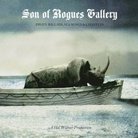
roguesgallery-f8be47f3887d51de57ea842a129f0a722e53ef74-s1This tune comes from the album Son Of Rogues Gallery.  The album is, of all things, a sequel to the album Rogues Gallery.  The full title is Son Of Rogues Gallery: Pirate Ballads, Sea Songs & Chanteys.  The first album was a kind of novelty–I can’t even say novelty hit as I don;t know if it was.  But it must have had some success because here’s a second one (and there’s no Pirates of the Caribbean movie to tie it to).

The album has 36 songs (!) by a delightful collection of artists, including: Shane MacGowan, Nick Cave, Macy Gray, Broken Social Scene, Richard Thompson, Michael Gira and Mary Margaret O’Hara (among many others).  I enjoyed the first one, but I think the line up on this one is even better.

“Shenandoah” is not a song that I particulalry like.  Because it is traditional, I have a few people doing versions of it, but I don’t gravitate twoards it–it’s a little slow and meandering (like the river I guess) for me. And this version is not much different.  What it does have going for it is Waits’ crazed warbling along with even crazier backing viclas from Keith Richards (there;s no guitar on the track).

[READ: January 7, 2012] Every Love Story is a Ghost Story

I had mixed feelings about reading this biography.  I’m a huge fan of David Foster Wallace, but I often find it simply disappointing to read about people you like.  And yet, DFW was such an interesting mind, that it seemed worthwhile to find out more about him. Plus, I’ve read everything by the guy, and a lot of things about him…realistically it’s not like I wasn’t going to read this.  I think I was afraid of being seriously bummed out.  So Sarah got me this for Christmas and I really really enjoyed reading it.

Now I didn’t know a ton about DFW going into this book–I knew basics and I had read a ton of interviews, but he never talked a lot about himself, it was predominantly about his work.  So if I say that Max is correct and did his research, I say it from the point of someone full of ignorance and because it seems comprehensive.  I’m not claiming that he was right just that he was convincing.  And Max is very convincing.  And he really did his research.

It’s also convenient that DFW wrote a lot of letters–Max has a ton of letters to quote from.  And DFW wrote to all kinds of people–friends, fellow authors  girlfriends, colleagues….  Aside from old friends, his two main correspondents were Don DeLillo, whom he thought of as a kind of mentor, and Jonathan Franzen, whom he considered one of his best friends and rivals.  I guess we can also be thankful that these recipients held on to the letters. (more…)

Read Full Post »

SOUNDTRACK: RA RA RIOT-“Is It Too Much” (2013).

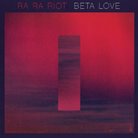
raraI loved the first Ra Ra Riot album The Rhumb Line.  This song expands on some of the ideas from that album, but I fear that it goes in the one direction I would have preferred they not go.  The album had strings, nice harmonies and a great singer all melded into an interesting rock structure.

This song retains all of the elements that were interesting, but it removes it from the rock structure, making it  sound much more lightweight.  It’s pushing too far into easy-listening.  And do I hear autotune on the vocals?  The instrumental middle section is the most interesting part of the song.  But Ra Ra Riot seems to have removed the riot part of their sound.  If this is the direction of the album, I’m afraid I won’t be following.

[READ: January 8, 2013] “Consider the Writer”

I just finished the D.T. Max biography of David Foster Wallace.  I was curious what kind of reception it received.  And lo, here’s a review by Rivka Galchen (something I would have read anyhow since I enjoy her so much).

Galchen opens with two main points–the biography is gripping (and it is, I’ll be saying more about that tomorrow, too).  She writes: “In writing a chronologically narrated, thoroughly researched, objective-as-­imaginable biography, Max has created a page turner.”

The second idea is that you keep thinking “that you just don’t find Wallace all that nice”  (which I also thought).  But then she wonders if it is fair to be worried about that.  We should not judge others after all.  Especially since, as she points out, “We don’t always find ourselves asking whether a writer is nice. I’ve never heard anyone wonder this at length about, say, Haruki Murakami or Jennifer Egan.”  So why is that a concern about Wallace?  Because niceness is what Wallace wrote about, tried to encourage.  And perhaps “One understandably slips from reading something concerned with how to be a good person to expecting the writer to have been more naturally kind himself.”  But that is not necessarily the case–people strive for things that they cannot achieve.   I like her example “the co-founder of A.A., Bill W., is a guru of sobriety precisely because sobriety was so difficult for him.”   And her conclusion: “Wallace’s fiction is, in its attentiveness and labor and genuine love and play, very nice. But what is achieved on the page, if it is achieved, may not hold stable in real life.”

And Galchen talks a bit abut DFW himself (the book is a biography after all).  How he wore the bandana because he sweated so much–how self conscious he was about that and by extension nearly everything he did.  This mitigates his not-niceness somewhat.  It also ties in to his alcoholism  drug use and depression.  And his competitiveness, which is obvious in the biography.  She enjoys the pleasure of Wallace’s correspondences, “especially with his close friend and combatant Jonathan Franzen, but also with just about every white male writer he might ever have viewed as a rival or mentor. Aggressive self-abasement, grandstanding, veiled abuse, genuine thoughtfulness, thin-skinned pandering — it’s all there.”  I rather wished that the authors’ own reactions were included (of course it’s not biographies of them, and they are still alive), just to see if they sparred back with Wallace or if they were put off by yet indulgent of his needs. (more…)

Read Full Post »

SOUNDTRACK: SILVERSUN PICKUPS-Live on KEXP, May 11, 2012 (2012).

Following the other day’s review of Silversun Pickups, I have this more recent show.  In this one, only two members of the band are here–singer/guitarist Brian Aubert and bassist Nikki Monninger for a stripped down acoustic show.

This set is much more enjoyable than the older set.  The songs are certainly stronger, especially “Bloody Mary” and “The Pit.”  But there’s also something refreshing about hearing this band who is usually so fuzzed out sounding clean and simple.  I wouldn’t want an entire acoustic album from these guys, but it’s so dynamic in this version.  You can really hear the construction of the songs in this simple setting.

And the rapport between Brian and DJ Cheryl Waters is relaxed (they are very funny) and engaging–I really want to like these guys.

It’s interesting that in the five years from the previous set the Billy Corganisms have not gone away at all, but I guess one can’t help what one’s voice sounds like.  It’s kind of hard to get past that, but it’s not impossible, and the songs are so good, you can overlook it.  This makes me want to check out their latest album.  You can hear it here.

And for  those who watch TV, Silversun Pickups were on Up All Night this week (in a very weird mash up of pop culture).  Is that how lesser known bands get publicity, or was that meant to be a draw for the show (I don’t know how popular they are–Sarah had never heard of them).

[READ: October 18, 2012] Marshall McLuhan: You Know Nothing of My Work!

I had not heard of this book until I saw it in my local library.  I wasn’t prepared to read another biography of Marshall McLuhan, and indeed, this isn’t one.  This is the American edition of Extraordinary Canadians: Marshall McLuhan with a spiffy new title.  And it is virtually identical.

There are several things that were in the Canadian edition that were left out of the American edition (although they did leave in all of the “u”s in words like “colour”).

The things that were left out are: (more…)

Read Full Post »

SOUNDTRACK: NADA SURF-Live at KEXP January 30, 2008 (2008).

Nada Surf is criminally underrated and shamefully treated as a one-hit wonder for a song that sounds nothing like the rest of their work.

This four song set at KEXP features four acoustic renditions of songs from their wonderful  album Lucky.  The songs are stripped down, but the harmonies are all there.  The only song that really suffers in this format is “See These Bones,” which is a little less spirited than the recorded version (although the harmonies stand out even better).

They are also funny guys and very personable, as the interview shows.  This set is definitely worth downloading.  You can get it here.

[READ: October 6, 2012] Timequake

Timequake is Kurt Vonnegut’s last novel.  It is very much unlike any of his other novels because it is actually more of a fictional memoir than a novel.

There are two main characters in the book–Vonnegut himself and Kilgore Trout.  Vonnegut talks about his life a lot–and if you know anything about Vonnegut’s life, you know that the details in the novel are accurate.  At the same time, he talks about Trout’s life, specifically the end of his life and how he went from being a destitute bum to a celebrated and oft-quoted author.

And then there’s the matter of the timequake.  In 2001, there was the first timequake.  The world stopped expanding and moving forward and instead flashed back to 1991, where everyone picked up exactly where they were on that date in 1991, and relived every detail of their lives in exactly the same way.  Only this time they knew what was going to happen.  So every person lived on autopilot through every day for the next ten years–all the good and all the band (like the man who spent several years in prison and had to relive those years all over again).  Even the dead were resurrected and relived their days.

It’s an interesting concept and yet in the end it’s really not that interesting of a topic.  In the Prologue, Vonnegut says that he had originally written Timequake (which version he calls Timequake One) with that very premise, and that Vonnegut himself made a cameo. And yet I can see that it wouldn’t really have worked as a very good novel–unless he made up ideas for what happened to everyone and we the readers lived them for the first time– or something.

But so he bailed on that novel, but he certainly left parts of it intact for this one.  And rather than a cameo, Vonnegut features largely in this one. (more…)

Read Full Post »

SOUNDTRACK: DJANGO DJANGO-“Default” (2012).

This song was featured in a post on NPR’s All Songs Considered site on July 31.  Django Django are a Scottish duo and they sound very retro.  The two guys sing in close harmony that is more of an echo than a harmony.  The music is mostly very old-sounding guitars–big and unprocessed–and yet the rest of the track is quite processed and electronic.

It’s a simple, straightforward song (with some cool effects).  The NPR write up about them says that they are more of an electronic band, although this song doesn’t really suggest that (except in the middle section where the sounds are manipulated in a cool way).  I’m not sure if I’m all that interested in the rest of the album  In fact, after a few listens, I’m not as excited by this song as I initially was.  But it’s still fun.

[READ: July 31, 2012] The Rector and the Rogue

The Collins Library is back!  And since this seems to be the summer of non fiction, I decided to read it now.  I have loved every Paul Collins book so far in the Collins Library (old, out of print and forgotten titles that Collins resurrects) and this one–which I admit seemed questionable–was just as wonderful as the others.  The Rector and the Rogue details a much-forgotten episode of a grand-scale prank–the systematic public abuse of Dr Morgan Dix, Rector of Trinity Church by a trickster known as “Gentleman Joe” in 1880.  Yes, 1880.

Swanberg told the story, eighty years later, as a rather gripping tale.  The afterward explains that he just happened upon some information about the story and needed to know more.  So, he did the research and compiled first an essay and then this (reasonably short) book.

And so he begins his tale without letting the audience know what they are in store for (just like Dix had no idea what he was in store for).  One morning in February 1880, Rev Dix opened the door to see a safe salesman from Acme Safe in downtown Manhattan.  The salesman says that Dix inquired about safes.  Dix had done no such thing and sent the man on his way.  Then a man from a local girls’ school rang the bell and said that Dix’ charge was more than welcome to attend.  Dix had no daughter or interest in the school. The schoolmaster showed him a postcard from Dix which asked for information.  The postcard was not his own (obviously) and was not in his handwriting (obviously).  Then came a man selling two horses, replying to his postcard….  This went on all afternoon.

The afternoon mail was full also of responses to similar inquiries–about wigs, dance lessons, kitchenware, etc.

And so began the botheration of Dr Dix. (more…)

Read Full Post »

SOUNDTRACK: SANDRO PERRI-Impossible Spaces [CST085] (2011).

This album has become one of my favorite releases of the year.  I simply can’t stop listening to it.  And the funny thing is that on first listen I thought it was too treacly, too “sweet,” especially for Constellation Records (home to the over-the-top Godspeed You Black Emperor amongst other wonderful bands).  But after a listen or two, I heard all of the genius that is present in this record–so many different layers of music, and so many interesting instrumental choices. Indeed, it does come off as sweet, but there’s really nothing wrong with that.

This album gives me a happy pick me up without being cloying in any way.  That’s a great accomplishment.

“Changes” opens kind of all over the place, with some noisey guitars and really high bass notes.  But once the shk shk of the shakers comes in, the sing settles into a great groove (and there’s a cool bassline that really holds the song together).  After about 3 minutes, it turns into a cool light funk jam, with retro keyboards, buzzed out guitar solos and some funky drums.  It’s unlike anything you’ll hear anywhere else.  “Love & Light” is one of the shorter pieces at just under 4 minutes.  It’s different from the other tracks, in that Perri’s vocals seem to be the dominant motif, rather than the cool music.  I like the song, but it’s probably my least favorite here.  “How Will I?” uses a similar multi-tracked vocal style but it has some wonderful flute moments (yes flute) that make the song bubbly and happy.  The song kind of drifts around the ether in a kind of jazzy world until about 5 minutes in, when the bassier notes anchor the song with great contrasting notes.  And the electronic ending is as cool as it is disconcerting.

“Futureactive Kid (Part 1)” is a shuffling minor key number that’s just over 3 minutes, it features a cool bass clarinet and backwards guitars to propel the song.  The backwards guitar solo segues into the uplifting (literally, the keyboards just go higher and higher into space. “Futureactive Kid (Part 2)” features fretless bass, a flute solo and My Bloody Valentine-esque sound effects (although radically simplified from MBV’s standards).  It fades out only to introduce my favorite song in forever–“Wolfman.”  I can’t get enough of this song.  It’s a simple structure, but at ten minutes long, it deviates in amazingly complex ways.  It has so many cool aspects that I love–I love the chord changes at the end of each verse.  I totally love the guitar solo that goes up and down the scale for an impossibly long run–well over 100 notes by my count.  I also love that the end of each section features a different guitar style playing the simple chord progression–from acoustic to loud solo to full band playing those same notes–so by the end of the ten minutes you ‘re not sure what to expect.   By the time the flute solo comes in at nearly 7 minutes, I’m totally committed to the song and wherever it’s going to take me.  So when it gets a bit of an electronic ending, I’m ready to go there with it.  Oh and lyrically the song is just as curious as the music.

The final song “Impossible Spaces” is a beautiful, quiet guitar song which is actually easy to sing along to.  It quiet a departure from the rest of the record, but it ties things together very nicely.  I have listened to this record so much lately, I just can’t get enough of it.

You can stream the whole thing here.

[READ: May 10, 2012] Conversations with David Foster Wallace

This is a book that collects interviews with David Foster Wallace.  Although DFW was reticent about d0ing interviews (as the introduction states), he did do quite a lot of them–often at the same haunts.  This book contains 22 interviews that span from 1987-2008.

The conversations are in chronological order, which is really a treat because you get to see DFW’s opinion (and his addiction to nicotine) evolve over the years.  You also get to see the topics that he was really focused on at one time and whether or not they stayed with him until the final interview.  DFW was outspoken about certain things, especially entertainment, which is unsurprising.  But he was also a big advocate of truth, honesty, realness.  It’s amazing seeing him when he lets his guard down. Although his honesty is there for all to see in his work, he is better known for his difficulty with language or his humor.  So seeing him without the multiple revision is quite enlightening.

The first pieces, “David Foster Wallace: A Profile” published after his first novel The Broom of the System launched Viking’s paperback imprint actually looks into his classroom a little bit and shows him interacting with a student (I wonder if she knows she is in this book?).  It seems sweet and almost naive compared to what is to come next.  And, for anyone who is familiar with him from later in, it’s a wonderful look behind the scenes.  There’s also a number of pieces from The Wall Street Journal.  Like the second piece in the book, the worryingly named, “A Whiz Kid and His Wacky First Novel.”  It’s not a bad piece at all, but man, headlines can be delicate matters. (more…)

Read Full Post »

SOUNDTRACK: ISOBEL CAMPBELL & MARK LANEGAN-Sunday at Devil Dirt (2010).

Sarah bought this disc for me for my birthday a few years ago.  I had a hard time getting into it even thought it was supposed to be amazing.  It turns out that it is amazing, but only when I’m in the right mood.

The is a disc of slow, moody songs.  The closest comparison I can think of is Leonard Cohen (even though all of the songs are actually written by Isolbel Campbell)–this disc is at times more and at times less ponderous than Cohen.

The main reason I couldn’t get into it is because the first two songs are really really slow.  “The Seafaring Song” is almost comically slow–as slow as Lanegan’s voice is deep.  And yet there is a very nice melody (and beautiful accompaniment from Campbell).  “The Raven” sounds like an old Western movie.  Indeed, a lot of the disc sounds like an old Western.

“Salvation” introduces the first real up-front melody. “Back Burner” has a very old school chanting chorus which is quite a change for this album (although at 7 minutes, it does drag a bit).

“Who Built the Road” is very much like a Leonard Cohen duet (especially the La la part) while “Come On Over (Turn Me On)” is like a sexy Serge Gainsbourg duet (the album really picks up around here).  “Shotgun Blues” is a big sexy blues (surprising for Campbell who sings lead) while “Keep Me in Mind, Sweetheart” is a country-style ballad.

By the time that “Sally, Don’t You Cry” comes on, I find that I have more or less had enough of the disc.  But that is the last official song.  My copy has five bonus tracks after two minutes of silence. But the bonus songs mix things up a bit more.  “Fight Fire with Fire” is a jaunty piano based song (although it’s still pretty slow-paced).  It’s funny to hear them talking about AC/DC albums in this slow piano song.

“Violin Tango” is just what the title says while “Rambling Rose, Clinging Vine” is probably the most upbeat song on the disc. Finally “Hang On” feels the most like a song from her old band Belle and Sebastian (by way of The Velvet Underground).  It’s also the only one she sings solo.

So yes, I do like this album quite a lot. Lanegan is a perfect foil for Campbell’s sweet voice and songwriting. They made another disc together, maybe I’ll get that in another couple of years, too.

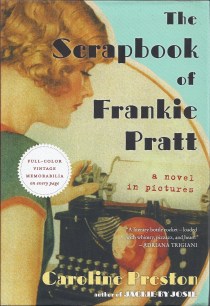
[READ: February 5, 2012] The Scrapbook of Frankie Pratt

This was a wonderful book that Sarah brought home and told me I had to read.  And I’m so glad I did.

The Scrapbook is a very simple story–it’s a biography of a lady named Frankie Pratt from the ten or so years after she gets out of high school.  She went to high school in Cornish, New Hampshire in the early 1920s; that’s when this scrapbook starts.  Over the decade, Frankie goes to college, gets a job in New York City, travels to Paris and then returns home.  That is the basic plot, but that simple summary does a grave, grave injustice to this book.

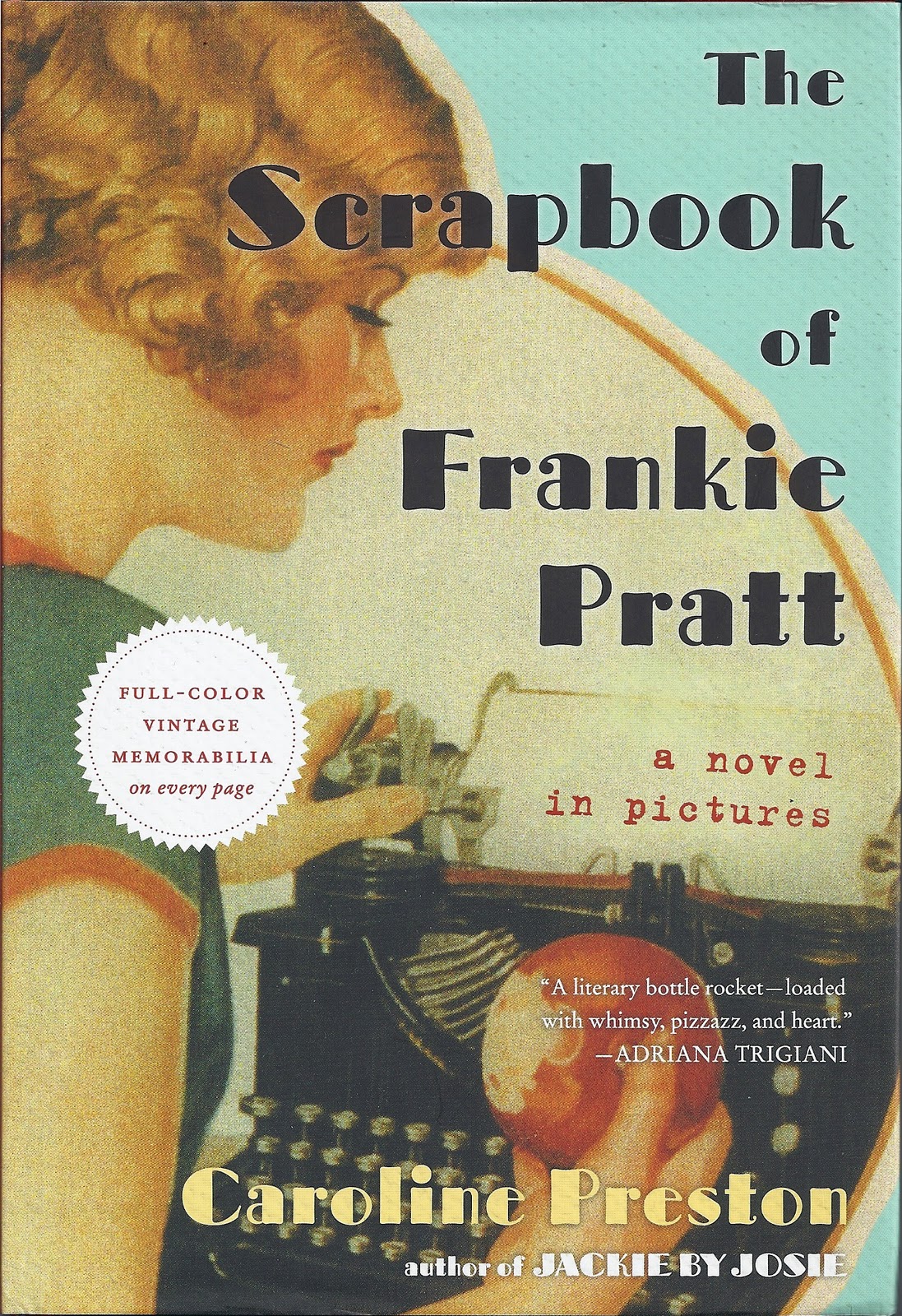
For Preston has created a wondrous scrapbook.  Each page has several images of vintage cutouts which not only accentuate the scene, they often move the action along.  It feels like a genuine scrapbook of a young romantic girl in the 1920s.
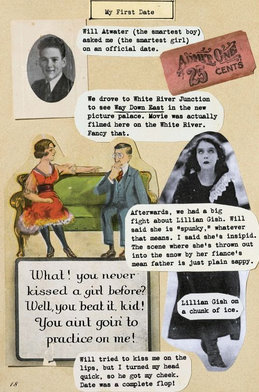
Check out the picture on the right.  Every page is like that–full of old photographs or ticket stubs, candy wrappers or advertisements.  And a few words here and there that Frankie has typed to move the story along.  It is a wondrous trip down vintage lane.

Now, as I said, the story is pretty simple (but it is befitting a scrapbook).  It showcases the highlights of Frankie Pratt’s life.  How she meets a man who wines her and dines her and treats her fine, until he reveals a shocking secret.  How she got out of Cornish, New Hampshire and went to Vassar (I admit I found this first section a little slow, but I was so absorbed in the look of the book that I didn’t really mind).

Once she gets to Vassar though, things are much more interesting because Frankie, small town girl with no money, is introduced to the rich sophisticates who attend Vassar–New York and Boston socialites.  She even rooms with one woman (who sends her down a path of debauchery and potential loss of scholarship).

Frankie longs  to be a writer, and she heads to New York to work on a magazine.  There she meets a man who wines her and dines her and treats her fine, until he reveals a shocking secret. (more…)

Read Full Post »

SOUNDTRACK: LE BUTCHERETTES-Sin Sin Sin (2011).

I learned about Le Butcherettes from their Tiny Desk Concert.  So I thought I’d check out their album.  I’ve listened to it a few times now and it’s really quite good.

While the Tiny Desk Concert showed a subtle side of Teri Gender Bender, this album rocks really hard.  All three songs from the Tiny Desk Concert rock much harder here, and are actually better in this full band context (especially “Henry Don’t Got Love”).

It has a punk feel and reminds me of a more commercial sounding Bikini Kill or other Kill Rock Stars punk.  “Dress Off” is all Teri’s voice shouting over drums: “You take my dress off. Yeah, you take my dress off.
Yeah, You take my pretty dress off.”

In the Tiny Desk concert, Teri Gender Bender channeled PJ Harvey completely.  On the album, she has a bunch of different vocal styles that all work well for the songs.  Although “New York” is totally PJ, “The Actress That Ate Rousseau” reminds me of punkier No Doubt and”Tainted in Sin” has a simple stark keyboard melody with Teri singing a more aggressive guttural style.

Unsurprisingly for someone named Teri Gender Bender, there are some political songs as well.  “Bang!” has the lyric, “George Bush and McCain taking over Mexico.  Next thing you’ll see is their army banning seranata

Although there’s a lot of short songs (7 are 2 and a half minutes or under), there’s a few long ones too.  “The Leibniz Language is over 5 minutes and “I’m Getting Sick of You” and “Empty Dimes” are both over 4.  There’s also an instrumental, “Rikos’ Smooth Talking Mothers” which is a simple song spurred on mostly by scratchy guitars.

The final song, “Mr. Tolstoi” is the anomaly on the album.  Teri “sings” with a fake Russian accent  over a very Soviet-style keyboard march.  The chorus:

I want Raskolnikov To be inside of me.  I want Sonya’s eyes.  I want Sonya’s eyes.

Weird.  But not outrageously crazy for this record.  It’s good noisy fun.

[READ: January 23, 2012] “Labyrinth”

It’s no secret that I love Roberto Bolaño.  And I’ve said before that one thing I love about him is the astonishing variety of subjects and styles that he comes up with.

So this short story is forthcoming from his newly translated collection of unpublished short stories called The Secret of Evil.  What I love and find so unique about this story is that the entire story is based upon a photograph.  The New Yorker includes the photograph (I wonder if the The Secret of Evil will include it also).  In the photograph, eight writers/thinkers sit around a table.  Thy are: J. Henric, J.-J. Goux, Ph. Sollers, J. Kristeva, M-Th Réveillé, P. Guyotat, C. Devade, and M. Devade.  The only person I know of this list is J. Kristeva, whose work on semiotics I have read.  [I just looked her up on Wikipedia and learned that she has also written novels, including: Murder in Byzantium, which deals with themes from orthodox Christianity and politics and has been described by Kristeva as “a kind of anti-Da Vinci Code.”  Gotta put that on my list].  But the others are (evidently) prominent in their fields as well (editor of Tel Quel, author of several novels and non-fiction, etc).

The beginning of the short story is an extensive detailing of the photograph.  Bolaño looks at each man and woman in the photo and describes them with exquisite accuracy.  Beyond that he imparts a bit of speculation about what they are wearing, where they are looking, their attractiveness and even, about the length (or lack) of necks. (more…)

Read Full Post »

« Newer Posts - Older Posts »