Feeds:
Posts
Comments

Archive for the ‘Big Books’ Category

SOUNDTRACK: SUPERCHUNK-“watery hands” (1997).

Even though I enjoy the manic energy of early Superchunk, I find myself really enjoying the later, more “sophisticated” songs.

“Watery Hands” continues this more “sweet” sound that Superchunk has been exploring.  It also includes a cool break that offers a little bass solo as well as even more keyboards (so it seems that the keyboard experiment pleased them).

Meanwhile, the final song, the “watery wurlitzer mix” of water hands is a goofy track, probably the first throwaway track on a Superchunk EP.  And yet, having said that it’s a catchy and silly little ditty, heavy on the wurlitzer and oddball keyboard sounds, which all but eliminates the original, except for faint traces of guitar that pop up here and there.

The middle track “With Bells On” is a decent mid-tempo song.  Nothing terribly exciting but even unexciting Superchunk is usually pretty good.

[READ: October 9, 2010] “The Saviors”

William T. Vollmann was the next writer in the New Yorker’s 1999 20 Under 40 collection.

I have heard a lot about Vollmann.  And I have read a few articles by him.  But I’m sort of daunted by his output.  And this is the first piece of his fiction of that I’ve read.

I don’t know if this is representative of his work, although from what I understand it kind of is.  This is historical fiction loaded down with details (some details which I have to assume he’s made up).  This story compares the lives of Fanya Kaplan and Nadezhda Konstantinova Krupskaya.  (As with so many Russian based stories, those names are hard to keep straight as the story goes along).

In the first paragraph we learn that Fanya Kaplan tried to assassinate Lenin on August 30, 1918.  She was captured and later executed on September 3.  In the second paragraph, we learn that Nadezhda Konstantinova Krupskaya was Lenin’s wife. (more…)

Read Full Post »

[LISTENED TO: October 19, 2010] David Foster Wallace Eulogies

There are some really nice eulogies done for when DFW died.  The official (written) memorial service eulogies (from Jonathan Franzen, Zadie Smith, George Saunders and others) are available here (from an outstanding online journal called Five Dials).  They’re all beautiful (I was amused that the second longest one comes from DFW’s editor!).

The audio eulogies are available at The David Foster Wallace Audio Project.  They include two very long full length ceremonies and several news (NPR mostly) reports.  And there’s a lengthy interview with David’s sister, Amy, which is by far the most moving one.

The first of the lengthy pieces is the ceremony from Amherst.  It consists of colleagues, friends and students all telling stories about DFW.  And their collective memories join together to create a great portrait of the man; things that you’d never know about him (except you kind of would) from reading his work.  The thing that really struck me from this memorial was just how many friends he had.  This seems like an insult but it isn’t meant to be; rather, the impression I had was that he was quite a solitary man, holing up with his dogs and his pens.  But the stories and love from his friends during his college years especially are really quite nice to hear, and showcase a side of him that he left out of his work (except, of course, really he didn’t). (more…)

Read Full Post »

[LISTENED TO: Week of October 10, 2010] David Foster Wallace interviews

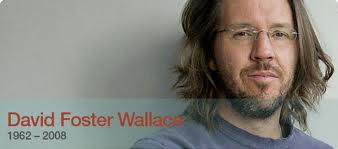
There will soon be a group read of Consider David Foster Wallace, a book of essays about, yes, David Foster Wallace.  In a sort of preparation for the group read, I decided to immerse myself in the available audio files online.

The David Foster Wallace Audio Project hosts quite a vast collection of audio files, including interviews, readings and eulogies.  Even the Howling Fantods points to it.

I started with the interviews.  They cover the period from Infinite Jest to Consider the Lobster.  For the most part, the interviews took place on various NPR stations.  There are not a lot of details given about the items on the site (which is the only flaw that I can see with the site), but you can more or less tell from the titles given what book is the cause for the interview.

I know that DFW was not a fan of interviews, yet I can’t help but be surprised at how few interviews actually seem to be extant (or at least preserved online).  You can see a list of all of the interviews on the site.  I’m listing and giving very brief notations for some of the longer interviews, but I just don’t have the time/inclination to go into great detail. (more…)

Read Full Post »

SOUNDTRACK: THE DUCKWORTH-LEWIS METHOD-The Duckworth Lewis Method (2009).

This is a CD released by the combined forces of Neil Hannon of The Divine Comedy and Thomas Walsh of Pugwash.  And if that weren’t enough of a sales pitch, the title of the band is a method of calculating cricket scores!  And even more…in concordance with that, this CD is largely about cricket.  Huzzah!  Buncha sellouts.

I don’t know a thing about cricket, but I know about great orchestral pop, and this disc has it in spades.  Some of the more obvious cricket songs are even understandable to non cricketers (the themes of “Jiggery Pokery” are familiar to anyone who has failed in a sport–and musically it sounds like a silent film soundtrack).

“The Age of Revolution” begins with an olde-fashioned soundtrack as well (jazz swing, including tap dancing) but quickly jumps into a dancey discoey verse (the two soundtracks blend surprisingly well in the chorus).  And the revolution?  Well, it has something to do with cricket.  Next, “Gentlemen and Players” is a wonderfully Divine Comedy-esque track complete with harpsichords.

“The Sweet Spot” is another discoey dancey track with some funky bass work (and innuendo whispered vocals).  And “Rain Stops Play” is a fun musical interlude.

“Mason on the Boundary” is the first track that seems distinctly Pugwash-y.  Hannon and Walsh have similar singing styles, and I find it hard to know who is who sometimes.  But this track is clearly Walsh’s and it’s very nice indeed.  Similarly, “Flatten the Hay” has that distinct Pugwash XTC/Beach Boys vibe and it’s quite good.

“The Nighwatchman” is also a very DC type song (it even sounds a bit like “The Frog Princess” but pulls away before being a repeat of that great single by introducing some very 70s sounding strings).  The rest of the disc follows in this same wonderfully orchestrated pop feel.  This a great record that, as far as obscure bands that get no statewide attention go, is top notch.

Oh, an it’s even more fun with headphones!

[READ: October 9, 2010] Skippy Dies

Wow, there’s a lot going on in this book.  It’s exhausting just trying to think of all the topics covered: boarding school life, failed romance (two big ones), life as a teacher, the appeal of pop singer Bethani, the Catholic priest sex scandal, drugs of all kinds, sneaking into a girls’ school, World War I, institutional cover ups, M-theory–which is pretty much the entire universe, and donuts.

But let’s start at the beginning.  Yes.  Skippy dies.  In the first couple of pages.  And what’s fascinating about this is that we don’t care.  I mean, in the scene where he dies, he’s not even the major character.  But then Skippy turns out to be more or less the glue of the book once the story proper begins.

Skippy resides at Seabrook school in Dublin (the best, most prestigious Christian academy in the country–sorry Gonzaga).   His roommate is Ruprecht (perhaps the strangest major character name I’ve read in a long time).  Ruprecht is a large boy who is incredibly smart (he will single-handedly raise the school’s average on the year’s final exams).  He is a computer geek who is obsessed with aliens and SETI.  And he hopes to be able to communicate with the other world by using techniques suggested in M-Theory.  The book does an admirable job explaining M-theory and string theory.  I’m not going to take up space here, but there’s a fine description at Wikipedia (or, if you don’t like Wikipedia, here’s an academic explanation that is written for the lay person).

Anyhow, Skippy and Ruprecht are two of a few dozen boys who reside full time at the school.  (Most of the other kids are day students).  And they have a cadre of half a dozen friends that they hang out with who make jokes at each other’s expense.  It’s a very realistically written entourage.  Mario is Italian and claims to have had sex with many many women (thanks to his lucky condom which he has had for three years).  Dennis is the ballbreaker.  He’s the abusive one (but by most standards, he’s not a bad guy).  And a few other hangers on.

This story of dorm life is a good one.  The boys are funny, their stories believable, even if they are all eccentric in their own way.  And then, one day, Skippy sees a girl playing frisbee at the girls’ school across the way (Ruprecht has a telescope which he uses for the stars, while eveyrone else uses it for the girls’ school).  And Skippy winds up becoming rather obsessed with the unknown “frisbee girl.”

This girls’ school plays a part in the story in another way too.  Carl and Barry are the Seabrook’s thugs.  When Barry hits upon the idea of selling ADD meds to the locals (as diet pills), it’s the girls’ school that he mostly preys on.  For yes, this story is also about drugs. (more…)

Read Full Post »

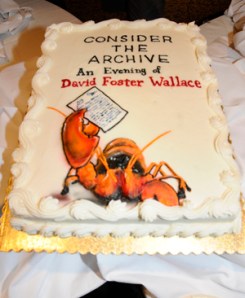
[LISTENED TO: September 27, 2010] Consider the Archive

On September 14, 2010, The Harry Ransom Center at the University of Texas commemorated David Foster Wallace through an evening of his readings and (I love this) Wallace-themed refreshments.  It was also the opening of the Wallace archives at the Center.

[UPDATE: November 8, 2010: The research archives have gone online, details are available here.]

There was a live videocast of the evening, which included excerpts from several of his books. I didn’t get to watch it, but I was able to get an audio copy of the event.

The evening’s readers were:

  • Molly Schwartzburg –Introduction
  • Wayne Allen Brenner, L.B. Deyo, Kurt Hildebrand, Shannon McCormack–The Broom of the System (Grand Ohio Dessert excerpt)
  • Doug Dorst, L.B. Deyo–Correspondence with Don DeLillo
  • Owen Egerton —Infinite Jest (1960, Jim’s Dad)
  • Jake Silvertstein and Kurt Hildebrand–A Supposedly Fun Thing (skeet shooting excerpt)
  • Elizabeth Crane–Infinite Jest: (Avril & Mario)
  • Chris Gibson–Commencement Speech (This is Water) (more…)

Read Full Post »

SOUNDTRACK: R.E.M.- Fables of the Reconstruction of the Fables of the  (1985).

I’m willing to go on record saying that I like the title of this disc to be elliptical, even if the band has a definitive answer for what it should be called.

So, I’ve learned that I’m a bit of a fair-weather R.E.M. fan.  I’ve always felt that they were the bedrock of any alt music collection.  But recently (with the re-release of this album, which I did not buy) I decided to go back and listen to the full albums (I listen to Eponymous a lot, but I wanted to hear some deeper cuts, as they say).

This album has a lot of quintessential R.E.M.-sounding songs, and yet it’s also not a very poppy album, so it doesn’t feature too much of that jangly guitar–the other trademarked R.E.M. sound.  Rather, we get a lot of picked guitar bits, some great bass (a very underappreciated aspect of the band) and a lot of one of my favorite things: Peter Buck’s backing vocals.

There are a  few “hits” on this disc, songs that I love very much, but this disc also features a bunch of songs that don’t really excite me.  In fact, the back end of the disc is kind of ho hum. “Green Grow the Rushes” is a nice enough song.  “Kohoutek” just never really grabs me.  “Auctioneer (Another Engine)” is a pretty interesting experiment: the minor chord vocals section in the middle are rather creepy (and the guitar sounds a bit like an early-80s Cure song).  It’s my favorite track in the back of the disc.  The last two songs are gentle folk songs that are, again, nice, but not mind blowing.

Of course the front half of the disc is full of weird gems. “Feeling Gravity’s Pull” is a bizarre, off kilter delight.  And that weird string section at the end is only part of the oddity of it. “Maps and Legends” is a fascinating song that just seems chock full of noises (like an acoustic Public Enemy track) that keeps you guessing what will happen next.

“Driver 8” begins my favorite section of the disc.  “8” is one of the major highlights of this disc.  It’s dark and mysterious without being swamped under by murk.  And while I have no idea what it’s about it never stops me from singing along.  “Life and How t o Live It” features some great bass work (and an interesting guitar riff).  “Old Man Kensey” starts out really promising with a cool bass and peculiar guitar line, but it kind of drifts a little after that.  But the final track of this section, “Can’t Get There From Here” is an ebullient song, that feels really out of place here.  It’s one of my all time favorite R.E.M. tracks, and it adds some much needed adrenaline here.

I admit that I am more of a fan of R.E.M.’s louder songs (Document is a highlight).  So this disc is a little too tame for me.  I’m lead to believe that the new edition of the disc features some live tracks that really bring these songs to life, but I think I may just stick with Eponymous.

[READ: September 19, 2010] “Mr. Difficult”

I am planning on reading The Corrections soon (and one of these days Freedom, too).  Somehow I missed all of the controversy surrounding Franzen (I am blissfully ignorant of Oprah) when it was all over the place, but I recently learned that he and David Foster Wallace were friends and respected each other, so I thought I’d give him a read.  But before I get to the big book I decided to read some of his nonfiction (I had read about this Franzen article in which he talks about William Gaddis and wanted to read this right away).

So this article is a lengthy discussion about William Gaddis.  It is inspired by a letter writer (whom he calls “Mrs. M—-“) who accused Franzen of being an elitist–for using big words like “diurnality” and “antipodes”–and for not writing for the “average person who just enjoys a good read.”  So Franzen talks about two types of writers.  First is the Status Writer (like Flaubert) where the best novels “are great works of art…and if the average reader rejects the work it’s because the average reader is a philistine.”  And then there is the Contract Writer where a novel represents a compact between the reader and the writer “with the writer providing words out of which the reader creates a pleasurable experience.”

Franzen never says what camp he himself falls into, but rather, he explains that when he was in school, he wanted to be a Status Writer, he wanted to love difficult books.  However, when his screenplay was described as, basically, a knock off, he was despondent.  So, he decided to sit down and read Gaddis’ The Recognitions, a 900 page Difficult Book.

And he loved it.  He was engrossed and couldn’t stop.   (more…)

Read Full Post »

[LISTENED TO: Week of September 13, 2010] Ulysses

Episode 15 is a huge one, so I finished up that and 16 this week.

One thing I noted about Episode 15 is that in this section:

THE VOICE OF ALL THE DAMNED Htengier Tnetopinmo Dog Drol eht rot, Aiulella!
(From on high the voice of Adonai calls.)
ADONAI Dooooooooooog!
THE VOICE OF ALL THE BLESSED Alleluia, for the Lord God Omnipotent reigneth!
(From on high the voice of Adonai calls.)
ADONAI Goooooooooood!

the texts that are printed backwards are played as the forward recording flipped in reverse.  It was a cool effect.

I really didn’t enjoy Episode 16 while I was reading it.  I felt it was overly long and perhaps too focused on the mis-named sailor.  Plus, I was really looking forward to Episode 17 (which is my favorite).  But this time, with someone else reading the hard words, I was able to appreciate quite a lot more about this Episode.

Lar’s comments about Skin-the Goat also helped to give some background to this odd character.  And this leads me to a question that I sort of thought about while reading, but which comes up a lot more for me in this listen:  Joyce’s opinion of Ireland and of Irish independence.  The Citizen in the earlier episode was all about the Irish language and Gaelic sports.  And now in this Episode there is a lot of talk about Parnell returning.  Was this all included because it is what old men in Dublin talked in Dublin in 1904, or was it something that Joyce had a vested interest in (even while he was living in Paris where he wrote the book).  [I could investigate this, but that seems like an awful lot of work.] (more…)

Read Full Post »

[LISTENED TO: Week of September 6] Ulysses

This week I almost finished Episode 15.  I’ve just finished where Bella turns into Bello and things get really weird.  And I have to say that this Episode, for all of its craziness, is masterfully handled by Donal Donnelly.  I’ve already raved about his vocal stylings in the earlier chapters, dealing with so many different men.  But in this chapter he proves to be very dextrous at male and female voices, with a very delicate voice for some and an incredibly masculine woman’s voice for Bello (very well done indeed).  He has also proven himself to be a treat with sound effects (of which there are many here).  I won’t say for certain that it makes this insane Episode a lot clearer, but it certainly makes it easier to follow.

Back to Episode 13. The Gertie section is written in a style that is supposed to be romantic, very quick and flowy.  And Donal really nails it.   After the business of Episode 12, the lightness of 13 is wonderful, and it really brings to life the scene, especially when the rockets go off.

One thing I picked up this time is that Bloom assumes that he knows exactly when Blazes and Molly consummated their affair.  Even re-reading it now, it wasn’t quite as clear as the way he read it aloud:

Funny my watch stopped at half past four. Dust. Shark liver oil they use to clean could do it myself. Save. Was that just when he, she?
O, he did. Into her. She did. Done.
Ah!

So, yes I suppose it’s obvious, but sometimes reading along you just don’t pick things up.  And it took the way he read it for me to realize just what those short sentences meant. (more…)

Read Full Post »

SOUNDTRACK: SINÉAD O’CONNOR-The Lion and the Cobra (1987).

I was tempted to say that this album came before all of the controversy.  But then, she’s always had controversy around her.  Just the fact that she had her head shaved was enough to incite some people to alarm (not to mention, we never received this more fierce looking album cover).

But before all of the success of “Nothing Compared 2 U,” she released this amazing, empassioned debut album.

I’ve no idea what the first track is about, but there’s something about her voice on the “oh’s” in particular that still gives me chills.  “Mandinka” has a great guitar sound (seemingly destined for hit radio) that seems very out of place on this disc (again, I’m lost on the lyrics here, too).

The album comes into its own with the really odd but delightful “Jerusalem.”  Musically it’s got a sort of funk base which resolves itself into a very winning chorus.  And, once again, her voice sounds otherworldly.  It’s followed by the largely acoustic “Just Like U Said it Would B” (Prince fan much?).  It’s a  fairly simple song (with interesting arrangement–I like the flute) that builds to a strong climax.

“Never Get Old” opens with some spoken Irish (and features future star Enya), but it’s “Troy” that is the absolute breakthrough on this disc.  From the occasionall string swells, to the eerie silences to the incredible heights that she reaches (and the notes that she can hold) it’s really tremendous.

“I Want Your Hands on Me” seems like another grab for a single.  The single version featured a bizarre little rap from MC Lyte.  In the pantheon of silly rap lyrics, I’ve alwys kept this near the top: “I’m not the kind of girl to put on a show coz when I say no, yo I mean no.”  Sentiment and good intentions aside, it’s very clumsy.   Not my favoite track.

The final two, “Drink Before the War” and “Just Call Me Joe” are interesting denouements after the pop of “Hands.”  “Drink is a slow paced, somewhat quiet track, until the chorus really blasts off.  And “Joe” sounds like a demo: a raw electric guitar, cranked way up (but mixed quietly) accompanying Sinéad’s instructions to just call her Joe.

In some ways this album is less subtle, and by that reckoning, less sophisticated, than the bajillion-selling follow up, but I find the naked passion on this disc to be even more amazing.

[READ: Week of August 30, 2010] Ulysses: Episodes 18

The final chapter of Ulysses is all about Molly.  It enters her head and doesn’t leave.  It doesn’t even pause for punctuation (there’s none in the entire chapter except for the final period).  There are paragraph breaks, which means that there are eight sentences in total.

The Episode is crass and sexual, beautiful and moving, personal and insightful and it seems incredibly forward thinking coming from a male writer.  And although it gets a lot more press as a stream of consciouness piece, it’s not that far removed from Stephen’s or Bloom’s pieces, [except that she doesn’t actually intearct with anyone to interrupt her thoughts].

The Epsiode reflects upon what we’ve learned in the day.  It inadvenrtanetly corrects some misperceptions (regarding Molly’s past infidelities–she didn’t have any–), but it also shows some pretty poor judgments on Molly’s part (mostly regarding Stephen).  And there’s just so much going on in the episode that it’s hard to catalog it all.   But it is certainly full of a lot of sexual thoughts. (more…)

Read Full Post »

SOUNDTRACK: A HOUSE-I am the Greatest (1991).

A House were a Dublin band that released a number of great songs and a few good albums from the mid 1980’s until the late 1990s.  I loved A House (but never knew whether to file them under A or H).  They were a smart, often sarcastic, occasionally poppy college rock band who played dissonant songs more often than not and wrote lyrics which could be off-putting more often than not, but which, in the right mind frame, were simply, as the album says, the greatest.

It opens with a nice jangly guitar which is quickly interrupted by a strange feedback sound and Dave Couse’s somewhat unsettling voice.  And he gives a litany of things about which he does not care, but mostly because nobody else does.  It’s followed by the sweet tender ballad “Too Young.”  The next track was the single, of all things.  “Endless Art” a simple riff which name checks dozens of dead artists that bridges with Beethoven’s Fifth.  It gets tedious after about 200 listens, but since I haven’t heard it in a while, I found myself really grooving to it again.

In keeping with the “let ’em guess” attitude of the disc, the next song is a plaintive moan of longing called “When I First Saw You.”  I’m fairly certain he’s singing out of tune for the whole track.

“Take It Easy on Me” opens with a great wah-wah’d guitar sound that should have been a left-field hit like The Flaming Lips had.  But it’s their simple acoustic songs that pack the most punch like “I am Afraid.”  It’s followed by what sounds like a Tindersticks song, until Couse’s voice kicks in, and we get a great questioning song about religion called “Blind Faith”.

He seems back to his old tricks on “I Lied” (“When I said that I loved you, I lied.”) Then the full band kicks in (with great harmonies) “When I said, when I vowed, I don’t love you anymore, I lied.  I adore you!”

The rest of the songs play with this formula: off kilter yet poppy, harmonies on top of dissonant leads.  The pace never slackens, and the albums stays strong through the brilliant final track, “I am the Greatest” (a spoken word folk track that is all smackdown which devolves into a bunch of blokes shouting “I am!”).

Check out the fantastic stop motion video for “Endless Art” on YouTube, and let me know if you can find a version that’s better than this one.

[READ: Week of August 23, 2010] Ulysses: Episodes 16-17

Nearing the end of the book, still recuperating from the insanity of the Circe episode, we get two episodes that are considerably mellower.  I enjoyed the beginning of Episode 16, but felt a little at sea when it was hijacked by the sailor.  Episode 17 on the other hand is definitely my favorite.  Even though I love the surrealism of Circe, there’s something about the catechism of Episode 17, with its question and answer format–its own sort of surrealism–that I find fascinating, funny and surprisingly informative.  It fills in a ton of details that were left out of the beginning (or that were hidden) and yet still retains a bizarre stream of consciousness. It also offers incredible insight into the man who is Leopold Bloom. (more…)

Read Full Post »

« Newer Posts - Older Posts »