Feeds:
Posts
Comments

Archive for the ‘Babies’ Category

wildrobot efterklangSOUNDTRACK: EFTERKLANG-Tiny Desk Concert #270 (April 8, 2013).

Efterklang is a Danish group whose recent album Piramida took its members to an abandoned mining town between the North Pole and Norway. There, they recorded sounds of empty oil tanks, old pianos and pretty much anything they could strike or record.

That blurb made me think this would be a noisy chaotic Concert.  And yet despite the found sounds, their music is really peaceful and lovely.

“Dreams Today” builds on a series of echoing keys and guitar notes.  After nearly two minutes the singer sings a series of high “ahhs and oohs” until the vocals officially kick in.  And then the whole band starts playing a series of fast looping notes while the percussionist plays some water bottles and mugs.  The songs builds and builds, with a steady bass keeping the melody strong and then just as it seems it should turn the corner into a new section, it abruptly ends, leaving you wanting much more.

Before the second song, “Danish Design” they explain that they “never went public” with this song. They played it once before in a huge power plant in Copenhagen.  It was a big room–very reverby (if you can say that).  The office is a very different place and they want to compare how it sounds.   They also sampled the worlds northernmost grand piano for this song.  They were in Piramida, a ghost town in the arctic.  The song begins with slow notes from the sampled piano while the keys play pinked notes. The singer sings in a baritone that is quite lovely.  When the loud drums kick in it’s quite a shock to the mellow music.  The song is only a bout 2 and a half minutes and, once again, it ends just as it seems like it might soar into something new.

“Alike” is from their previous album.  It opens with keys and percussion (all kinds of things like a fork on a mug).  They sing in harmony for much of the song.  It doesn’t use much in the way of guitar or bass (the bassist is keeping time with a pair of scissors and then a beer bottle on a step stool) until the end of the song when the guitar chords kick in fast (but not too loud).  It’s the longest song but the way it builds slowly it feels like it could go on for much longer.

This Tiny Desk really made me want to learn more about this interesting group and to hear more from them.

[READ: April 20, 2016] The Wild Robot

I love Peter Brown’s picture books.  I think Chowder is absolutely genius and The Secret Garden brings me to tears each time I read it.  So I was pretty excited to read this novel–his first.

It’s quite a fast read (with about 70 chapters all about 3 pages long) and lots of pictures.  The blurb on the book said that a robot woke up on a remote island. She has to learn to survive from the animals. And once she starts to feel comfortable, her past comes back to haunt her.

And that is a fair summary of the book.  The plot is very simple, but Brown adds a lot of details and a lot of characters to make the plot interesting. (more…)

Read Full Post »

storiesSOUNDTRACKPOLYPHONIC SPREE-Tiny Desk Concert #259 (December 21, 2012).

The Polyphonic Spree performs a Tiny Desk Concert.I really enjoyed Polyphonic Spree’s first album (and their strange robes and cult-like following (apparently even within the band).

They put out a Christmas album some time ago, and since we have a big pile of Christmas albums, I grabbed that one.  I didn’t love it, but it was a fun addition to our collection.

This Tiny Desk Concert is notable for just how many members of the band are behind (and on the side of) the Tiny Desk (perhaps 18?).

And the band is suitably musical–trombone, trumpet, keys, drums, bass, cello, violin and a ten (or so) piece choir.

Interestingly, I find that the weak link in this whole thing is leader Chris DeLaughter.  It’s just that his voice is really not that interesting. It’s especially notable on “The Christmas Song” where he sings some high notes unaccompanied.  When the choir comes in (and they change the melody) it sounds really cool.  I especially love the way they make “reindeer really know how to fly” into a high note.

The first song is “Happy Xmas (War Is Over)” which I feel is the Christmas song they might be best known for.  It’s pretty traditional to the original, with the choir filling in for the kids.  The addition of horns really adds a lot to it.

“Silver Bells” gets a pretty rocking treatment–the buildup at the beginning is pretty cool.  They change the main melody to an almost circus-like waltz. I love the way it sounds when everyone joins in–and when the choir is singing along to the rocking end (with a very different melody) it sounds great.  But once again DeLaughter’s voice doesn’t seem up to the task of leading this larger group.

But it’s festive and fun, especially with everyone in red robes (and DeLaughters green one).

[READ: December 2016] Christmas Stories (1854-1864)

Last year, I started reading some Charles Dickens Christmas Stories in December.  I imagined that I’d finish the whole book this season (all 750 pages of it), but I didn’t come close.  I enjoy these stories but they are not quick reads by any standard.

The fascinating thing with a lot of these stories is that they appeared in All the Year Round, a Victorian periodical founded and owned by Dickens and published between 1859 and 1895 throughout the United Kingdom.  But just because these stories came out for the Christmas issue doesn’t mean they have anything to do with Christmas directly.

I thought I’d be reading a whole chunk of the book in a row, but I wound up skipping around a bit.  Maybe next year I’ll finish the remaining stories. (more…)

Read Full Post »

2016-12-05-21-06-09SOUNDTRACK: JANET FEDER-Tiny Desk Concert #233 (August 6, 2012).

I’d published these posts without Soundtracks while I was reading the calendars.  But I decided to add Tiny Desk Concerts to them when I realized that I’d love to post about all of the remaining 100 or shows and this was a good way to knock out 25 of them.

federJanet Feder is an amazing guitarist.  I enjoyed the simple act of her picking out the notes in a chord and simultaneously using her pinky to play harmonics on two different strings.

But beyond that she has a great sound. In part it’s the guitar which is a nylon-string baritone electric! But it’s also because of the way she prepares her strings—she gets interesting bell sounds and other rattling noises.  These aren’t the focus of the song,  just the accents of them.

The first song is not an instrumental, it’s called “Angles And Exits.” She says that she was used to not singing since she primarily played classical music.  But she has enjoyed adding voice to her songs.  Her voice is soft and delicate.  The song works with words, but it would probably be fine without them.

It looks like she has some kind of thing on the first fret on the high strings—so an open notes gets that bell sound.  She says that these additions to the guitar have allowed her to have fun playing the guitar again.

She describes what she does on the second song “Heater.”  She puts a device on her string to make a great sound.  Although even after she describes it I don’t understand how it works.  She begins the song by pulling on what sounds like an uncoiled guitar string ratcheting it tighter ad tighter.  When she finally gets to the melody, her playing is excellent—all over the guitar but not really flashy, just interesting.  The melody in the slow part at the end is enchanting.

“I Hear Voices” opens with harmonics and a rattling on the strings—a neat combination of heavenly notes and noise from an alligator clip on the strings.  It’s a mesmerizing and very cool sound and a beautiful song too.

[READ: December 16, 2016] “The Heaviest Dress”

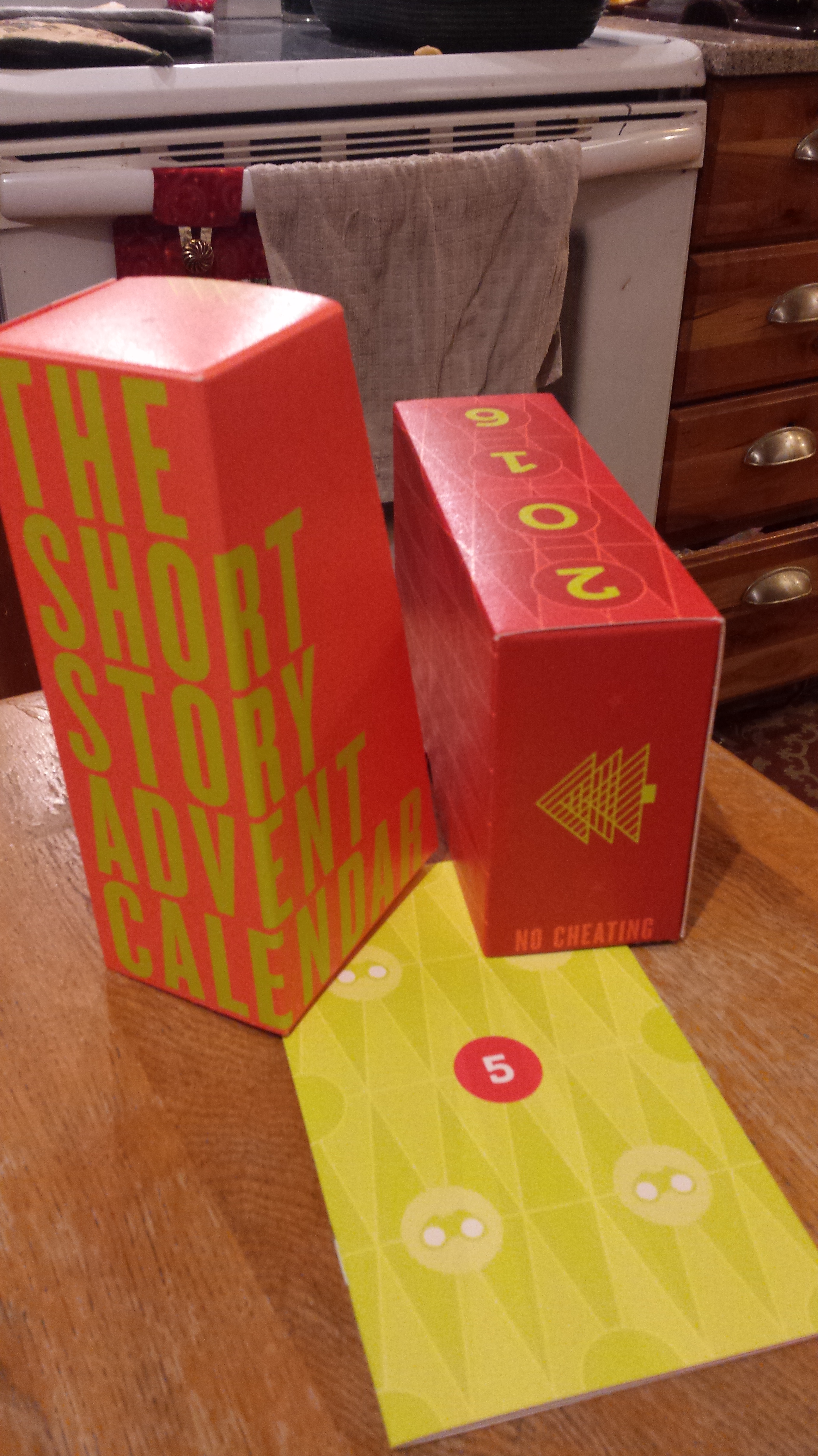
Near the end of November, I found out about The Short Story Advent Calendar.  Which is what exactly?  Well…

The Short Story Advent Calendar returns, not a moment too soon, to spice up your holidays with another collection of 24 stories that readers open one by one on the mornings leading up to Christmas.  This year’s stories once again come from some of your favourite writers across the continent—plus a couple of new crushes you haven’t met yet. Most of the stories have never appeared in a book before. Some have never been published, period.

I already had plans for what to post about in December, but since this arrived I’ve decided to post about every story on each day.

This is the story of a young Jewish girl returning to her home in Montreal after some time in New York City.

The girl’s parents died when she was five and she had lived with her Aunt Rita and Uncle Mort ever since.  She felt that their house was never hers, and so it never grew mundane.  In the past year she had moved to New York City to go to fashion school. (more…)

Read Full Post »

2016-12-05-21-06-09SOUNDTRACK: SOUAD MASSI-Tiny Desk Concert #231 (July 15, 2012).

I’d published these posts without Soundtracks while I was reading the calendars.  But I decided to add Tiny Desk Concerts to them when I realized that I’d love to post about all of the remaining 100 or shows and this was a good way to knock out 25 of them.

souadSouad Massi has a fascinating story:

Born in Algeria to a Berber (Kabyle) family in 1972, Massi grew up in the capital city of Algiers. On her way to rehearsals with her rock band as a teenager, men used to spit at and harass her for wearing jeans and toting a guitar. When civil war erupted in 1992, life became even more dangerous for Massi: After she released her first album, she was targeted for assassination by Islamic fundamentalists.  Now based in Paris, she’s since become one of the major musical stars of the Arab world: Massi has sold hundreds of thousands of albums across Europe and North Africa,

She sings unflinching, deeply intimate songs in a mix of North African Arabic, Berber and French

Since I don’t know what she’s singing I’m going to use some of the blurbs

  • “Raoui” (Storyteller) is a beautiful delicate song with lyrics like: “Every one of us has a story in his heart… Storyteller, tell us stories to make us forget our reality. Leave us in the world of once upon a time.”
  • “Ghir Enta” (No One but You)  has a faster tempo–Confessional love songs like “Ghir Enta”bear little resemblance to the sappy sentiments that dominate Arab pop ballads. There’s a trembling note of fragility within: “Now you’re by my side,” she sings, “But tomorrow, who knows? That’s how the world is — sweet and bitter at the same time.”
  • “Amessa” (A Day Will Come) a much faster track in which she says she needs help with the rhythm, which the crowd provides.  You can still feel the North African undercurrent which propels the song that was sung in Arabic in the beginning and in Berber in the second part
  • “Le Bien et le mal” (The Good and the Evil)  is a pretty, slow song with lyrics like: “There are people who lament over their destiny, people who cry on their own tombstones while they are still alive … There are people who grow old before their time. We’re fed up with this life.”

Massi’s voice is really lovely on top of it.

[READ: December 14, 2016] “Blue Light, Red Light”

Near the end of November, I found out about The Short Story Advent Calendar.  Which is what exactly?  Well…

The Short Story Advent Calendar returns, not a moment too soon, to spice up your holidays with another collection of 24 stories that readers open one by one on the mornings leading up to Christmas.  This year’s stories once again come from some of your favourite writers across the continent—plus a couple of new crushes you haven’t met yet. Most of the stories have never appeared in a book before. Some have never been published, period.

I already had plans for what to post about in December, but since this arrived I’ve decided to post about every story on each day.

I have read an enjoyed J. Robert Lennon’s stories in the past.  But as with yesterday’s story, this one had the potential of being very dark indeed.

This is the story of a 7-year-old boy.  When his baby sister is born he is quite jealous of her.  But he soon grows affectionate towards the little creature who stares at him so intently and for so long.

One night, when the boy can’t sleep, he goes downstairs to his parents. They let him sit with them for a while in front of the TV. The parents fall asleep but the boy does not.  And on comes a real-crime show.  In this show, which the boy is mesmerized by, a man breaks into a house and kills an entire family, including a baby. (more…)

Read Full Post »

castle SOUNDTRACK: TINDERSTICKS-The Waiting Room (2016).

tinderstIt had been four years since the previous Tindersticks album.  And this one was not released on Constellation Records, but rather on Lucky Dog.  Whether or not that had anything to do with the sound of this record I don’t know, but I really like this album a lot.

“Follow Me” is a slow broody melancholy instrumental with a high accordion playing a lovely melody.  It’s completely evocative.  “Second Chance Man” has a kind of unsettling vibrato on Staples’ voice.  But the melody (sparsely played initially on keyboards) is really catchy.  The rest of the band fleshes out the sound after a verse and chorus.  I love that it builds in the middle and then again at the end with horns lifting the gloom off the song.  “Were We Once Lovers” has a thumping bass line and an uptempo feel as Staples’ sings in a kind of falsetto.  I love the way all of the parts form together in the chorus that’s introduced by a simple but effective guitar: “How can I care if it’s the caring that’s killing me.”

“Help Yourself” opens with some soulful horn blasts and Staples’ whispered vocals.  The bass keeps the song going as occasional horn blasts accent this strangely catchy song.  Staples also sings in an uncharacteristically angsty style in this song, which is strangely unsettling as well.  I love the way the song keeps circling round and then almost surprising the chorus when it comes back.

Whenever Tindersticks use a female guest vocalist, they really seem to step up their game.  “Hey Lucinda” is an incredibly catchy song, starting with simple bells and an accordion playing a great melody.   When Staples’ deep voice is balanced by the exotic voice of Lhasa, it makes for a great pairing.  It’s unusual for a catchy song to be so spare, but the simple accordion accents really hold the song together before it takes off near the end.

“This fear of Emptiness” is another gentle instrumental with bass and acoustic guitar accompanied by accordion sections (sometimes dissonant near the end).  “How He Entered” is another spare song with mostly bass and keys and an occasionally scratching sound as an ascent.  But it’s still a very catchy melody.

“The Waiting Room” has that same echo on his voice as he slowly sings over a keyboard melody.  His anguished singing of “don’t let me suffer” totally makes the song.  “Planting Holes” is a short delicate instrumental with a sweet but melancholy keyboard riff running through it.

Perhaps the most dynamic song on the disc is “We Are Dreamers!”  It’s the angriest song I can think of from Tindersticks, with rumbling keyboards and tribal beats as Staples sings bursts of vocals.  But it’s when Savages’ singer Jehnny Beth adds her voice that the song turns really aggressive.  They sing the chorus “This is not us/ We are dreamers!”  And as Beth takes over the chorus, shifting pitch and intensity, Staples is commenting including lines like “You can rob us/ You can trick us/ Peer over our shoulders and steal our ideas”

The final song is “Like Only Lovers Can.”  The delicate and pretty keyboards belie the sadness in the lyrics: “We can only hurt each other the way lovers can.”  The quiet keyboards end the disc.

[READ: March 15, 2016] Castle Waiting Volume 2

I loved Castle Waiting.   And I couldn’t wait to read Volume II.

And I loved it even more.  Linda Medley is such an engaging storyteller.  Her characters feel utterly real and funny and charming.  I could read more and more and more from her.  Which is why I am so bummed that the series ends here (with rumors that she is doing more).

This volume is a bit more playful.  The characters are well-established and settling into their lives at the castle.

As in the previous volume, there are a lot of flashbacks to Jain’s childhood.

But there’s also a lot of wonderfully meandering stories in the present. The man who looks like a horse (literally) has injured his hoof, so he is hobbling around and is not as useful as he might be (and is cranky about it).

But the main story centers around the arrival of two dwarves, I mean hammerlings–only racists would say dwarves.  They are the relatives of Henry, the quiet blacksmith (who is actually human, but was adopted by the dwarves).  Henry is super excited to see them (as excited as his monosyllabic grunts allow him to be).  Actually, we finally learn why he is so standoffish and quiet most of the time.

They are here for a very specific an(and embarrassing) purpose.  They need women’s clothes for the human who works with them back home.

Their presence enlivens everyone in the Castle. They are fun and interesting–enjoying hard work and being very playful. It is with their help that the Castle dwellers do some remodeling, find a booby trap and even learn how to play nine pin bowling.  The older women who still live in the castle take some bets about who will win–with much merriment.  I love that there a whole chapter about them bowling.

There’s a subplot about Jain’s son Pindar being a leshie–a species we learn a bit about, although we also learn that they are extinct.  This plot line is never concluded properly, though.

We also finally learn about Doctor and his crazy mask (it was a sort of gas mask for the plague).  They are all worried about his sanity, especially when he starts walking around wishing everyone a happy Yule (the Christmas stocking subplot is outstanding).

Speaking of Jain, she has decided to move into the Castle (where there is indeed a ghost).  But her kindness appeases the ghost somewhat.  Especially when she teaches Simon to read (I love the scene where he learns to read and then sits at the table reading instead of eating–just like in my house).

There’s a hilarious thread about a very stubborn goat (whom Simon can outsmart).  And a multi-chapter thread about Sister trying to get a cross for Jain’s room.  We finally get to the bottom of the house sprites (they are adorable when we finally find out what they want).  Finishhtory!  Finit!  Reetoomee.

I am so attached to these characters, that I need to hear more about them.

As in the previous book,Medley’s art is simply gorgeous.  She does realism like no one I know and her characters have an awesome blend of realism and hyper-realism that makes them so enjoyable to look at (and unbelievably detailed as well).

There have been a number of graphic novels that I have gotten completely attached to, but none like this.  It was so bittersweet to finish this, knowing there’d be no more–but holding out hope for a surprise some day.

Read Full Post »

castlewaitingSOUNDTRACK: TINDERSTICKS-The Something Rain [CST086] (2012).

tinders This was Tindertsicks third and final full length album for Constellation.  It has some noisy elements–especially the distorted guitar–that feel different from their other releases.  Although overall I find the album a bit too slow and drawn out.

The first song on this disc, “Chocolate” is quite unlike other songs by the band.  It is a 9 minute slow song with a spoken word story delivered by by keyboard player David Boulter.  The music sets a nice tone for this story of living in a squalid bedsit and heading into town.  As the song picks up momentum, the guitar lines and the rest of the band add more atmosphere.  In the story, he goes to the bar to play some pool and picks up a woman–a regular.  By six minutes, the whole band, including horns is playing and the song is louder and more noisy while the story continues.  For the final two and a half minutes the band drops out and the denouement reveals a secret.  It’s a cool story, well delivered.

“Show Me Everything” opens with some slow bass and a buzzy electric guitar as the backing voice sings “show me…”  And, after ten minutes on the disc, we finally hear Stuart Staples’ iconic voice sounding deep and whiskery as lawyers.  I love the songs with the female backing vocals like this one.  “This Fire of Autumn” is a faster song with a throbbing bass line and catchy chorus (with more backing vocalists).  The addition of the vibes makes this a great Tindersticks song.

“A Night so Still” slows things down almost to whisper with the gentle keyboard riff under Staples’ languid delivery.  “Slippin’ Shoes” is a bit more upbeat and the horns come in right at the front of the song.  I love the way the bridge seems almost sinister and slick before resolving into a bright chorus.  “Medicine” is another slow song with multiple layers of guitars and slow horns and strings.

“Frozen” opens with slow horns that sounds like feedback, almost.  When the fast bassline and almost discoey drums come in, it’s kind of surprise, but a nice pick me up from the previous slower songs.  Staples is singing quickly over himself–the echoes of his voices catching up to his new lines. And the scratchy guitars and jazzy horns make a nice moody soundtrack of him pleading “If I could just hold you, hold you.”

“Come Inside” is  7 minute song with a simple keyboard riff that floats over the slow beat.  There’s a long slow jazzy outro–too long frankly.  The final song is the 2 minute “Goodbye Joe.”  Its all tinkling bells and a shuffling bass, a pleasant instrumental to end the disc.

While Tindertsicks albums tend to be kind of slow, this one has a few too many extended slow parts and not enough of Staples’ magical crooning or the more dramatic sounds that the band does so well.  I’m not sure why their next album was not put out by Constellation, ether.

[READ: February 15, 2016] Castle Waiting 1

I have been aware of Castle Waiting for a long time.  I believe I have even picked up an individual book at the comic book shop (of course I never read it because I wanted to start from the beginning).

So this book collects Chapters 1-19 (plus an epilogue).

I was instantly hooked by Medley’s outstanding drawings–so believable and realistic while exaggerated enough to make them all unique characters.  Not to mention the fact that there are humans and human hybrid creatures (and no one bats an eye).  And then top it off with the incredibly creative first chapter.

The story opens with a king and queen having a baby.  Actually they couldn’t have a baby so they employed a local witch for assistance.  The nice witch gives them good advice but when the town’s evil witch hears of this betrayal she plans to curse the baby.  And thus on the girls’ fifteenth birthday, the evil witch says she will prick her finger on a needle and die.  This should sound vaguely familiar to fans of fairy tales   But Medley puts a twist on things immediately by removing all needles form the castle and hiring a creature named Rumpelstiltskin to do all of their work off site.  Rumpelstiltskin has been cut in half and stitched together so when the creature asks for the Queen’s child in payment, the King yells at him and says he knows what kind of trouble that leads to.

The good witch is able to deflect the curse somewhat to make her sleep for 100 years (that should also sound familiar) rather than dying.  So, when the girl’s fifteenth birthday arrives, the bad witch comes and brings a needle to set the plan in motion.  The princess falls asleep–the whole castle falls asleep and, in a neat twist, the bad witch is killed.

And then Medley has a ton of fun with the story.  When the prince comes to wake up the princess, they run off an get married.  And there’s a hilarious multiple paneled spread of the rest of the castle sanding there, mouths agape.  As the scene ends, we see three older women telling a man with a bird’s head that that all happened along long time ago.  And the castle has been a refuge ever since. (more…)

Read Full Post »

2016-12-05-21-06-09SOUNDTRACK: COWBOY JUNKIES-Tiny Desk Concert #211 (April 26, 2012).

I’d published these posts without Soundtracks while I was reading the calendars.  But I decided to add Tiny Desk Concerts to them when I realized that I’d love to post about all of the remaining 100 or shows and this was a good way to knock out 25 of them.

cowboyAfter all of these years there’s not much to say about Cowboy Junkies that hasn’t been said.  They sound a certain way and only ever sound that way.  Their songs are slow, “mournful and thoughtful,” relatively long (because they are so slow) and Margo Timmins has a beautiful voice which hasn’t changed in 25 yeas.

There are no surprises in this set.  (Well, except for the fact that in the two years from 2010 to 2012, the band released four albums).

This concert features Michael and Peter Timmins on guitar and mandolin accompanying their sister Margo.

They play three songs, two new ones “Angels In The Wilderness” and “Fairytale” and an oldie “Misguided Angel.”  “Angel” is the only song I knew already and it seems so much louder tan the other two because there’s a surprisingly loud harmonica to open the track.

I think that Timmins’ voice is lovely and I like a few of their songs, but I simply can’t listen to more than a song at a time—it’s just too depressing.

[READ: December 7, 2016] “Deep Wells, USA”

Near the end of November, I found out about The Short Story Advent Calendar.  Which is what exactly?  Well…

The Short Story Advent Calendar returns, not a moment too soon, to spice up your holidays with another collection of 24 stories that readers open one by one on the mornings leading up to Christmas.  This year’s stories once again come from some of your favourite writers across the continent—plus a couple of new crushes you haven’t met yet. Most of the stories have never appeared in a book before. Some have never been published, period.

I already had plans for what to post about in December, but since this arrived (a few days late for advent, but that was my fault for ordering so late) I’ve decided to post about every story on each day.

I have had a mixed reader relationship with Chris Bachelder.  I either find his stuff pretty funny or just weird and kind of pointless.

This is a weird one.

The premise of this story is about babies in well and the kind of media sensation they can create.

It is set up in XXI sections (and an epilogue) in which we get to hear input from dozens of people involved directly or not with this issue. But the crux here is that no one is even sure if there is a baby in a well–they just all sort of hope there is.

It is set up like a play, sort of, with “characters” speaking dialogue.  It begins with a Celebrity saying there is an unconfirmed report of a baby in a well.  Consumer: “Hot damn. I love well babies.”  And off we go.

Professors, students, experts, pollsters, historians, and even Flannery O’Connor all weigh in.

Eyewitnesses are deemed unreliable: “That’s not a baby in a well.  That’s a wino in a sandbox.

And then of course there is the Mayor, who tries to calm everyone during this excitement.

But the main voices seem to come Celebrity–asking if this story harms the sheriff or proposing that certain people who have come forth are the baby’s parents.  Celebrity lists all of the previous well-babies and what has happened to them since (it’s not promising).

Even the news of a murder (of adults only) is dismissed for this potential well-baby story.

So do we ever find out if there was a baby in the well?  Sort of.

As this story ends we see the sheriff and his wife heading home, remembering back to Baby Finkerton.

I didn’t realize that I had read this before (in McSweeney’s 14, back in 2013).  I didn’t remember it, obviously.  But this story is not really something that would stick with me.

Read Full Post »

beraSOUNDTRACK: ANDRA DAY-Tiny Desk Concert #478 (October 13, 2015).

andra Andra Day looks…unusual.  Her hair is put up in a yellow scarf, she has a day-glo green clip in the front of her hair. She has dramatic eye liner on and bright red lips.  It’s quite a look.  And when she contorts her face in voice–the makeup really accentuates everything–as if she was made up for the stage rather than a close up.

But she earns the look with her powerful voice and delivery.

“Forever Mine” is an R&B song that her band assist with nice backing vocals. I love that the pianist is playing what sound lie a toy piano on top of the real piano.

“Rise Up” has a descending vocal melody that’s not unlike Prince.  It is a simple ballad played on keys and acoustic guitar.  The end has a kind of gospel tinge (and of course she does the vocal gymnastics of the genre that I really hate).  This could easily be in a movie or on some TV singing show.

Before “Gold” she asks “am I allowed to say that?” but I can’t figure out what she’s asking about as there’s nothing bad in the song that I can hear.  Of the three songs this is my favorite, particularly her unusual deliver of some of the verses and the neat keyboard sound they use.  Of course it drives me a little nuts that she sings “slipping true my hands” (her backing singers do actually sing “through” thankfully), but this is a good dramatic set ender.

[READ: October 12, 2016] Bera The One-Headed Troll

This is an unusual book.  It’s kind of cute, but in a dark and creepy way.  The whole book is done in tones of brown, making it unique in its appearance.

It took me a few dozen pages to get into this book (which is 126 pages–pretty long for a children’s graphic novel), but once the flow started happening, I thought it was quite good.

The slowness in the beginning was largely because of exposition–some of which wasn’t really necessary, I don’t think.

I also felt some confusion about Bera herself. Bera is a one-headed troll.  The fact that this is important enough to be the title seems like it should be addressed in some way in the story. But it isn’t.  We meet some other trolls with more than one head, but it’s unclear if they get more heads as they get older or if they are born that way.  Her one-headedness is never actually addressed. (more…)

Read Full Post »

jerusalemSOUNDTRACK: JERUSALEM IN MY HEART-If He Dies, If If If If If If [CST114] (2015).

ififif Since 2005, Jerusalem In My Heart has been Radwan Ghazi Moumneh (all music) and Charles-Andre Coderre (all visuals).  This is only their second album, however, because they were always more of a live band.

Obviously there’s no real visual component to the record.

Since I don’t know all that much about this band, I rely on the Constellation records website for my information.  Thus:

Moumneh expands his compositional palette on If He Dies, If If If If If If, exploring new deconstructions and juxtapositions of both traditional and popular Arab musical currents, with an album that oscillates between powerfully emotive vocal tunes and instrumental works that primarily make use of Radwan’s expressive acoustic playing on buzuk as a point of departure.

The album’s first song “Al Affaq, Lau Mat, Lau Lau Lau Lau Lau Lau (The Hypocrite, If He Dies, If If If If If If)” opens the disc with a short piece of processed vocals.  The Arabic traditional voice is mildly auto-tuned which sounds kind of cool.  [FROM CST: One of Moumneh’s finest melismatic a cappella vocal performances].

Track 2, “A Granular Buzuk” is a 7-minute instrumental piece of Moumneh on buzuk with pulsing electronic background music.  [CST: the buzuk is processed, re-sampled and otherwise disrupted through Radwan’s real-time custom signal patches]. As with a lot of this record, pretty instrumental passages are interrupted and taken over by noise—this time a kind of mechanical scratching.  It ends with some quietly ringing percussion as the electronics all slowly drift away.

“7ebr El 3oyoun (Ink From The Eyes)” is a vocal track with an electronic drone.  It sounds traditional and mournful, but about 3 minutes in, a drum and buzuk keeps time and the song grows a bit more upbeat.  [CST: languidly plaintive vocals set against a gradually accelerating riff underpinned by hand percussion].

“Qala Li Kafa Kafa Kafa Kafa Kafa Kafa (To Me He Said Enough Enough Enough Enough Enough Enough)” has incredibly loud static with a buzuk playing in the background.   After a minute and a half the static drops away and the background is filled with a quiet pulsing kind of static.  You can finally hear the instrument being played in all its glory.  [CST: a scabrous white noise intervention wherein the entire audio mix is fed through a contact mic placed in Radwan’s mouth].

“Lau Ridyou Bil Hijaz (What If The Hijaz Was Enough?)” is mostly synth–again an old sound with metronymic electronic percussion and quiet vocals. It’s all kind of muffled and very retro.  [CST: Moumneh continues to channel his love for Arabic pop and Casio/cassette culture with this silky lo-fi dance].

“Ta3mani; Ta3meitu (He Fed Me; I Fed Him)” is a faster piece.  Echoed vocals and drones rest behind a fast buzuk melody.  [CST: he pays homage to the until-recently-exiled Kurdish poet and singer Sivan Perwer on this traditional-minded, unadorned folk tune].

“Ah Ya Mal El Sham (Oh The Money of Syria)” opens with a loud vocal and a flute mirroring the voice.  It runs for seven-minutes and ends quietly.  [CST: a tour-de-force drone piece built from Bansuri flute (performed by guest player Dave Gossage)].

The disc ends with “2asmar Sa7ar (The Brown One Cast A Spell),” a fast buzuk solo played over the relaxing sounds of oceans waves.  It has a cool melody and runs quickly and then calmly for some five-minutes before the disc ends with more waves lapping against the shore.  [CST delicate acoustic number set against the sound of waves recorded on a beach in Lebanon].

As with the previous record, song titles employ the transliterative characters used in Arabic phone texting, which I think is pretty cool.

[READ: March 30, 2016] Jerusalem

With a title and subtitle like that you know this isn’t going to be a fun and lighthearted story.  And it is not.  The introduction explains how this is the story of a family, but it is more about the land and the strife that has been there for generations.

A lengthy history of Jerusalem is given, but for the purposes of this story the most recent action is the 1929 dispute over prayer rights which led to riots.  And then the British imposed the White Paper of 1939 which blocked Jewish immigration and was in place as the Nazis were riding to power. This led many Palestinian Jews to regard the British as hostile. And yet many Palestinian Jews joined the British army to fight the Nazis in Italy and the Middle East.  At the same time there were underground forces of Palestinian Jews who were attacking the British.

The action of this story takes place in 1945.

There is also a history of the Halaby family about whom this story is concerned.  Yakov Halaby was born after a series of girls were born in his family.  His father vowed that if they had another son they would move to Jerusalem.  After Izak was born they did so.  But Yakov was jealous from the start.  And he made Izak’s life miserable.  Eventually Izak left and married an Egyptian woman and they both moved back to Jerusalem. (more…)

Read Full Post »

harpjulySOUNDTRACK: JERUSALEM IN MY HEART-Mo7it Al-Mo7it [CST093] (2013)

mo7So just what is Jerusalem in My Heart?  According to the Constellation records website:

Jerusalem In My Heart (JIMH) has been a live audio-visual happening since 2005, with Montréal-based producer and musician Radwan Ghazi Moumneh at its core. Moumneh is a Lebanese national who has spent a large part of his adult life in Canada.  Moumneh is also active in the Beirut and Lebanese experimental music scenes, where he spends a few months every year.

but more specifically, what does it sound like?

Jerusalem In My Heart (JIMH) is a project of contemporary Arabic and electronic music interwoven with 16mm film projections and light-based (de)constructions of space, exploring a relationship between music, visuals, projections and audience.  …   [The album blends] melismatic singing in classic Arabic styles and electronic compositions with contemporary electronic production. …  Moumneh’s voice has become a powerfully authentic instrument, [along with Saturated synths and the overdriven signals of Moumneh’s acoustic buzuk and zurna].

And what’s up with the title of the record?

The numeral 7 is pronounced like an h; all titles on the album are rendered in contemporary colloquial “mobile” Arabic (the transliterative characters used in Arabic phone texting).

Alright, now that that’s out of the way, the album begins with “Koll lil-mali7ati fi al-khimar al-aswadi (Speak of the Woman in the Black Robe)” which opens with an echoed voice that reminds me of the way a dance track might start.  But it quickly becomes clear that the singer is sing in Arabic and in a somewhat traditional manner (but with an echoed effect on the voice).  I don’t really know how Arabic music might be sung, but this is what it sounds like to me.  By the end of the track, some keyboards are added, echoing to the end.

The second track, “3andalib al-furat (Nightingale of the Euphrates)” is a 9-minute instrumental.  It opened with acoustic stringed instruments Dina Cindric playing the Rast Virginal on the banks of Al-Furat.  It is a beautiful piece, recorded outdoors with the sounds of birds and other animals contributing.  It never grows louder than these instruments.

And then this acoustic and mellow piece jumps into the very electronic sounding third song, “Yudaghdegh al-ra3ey wala al-ghanam (He titillates the shepherd, but not the sheep…).”   The opening riff is very late 70s Tangerine Dream-sounding.  I expected a lengthy instrumental, so I was very surprised when the female vocalist (I assume Malena Szlam Salazar) began singing in tradition Arabic style.  It’s a great mix.  Especially at the end as her voice gets more processed.

Track four, “3anzah jarbanah (Sick, Diseased Goat)” is a mostly a capella vocal song with Moumneh singing in his mournful keening voice.  He sounds pained as his voice has a slight echo to it.  After about three minutes a distorted keyboard plays behind the voice.  It has a distinctly 1980s sci-fi vibe.

“Ya dam3et el-ein 3 (Oh Tear of the Eye 3)”  is 5 minute-instrumental which I believe is done mostly by Sarah Pagé playing the Bayat Harp on the banks of Dajla.  Again birds are heard throughout.  These instrumentals are just lovely.

“Ko7l el-ein, 3oumian el-ein (Eyeliner of the Eye, Blindness of the Eye)” has a kind of solo opening on what I assume is the buzuk.  It’s fast and a little wild by the end with an electronic sounding synth line running in the background that more or less takes over the song.  The final track is ” Amanem (Amanem)” which has Moumneh’s vocals and a keyboard drone behind it.  It’s a rather mournful and spooky  vocal style and sounds likes he as about to cry.

Since I don’t really know what the album is about, the ending seems like kind of a downer.  But since I am exposed to practically no contemporary Arabic music, I found this to be a really interesting listen, and I wonder if it is in any way representative of contemporary Arabic music.

[READ: August 22, 2016] “My Holy Land Vacation”

I read this more of Bissell, not because of the contents, as I like Bissell quite a bit.  But I found myself strangely engrossed by this story of traveling to Israel with a busload of Conservatives.

Bissell says that he enjoys listening to right-wing radio.  He names a few hosts who I don’t know and then ends with Dennis Prager.  I don’t know him either, but he is the impetus for this article so there ya go.  Bissell describes him as the “patriarch trying to keep the conversation moderately high-minded” which sounds pretty good.

Prager is Jewish and his audience is largely Christian.  And in the summer he organized a Stand with Israel tour.  For about $5,000 you could go on an all-inclusive guided tour across the world’ holiest and most contested land.

Bissell provides some context that the religious right hasn’t always been fans of Israel.  Indeed my recollection is that the Christian right was very antisemitic.  But by 2002 conservatives were vested in the cause because of some common beliefs like forbidding abortion and being suspicious of Muslims.

When Bissell first saw Prager in person he admits to the man’s charisma.  Bissell talks about what is known as the Israel Test which is summed up “if you ever find fault with Israel, you’re horrible.”  Prager believes that all American parents should send their children to Israel between high school and college to let their moral compass be righted again.

As for the trip itself–the food is plentiful everywhere–embarrassingly so.  He doesn’t like many of the people on the trip.  And he and his wife have to remember to not act like New York liberals.  But the one thing that Tom and his wife (and the people he has grown to like on the bus) can agree on is that their guide David is “the tour guide to have while Standing with Israel.”

Bissell is pleased to hear that the locals are pretty even-handed about a lot of things, always trying to explain up how most of the citizenry–both Israelis and Palestinians want peace.  But the travelers are appalled at this even handedness.  They want partisanship.  A woman yells that there no way that Israelis are teaching their children to hate.  A soldier–a man who lives here–responds to her that he knows Israeli families who do raise their children to hate Palestinians.  She responds, “Respectfully, no.  Respectfully, no.”

Later when they go to Nazareth, their tour guide explains that Nazareth has pretty much always been Arab territory–they didn’t take it from the Israelis, but no one appears satisfied with this answer.

Eventually they go to a settlement and meet self-described “Israeli rednecks.”  The man was born in Cleveland and moved to Israel in 1961.  He is a rabble-rouser and makes Bissell uncomfortable.  Bissell has to leave the room during the man’s excoriations.  When he steps outside, he meets Pastor Marty who is also appalled at the belligerence.  Marty blames talk radio in general and wonders when the last time “anyone was forced to have a civil discussion with someone who thought differently.”

But the real crisis is aboard Bus Five–Bissell’s bus–because their beloved tour guide has been fired because of complaints.  And a whole section talks about the bus’ reaction to this.  They even form factions who want to Stand Up for Dave, and the de facto leader begins trying to find out who is for or against Dave.  The section is pretty fun and strangely exciting.

But the final section grows much more serous.  They visit Yad Vashem, Jerusalem’s Holocaust Memorial.

Soon the rest of the bus and its occupants are forgotten and Bissell simply thinks about this memorial and the thousands of dead.  And then he thinks of his own family–he and his wife left their relatively new-born daughter home with grandparents.

I expected that this essay would be full of some crazy people spouting crazy things.  And to an extent it was, but what I like about Bissell’s writing is how empathetic he is and how he can really convey different perspectives while retaining his own individuality.  The essay also  contained a lot of interesting information and had a surprisingly emotional ending–one that is far removed from right-wing radio..

Read Full Post »
« Newer Posts - Older Posts »