Feeds:
Posts
Comments

Archive for the ‘Babies’ Category

SOUNDTRACK: VANILLA FUDGE-The Beat Goes On (1968).

I thought the first Vanilla Fudge album was odd–covers of contemporary songs done slowly and with little resemblance to the originals.

Well, this second album was downright bizarre.

It  doesn’t really have any “songs.”  Rather, it’s more of a collage–a history of recorded sound as interpreted by the Vanilla Fudge.  There’s a few snippets of classical pieces, some rocks songs, historical vocal recordings and final words from the guys in the band.  All sandwiched between snippets of them playing The Beat Goes On, the Sonny Bono song.

It’s a weird enough record on its own, but when you read just a little but about it, it gets even weirder.  According to the Wikipedia entry:

The group was at odds with producer George “Shadow” Morton during recording, as Morton made his own concept album without significant input from them. In the liner notes of Sundazed Records’ 1990 CD reissue, the band denounces it as a failed experiment on the producer’s part.     ….
In his autobiography Stick It!, Carmine Appice declares: “Even listening to it now – which, let me tell you, I rarely fucking do – The Beat Goes On sounds like an album that Spinal Tap would be wary of making.”

The album opens with an instrumental “sketch.”  It is primarily the Vanilla Fudge keyboard sound with some occasional piano and guitar sounds washing in and out.

After a recording of Thomas Edison reciting Mary Had a Little Lamb, a ponderous voice says PHASE ONE and they start with the first iteration of “The Beat Goes On.”

Then comes what is now probably the fourth surprise already.  The track is titles “Eighteenth Century: Variations on a Theme by Mozart: “Divertimento No. 13 In F Major”” and it’s 45 seconds of Mozart on harpsichord!  It’s followed by a 45 second version of “Old Black Joe” by Stephen Forster, this time sung quietly with acoustic guitar and bass.

That was meant to represent the nineteenth century.  The twentieth century has a bit more diversity with Cole Porter, Glenn Miller and Elvis.  There’s rags on piano with a trap drum.  “In the Mood” sounds like it’s in a roller rink and “Hound Dog” sounds really tinny and awful.  The music is played perfectly, but the quality of the recording is deliberately (I assume) poor.

The next section is called The Beatles, because they clearly didn’t record enough Beatles on their first album.  But this time they do it more like the originals, not like the Vanilla Fudge.  In less than two minutes, they run through excerpts from “I Want To Hold Your Hand,” “I Feel Fine,” “Day Tripper,” “She Loves You,” and “Hello Goodbye.”   Except that for the final track they sing “You say hello and I say goodbye…”  And they laugh into…

PHASE TWO.  This has another version of “The Beat Goes On” followed by six minutes of Beethoven (if you;re keeping track, Beethoven was before the 20th century).  They play “Fur Elise” & “Moonlight Sonata” on keys with bass.  But it builds up with rocking drums and   build rocking with drums and keys and guitar.  It gets crazy fast and loud.

Then another version of “The Beat Goes On” followed by another version of it (the original would have switched sides at this point.

PHASE THREE is called “Voices in Time” and it is literally 8 minutes of historical recordings by: Neville Chamberlain, Winston Churchill, Franklin Delano Roosevelt, Harry S. Truman and John F. Kennedy.

Then on to PHASE FOUR which after one version of “The Beat Goes On” is talking sections with the band members.  They are labelled “Merchant/The Game is Over”

Vinnie on guitar says a few things concluding with “As life goes on, the beat goes on.”  Tim on bass does an “interview” in which he (or someone) asks him questions which he answers–about sex, politics and ice cream among other things.  He sounds pretty much  like an ass.

Carmine says “I play drums.  Listen to my drums if you wanna hear me talk.”  And finally after some Indian style music comes Mark the lead vocalist.  He uses his time to read a bit of the Bible, a passage about Moab.

The whole business ends with the longest yet version of “The Beat Goes On.”

The CD comes with a Bonus Phase.  There’s a cover of The Beatles’ “You Can;t Do That” and an original  These two songs are certainly the highlight, especially their original song “Come By Day, Come By Night.”  I love the bassline and choral voices.  This really points out what a waste it was not to record their own songs.

The sixties were a weird time.

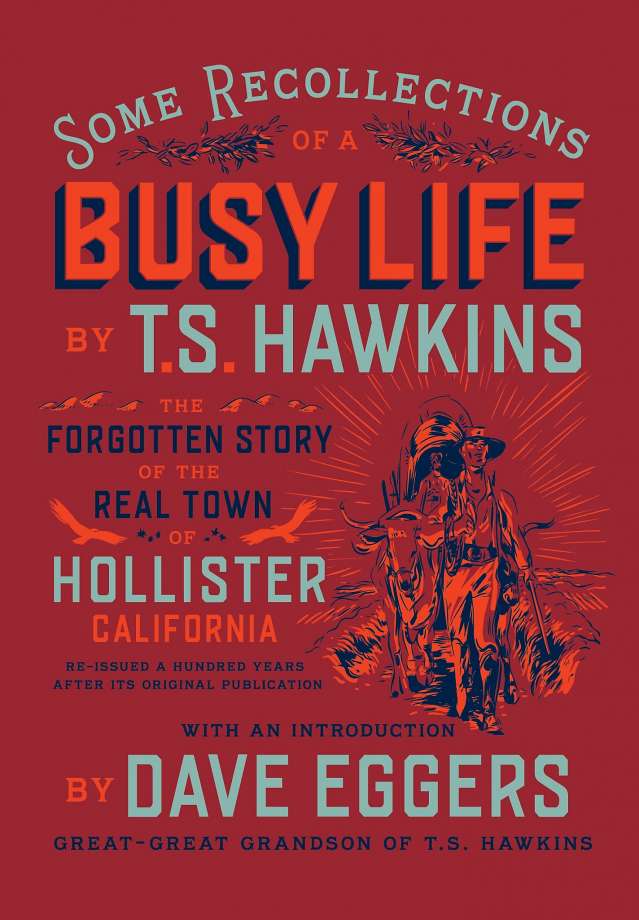
[READ: July 22, 2017] Some Recollections of a Busy Life

The beginning of this book includes Dave Eggers’ essay that was in the New Yorker, July 20, 2015 issue.

Read about it here.

T.S. Hawkins was Dave Eggers’ great-great grandfather.  In 1913 Hawkins wrote Some Recollections of a Busy Life and printed 300 copies.  Now 102 years later, Eggers was able to use his press to get it reprinted,

What’s even more disconcerting is that we’re prepared for the book to be 102 years old, but it starts with Hawkins talking about what it was like seventy years ago.  So the beginning of this book is actually set in the 1840s and 50s.  He was born March 6, 1836 in Missouri about 12 miles from the Mississippi River. His grandfather had been from Virginia and then moved to Kentucky and then on to Missouri.

He is writing his recollection not believing that the general public would care about them but he hopes his children and grandchildren might be interested in the changes which have taken places over the years of their grandfather’s life.

He grew up West of the Mississippi with no railroads and no telegraphic or telephonic communication with the rest of the world.  News in the East took weeks to reach them.  Electrical lighting was a thing undreamed of.  They made their own soap with the ashes from their fires.  Their clothes were homemade. (more…)

Read Full Post »

SOUNDTRACK: ANTONIO LIZANA-Tiny Desk Concert #615 (April 28, 2017).

I am fascinated by Lizana, but more for his voice than anything else.  Lizana’s singing voice/style sounds a lot like the lead singer of Gipsy Kings (musicians from Arles and Montpellier in the south of France, who perform in the Spanish language with an Andalusian accent).  Lizana is from Spain, but he has that same strained and fascinating delivery.  The blurb here hints that maybe that is just the style of flamenco:

In many ways, the traditions of flamenco and jazz could not be further apart, but in the hands of a few Spanish jazz musicians, these two worlds commingle and find common ground. Antonio Lizana is one such musician, both a saxophonist and vocalist with one foot firmly planted in each tradition. As a vocalist he has mastered the Moorish, note-bending improvisations that make flamenco singing so beguiling, while the fluidity of ideas he expresses as a saxophonist place him in the time-honored tradition of composing while playing.

Indeed, between jazz-like saxophone, Lizana sings flamenco vocals.  For these three songs, Lizana and Jonatan Pacheco (percussion) and Andreas Arnold (guitar) play quite a mix and it works very well.  The band is also quite multicultural as well as Andreas is from Germany and Jonatan is from Spain (and he plays a mean box drum).

“Airegría” is about 6 minutes long.  It begins with hims singing over the percussion.  It after a minute and a half that the guitar comes in and not until almost 2 and a half minutes before the sax comes in.  The guitar is kind of staccato while the sax is pretty fluid.

Introducing the band he says, “We’re very happy to be here playing.  We have today on the stage or on the desk…”

“Déjate Sentir” more conventionally jazzy sax but the main melody comes from his kind of scat singing.  Ad I find tat when the guitar kicks in I prefer him singing to guitar rather than playing the sax–I suppose traditional flamenco over jazz. But I can appreciate the sax too–especially when it seems to push aside the flamenco style for a bit.

“Viento De La Mar” is a smoother song with some pretty guitar and light jazzy sax.  My favorite moments comes in the middle with the chiming percussion and the big ending.

[READ: June 24, 2016] Big Bad Ironclad

How cool is this series?  It is so cool that this is the official author bio:

The spy Nathan Hale was executed in 1776.  The author Nathan Hale was born in 1976.

Nathan Hale is the author/illustrator’s real name and he uses the spy Nathan Hale as the narrator of his stories about history (or in this case the future–for the spy, that is).

The book begins on September 22, 1776 as Nathan Hale is about to be hung for treason.  The British soldier in charge of the execution is cross, but the executioner himself is kind of giddy because Hale is going to tell another tale.

After some amusing introductions, designed to antagonize the solider, Hale settles in to tell the story of the iron ships (iron doesn’t float!).

And thus he begins the story of the Merrimack and the Monitor.  The year is 1861 and Abraham Lincoln has just been elected.

Hale uses some very funny narrative devices to get some of the salient battle points across, like General Scott’s anaconda plan–surround the enemy and squeeze.  But how can they do that with only four, yes four, ships?

The North’s man in charge was Gideon Welles, nicknamed Father Neptune.  Stephen Mallory is in charge of the confederate navy–the executioner dubs him “sharkface.”  And in the most amusing nod to comics, Gustavus Fox (Foxy) is rendered as a fox (he’s a cute li’l fox). (more…)

Read Full Post »

SOUNDTRACK: DANILO BRITO-Tiny Desk Concert #619 (May 12, 2017).

This is a pretty great  introduction to the music of Danilo Brito:

After four chords, the notes start to fly — Danilo Brito and his four collaborators, three Brazilians and one American, are off like jackrabbits in front of a hound, having hustled their instruments to the Tiny Desk at the end of a North American tour.

Brito plays the mandolin, and boy how his finger fly.

Brito a 32-year-old mandolin player, made his first record when he was a teenager, plays a type of music called choro (pronounced “shore-oo”).  It’s said that choro started in the streets and back yards and made its way to the concert hall. Brazilian musicians of all genres have drawn on choro, from popular composer Antonio Carlos Jobim to Heitor Villa Lobos, one of the giants of Latin American classical music. Its literal translation from the Portuguese is “to cry,” but in Brito’s dextrous hands a better translation may be “crying out to be heard.”

They play five songs.  “Sussuarana” is just full of amazing finger work.  The pace is breakneck and exhausting.  How does he do it?.  There are two guitars (Carlos Moura (7-string guitar) and Guilherme Girardi (guitar)) playing chords and the mandolin zipping all over the place.  In the background, Lucas Arantes plays a small guitar called the cavaquinho and Brian Rice (the American) keeps the beat on the pandeiro.

Between songs he has a translator explain that they are playing “a little bit of Brazilian instrumental music.”  He says this style of music started around 1860, mixing jazz and classical and African music.”

“Lamentos” is a much sadder song (as you might imagine), but it is gorgeous.  For “Tica” Arantes and Rice step aside.  “Tica” is his own composition.  It is a waltz in two tempos.  There’s some wonderful lead lines that run up and down the instrument.  It’s fascinating that while his lines are still fast the rest of the musicians are at a slower pace.  There’s a lovely middle section of delicate guitar, but once it ends they take off again.

The next song is “Melodia Sentimental” it sounds like the soundtrack of a weepy romance film–heart string tugging.

Brito and his colleagues play their arrangement of Villa Lobos’ “Melodia Sentimental,” originally written for voice and orchestra.  What you’re actually hearing is a kind of formal Rodas de Choro, the circles of players who developed this music more than a century ago and have carried it on to the present.

Only — in the backyards, they don’t wear suits and ties.

The final song “Pega Ratão” is also an original piece.  It is short and never stops.  It is great watching his fingers fly.

[READ: June 12, 2016] One Dead Spy

How cool is this series?  It is so cool that this is the official author bio:

The spy Nathan Hale was executed in 1776.  The author Nathan Hale was born in 1976.

Nathan Hale is the author/illustrator’s real name and he uses the spy Nathan Hale as the narrator of his stories about history (or in this case the future–for the spy, that is).

This is the first book in the series so it begins with the historical Nathan being brought up to the gallows.  The people are all there to watch a hanging, but they are disappointed that the guy to be hung is a spy, not the arsonist.  And then Hale is brought up to the British soldier and the executioner (who looks at Hale and say “This is awkward”).

Hale mutters his famous last words: I regret that I have but one life to give for my country.  And as that happens a The Big Huge Book of American History comes down and swallows Hale and then lets him back out because he just “made history.” (more…)

Read Full Post »

   SOUNDTRACK: WAXAHATCHEE-Tiny Desk Concert #321 (November 23, 2013).

Waxahatchee is pretty much Katie Crutchfield.  The band recently played a show near me and I wondered if it was a band or just her.

This might be as intimate as hearing Katie Crutchfield sing in her basement. That’s where she and her sister would play guitar, write and sing songs 10 years ago, when she was 14. Katie and Allison Crutchfield had a band back in Birmingham together, The Ackleys; these days, Katie performs as Waxahatchee, while Allison’s band is called Swearin’.

The songs Waxahatchee brought to the NPR Music offices aren’t just stripped down for this Tiny Desk Concert, this is Katie Crutchfield as Waxahatchee, spare and exposed; this is what she does. Sometimes there’s a drummer (her sister’s boyfriend Kyle Gilbride) and at other times another guitarist, her boyfriend Keith Spencer (both play in Swearin’), but even on Waxahatchee’s second album, Cerulean Salt, there are plenty of bare-boned songs. This is intimate music for an intimate setting, as we got to stand in careful silence, listening intently and capturing this frail and powerful performance.

And all of that is true.   These are pretty, quiet folk songs.  They are so quiet it almost seems like she doesn’t have her amp on—you can hear her pick striking against the strings.

To me the power of these songs is in the lyrics, and yet the music isn’t boring or simple either.  Her chords are always, if not interesting, then certainly spot on.  But I keep coming back to the lyrics.  Like the end of “I Think I Love You”

I want you so bad it’s devouring me / and I think I love you but you’ll never find out.

Her speaking voice is quiet too, and after the first song she admits, “This is one of the coolest things I have ever gotten to do.”

“Bathtub” has this wonderfully intense line:

And I tell you not to love me
But I still kiss you when I want to
And I lament, you’re innocent
But somehow the object of my discontent
And it’s fucked up, I let you in
Even though I’ve seen what can happen

The entire Tiny Desk Concert is only 9 minutes–which is simply too short.  I know that the Tiny Desk Concerts usually have bands play 3 songs, but when they are mostly short ones like “Tangled Envisioning” (not even 3 minutes), they could tack on an extra one or two.

[READ: August 30, 2016] Science: Ruining Everything Since 1543

Zach Weinersmith writes the daily webcomic Saturday Morning Breakfast Cereal.  I supported the Kickstarter project for this book because it looked frankly hilarious.  The one thing I have to say off the bat is that I don’t love his drawing style.  There’s something about it that I simply can’t get into.  Even after two full books of these drawings, it just never gels for me.  But that’s fine. because I’m here for the jokes.  And they are awesome.

The book is comprised of the best religion-themes comic from the 13 years that SMBC has been around.  There’s also a whole slew of comics that are exclusive to this book.

We are greeted with this: “For these drawings, the part of God is played by a giant yellow disc.” (more…)

Read Full Post »

  SOUNDTRACK: DAUGHTER-Tiny Desk Concert #313 (October 21, 2013).

Daughter is a quiet folk band (at least in this Tiny Desk Concert) in which two acoustic guitars (Elena Tonra and Igor Haefeli) and one drum (Remi Aguilella) play behind Tonra’s gorgeous, angsty vocals.

For all three of these songs, she sings delicate whispered vocals that are quite lovely, but also quite dark.

Like this line from “Youth” “Most of us are bitter over someone / setting fire to our insides for fun.”  I love the way Haefeli’s guitar harmonics sound like keyboards and how powerful the martial drumming sounds when it comes in.

“Landfill” opens with thudding drums (Mallets instead of sticks) which are louder and bigger and yet still feel gentle.  And yet, as the blurb says: The song is “achingly pretty and melancholy, the track builds to an absolute gut-punch of a line — “I want you so much, but I hate your guts” — that conjures a pitch-perfect mix of gloom, desire and hostility.”

They put out an EP and in 2013 released an album:

the lovely If You Leave, but Daughter was kind enough to resuscitate “Landfill” for this stripped-down performance at the Tiny Desk. As you’ll see and hear, that aforementioned gut-punch is a recurring specialty for the band: In all three of these sad, searing songs, singer Elena Tonra showcases a remarkable gift for coolly but approachably dishing out weary words that resonate and devastate.

Between these two songs, Bob asks if this is an awkward place to play, and she responds, “No, we’re just awkward people.”

For “Tomorrow” there is a beautiful ascending guitar melody and loud drums.  I really like the way the guitars play off of each other–even though they are both acoustic, they sound very different and complement each other nicely.  Like in the wonderful melody at the end.  Despite how pretty the song was, apparently she was unhappy with it saying “a bit ropey, that one.”  I hadn’t heard that before, but evidently it means “unwell…usually alcohol related” so that’s pretty funny.

[READ: August 30, 2016] Science: Ruining Everything Since 1543

Zach Weinersmith writes the daily webcomic Saturday Morning Breakfast Cereal.  I supported the Kickstarter project for his book Religion: Ruining Everything Since 4004 BC and this book was part of my funding level.

I was more interested in the religious comics, but I am tickled by how funny the Science comics are.  Weinersmith knows a lot of science (or at least scientists) and make some really funny jokes about the subject.

The one thing I have to say off the bat is that I don’t love his drawing style.  There’s something about it that I simply can’t get into.  Even after two full books of these drawings, it just never gels for me.  But that’s fine. because I’m here for the jokes.  And they are awesome. (more…)

Read Full Post »

SOUNDTRACK: HEM-Tiny Desk Concert #306 (September 28, 2013).

Hem is one of All Songs Considered‘s earliest discoveries. Back in 2002, we received a beautiful and unique album called Rabbit Songs. It was a homey, fireside kind of record, with a sound that could be called country or Americana, and the arrangements by Dan Messé made it feel quaint and warm. To top it off, there was singer Sally Ellyson, an untrained natural talent with an effortless yet breathtaking voice. Hem has gone on to make five more albums since Rabbit Songs; their latest, Departure and Farewell, finds the group still writing songs that feel as if they’ve always been there.

Bob is quite right about the feel of this band, the drums are actually foot stomping and piano tapping, and that makes the band sound like they are siting around cozy room with friends.   And then there’s her voice.  There’s nothing specific about it that stands out, and yet it really does.  Her voice feels incredibly warm and welcoming, making you want to stop and listen.  And perhaps it’s something about the recording which makes everything feel soft (but not muddy) and warm.

And even in the songs themselves, it feels like friends hanging out.  During “Walking Past The Graveyard, Not Breathing” they say “go George” as the intro to the bass solo and then “go Heather” for the violin solo.   “Tourniquet” has some great lyrics, between the alliteration at the beginning and the great metaphor of the song, I was so taken with the lyrics that I didn’t even realize how pretty the melody was:

Brooklyn, I’m broken — I’m breaking apart
Oh Brooklyn, your bridges are bound up in light —
Every artery’s clogged as you pull the belt tight —
And this tourniquet turns even tighter until
Traffic comes to a standstill

When the song suddenly takes off near the end (but only briefly) it really elevates the song which was already delightful.  Introducing the final song, “Seven Angels” she says they are excited to be there, playing in this format.  She says the song can be seen as a lullaby–she likes to sing it for her sister.  She says she doesn’t write the songs but she can pretend this one is hers.

It’s hard to imagine this band playing a venue much larger than this one–they seems right at home in a small space.

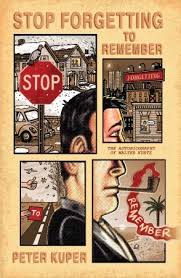
[READ: July 31, 2016] Stop Forgetting to Remember

This is a fascinating story about the comics artist Walter Kurtz.  I know very little about Peter Kuper, but I gather that this is sort of his life but written as an autobiography of somebody else.  (For instance, Kurtz was born on the same day as Kuper).

The back cover blurb also states how daring it was for Kurtz to write all of this –showing the embarrassing details, etc.: “My spouse would have killed me!”

This book is a collection of “stories” (not sure if they were ever published separately) that are joined by the narrative thread of Kurtz telling us about his life.  And the “occasion” for this reflection is the pending birth of his first child.  He is freaking out a bit–when he was young he never wanted kids, and then maybe he was cool with it, but recently he’s become terrified again.  He’s particularly afraid because he’s engaged with the world and he sees that as each month goes by, things get worse: AIDS, global warming, overpopulation, famine, wars (and that’s just 1996). (more…)

Read Full Post »


SOUNDTRACK
: BATHS-Tiny Desk Concert 300 (September 4, 2013).

I was unfamiliar with Baths and I am impressed by their busy-ness in this set.  There are only two guys playing, both play with various computer gadgets and then switch to keyboards and guitars.  They layer more and more music on this fairly dancey and very electronic sound.

Baths, a.k.a. Will Wiesenfeld, plays mysterious and textured electronic music. When Wiesenfeld came to the Tiny Desk, I expected contemplative tones and a laid-back performance; he does, after all, call his project Baths. But what sets him apart from the vast majority of like-minded performers is that his music doesn’t get buried behind the buttons or lost in a hypnotic glaze.

Wiesenfeld is an extrovert live, and at the Tiny Desk, he sounds vibrant and compelling as he performs songs from this year’s Obsidian. His partner Morgan Greenwood, an accomplished music-maker in his own right, keeps the music dense but frees up Wiesenfeld to sing with few distractions; there’s a mind-meld between the two that’s undeniable. They’re not accustomed to playing in the light of day, but they enchant in this perfect introduction to their work.

Wisenfeld’s vocals are a lot of wordless sounds (ba ba ba, na na na) that get looped and mixed around.  He sings in a rather high register, especially when making the looped sounds.

“Miasma Sky” builds with layers upon layers of sounds and vocals.  The sounds are manipulated in great ways with those little knobs and sliders. And just as you think it’s going to end with a series of delicate synth and guitar notes, he begins looping them which create the building blocks for the rest of the song.   It’s primarily keyboards and glitchy drums until the end.

“Phaedra” begins with some heavy drums and them playing around with all their gadgets.  This is a fast, pumping, dancing song.  Greenwood sings backing vocals in an equally high register.

“Ocean Death” has deep thumping drums and an opening with lots of na na nas and la la las in a textually rich soundscape.  It all fades down o just drums before building back up again.

[READ: July 9, 2016] Ruins

Seven years ago I read a book called Diario de Oaxaca, a sketchbook by Peter Kuper that I really enjoyed.  When I grabbed this book of the shelf the other day I didn’t realize it was the same guy.  But I can see that that sketchbook informed this excellent graphic novel.

The Diario covered his two-year stay in Oaxaca where he drew a lot, studied insects (and saw the monarch butterflies) and experienced both chaos and contentment.

This fictionalized account of the story places two characters into a situation that sounds similar to what he experienced, but with enough difference to keep it purely fictional. (more…)

Read Full Post »

harpers-magazine-march-2017-4 SOUNDTRACK: GUCCI MANE-Tiny Desk Concert #586 (December 12, 2016).

gucci

Usually when someone is popular I have heard of him or her.  So I’m always surprised when someone gets a Tiny Desk Concert and I don’t know them (especially given his story).

Gucci Mane sounds kind of familiar, but I don’t think I’d ever heard of him before.  So what does the blurb say:

Gucci Mane’s smile makes you feel like there’s still some good in the world. He’s really earned it, and that thing is infectious. We asked him to come to NPR because we wanted to be a part of the victory tour he’s been on this year: In the past six months or so, Gucci Mane was released early from the federal penitentiary; he proposed to his girlfriend on the kiss cam at a Hawks game, and she said yes; he’s releasing a total of three albums, all over which he celebrates his newly committed sobriety; he and Courtney Love look like they get along; and he remade “Jingle Bells.”

In this Tiny Desk concert, Gucci Mane performed with just his longtime producer and friend, Zaytoven, on piano. Their version of stripped-down is a minimal backing track and plenty of church-groomed trills. They performed with the understanding that everyone in the room knew their songs — one from 2009 and two from this year — and knew that this performance would represent a surreal dip into a parallel universe where ingenuity is rewarded, snobbery is gone and love is real. Gucci Mane agreed to this unlikely set as a gesture to those people — for remembering his work while he was away, and for cheering on his resurgence, his health, his charm and his singular nature.

Gucci does the three songs, “First Day Out,” “Waybach,” and “Last Time,” all accompanied by Zaytoven, easily my favorite stage name and the absolute highlight of this show for me.

Gucci Mane’s flow is a kind of slow drawl.  It’s kind of charming and engaging.  I find it really strange that he’s rapping over himself (I guess).  But it’s so stripped down that it’s weird to hear his backing track so clearly.  But that live piano totally make the show fantastic–Zaytoven has some amazing chops.

[READ: February 21, 2017] “Sinking Ships and Sea Dramas”

The introduction to this story was pretty fascinating.  This piece is an except from a manuscript in progress inspired “in part by lines from the work of Ben Lerner, the poetry editor of Harper’s

This was translated from the German by Isabel Fargo Cole.

I’m not sure what Lerner wrote that inspired this, but this “cycle” consists of 6 ruminations on death and the sea. (more…)

Read Full Post »

15 SOUNDTRACK: SPIRIT FAMILY REUNION-Tiny Desk Concert #244  (October 8, 2012).

sruI first heard Spirit Family Reunion when NPR covered their show at Newport Folk Festival in 2012 (a few months before they played the Tiny Desk).  I really enjoyed their set which was vibrant and fun.  And clearly Bob Boilen did too.

Spirit Family Reunion was my favorite find at this year’s Newport Folk Festival. The group makes music I’d call “new old-timey,” but which its members call “open-door gospel” — gospel music that’s not tied to any particular religious denomination.

There are 6 0f them plating–an upright bass, banjo, guitar, fiddle washboard (!) and drums.  And they play three songs.

“Leave Your Troubles At The Gate” opens largely a capella and then just takes off with some wild fiddling and fast strumming from everyone else.  For this song, the guitarist sings lead and the fiddler sings a higher pitched backing vocal—his voice is powerful and at an unexpected pitch.   They finish up and he says, “first song of the day… that’s a way to wake up.”

For the second song, “Green Rocky Road,” the violinist sings this one.  It changes the tone of the band since his voice is so different—strained and intense sounding.  When the song ends, he says, I hope you like singing….  we need help on this one.”

Throughout “I’ll Find A Way” he tries to encourage everyone to sing along (it’s hard to hear if they do): “Its fun, don’t be bashful.”   It is a simple song with an easy to repeat refrain.  And it is indeed uplifting: “When we’re singing together we’re shining a light on the dark places between us.”

[READ: July 10, 2016] “Foster”

This is a story set in Ireland.  It’s about young girl whose Ma is about to have another baby.  The girl is being shipped out to a friend for the summer so that her mom and dad can have the baby in peace.

The story is about the girl, but it is also about the couple who have fostered her.  They are much better off than the girl’s family–a far more successful farm with a much nicer house.  But something about them seems a little off to the girl.

I enjoyed the story although I was unclear when it was set.  The setting is quite rural, and there is talk of an outhouse and a chamber pot.  But there is also a television and plastic washing up on the shore, so it’s not as old as I thought. (more…)

Read Full Post »

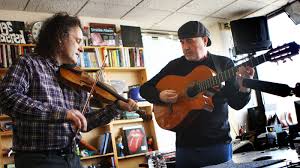
19SOUNDTRACK: MARTIN HAYES & DENNIS CAHILL-Tiny Desk Concert #269 (March 11, 2013).

hayescahillEven though I have enjoyed much Irish music over the years, I was unfamiliar with Martin Hayes and Dennis Cahill.

The blurb says:

You’re about to watch one of the best fiddlers on the planet and a subtle guitar master work their magic. For too many of us, Irish music is something that merely gets trotted out around … St. Patrick’s Day and the coming of spring — and made a cliche by commercialism.

But for a moment, stop, put aside your notion of jigs and reels, and just listen. Martin Hayes plays his fiddle with an exquisite touch and tone, as well as a magnificent sense of melody and rhythm that never ceases to astonish.

Hayes has worked with many accompanying musicians, and some are equal partners, but with Dennis Cahill you get delicate support. It’s a rhythm that keeps the tune in; that accents and colors it but never overtakes it. It’s brilliant restraint that serves the music and perfectly suits his partner. So with fresh ears, come join us in a rare treat with a familiar sound.

And indeed, this is just beautiful fiddle playing and understated guitar work.  It’s a fantastic pair.

They play three pieces (some of which are actually made up of smaller independent pieces).

“The Mountain Lark/Tom Doherty’s Reel” I’m not sure when the first part ends, but I love as they get near the end of the piece—the fast bowing is just great.   Hayes gets some really amazing sounds.

As with many great Irish players, modesty is the key.  He talks about how he learned while watching his father and how he enjoys other players.  He talks about how traditional Irish music is not slavishly about the past, but it incorporates new elements into an old tradition.  As you can tell by the name of the second half of this next pair: “P. Joe’s Reel/The Barack Obama Reel.”

He also says that it’s good to see you get music breaks.  Music breaks should be part of all work—lunch break and music break.  The final piece is in fact a traditional piece called “O’Carolan’s Farewell To Music.”  It was originally written for harp by Turlough O’Carolan and is rumored to be the final piece that O’Carolan played before he died.  The transposition to fiddle and guitar is perfect.

[READ: February 8, 2016] Bad Babysitter

Babymouse continues to delight with the funny stories and amusing spoofs.

This story opens with Babymouse dreaming about “The Old Woman Who Live in a Shoe” (which is instantly transformed into a bunny slipper).  She wakes from her daydream about comics to see an ad for a Super Scooter, only $79.  There’s no way Babymouse’s mom will pay for this, so Babymouse better save up!

The next day at school one of her friends say that there’s a babysitting job available if Babymouse would like it.  Babymouse imagines herself as Mary Poppins until the dream kitten (who looks suspiciously like Felicia Furrypaws) complains about her whiskers.

Babymouse is set to babysit for Mrs Ladybug whose child (she swears) is a sweteahrt and only cries when he is hungry.  And, he should sleep the night. Ha!  He is up all night and, just like with her goldfish, Babymouse overfeeds the baby until it throws up all over her.  This job ends with her watching a zombie movie (called Babysitting Movie) and causing serious damage to the hosts’ house. (more…)

Read Full Post »

« Newer Posts - Older Posts »