 SOUNDTRACK: Jazz Lives At Duke Ellington’s Resting Place (Field Recordings July 2, 2015).
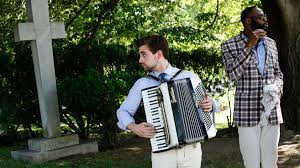 Playing jazz at a cemetery during the day seems like an odd decision. But it’s all part of the one-day Make Music New York festival (MMNY) which celebrates music and community. It happens every June 21 with more than 1200 outdoor concerts across the five boroughs running from morning till night.
For the 2015 edition, the festival’s organizers invited musicians to six different burial grounds across the city to riff on the idea of “exquisite corpse,” a surrealist parlor game popularized by artists and poets in the 1920s. In the game, someone writes a phrase (or draws part of a figure or scene), folds that part of the page over, and then passes it to the next player, who then does the same. The game ends when everyone has had a turn. That game is a natural bridge to the art of improvisation, and to jazz.
Woodlawn Cemetery is a mecca for the jazz world — it’s the final resting ground of royalty like Duke Ellington, Miles Davis and many others, including Ornette Coleman now as well. So as a tribute to their musical forerunners, the group — singers Michael Mwenso and Vuyo Sotashe, trumpeters Alphonso Horne and Bruce Harris, saxophonist Tivon Pennicott, pianist Chris Pattishall, bassist Russell Hall, drummer Evan Sherman and tap dancer Michela Marino Lerman — took as their point of departure W.C. Handy’s 1914 tune “St. Louis Blues,” a tune essential to jazz’s DNA. But they made it their own via surprising and turns that saunter through many textures, colors and rhythms.
The song begins with vocals from “St. Louise Blues” from Vuyo Sotashe and accordion from Chris Pattishall. After a verse, Michael Mwenso (whose voice sounds very different) takes over. The accordion drops out and it’s just voice and bass.
They pass the baton along to the horns, two trumpets, one with a mute in, the other using the mute and a saxophone play a lively instrumental break. This is followed by the percussion. Evan Sherman and Michaela Marino have a percussive call and response. I could have watched that part for a lot longer.
When that’s over the whole group joins together to end the song.
[READ: September 10, 2018] “Audition”
The first line of this story reads, “The first time I smoked crack cocaine was the spring I worked construction for my father on his new subdivision in Moonlight Heights.”
A first implies a second (especially with crack).
The story is about a 19-year-old college dropout. He went to school to study theater but “unmatriculated” and has been working for his father’s construction firm. His father came from nothing and build up this firm which is presently creating a development. His father is not too happy about him wanting to be an actor and as such is paying him the same as everyone else (which isn’t much).
He still acts–in community theater, but usually to 15 people at a time.
No one knew that he was the owners son and he liked it that way–he was using this time to study the laborers to learns their mannerisms–he was acting in his job, too, New workers came through all the time (the pay was lousy after all).
The crack came from a coworker Duncan Dioguardi who was not acting. He was a laborer living in his mother’s basement and longing to party.
The narrator knew “party” meant get high. When Duncan’s car died and the narrator drove Duncan home (an hour out of his way), Duncan invited him to party. The narrator was intimidated, then intrigued so he did. And that was the first time he smoked crack.
He marveled how the lump of crack looked like some drywall that could easily be swept away. Duncan showed him how to smoke it. It tasted like nothing. It smelled like nothing. It was ant climatic except for his new-found fondness for Duncan whom he now considers a good friend.
That following spring he received a call from his old acting teacher to audition for a role It was a stage show. The character would be on stage for all three acts but would not speak a word. The narrator didn’t know if this was a step forward or backward. The audition went well and he was sure he would get the gig.
Duncan’s car broke down again and the narrator told him all about the potential role. But the narrator was more excited about the option of partying some more.
The story ends soon after this, which is a little disappointing as it is told from many years later and we never learn how he turned out. But i did like the details of the past like “wiring th ehouse for internet, whatever that was.”
For ease of searching, I include: Said Sayrafiezadeh







 SOUNDTRACK: BLUE ÖYSTER CULT-compilations and live releases (1978-2010).
 For a band that had basically two hits (“Don’t Fear the Reaper” and “Burnin’ for You”) and maybe a half a dozen other songs that people might have heard of, BOC has an astonishing number of “greatest hits” collections.


 This doesn’t include any of the “budget price” collections: E.T.I. Revisited, Tattoo Vampire, Super Hits, Then and Now, The Essential, Are You Ready To Rock?, Shooting Shark, Best of, and the 2010 release: Playlist: The Very Best of).
 The lesson is that you evidently won’t lose money making a BOC collection.


 And, although none of them have “Monsters” for the average person looking for some BOC, any disc is a good one.


 Then, in 1994 we got Live 1976 as both CD and DVD (which spares us nothing, including Eric Bloom’s lengthy harangue about the unfairness of…the speed limit). It’s the most raw and unpolished on live sets. 2002 saw the release of A Long Day’s Night, a recording of a 2002 concert (also on DVD) which had Eric Bloom, Buck Dharma an Allan Lanier reunited.

 They also have a number of might-be real live releases (fans debate the legitimacy of many of these). Picking a concert disc is tough if only because it depends on the era you like. ETLive is regarded as the best “real” live disc, although the reissued double disc set of Some Enchanted Evening is hard to pass up. Likewise, the 2002 recording is a good overview of their career, and includes some of their more recent work.

 If you consider live albums best of’s (which many people do) I think it’s far to say that BOC has more best of’s than original discs. Fascinating. Many BOC fans believe that if they buy all the best of discs, it will convince Columbia to finally reissue the rest of the original discs (and there are a number of worthy contenders!) in deluxe packages. I don’t know if it will work, but I applaud the effort.
 SOUNDTRACK: BLUE ÖYSTER CULT-Mirrors (1979).
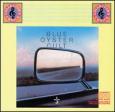 Lord only knows what happened to BOC on this disc. It’s almost as if the mirror on the cover was indicating a weird backwards image of the band. They had been flirting with pop tracks for a few albums now, but this one goes far over the edge. Backing female vocalists! Poppy ballads! No weirdo titles! And yet still no hits.
 I Just Read About That...