Feeds:
Posts
Comments

Archive for the ‘Rivka Galchen’ Category

harperioctSOUNDTRACK: BROOKLYN RIDER-Tiny Desk Concert #44 (January 26, 2010).
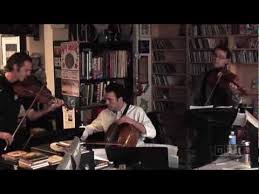
brooklynThis is one of the darkest Tiny Desk Concerts I’ve seen.  Meaning it is rather poorly lit.  I’m not sure why it is so dark in the office–oh, I see that it’s 4;30 PM.  But this string quarter isn’t hindered by it (although they do remark on it before the final song).

The notes state that the quartet (two violin, a viola and cello) loves Debussy and Brahms but they also write their own music and have teamed up with a Kurdish kamancheh player (or as the one player states, a Japanese shakuhachi player and an electronics musician).

The first song, “Vagharshabadi Dance” is an Armenian dance written by an Orthodox priest named Komitas. And they are quite animated as they play it.

In the introduction to the second piece called “Second Bounce” (which is a companion to a Debussy piece, which they play next). Colin Jacobsen (violin) says that he based it on the way a super ball’s first bounce is expected but the second can go anywhere.  And the notes they play are often unexpected (and bouncy).  They’re also quite hard (the viola player (Nicholas Cords) says the piece hurts his hand).  That piece is only a trio–they wanted to mix it up a bit.

The Debussy piece “String Quartet in G Minor: 2nd Movement” is very nice.  It’s got a lot of pizzicato (from all the instruments) while the others play a cool riff.  Johnny Gandelsman (violin) sat out of “Second Bounce” but he gets some great “solos” in this one.  I don’t know all that much by Debussy, but I like this.

“Ascending Bird” is sort of their theme song–an arrangement of a Persian folk song.  It has some incredibly fast riffs (even from the cello (Eric Jacobsen)) and some interesting scratching on the strings.

Check them out here.

[READ: March 6, 2015] “The Monkey Did It”

I had just read a short story by Murakami, so I was interested to read this piece by Galchen, whose insights are, I think, spot on.

toricelliShe talks about Murakami’s latest book, Colorless Tsukuru Tazaki and His Years of Pilgrimage and she uses the simile  that Murakami’s works are like Torricelli’s Trumpet or Gabriel’s Horn–finite space with infinite surface area.  And while I wouldn’t say that I thought of that myself, I would say that I have often thought that his stories seem so simple (at least in plot) but there is so much more in them.

I like the way that she talks about his books as having a plot that sums up pretty easily, but within the plot several other new threads are opened.  And they are more metaphysical at the same time.

In the novel friends vanish, but that is not the main plot.  Rather, Tazaki is haunted by the fact that his friends abandoned him some time ago.  His girlfriend Sara tells him he needs to figure this out.  So he sets off on a kind of quest.  Galchen notes that the girlfriends in his stories are always encouraging the main characters to do these quests. (more…)

Read Full Post »

harp marchSOUNDTRACK: RHEOSTATICS-Harbourfront Toronto, Canada Day (July 1, 2000).

harbourThis recording comes from an outdoor venue in honor of Canada Day.

As I understand it, the band was asked to write a new song for the Canada Day celebration and they came up with “When Monkeys Comes.”  It opens with a kind of disco version of “Also Sprach Zarathustra” and then morphs into a jamming Rheos song.  It doesn’t sound awesome on this mix (although the rest of the disc does), so it’s hard to get a real sense of what’s happening.  It feels a little meandering.  And since it doesn’t really appear anywhere else (except for an upcoming show), it’s hard to really parse it.

This show is interesting in that the band doesn’t talk very much–usually they’re very chatty.  Dave Bidini says that since their set is short (barely over an hour), they didn’t want to talk to much, so it’s all about the music.  They play the first seven songs without saying a word in between songs.  Also interesting is that those first seven songs are all new–not yet recorded for the Night of the Shooting Stars album.

There is a drum machine or at least a lot of electronic drumming on a couple of songs, which I believe are supplied by Michael Phillip Wojewoda, erstwhile extra member of the band for years, and official drummer in a few months.

After playing the new songs, the band does play some older songs.

They are still doing songs from Harmelodia (“I Fab Thee” and “Song of the Garden”) and this crowd, which I assume is all ages, is probably a good place for them.  They also play “The Ballad of Wendel Clark” which is super fun (and not played that often).  There’s some great versions of “Stolen Car” and “Self Serve Gas Station.”

It’s a good set (with good sound quality), especially if you like NotSS.

[READ: March 6, 2015] new movies

I rarely talk about movie or movie reviews here.  But since I like Galchen, and I’ve mentioned most of her writings so far, it seemed like a worthwhile inclusion.  And she’s talking about Paddingon, a movie I’d like to see

What I liked about Galchen’s review was that it’s not so much about the movie (which she likes and says is silly and smart and witty and pretty) as it is about the story of Paddington.

I don’t know the plot of the movie (or the books, actually, although I do know the premise of who Paddington is), but it sounds like a fun farce, with Hugh Bonneville (Mr Crawley on Downton Abbey) dressing as a cleaning lady to aid Paddington on “an essential fact-finding mission.”

But Galchen talks about how the movie (like the book by Michael Bond) pays attention to money (the cost of marmalade for instance) and to the African-Caribbean immigration to London in the 1950s.  Paddington is from darkest Peru (evidently Bond was going to have him be from Darkest Africa but there are no bears there).  And its this immigrant story which the movie focuses on.

Galchen also talks about how characters like Paddington (or Curious George or Pinocchio) are stand ins for children. But if they were actual children in the stories we would be repelled by them.

It turns out that Galchen has visited darkest Peru on a research mission.   They were checking fecal samples of the native chickens–looking for antibiotics.  They also conducted a kind of socioeconomic census of the region, which was, of course, ridiculous as none of the natives had much of anything.  Although she notes that the most common name for boys was Israel and the most common among girls was LadyDi.

This article didn’t make me want to see the movie any more than I do (because I am looking forward to it already), but it was certainly an interesting perspective and certainly one I wouldn’t be reading in Entertainment Weekly.

Read Full Post »

nov3SOUNDTRACK: COLONEL LES CLAYPOOL’S FEARLESS FLYING FROG BRIGADE-Live Frogs Set 1 (2001).

220px-Live_Frogs_Set_1With Primus on hiatus, Les Claypool set out to do some solo work with a band that was quite different from Primus’ three man set up.  But staying ever true to his roots, he included former Primus guys Todd Huth (guitar) and Jay Lane (drums) in addition to guitarist Eenor, Jeff Chimenti on keyboards and Skerik on saxophone.

The band in this incarnation released two live albums that were recorded in 2000.

This first one is the first set which is a couple of covers and some Les solo work all extended into lengthy jams.

The opening track is a cover of King Crimson’s-“Thela Hin Ginjeet.”  Musically they are great–the get all the complicated sounds perfectly.  Les can’t quite hit all the vocal notes that Belew does, but that’s okay.  There are a few lengthy jamming solos, which are quite different from the original.

Next comes the Sausage song “Riddles Are Abound Tonight.”  It’s the shortest song on the disc even with the sax solo.  Then come’s Les’ solo song “Hendershot.”  I like the album version better because of the dynamic way it is sung, but it’s cool live too.  “Shattering Song” has more energy live than on record.  I enjoyed the segue into “Riders on the Storm.”

“Running the Gauntlet” has a weird opening with that crazy watery bass and a song about a chicken laying a hard-boiled egg.  Then it gets into the song proper. After each section, a musician gets to take a solo.  Skerit goes over his allotted time  and Les gives him a hard time about it.  “Girls for Single Men” sounds much more sinister here and Les sings it very quickly–it’s a weird version.

The set ends with a really good version of “Shine on You Crazy Diamond.”  They really nail the music of it and Les sings it quite well, too.  This is a really solid collection of songs, especially if you like prog rock.

[READ: January 20, 2014] “Medical Meals”

This week’s issue of the New Yorker was its semi-annual food issue.  As such there were four food-related essays by writers who I’ve written about before.  The section was called “Rations.”

The first was by Rivka Galchen.  I’ve enjoyed Galchen’s writing quite a bit in the past.  And while I may have known she was a nurse, I never thought about her going to residency school or anything like that.

So this essay is about the kinds of crappy food that medical school students would eat during their rotations.  This is of course kind of funny to think that they are eating badly while they are supposedly taking care of other people.  It seemed especially obnoxious that they were eating this badly while working at a bariatric surgery center. (more…)

Read Full Post »

CV1_TNY_12_09_13Banyai.inddSOUNDTRACK: THE REPLACEMENTS-“Alex Chilton” (live on the Tonight Show) (2014).

matsI was pretty surprised to hear that the Replacements were going to be on the Tonight Show (and even more surprised to hear that they were going to play “Alex Chilton.”  I didn’t realize they were touring (or reunited or whatever they are), and I knew that at least one of the former members had died.  So, really this version of The Replacements is just Paul Westerberg singing and Tommy Stinson on bass.  The other two guys Dave Minehan on guitars and Josh Freese on drums are new as of 2012 (but have a history of working with Westerberg).

It was great to hear this song.  I never saw them in their heyday, when I understand the odds of them being drunk were 100% and the odds of a great show or a disastrous show were 50/50.

I’ve no idea how sober the guys were, but this version of the song was super sloppy (in a good way) and made it seem like they were channeling the ‘Mats of old.  Guitarist Minehan has played on Westerberg’s solo albums, so there is a connection, and he seemed to get that “can’t be bothered to hit every note” vibe.  Even Westerberg was skimpy with all of the words (was he having fun or annoyed at being there?  who knows).  But they weren’t sloppy bad, especially when the song ended and they added on a coda–they were all super tight and right on tempo.

It was good to hear, but I have to admit I like the album version better.

[READ: June 26, 2014] “The Late Novels of Gene Hackman”

Rivka Galchen had two short stories in the New Yorker in 2013, one in January and now one in December.

The story is about J, a young woman who makes presentations to older people, in this case in Key West, Florida.  She had accepted the invitation to the writers conference because it was going to be in February in Florida, and that seemed like a good time to be warm.  J was allowed to bring a guest, and she decided to invite her stepmother, Q, rather than her husband.  She felt a little sorry for Q, whose latest business venture had failed and whose hair was turning gray.  J is under the impression that Q is having financial troubles, she keeps talking about things that make it seem like she does, but J can never get a straight answer out of her.

They were picked up by M (this initial thing was a little confusing but ultimately more comical, I decided) who had organized the convention.  M had married a much younger woman, but she had recently died.  “Of something.”  M also had an eye patch, and J told Q not to stare at it, “‘I would never stare at an eye patch,’ Q said.”  (more…)

Read Full Post »

dtmaxSOUNDTRACK: TOM WAITS & KEITH RICHARDS-“Shenandoah” (2013).

roguesgallery-f8be47f3887d51de57ea842a129f0a722e53ef74-s1This tune comes from the album Son Of Rogues Gallery.  The album is, of all things, a sequel to the album Rogues Gallery.  The full title is Son Of Rogues Gallery: Pirate Ballads, Sea Songs & Chanteys.  The first album was a kind of novelty–I can’t even say novelty hit as I don;t know if it was.  But it must have had some success because here’s a second one (and there’s no Pirates of the Caribbean movie to tie it to).

The album has 36 songs (!) by a delightful collection of artists, including: Shane MacGowan, Nick Cave, Macy Gray, Broken Social Scene, Richard Thompson, Michael Gira and Mary Margaret O’Hara (among many others).  I enjoyed the first one, but I think the line up on this one is even better.

“Shenandoah” is not a song that I particulalry like.  Because it is traditional, I have a few people doing versions of it, but I don’t gravitate twoards it–it’s a little slow and meandering (like the river I guess) for me. And this version is not much different.  What it does have going for it is Waits’ crazed warbling along with even crazier backing viclas from Keith Richards (there;s no guitar on the track).

[READ: January 7, 2012] Every Love Story is a Ghost Story

I had mixed feelings about reading this biography.  I’m a huge fan of David Foster Wallace, but I often find it simply disappointing to read about people you like.  And yet, DFW was such an interesting mind, that it seemed worthwhile to find out more about him. Plus, I’ve read everything by the guy, and a lot of things about him…realistically it’s not like I wasn’t going to read this.  I think I was afraid of being seriously bummed out.  So Sarah got me this for Christmas and I really really enjoyed reading it.

Now I didn’t know a ton about DFW going into this book–I knew basics and I had read a ton of interviews, but he never talked a lot about himself, it was predominantly about his work.  So if I say that Max is correct and did his research, I say it from the point of someone full of ignorance and because it seems comprehensive.  I’m not claiming that he was right just that he was convincing.  And Max is very convincing.  And he really did his research.

It’s also convenient that DFW wrote a lot of letters–Max has a ton of letters to quote from.  And DFW wrote to all kinds of people–friends, fellow authors  girlfriends, colleagues….  Aside from old friends, his two main correspondents were Don DeLillo, whom he thought of as a kind of mentor, and Jonathan Franzen, whom he considered one of his best friends and rivals.  I guess we can also be thankful that these recipients held on to the letters. (more…)

Read Full Post »

SOUNDTRACK: RA RA RIOT-“Is It Too Much” (2013).

raraI loved the first Ra Ra Riot album The Rhumb Line.  This song expands on some of the ideas from that album, but I fear that it goes in the one direction I would have preferred they not go.  The album had strings, nice harmonies and a great singer all melded into an interesting rock structure.

This song retains all of the elements that were interesting, but it removes it from the rock structure, making it  sound much more lightweight.  It’s pushing too far into easy-listening.  And do I hear autotune on the vocals?  The instrumental middle section is the most interesting part of the song.  But Ra Ra Riot seems to have removed the riot part of their sound.  If this is the direction of the album, I’m afraid I won’t be following.

[READ: January 8, 2013] “Consider the Writer”

I just finished the D.T. Max biography of David Foster Wallace.  I was curious what kind of reception it received.  And lo, here’s a review by Rivka Galchen (something I would have read anyhow since I enjoy her so much).

Galchen opens with two main points–the biography is gripping (and it is, I’ll be saying more about that tomorrow, too).  She writes: “In writing a chronologically narrated, thoroughly researched, objective-as-­imaginable biography, Max has created a page turner.”

The second idea is that you keep thinking “that you just don’t find Wallace all that nice”  (which I also thought).  But then she wonders if it is fair to be worried about that.  We should not judge others after all.  Especially since, as she points out, “We don’t always find ourselves asking whether a writer is nice. I’ve never heard anyone wonder this at length about, say, Haruki Murakami or Jennifer Egan.”  So why is that a concern about Wallace?  Because niceness is what Wallace wrote about, tried to encourage.  And perhaps “One understandably slips from reading something concerned with how to be a good person to expecting the writer to have been more naturally kind himself.”  But that is not necessarily the case–people strive for things that they cannot achieve.   I like her example “the co-founder of A.A., Bill W., is a guru of sobriety precisely because sobriety was so difficult for him.”   And her conclusion: “Wallace’s fiction is, in its attentiveness and labor and genuine love and play, very nice. But what is achieved on the page, if it is achieved, may not hold stable in real life.”

And Galchen talks a bit abut DFW himself (the book is a biography after all).  How he wore the bandana because he sweated so much–how self conscious he was about that and by extension nearly everything he did.  This mitigates his not-niceness somewhat.  It also ties in to his alcoholism  drug use and depression.  And his competitiveness, which is obvious in the biography.  She enjoys the pleasure of Wallace’s correspondences, “especially with his close friend and combatant Jonathan Franzen, but also with just about every white male writer he might ever have viewed as a rival or mentor. Aggressive self-abasement, grandstanding, veiled abuse, genuine thoughtfulness, thin-skinned pandering — it’s all there.”  I rather wished that the authors’ own reactions were included (of course it’s not biographies of them, and they are still alive), just to see if they sparred back with Wallace or if they were put off by yet indulgent of his needs. (more…)

Read Full Post »

2013_01_07_p139SOUNDTRACK: HOLLY HERNDON-“Breathe” (2012).

herndonI love when Viking (Lars Gottrich) publishes his year’s best lists on NPR.  Between his Metal and his Outer Sound categories, there’s always something weird and cool to listen to that I would not have heard elsewhere.  This year he may have outdone himself with one of the weirdest “songs” I’ve heard.  In one sense there’s nothing weird about it–it’s very natural–but the fact that Holly recorded it, manipulated it, tinkered with it and released it on an album is fascinating.

It begins with Herndon (presumably) inhaling (a gasping, disturbing inhale) and then silence.  A long silence.  Which I believe is Herndon holding her breath.  Then she exhales.  And the process begins again.  The ins-and exs-are manipulated a little bit, making them sound mechanical and somehow even more desperate.  Nearing the end, the breath has been manipulated beyond all recognition as a human sound.  And then it comes back, sounding more male than female.  It’s staggering.

This should absolutely be used for some kind of soundtrack for something.  It’s utterly unique and utterly fascinating.  And, best of all, there’s a youtube clip for it–no video, just the album cover, which means you can just focus on the sound.


[READ: May 26, 2012] “The Lost Order”

I was delighted to see that Galchen had a new short story in the New Yorker.

The story concerns a woman who has lost a lot recently.  She is standing in the kitchen not making spaghetti (an arresting opening if ever there was one).  She is concerned that she needs to lose weight, so she is trying not to eat.  She has also recently lost her job–she tendered her resignation (she likes that word, tender).  Her husband has recently lost his wedding ring (it doesn’t “mean” anything–they don’t care for symbols).  And she has just taken a phone call from a belligerent man who orders Chinese food from her.  She listens to the entire order and even frets about making it. But of course, she doesn’t.

I loved the idea of the her taking the man’s order and promising 30 minutes.  This actually happened to me once.  I mis-dialed and the person on the other end took my order, but when I went to the (Chinese) restaurant to pick it up they had no idea what I was talking about.  I did not, as this caller does, call back 50 minutes later and call the person a cunt.  I just waited for my food with a new order.  Because of my personal association with that part I would have liked more of that angle of the story, but it proves just to be one part of a disarming collection of happenings for the narrator.   (more…)

Read Full Post »

SOUNDTRACK: KISS-Alive III (1993).

Kiss put out Alive! after just three albums.  Alive II also came out after three albums.  Alive III has 14 albums between it and Alive II (if you count the solo albums as 4).  I guess poor sales and poorly attended concerts don’t really suggest live albums.  But Revenge revitalized them somewhat so it was time for a new one–their first with no makeup!  And it’s a pretty good one.

But it’s also like Kiss has forgotten all about being Kiss.  There’s no “You wanted the best, you got the best, the hottest band in the world…Kiss” (which would have been untrue at the time anyhow, but since when has that stopped Kiss?)  The tracklisting is pretty darn good though.  For Alive II, the band didn’t want to repeat any tracks from Alive! (that’s such an endearing thing to say about the band with 400 repackaged hits records).  Since there are tons of records since Alive II, you’d assume Alive III was all 80s songs.  But that’s not the case.  There are a few inevitable duplicates (how could there not be–all their biggest hits were from the 70s), but I’m surprised they didn’t throw more current stuff on the disc.

It opens with “Creatures of the Night” a great heavy version.  Then they go way back to “Deuce” which is a cool surprise.  Since this was the tour for Revenge, you’d think there might be more songs from it, but there’s only three: “I Just Wanna” “Unholy” and “Domino.”  “I Just Wanna” was perfectly crafted for Paul to banter with the audience and get them to sing “I just wanna fuck” (which was edited from the album I understand).  And in this live setting “Unholy” sounds great.

“Heaven’s on Fire” works well live, even if I don’t really like the song–but the band can really ham it up here.  The big surprise has got to be “Watching You,” a totally unexpected song form the past.  And even if it was on Alive!, this version is quite different (no Peter Criss cowbell).  I don’t think much of “Domino” anyhow (well, the music is great but the lyrics, ick), but in this version Gene just seems kind of bored.

Another surprise comes in “I Was Made for Lovin’ You”  true it’s one of Kiss; biggest hits but they often try to distance themselves from the “disco” era.  Nevertheless this version sounds revitalized.  And since there were no live albums in the 80s, there’s no official live recordings of it.  “I Still Love You” is another great chance for Paul to shine.  “I Love It Loud” sounds great (although the harmonies get a little sketchy at times.  But it’s weird to hear “Rock N Roll All Nite” in the middle of the set instead of at the end.  It’s also odd to start off this song with “It ain’t bullshit when you say rock and roll all nite and party every day.”   The intro to “Detroit Rock City” is also very strange “It doesn’t matter where you’re born ,it doesn’t matter where you come from, it matters where your head is at. This one;s called Detroit Rock City.”  Huh.

There’s not much you can do with a dreadful song like “Lick It Up,” and ad-libbing “I wanna lick you” doesn’t make it any better.  The disc ends with “God Gave Rock n Roll to You II,” which I don’t like, but which sounds good live, a lot of energy.  And it wraps up with a very odd thing–a guitar solo version of the Star Spangled Banner.  It doesn’t compare to Alive! or Alive II, but Alive III is a good live album from a good live band.

[READ: August 15, 2012] “From the Pencil Zone”

This is a review of the microscripts of Robert Walser, an author whom I have never heard of.  Walser was born in Switzerland in 1878 and he published several shorts and several novels (which were admired by Kafka!).

As the market for shorts dried up, so did his career, and he moved into smaller and smaller places.  Accordingly, his handwriting grew smaller and smaller, too.  Eventually he cheeked himself into a series of mental institutions.

Walser’s early novels dealt with everyday life, like the “young boyish man” who wants to become a bookshop proprietor in The Tanners.  The character (whose name we don’t learn for a long time) is effusive, praising the job to the heavens as a divine calling!  And lo he is given the job.  A week later he declares, “the entire book trade is nothing less than ghastly.”  Wasler himself had a multifaceted career: butler, inventor’s assistant, clerk, journalist.  But he was eventually diagnosed with schizophrenia and is responsible for this quotable quote: “I’m not here to write.  I’m here to be mad.”

After Walser died, people discovered a treasure trove of 526 pages of “microscripts.”  The writing was so small that these 526 pages, when written in book form came to six VOLUMES of books.  They were released as Aus dem Bleistifsebiet (From the Pencil Zone).  Galchen’s review here is for the short one volume New Directions collection called Robert Walser: Microscripts.  Interestingly, most of the stories have no title and some seem unfinished.  New Directions (and Harper’s) include images of this man’s microscopic writings (all done in pencil of course).  He wrote in Kurrent, a widely used script at the time which was a version of medieval shorthand and which dramatically reduced the number of strokes per character.  His letters were often one or two millimeters tall.  He was able to fit six stories on a postcard received from a newspaper editor. (more…)

Read Full Post »

SOUNDTRACK: TARKIO-Sea Songs for Landlocked Sailors (1999).

Tarkio was Colin Meloy’s band before he formed the Decemberists.  My first reaction to the name Tarkio was that it sounded like Tarkus, the album by Emerson lake and Palmer.  And, since I heard about it during The Decemberists’ The Crane Wife album, which is proggy, I assumed Tarkio would be a prog rock band.  Little did I know that the real name of Tarkio comes from a train stop in Montana and that the real (at least to me) forerunner for this album is Tarkio by folkies Brewer & Shipley which featured the song “One Toke Over the Line.”

All of Tarkio’s music was collected in 1995 on the album OmnibusOmnibus contains their album I Guess I was Hoping for Something More, this EP, and various other unreleased tracks.

This EP actually came out after Tarkio’s debut album (when I decided to write this first I assumed it came first).  It seems especially surprising to me because the opening song sounds very different from anything on the LP.  Not worse, just like a direction they chose not to go in.  His voice is kind of processed and sounds, yes, funny.  Although I have to admit I rather like it—it’s much more alt sounding than the rest of the disc, which has a more folkie charm.  This disc was self released.  And I cannot believe that there are no images of it online anywhere.  Decemberists fans are crazy intense and no one has a copy of this CD?  Weird.

So as I said, the first song, “Devil’s Elbow” is full of vibrato and sounds like an alt rock song circa the mid 90s.  The solo sounds like it could be done by Robert Smith.  “Weight of the World” sounds more alt-folkie, big guitars and whatnot.  And the chorus sounds very much like a Decemberists song.  And check out these lyrics: “we hear the homeless philharmonic singing all the Charlies Angels to their heavenly convergence in the sky.” Pure Colin.

If you had any doubt that this was Colin Meloy’s band (which you wouldn’t, but if you did), this song title will tell you all you need: “My Mother Was a Chinese Trapeze Artist.”  Lyrically it is pure Meloy, although musically it’s more spare.  Decemberists fans will recognize this song from Castaways and Cutouts (that version is over a minute longer).  The Tarkio version has louder guitars as the song progresses, although the Decemberists’ version has more interesting instrumentation.  “Mountains of Mourne,” is a sad ballad played mostly on banjo.  “Never Will Marry” is a slow dirgelike song–very traditionally folk-sounding.

I really don’t know much about why Tarkio broke up.  This EP shows a band experimenting with their more ballad-y side.  Probably not destined to be a big seller, it works as a nice companion to their debut.

[READ: May 26, 2012] “The Region of Unlikeness”

This was the last short story I found by Galchen and I was really excited to read it.  It starts off a little oddly—it’s one of those stories where there are two characters spoken about and they are inseparable and it’s not always clear which is which.  Especially when the opening is as peculiar as this, “Ilan used to call Jacob ‘my cousin from Outer Swabia’”  Originally the narrator thinks it a joke, but she later decides it’s a sort of a clue.  She met the two of them by chance.  They were talking loudly and boisterously about Wuthering Heights in a coffee shop.  And that intrigued her to no end.  So she chimed in, and the three of them ended up talking for a while.  The crazy thing about them was that Jacob had a daughter. He seemed so carefree and like he had no responsibilities.   She never met the daughter, he barely mentioned his family, and yet she was always there in the back of his mind.

And she fell hard for Ilan—he seemed antiquated and resourceful like “fancy coffee and bright-colored smutty flyers.”  Of course all of her friends found the two of them arrogant and pathetic, but the narrator could not be drawn away from them.  Although really she was drawn to Ilan, who was generous with praise, while Jacob was kind of sulky and dark and was “jealous of Ilan’s easy pleasures.”  The narrator felt Jacob was pedantic.  All of this makes it surprising that the bulk of the story is about the narrator and Jacob.

And then she stopped seeing them.  Literally, they were nowhere to be found. (more…)

Read Full Post »

SOUNDTRACK: COLIN STETSON-Those Who Didn’t Run (10″ vinyl) [CST084] (2011).

This 10″ vinyl contains two more of Stetson’s amazing bass saxophone solo monstrosities.  Each is over ten minutes.  And while ten minutes can be a bit much to take for one of these songs, the music is so powerful and so jaw dropping to listen to that, frankly he could play for days (and maybe he actually could) and I’d enjoy it.

The amusing thing about this 10″ is that when I played it on my record player, I didn’t know what speed to play it at.  And, since the whole platter is full of bass saxophone blasts, and all of the percussion is clacking from the saxophone, I honestly couldn’t tell what speed it was supposed  to be played at.  It wasn’t like a song with vocals or anything.  And the first song I played was the B Side “The end of your suffering ” which is played on a low alto sax–meaning it’s higher than his usual stuff, so the 33RPM actually sounded like it might be right!

After knowing the proper sound (you can stream the music here), it’s funny to hear the slow version–which just sounds meaner and angrier (especially around the 6 minuite mark of “Those Who Didn’t Run,” when he’s really hitting some crazy notes.  But I was so intrigued by the slow version that I went back and listened to both sides at the slow speed, just for fun.  In the dark.  By myself.

[READ:May 22, 2012] “About the Typefaces Not Used in This Edition”

This seemed like a perfect piece to put next to Rivka Galchen’s piece about the future of paper.  This is listed as a short story, and in a way it is, although not in any conventional sense.  This was published in 2002, long before Safran Foer’s book of cut up text, Tree of Codes was even conceived, so it’s obvious that he has been interested in type, in the way words play off of each other, in the way words appear on the page for quite some time.

This short piece (two pages) discusses the eight fonts that the editor chose not to use for publishing “this book.”  I don’t know if this references a specific book or not, although he does include character names and broad concepts from “the book”: Henry, Elena, an unsafe wooden bridge, the last word is “free,” and many times the words, “I love you.”

The typefaces are: (more…)

Read Full Post »

« Newer Posts - Older Posts »