Feeds:
Posts
Comments

Archive for the ‘Authors’ Category

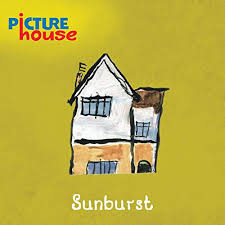
SOUNDTRACK: PICTUREHOUSE-“Sunburst” (1998).

Picturehouse drummer Johnny Boyle was in the Irish Drummers book.  I was unfamiliar with them, but apparently they were pretty huge back in the late 1990s (at least in Ireland).  Boyle played on this album (Karmarama) and the follow up.

“Sunburst” was apparently all over Irish radio when it came out.  After a fun opening drumfill, this song falls into a gentle indie rock vein.  There’s some lovely harmonies, some nice gravelly vocals from singer Dave Brown and a big soaring “what a day” chorus.

The end of the song bops along on series of bah bah bahs and and a tasty fuzzy guitar solo.

It’s a delightful jangly pop song and was understandably a big hit

[READ: March 15, 2021] “Girl with Lizard”

I was sure that I had read this story, or something like it, before.  But this is the first story by this author that I have read.  This story and the resulting short story collection Flights of Love were translated by John E. Woods.

The story concerns a boy and a painting.  It was a painting of a girl looking at a lizard on the beach.  His mother and father called it “The Girl with the Lizard” and his mother referred to the girl in the painting as “The Jewish Girl.”  The painting played a large role in the boy’s childhood.  He napped under the painting every day during nap time.  He became very familiar with the details of the painting, which had a pride of place in his father’s office.

He became so familiar with it that when asked to describe a painting in detail for school, he was excited to write about this one.  He stared at the painting and took in all the details. He marveled that when he was little he had to look up at the girl and now that he was older the two were at eye level with each other.

His father admired the essay but told him that the painting was very important and it would be much better if people didn’t know they had it.  He said it was valuable and din;t want anyone to steal it.  He refused to say anything more about it and over the boy’s life, he never learned the provenance of the painting,  But his father certainly believed it was valuable. (more…)

Read Full Post »

SOUNDTRACK: RHEOSTATICS-Jasper Heritage Folk Festival-Night set (August 3 2001).

The guys played a 40 minute set earlier in the day (playing the entire Harmelodia album).  Then in the evening they returned for an hour long set of new songs and some classics.

Night of the Shooting Stars was coming out soon and they were primed to play some news songs.  There’s also not a lot of goofiness–it’s a short set and they need to get it all out.

You can really hear Dave B’s acoustic guitar in “Mumbletypeg” and “In It Now.”

When they play “Aliens,” Dave sings “Artenings Made of Gold” at the end.  “Record Body Count” runs a little long with a lengthy solo at the end.

“Legal Age Life” has a country feel and when they do the “12 Bar Blues” part, they credit NRBQ–I never realized it was a song before–just thought they were making it up.
Dave asks, “Do the people of your generation still do the twist?  Because i saw very little twisting.  You twist now but there’s no music.

After a lovely “King of the Past,” They’re going to take it down for a couple of long slow songs.  They’re very poetic and we know how much the people of japer die for the poetry.  “Saskatchewan” is first and then “We’re gonna crank up the Hitmaker 2000” for “We Went West.”  Introducing the song:

The first time we toured was in 1987 across Canada.  I bet that was before you were born.  Every verse is devoted to a province–not every province but the ones we went to.  Yes, Alberta’s in it.  [cheers] Wait, you haven’t heard the verse about Alberta.

Someone shouts a request and Dave says, “We’re going to do a new song, but thanks for the request.”  Up comes a good “P.I.N.”

The set ends with a great “Stolen Car.”  The acoustic really rings and the end has a wicked loud and wild solo from martin.

These short sets are definitely less fun than the full length ones, but they sound fantastic.

[READ: March 14, 2021] “Austerlitz”

About ten years ago I read the novel Austerlitz, from which this excerpt comes.  At the time I had written

I read about Sebald in Five Dials. And the glowing talk about him made me want to read one of his books (specifically, this one).

This excerpt is quite long, but so is the novel.   It’s essentially the first few sections of the the novel.  I had written

Austerlitz is a strange novel [translated by Anthea Bell] which I enjoyed but which I never really got into.  I feel like rather than absorbing me into its words, the book kind of held me aloft on the surface.  As such, I have a general sense of what happened, but I’d be very hard pressed to discuss it at length.

The basic plot summary is that an unnamed narrator runs into a man named Jacques Austerlitz.  Austerlitz talks to him at length about his life. They run into each other at various points over the years, and Austerlitz’ story is continued.  And literally, that is the book.  Now, of course, Austerlitz’ story is multifaceted and complex.  But we will never forget that this is a story within a story (it’s impossible to forget because the phrase “said Austerlitz” appears about 500 times in the book.

It was interesting to me that the details I wrote about this novel ten years ago were the same ones I kept from this reading, more or less.  (Particularly the part about how it says “said Austerlitz” all the time). (more…)

Read Full Post »

SOUNDTRACKRHEOSTATICS-The Beverley Tavern (October 28, 1983).

This is one of the first recordings of the Rheostatics live.  As the blurb says, the band was only a trio at the time (Martin Tielli had not joined yet).

It is amazing that a show this old sounds so good – not great but considering it is from 1983 not too bad. It is also weird as hell. I’m not sure if it was the 27, 28 or 29 of October 1983 but since the 27th is my birthday I’ll go with that date. [They later say it’s Friday night, which was the 28th].  I think this is a Triostatics show with just Tim, Dave B and Dave C.

Some of these songs don’t appear anywhere else.  Like the first one “Get Rich, Get Bored” which really shows off how new wave they were in the beginning.  It’s got a funky bass line with jagged new wave guitar from Dave and I assume Tim singing.

The band was really goofy back then too (not that they aren’t now, but a sort of wild goofiness pervades this evening.  Like Clark saying “I don’t know what the hell’s sitting behind the drum kit” and Tim letting everyone know that “anything’s possible on Halloween.”  Until someone helpfully yells “It’s not Halloween yet.”

“Chemical World” is one of those early new wave songs that they played a lot but which never made it onto Greatest Hits.

There’s some peculiar banter that is hard to hear but it sure sounds like they thought it was funny.

“we’re gonna change our name to R and then to H and then K?   What’s up next on the bill Mr Vesely?  It’s in the key of C.  You’re cheap, like your clothing.  Woman in audience: “but he’s not easy.”

Dave Clark says “Straight to Hell” is about Dave B’s father.  Tim sings in a weird style, over new wave guitar chords and a seemingly random bass.  The middle has a spoken word part with a drum and bass breakdown: “Now Richard, what seems to be the problem…   doesn’t know what to do–he’s going straight to hell.”

Dave B asks, “Satellite Dancing” Someone: “No!”  “Satellite dancing” “No!”

So instead they play “National Pride” another song that they played a lot but which didn’t make it onto the debut (which in fairness came out four years later.  Dave B says they released this song a long time ago and nobody bought it so they’re going to play it tonight and hope someone buys it.  Midway through Dave says “specials effects, Julia Child” and then sings in a crazy falsetto.  Then Dave says “What was Reagan doing on TV the other night?  Explaining why he had invaded a country the size of East Toronto.”  The song ends with a mangled opening of The Star Spangled Banner.

Dave says someone complained they weren’t going to come to the show, “aw you guys play funk. I don’ want to see you play funk.”  So they play a funky “Thank You (Falettinme Be Mice Elf Agin).”  They thank Rick the amazing man with the echo machine.  Tim says, before you take anymore pictures let me put my hair on.  As the song ends, Dave says, “who said the 70s are dead?  Not us I tell ya.”  “It was you!  In a drunken haze you said the 70s are dead.”

Clark: lets do all 70s songs about the word Monday.

Up next is “No Religion,” the b side of our National Pride single that nobody bought.  It’s a bouncy song with la la las, although I can’t really make out words.
Clark: The b side of Tim’s underwear.
Tim: “The dirty side. Oh my gosh I don’t say things like that.

Someone shouts, “chicken rap.”  Then they say “Do ‘Walk the Line.’  It’s Friday night!  Tim plays a minute long bass riff “okay, that was our cover of “I Walk the Line.”
Clark: “we play both kinds, country and western.”

It’s crowd participation night we want the guy who was dressed like an albino up here. (dressed like an albino?).
He left.
They play “Louie Louie” and ask for volunteers.  Someone comes up” “Ladies and gentlemen the Prince of Toronto.”  The guy sings a made up verse.  It comes to a wild crashing rumbling ending.  You can almost imagine them smashing things.

Clark: “Okay that means we have to do an encore.”
It’s a song by Chic called “Good Times.”  Tim plays the bass line more or less the right way but the song sounds different the way they play it.  Then comes “the highlight of the evening” Dave Bidini singing “Fly Robin Fly” in falsetto!

Definitely an unusual show, but I love Darrin’s name “Triostatics.”  I’m glad they didn’t stay a new wave band.

[READ: March 10, 2021] “The Specks in the Sky” 

I had put off reading this story because it was so long (19 pages!).  But I regretted putting it off as soon as I started it because this story was weird and wonderful. Until the end.

Set on a farm in the middle of nowhere, “two-hundred and twenty-five days after my father left home” the young narrator Ryder, along wither her older sister, Aileen, and her mother are outside when they see specks in the sky.

They don’t know what they are until the get closer and it becomes clear that these are men parachuting to the ground.  The parachutes are pink, the men are all in red jumpsuits.

The first man lands mostly gracefully and clears his parachute away.  He introduces himself as Commander Kyle Cheshire.  Slowly, thirteen more men fall out of the sky.  One of them is immediately taken with Aileen “a real beauty with long hair and breasts and everything.”  But before anyone can say anything the commander takes roll call.

That’s when they realize that Chip Gainsborough didn’t make it.  His parachute must not have opened. The men are very upset, none more so than Bud who bemoans his oldest friend–they used to go crabbing in Maine together when they were little.

Finally the mom asks them who the hell they are–army navy, what?  The commander regrets that everything is classified, he can’t say anything,  The only thing he can relate is that their plane had trouble 20,000 feet in the air and they all had to jump out.  But they will be acting lawfully under the terms and conditions outlined in Section 15 of the Parachuting Handbook, Landing Upon Civilian Property Clause No 33B where it sates explicitly that we are to assist the said civilians in any way we can during our stay on the civilian premises. (more…)

Read Full Post »
SOUNDTRACK: PUP-Tiny Desk (Home) Concert #149 (January 21, 2021).

A lot of Tiny Desk Concerts are by bands I don’t know (and then really like).  Some are by bands I don’t like.  And every once in a while they have one by a band I like a lot.

Pup is a hugely popular pop punk band from Canada.  I’m bummed I didn’t get to see them when they played around here, but I wasn’t really aware of them at the time.

I have since come to enjoy their music quiet a lot.

“Rot” (from the group’s aptly-titled 2020 EP, This Place Sucks A** ) opens with some fast drumming from Zack Mykula, then Stefan Babcock starts singing and playing rhythm guitar.  After the first verse, Steven Sladkowski adds higher harmony notes–a simple but cool effect.  It’s not until the (outrageously catchy) chorus that Nestor Chumak adds the bass notes and, suddenly, the song feels huge.  I really like that Babcock adds some noisy harmonics and mini feedbacks into the chaos.

The other fun thing is that everyone except Babcock is wearing a mask–even while signing backing vocals (it’s not hard to wear a mask, people).  For a fast punk song, it’s actually quote long–over three minutes.

“My neighbors hate us, and I don’t blame them,” Babcock said.  The Toronto group refused to dial down the volume, filling Babcock’s neatly-furnished living room – complete with an Ontario pennant – and just maybe making a few enemies down the street in the process.

“Kids” (From 2019’s Morbid Stuff) opens differently–bass and harmonics for the first verse, before the rest of the band crashes in. There’s even a harmonic-filled guitar solo.  I like in the middle when it’s almost only drums and Mykula plays some cool rhythms on the floor tom.

Up next is “Reservoir,” a track off the group’s debut.  It’s full on with lots o crash cymbal, and lots of fast playing from everyone during the chorus.

“Scorpion Hill” runs to almost seven minutes and has several parts.  It opens quietly with just Babcock singing and playing.  After the first verse the whole band joins in including backing vocals.  But it’s still fairly quiet until after a pauses a n a misdirecting guitar strum, the song rockets off with lots of thumping drums and bass  After a couple of lengthy section, there’s pause and then a simple riff during which everyone sings “ah ah ah oh.”

This was a wonderful set.  And the even better news

the handmade “Ceci n’est pas une Tiny Desk” (“This is not a Tiny Desk”) sign serves as a warning: When the Tiny Desk returns to NPR HQ and the U.S.-Canada border reopens, prepare to have your workday interrupted.

[READ: February 1, 2021] “Comfort”

This story seemed rather different from Munro’s usual work.

It is about Nina and her husband Lewis. Lewis was a teacher at the high school left until he left under less than positive circumstances.

Nina met with Margaret (another former teacher who left on good terms) at the high school tennis courts.  Nina had not set foot on high school grounds since Lewis had left

When she returned (victorious from her matches), she discovered that Lewis had taken his own life.  They had talked about Lewis doing this, but Nina always thought she would be there–a ceremonial act of some sort.  But clearly Lewis didn’t want her to see him do this.  (more…)

Read Full Post »

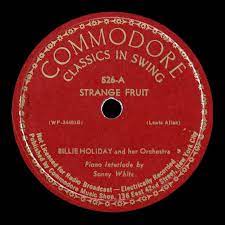
SOUNDTRACK: BILLIE HOLIDAY-“Strange Fruit” (1939/ (live1959)).

This haunting song is sung with minimal piano accompaniment.  In between verses, the original version has some stark trumpet solos, although they are not present in this live version.

Southern trees bear a strange fruit
Blood on the leaves and blood at the root
Black bodies swingin’ in the Southern breeze
Strange fruit hangin’ from the poplar trees
Pastoral scene of the gallant South
The bulgin’ eyes and the twisted mouth
Scent of magnolias sweet and fresh
Then the sudden smell of burnin’ flesh
Here is a fruit for the crows to pluck
For the rain to gather
For the wind to suck
For the sun to rot
For the tree to drop
Here is a strange and bitter crop

She sings the words slowly (the song is 3 minutes long despite the relatively few words), letting the image linger in your mind as she stretched out “burning flesh”  and “for the crows to pluck.”  The way she agonizingly sings “drop” and “crop” really emphasizes the last lines.

The studio version has a haunting guitar line–the only guitar in the song–as a little coda.  It’s a remarkable addition and really affecting.

I can’t imagine the courage it took to sing these words in 1959 let alone 1939.

This song has a fascinating origin.

Thomas Shipp and Abram Smith were two Black men who were hanged in a spectacle lynching in 1930.  A photograph was taken by studio photographer Lawrence Beitler.  He sold thousands of copies of the print [which is amazingly disturbing and I can’t imagine who would have bought them].  In 1937 Abel Meeropol, a Jewish school teacher from New York City saw a copy of Beitler’s 1930 photograph which “haunted [him] for days” and inspired his poem “Bitter Fruit” which was published in The New York Teacher in 1937 (under the pseudonym Lewis Allan). Meeropol then set his poem to music, renaming it “Strange Fruit” which Billie Holiday recorded in 1939.

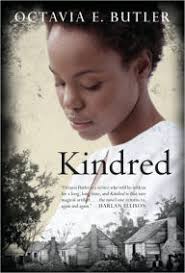
[READ: March 8, 2021] Kindred [the fight]

This week took us to the end of the book.

Dana arrived home with Kevin this time.  He’s initially happy to be home, but is soon very restless. He was in the past for five years.  They have only been in their new house together a few days–noting is familiar here.  He is agitated and irritable.  He tells her about some of the horrible things he’s seen like a woman dying in childbirth.  It’s interesting that this horror comes from Kevin telling Dana about a woman’s whose master beat her until the baby fell out of her.

I feel like Kevin is overreacting to his return–his agitation seems way too great.  I realize that things are new in this house, but you’d think that even after five years, being home wouldn’t be such a bad thing.  And then he tells a story like the above and while I still don’t understand why it’s not just a relief to be out of there, i can see that he’s got PTSD.

But he was jumpy–the sound of jet overhead freaked him out.  Again, would five years without a jet overhead make you forget that they existed before hand?

Earlier Dana had been concerned that Kevin could be “won over” to the bad side. But he tells her that he had been helping slaves to escape.  he even imagined that they might both want to go back to help more slaves escape–to do good historically speaking. (more…)

Read Full Post »

SOUNDTRACK: MUZZ-Tiny Desk (Home) Concert #162 (January 29, 2021).

I had not heard of Muzz before this set.  They are a project of Interpol singer Paul Banks.

Paul Banks and Josh Kaufman have known each other since childhood. You likely know Paul Banks as the singer for Interpol; Josh Kaufman is a producer and one-third of Bonny Light Horseman. They are both friends with drummer Matt Barrick, who played a Tiny Desk concert in 2012 with his band The Walkmen.

The trio plays three songs from their self-titled debut album.  I’m not sure what the record sounds like (Barnes suggests that at least one of the songs is more rocking), but this is a mellow gathering.

Josh Kaufman told me via email that “Paul was stuck in Glasgow and Matt and I were quarantining with families in Philadelphia and Brooklyn, respectively. At the very end of a long couple of days of rehearsal and taping, we — very late at night, Paul jet-lagged and the rest plain exhausted — stayed awake a little longer to try a campfire style strum along to some of the songs from our new LP. The result here is our Tiny Desk.”

All three of them are wearing masks and Barnes can sing no problem–people need to lighten up about the masks.

“Bad Feeling” has one guitar from Kaufman and quiet malleted drums as Banks sings.  I don’t really hear Interpol in this at all, it’s much folkier

“Knuckleduster” is kind of a rock n roll song but they’re playing it rather quietly.  It doesn’t sound any different in this format except the drums are heavier and there are some deeper chords.

Barnes picks up a guitar for “Trinidad” and plays the opening melody.  Having the two guitars playing harmonies is really nice.  The drums are just brushes rubbed on the heads.  It has a very campfire feel.

As they prepare for the last song, Barrick brings his drum mic up front.  It takes a moment or two (no edits, Banks jokes). “Summer Love” has a drum machine and Barrick playing a very quiet synth. It, too is a pretty, quiet song with a delicate solo from Kaufman.

[READ: March 10, 2021] “Family Furnishings”

One of the great things about Alice Munro stories is the way she fully fleshes out the characters.  In this story, the plot (such as it is) is one thing, but Munro adds in so much detail  about the characters–details that give you a fuller picture of them, but which don’t really have an impact directly on the plot–that you feel like you are fully a part of this world. We learn that the narrator was married twice an we learn a bunch  about her first and second husbands. None of this has any direct bearing on the story, but these details give you the most complete picture of the narrator and helps to flesh out the decisions she makes.

This is the story of a young woman who grows up to become a writer and how her father’s cousin had an unexpectedly big impact on that career trajectory.

When the narrator was little her father’s cousin Alfrida (Freddy) was a dramatic and dynamic person.  She worked for the newspaper and was part of the collective of writers who contributed to “Flora Simpson Housewives’ Pages” (there was no Flora Simpson, just a photo of a woman).  She also wrote the “Round and About Town” column which allowed her to give her opinion on all things local.

She was appropriately full of herself but she was always a delight to have around.  The rest of her family was quite dull and formal and the narrator felt like Alfrida loosened everyone up. (more…)

Read Full Post »

SOUNDTRACKFUTURE ISLANDS-Tiny Desk (Home) Concert #158 (January 25, 2021).

I’m not a huge fan of Future Islands.  I like some of their songs, and I think singer Sam Herring’s voice is really interesting.  The biggest thing I remember about them is NPR’s fascination with singer Sam herring’s dancing.  Herring does some dancing here, but saves most of it until the final song.

Future Islands’ four members are gathered not too far from their Baltimore base in Carroll Baldwin Memorial Hall, sans desk. “We lost the desk,” singer Sam Herring tells us with a smile. With drummer Michael Lowry on the tiny stage, the rest of the band — including bassist William Cashion and Gerrit Welmers on electronics — took to the floor, allowing Sam Herring to make his moves and sing his heart out. This music is clearly for the head and the feet.

The first three songs are from

their sixth and very recent album, As Long As You Are. 

“Hit the Coast” is an upbeat song musically.  The notable thing about Future Islands is that their music is primarily keyboard based, but there’s something about having a bassist that brings an organic element to the music.

Along with themes of loneliness and love, we also hear songs about race, which is most evident in “The Painter,” a song about how we can all look at the same thing and see it so differently.

He continues, “Art is subjective but they way we think about people and the way we treat human lives shouldn’t be.”

My favorite part of this very precise song comes mid-song when Cashion scratches up the strings a bit to add some chaotic distortion.

“Thrill” is set in Greenville NC on the banks of the great greasy Tar River.  It’s about feeling isolated in your society, about self-isolating through substance abuse and about continuing to push forward as all the seething bubbles up inside of you like the great river.  It is a slow and moody song and yo can tell that its very personal to Herring.

We end with a song that came out shortly after visiting NPR in 2011 [Oh man, I miss my hair] called “Balance.” It’s one of those tunes that feels repurposed for the 2020s: “This is a song for anybody who’s struggling through their lives,” Sam Herring says, “and I know there are a lot of you all out there, just trying to get by, but it’s going to take a little bit more time.”

This is a fun dance song–the kind of earlier, faster song that I like from them.  Herring lets his dance shoes lose, with some impressive and wild moves.

[READ: March 1, 2021] Behemoth

Book two of this series was longer and more dangerous–as a sequel should be.

As this book opens, everyone is on board the Leviathan having just sailed to safety.   Alek is showing Deryn how to fence.  She is impatient and has no technical skill.  But it’s nice for her to be with Alek (who Deryn has admitted to herself that she fancies) and it’s nicer that he is saying things like “we” when he talks about the Leviathan.

But soon they see some enemy ships.  The ships look in bad shape and the Leviathan looks poised to destroy them.  Until one of them fires up what they learn is a Tesla tower–a generator that can shoot lightning across great distances.  No one has ever seen one before.  But Alek’s men piece together what it is.  Since they are the only ones who know how to fly Clanker engines, they are in charge of propulsion.  And they disobey orders by bringing the ship to a halt.  The Leviathan, being sentient, also senses what’s going on and starts to concur with the decision.

But disobeying orders is mutiny (except that Alek’s men aren’t technically part of the crew so they can’t be punished).

The Tesla cannon fires and grazes the Leviathan.  It doesn’t puncture the ship (it could literally blow it up if it got to any of the hydrogen), but it does mess with everything electrical.  It also leaves one of the men stranded on a Huxley–essentially electrocuted.

Deryn takes it into her hands to save her mate in an exciting an daring rescue. (more…)

Read Full Post »

SOUNDTRACKNORA BROWN-GlobalFEST Tiny Desk (Home) Concert #136/148 (January 14, 2021).

Nora BrownGlobalFEST is an annual event, held in New York City, in which bands from all over the world have an opportunity to showcase their music to an American audience.  I’ve never been, and it sounds a little exhausting, but it also sounds really fun.

The Tiny Desk is teaming up with globalFEST this year for a thrilling virtual music festival: Tiny Desk Meets globalFEST. The online fest includes four nights of concerts featuring 16 bands from all over the world. 

Given the pandemic’s challenges and the hardening of international borders, NPR Music and globalFEST is moving from the nightclub to your screen of choice and sharing this festival with the world. Each night, we’ll present four artists in intimate settings (often behind desks donning globes), and it’s all hosted by African superstar Angélique Kidjo, who performed at the inaugural edition of globalFEST in 2004.

The third artist of the fourth and final night is fifteen year old banjo player Nora Brown.  Nora was born and bred in Brooklyn, but she has a huge affinity for Appalachian banjo music.

30 feet below the surface in Brooklyn, 10th grader Nora Brown brings incredible, surprising depth to the Appalachian music she plays. Over the course of her Tiny Desk Meets globalFEST concert, surrounded by innumerable globes and instruments, she infuses new life and energy into the traditional songs of Addie Graham, Virgil Anderson and Fred Cockerham. Nora weaves together songs and storytelling, speaking of the great history of the music that came before her and at which she excels.

Nor plays three songs. “The Very Day I’m Gone” is an Addie Graham song.  Graham was a singer from eastern Kentucky.  It is a slow piece that is primarily a bass riff with some high notes and very soft singing.

Her dad made the banjo she is playing.  As the song ends you can hear the shuttle train that runs back and forth about every seven minutes.

Nora has her school stuff on her tiny desk, since she’s been doing remote school learning.  And she’s a high school student which means she ends her sentences with, “So yeah”

“Miner’s Dream” is a Virgil Anderson tune.  He is from the Kentucky/Tennessee border and brought a bluesy touch to his banjo playing.  This one is a faster instrumental played on a snake head Gibson banjo, the bowl of which is over 100 years old.

“Little Satchel” is by Fred Cockerham.  The banjo she is playing is from John Cohen’s of the New Lost City Ramblers.   Roscoe Halcomb would use it when touring with John.  John recently passed away and the banjo is on its way to the Library of Congress.   The song has fast playing with a cool lyrical melody.  It’s my favorite of the three.

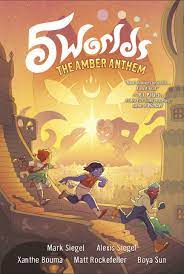
[READ: February 10, 2021] 5 Worlds Book 4

I had actually forgotten about this series, and was quite happy to see this book at the library.  This is book 4 of 5 (5 due out in May).

The book does a nice job of bringing us back up to speed in the first few pages–reintroducing everyone and reminding us what is going on.

Of all the books, this one was the most straightforward.  There’s not a lot of travels and we understand most of what’s going on by now.

Oona, Jax, An Tzu and Ram Sam Sam land on planet Ambrine in the town of Salassanra (where Ram Sam Sam is from).  They receive a mixed welcome.  Since they have lit 3 beacons things have not been great on all the worlds.  (The task is not completed, and the process is a little rocky).  Oona is met with some hostility although the planet people love her (she brought water to them after all).

But this task (to light the fourth (amber) beacon) seems pretty easy. The beacon is in a pyramid.  It’s right in front of them and they meet little resistance.  As Oona begins to dance she realizes this beacon is encrusted in indestructible amber.  She can’t break it, but old runes pop up and most likely lead to a clue. (more…)

Read Full Post »

SOUNDTRACKMAX RICHTER-Tiny Desk (Home) Concert #150 (January 22, 2021).

I really enjoyed Max Richter’s Tiny Desk Concert back in January of last year.  The pieces were pretty and sad and had a modern classical feel.

For his Home Concert, he seems to be one of the few people who actually plays in his home.

Shot in artful black and white, their simplicity and beauty invite us into a world as we once knew it, where fresh air wafts through open doors and dogs peacefully snooze (canine cameos by Evie and Haku) in the late summer sunshine in southern England.

These half-dozen short pieces can offer two very different modes of experience.  There’s a mysterious potency in instrumental music, where the mind is open to wander and free-associate. Max Richter taps into that power with singular grace and humanity.

His entire set is 16 minutes, so indeed all of these pieces are quite short.

He played “Vladimir’s Blues” when he was at the Tiny Desk.  There’s no blurb about it here, but the first time, the blurb told us

Its delicately toggling chords are an homage to novelist Vladimir Nabokov who, in his spare time, was a respected lepidopterist, obsessed with a subfamily of gossamer-winged butterflies called the blues. Richter plays the piano with the practice pedal engaged for a warm, muted sound.

It’s a 2004 piece that’s only a minute and a half and it is quite lovely.

Up next are the

gently swaying chords of “Origins,” where the music lumbers in the lower half of the keyboard.

It reminds me a lot of a famous piano piece which I can’t quite remember the name of.  After about three minutes of the piece, one of the dogs who had been lying outside gets up and walks almost up to the camera.

Infra is a ballet he made with Wayne MacGregor for the Royal ballet in London in 2008.

He plays the “soothing, oscillating figures” of “Infra 3” and follows it with the mellow but more upbeat “Horizon Variations.”  This piece also lasts less than two minutes as well.  It’s lovely.

“Prelude 6” from Voices which has a much faster melody than the other pieces.  About half way through, the other dog (who looks like a puppy) comes in all tail-wagging and heads over to dog number 1 (both off camera now).

“Fragment” is a pretty, sad piece to end the set (also about a minute in a half).  As he signs off he says

“Looking forward to the time when gigs can come back and we can do this for real,”

As the video ends, both dogs get up and walk into the lovely sunshine.

[READ: March 1, 2021] Klawde: Evil Alien Cat

I saw this book at the library (actually I saw book 5, I think) and thought it sounded funny. They had book one so I decided to start from the beginning.

The title says it (almost) all.  Klawde is an evil alien warlord cat.  The book opens on the planet Lyttyrboks where Klawde (whose Lyttyrboks name is Wyss-Kuzz) is on trial.  He is found guilty of clawing his way to power and committing crimes against felinity.

The elder says that thousands of years ago the punishment’s on Lyttyrboks was banishment to a vast wasteland of a planet inhabited by a race of carnivorous ogres.  For generations they sent their convicts there, but eventually that punishment was deemed to cruel.  However, given the severity of Wyss-Kuzz’s crimes, they have resurrected this punishment.  He is transported across the galaxy to the horrible planet known as Earth.

Alternating chapters are written from the point of view of Klawde’s and an earth boy named Raj.  Raj’s family recently moved from Brooklyn to Elba, Oregon and he is bored and alone.  So when a spaceship lands in front of his house and the doorbell rings… well how exciting to find a cat without a tag.  Even if this cat meows like nothing he’s ever heard before and seems kind of mean.

The book is full of illustrations by Chenoweth.  I love the wickedness of Klawde and Raj’s parents are a hoot as well.

Klawde sees the humans as furless ogres and fears what they will do to him.  They put him in a cage (kitty carrier) and force him to eat horrible food–what is this torture?  Raj’s dad names him: “like clawed, but spelled in a more exciting way.  Why use a C when you could use a K?  K is the alphabet’s party letter.” (more…)

Read Full Post »

SOUNDTRACKGABRIEL GARZÓN-MONTANO-Tiny Desk (Home) Concert #147 (January 19, 2021).

Gabriel Garzón-Montano did a solo Tiny Desk Concert a few years ago, as the blurb quickly points out

If Gabriel Garzón-Montano’s solo Tiny Desk back in 2017 was an exercise in restraint and vulnerability, his home set is the polar opposite. It beams ingenuity and unveils multiple layers, figuratively and literally.  In this performance he brought the full band, sporting all white from mask to toe and bringing to life all the sonics we hear on the record, last year’s genre-snubbing Agüita.

They play three songs.

Garzón-Montano morphs into three different characters from Agüita and stretches the boundaries even more, adding salsa flavor to “Muñeca” and delivering some bonus bars on the set opener, “With A Smile.”

“With A Smile” opens with just his face surrounded by flowers as he plays a pretty acoustic guitar.  The flowers move away as the Gracie Sprout’s harp adds more pretty notes.  As the song moves along with Gabriel’s soft and sexy voice, Itai Shapira’s bass and Lenny “The Ox”‘s drums come thumping in.

Like the rest of his band, Gabriel is in all white, including white Uggs and a long white coat with tails.   The only color is from the sweater underneath.

At the end of the song he raps in Spanish, which has a really nice flow.

Taking advantage of of the rare opportunity to gather musicians in quarantine times, he says “It’s like being a child who’s allowed to do what they always wanted to do when they didn’t wanna get up for school, and it’s also felt like an adult who didn’t know what to do at 3 p.m. on a Tuesday afternoon. I’m focusing on oscillating between those states with ease.”

For “Muñeca” he takes off the big coat and shows off the colorful sweater which has a fascinating cut, including tails.  For this song, it’s a trio of bass and Daniel Rodriguez on drums. Rodriguez plays a funky middle with conga and cowbell as Gabriel gets up and dances.  He picks up the guitar again at the end of the song for a little strumming outro.

Before the final song, Gabriel moves to the piano.  He takes off the colorful sweater to reveal a sleeveless shirt underneath (which shows off his tattoos).

“Tombs” features the KROMA Quartet and everyone else on synths.  Nicholas Semrad plays the lead, but everyone else adds melody.  It’s a delicate song with an interesting and slightly creepy synth melody.  About half way through this six minute song he gets up and picks up an electric guitar.  He and  Justin “Jhawk” Hawkins play a harmony solo together, which sounds pretty cool.

I am quite intrigued by this singer, and I love the description of genre-snubbing.

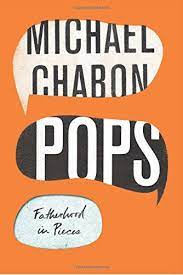
[READ: February 28, 2021] Pops

I have often said I wanted to read more books by Michael Chabon.  And after finishing this I realized that the only novel by him that I’ve read is Kavalier and Clay and that was 21 years ago.  So maybe it’s time to get into some of these other books.

Pops is a collection of (very) short essays.  Most were written for Details Magazine (which folded in 2015), one for GQ and a final one I’d already read in the New Yorker.

“Introduction: The Opposite of Writing”
It’s not too often that you really enjoy an introduction, but this one was pretty great.  In it, Chabon talks about when he was an up and coming writer and he met a well-established Southern writer.  This writer told him that the secret to being a good writer was not having children.  That for every child you have, you will lose one book.

Chabon had no children with his first wife but has had four with his second wife (the writer Ayelet Waldman).  So clearly they have lost eight books between them.

The writer’s argument was that children take away time from novel writing and that novel writing takes away time from children.  Chabon had always felt that his father was not very present (as one of the essays says) and he promised to be much more involved in his children’s lives).  These essays suggest that he was.  So how did he find time to write?  He does not say. (more…)

Read Full Post »

« Newer Posts - Older Posts »