Feeds:
Posts
Comments

Archive for the ‘Authors’ Category

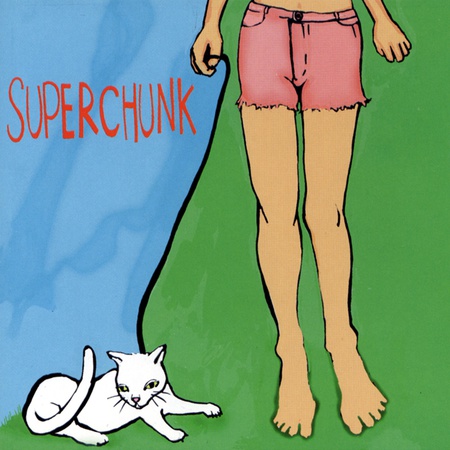
SOUNDTRACK: SUPERCHUNK Hello Hawk (1999).

Hello Hawk is another of my favorite Superchunk songs (and it’s vastly different from “Hyper Enough”).  It opens with some really interesting guitar noodling.  And then after a bridge that promises a noisy chorus, the chorus backs down into another gentle section (followed by the loud and heavy post chorus…a neat trick).  This song is also laden with strings (!).  And it’s catchy as heck.

The second song, “Sexy Ankles” sounds (recording style-wise) like early 60s rock and roll.  It’s quite odd for Superchunk, although it rocks nicely at the end.

The final three tracks are acoustic version of songs from the Come Pick Me Up album.  The paradox: as the original songs grow less heavy and rocking, these acoustic versions become less dramatic as interpretations of them.  And yet, since the originals are growing more complex, these acoustic versions sound even better than previous acoustic versions of their older songs.

[READ: October 10, 2010] “Party of One”

Antonya Nelson is another of the 1999 New Yorker 20 Under 40 writers.  I’d never heard of her before seeing this story, but I enjoyed it enough to want to check out more of her stuff.  This is the story of a broken love affair.  And yet it has so many different angles, and so many wonderful observations (and disarming frankness), that it struck me as a wonderfully original and enjoyable story.  Even the way she used the title was clever.

First the breakup.  It is not the main character who is breaking up, but rather her sister.  The main character is meeting her sister’s lover, who is married.   He is getting cold feet and her sister is despondent.  What is wonderfully twisted about the story is that the sister has a had a previous affair with a married man and when that affair ended, she tried to kill herself.  I hate to reveal this tasty piece of information, but it really highlights the interesting angles of this story–the affair was with her the narrator’s husband.  [Woah]. (more…)

Read Full Post »

SOUNDTRACK: PETER, BJORN & JOHN-Living Thing (2009).

After the raging (relative) success of Writer’s Block, with their crazily catchy whistling song, “Young Folks”, PB&J could have gone in any direction.

And I was quite surprised when the opening song of this follow up (actually, there’s an instrumental disc in between) opened with single note and drum sounds and virtually a capella vocals.  But unlike a typical a capella song, the thudding notes were kind of dissonant and unpleasant.  And there wasn’t much more to the song than that.

Even the second song starts out starkly.  A single piano note plays a simple riff.  The verse kicks in with some simple electronic drums (and again minimal accompaniment).  And this sparseness is the main musical theme on the disc.

And I have to say it took almost a half a dozen listen before I really enjoyed what they were doing.  They are eschewing the pop structure that won them popularity and they’re shifting their melodies to the vocal lines rather than the instruments (I guess).  It’s a risky proposition, but it pays off.

Take “Nothing to Worry About.”   It opens with what sounds like a distorted children’s choir singing the chorus at full volume.  But then it settles down into, again, a simple drum and vocals song with just a hint of instrumentation.  (Did they get all their music out on the instrumental?  I don’t know I’ve not heard it).  Even the title track is sparse guitar noises and clicked drums.  But, man, is it catchy (it reminds me in a weird way of Paul Simon).

And then, continuing my contention that the best and catchiest songs always have curses in them, “Lay It Down” with the chorus, “Hey, shut the fuck up boy, you’re starting to piss me off” will stick in your head for days.

The end of the disc (the last three songs) are considerably mellower.  They’re less catchy, but they use the starkness very well.

Initially I really didn’t like this album.  It had none of the immediacy of the previous disc.  But I found myself really enjoying it.  I wouldn’t want all of their albums to sound like this, but it was an enjoyable twist on a good formula.

[READ: October 7, 2010] Garden State

I mentioned the other day that I just found out about this book when looking up information about Rick Moody.  I was so excited to read a book set in Haledon (two towns from where I grew up) that I checked it out and begin it immediately (it’s only 200 pages, so that helped too).  But I have to say I was really disappointed with the book (even if it did win the Editor’s Book Award).

My first gripe is about the supposed setting in New Jersey.  I have no problem with fictionalizing an area.  Writers do it all the time.  But Moody fictionalizes the area in two ways to suit his thesis, and as a lover of New Jersey and a former resident of the region, I found the lack of reality to be very upsetting.

The first minor, and I have to say really weird thing is that despite the real towns included (Haledon, Paterson, Paramus) he makes up towns nearby–Fleece, Tyre– and he makes up a river–The Dern River.  He also plays around with the names of the highways that run through the state, constantly referring to the non-existent Garden State Thruway.  Now, again, there’s no problem with making things up, but nobody in the story ever goes to Fleece or Tyre, the Dern River doesn’t come into play aside from being a river that people refer to (it’s not a renamed Passaic river, because that’s included in the story, too).  So, why make up random town names?  Why say that you drive from Haledon to the edge of Paterson near Boonton, when that is not geographically correct (or relevant to the story)?  It just seems like he didn’t have access to a map. (more…)

Read Full Post »

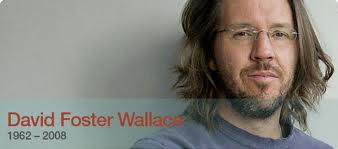
[LISTENED TO: October 19, 2010] David Foster Wallace Eulogies

There are some really nice eulogies done for when DFW died.  The official (written) memorial service eulogies (from Jonathan Franzen, Zadie Smith, George Saunders and others) are available here (from an outstanding online journal called Five Dials).  They’re all beautiful (I was amused that the second longest one comes from DFW’s editor!).

The audio eulogies are available at The David Foster Wallace Audio Project.  They include two very long full length ceremonies and several news (NPR mostly) reports.  And there’s a lengthy interview with David’s sister, Amy, which is by far the most moving one.

The first of the lengthy pieces is the ceremony from Amherst.  It consists of colleagues, friends and students all telling stories about DFW.  And their collective memories join together to create a great portrait of the man; things that you’d never know about him (except you kind of would) from reading his work.  The thing that really struck me from this memorial was just how many friends he had.  This seems like an insult but it isn’t meant to be; rather, the impression I had was that he was quite a solitary man, holing up with his dogs and his pens.  But the stories and love from his friends during his college years especially are really quite nice to hear, and showcase a side of him that he left out of his work (except, of course, really he didn’t). (more…)

Read Full Post »

SOUNDTRACK: SUPERCHUNK-Laughter Guns EP (1996).

The first track “A Small Definition” is a surprisingly slow track from them.  Even when the band kicks in about midway through, it’s still a fairly mellow sound  And yet it is not a light track by any means.  (A nice squalling guitar solo certainly helps.)  But in case you thought the band had mellowed, track two “Her Royal Fisticuffs” brings back their punky bratty sound.

The third track, “The Mine Has Been Returned…” brings in a new sound altogether.  It opens with a heavy heavy destorted bass riff (instead of the usual guitars).  But the real surprise comes with the very distorted organ sound that throws the bass into sharp relief

The final song, “Hero,” is part surf rock part detective song, and continues the interesting departures that Superchunk explore on this disc.

And then there’s the bonus track.  It’s a radio broadcast from WXYC a radio station in Chapel Hill.  The track is a 42 minute deconstruction of “Hyper Enough.”  It’s a few guys (and radio callers) dissecting the song in incredible detail.  (hey listen to one verse about 20 times).   The track starts about 20 minutes into the show, and they have just gotten past the first verse).  At about 10 minutes into the track, the discussion turns into a fascinating look at deconstruction and the primacy of the author.  There’s a caller’s snide comment that the band is all on crack and they should stop wasting their time–which of course, leads to a discussion of how drugs might impact the lyrics of the songs.  It’s a crazy track and a crazy radio show.  And shows how much fun college students can have when they really enjoy something.  I listened to it when it came out, but haven’t listened to it again until this week.   And I enjoyed it just as much this time. Perhaps I’ll try again in another 15 years.  Oh, and until iTunes, I never knew the song was called, “Cool-Ass Mutherfuckin’ Bonus Track.”

[READ: October 1, 2010] “The Local Production of Cinderella”

Allegra Goodman was the next writer in the 1999 New Yorker 20 Under 40 issue.

The opening paragraph of this story confused me greatly.  I wasn’t sure exactly what the author was trying to say.  I re-read it three times, and then it finally clicked.  And after that, the story flowed very nicely.   The story is set in Hawaii in 1978.  Two women, Roselva and Helen, have worked at the Hawaii Dept of Human Services at adjoining desks for years.

Roselva is Chinese-Hawaiian, very religious and a real believer in her job.  Helen is of German descent and was born in Maine.  She wanted out of human services. (more…)

Read Full Post »

SOUNDTRACKSUPERCHUNK-Hyper Enough (1995).

“Hyper Enough” is one of my favorite songs of all time. I don’t know if there’s much more that i can say about it.

“Never Too Young to Smoke” sounds surprisingly like a Cure song to me.  The guitar seems very unSuperchunk and Mac’s voice even has traces of Robert Smith in it.  It’ s neat trick.  And it’s good song, too.  It’s got a lot of slow building tension (again, unusual).  And it really pays off.

The final track, “Detroit Has a Skyline” is another acoustic version (original on Here’s Where the Strings Come In).  It has certain Cure-isms on it as well, but it is much more clearly Mac than Robert Smith.  It has a great chord progression in the bridge, but we knew that from the original.

[READ: September 30, 2010] “Raft in Water, Floating”

A.M. Homes was the fifth writer in the New Yorker’s 1999 20 Under 40 collection.

I’ve really enjoyed A.M. Homes’ books.  I liked The End of Alice, and I really liked This Book Will Save Your Life.  She has a few books in between these, but I’ve been remiss about reading her.

And this story was definitely not my favorite.  It is written in an exceedingly detached tone.  A young woman is floating on a raft.  She is described by an almost uninterested 3rd person voice.  Even the young woman’s conversations are robotic and emotionless.  In many ways it reminded me of Bret Easton Ellis’ style of distant characters.

Her boyfriend comes over, he gives himself an orgasm which she is complicit in and yet somewhat oblivious to, and then it gets really strange. (more…)

Read Full Post »

[LISTENED TO: October 5, 2010] Dubliners Part I

I found listening to Ulysses to be rather satisfying.  And, since I have recently commenced an indoor exercise regime, I thought it would be “fun” to listen to some audio books during the workout.  I started with Dubliners because and because Jim Norton is the reader (and I enjoyed his style on the abridged Ulysses) and because I own it.

It’s disconcerting to read/listen to Dubliners after Ulysses because Dubliners is such a conventional collection of stories.  There’s nothing untoward about them, there’s nothing scandalous (except for drinking and mistreating wives), and there’s nothing to be confused about (except maybe early 20th century Irish political references).  But one thing that  is abundantly clear is that Joyce was a great writer, right from the get go.

This disc’s stories are mostly between 10 and 21 minutes long, although “A Little Cloud” runs to half an hour.  The titles included in Part I are:

The Sisters
An Encounter
Araby
Eveline
After the Race
Two Gallants
The Boarding House
A Little Cloud
Counterparts
Clay

I’m not really going to review the quality of the audio.  It is uniformly very good, with Norton conveying accents wonderfully.  And those accents really bring the stories to life.  There is music in between each story, and the songs are all relevant to the time, if not the individual story. As with most of these audio books, it could be mixed louder, but that’s a minor quibble. (more…)

Read Full Post »

[LISTENED TO: Week of October 10, 2010] David Foster Wallace interviews

There will soon be a group read of Consider David Foster Wallace, a book of essays about, yes, David Foster Wallace.  In a sort of preparation for the group read, I decided to immerse myself in the available audio files online.

The David Foster Wallace Audio Project hosts quite a vast collection of audio files, including interviews, readings and eulogies.  Even the Howling Fantods points to it.

I started with the interviews.  They cover the period from Infinite Jest to Consider the Lobster.  For the most part, the interviews took place on various NPR stations.  There are not a lot of details given about the items on the site (which is the only flaw that I can see with the site), but you can more or less tell from the titles given what book is the cause for the interview.

I know that DFW was not a fan of interviews, yet I can’t help but be surprised at how few interviews actually seem to be extant (or at least preserved online).  You can see a list of all of the interviews on the site.  I’m listing and giving very brief notations for some of the longer interviews, but I just don’t have the time/inclination to go into great detail. (more…)

Read Full Post »

SOUNDTRACK: SUPERCHUNK-“Driveway to Driveway” (1994).

This disc is a first for Superchunk EPs.  The three “B” sides are all acoustic.  One of the nice things about that is that it showcases how good the songs are underneath all of the noise and distortion.

“Seed Toss” is from No Pocky for Kitty & “Sick to Move” is from Superchunk.  Obviously, they’re good songs or they wouldn’t have chosen them (out of all the back catalog…I mean, they could have chosen “Slack Motherfucker” after all).  And these acoustic versions are fun and interesting.

The final track is an acoustic “Driveway to Driveway.”  This is the most immediate in terms of comparison to the original (not least of which is the acoustic is a minute longer).  It allows them to breathe a little bit (and to make the lyrics more clear).

I’m not suggesting that Superchuink should be acoustic by any means, but it’s nice to hear the heart underneath the noise.

[READ: September 30, 2010] “Hawaiian Night”

Rick Moody is the fourth New Yorker 20 Under 40 author in the 1999 issue.

I’ve enjoyed a few of Rick Moody’s works (although now that I looked him up I found that he wrote a book called Garden State set in Haledon NJ (right near where I grew up…how did I not know this?…I shall have to read it very soon).

This piece seems like an experimental scene rather than a short story (or perhaps it’s from a longer work?).  It begins quite fascinatingly in a stark narrative style.  Pieces of information are doled out.  The information sets a scene with more and more detail. It is “Hawaiian Night” at a corporate picnic.  We see the limbo and the tuna skewers.  And then we meet the cast: dozens of interchangeable children having sanctioned fun amidst the adult workers.

And then suddenly things grow dark.   (more…)

Read Full Post »

SOUNDTRACK: SUPERCHUNK-The First Part (1993).

The First Part opens with a guitar riff, very different from the chugga-chugga songs that they’ve played on the other tracks.  In fact, at the end of the verses, the bass backs out entirely leaving an interesting and unexpected sound for the song.

The second song, “Connecticut” is similar in that it also has a guitar riff (and a kind of solo) in the introduction.  The surprise comes at about a minute thirty-five when the guitar solo kicks in and the song suddenly shifts into an all out rocker.  This change is especially surprising since the song is just over 2 minutes long.

“Foolish” plays with a distortion-fueled repetitive riff that keeps the song moving.  It’s really quite infectious and something of a departure for the band.  This whole EP shows quite a leap forward in terms of Superchunk singles.

[READ: September 30, 2010] “The Toughest Indian in the World”

Sherman Alexie is the third author in the New Yorker’s 1999 20 Under 40 collection.

I have read a few Sherman Alexie pieces, and I’ve enjoyed what I’ve read.  And yet, for some reason, he’s not one of the authors I keep a look out for.

This story is about a newspaper writer. He is Spokane Indian.  We learn a little about his past.  And one thing–his father only ever picked up hitchhikers if they were also Native–is a tradition he follows today.  Even though his girlfriend doesn’t want him to pick up anyone.   We also learn a little about his previous girlfriends (like the white woman who only dated non-white men).

Alexie’s writing style is wonderfully fluid and relaxed during this background information. It’s a very easy read, and quite funny too.  But things change when he meets the titular toughest Indian. (more…)

Read Full Post »

While I was looking around for Jonathan Franzen pieces in the New Yorker, I stumbled upon the first 20 Under 40 collection from 1999.  Since I had received so much enjoyment from the 2010 version, I decided to read all of the 1999 stories as well.  It was interesting to see how many of the authors I knew (and knew well), how many I had heard of but hadn’t read, and how many were completely off my radar.

I initially thought that they had published all 20 authors in this one issue, but there are five stories (including Franzen’s) that were just excerpted rather than published in full.  And I will track down and read those five in their entirety.  But otherwise, that’s a lot of fiction in one magazine (a few of the stories were quite short).  And it features a cover by Chris Ware!

So here’s the list from 1999.

**George Saunders-“I Can Speak™”
**David Foster Wallace-“Asset”
*Sherman Alexie-“The Toughest Indian in the World”
*Rick Moody-
“Hawaiian Night”
*A.M. Homes-
“Raft in Water, Floating”
Allegra Goodman-
“The Local Production of Cinderella”
*William T. Vollmann-
“The Saviors”
Antonya Nelson
-“Party of One”
Chang-rae Lee-
“The Volunteers”
*Michael Chabon-
“The Hofzinser Club” [excerpt]
Ethan Canin-
“Vins Fins” [excerpt]
*Donald Antrim-
“An Actor Prepares”
Tony Earley-
“The Wide Sea”
*Jeffrey Eugenides-
“The Oracular Vulva”
*Junot Diaz-
“Otra Vida, Otra Vez”
*Jonathan Franzen-
“The Failure” [excerpt]
***Edwidge Danticat-
“The Book of the Dead”
*Jhumpa Lahiri-
“The Third and Final Continent”
*Nathan Englander-
“Peep Show” [excerpt]
Matthew Klam-
“Issues I Dealt with in Therapy” [excerpt] (more…)

Read Full Post »

« Newer Posts - Older Posts »