Feeds:
Posts
Comments

Archive for the ‘Authors’ Category

SOUNDTRACK: ROCKWELL KNUCKLES-You’re Fucking Out I’m Fucking In (2011).

I downloaded this disc a while ago because I really liked “Silly Human

I listened to it again recently and realized just how much I like the whole disc.  Rockwell Knuckles has a great delivery style—a basso profundo voice—and a great sense of melody both in his delivery and his backing music.  He captures the best of Chuck D and Ice T.  “Bullet Train Army” has such a cool melody line—and the fact that he raps along with it is fantastic.  Apparently the Bullet Train Army is his posse or something, because it appears a lot on the disc.

“Silly Human” is a fantastic song—a wispy futuristic keyboard riff fizzes away behind Rockwell’s super fast delivery and funny (but not really) lyrics.  The chorus is delivered super quickly in a cool descending melody line.  And I love that someone in the background is shouting Yes Yes! YES! as he deliveries his lines.  It reminds me in strange way of The Flaming Lips.  “Play Catch” shows off his diversity of styles with this more gentle song.  I like the way the verses end with a repeated word which seems like it’s going faster because the beasts speed up,  It’s a cool trick.

“Baking Soda” has a guest rapper (I really don’t like guest rappers, I’m here for Rockwell not Tef Poe, who immediately lost my respect by having his first rhyme end with bitch—lazy!).  I don’t really care for the music behind this one either—cheesy sax and horns.   It’s made up for with “Point of No Return.”  This song has a sung chorus with a weird sci-fi-sounding melody and some great lyrics.  I haven’t really mentioned the lyrics yet but they stand out here “the early bird catches the worm, but the first sponge catches the germs) and a reference to Sojourner Truth.

The lyrics are even better on “Unstoppable” (which has a cool synthy sound over the chorus): “My competition ‘s delayed I’m rocking digital/
Ive been around the world in a day not in the physical/Artistic freedom in what I say y’all are to literal.”

The simple riff behind “Intergalactic” is also cool.  At first I wasn’t sold on Theresa Payne’s backing vocals but I think it works quite well.  I particularly love the chorus of “Supercalifragilisticexpiala-futuristic”

There’s another great delivery melody on “Motto of Today” with more cool sci-fi backing music.  “You Got It” has the great fast beats and delivery that I love out of Atlanta, even though Rockwell is from St. Louis.  There’s even a cool binary joke in the lyrics (1001001).  Guest rapper Vandalyzm fares better, although there’s more curses than actual lyrics in his verse, I think.

“Nomanisan Island” also features Tef Poe, but I like him better on this track.  But maybe that’s because the chorus is great: “No man is an island and we are never stranded”  I’m not sure though that Tef Poe should be singing the line “black tea party, we’re coming to impeach” with Obama in the white house.

“Controlled” I assume has a sample for a chorus, it slows things down nicely and the sound of the drums is fantastic.  I’m partial to the lines “Stone cold like Medusa” and  “Shows about to start, I don’t know when it will end, son/ Puppet on a string controlled by Jim Henson” (whatever that means, I like it).

“Every Angle” has a groovy chorus that I like despite itself.  Rockwell makes it flow wonderfully.  And the final track, “Natural Born Leader” opens with a simple rocking guitar riff.  When the lyrics kick in, the song soars with 70s keyboards and big guitars.

This album is really fantastic.  And while there are plenty of deserving artists out there, Rockwell Knuckles is amazing and should be huge.  Don’t be put off by the album title or the cover, this album is more about melody than a cursing.

You can download the whole album here for free.

Oh, and the reason I chose this is because of a note I had written in the margins of GR, which I thought had read No Man is an Island, but which didn’t.  Oops.

[READ: Week of February 27] Gravity’s Rainbow 1.13-1.18

I found a few of this week’s sections to be more challenging to get through.  There are a lot of long passages that are meandering–often with an unclear narrator (although the narrator usually becomes apparent by the end).  During these section, it feels like the book is just drifting of into a reverie for a while before snapping out of it and getting back to the business at hand.  And that seem apt given all of the crazy stuff that happens in the book (all of the mental/psychological ideas).

After reading a few of the posts at Infinite Zombies this week, I have new eyes for the book.  When I first read all of the sex in the book, I thought again about Joyce’s Ulysses and all of the sex that he described (shockingly for the time) and how modern writers seem to revel in writing about sex–not pornographically, just “real.”  But now, after reading Christine’s post, I had to rethink this attitude on sex.  I’ve been surprised by Pynchon’s frequent use of the words “cock” and “cunt” as anatomical names.  “Cock” in particular is a word I don’t hear used all that often in fiction and it has (to my ear) a kind of crass/vulgar connotation. And what more needs to be said about “cunt.”  I wondered if this was a Pynchon thing or a 70s thing or an I’m-too-uptight thing, but in Christine’s post she writes: “One of the things I most loathe about the other Pynchon books I’ve read is the latent, creepy, old-man sex fetish” and “the constant phallic status updates (noted in my paperback as I.P.R.s [infantile penis reference]” (which is hilarious, by the way).  This has made me even more aware of all the sex in the book–although to what end I’m not sure yet.

Jeff’s post at Infinite Zombies focuses on Roger and Jessica (I know that wasn’t the point of the post, but the mind takes what it will) and makes me think of Roger as more of a protagonist of the story.  Even more than Pirate (who, coming first, I assumed was the focus).  And  this week’s reading reveals more importance for Roger.

So on to the read: (more…)

Read Full Post »

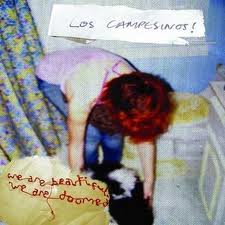
SOUNDTRACK: LOS CAMPESINOS! We Are Beautiful We Are Doomed (2008).

This is Los Campesinos! second disc in a year (after the smashing success of their debut).

The disc opens with a blast in “Make It Through the Walls”–great male and female shared vocals as well as gang screamed vocals; and by the end: violins.  It’s like the Los Campesinos! catalog packed into four minutes.  It’s followed by “Miserabilia” a perfect three-minute pop song (except for all those rough edges, of course), but it very nicely combines melody and punk attitude.

The title track continues with the frantically happy sounding music that backs off for lyrics like “We kid ourselves that there’s future in the fucking, but there is no fucking future.”   Meanwhile, “You’ll Need Those Fingers for Crossing” emphasizes their low end, which doesn’t often get a lot of emphasis.  “It’s Never That Easy Though, Is It?” has some great violins and group vocals (not screamed for a change).  “The End of the Asterisk” is an under two-minute blast of fun nonsense (with a fun chorus).

I’ve talked about the music but not much about the lyrics–but rest assured they are just as literate and darkly comic as on Romance is Boring.  Although the titles are certainly a giveaway, none sum up Los Campesinos! as much as “Documented Minor Emotional Breakdown #1” (which has some very cool sound effects thrown in too).

“Heart Swells–Pacific Daylight Time” is one of their achingly slow songs that reminds me of “The Sea Is a Good Place to Think of the Future” (I know, that song came later, but I’m reviewing them backwards).  Although this one is much shorter.  The disc ends with “All Your Kayfabe Friends” which has these fun triplet notes that ascend and descend with each line.

My copy came with a bonus DVD.  The disc contains a 30 minute home movie of the band on tour.  It’s nothing terribly revelatory, although it is amusing in places.  The home movie quality of it makes it a bit more personal, but also means that some shots are totally missed, which is a shame.   There’s also a few minutes of the band on various stages, which is quite a treat as I’ve never seen them live–they really embody their music and Gareth Campesinos! is a great front man.

At only 32 minutes, this is certainly a short release.  Wikipedia says that they argued that this was not a cash grab after the success of their first album.  And that’s believable, even if the only thing that makes this more than half an hour is the fiddly instrumental “Between an Erupting Earth and an Exploding Sky.”   Nevertheless, Los Campesinos! released some wonderfully cool songs.

[READ: February 28, 2012] “Laikas”

I complained recently that although Kuitenbrouwer calls this piece “Laikas” when you click on the link to Significant Objects, it is listed as “Greek Ashtray-Plate.”  This evidently has something to do with the nature of its publication.  Although I don’t know the pre-publication information, underneath the story it says:

The bidding on this object, with story by Kathryn Kuitenbrouwer, has ended. Original price: 69 cents. Final price: $30. Proceeds from this auction go to Girls Write Now

So, one assumes that Kuitenbrouwer wrote this short (very short) story about the ashtray-plate–after all, the full name of the website is Significant Objects…and how they got that way–so it all pieces together nicely.

As I said this is a very short piece (a page and a half, tops) that works as a quick sketch of why the ashtray-plate looks the way it does as well as a brief sketch of its owner. The details about the ashtray-plate are wonderful, vivid and violent in ways that I wouldn’t have expected–the placement of the burns is wonderfully described.

The rest of the story is strange, though. (more…)

Read Full Post »

SOUNDTRACK: STEREOLAB-Chemical Chords (2008).

You never really know what you’re going to get with Stereolab. Well, that’s not entirely true, you know you’re going to get some unusual sounding loungey keyboard songs with lyrics that are either in French or in highly accented English.  But beyond that each Stereolab album tends to go in its own direction.

Chemical Chords creates its own poppy bouncy bliss, making it one of their most approachable albums.  “Neon Beanbag” even features the chorus: “there’s nothing to be sad about” over a set of the bounciest keyboard riffs around.  “Three Women” has a brisk pace and some bright horns.   “One Finger Symphony” has a minor key and as lightly sinister tone (but it’s only 2 minutes long).

The title track has some cool echoed vocals and a wonderful break in the song that allows a sweet little string section to sneak through.  “The Ecstatic Static” is another pulsing song that seems alive somehow and “Valley Hi!” is a short darker piece with cool sound effects.

“Silver Sands” is a wonderfully bubbly pop song–the kind that Stereolab does so well, with vocals that seem like they might belong to another song.  “Pop Molecule” is a great minor key instrumental, which is a nice introduction to the super pop of “Self Portrait with ‘Electric Brain'” another bubbly song with a cool break in it.  “Nous Vous Demandons Pardon” opens with a martial beat before it settles down into a groovy song with French lyrics.

“Daisy Click Clack” shows off Stereolab’s totally unexpected lyrics:  “Snap snap snap snap with your fingers/Off beat on time make it linger/Enriching the rhythm/Do away with skepticism/Come and join the hymn, tap/Sensing the symbiotic force.”  From nonsense to the sublime in just a few short lines.

The final song “Vortial Phonotheque” reminds me of “I am the Walrus” in the music, but the gentle lyrics change the tone completely.  It’s a wonderful disc full of all of the bright sounds Stereolab does so well.  This would be their second to last disc before they went on a hiatus.

[READ: February 28, 2012] “How I Met My Daughter”

Two baby stories in a row!

Those following closely think that I was done with Max Barry last week.  But there was one final piece for me to read.  Technically this doesn’t make the last post wrong because although this story was on his website, it was also published in a magazine called The Bulletin.

If I thought that last week’s “Cement” story was dark, it’s nothing compared to this one!  Barry, while a somewhat violent writer (his last book was all about surgical procedures), is usually quite funny as well.  But this story eschews all humor for a walk through the dark side of man’s nature.

It opens with this incredibly dark couple of sentences:

They dragged this bloody, howling thing from my wife’s abdomen, its limbs twitching and clawing, its face like an angry pumpkin, and asked me, “Do you want to take a photo?”

Yes. I want to take a photo, so I can look back on the end of my life.

This story explores the feeling that men apparently have when their baby is born–jealousy at the lack of attention they will now receive.  I didn’t experience this at all and frankly it seems like a fictional thing to me, because I don’t know of any men who felt real jealousy of their babies.  But it makes for an interesting story. (more…)

Read Full Post »

SOUNDTRACK: NICK CAVE AND WARREN ELLIS-The Road: Original Film Score (2009).

I haven’t seen The Road, and I probably never will.  Nor have I read it.  The only reason I was listening to the soundtrack was because I like Nick Cave.  So this is a contextless review.  Of course, I know what the book is about and I rather assume that the film is equally harrowing.  I expected the soundtrack to be full of desolation and horror.

So I was quite surprised that most of the main themes are played on a piano with gentle strings or simply violins.  True there is a sense of emptiness and loss in these songs (they’re not jaunty piano pieces or anything) but they are still unexpectedly pretty.

Of course,a song like “The Cannibals” is bound to be more disconcerting, which it is.  It starts with creepy scratchy violins and then tribal drums take over–all set over a buzzing background.  This is more of what I expected the whole score to be like.   Similarly, “The House” must be a very frightening scene, as the music is threatening, loud, intense and quite scary with, again, more creepy percussion.  Unsurprisingly, a track called “The Cellar” is also spooky; it is only a minute long.

But then songs like “The Church” are so delicate and beautiful and not even all that sad–it actually makes me wonder what the scene in the film is showing.  The end of the score feels like the end of a movie, which I know it is, but it feels like a conventional movie, with closure, something I’m led to believe the book doesn’t have a lot of.

Taken away from the movie, this soundtrack is quite nice.  Aside from the three scarier tracks, this would make for some nice listening on a sad, rainy Sunday.

[READ: February 28, 2012] “The Longest Destroyed Poem”

I enjoyed Kuitenbrouwer’s “Corpse” so much that I decided to see what else she had written.  It comes to three books and four uncollected short stories.  There’s “Corpse” from The Walrus, this one here, another one called “Laikas” (which has a different title on the site where it lives) and a fourth with a broken link.  Boo.

But that’s okay because I’ll certainly investigate her books too.

Like “Corpse,” this story explores women’s sexuality, but it explores it in a very different way.  In fact, I loved the way it was introduced–especially because of the wonderfully convoluted way the sentence reveals it (and how it’s not even the main point of the sentence):

She looked fabulous. Better than back then, when she’d thought she wanted to be an artist, and Victor had made a point — she realized this as she realized many many things, that is she realized it in retrospect — of dropping into the conversation — the one she hadn’t actually been having with him, because she was instead focused almost solely on the fact his much younger roommate had a hand under the blanket her crotch also happened to be under — that he was off to bed early so he could work on a poem he’d been having trouble with.

I had to read it twice because I thought it was funny the first time, and when I fully parsed it, it was even funnier.

So yes, sex.  But as the story opens, years after the above event, Rosa sees Victor and decides to crash into him with her car.  It’s shocking and it’s shockingly well told.

I love the way Kuitenbrouwer uses language.  I could probably quote from this story six or seven times, but I love this sentence that forecasts the trouble ahead:  “Victor noticed her in that split second, too, and he knew what Rosa was up to, for his face changed, channel surfing from neutral smug — well, this was his everyday face — to impending doom.”

As she’s about to ram him (with a Prius, no less), we flash back to their spirited relationship. (more…)

Read Full Post »

SOUNDTRACK: MUMFORD & SONS-Sigh No More (2011).

I had assumed that this album was massive until an email sent around to some of my friends revealed that many of them had never even heard of the band.  So I guess it’s massive in my own little world.  Well that’s fine, I’ve always liked rougher folk music.  And there are two or three songs on this album that absolutely deserve to be massive.

If you’re like my friends and you don’t know Mumford & Sons, this album is a kind of rocking folk album (lots of banjos and harmonies).  But it’s less Fleet Foxes and more Waterboys–earnest folk with updates to the traditional sound.  The disc opens kind of slowly with “Sigh No More.” It take about two minutes to get going (and for the banjo to kick in).  In addition to the banjo (seriously, who knew a banjo could be so catchy?–well, bluegrass musicians, for one), the main selling point is main Mumford’s voice–it’s powerful, bellowing and quite emotive.

“The Cave” is the first indication that this album is going to be impressive.  It starts out deceptively simple. Once you get to the second round of the bridge, “and I….” the song soars to the heavens in catchiness, (the singer’s enunciated vowels are weird and fun too).  “Winter Winds” has a bit more Irish feel to it (Irish via The Pogues), but it also has the same kind of soaring qualities as “The Cave.”

“Roll Away the Stone” features the banjo heavily and is all the better for it.  And “White Blank Page” really features the rough-hewn vocals that are the signature of Mumford & Sons.  Never has the word “raaaaage” been so singable!

Some of the slower moments of the album kind of bog the disc down.  Of course you couldn’t play everything at breakneck speed and still have your dynamic parts sound dynamic.  So a song like “I Gave You All” opens slowly but it builds in power.  The break is welcome (although quite a lot of songs start out slow and then get faster).  But the chorus is outstanding.

The pinnacle of the album comes with “Little Lion Man” an amazingly catchy chorus (with a very bad word in it) and more raucous banjo playing.  It’s almost impossible not to stomp your feet along.  “Thistle & Weeds” is another slow builder–you can really hear the angst in his voice by the end.  The end of the album is kind of a denouement.  On my first few listens I didn’t care for the end of the disc so much but by now the album has so won me over that I can just enjoy this folkier ending.

In many ways there’s no major surprises on this disc–it’s rocking folk after all–except for just how damn catchy the band is.

[READ: February 22, 2012] “Corpse”

I wasn’t too keen on reading this story (one of the Walrus‘ longer stories) because of the title (and the accompanying picture of two boys with a deer in their sites).  I didn’t think I would enjoy a hunting story.  And yet, it started out so peaceful and zen that it sucked me right in.

It opens in a very female space.  Maura and Angie are relaxing in Maura’s house.  Well, Maura is doing yoga while Angie is relaxing.  Maura is talking about the yoni, the great universal twat. Angie visualizes a massive latex vulva that she and her boyfriend Gordon enter.  After a few moments, Angie and Maura look at each other and start cracking up.

The female space is penetrated by Malcom, Maura’s 13-year-old son, carrying the beginnings of a bow and arrow.  He wants to know what’s so funny.  They pass of a few lame jokes which he doesn’t fall for until Angie comes up with a really funny one.  One that is especially funny in the printed delivery, in which you’re not entirely sure that  joke is being told (a nice trick!).  So I won’t spoil it here.

Malcolm informs them that he is just going to shoot his arrows at cans with his friend Andrew.  But in fact they have bigger plans.  A deer has been spotted in the local dog park (they live in the city so the deer are a rarity).  After laughing at the joke, he runs off with Andrew to go hunting. (more…)

Read Full Post »

The edition I’m using.

SOUNDTRACK: KINCH-The Incandenza (2011).

I like this album more than I have any right to like an album that I bought purely for the name.  The album name is The Incandenza which is named after the main family in David Foster Wallace’s Infinite Jest.  The band name is Kinch which is named after what Buck Mulligan calls Stephen Dedalus in The Odyssey. That’s pretty high literary tributes.  So who cared if the music sucked.  But the thing is is that it doesn’t.  And I’ve been having a hard time writing about it because I like it so much and yet I don’t know what it is that grips me about the disc so intensely.  It’s not staggeringly original.  It’s more of an alt rock take on classic rock.  But even that doesn’t work because they use pianos prominently and the classic rock is more sound styles than sounds themselves.  Yet at the same time I hear a number of different band in the mix (and only a few of them use pianos).

“When I was Young” opens the disc with a great loud piano sound and a strong vocal line.  When the chorus comes in, the song picks up tempo and strings add intensity to what is already a catchy song.

“Evelyn” has a great stomping rock guitar sound.  At two and half minutes, it’s an amazing potential single with, again, a great chorus.  “45 Minutes” opens with screaming guitars and a great bass line that sounds like a classic song from The Jam.  “That’s Just the Mess That We’re In” features some horns that accentuate the chorus nicely.

“Once I was a Mainsail” starts like a pretty normal piano based rocker but the screaming chorus adds a great punk feel to the song.  “Tea Party Bomba” unravels its beginning into a great prog rock riff, with shades of Queen via Muse everywhere.  The same is true in “Bye Bye Bye Bye” which has a bombastic bridge (really showcasing the singer’s voice) until we get to the great shift to the quiet “I don’t think he ever knew.”  It’s a wonderful change of pace. It’s followed by the punky buzzy guitars and a simple melody of “Ocean”

“VHS” is another song that is just over 2 and a half minutes.  It begins quietly and (again) simply, this time with some gentle keyboard washes as the song build and builds adding drums and guitars.  It bleeds into “The Incandenza,” the longest song on the disc at just over 5 minutes.  It never feels like it’s 5 minutes long–another great bride with more sing along bits (and a great tempo change after the bridge) and a guitar and whistling solo make the song ever-interesting.  even if I don’t think it has anything to do with the Infinite Jest.

Kinch have a few other short albums out and I’m looking to get them as well, but in the meantime all of these great music can be streamed at their bandcamp site.

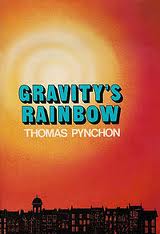
[READ: Week of February 20] Gravity’s Rainbow 1.1-1.12

This is my first time reading Gravity’s Rainbow.  And I know literally nothing about it.   I have always felt like I should read it (being a good modernist and a fan of Joyce and David Foster Wallace), but I never bothered to find out even a basic plot.  And it’s kind of fun going into this thing completely blind.  I had no idea even that it was set in England just Post WWII (1945).  So that was a surprise.  [Interestingly, having just read The Apothecary which was set in London right after WWII, it is cool to read another story set just around WWII and to hear similar things about the living conditions.]

But back to GR.  The only thing I have read before writing this post (aside from a few thoughts over at Infinite Zombies) was a comment (again, on IZ) that you will be confused while reading this book and that’s okay.  Phew.

Having said that I didn’t find it as confusing as I imagined.  (I’ve been intimidated by reading this book for fear of its difficulty).  I admit there are several scenes with pronouns that are somewhat elusive to me, and there’s a few other scenes where characters seem to be there without being fully introduced until later, but overall it’s not that bad.

The first section of the book seems like a lot of exposition–good, thorough exposition, which is also funny—but by section 1.12 we’re still meeting new characters.  It feels like serious plot things will happen later.   The book opens with a more or less famous line (Okay, I knew about that line before reading the book, but that doesn’t give any context).

And so, the screaming comes across the sky and the city is in the midst of an evacuation, but it is too late.  At least for some.  And the opening is a little confusing, as an evacuation might be.  It certainly seems like the end of everything, but then we also find out that some people are sleeping through it.  That this bomb is a localized attack.

Section 1.1 also introduces us to Lt. Capt. Geoffrey (“Pirate”) Prentice.  Pirate is just waking up when he notices that his flatmate Teddy Bloat is about to fall off of the minstrels’ gallery but Pirate manages to shove a cot in the way just as Teddy falls off the balcony.  Pirate is famous for his Banana Breakfasts (he’s the only person in England who has bananas).  And at this point the story settles down into a rather enjoyable domestic scene.  I mention in a post at Infinite Zombies that this opening scene of Pirate on the roof is reminiscent of the opening scene of Ulysses (I won’t go into that here).

The next scene is a raucous affair with a bunch of locals clamoring for their Breakfast plates.  The scene feels like a college dorm, although the participants are (I assume) older—Pirate himself is in his early 40s.

It’s time to mention Pynchon’s astonishing character names. I love them all, they are so weird and evocative without (always) being obvious.  So Teddy Bloat is a good name, but what about Coryson Throsp, the designer of their building.  And with the Breakfast comes names out of the woodwork:  Osbie Feel, Bartley Gobbitch, DeCoverley Fox, Maurice “Saxophone” Reed, Joaquin Stick.  I’m not going to go speculating about names in these posts, but I am sure going to highlight my favorites. (more…)

Read Full Post »

SOUNDTRACK: cuppa joe-“Better in Your Head” (2012).

After an eternity (okay, 18 years), Cuppa Joe is back with another release on Dromedary Records.  Things have changed over the years in cuppa joe’s world.  Their previous release, nurture was a delightful twee pop confection.  This track (you can see the video here) adds an unexpected depth to their catalog.

The first change comes from the minor chord guitar strums; the second comes from the bass, which is following its own cool riff–although it melds nicely with the verse, it’s unexpected from cuppa joe.  The pace of the song is much slower than the frantic songs on nurture.  Even the vocals, while noticably cuppa joe, seem less so–call it a more mature version of the vocals. Indeed, the whole sounds seems to have relinquished their more childlike qualities  and embraced a more mature outlook.

This could be a death knell for a band, but not in this case.  All of their songwriting sensibilities remain intact.  Indeed, they have added a wonderful new component: terrific harmonies in the chorus (which may have been there before, but which really stand out here).

It would almost seem like an entirely new band (18 years will do that to you).  But rather than a new band it’s like an old band coming out of a coocoon like a butterfly.  (That’s too treacly, sorry guys–maybe we’ll just stick with them being older and wiser.  Welcome back guys.

The new cuppa joe album Tunnel Trees is available here.

[READ: September 8, 2010] “The Science of Flight”

I read this story in September of 2010.  I liked it but I wasn’t that impressed by it.  Well, it turns out I either skipped or missed an important section of the story.  So I’m trying again.  here’s the start of my original post

Yiyun Li’s is one of the 20 Under 40 from the New Yorker.  This story (which I assume is not an excerpt) is about Zichen.  Zichen (whose name is unpronounceable to Westerners) emigrated from China to live in America with her then new husband.

As the story opens, we see Zichen at work at an animal-care center.  She is talking with her coworkers about her upcoming visit to England (this will be her first-ever vacation that is not to China).  The men are teasing her about the trip (why would she want to go to the ocean in the winter, she doesn’t know anyone there, etc).  The teasing is friendly, because they are friendly, although Zichen is very reserved around them.  Of course, of all the people she has known, she has opened up to them the most–which still isn’t very much.

That much is accurate.  However, the rest of my post about this story is completely (and rather ineptly, I must admit) incorrect.  Recently, Carol Schoen commented on my original post and informed me that I was a bonehead (although she said it much more politely than that).  I had completely missed the point of this story the first time around.  And indeed, re-reading it this time, I can’t help but wonder what happened last time.

Zichen is a bastard, literally.  She was born our of wedlock to a man who ran away.  In China, this was like compounding one sin atop another one.  Her grandmother agreed to raise her (after a failed adoption) more or less to spite Zichen’s mother, provided Zichen’s mother had nothing to so with her.  And so, Zichen’s grandmother worked in her shop extra long hours to care for a child who was a visible symbol of the family’s disgrace.  (I seem to have gotten the point about her grandmother raising her, but seem to have missed the important part about her parents not being in her life at all). (more…)

Read Full Post »

SOUNDTRACK: THE MARK LANEGAN BAND-“The Gravedigger’s Song” (2012).

Sometimes a song works perfectly with a story.  Titles alone, these two pieces work wonders together.  And then musically–sweet perfection.

I liked The Screaming Trees just fine.  Although they were always a third tier band for me–someone I enjoyed a song or two, but not much more.  I was surprised how much I enjoyed Mark Lanegan and Isobel Campbell together.  And now, here’s a “solo” Lanegan song.  For this song (and with Isobel Campbell), his voice sounds more mature, more robust–almost as if since he doesn’t have to rock out, he can make his voice more sinister.

In spirit it reminds me of Nick Cave’s Murder Ballads, but it’s got a very different sound.  It’s less claustrophobic–no doubt because of the grungy guitars.  In fact, sound-wise, it sounds more like Queens of the Stone Age (less trippy and more dark, but that may be more because of  the vocals).

The guitars are spare but have a  great sound (and cool solos).  And while the relentless drums are never in your face, they keep the song moving nonstop.

It’s a really gorgeous song (although obviously very dark) and makes me want to re-inspect more of his work to see what I’ve been missing.

[READ: February 17, 2012] “I Should Buy Some Cement”

This is the final piece from the maxbarry website that I’ll be talking about here. Thanks, Max for getting me through the dry spell.

The thing that made me laugh the most about this story was that at the very end he has a large box with these words:

Author’s Note: This was a Work of Fiction.

Yay fiction!  But it’s a good thing he includes that, this story is dark.  Very dark.

As you may guess from the title, Max is thinking he should really have some cement on hand.  Now, I also think that quite often.  I was delighted to have a couple of bags of cement in our shed on the afternoon that I erected our birdhouse.  But Barry has something else in mind. (more…)

Read Full Post »

SOUNDTRACK: STEVEN KATZ-In the Garden of Earthly Delights (2009).

Since I mentioned an album my Aunt Marg gave me, I’m also going to mention this one, that she gave me the following Christmas.  She told me that Steven Katz is a classical guitarist in St Croix.  They saw him play when they were on vacation and they were amazed that he this amazing guitarist who was just sort of hanging around in St Croix (that’s the life, eh?)

I enjoy classical guitar, although I suspect if I was able to play it I’d enjoy listening to it even more.  As it stands, I can appreciate the fast trills (and Katz is masterful at them) and the general feel for the form.  On the other hand, I’m a terrible critic of this kind of music.  It all sounds kind of samey to me.   This is not a criticism of the genre or of Katz, it’s simply an admission that I like the stuff, but I couldn’t tell you a grand master from a regular master.  The one big difference I can say is that unlike the Gipsy Kings (of whom I am quite a fan) there are no extended clapping sections (well, a small clapping section in “Moroccan Roll”).

All of Katz’ composition are beautiful (all the songs are original except for one cover).  They often feature slow sections that are very moody as well as virtuosi parts (that I’ll bet are amazing to watch).  Katz is an amazing guitarist (of course I think anyone who can play this style is amazing).  He plays a Flamenco acoustic guitar over some simply keys and percussion on most of the tracks.  If I had any song to quibble with it would be “Parting at the Ganges” which has a cheesey keyboard in the background and chimes that are clearly sampled–that isn’t a bad thing necessary, except when they stop abruptly and start again.  But I only noticed that on my third listen.  But most songs have simple arrangements (bongos and whatnot).

On the plus side there’s some really unexpected guitar lines at the end of “Gypsy Caravan” and the whole feel of “Moroccan Roll” is very cool.  “Shake It Up” diverges from style on the rest of the disc with some interesting and familiar south of the border musical setups (before returning to some amazing fretwork).  I also really liked the opening of “Desert Rain Cry” because it sounds (I’m sure completely unintentionally) like the opening of Rush’ “Xanadu” (without the wooden blocks).  (The rest sounds NOTHING like the Rush song).

I mentioned the Gipsy Kings above and the comparison is apt because like the Gipsy Kings, Katz also does  cover of Hotel California. Unlike the Kings’ version, there are no vocals. Also unlike their version, this version is quite subtle.  He uses his guitar to play the vocal line, but he does it in a flamenco style–incorporating the melody into the fingerwork–it’s very cool.  He also incorporates the famous guitar solo into his playing–you hear it but he’s not “just” playing the solo.  It becomes and entirely different song than the original.

I went to Katz website and he is funny and self-deprecating, but he also tells us that he has played with all kinds of people including Dr. John, Mavis Staples, Edgar Winter and Mountain (this last one shows that he’s not a young man).   But I’m also quite certain he is not this Steve Katz who was in Blood Sweat and Tears.

[READ: February 21, 2012] “Thief”

I have read two other things from Walter, both of them via McSweeney’s journals.  It’s interesting to read him outside of that context as this piece is different from those two (I’m also amazed that he is releasing his sixth novel!).

I didn’t like the way this story started out, but once we got past the awkward introduction, I thought it was extremely compelling.  And then when it ended, I had some weird feelings about the conclusion.  But more on that later.  (I’m learning that when I say things like “I didn’t like the beginning, it’s usually like the first paragraph or two, which isn’t really fair, but which can often make or break someone’s interest in a story).

So the story starts out with observations about the Girl from her dad (capitalized because all three kids are apparently referred to as Little, Middle and Girl).  Wayne is watching his daughter sleep.  He had her when he was just 19 and she changed his world.  Now she’s 14 and he doesn’t like that Girl hangs album covers on the wall and wears her hair like Peter Frampton (I did enjoy the very simple pop culture references that set the time of this story perfectly).  Then he looks in on the sleeping Middle (who is so unlike Wayne that he thinks of him as the Milkman’s kid) and Little.  Any of the three could be the thief.  Little is a greedy sumbitch (I love the detail about his first words).  Middle is a pretty unlikely candidate (he’s bookish and timid).  And then there’s Girl.  She walks to the bus stop but sneaks a ride with the guy in the Nova; she’s probably smoking pot.

One of them is definitely the thief.

Wayne has a giant jug in which he dumps his change.  It is the family vacation jug.  After two years of change, it will be full enough for a vacation.  And this year’s is Kelowna, BC and the Bedrock City there (yes a Flintstone’s Theme Park–which was real, but is now sadly closed).  Wayne suspects that the Girl doesn’t want to go to Flintstones land and is stealing money to sabotage the trip.  His wife thinks he’s crazy, but he has set little traps and he knows the vacation jug is moving and emptying. (more…)

Read Full Post »

SOUNDTRACK: RED BUDDHA-Raindance (2007).

My Aunt Marg gave me this disc for Christmas a few years ago.  She said that she knew it from a spa that she went to.  And I can totally tell. I don’t know anything else about the artist, and it’s even hard to find stuff about him online.

The disc has an Indian (Eastern) vibe (which surprises me given the name of the artist and the African-looking person on the cover).  It also has a real world music feel.

Sarod

Overall, I like the music quite a lot.  It’s certainly new agey, but not treacly new age or anything.  It showcases some cool world music without resorting to clichés.  However, I admit to not caring much for the spoken lyrics of the opening track,  “Sometimes.”  His voice is deep and distracting, especially over such mellow music.  Despite the very Indian feel of “Sometimes,” the rest of the disc explores other sounds as well.  “Kokou” has a 70s kind of organ and bongos (with more appropriately world musicy chanted vocals).  “Raindance” has a cool flute over some bongo beats (all very soothing…with crickets).

Veena

I really like “Girl from Orissa” with its cool Eastern instrumentation.  There’s a sarod, a veena and a sitar on the disc.  (Orissa is located on the eastern side of India).  “Khali Gandaki” also features this cool instrumentation. (The Khali Gandaki valley is in Nepal).

“Mswati” opens with some percussion. But this track differs because of the interesting riff that plays throughout the song (whether guitar or keyboard, I can’t tell).  “Touba” has a nice bassline, which really stands out on a disc with minimal bass. It also has some neat wah-wahed guitars.  And “Preaching of Buddha” has a kind of Dead Can Dance feel to the vocals (they’re my go-to band for world music).

Sitar

“Katarajama” (a pilgrimage site for Sri Lankans and South Indians) has a great riff to it, and it’s even better when the other instruments play along.  “Patan Part 1” also has a cool sitar riff.  Although if Part 1 is 8 minutes, how long is  the whole song?

The final song, “Sufi Kalaam” has a somewhat more sinister or perhaps just movie soundtracky sound (low bass chords underpin the beginning of the track).  There are chanted vocals and lead vocals in another language.  I rather like the song, but it doesn’t really fit on the disc.

The whole disc is definitely a background/new agey kind of deal.  I can hear it all (except the first and last songs) working well for a relaxing evening of massage.  Just don’t listen to it while driving!

[READ: February, 17 2012] “Lorry Raja”

“Lorry Raja” won Narrative magazine’s “30 Below” contest for 2011.  After the wonderful stories that came in second and third place I expected something pretty amazing to win.  And I was maybe a little disappointed by this story because of it.  And I think I have to blame a cultural disconnect for that.

This story is set in Karnataka, India, a poor state in the south of the country.  People there are so poor that they live in tents and work in the mines–smashing up rocks to get at the iron ore inside.  The children can’t afford to go to school, there’s no electricity and everyone is covered in a red dust from all of the dirt in the mines.

Madhuri Vijay is able to create a compelling story out of this harsh environment.   The story concerns one family as they struggle to survive under these conditions.  The father (I had a really hard time keeping the names straight, so I’m not going to include them here) had an accident and cannot work to his full capacity, so he is stuck working less lucrative jobs. The mother works smashing up iron ore.  The middle son, 12, works and plays around the mine (collecting a few rupees each day).  They put some money aside for his eventual education.  The older brother has just gotten a job as a lorry driver for the mines–he takes the ore out to the port cities.  He is only 14, and, being 14, he takes especial care of his lorry–cleaning it from all the red dust and driving it in a very proud manner.  So much so, that everyone starts calling him Lorry Raja.  There’s also a baby brother who doesn’t play much of a part except (in the way I read it) to show off how hopeless things are (the boy is playing in the dirt and when it is time to feed him, his mother just takes her breast out in front of everyone).

The story is narrated by the middle son.  And we watch as he grows jealous of his brother–the Lorry Raja.  We see the narrator break up rocks, spy on his mother, spy on his father (who is lowered by a rope in to a deep mine (!)).  And we see him talk to the owner of the mine (who has a car, a generator and drinks Pepsi).  And finally we see him spend some time with his brother’s ex-girlfriend (they broke up more or less once he started driving his lorry).

When the girl casually remarks that the narrator should get his lorry license and then he could drive her to China, that sets a new part of his life in motion.  (They are thinking about China because the “Lympic Games” (“Whatever they are” he says) are being played there this year). (more…)

Read Full Post »

« Newer Posts - Older Posts »