Feeds:
Posts
Comments

Archive for the ‘Authors’ Category

5dials31SOUNDTRACK: BEACH SLANG-Tiny Desk Concert #431 (April 10, 2015)

beachslangI had never heard of Beach Slang before watching this Tiny Desk Concert.  Evidently they are a new band with only a couple EPs out.  The write up says they are a punk band.  But in this Tiny Desk show, it’s just lead dude James Snyder and his guitar.

He plays four songs.  They are all sort of jaunty acoustic songs.  They are almost anthemic, but not quite.  The strangest thing is Snyder’s super-raspy singing voice, especially since his speaking voice is gentle and his laugh is kind of high-pitched. He is very funny and nervous when he talks, which I enjoyed quite a bit.

Exploring a little their bandcamp site, I see that they do a cover of the Psychedelic Furs’ Love My Way, and that sound is pretty apt.

Their recorded versions are heavier and actually sound a bit like the Goo Goo Dolls.

This is a brief but enjoyable set.  I find him so charming that I like it more than I might normally.

[READ: April 1, 2015] Five Dials 31

It has been quite a while since I’ve read a Five Dials.  And that’s no fault of the magazine–its all on me.  I always think, I’ll just put it off till I have time, and then I realize that I can always find something to read…so I just need to actually make time for Five Dials because it is totally worth it.

So this issue came out about a year ago.  Maybe that’s not too bad?

It begins with the contributors page and is followed by the Unable to Contribute page which lists five journalists who are currently in prison (find out more at the Committee to Protect Journalists).  Page 5 is a Table of Contents which I feel they haven’t done before.  It has a cool drawing on the bottom.  All drawings from this issue came from The Public Domain Collection of the British Library.

Then there’s a Frequently Asked Questions page.  Many pertain to corresponding with Five Dials, but others, well: (more…)

Read Full Post »

[LISTENED TO: April 4, 2015] The Penderwicks

penderEverything about this book feels like it’s an old story–from the cover (which is consistent in all versions as far as I can tell) to the tone.  It feels like a book that was set in perhaps the fifties or even the seventies.  Until we learn that the father has a computer and you see that the book was written in 2005.  Then you realize that Birdsall has simply captured an idyllic moment for a family and that although there are some trappings of modernism, it could be set at (nearly) any time (the computer is not really significant to the story).

Sarah had read the story and really liked it so she brought home the audio book and we all enjoyed listening to it.  (How upsetting to have about 30 minutes left in the 6 hour story when we got to the airport for our vacation and had to wait a week to finish).  The reader, Susan Denaker had a good selection of voices.  Sarah didn’t like her voice for the littlest girl, but I thought it was cute.  I was also impressed by her male voices–all similar (since they were from the same part of the country) but with enough different inflections so you could tell them apart.

So what is this story about?  Well, it is about the Penderwick Family.  Mr Penderwick is a scholar (he says Latin phrases to the girls all the time and they are not translated–so brush up!).  He has four daughters: Rosalind (12), Skye (11), Jane (10) and Batty (4).  The girls’ mother died shortly after giving birth to Batty (but not because of giving birth to Batty, she had cancer).  I always think it’s weird when a parent is dead in a story, especially if it said death is designed just to give the living parent a romantic interest.  But that doesn’t happen in this story. Their mother is dead, and the girls have to move on without her, but it also brings them together.  Rosalind more or less falls into the mothering role (poor girl) and their mother’s loss is felt throughout the book. (more…)

Read Full Post »

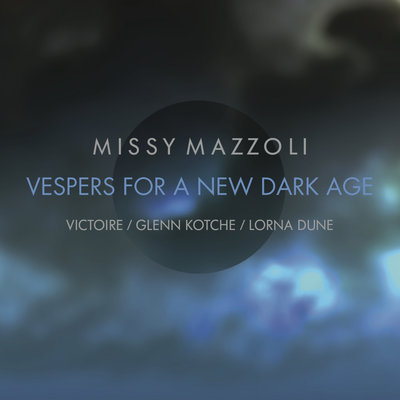
ampsSOUNDTRACK: MISSY MAZZOLI-Vespers For A New Dark Age (2015).

missymazzoli_sq-80d1109aad30ab9a4bfe1a45d5c82d99354bc079-s400-c85Missy Mazzoli’s Vespers for a New Dark Age, is a 30-minute suite for singers, chamber ensemble and electronics. The piece was commissioned by Carnegie Hall for the 2014 Ecstatic Music Festival.

It’s a fascinating mix of traditional and contemporary instruments.  And there’s a surprise musician as well: Martha Cluver and Virginia Warnken Kelsey from Roomful of Teeth, provide operatic soprano voices.  Mazzoli’s own ensemble Victoire, provides the music while Wilco drummer Glenn Kotche adds percussion and thunderous pounding.

As the suite opens, electronic chimes sound before the beautifully soaring voices come in (I don’t know who is who).  The instrumentation is complex and the vocals are often in English (but operatic and not always obvious to hear). There’s some great rising and falling notes from various instruments.

The first piece is called “Wayward Free Radical Dreams” and I like the surprise of the simple English phrase “Come on, come on come on” A bell ringing is the segue into part 2, “Hello Lord.”  Over a lonely flute and some synths, the vocalist sings a poem by Matthew Zapruder for lines like: “hello lord / sorry I woke you / because my plans / are important to me / and I need things / no one can buy / and don’t even know / what they are / I know I belong / in this new dark age.”

I love the rising and falling notes of “Interlude 1″ over the fast violin moments.  “Come On All You” opens with some ticking hi-hats and squeaky violins.  There’s a lot of drums in this song—some punctuate the melody until the soprano voice takes over and then around 4 minutes into the section, the drums burst to life.  “New Dark Age” has some moody synths under the soaring voices and “Interlude 2” opens with the sound of big deep bells.

“Machine” has a mechanical staccato feel in both strings and voices.  When it returns to “Come on Come on” refrain (this time with two voices), it’s very cool.  The “Postlude” ends the piece with moody strings and distorted mechanical sounds that overwhelm the voices at times.   The piece ends on an up note but not in an overwhelmingly happy feeling.

The final piece on the disc is not part of the suite, although it fits in sonically.  It is called “A Thousand Tongues (Lorna Dune Remix)” and it has echoing pianos and overlapping synths.  While this piece is pretty it is probably the least interesting of the disc.  Perhaps because there are fewer voices and more synth melodies.  Perhaps because it is a remix.  The song feels fine, but not as compelling as the suite.

I was happy to discover his disc, which really explores different classical motifs.

[READ: March 15, 2015] All My Puny Sorrows

As with many books, but especially those published by McSweeney’s, which I always read, I didn’t really know what this was about.  I can pretty much guarantee it would not have been high on my list had anyone told me it was about dealing with a suicidal sibling.

But what’s great about the McSweeney’s imprint is that they gather such a wide variety of books and most of them are of such good quality that I know I won’t be disappointed.  And this book not only didn’t disappoint, I found it really fantastic.

The story is fairly simple, although from my perspective it was also fairly exotic.  The main action of the book takes place in present day Winnipeg.  But there are flashbacks to the main characters’ childhood in 1979.  And the way it opens–with the family watching as the house that their father built is put on the back of a truck and driven away is one of the more memorable opening passages of a book that I’ve read.

The family consists of the narrator  Yolandi, her older sister Elfrieda and their parents.  And, perhaps most exotic to me they are Mennonites.  Their family is not entirely pious in the tradition in their town–they are seen as somewhat less than observant.  Things were made even worse by the deliberately provocative nature of Elf.  She was creative, she loved to read and she had a real sense of outrage.  The church pastor once accused her of “luxuriating in the afflictions of he own wanton emotions.”  She embraced poetry, particularly the line “all my puny sorrows” and decided it would be her slogan.  So she began spray paining AMPS all over the town. (more…)

Read Full Post »

dec2014SOUNDTRACK: BOOGIE-Live at SXSW (March 21, 2015).

boogieAt this year’s SXSW, NPR had a showcase featuring 5 artists.  One was Courtney Barnett (see Saturday’s post).  The other artists were Stromae, TV on the Radio and Shamir.  I assumed that they’d be posting full shows from all the artists.  But aside from the Courtney Barnett show and two songs from Stromae, the boogie show is the only other one that we can view.

The first artist was rapper Boogie. Boogie is from Compton and he defied Compton stereotypes by not only not singing about gangs (well, he does but not as a gang member) but actually speaking about love and change. Like many rappers he has a weird tic (most seem to say Uh huh, yeah, but he says “wuh wuh” a lot). It’s a bit tiresome but not the end of the world.

I didn’t enjoy his first few songs because although his introductions to the songs were really nice—about love and respecting women while disrespecting bitches etc, I thought his lyrics were really poor.  Just a ton of repeated fucks and bitches. It was lazy.  And the second song “Bitter Raps” was just list of things he doesn’t like, which I also thought was weak—although may be the crowd enjoyed it.

And the beats weren’t all that interesting to me—I don’t really like the music behind West Coast rap so that’s a strike against it for me anyhow.

But by the end of his set I thought he really showed some good stuff.  “Gangbangin’” was a really good song (rhyming bullshit with pulpit was clever). “God Work” was also good, but “Oh My” was the best song of the night—a great chorus of “Oh my goodness” was funny but also effective.  Using his 5 year old son as a sample was also fun as the boy really enjoyed putting so words down for his dad.

By the end of the set with “The Change,” he had won me over, and while I won’t be listening to him again, I imagine he was a good warm up for the night.

You can watch his set here.

[READ:March 25, 2015] “Forbidden City”

I enjoyed this story a lot more than I was expecting to.  It’s not that I thought it would be bad, I just didn’t really have any expectations.  I barely know Dyer at all.  But it proved to be really enjoyable.  Although I feel like the ending was a bit of a let down (and how could it not be, with the way it was set up?).

James is a (British) author on a tour of China.  He has been to many cities in China and he is exhausted.  He had been to Shanghai and Beijing and he had been plied with many many drinks.  These combined with his jetlag to wipe him out.

He was being chaperoned by Min, the coordinator from his Chinese publisher and although she had done just about everything with him, she was relentlessly cheerful and up.  And on his last day the last thing he wanted to hear was that she had scheduled a tour of the Forbidden City.  He feared the well meaning and knowledgeable tour guide would bore him silly as they walked around the huge Forbidden City in stultifying Beijing heat. (more…)

Read Full Post »

zooboxSOUNDTRACK: THE NOT-ITS-“Nose in a Book” (2014).

notitsIs it okay for parents to enjoy children’s music?   Like, even if your kids don’t really care about it?  I heard this song on the radio the other day and I thought it was so much fun.  My kids weren’t even in the room but I sang along anyway.

The song starts out with an interesting bass riff and feedback!  The guitar is nicely fuzzy–this is not a typical kids song.

Then the lyrics start–“Dad told me to turn out the light, but I just wanna read a couple more pages.”  The music in the verses is cool and even a little dark.  The chorus, on the other hand, is very poppy and fun to sing along with.

The bridge is a chant of Chapters 1-8, and the end of the song really rocks out.  It’s a totally great song, and clearly, I can relate.

Check it out at their bandcamp site.

[READ: March 26, 2015] The Zoo Box

As part of my decision to read all of the First Second publications (which I have been doing I just haven’t had a chance to post many of them recently), I knew that I wanted to read this book.  But I was delighted to see that Sarah brought it home to read to the kids.  And it seems like a good book to talk about for Easter.

The Zoo Box opens with two parents going out for the night.  They leave their older daughter in charge of their younger son.  There’s no fighting–the daughter is happy to be in charge, but the son isn’t upset by it.  And if they promise to be asleep when the parents get back, they will go to the zoo the next day.

As soon as the parents leave, the daughter suggests they play dress up in the attic.  I love that this is the idea she has and that he is excited by it.  And I love even more that dress up consists of full sized tiger and ape costumes.  It’s fantastic.  The kids growl and play (the attic is locked, but it seems very nice with a bed and plenty of space) and then they discover a box that says Do No Open. (more…)

Read Full Post »

ageSOUNDTRACK: COURTNEY BARNETT-Live at SXSW, (March 21, 2015).

cbsxswI enjoyed Barnett’s single “Avant Gardener” a lot.  Then I got a little sick of it (I love WXPN, but man they can overplay a song).  And yet I still like Barnett’s wordplay and her sense of melody.

I was really psyched to hear how noisy her latest single “Pedestrian at Best” was.  When she played the NPR SXSW showcase, a night in which she played exclusively songs from her then unreleased new album, I did not expect her to be so rocking.

But she really embraces the noise.  The sharpest, clearest sound in this show is Dave Mudie’s ever present snare drum–a cracking sound that keeps the beat and the song steady while Courtney thrashes away on her guitar and Bones Sloane’s low bass thuds along.

The set is short, and Barnett seems genuinely delighted at the size of the crowd.  They run through 8 of the songs of the new album, and they sound great.

  • “Elevator Operator” a great opener, familiar sounding but new.
  • “Pedestrian at Best” noisy and rocking–she has a ton of fun with this.
  • “An Illustration of Loneliness (Sleepless in New York)” is a bit mellower
  • “Depreston” a slow song with great lyrics.
  • “Nobody Really Cares If You Don’t Go to the Party” a bratty fast rocker with Barnett slurring her lyrics in a fun way.
  • “Aqua Profunda!” a song about swimming in Melbourne.  2 minutes long which she describes as “stupid.”
  • “Dead Fox” super catchy and poppy.
  • “Kim’s Caravan” closes this short show with a long song.  It starts slow and moody, But Barnett starts wailing on her guitar by the end.

It’s kind of a shame that the show is only 36 minutes, but it’s a great way to get in, play some great songs and get out leaving us wanting more.  I hope the full length rocks as much as this show does.

You can watch her whole set at NPR.

[READ: March 20, 2015] The Age of Earthquakes

I saw this book at work and could tell just from the typeface that it was a Douglas Coupland book (he is that much of a brand).  I was a little thrown off by the other names on the book as I’ve never heard of them, but it is clearly a Coupland production, even if he is alphabetically second.

I’m not even sure what the other two authors contribute (or who they are), as the book is so clearly Couplandy.  Of course, having said that, the majority of the book is pithy aphorisms about the age of technology and the future.  So truly any one could have said them.

There is something kind of staid and conventional about Coupland writing about the craziness of the future and all that.  He’s been doing it for decades now.  But I found this book enjoyable.  Not mind blowing (although some ideas are pretty fascinating), not life changing, but enjoyable. (more…)

Read Full Post »

dec2014SOUNDTRACK: TORRES-“A Proper Polish Welcome” NPR Lullaby SXSW (March 21, 2015).
torresFrom March 17-March 21, the SXSW festival raged on. And my friends at NPR Music were there so I didn’t have to be. In past years they have had a nightly recap of their favorite shows of the day. This year they upped the ante by inviting a musician to sing a lullaby.  Most of these lullabies occurred in some unexpected outdoor location at 2 or so A.M. after a long day of music.

The final lullaby comes from new to me singer Torres. She has one of my favorite songs from the NPR Austin 100 “Strange Hellos.” It starts slow and builds and builds.  This is not that song (which would never work as a lullaby).

This is the only lullaby to feature an electric guitar.  And even though it is played quietly you can hear her fingers sliding up and down the strings squealing away.  This is a song from her new album Sprinter.  And it’s quite lovely.  I’m looking forward to hearing the full album when it comes out.

Check it out here.

[READ: March 23, 2015] “Hammer Island”

This issue of Harper’s featured five essays (well, four essays and one short story) about “Growing Up: five coming of age stories.”  Since I knew a few of these authors already, it seemed like a good time to devote an entire week to growing up.  There are two introductions, one by Christine Smallwood (who talks about Bob Seger) and one by Joshua Cohen who talks about the coming of age narrative.

I’m not sure why Wells Tower submitted fiction rather than an essay (he comfortably does both), but I’m glad he included this story as I think it’s a really interesting one.  And yes it does cover growing up–and may even be based on fact, who knows.

This is written from the point of view of a seventeen year old girl, Maxine.  She has been invited to Hammer Island (of the coast of Maine) for the summer to watch the (frankly wicked) daughter of famed film producer Morris Walls.  Walls terrifies people in Hollywood, but when he comes to Hammer Island he is treated like everyone else.  I loved this example:

Morris flicked a cigarette butt over the boardwalk rail. A teenage boy walking behind us retrieved it. He jogged up to Morris, tapped him on the shoulder, and slipped the cigarette butt into his palm. “No littering,” said the boy. “I know you’re new here, but we take it pretty seriously. Technically, there’s a three-hundred-dollar fine. I’m not going to report you, but just so you know, most people would.”  In California or New York, threatening Morris Walls and handing him garbage would have been a sure way to get sworn at, slapped, doused with hot coffee. But Morris understood that attacking the boy would be pointless. The boy was of the island, and he spoke with the full authority of the place behind him.

And I loved the general pretension of the island:

Whenever anybody walked by, you had to call, “Hello! Come up, come up! We’re picking crabs!” Or you had to say that if you owned the house and the person passing by owned a house on Hammer, too. If you had been coming to Hammer Island for thirty summers, renting the same house for $4,000 a week, you did not get summoned to a porch for crab picking. You were still looked upon as an interloper and a thug.

Interestingly, this is all just set up for the real story which has little to do with Walls and nothing exactly to do with the island.  For this story is about Maxine and a teenaged boy, Todd Greene.  When Maxine is able to get a way from Lola (the brief story about Lola is hilarious), she would watch Todd play tennis.  He was masterful.  And after his matches he would talk with her.  And soon enough he invited her onto his boat.

When she arrived at the dock, a short, dwarfish man was polishing the boat and Todd was nowhere to be seen.  The man seemed to have nothing but admiration for Todd, talking about what a good sailor he was and making the boat perfect for the young man.  When Todd finally arrives, he takes the keys, says nothing to the man and he and Maxine head out to open waters, where “Todd talked me out of some but not all of my clothes.”

Two days later, Maxine was invited to the Greene’s house where she discovered that the “dwarf” was actually Todd’s father.  Todd’s mother and brother are, like Todd, gorgeous, and she can’t figure out the father’s place.  But it seems that his place is simply to serve everyone.   And when he makes a mistake with dinner, the whole family reams him out.  But this time, having had enough, the father storms out and is not seen on the island again that summer.

Maxine is surprised that Todd keeps in touch over the year with quarterly updates on his exploits.  And they both plan to return to Hammer Island next summer.  When they do return Todd’s father is there waiting (and he has a plan).  The end of the story is exciting and emotionally complicated.  It’s a very satisfying story indeed.

I’m looking forward to more fiction from Tower.

Read Full Post »

dec2014SOUNDTRACK: LAURA MARLING-“Walk Alone” NPR Lullaby SXSW (March 19, 2015).

marlingFrom March 17-March 21, the SXSW festival raged on. And my friends at NPR Music were there so I didn’t have to be. In past years they have had a nightly recap of their favorite shows of the day. This year they upped the ante by inviting a musician to sing a lullaby.  Most of these lullabies occurred in some unexpected outdoor location at 2 or so A.M. after a long day of music.

This late night lullaby was actually recorded much earlier than most (around 9:30P.M) because one of the gang had to leave early.

Marling has become one of my favorite new (to me) voices. I love the way she sings. It feels unconventional or unexpected somehow.  The way she doesn’t follow the melodies of her guitar playing is really cool and exiting. And when she drops into a nearly spoken word it’s quite arresting.

This song is from her soon to be released new album Short Movie, and it is as enchanting as anything she’s done.  You can check it out here.

[READ: March 23, 2015] “Nina”

This issue of Harper’s featured five essays (well four essays and one short story) about “Growing Up: five coming of age stories.”  Since I knew a few of these authors already, it seemed like a good time to devote an entire week to growing up.  There are two introductions, one by Christine Smallwood (who talks about Bob Seger) and one by Joshua Cohen who talks about the coming of age narrative.

This is a story of meeting a bad person and getting sucked into her life.  There’s nothing terribly original about this.  However, the characters (her name has been changed) are not your typically teenage angsty college students.  Set in 1981 at NYU, the narrator is Indian and the girl sitting next to him is Latina.  It’s cool to have a familiar story told with slight differences like this one does.

The girl asks him for help with her computer.  He fixes her problem and she asks to get his number so they can keep in touch.  She is very pretty.  He couldn’t resist calling her, so he invited her to a play and she agreed. (more…)

Read Full Post »

dec2014SOUNDTRACK: MYNABIRDS-“All My Heart” NPR Lullaby SXSW (March 19, 2015).

mynaFrom March 17-March 21, the SXSW festival raged on. And my friends at NPR Music were there so I didn’t have to be. In past years they have had a nightly recap of their favorite shows of the day. This year they upped the ante by inviting a musician to sing a lullaby.  Most of these lullabies occurred in some unexpected outdoor location at 2 or so A.M. after a long day of music.

For this lullaby, the NPR gang met by Waller Creek, giving Laura Burhenn a perfect backdrop to her 2 A.M. lullaby. It’s just her and her tiny Casio keyboard (which is on an interesting setting that makes it sound more like a harmonium).

This is an as yet unreleased song.  It is simple and charming.  And I really like the way she plays an unexpected note in the chorus. Her voice is dusky and quiet and it all works so well in this setting. It’s a beautiful lullaby.

Check it out here.

[READ: March 23, 2015] “My Mother’s Apartment”

This issue of Harper’s featured five essays (well four essays and one short story) about “Growing Up: five coming of age stories.”  Since I knew a few of these authors already, it seemed like a good time to devote an entire week to growing up.  There are two introductions, one by Christine Smallwood (who talks about Bob Seger) and one by Joshua Cohen who talks about the coming of age narrative.

I don’t know Barrodale’s writing.  She says that she was 24 and took a writing class but only lasted for one day in the class.  She felt that getting an MFA was dishonorable.  Rather, she wanted to a have a real job but to write fiction on the side:  “I wanted to be like William Gaddis.  I wanted to work, drink, wear normal clothes, pay my bills and write.”

She was 31 when she realized her plans were not going to come true. (more…)

Read Full Post »

dec2014SOUNDTRACK: LULUC-“Star” NPR Lullaby SXSW (March 18, 2015).

lulucRecorded outside of Stubbs while the groundscrew was cleaning up the huge mess, Luluc play a beautiful quiet ballad.

Steve Hassett plays lead acoustic guitar and sings harmonies while Zoë Randell plays rhythm guitar and sings lead. Interestingly, his voice often goes in higher registers than hers.

I really like the solo that he plays that adds a bit of uptempo feel to this otherwise quiet song.

Check it out here.

[READ: March 23, 2015] “At First Blush”

This issue of Harper’s featured five essays (well, four essays and one short story) about “Growing Up: five coming of age stories.”  Since I knew a few of these authors already, it seemed like a good time to devote an entire week to growing up.  There are two introductions, one by Christine Smallwood (who talks about Bob Seger) and one by Joshua Cohen who talks about the coming of age narrative.

Here’s yet another piece by Karl Ove (like the recent essay in the New York Times Magazine) translated by Ingvild Burkey

It’s hard for me to imagine that Karl Ove (who has written literally thousands of pages about his life) could have anything more to say–any incident that he hasn’t gone over with a microscope.  And yet, here he is with a new incident.

As with most things from Karl Ove, it explains a minute detail which proves to be a big event.  He was 12 and in school and told to spit out his gum.  As he walked up to the wastebasket the attention made him blush.  The first time he can recall the burning shame making him more self-conscious which then kept repeating itself.   And then some one said “Karl Ove’s face is all red!” (more…)

Read Full Post »

« Newer Posts - Older Posts »