Feeds:
Posts
Comments

Archive for the ‘P.G. Wodehouse’ Category

51196238._SX318_SY475_SOUNDTRACK: LYRIC JONES-Tiny Desk (Home) Concert #57 (July 29, 2020).

download (69)Lyric Jones is a delight.  A smart, thoughtful woman who not only raps really well, she has a great singing voice too.

She talks A LOT between songs.  She plays 3 songs in 21 minutes.  She talks a lot about her hustling–driving for Uber and Lyft as well as all of the running around one has to do to be a musician.

Lyric makes it abundantly clear that her hustle is nonstop – writing, rapping, singing, drumming, engineering, and grinding it out to make Gas Money (the title of her latest album).  This quintuple threat, trained in the Berklee College of Music’s City Music program, recorded this Tiny Desk (home) concert from her studio in Los Angeles in May.

“All Mine” opens the song and I love how she plays her electronics while keeping her flow fresh.

My favorite song is “Adulting.”  I love watching her create the song a capella–making the beats and the music looping her voice and manipulating it with electronics.

 Her multi-layered prowess is present on “Adulting” a song about the evolutionary growth that happens in your late 20s and early 30s. Lyric uses a TC Helicon vocal processor to create percussive beats, looping her voice as a backdrop and packing a punch with vocal harmonies and ad libs.

After the song she jokes about how in the song she is complaining about wanting to stay home all day and not get up and do shit.  Be careful what you wish for.

Before the last song she has two important things.  First, how you can support Lyric Jones (ha).  But she takes the virus seriously, encouraging everyone to be kind to ourselves and patient with ourselves. It’s important to feed ourselves mentally, creatively and to literally feed ourselves.

In grappling with the pandemic, Lyric expresses the deep importance of this moment: “Whatever we put out in this time, in this era is a bookmark in history. Especially as musicians. … For me, my personal testament, I want to be intentional. … My children’s children are gonna know about this time. And I want to know that I impacted it with intentional music, intentional thoughts, insights and perspectives.”

She ends with “Lush Lux Life,” her “affirmation song” about “what I should be doing–living luxuriously.”  I really like this song for the excellent retro-sounding music behind the song.  I’m really curious if the jam at the end of the song is new or a sample from an interesting rocking jazzy solo.  Her producer Nameless has some great skill.

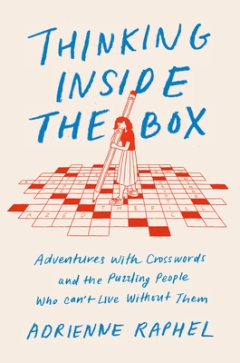
[READ: July 29, 2020] Thinking Inside the Box

A couple of years ago I read Cluetopia, a history of the crossword puzzle written from a British writer.  Now here’s a book about crossword puzzles written from an American writer.

Is the country significant?  In some ways, very much so.  Because Americans and Britons have very different styles of crossword.  Americans’ puzzles are full of puns and definitions as well as facts and information.  British crosswords are known as cryptics and are mostly full of wordplay–you don’t need external information to solve the puzzles, exactly.  Most of the time the clue contains all you need to find the answer (sometimes it even contains the answer itself) but they are quite challenging.

Other than that, the origin of the author is not that significant, because the origins of the crossword are the same regardless where you write from.  Arthur Wynne was a Liverpudlian lad who moved to Pittsburgh and then to New York City.  He worked on the New York World which was eventually run by Joseph Pulitzer.  (It’s ironic that awards of excellence are in his name since he ran the World full of pulpy news and yellow journalism).

In 1913, Wynne was put in charge of the FUN section.  He needed to fill space so he came up with a Word-Cross Puzzle.  It was shaped like a diamond and the three and four letter answers ran around a center hole.  He based it on similar word puzzles he had seen as a child in England.  The puzzle became a weekly feature.  Eventually a typo changed it to crossword.  The puzzles weren’t especially challenging because they were meant to be fun.

Wynne wanted to patent the crossword but the paper wouldn’t pay for the expense. (more…)

Read Full Post »

woosterSOUNDTRACK: JULIETA VENEGAS-Tiny Desk Concert #126 (May 9, 2011).

julietaJulieta Venegas has a sweet voice.  She plays accordion and guitar and, for this show, is accompanied by a clarinet and flute.  The whole concert is delicate and lovely.

She sings threes songs in Spanish but describes them in English.

“Si Tú No Estas” features her on the accordion.  She plays a delightfully simple riff that sounds jaunty on the little accordion.  The clarinet is a fitting accompaniment to her on this quiet song.  I love that it feels vaguely French, even though it is sung in Spanish.  This is about the people you leave at home when you travel.

“Debajo De Mi Lengual” (Under My Tongue) is a bit more folk sounding because she plays the song on guitar and is accompanied by a flute.  The song is about being insecure to talk to others.  The melody is simple, but the flute adds some lovely notes.

For “Bien O Mal” she stays on guitar but this time is accompanied by the accordion.  This song is the most rollicking (not very rollicking at all, of course, but the tempo is much faster.  The accordion mostly plays chords to flesh out the song.  The song sounds lovely, which is why it’s especially funny that at the end she seems unsure of just how good it was.

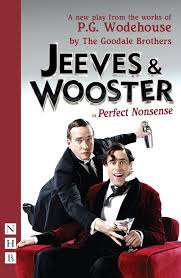
[READ: December 14, 2015] Jeeves & Wooster in Perfect Nonsense

I have never read any of P.G. Wodehouse’s Jeeves and Wooster stories, although I have seen most of the series starring Stephen Fry and Hugh Laurie (incomparably played).

This play is a “new” story written by the Goodale Brothers.  It is based on a bunch of Wodehouse’s pieces, particularly The Code of the Woosters (1938).  Robert and David Goodale were asked to put the above story on the stage.  So they worked on it and modified it and came up with this version.

They came up with the idea of Wooster telling one of his tales and Jeeves “helping” as only Jeeves can.  So in this production, there are only three actors.  But they play multiple parts each trying to flesh out Bertie’s story.  Wooster is Wooster, Jeeves is Jeeves and several others, and their friend Seppings plays many many roles, including some women and a nine foot tall man.

The story itself is intentionally convoluted and hilarious.  It involves an expensive creamer, a police officer, Bertie’s aunt and the ghastly woman Bertie might jut have to marry. (more…)

Read Full Post »

mannersSOUNDTRACK: MARTIN TIELLI-Hugh’s Room Toronto, ON (September 27, 2009).

hughsThis is the final solo show from Martin Tielli on the Rheostaticslive site.  And it’s a great final show.  The sound quality is excellent and the crowd is also really into it.

Martin says that it is the fourth show ever with this band which includes Martin Tielli – vocals, guitar
Selina Martin – acoustic guitar, vocals, bowed saw
Monica Guenter – piano, synth, viola, vocals
Greg Smith – bass, vocals
Ryan Granville-Martin – drums, vocals, glockenspiel

(That’s a lot of Martins).

They open with a Rheostatics song, “Dead is the Drunkest You Can get,” a mellow song that works really well and has outstanding backing vocals from Selina and Monica.  Then they play two Nick Buzz songs, “That’s What You Get for Having Fun” and “Love Streams.”

“Something Wild” introduces a lot of vocoder–his vocals sound very different from on the Danny Gross record.  “Underbrush” is very slow and dramatic.

There’s something about this band that really brings out the best of these songs.  “Voices from the Wilderness” is lovely and “I’ll Never Tear You Apart” is also lovely, done in a slower tempo.  Although Martin keeps correcting himself when he messes up the words.

When they get to “Hymn to the Situation” (an old Nick Buzz song) he says it was an audience request and he thought it was funny.  He asks that the audience cheer wildly when he says the word “axe” (which is what happens on the record).  His description of the song is very funny, saying that it is about love.  Not sex, which is disgusting and which is all you hear in the media.  He concludes, “Never confuse the savory and the sweet.”  The song is played entirely on the piano.

“Saskatchewan” is great.  Big and loud.  Although Martin plays some amazingly bad chords at the end of the song–presumably intentionally.  The guitar solo is played on a violin, which is also pretty neat.

The set list says that the song “Our Keepers” was supposed to be next, but it is not included.  Indeed, the set ends with “Saskatchewan” making this show only 55 minutes.  Nevertheless, it’s a great recording and a wonderful spanning of Martin’s solo career.

[READ: October 10, 2015] The Importance of Manners

I found this book at work and was intrigued by the blurb: a Dali-esque fable, and that it was “in the vein of Evelyn Waugh and PG Wodehouse.”  I was committed to the book when I saw that the print was huge and that the chapters were really short.  Not the best recommendation for reading a book, but if you’re looking for quick read, those are some good markers.

The story is a travelogue farce that involves religion, sex, more religion, death and the end of the world.

There are several main characters, although I suppose the main protagonist is Burt Darwin.  Darwin is concerned for his afterlife and he cycles through a different religion multiple times during the day to make sure he has all of his bases covered.  He also keeps a journal in which he must tell the truth because this will lead to a successful afterlife (according to some healer or another).

We next meet Lady Chanel Malory.  Chanel was a hand model, is quite pretty and is looking for adventure (sexual if possible).  But she is married to Lord Percy, an old stuck up aristocrat who says all the things you’d expect someone like him to say.  He also believes that Lady Chanel is French and she is happy to play up the charade of being French for most of the story (it cracks briefly).  The final main character is Sister Mary.  She is an exiled nun, but she dresses like Mother Theresa, blesses everything and everyone and considers everything including flossing to be blasphemous.

They are all on a cruise ship traveling to Africa (you can probably see already the kinds of jokes and scenes that are going to appear).  They meet angry Kings (one who calls Lord Percy “Hitler”), they meet a talking (at least to us) snake who is mad to be stepped on, we encounter Vodun gods (and sellers of Authentic African knickknacks (most likely made in China) and a spell that makes Sister Mary forget that she is a nun and remember the past that brought her there.

There’s even a couple of authorial interruptions.

While most of the book is made of comic episodes (and some are indeed very funny) there are also some intriguing subplots.  Like Lady Chanel’s connection to pirates (which is sadly never explored fully), there’s even the exorcism of a demon.

Oh, and there’s someone who is about to set off a nuclear bomb destined to blow up the whole word.  Although none of our cast know that, somehow one of them saves the entire world.

H.G. Watt is also known as Hande Zapsu Watt.  She was born in Istanbul but now lives in Scotland.  According to some information, she has published four more novels and four children’s books which have all been translated into several languages, but I can’t find any of them.

So this book was a little broad, with some fairly easy targets, and yet I enjoyed it quite a bit.  There was a lot that made me laugh including  the acknowledgments in which she thanks her editor “who edited all the way to page 42 before writing in the margin: “umm, isn’t this a bit racist?”  [The book is, but it attacks everyone mercilessly, so no one need feel singled out].

Read Full Post »

SOUNDTRACK: VAMPIRE WEEKEND-Vampire Weekend (2008).

There’s some hype surrounding this record. And of course, I wouldn’t have heard about it without the hype. But I have to say this is my favorite record in a long, long time. It has everything! It’s got really tight, fun catchy songs…some as short as 2 minutes. It has wonderfully pretentious lyrics, and outrageous instruments, like the mellotron and harpsichord. And yet somehow, it manages to avoid all manner of pretension. Rather, it’s just catchy as all get out.

I can’t even pick a favorite song, as they are all great in their own way. I’ve heard that this album is compared to Paul Simon and that it’s being described as AfroPop. I only see the Simon comparison on one song, and I’m not sure what AfroPop is exactly, so I can’t address that. But I will say that it reminds me of many different genres as the record speeds by. There’s even a retro ska feel to a couple of songs, and I do loves me some ska! No song overstays its welcome, and it all seems so effortless and joyful. I finally got to listen to it in the car on a warm night and it was absolutely perfect.

Yet despite all the simplicity and brevity, the album has a lot going on underneath it. The rhythms are fairly complex, the basslines are fantastic–not show offy, just busy–and yet they perfectly propel the songs along. And, since I love smart lyrics, I love these guys for their great couplets. The songs are smart, without being cute and even though they do boil down to basic love/lost love themes, the words within are original and wonderful.

I absolutely love this album.

[READ: April 10, 2008] The Lunatic at Large

This book is from 1899 and was reissued by McSweeney’s in 2007. I bought this book without knowing…anything about it. I’d certainly never heard of it before. I had put it aside with low expectations.

The introduction indicated that this book is a missing link between the humor of Oscar Wilde and P.G. Wodehouse. That was a promising idea, and I’m delighted to say that it is quite true.

(more…)

Read Full Post »