Feeds:
Posts
Comments

Archive for the ‘Jonathan Swift’ Category

6616 SOUNDTRACK: DANIEL JOHNSTON-Tiny Desk Concert #224 (June 11, 2012).

danDaniel Johnston makes me uncomfortable.  I find his music to be simple and his voice isn’t very good.  And yet he is beloved by so many other people.  The fact that he is schizophrenic makes me worried that there’s some kind of exploitation going on.  But who knows.  He has had rather a lot of (relative) success.

The blurb tells us

Johnston has been diagnosed with bipolar disorder and schizophrenia, and he’s been institutionalized, but these days he travels and performs. It’s amazing to see and hear a spark of candor in what he does, all while he’s shaking like a scared child. There’s an odd sort of curiosity to watching Johnston perform, but it’s easy to root for him: He’s endearing and sloppy and unmistakably talented.

He and his guitarist Friend McFriendstein (actually Shai Halperin who plays under the name Sweet Lights) play four songs.

“Mean Girls Give Pleasure” is a pretty funny fast romp.  “Sense of Humor” is a slower song.

Between songs, they show off Johnston’s book Space Ducks.  There’s an iPad app and video game which is “Much beter than checking out Starbucks on yelp.”

“American Dream” is a clever song that’s full of monsters as metaphors.  “True Love Will Find You In The End” is a pretty, uplifting song.

His songs are short and unadorned, and surprisingly catchy.  But I don’t think I’d ever listen to him intentionally.

[READ: January 12, 2017] “Uninhabited”

The June 6 & 13, 2016 issue of the New Yorker was the Fiction Issue.  It also contained five one page reflections about “Childhood Reading.” 

Young says that when he was in fifth grade he read Robinson Crusoe (not the abridged version) in one weekend.  But he wasn’t showing off.  He saw an image or cartoon of the book and picked it for a book report not realizing how massive the actual book was.  He delayed until Friday for a report due Monday and thus had to cram in an entire novel.  He did the same thing with Gulliver’s Travels, “Who knew Gulliver met more than just Lilliputians?”

But he says that these masterpieces didn’t seem that different from non-fictional travelogues like Thirty Seconds Over Tokyo, the gory account of the U.S. bombing of Japan.

Crusoe is apt because he says he felt shipwrecked when they moved from New York to Topeka, Kansas.  (more…)

Read Full Post »

HarpersWeb-Cover-2016-01-410SOUNDTRACK: WILCO-Tiny Desk Concert #168 (October 17, 2011).

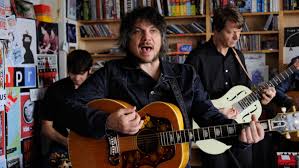
wilco2011Wilco is virtually the only band to have been asked back for a second Tiny Desk Concert.  I’ve listened to this concert a bunch of times but didn’t realize I hadn’t posted about it here.

There is a huge crowd for this show and as it starts, everyone shouts WILCO!

The band sounds great with all the members crowding in behind the Tiny Desk.  Tweedy plays his big acoustic guitar, Nels Cline plays all kinds of interesting sounds in the corner.  The drummer is on a small computer thing that seems to be made up of all manner of small percussive items.  There’s a bassist and keyboardist and a second guitarist all making a great sound.

“Dawned on Me” starts the set and sounds great in this setting—I love the walking bass throughout the song and of course Nels Cline plays a wonderfully insane noisy solo amid this simple and catchy folk song

Before the second song, “Whole Love” Glen’s got to get some things out of his toiletry bag.  This is another great song with Nels playing high notes to complement the rumbling bass.  No idea what the drummer is playing this time—a book?  Tweedy sings in falsetto for much of the song.

Tweedy says “this next song requires a certain amount of tuning—quiet please.”

He asks if anyone has any questions and when Bob says “I’m speechless,” someone on staff says “That’s a first,” which gets everyone laughing.  Bob asks if Jeff likes his bag of toys and Jeff says anyone who would make fun of his bag of toys is an idiot.  Sadly we never see the bag or the toys.

“Born Alone” has another great bass line that opens the song and the drummer is hitting lord only knows what.  This was the song by Wilco that made me really fall in love with the band.  Cline’s slide guitar is very cool.  But there’s something about the end of the song when the whole band plays a series of chords–the steps keep going lower and lower, and each time you think they’re going to stop, they just keep going. It’s very fun.

After that song Tweedy admits to breaking a sweat–Tiny Sweat!

The final song is “War on War.”  He says they played it about ten years ago in the city possibly for the first time.  They messed up the ending the other day, but they hope it doesn’t mess them up this time.  Cline goes berserk on his guitar.  The whole band rocks this song.  There’s some really cool harmonies on this track, too.  The keyboardist even has a little cow sound maker (that you can just barely hear, until the very end).  They get the ending right and Tweedy shouts “Nailed It!”

There is much applause as Bob asks, “Pretty good for a Saturday, huh?”  And as the applause dies down, someone yells, “Now lets trash this dump!”

It’s a great set.

[READ: March 25, 2016] “Hallelujah!”

I wanted to finish up all of the Harper’s pieces by Rivkla Galchen.  I had no idea what to expect from this piece.

It is one of those pieces in Harper’s that has images in the background–in this case musical notes and a portrait of Handel–to go with the  story.  And it is broken up into many little sections labelled 1. Sinfonia (Overture) 2. Accompagnato. 3. Air, etc up through 53 (!).

So this is obviously about Handel’s Messiah and the Hallelujah Chorus. (more…)

Read Full Post »

PalmSundayFrontandBackSOUNDTRACK: THE STATLER BROTHERS-“Class of ’57” (1972).

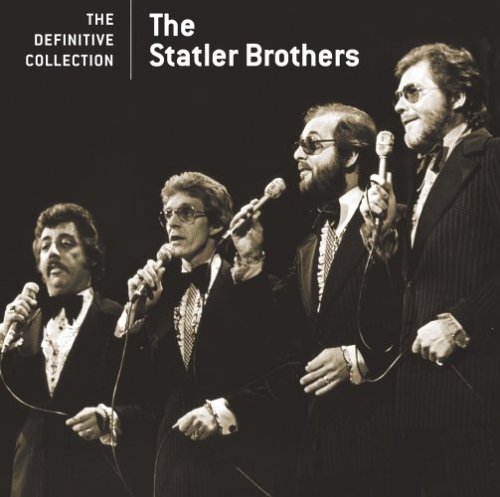
stalerI don’t know much about The Statler Brothers.  They are considered country, although this song is hardly country–it’s more folk with some bluegrass and, the real selling point–great harmonies (especially the bass singer with the big mustache).

The song is a wonderful coming of age song, sad and funny with a list of what happened to everyone in the class of ’57.  Like:

Betty runs a trailer park, Jan sells Tupperware,
Randy’s on an insane ward, Mary’s on welfare.
Charlie took a job with Ford, Joe took Freddie’s wife,
Charlotte took a millionaire, and Freddie took his life.

John is big in cattle, Ray is deep in debt,
Where Mavis finally wound up is anybody’s bet.

But the kicker comes at the chorus:

And the class of ’57 had its dreams,
Oh, we all thought we’d change the world with our great words and deeds.
Or maybe we just thought the world would change to fit our needs,
The class of ’57 had its dreams.

And then at the end:

And the class of ’57 had its dreams,
But living life from day to day is never like it seems.
Things get complicated when you get past eighteen,
But the class of ’57 had its dreams.

Vonnegut quotes the entirety of this song in the book and I’m glad he did, it’s a very moving song and really captures American life.

[READ: May 26, 2013] Palm Sunday

After writing several successful novels, Vonnegut paused to collect his thoughts.  And Palm Sunday begins: “This is a very great book by an American genius.”  It is also a “marvelous new literary form which combines the tidal power of a major novel with the bone-rattling immediacy of front-line journalism.”  After all the self praise, he decides that this collage–a collection of essays and speeches as well as a short story and a play which is all tied together with new pieces (in TV they would call this a clip show)–this new idea of a book should have a new name and he chooses: blivit (during his adolescence, this word was defined as “two pounds of shit in a one-pound bag.”  He proposes that all books combining facts and fiction be called blivits (which would even lead to a new category on the best seller list).  Until then, this great book should go on both lists.

This book is a collection of all manner of speeches and essays, but they are not arranged chronologically.  rather they are given a kind of narrative context.  What’s nice is that the table of contents lists what each of the items in the book is (or more specifically, what each small piece is when gathered under a certain topic).

Chapter 1 is The First Amendment in which he talks about Slaughterhouse Five being burned and how outraged he was by that–especially since the people so anxious to burn it hadn’t even read it (and the only “bad” thing is the word motherfucker).  The first speeches included are “Dear Mr. McCarthy” to the head of the school board where his books were burned and “Un-American Nonsense” an essay for the New York Times about his book being banned in New York State.  The next two are “God’s Law” for an A.C.L.U. fund raiser–it includes his confusion as to why people don’t support the A.C.L.U. which is working for all of our own civil liberties. (more…)

Read Full Post »

SOUNDTRACK: PUBLIC ENEMY-Fear of a Black Planet (1990).

NPR recently broadcast a PE show from the All Tomorrow’s Parties Festival.  I didn’t know that PE was still touring, so that was a surprise to me.  The show was largely a celebration of Fear of a Black Planet, which meant that I had to go back and listen to the original.

Man, is this a solid album.  The lyrics pack a punch even twenty years later and what is perhaps more amazing is that the sound collages that Terminator X created, which were something of an oppressive sonic assault are now fairly mainstream-sounding (forward thinking or what?).

What I like about this (and most PE) albums, is that  they have little skits between songs, but unlike most rap skits they’re not one-not jokes that you listen to once and then skip every future time.  A wonderful skit (for lack of a better word) is “Incident at 66.6 FM” in which we hear an amazing amount of racist epithets thrown at PE apparently on the radio.  Or the rather disturbing “Meet the G That Killed Me.”  “Anti-Nigger Machine” is a great collage of samples like “Think” and James Brown and a dozen more songs.

“Can’t Do Nuttin for Ya, Man!” is a (sort of) comic song from Flav that is catchy as anything. While “Reggie Jax” is a confusingly titled song that has nothing to do with baseball, but everything to do with funk.

Of course, this disc has some of PE’s best songs as well.  From the awesome “911 is a Joke” to one of the best rap songs ever, “Welcome to the Terrordome” (my favorite story of this song is when I was wearing a  Welcome to the Terrordome shirt and my philosophy professor asked me quite pointedly, “What in the hell is a terrordome.”  That was a fun conversation).  “Terrordome” is still amazing–powerful, musically intense and for all of its lyrical acuity, it still has funny moments….boing.

And of course, “Burn Hollywood Burn” is an amazing critique of the movie industry (and it’s catchy too).  I got Black Caesar back at the crib, right Lar?

I’ve always been a little confused by “Pollywannacracker.”  Not lyrically, but vocally, as Chuck’s (is it really Chuck?) voice is treated in a surprisingly tinny way.  I liked the song more on this listen than any other, I guess in the past it just kind of snuck by me.

The album is a little front loaded with greatness.   “Power to the People” is another powerful song, but it’s not quite as memorable as the other tracks.  “Fear of a Black Planet” has some really cool sounds on it (where did they get that “black man, black woman, black baby” sample?).   “Revolutionary Generation” is a great track in which Chuck and Flav stand up for black women: “R-E-S-P-E-C-T, my sister’s not my enemy.”  Not your average rap subject.

And the last couple of proper songs, “B Side Wins Again” and “War at 33 1/3” are fast paced and furious, but they don’t really have much in the way of a hook.  Nevertheless, lyrically they are really great, and I love to hear Chuck D flow that quickly.

The biggest surprise for me is the censored version of “Fight the Power” (the song that got me into PE in the first place, thanks Spike).  It’s really surprising to me that PE allowed their music to be bleeped–unless it was just for a deliberate radio play (which I can accept).  Although they also list a title as “Leave This Off You Fu*Kin Charts” (did I buy a Columbia House version or something?)

This is an amazing album, one that still sounds fresh and sadly, is still relevant.

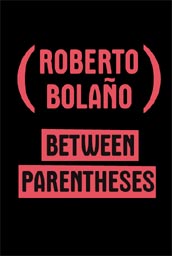
[READ: October 15, 2011] Between Parentheses

I never expected to get so addicted to Roberto Bolaño.  And despite his death, there is no shortage of works coming out in English (that is one of the advantages to reading a translated author–even death doesn’t cease the available materials).  Indeed, this year alone, New Directions is publishing Between Parentheses, and Tres and FSG is publishing The Third Reich (a collection of non fiction, a collection of poetry and a novel respectively).

When I really get into an author, I fall for his or her works, not necessarily him or her as a person (heck, some author are downright jerks).  But there are some authors that I want to know about, personally.  Bolaño is a pretty polarizing figure–he seems obnoxious, his works don’t shy away from very specific opinions, and sometimes it’s unclear what kind of views Bolaño himself has in his works (or if he’s even telling the truth about his so-called truths).  One thing in particular is the constant use of the word “faggot.”  It is used often in 2666 (and I know that is a translator’s choice, but still) and used derogatorily.  Now, clearly the context is everything for something like that.  But it seems to speak badly of Bolaño.  And yet, when reading these essays he is not homophobic in the least.  He is obviously well aware of institutionalized homophobia in Latin America, and he is obviously not supportive of it.

But that’s just one interesting thing about this book.  So let me back up. (more…)

Read Full Post »