Feeds:
Posts
Comments

Archive for the ‘James Joyce’ Category

SOUNDTRACK: FEIST-“Femme Fatale” (2011).

The funny thing about The Velvet Underground is that it seems like it would be very hard to fail at covering them.  Their songs are pretty open to interpretation.  But, it’s even more true if you wanted to do it pretty straight.  I mean, while Lou Reeds voice is unique, Nico’s isn’t really.  It’s slow and languorous, sexy and distant.  I would never have thought to describe Feist that way and yet she fits into the Nico mold very nicely.

This cover comes from the Velvet Underground Revisited show from 2011, with a band comprised of members of Radiohead, Air and Supergrass.  Feist did vocals for this one.  It’s not an earth-shattering cover.  In fact it’s pretty spot on.  Maybe everyone who hears this will start a band too.

You can hear it here.

[PLANNED: Summer 2012] #OccupyGaddis

I had my books all planned out for the summer.  A series of smaller books to get through before trying to tackle any really big books that are on my shelf (and there are plenty).

And then came #OccupyGaddis.

William Gaddis is an author, like Thomas Pynchon, who writes large, unwieldy novels which are something of a bedrock for contemporary American fiction–like The Velvet Underground–not many people have read him, but those who have all went on to write wonderful books.  And he forms a kind of continuum of (among many many others) Joyce>Gaddis>Pynchon>Wallace which means that I ought to be reading him.

I read JR about a decade ago.  I remember a few things about it–basic plot details and the fact that you never know exactly who is speaking.  I wasn’t keeping this blog then, so I didn’t exactly take notes on it or anything.  It’s kind of a blur.

So Lee Konstantinou is running #Occupy Gaddis this summer.  It is meant  to be an Infinite Summer type-deal.  Unlike Infinite Summer which was weekly, he’s planning on posting every two weeks.  I’ll try to do my weekly post (work permitting), by picking a midpoint as a Spoiler Line.  Since my recollection is that JR is like one large block of text with no breaks anywhere, my spoiler line will be pretty arbitrary.   But here’s his:

June 29: pp. 150

July 15: pp. 300

July 31: pp. 460

August 15: pp. 610

August 26: done!

(more…)

Read Full Post »

SOUNDTRACK: LAMBCHOP- “2B2” (2012).

I don’t have much exposure to Lambchop.  I know of  them mostly as a slow, country-type band.  And that’s why I haven’t listened to them much.  So I picked one song from their latest album, Mr. M, to talk about (because they are associated with Five Dials, see below).

And, indeed, they are slow.  I wouldn’t say country so much as roots, maybe, traditional folk or something.  It’s certainly slow.  This song reminds me in someways of Tindersticks, although a very stripped down Tindertsicks.  Of course, what I like about Tindertsicks is that they are not stripped down.  So this song kind of leaves me a little flat.  I like it, but I’ve already got music that’s like this ti listen to.

I’ll bet though, that it would make great background music to an engaging story (see below).  I wonder what song they chose to remix.  It’s be crazy if I picked it.

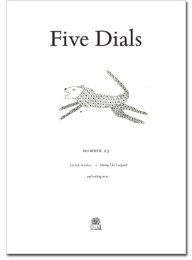
[READ: May 3, 2012] Five Dials 23

Five Dials 23 was recently released with quite little fanfare.  That may be because it is like an appetizer for the soon to be released Issue 24 which promises to be very large.

Five Dials 23 contains only one piece (and an Letter from the Editor).  The piece is by Javier Marías, whom I’ve read and enjoyed and have put on my list of authors to explore more.

CRAIG TAYLOR-“On That Fiction Feeling and Lambchop”

Craig Taylor’s introduction wonderfully encapsulates why I prefer to read fiction to non-fiction.  I have friends who say they only like to read non-fiction because at least they’re learning something (or some variant of that).  And while it’s compelling to argue that you learn stuff from fiction too, it’s not always easy to prove.  So Taylor’s Letter from the Editor is where I can point people in the future:

I remember it happened when I read part of Runaway by Alice Munro, specifically the three linked short stories ‘Chance’, ‘Soon’ and ‘Silence’. I remember the names of the North London streets I was compelled to walk – from Messina Avenue to Woodchurch Road to Greencroft Gardens – just to free myself from the sensation that had blossomed within me after I set down the book. During that walk, the neighbourhood seemed raw and responsive. I was unsettled, but in the best possible way; I was in the midst of experiencing the kind of sadness that can only be induced by fiction, which is more potent sadness than most. Also in this jumble of sensation brought on by Munro was a vow to live better, to somehow dodge the mistakes of her characters. There was a bit of a ‘what the hell am I doing with my life?’; a bit of a ‘pay attention to the details’; a bit of an ‘appreciate life more’. In short, the great inner churning that comes at the end of a few extraordinary pieces of fiction.

The details aren’t relevant, it’s the overall mood and idea that he conjures that is.  Although he mentioned Munro, he begins to talk about The Leopard by Tomasi di Lampedusa.  How this debut (and only) novel has left a strong impact not only on him and many more who have read it but also on Marías.  And that that it was Marías’ essay is about: The Leopard.

The second half of his introduction talks about the next issue and that a 10″ vinyl album will be released with it.  It will feature a double A side with author Hollis Hampton-Jones reading from her novel Comes the Night, while backed by Lambchop.  The other side features a remix of a song by Lambchop from their Mr. M album.  The end of the Letter from the Editot is given over to Hampton-Jones and her remembrance of the recording session.  (It’s very cool).

EMILY ROBERTSON and TUCKER NICHOLS drew the cool pictures of leopards.

JAVIER MARÍAS-“Hating The Leopard

This essay, translated by Margaret Jull Costa,talks about the novel The Leopard and how as a novelist, Marías hates it, even though as a reader, he loves it.

I love the surprising way he opens this: There is no such thing as the indispensable author or novel.”  Because even if the best novelist in the world never wrote, the world woul dnot be different.  I also love this insight, which I actually used recently when talking about Ulysses to someone (yes, I’m that guy) that books which “aspired to being ‘modern’ or ‘original’… leads inevitably to an early senescence or, as others might say, they become ‘dated.’  …. They can sometimes seem slightly old-fashioned or, if you prefer, dated, precisely because they were so innovative, bold, confident, original and ambitious.”  But he quickly points out that The Leopard does not fall into this dated category.

Before explaining why The Leopard has stayed with him, he gives some basic background about its publication and near lack of publication.  Indeed, Tomasi di Lampedusa (how do you say that last name?) died before it was published (but not before receiving several rejection letters).  What’s especially surprising is why he wrote the novel in the first place: “the relative late success of his cousin, the poet Lucio Piccolo…led Lampedusa to make the following comment in a letter: ‘Being absolutely certain that I was no more of a fool than he, I sat down at my desk and wrote a novel.'”  Nothing inspires like jealousy!  He also wrote because he was a solitary person.  He was married, but he seems to spend a lot of time alone.  He wanted the book published but not at the expense of his heirs (that’s nice).

Marías talks a bit about why he finds the book so extraordinary (although he says that so much has been written about the novel that he is reluctant to add more).  But one thing that impressed upon him was how the book is about preparing for death, but how, “Death stalks the book not in any insistent way, but tenuously, respectfully, modestly, almost as part of life and not necessarily the most important part either.”  As far as hating the book, Marías feels that perhaps some novelists have earned the right to hate it.

I always enjoy Five Dials.  I can only hope that my posting about it here can get more people to check it out.  Now to see why my library doesn’t have a  copy of The Leopard.

For ease of searching I include: Javier Marias.

Read Full Post »

SOUNDTRACK: PHOEBUS CARTEL-“Difficult,” “Asylum Energy,” “November”

If I had any idea how many bands were named after things in Gravity’s Rainbow, or were perhaps tangentially related to it, like this one, I would have never bothered mentioning bands that I actually know.

Phoebus Cartel is a heavy metal band based out of Denmark.  And…  well, that’s really all I know about them.  I found this image for them online which linked me to their site on bandbase (if you must, you can also get it in English–although there’s no extra information).

There are three songs here on the site.  They are all sung in English and all have heavy guitars.  The band is clearly heavy metal inspired, but they also classify themselves as “alternativ.”

“difficult” has elements of Marilyn Manson in the singing (and even the melody). It’s a very catchy interesting song and very heavy.  “asylum enemy” has some great heavy chugging guitars. I like the part in the middle where we just get two heavy notes and a pause.  It reminded me a lot of Tool.  “November” has the most normal sounding singing in the bunch–it’s also the least metal sounding–more like heavy alt rock.  Although the break in the middle with slow guitars is nicely atmospheric.

I really enjoyed all three songs.  I’d like to learn more about these guys but I literally can find nothing else about them anywhere.

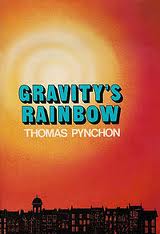
[READ: Week of April 23] Gravity’s Rainbow 4.1-4.6

Section 4, the final section is here at last.  We are out of The Zone and into The Counterforce.  The epigram here is by Richard M. Nixon.  Hilariously it is simply, “What?”  Unfortunately, I found it to be way too apt for my own feelings while reading this pretty confusing section.  While some sections advanced the “plot,” there were a ton of new characters added and, even more confusingly, a bunch of scenes that were either hallucinations or fantasies  or both.  And none of these do much for you sense of what the hell is going on. (more…)

Read Full Post »

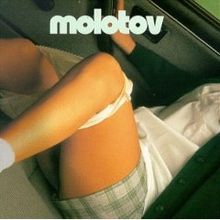
SOUNDTRACKMOLOTOV-¿Dónde Jugarán las Niñas? (1998).

Molotov was the last Rock en Español band that I really bothered to check out.  They were probably most notorious for the cover of the album.  Interestingly, the cover is actually a four sided cover which you can flip to three other far less sexist scenes, so yes, that was pretty much a sales gimmick.  And it certainly attracted attention (and a law suit!).  So they reissued the title with the far less offensive, but very different cover below.

My Spanish is poor at best, but this album is a mix of Spanish and English.  And, of course, I know some bad Spanish words, so I get a sense of what this album is about. But here’s the thing–it rocks really hard and has some really great elements of the metal/rap/funk hybrid genre, regardless of whether you know what they’re talking about (although don’t go singing “Chinga Tu Madre” around the office, capiche?).

The opening song  “Que no te haga bobo Jacobo” has a very Rage Against the Machine vibe–heavy guitars and sound effects with militant rapped lyrics.  The riff is great and the vocals are smoother than Rage’s Zach–“Tito” Fuentes has great flow.  There’s also some good funky bass in the middle section.  “Molotov Cocktail Party” is a mix of English and Spanish, a pretty straightforward rap, not unlike Kid Rock.

“Voto Latino” has a more alt rock vibe in the guitars, although the vocals are pretty straightforward rap style.  The song title means Latino Vote, so perhaps there’s a politics context to it.  And “Gimme Tha Power” is a political song, too.  A rap (in Spanish) over some nice acoustic guitars.

There definitely isn’t in “Chinga Tu Madre” which has more of those cool guitar effects and group chanting, although it’ probably not worth investigating the lyrics much more.  But the chorus is catchy as anything.  “Matata Tete” and “Mas Vale Cholo” return to that Rage Against the Machine style, with vocals that are a bit more cookie monster-y (I’m not sure who sings lead on which songs, actually) although “Mas Vale Cholo” has some fun with the vocal delivery.  And there’s a spirit of early Red Hot Chili Peppers at work, too.

“Use It or Lose It” is rapped in mostly English.  It has a very cool acoutsic-feeling chorus (and a quote of the line, “what cha gonna do rap is not afraid of you.”).  “Puto” is presumably an anti-gay song (I suppose I should find that out before I say so).  “Porque No Te Haces Para Alla?…Al Mas Alla!” has a fun chorus and cool guitar effects once again.  “Cerdo” has a cool 70s vibe, with funky bass and scratchy guitars–it’s got a sexy feel, although the title means “pig,” so who knows.

The final track also rocks very well.  According to Wikipedia, the translated title of “Quitate Que Ma’sturbas (Perro Arrabalera)” is “Stay Away Because You Masturbate (Suburban Bitch)” which seems weird .  But maybe they had nothing better to write about.  Sometimes ignorance of a subject is not a bad thing.

¿Dónde Jugarán las Niñas? is not the classiest album around, but it’s got some really interesting sonics.  And I’m led to believe their later albums are even better.

[READ: Week of April 9] Gravity’s Rainbow 3.16-3.24

Last week ended with sex and this week opens with the way I felt–like a voyeur who can’t look away.  The exhausting orgy was exhausting to read about as well.  And I’m starting to wonder if Pynchon is making a point about sex rather than just enjoying writing about it.

This week’s read also brings back two characters from way way ago.  Well, one from not too long ago, but another from what seems like an eternity.  I assumed we’d see Pirate Prentice again, but I assumed that it wouldn’t be until Section 4. So that was a nice treat, even if it’s a less than happy return for him. (more…)

Read Full Post »

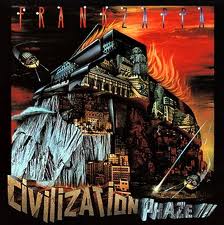
SOUNDTRACK: FRANK ZAPPA-Civilization Phaze III (1994).

There were a number of choices for soundtracks for this week’s read.  I could have chosen the Andrew Sisters (and their wonderful “Don’t Sit Under the Apple Tree”) who get a mention in the book.  And, of course, I could have chosen Elton John’s “Rocket Man.”  But, when I read Trudi tell Magda about her boyfriend Gustav who wants to live inside a piano, well, it was hard not to think of this, Frank Zappa’s final work.

Civilization Phaze III is an opera-pantomime.  According to the libretto, “The speaking characters all wear oversized masks, gloves and shoes.  They live in an abstracted grand piano….”  And musically opens with this introductory spoken passage:

FZ: The audience sits inside of a big piano and they listen to it grow.
Spider: People are going to sit inside of a piano. They’re going to listen to this piano grow.
John: They’re going to listen to the piano grow?

Civilization Phaze III was released posthumously in 1994.  But here’s the weird thing.  Most of the sessions of “piano people” dialogue were recorded in 1967.  Zappa had a bunch of people come into the studio, sit under a piano that was miked and improvise dialogue (sounds like the 60s to me).  He released some of this dialogue on his  late 60s albums, but as far as I can tell, the parts about the piano were never included (in Lumpy Gravy someone talks about wanting to live in a drum).  I’m also not sure how well-known the “piano sessions” were at the time.

So, here’s the question…did Zappa influence Pynchon or did these two people come up with the same idea at roughly  the same time.  The reason Zappa put off using the material recorded in 1966 was because technologies were simply not advanced enough to let him manipulate the dialogue so it would sound decent, much less coherent.  So Civilization Phaze III became his exploration of the past with contemporary technology.

He also recorded new spoken dialogue in 1991 and merged the two.  It’s an interesting idea, but I fear that the new dialogue absolutely misses the vibe of the earlier dialogue.  In the early dialogue, they all sounds like they’re stoned and are talking crazy nonsense about horses, smoke and music.  The later dialogue is much more abrasive (especially Michael Rappaport, the only person who has since gone on to renown).  At the time, Rappaport had been on one TV show as a guest, but by now he is too famous for this.  I find him a distraction (not Zappa’s fault obviously), even more so because he talks as if he is black (he says “Nobody said nothin’ when y’all bought my people, right?”) while he is demonstrably not.  And then ruins it contextually by mentioning Yo MTV Raps, the only thing that places the story in time.  It’s weird that Frank wouldn’t have a black person say these lines, especially since he has so many other races and nationalities represented in his music.  But maybe that’s me intellectualizing that I just don’t like Rappaport.

So, what’s this monstrosity about?  I have no idea.  Improvised stoner dialogue from the 60s is pieced together into a kind of story.  Occasionally Frank’s voice chimes in and prompts them to talk about certain things (which is quite  disorienting).  And the whole “plot” well, I’m not even sure if it can be called a plot, but Frank tries to cobble something together–again, the 1991 dialogue seems to be more pointed, more about conflict, possibly something about overcrowding and racism, and there’s certainly some social criticism at work, but as for a story, well, not so much.

The music, on the other hand, is the culmination of Zappa’s more experimental, atonal “classical” music.  Most of the first disc is performed on the synclavier while most of the second disc contains more actual musicians.  The music is difficult and not to everyone’s tastes, for sure.

Atonal music is far more intellectual than visceral, so it’s hard to “enjoy” this music.   Zappa obviously knew how to write catchy poppy friendly music, so this is a deliberate attempt to write something more challenging.  I like Zappa’s crazy music in small dozes, so listening to this entire thing (over 2 hours) can be a tough in one sitting.  But each piece (especially the two really long pieces “N-Lite” (18 minutes) and “Beat the Reaper” (15 minutes) ) showcases something interesting or satisfying.

The libretto that Zappa includes with the discs explains the story in far more detail and shape than one would ever get from listening to the music.  Without the book, you would know that this is a dark and moody piece, but with the book, you can actually see what the music is showing.  That may be a flaw, or that may be the way of a staged performance.  I have no idea if it was ever staged.

There are certainly easier introductions to Zappa’s music.

[READ: Week of March 26] Gravity’s Rainbow 3.6-3.10

Last week was a bear of a read for me, but this week was so fast (and short) that I just kept going because I was so into the Slothrop story (I won’t go past the spoiler line, I promise).  And yes, it’s (almost) all Slothrop this week.

Section 3.6 begins with Slothrop violently ill.  [I admit I don’t think of novel characters as getting ill very much–unless it’s a plot point–but surely characters get colds and tummy aches just like everyone else, right?].  He drank out of an ornamental pond in the Tiergarten–but, duh, everyone knows to boil water before drinking these days.  This also introduces Slothrop as Rocketman, something we won’t get more details on until later. (more…)

Read Full Post »

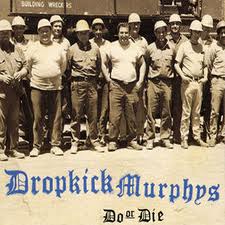
SOUNDTRACK: DROPKICK MURPHYS-“Finnegan’s Wake” (2005).

This song has been around forever and there are dozens of different versions of it.  For your more traditional versions, you want The Dubliners of Christy Moore (if you really want to hear the words).

But The Dropkick Murphys do it the way I like my traditional Irish songs–fast and loud and full of punk.

Although to be honest, The Dubliners’ version has a bit more swagger and fun (it’s hard to beat Ronnie Drew for a hard living singing voice).

Whichever version you choose, be sure to have your favorite ale or lager (or whiskey punch) on hand.

[READ: April 1, 2012] Finnegans Wake

I decided it was time.  How many times have I read the opening line of this book:

riverrun, past Eve and Adam’s, from swerve of shore to bend of bay, brings us by a commodius vicus of recirculation back to Howth Castle and Environs.

And as many times I have read the end of the book:

A way a lone a last a loved a long the

But now it was time to read the other 620-some pages of it.  So I set aside some time this weekend, and, in the spirit of Joyce’s stream of consciousness, I stayed awake until I finished it. And having digested the book, I now get to write all my thoughts about it.

(more…)

Read Full Post »

SOUNDTRACK: FRANK ZAPPA AND THE MOTHERS OF INVENTION-Over-nite Sensation (1973).

When I saw Marvy’s Mothers, it was hard not to pass up the connection to Zappa and his band.  But oh, what album to pick?  (He released like 40). I chose the one released in the same year as Gravity’s Rainbow.

It also happens to be full of all kinds of sex (imagine that).

It opens with “Camarillo Brillo” the kind of simple, catchy song that Zappa seems to whip out very easily.  I assumed that the title was some kind of sexual slang (not a bad assumption), but Wikipedia suggests it has something to do with an insane asylum (Camarillo) and the crazy hair they often had, which makes sense given the crazy lyrics.  It starts kind of trippy with inscrutable lyrics.  And then the bridge, “she was breeding a dwarf” is pretty insane.  It also features a very funny sequence that was oft-quoted in MST3K–“Is that a real poncho or a Sears poncho.”

“I Am the Slime” is a funky (a great Zappa riff) diatribe against TV (because it makes you buy crap you don’t need and makes you listen to the government).  “Dirty Love” is a perverse song with lots of guitar solos.  There’s some kind of bestiality in this song (which also ties in with parts of this section).

“Fifty-Fifty” features the vocals of Ricky Lancelotti (in a screaming style that would later be used a lot by Terry Bozzio).  It’s about an ugly guy who is crazy enough to sing to us.  The songs seem to be more about solos though, as there’s a keyboard solo an electric violin solo (from Jean-Luc Ponty) and some crazy guitar solos.

I don’t know what “Zomby Woof” is about, but it has some wicked guitar soloing and horns playing Zappa’s staccato riffs up and down the scale.

“Dinah-Moe Humm” is a song perfectly suited to this book–it’s a song in which a woman bets the narrator that he can’t make her have an orgasm.  The melody is twinkly and silly.  It’s shockingly explicit. But it’s even funnier to know that the backing vocals are supplied by The Ikettes (Ike and Tina were recording in the next room).  They got paid almost nothing and when Ike heard the song he called it “shit” and asked that their name be removed from the credits.

It also plays around with hippy slang.  “Kiss my aura Dora/It’s real angora/Would you all like some more-a/right here on the floor-a/and how about you fauna/You wanna?”

He also starts talking about Zircon encrusted tweezers, which come back in “Montana.”  “Montana” is about moving to Montana to raise dental floss (really).  It features some wonderful fast pizzicato notes that are more or less Zappa’s signature.  The middle section is  hugely difficult and very impressive for the backing vocalists (Tina apparently was really impressed that one of her girls could do it).

Zappa packs a lot of music into 35 minutes, and this album seems to be a turning point in his desire to cram sex and craziness into his commercial music.  Just about every song on this disc was played a lot live and this album has become something of a classic.

[READ: Week of March 19] Gravity’s Rainbow [3.1-3.5]

This week’s read has been the most challenging for me so far.  I enjoyed Section 2 very much.  The Slothrop scenes were funny and wild and even advanced the plot.  I never expected that Section 3 would introduce a ton of new characters, more or less ignore the old charterers and stay with these new characters so that by not paying close attention to them in the beginning I was just confused by the end.

I do admit that while skimming again for this post, I was able to focus on the new characters more and found it far less confusing.  It’s just that on a first read, suddenly there’s this whole new sequence of people and their histories to deal with!  Wow.

It was especially surprising because Section 3 begins with Slothrop (so it’s not like in 2666 where a new section means a new cast).  But he meets new characters and then we flash all the way back through each person’s life.  And yes, it was quite interesting once I actually paid attention, and the connections were pretty awesome.  But it was still pretty surprising on the first read through.

Section 3 is called In the Zone.  And the Zone is mentioned quite a lot, although I never figured out where it is meant to be exactly. (more…)

Read Full Post »

SOUNDTRACK: BUGS EAT BOOKS-“Imipolex G” (2004).

I had a CD planned for this week, but when I searched for Imipolex G online to see if it was real or based on anything, I can across this song by a band I’ve never heard of.  How could I pass it up (at least it wasn’t a song about coprophagia).

I listened to the whole album (only once, so this isn’t a fair criticism) and it’s all in a similar vein–lo-fi sounding.  Like maybe it was recorded on a two-track. The vocals are slightly whiny–not bad whiny–90s indie rock whiny.

And I see that Joe Jack Talcum from the Dead Milkmen has a solo album on the same label, so that makes sense.  I probably would have lived this album back in college.  And I would have wondered what Imipolex G was and then I would have found out about Gravity’s Rainbow and tried to read it.  And given up.

So this song is just over three minutes and opens with feedback squalls, but that noise is undermined by the jangly guitar that takes over the song. It’s quite catchy (in a noisy indie rock kind of way that almost dares you to think it’s catchy.

I’ve tried to determine any lyrics I could “plans etched on the wall… target for my head…I’ve got to go away.”

I’ve embedded the song below, although clicking on the button will take you to their My Space page, rather than playing it directly.

Imipolex G

The album appears to still be available (original pressings came with a bug).

[READ: Week of March 12] Gravity’s Rainbow 2.4-2.8

This was a conveniently short read this week (I had a lot going on, so those 30 fewer pages were a nice breather).  Section 2 continued mostly with Slothrop, although it was also an extrapolation of the people who were impacted by him in the beginning of the section.

For those with weak stomachs, we saw what I have to assume is the most disgusting section of the book.  And there was also a reverie (and the use of the word reverie) that had me a little confused. (more…)

Read Full Post »

SOUNDTRACK: ARMY OF LOVERS-Massive Luxury Overdose (1991).

The only way that I, and I suspect any American, knows this band is because they were  mocked on Beavis and Butthead for their video “Crucified.”  In the video, which I have thoughtfully tacked on at the end here,  the three members of the  band are dressed up like extras from a  Duran Duran by way of Adam and the Ants music video (and maybe that’s not over the top enough).  This, by the way, seems to be their regular costumery (a French-seeming design despite their Swedish origins).

Beavis and Butthead cheer for the (impressive) cleavage and then gag at the lead singer’s  largely naked hairy body dancing in a bathtub.  It’s  pretty confusing.  But it’s also super catchy in a really over the top Europop way.

I have learned over the years that while I don’t really like pop music, I like Europpop a lot more than Ameripop.   It’s much crazier and outlandish, hence: Army of Lovers.

“Crucified” is a really fun, over the top bit of nonsense.  The chorus is incredibly catchy with a wonderful choral voice singing, and the verses are catchy too, they are spoken and in part French.   It’s good campy fun.

Having said that, the rest of the album is a mix of songs that aren’t quite as good as “Crucified” and songs that are just really bad.

The opening of “Candyman Messiah” is dreadful.  “Obsession” features a very mousey-voiced guy singing.  It’s a change and an interesting one, although like a lot of Europop, there’s not a lot of substance to it.

But it’s clear that the Army are not taking themselves seriously, “Dynasty of Planet Chromada” anyone.  The band has some really catchy choruses and I’ll bet it ‘s a hell of a lot of fun to dance to.  Especially if you have a pencil thin mustache.

Believe it or not, Army of Lovers were not just a one-hit wonder .  They released four albums.  And although their website seems to be updated often, I’m fairly certain the band broke up in 1995.  Well, why should that stop anyone?

[READ: Week of March 5, 2012] Gravity’s Rainbow Sections 1.19-2.3

I postulated that Section 1 (called Beyond the Zero) was a mostly expository set up (in one way or another).  And that seems to have been true.  Yes there was some plot development, but it was a lot of setting up new people.  New people are introduced in Section 2, but it is primarily about Slothrop (so far).  These first three sections don’t do a lot to advance the “plot” (I don’t really know what the plot is exactly but it must have something t o do with the war, right?)  Section 2 zooms in on Slothrop.  And while we do learn about the monitoring that goes on with him, for me, Section 2 is all about providing character depth and sympathy for Slothrop.

I found this week’s read to be the easiest so far, with only a few moments of stream of consciousness or reverie to get lost in.   And there were a lot of farcical moments–moments that were practically like a sitcom, which were fun to read and enjoyably insubstantial.

Towards the end of the reading, when Katje ultimately leaves Slothrop, she uses a metaphor comparing the rockets to sex.  And I wondered if maybe that’s why there is so much sex in the book–is it a physical manifestation of the theoretical idea?  Or does he just like using the word cock?

(more…)

Read Full Post »

SOUNDTRACK: ROCKWELL KNUCKLES-You’re Fucking Out I’m Fucking In (2011).

I downloaded this disc a while ago because I really liked “Silly Human

I listened to it again recently and realized just how much I like the whole disc.  Rockwell Knuckles has a great delivery style—a basso profundo voice—and a great sense of melody both in his delivery and his backing music.  He captures the best of Chuck D and Ice T.  “Bullet Train Army” has such a cool melody line—and the fact that he raps along with it is fantastic.  Apparently the Bullet Train Army is his posse or something, because it appears a lot on the disc.

“Silly Human” is a fantastic song—a wispy futuristic keyboard riff fizzes away behind Rockwell’s super fast delivery and funny (but not really) lyrics.  The chorus is delivered super quickly in a cool descending melody line.  And I love that someone in the background is shouting Yes Yes! YES! as he deliveries his lines.  It reminds me in strange way of The Flaming Lips.  “Play Catch” shows off his diversity of styles with this more gentle song.  I like the way the verses end with a repeated word which seems like it’s going faster because the beasts speed up,  It’s a cool trick.

“Baking Soda” has a guest rapper (I really don’t like guest rappers, I’m here for Rockwell not Tef Poe, who immediately lost my respect by having his first rhyme end with bitch—lazy!).  I don’t really care for the music behind this one either—cheesy sax and horns.   It’s made up for with “Point of No Return.”  This song has a sung chorus with a weird sci-fi-sounding melody and some great lyrics.  I haven’t really mentioned the lyrics yet but they stand out here “the early bird catches the worm, but the first sponge catches the germs) and a reference to Sojourner Truth.

The lyrics are even better on “Unstoppable” (which has a cool synthy sound over the chorus): “My competition ‘s delayed I’m rocking digital/
Ive been around the world in a day not in the physical/Artistic freedom in what I say y’all are to literal.”

The simple riff behind “Intergalactic” is also cool.  At first I wasn’t sold on Theresa Payne’s backing vocals but I think it works quite well.  I particularly love the chorus of “Supercalifragilisticexpiala-futuristic”

There’s another great delivery melody on “Motto of Today” with more cool sci-fi backing music.  “You Got It” has the great fast beats and delivery that I love out of Atlanta, even though Rockwell is from St. Louis.  There’s even a cool binary joke in the lyrics (1001001).  Guest rapper Vandalyzm fares better, although there’s more curses than actual lyrics in his verse, I think.

“Nomanisan Island” also features Tef Poe, but I like him better on this track.  But maybe that’s because the chorus is great: “No man is an island and we are never stranded”  I’m not sure though that Tef Poe should be singing the line “black tea party, we’re coming to impeach” with Obama in the white house.

“Controlled” I assume has a sample for a chorus, it slows things down nicely and the sound of the drums is fantastic.  I’m partial to the lines “Stone cold like Medusa” and  “Shows about to start, I don’t know when it will end, son/ Puppet on a string controlled by Jim Henson” (whatever that means, I like it).

“Every Angle” has a groovy chorus that I like despite itself.  Rockwell makes it flow wonderfully.  And the final track, “Natural Born Leader” opens with a simple rocking guitar riff.  When the lyrics kick in, the song soars with 70s keyboards and big guitars.

This album is really fantastic.  And while there are plenty of deserving artists out there, Rockwell Knuckles is amazing and should be huge.  Don’t be put off by the album title or the cover, this album is more about melody than a cursing.

You can download the whole album here for free.

Oh, and the reason I chose this is because of a note I had written in the margins of GR, which I thought had read No Man is an Island, but which didn’t.  Oops.

[READ: Week of February 27] Gravity’s Rainbow 1.13-1.18

I found a few of this week’s sections to be more challenging to get through.  There are a lot of long passages that are meandering–often with an unclear narrator (although the narrator usually becomes apparent by the end).  During these section, it feels like the book is just drifting of into a reverie for a while before snapping out of it and getting back to the business at hand.  And that seem apt given all of the crazy stuff that happens in the book (all of the mental/psychological ideas).

After reading a few of the posts at Infinite Zombies this week, I have new eyes for the book.  When I first read all of the sex in the book, I thought again about Joyce’s Ulysses and all of the sex that he described (shockingly for the time) and how modern writers seem to revel in writing about sex–not pornographically, just “real.”  But now, after reading Christine’s post, I had to rethink this attitude on sex.  I’ve been surprised by Pynchon’s frequent use of the words “cock” and “cunt” as anatomical names.  “Cock” in particular is a word I don’t hear used all that often in fiction and it has (to my ear) a kind of crass/vulgar connotation. And what more needs to be said about “cunt.”  I wondered if this was a Pynchon thing or a 70s thing or an I’m-too-uptight thing, but in Christine’s post she writes: “One of the things I most loathe about the other Pynchon books I’ve read is the latent, creepy, old-man sex fetish” and “the constant phallic status updates (noted in my paperback as I.P.R.s [infantile penis reference]” (which is hilarious, by the way).  This has made me even more aware of all the sex in the book–although to what end I’m not sure yet.

Jeff’s post at Infinite Zombies focuses on Roger and Jessica (I know that wasn’t the point of the post, but the mind takes what it will) and makes me think of Roger as more of a protagonist of the story.  Even more than Pirate (who, coming first, I assumed was the focus).  And  this week’s reading reveals more importance for Roger.

So on to the read: (more…)

Read Full Post »

« Newer Posts - Older Posts »