Feeds:
Posts
Comments

Archive for the ‘David Foster Wallace’ Category

SOUNDTRACK: SANDRO PERRI-Impossible Spaces [CST085] (2011).

This album has become one of my favorite releases of the year.  I simply can’t stop listening to it.  And the funny thing is that on first listen I thought it was too treacly, too “sweet,” especially for Constellation Records (home to the over-the-top Godspeed You Black Emperor amongst other wonderful bands).  But after a listen or two, I heard all of the genius that is present in this record–so many different layers of music, and so many interesting instrumental choices. Indeed, it does come off as sweet, but there’s really nothing wrong with that.

This album gives me a happy pick me up without being cloying in any way.  That’s a great accomplishment.

“Changes” opens kind of all over the place, with some noisey guitars and really high bass notes.  But once the shk shk of the shakers comes in, the sing settles into a great groove (and there’s a cool bassline that really holds the song together).  After about 3 minutes, it turns into a cool light funk jam, with retro keyboards, buzzed out guitar solos and some funky drums.  It’s unlike anything you’ll hear anywhere else.  “Love & Light” is one of the shorter pieces at just under 4 minutes.  It’s different from the other tracks, in that Perri’s vocals seem to be the dominant motif, rather than the cool music.  I like the song, but it’s probably my least favorite here.  “How Will I?” uses a similar multi-tracked vocal style but it has some wonderful flute moments (yes flute) that make the song bubbly and happy.  The song kind of drifts around the ether in a kind of jazzy world until about 5 minutes in, when the bassier notes anchor the song with great contrasting notes.  And the electronic ending is as cool as it is disconcerting.

“Futureactive Kid (Part 1)” is a shuffling minor key number that’s just over 3 minutes, it features a cool bass clarinet and backwards guitars to propel the song.  The backwards guitar solo segues into the uplifting (literally, the keyboards just go higher and higher into space. “Futureactive Kid (Part 2)” features fretless bass, a flute solo and My Bloody Valentine-esque sound effects (although radically simplified from MBV’s standards).  It fades out only to introduce my favorite song in forever–“Wolfman.”  I can’t get enough of this song.  It’s a simple structure, but at ten minutes long, it deviates in amazingly complex ways.  It has so many cool aspects that I love–I love the chord changes at the end of each verse.  I totally love the guitar solo that goes up and down the scale for an impossibly long run–well over 100 notes by my count.  I also love that the end of each section features a different guitar style playing the simple chord progression–from acoustic to loud solo to full band playing those same notes–so by the end of the ten minutes you ‘re not sure what to expect.   By the time the flute solo comes in at nearly 7 minutes, I’m totally committed to the song and wherever it’s going to take me.  So when it gets a bit of an electronic ending, I’m ready to go there with it.  Oh and lyrically the song is just as curious as the music.

The final song “Impossible Spaces” is a beautiful, quiet guitar song which is actually easy to sing along to.  It quiet a departure from the rest of the record, but it ties things together very nicely.  I have listened to this record so much lately, I just can’t get enough of it.

You can stream the whole thing here.

[READ: May 10, 2012] Conversations with David Foster Wallace

This is a book that collects interviews with David Foster Wallace.  Although DFW was reticent about d0ing interviews (as the introduction states), he did do quite a lot of them–often at the same haunts.  This book contains 22 interviews that span from 1987-2008.

The conversations are in chronological order, which is really a treat because you get to see DFW’s opinion (and his addiction to nicotine) evolve over the years.  You also get to see the topics that he was really focused on at one time and whether or not they stayed with him until the final interview.  DFW was outspoken about certain things, especially entertainment, which is unsurprising.  But he was also a big advocate of truth, honesty, realness.  It’s amazing seeing him when he lets his guard down. Although his honesty is there for all to see in his work, he is better known for his difficulty with language or his humor.  So seeing him without the multiple revision is quite enlightening.

The first pieces, “David Foster Wallace: A Profile” published after his first novel The Broom of the System launched Viking’s paperback imprint actually looks into his classroom a little bit and shows him interacting with a student (I wonder if she knows she is in this book?).  It seems sweet and almost naive compared to what is to come next.  And, for anyone who is familiar with him from later in, it’s a wonderful look behind the scenes.  There’s also a number of pieces from The Wall Street Journal.  Like the second piece in the book, the worryingly named, “A Whiz Kid and His Wacky First Novel.”  It’s not a bad piece at all, but man, headlines can be delicate matters. (more…)

Read Full Post »

SOUNDTRACK: DROPKICK MURPHYS-“Finnegan’s Wake” (2005).

This song has been around forever and there are dozens of different versions of it.  For your more traditional versions, you want The Dubliners of Christy Moore (if you really want to hear the words).

But The Dropkick Murphys do it the way I like my traditional Irish songs–fast and loud and full of punk.

Although to be honest, The Dubliners’ version has a bit more swagger and fun (it’s hard to beat Ronnie Drew for a hard living singing voice).

Whichever version you choose, be sure to have your favorite ale or lager (or whiskey punch) on hand.

[READ: April 1, 2012] Finnegans Wake

I decided it was time.  How many times have I read the opening line of this book:

riverrun, past Eve and Adam’s, from swerve of shore to bend of bay, brings us by a commodius vicus of recirculation back to Howth Castle and Environs.

And as many times I have read the end of the book:

A way a lone a last a loved a long the

But now it was time to read the other 620-some pages of it.  So I set aside some time this weekend, and, in the spirit of Joyce’s stream of consciousness, I stayed awake until I finished it. And having digested the book, I now get to write all my thoughts about it.

(more…)

Read Full Post »

SOUNDTRACK: NOW,NOW-“Dead Oaks” (2012).

How do you make a song that I want to listen to over and over again?  Easy chord changes?  Sure.  Add instruments as the song goes on?  Absolutely.  Have a simple chorus that’s easy to sing along to?  Indeed.  Bring in a harmony vocal to repeat the chorus?  Definitely.  But the best way?  Do all of those thing and make your song 90 seconds long.

Holy cow.   This song starts with simple acoustic guitars and a charming girly voice (not unlike Juliana Hatfield).  At 40 seconds the drums kick in for the chorus.  After one run through, a harmony vocal comes in with all of the “oh oh ohs” that make this chorus so irresistible.  And just as the song shifts back to the guitars for the verses…it ends.

And I had to listen to it again and again.  As will you.

[READ: March 27, 2012] “Appreciation”

The first thing I thought when I read this story was that it was like David Foster Wallace.  Superficially because it opens with a lengthy segment about finances and taxes and the IRS (which was the subject of his unfinished novel The Pale King).  But once the story started going, it had mannerisms that were similar to DFW’s occasional style–a kind of detached narrator (no names are given in the story) coupled with a very formal style and excessive detail (repeating information, including which “she” the pronoun refers to in parentheses after the pronoun, etc)..

None of this is to say that the story is bad or a rip off of DFW’s style.  Just that I noticed it immediately.  In the Q&A that accompanies the story, no mention is made of DFW.  So perhaps that style has simply been assimilated.  Which is cool.

But beyond style, there’s a lot to like about this story.  The title is a clever play on words.  The story is about a mother and a daughter.  The mother has paid for a lot of the daughter’s expenses in her life, including buying her a house which was worth much more when they sold it.  And so, with the title we have two meanings of the word “appreciate.” (more…)

Read Full Post »

SOUNDTRACK: FRANK ZAPPA AND THE MOTHERS OF INVENTION-Over-nite Sensation (1973).

When I saw Marvy’s Mothers, it was hard not to pass up the connection to Zappa and his band.  But oh, what album to pick?  (He released like 40). I chose the one released in the same year as Gravity’s Rainbow.

It also happens to be full of all kinds of sex (imagine that).

It opens with “Camarillo Brillo” the kind of simple, catchy song that Zappa seems to whip out very easily.  I assumed that the title was some kind of sexual slang (not a bad assumption), but Wikipedia suggests it has something to do with an insane asylum (Camarillo) and the crazy hair they often had, which makes sense given the crazy lyrics.  It starts kind of trippy with inscrutable lyrics.  And then the bridge, “she was breeding a dwarf” is pretty insane.  It also features a very funny sequence that was oft-quoted in MST3K–“Is that a real poncho or a Sears poncho.”

“I Am the Slime” is a funky (a great Zappa riff) diatribe against TV (because it makes you buy crap you don’t need and makes you listen to the government).  “Dirty Love” is a perverse song with lots of guitar solos.  There’s some kind of bestiality in this song (which also ties in with parts of this section).

“Fifty-Fifty” features the vocals of Ricky Lancelotti (in a screaming style that would later be used a lot by Terry Bozzio).  It’s about an ugly guy who is crazy enough to sing to us.  The songs seem to be more about solos though, as there’s a keyboard solo an electric violin solo (from Jean-Luc Ponty) and some crazy guitar solos.

I don’t know what “Zomby Woof” is about, but it has some wicked guitar soloing and horns playing Zappa’s staccato riffs up and down the scale.

“Dinah-Moe Humm” is a song perfectly suited to this book–it’s a song in which a woman bets the narrator that he can’t make her have an orgasm.  The melody is twinkly and silly.  It’s shockingly explicit. But it’s even funnier to know that the backing vocals are supplied by The Ikettes (Ike and Tina were recording in the next room).  They got paid almost nothing and when Ike heard the song he called it “shit” and asked that their name be removed from the credits.

It also plays around with hippy slang.  “Kiss my aura Dora/It’s real angora/Would you all like some more-a/right here on the floor-a/and how about you fauna/You wanna?”

He also starts talking about Zircon encrusted tweezers, which come back in “Montana.”  “Montana” is about moving to Montana to raise dental floss (really).  It features some wonderful fast pizzicato notes that are more or less Zappa’s signature.  The middle section is  hugely difficult and very impressive for the backing vocalists (Tina apparently was really impressed that one of her girls could do it).

Zappa packs a lot of music into 35 minutes, and this album seems to be a turning point in his desire to cram sex and craziness into his commercial music.  Just about every song on this disc was played a lot live and this album has become something of a classic.

[READ: Week of March 19] Gravity’s Rainbow [3.1-3.5]

This week’s read has been the most challenging for me so far.  I enjoyed Section 2 very much.  The Slothrop scenes were funny and wild and even advanced the plot.  I never expected that Section 3 would introduce a ton of new characters, more or less ignore the old charterers and stay with these new characters so that by not paying close attention to them in the beginning I was just confused by the end.

I do admit that while skimming again for this post, I was able to focus on the new characters more and found it far less confusing.  It’s just that on a first read, suddenly there’s this whole new sequence of people and their histories to deal with!  Wow.

It was especially surprising because Section 3 begins with Slothrop (so it’s not like in 2666 where a new section means a new cast).  But he meets new characters and then we flash all the way back through each person’s life.  And yes, it was quite interesting once I actually paid attention, and the connections were pretty awesome.  But it was still pretty surprising on the first read through.

Section 3 is called In the Zone.  And the Zone is mentioned quite a lot, although I never figured out where it is meant to be exactly. (more…)

Read Full Post »

SOUNDTRACK: ARMY OF LOVERS-Massive Luxury Overdose (1991).

The only way that I, and I suspect any American, knows this band is because they were  mocked on Beavis and Butthead for their video “Crucified.”  In the video, which I have thoughtfully tacked on at the end here,  the three members of the  band are dressed up like extras from a  Duran Duran by way of Adam and the Ants music video (and maybe that’s not over the top enough).  This, by the way, seems to be their regular costumery (a French-seeming design despite their Swedish origins).

Beavis and Butthead cheer for the (impressive) cleavage and then gag at the lead singer’s  largely naked hairy body dancing in a bathtub.  It’s  pretty confusing.  But it’s also super catchy in a really over the top Europop way.

I have learned over the years that while I don’t really like pop music, I like Europpop a lot more than Ameripop.   It’s much crazier and outlandish, hence: Army of Lovers.

“Crucified” is a really fun, over the top bit of nonsense.  The chorus is incredibly catchy with a wonderful choral voice singing, and the verses are catchy too, they are spoken and in part French.   It’s good campy fun.

Having said that, the rest of the album is a mix of songs that aren’t quite as good as “Crucified” and songs that are just really bad.

The opening of “Candyman Messiah” is dreadful.  “Obsession” features a very mousey-voiced guy singing.  It’s a change and an interesting one, although like a lot of Europop, there’s not a lot of substance to it.

But it’s clear that the Army are not taking themselves seriously, “Dynasty of Planet Chromada” anyone.  The band has some really catchy choruses and I’ll bet it ‘s a hell of a lot of fun to dance to.  Especially if you have a pencil thin mustache.

Believe it or not, Army of Lovers were not just a one-hit wonder .  They released four albums.  And although their website seems to be updated often, I’m fairly certain the band broke up in 1995.  Well, why should that stop anyone?

[READ: Week of March 5, 2012] Gravity’s Rainbow Sections 1.19-2.3

I postulated that Section 1 (called Beyond the Zero) was a mostly expository set up (in one way or another).  And that seems to have been true.  Yes there was some plot development, but it was a lot of setting up new people.  New people are introduced in Section 2, but it is primarily about Slothrop (so far).  These first three sections don’t do a lot to advance the “plot” (I don’t really know what the plot is exactly but it must have something t o do with the war, right?)  Section 2 zooms in on Slothrop.  And while we do learn about the monitoring that goes on with him, for me, Section 2 is all about providing character depth and sympathy for Slothrop.

I found this week’s read to be the easiest so far, with only a few moments of stream of consciousness or reverie to get lost in.   And there were a lot of farcical moments–moments that were practically like a sitcom, which were fun to read and enjoyably insubstantial.

Towards the end of the reading, when Katje ultimately leaves Slothrop, she uses a metaphor comparing the rockets to sex.  And I wondered if maybe that’s why there is so much sex in the book–is it a physical manifestation of the theoretical idea?  Or does he just like using the word cock?

(more…)

Read Full Post »

SOUNDTRACK: ROCKWELL KNUCKLES-You’re Fucking Out I’m Fucking In (2011).

I downloaded this disc a while ago because I really liked “Silly Human

I listened to it again recently and realized just how much I like the whole disc.  Rockwell Knuckles has a great delivery style—a basso profundo voice—and a great sense of melody both in his delivery and his backing music.  He captures the best of Chuck D and Ice T.  “Bullet Train Army” has such a cool melody line—and the fact that he raps along with it is fantastic.  Apparently the Bullet Train Army is his posse or something, because it appears a lot on the disc.

“Silly Human” is a fantastic song—a wispy futuristic keyboard riff fizzes away behind Rockwell’s super fast delivery and funny (but not really) lyrics.  The chorus is delivered super quickly in a cool descending melody line.  And I love that someone in the background is shouting Yes Yes! YES! as he deliveries his lines.  It reminds me in strange way of The Flaming Lips.  “Play Catch” shows off his diversity of styles with this more gentle song.  I like the way the verses end with a repeated word which seems like it’s going faster because the beasts speed up,  It’s a cool trick.

“Baking Soda” has a guest rapper (I really don’t like guest rappers, I’m here for Rockwell not Tef Poe, who immediately lost my respect by having his first rhyme end with bitch—lazy!).  I don’t really care for the music behind this one either—cheesy sax and horns.   It’s made up for with “Point of No Return.”  This song has a sung chorus with a weird sci-fi-sounding melody and some great lyrics.  I haven’t really mentioned the lyrics yet but they stand out here “the early bird catches the worm, but the first sponge catches the germs) and a reference to Sojourner Truth.

The lyrics are even better on “Unstoppable” (which has a cool synthy sound over the chorus): “My competition ‘s delayed I’m rocking digital/
Ive been around the world in a day not in the physical/Artistic freedom in what I say y’all are to literal.”

The simple riff behind “Intergalactic” is also cool.  At first I wasn’t sold on Theresa Payne’s backing vocals but I think it works quite well.  I particularly love the chorus of “Supercalifragilisticexpiala-futuristic”

There’s another great delivery melody on “Motto of Today” with more cool sci-fi backing music.  “You Got It” has the great fast beats and delivery that I love out of Atlanta, even though Rockwell is from St. Louis.  There’s even a cool binary joke in the lyrics (1001001).  Guest rapper Vandalyzm fares better, although there’s more curses than actual lyrics in his verse, I think.

“Nomanisan Island” also features Tef Poe, but I like him better on this track.  But maybe that’s because the chorus is great: “No man is an island and we are never stranded”  I’m not sure though that Tef Poe should be singing the line “black tea party, we’re coming to impeach” with Obama in the white house.

“Controlled” I assume has a sample for a chorus, it slows things down nicely and the sound of the drums is fantastic.  I’m partial to the lines “Stone cold like Medusa” and  “Shows about to start, I don’t know when it will end, son/ Puppet on a string controlled by Jim Henson” (whatever that means, I like it).

“Every Angle” has a groovy chorus that I like despite itself.  Rockwell makes it flow wonderfully.  And the final track, “Natural Born Leader” opens with a simple rocking guitar riff.  When the lyrics kick in, the song soars with 70s keyboards and big guitars.

This album is really fantastic.  And while there are plenty of deserving artists out there, Rockwell Knuckles is amazing and should be huge.  Don’t be put off by the album title or the cover, this album is more about melody than a cursing.

You can download the whole album here for free.

Oh, and the reason I chose this is because of a note I had written in the margins of GR, which I thought had read No Man is an Island, but which didn’t.  Oops.

[READ: Week of February 27] Gravity’s Rainbow 1.13-1.18

I found a few of this week’s sections to be more challenging to get through.  There are a lot of long passages that are meandering–often with an unclear narrator (although the narrator usually becomes apparent by the end).  During these section, it feels like the book is just drifting of into a reverie for a while before snapping out of it and getting back to the business at hand.  And that seem apt given all of the crazy stuff that happens in the book (all of the mental/psychological ideas).

After reading a few of the posts at Infinite Zombies this week, I have new eyes for the book.  When I first read all of the sex in the book, I thought again about Joyce’s Ulysses and all of the sex that he described (shockingly for the time) and how modern writers seem to revel in writing about sex–not pornographically, just “real.”  But now, after reading Christine’s post, I had to rethink this attitude on sex.  I’ve been surprised by Pynchon’s frequent use of the words “cock” and “cunt” as anatomical names.  “Cock” in particular is a word I don’t hear used all that often in fiction and it has (to my ear) a kind of crass/vulgar connotation. And what more needs to be said about “cunt.”  I wondered if this was a Pynchon thing or a 70s thing or an I’m-too-uptight thing, but in Christine’s post she writes: “One of the things I most loathe about the other Pynchon books I’ve read is the latent, creepy, old-man sex fetish” and “the constant phallic status updates (noted in my paperback as I.P.R.s [infantile penis reference]” (which is hilarious, by the way).  This has made me even more aware of all the sex in the book–although to what end I’m not sure yet.

Jeff’s post at Infinite Zombies focuses on Roger and Jessica (I know that wasn’t the point of the post, but the mind takes what it will) and makes me think of Roger as more of a protagonist of the story.  Even more than Pirate (who, coming first, I assumed was the focus).  And  this week’s reading reveals more importance for Roger.

So on to the read: (more…)

Read Full Post »

The edition I’m using.

SOUNDTRACK: KINCH-The Incandenza (2011).

I like this album more than I have any right to like an album that I bought purely for the name.  The album name is The Incandenza which is named after the main family in David Foster Wallace’s Infinite Jest.  The band name is Kinch which is named after what Buck Mulligan calls Stephen Dedalus in The Odyssey. That’s pretty high literary tributes.  So who cared if the music sucked.  But the thing is is that it doesn’t.  And I’ve been having a hard time writing about it because I like it so much and yet I don’t know what it is that grips me about the disc so intensely.  It’s not staggeringly original.  It’s more of an alt rock take on classic rock.  But even that doesn’t work because they use pianos prominently and the classic rock is more sound styles than sounds themselves.  Yet at the same time I hear a number of different band in the mix (and only a few of them use pianos).

“When I was Young” opens the disc with a great loud piano sound and a strong vocal line.  When the chorus comes in, the song picks up tempo and strings add intensity to what is already a catchy song.

“Evelyn” has a great stomping rock guitar sound.  At two and half minutes, it’s an amazing potential single with, again, a great chorus.  “45 Minutes” opens with screaming guitars and a great bass line that sounds like a classic song from The Jam.  “That’s Just the Mess That We’re In” features some horns that accentuate the chorus nicely.

“Once I was a Mainsail” starts like a pretty normal piano based rocker but the screaming chorus adds a great punk feel to the song.  “Tea Party Bomba” unravels its beginning into a great prog rock riff, with shades of Queen via Muse everywhere.  The same is true in “Bye Bye Bye Bye” which has a bombastic bridge (really showcasing the singer’s voice) until we get to the great shift to the quiet “I don’t think he ever knew.”  It’s a wonderful change of pace. It’s followed by the punky buzzy guitars and a simple melody of “Ocean”

“VHS” is another song that is just over 2 and a half minutes.  It begins quietly and (again) simply, this time with some gentle keyboard washes as the song build and builds adding drums and guitars.  It bleeds into “The Incandenza,” the longest song on the disc at just over 5 minutes.  It never feels like it’s 5 minutes long–another great bride with more sing along bits (and a great tempo change after the bridge) and a guitar and whistling solo make the song ever-interesting.  even if I don’t think it has anything to do with the Infinite Jest.

Kinch have a few other short albums out and I’m looking to get them as well, but in the meantime all of these great music can be streamed at their bandcamp site.

[READ: Week of February 20] Gravity’s Rainbow 1.1-1.12

This is my first time reading Gravity’s Rainbow.  And I know literally nothing about it.   I have always felt like I should read it (being a good modernist and a fan of Joyce and David Foster Wallace), but I never bothered to find out even a basic plot.  And it’s kind of fun going into this thing completely blind.  I had no idea even that it was set in England just Post WWII (1945).  So that was a surprise.  [Interestingly, having just read The Apothecary which was set in London right after WWII, it is cool to read another story set just around WWII and to hear similar things about the living conditions.]

But back to GR.  The only thing I have read before writing this post (aside from a few thoughts over at Infinite Zombies) was a comment (again, on IZ) that you will be confused while reading this book and that’s okay.  Phew.

Having said that I didn’t find it as confusing as I imagined.  (I’ve been intimidated by reading this book for fear of its difficulty).  I admit there are several scenes with pronouns that are somewhat elusive to me, and there’s a few other scenes where characters seem to be there without being fully introduced until later, but overall it’s not that bad.

The first section of the book seems like a lot of exposition–good, thorough exposition, which is also funny—but by section 1.12 we’re still meeting new characters.  It feels like serious plot things will happen later.   The book opens with a more or less famous line (Okay, I knew about that line before reading the book, but that doesn’t give any context).

And so, the screaming comes across the sky and the city is in the midst of an evacuation, but it is too late.  At least for some.  And the opening is a little confusing, as an evacuation might be.  It certainly seems like the end of everything, but then we also find out that some people are sleeping through it.  That this bomb is a localized attack.

Section 1.1 also introduces us to Lt. Capt. Geoffrey (“Pirate”) Prentice.  Pirate is just waking up when he notices that his flatmate Teddy Bloat is about to fall off of the minstrels’ gallery but Pirate manages to shove a cot in the way just as Teddy falls off the balcony.  Pirate is famous for his Banana Breakfasts (he’s the only person in England who has bananas).  And at this point the story settles down into a rather enjoyable domestic scene.  I mention in a post at Infinite Zombies that this opening scene of Pirate on the roof is reminiscent of the opening scene of Ulysses (I won’t go into that here).

The next scene is a raucous affair with a bunch of locals clamoring for their Breakfast plates.  The scene feels like a college dorm, although the participants are (I assume) older—Pirate himself is in his early 40s.

It’s time to mention Pynchon’s astonishing character names. I love them all, they are so weird and evocative without (always) being obvious.  So Teddy Bloat is a good name, but what about Coryson Throsp, the designer of their building.  And with the Breakfast comes names out of the woodwork:  Osbie Feel, Bartley Gobbitch, DeCoverley Fox, Maurice “Saxophone” Reed, Joaquin Stick.  I’m not going to go speculating about names in these posts, but I am sure going to highlight my favorites. (more…)

Read Full Post »

I’ve more or less stopped counting milestones on this site.  But today I hit a quarter of a million views.  Sure, some site get that traffic in a day, but it’s not bad for a site that’s all about the books I’ve read.


And since I’m at 250,000, here’s a snapshot of my most popular posts: (more…)

Read Full Post »

[LISTENED TO: January 12, 2012] Girl with Curious Hair
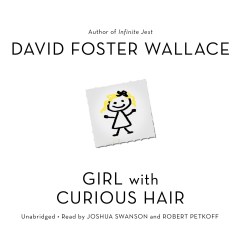
I saw a placeholder on Amazon for this audio book in early 2011.  And then I promptly forgot all about it.  My friend George just asked if anyone had heard it yet, so I decided to check it out.  I downloaded it through Audible.com.

And here’s my two cents about Audible.  Although it was free (for a 30 day trial), it was a lot of work.  The entire book (14 hours) downloaded in two files.  Each was about 7 hours with no breaks or chapters of any kind–just two huge 7 hour files.  Okay, I often download stuff and bring it into Audacity to make my own chapter breaks.  But you can’t import this file into Audacity because it is its own proprietary format and doesn’t want you to put it in MP3 format.  So, I had to burn it to CD (but not in MP3, only in WAV) and then put the CDs back in to iTunes to import them as MP3.  From there I could import them into Audacity and put tracks where I wanted.  That’s a lot of work to save $29.

I’m also going to say that I didn’t want a membership to Audacity because it costs $15/mo and the savings aren’t really that good anyhow.  Even kids books are about $10 each.  Oh, and just see how many hoops they have you go through to try and cancel.   Heavens to Betsy.

And but so on to the actual audiobook.

The book was read by Robert Petkoff (who is Reader A below) and Joshua Swanson (who is reader B below).  I don’t know anything about them, but their websites will give you more info about them.

I found the readings to be simply wonderful.  They were impassioned and articulate and dealt with some of DFW’s tongue twisting word choices with ease.  They also handle DFW’s dialect and accents with ease.  And while Swanson has a much much broader range of voices to play around with (his women voices are far superior to Petkoff’s), Petkoff also pulls of some amazing voices, especially in “John Billy.”  I never questioned what was happening.

Some of these stories are challenging and I admit I found them difficult to read.  But the audio versions seemed to really clarify things.  (There are all kinds of reasons why this could be so, but I’m not going to delve into that, for there lies madness).  Nevertheless, this was a great way to hear these stories.  Especially the ones that had heavy dialect.

“Little Expressionless Animals” [Petkoff] (90 minutes)
Petkoff sounds uncannily like Kyle McLachlan–no bad thing.  Although Petkoff doesn’t work too hard trying to do different voices, he puts in enough distinction to make the characters distinguishable.  (We have been listening to a lot of kid’s audio books, and the narrators of those are amazing with the kind of vocal acrobatics they can do!).  Petkoff is more subtle, but it is also effective–it’s not just a straight voice, which I think might get confusing especially in the dialogue scenes.

There is a hint of Alex Trebek’s voice when doing Alex Trebek, but he’s definitely not trying to mimic the voices of the celebrities.  For the most part, the voices are slight variations of the main narrator.  Indeed, during the later Faye and Julie dialogue section, he does slight differences between their voices to help distinguish the characters.  Which is quite helpful in the story.

This story works very well in audio book format.

One of the things that I loved about this story this time was really piecing together all of the various compnents.  Inclduing things like the revealtion of why Julie does poorly on the subject of animals.  It’s quite obvious when the story ends, but through the whole story you keep wondering, what is it about the animals?  I’m aslo intrigued at the number of gay characters in the book.

And, of course, this story has a major obsession with pop culture, especially TV.  And knowing (from interviews) that DFW sais he would just get sucked in to watching TV all day if it wa svailable, his tone (as is Petkoff’s) is perfect when dealing with the TV issues.

“Luckily the Account Representative Knew CPR” [Petkoff] (18 minutes)
Petkoff sounds slightly differnt than in “LEA.”  Since thist story has no dialogue, there’s not a lot of differentiation in the story.  His deadpan delivery is perfect for all of the details in the story. Although at the end, his “Help”s are quite empassioned, letting you know there’s a little bit more going on.

“Girl with Curious Hair” [Swanson] (50 minutes)
Swanson’s voice is of a much higher timbre, and it’s kind of fun to have two different voices in this book.  This story benefits quite well from an audio format.

The story is deliebrately flat and, I have to admit, is not terribly easy to read.  Swanson handles the flatness very well, he reads it incredibly deadpan and yet he puts enough inflection in it to keep it from being monotone.  I have to assume it wasn’t easy to read this.  I think that he has really made this disturbing character quite real.

Obsevrations about the story.  Hearing this story out loud was more shocking than reading it.  The explicit sex is pretty shocking for DFW and the revelation about what happened to Sick Puppy when he was a kid is prodoundly distrubing, especially when it is read in this non-inflected voice.  It was uncomforatble and very effetcive.

There were times when I wondered about the believability of the charcter.  The use of the word negro, the utter flatness of him. I realize that he is quite damaged, but at times it seemed like maybe this story was too much.  Which is a bit of a surprise, as I find DFW’s charcatersto be very real.

“Lyndon”  [Swanson] [1 hr 45 min]
I didn’t really enjoy “Lyndon” when I read the story.  It’s a little long and had many different things going on.  I kept wondering about Lyndon himself.  About what made DFW write a story based around Lyndon Johnson, around jhis life and politics.

But hearing this story read aloud, with the Swanson’s various voices and accents and newspaper stories all differentiated really brought this to life.  I felt like it was so much more vibrant and alive and passionate in this audio version.  I read in my post that i found the ending quite moving when I read the story, but it felt even more so, with Lady Bird’s quiet, dignified delivery, here.

Observations on the story.  How odd that he chose to make this story that is about a real, and quite famous and well studied person.  I don’t know a thing about Lyndon, so I have no idea how much of this is true (the few LBJ quiotes I looked up seem faked).  I don’t think I spent enough time thinking about the main character when I read the story.  Boyd is so fully realized and amazing that Lyndon is really superflous.  This is awonderfully emotive story.  And Swanson really does an amazing job.

“John Billy” [Petkoff] (1hr 10 min)
I thought “John Billy” was a real challenge to read.  The dialect is pretty crazy.  And the story is not exactly easy to begin with.  But much like Swanson in “Lyndon,” Petkoff’s voices are outstanding here.  The main voice of John Billy is great–he handles the accent and the crazy word choices that John Billy has with ease.  The story flows perfectly.  It’s really impressive.

And while the voice of Glory Joy isn’t wonderful (Petkoff’s women are just softer versions of his voice), he more than makes up for it with the amazing transformation of Simple Ranger.  In the reading, it is clear that Simple Ranger “grows younger” from a quiet, hard to hear older to a youthful loud charcater.  And Petkoff takes that literally so you can really hear him change into a man with a “curious plus haunting voice that was not…of his gravelly, gray-lunged voice somehow, his own, somehow.”  And then, later in the story Ranger’s voice changes again when he “whispered, the big sharp clear new Ranger in a smooth new clear young voice.”   But nothing prepared me for the voice of T Rex Minogue. It is stunning.  It’s an amazingly processed voice that is as malevolent as it is “mechanical.”  It’ s masterful.

As for the story itself, the whole saga of C.Nunn Jr is bizarre and wonderful, a crazy hyperbole of a story.  It also seems crazily over the top hearing it aloud (like in “GwCH”).  The whole story’s end with C Nunn’s eyes is preposterous (what is it with people’s eyes in this book?).  And yet it feels like the nonsense is there as a balance for the heaviness.

The story is funny and silly but by the end it gets incredibly dark and thoughtful.  It’s a challenge to listen to, especially the end, but I think it benefits from an audio version.

“Here and There” [Swanson] (55 min)
I found this story somehow more confusing while listening than when reading.  There’s so much back and forth with voices and the whole conceit that this is some kind of fiction therpay doesn’t really translate easily here.  I also found some of the more academic sections to be kind of dull in his reading.  It’s a challenge to read aloud and keep interesting, I’m sure, but I found this story to be the least successful of the collection.

“My Appearnce” [Petkoff] (58 minutes)
This is written in frist person from a woman.  Petkoff, who has quite a deep voice conveys a woman very well.  This is a great reading for this story.  He does “versions” of David Letterman and Paul Schaffer.  They are not impersonantions by any means, but he has the tone down perfectly.   The male voices whispering in her ear are done in a very simple whisepred voice.  Very effective.

This is a great story and the audio is also wonderful.

“Say Never” [Petkoff and Swanson] (42 minutes)
Petkoff does a very good job with the accents in this story.  Labov’s heavy Jewish accent is very impressive.  And although Mrs Tebof is not very different from Labov, it is different enough to convey the accent and the tone.   He also does Lenny’s voice, which is the bulk of the story.

Swanson also comes in this story as well, doing the voices of Mikey and Louis (two very distinct voices, even if they are both a little Hollywood Gangster from the 40s).  I would have been interesting to hear them interact more in the book somehow.

I was struck by this story more in the listening than the reading.  There’s something about hearing people say these things that makes them more shocking.  Especially the note that he sends to his family (talking about his wife’s lack of sex drive–gasp!).  This is another one of DFW’s stories that ends before something big happens.  It’s funny how many of his stories seem like preludes.

“Everything is Green” [Petkoff] (3 minutes)
It’s also amazing that this whole story is only 3 minutes and thirty seconds long.  Petkoff reads this story in a perfect DFW deadpan style.  He even does May Flys voice with a (slight) accent.

“Westward the Course of Empire Takes it Way”  [Swanson] (6 hours)
Swanson does an amazing job with this difficult story.  There are nearly a dozen charaters in here and he manages to keep them all separate and distinct.  It’s really great.  This is especially true late in the story, when they are in the car on the way to Collison.  He has six people in the car and he manages to make sthem all unique:  J.D. is dark and gravelly while DeHaven has a kind of Midwestern Stoner tone.  Tom Sternberg is neurotic and aggressive at the same time.  D.L. is snotty and presumptuous (although it may be Swanson’s weakest voice, it really conveys the character well).  Magda is exhausted.  And Mark is a solid late teenager.

Let’s not froget the pissed off Fertilizer salesman, the Avis clerk and the bartender.  And the narrator of course.

This story is also fairly complex and hard to follow (when reading).  There so much going on what with the narrator’s interruptions and the metafiction.

What I really noticed this time is how the parts that are not metafictional, the actual narrative of the story is really good, really strong and emotional.  Not to say that the more meta- sections of it are bad, they just don’t have the same kind of impact.  Of course, the whole point of the story is to play around with meta-fiction, so I’m not entirely sure how successful it is in that regard.

Nevertheless, it’s a fascinting look at youth in America.  And I have to say that it really works as a foreshdaowing of issues that he would explore more in his later stories and IJ.

Some things I notice din this listen.  DFW uses the word “plus” instead of “and” a lot.  It’s a fascinating word choice, and one that I think virtually no one uses.  Sometimes it’s effective and other times it’s very clunky.  I never noticed it while reading but it’s very obvious when listening.

I just read my review of the short story collection, which I think was kind of brief.  I feel like I got a lot more out of the book this time around. Of course this is my second reading so that makes sense as well.  It’s also interesting how I enjoyed some stories more and other stories less.

Overall though, this is an excellent audio book.

Read Full Post »

SOUNDTRACKPEARL JAM-Austin City Limits (2009).

Pearl Jam records (and sells) most of their shows and they occasionally videotape them as well.  But they don’t do TV all that much (excepting the recent Late Late Show episodes).  There seemed to be something special, or at least different, about Pearl Jam on Austin City Limits.  Think of it almost like Unplugged Updated.

It opens slow with Eddie on an acoustic guitar and strings behind him.  In fact, the whole set seems less heavy than many of their sets.  But that’s not to say that the band doesn’t rock out, because they do.

The first six songs of the set come from Backspacer.   And then they bust out “Army Reserve” (which makes sense given who is in the audience, see below).  Then there’s a wonderfully raucous version of “Do the Evolution” (one of my favorite PJ songs).

After that riotous track, they bring the strings out for one more song.  It’s a rather funny little joke because it’s just the strings and Eddie on acoustic guitar playing “Lukin,” the 80-second song that is so fast you can barely hear the words.

For an extra treat, touring mate Ben Harper comes out to play slide guitar on “Red Mosquito” (which is always a treat).  And the set ends with an amazing version of “Porch” with a super long guitar solo in which Mike McCready really shows off his chops.  There’s even a moment where Mike and Stone are riffing off each other, classic rock style.
The set ends the Eddie talking about playing for the wounded veterans in the audience and how it was quite moving for him given all they have done for us.  Over the closing credits you see the band mingling with the veterans (including a guy who has lost a leg).  It’s all surprisingly touching for a rock show.

[READ: November 20, 2011] “Perchance to Dream”

A while back I read all of the Jonathan Franzen articles that were published in The New Yorker.  I thought I had read everything he’d published until I realized I had forgotten to read this piece (possibly his most famous) that was published in Harper’s.  It fits in well with this weekend’s theme because it was mentioned in Evan Hughes’ article that I talked about yesterday and because David Foster Wallace is mentioned in it.

As with most of Franzen’s non-fiction, it’s not easy to write about critically unless I want to argue with him, which I don’t necessarily want to do.  So instead, I’ll try to summarize.  Of course, this is a long and somewhat difficult article, so let’s see what we can do with it.

The first surreal thing is when you see the byline: “Jonathan Franzen is the author of two novels, The Twenty-Seventh City and Strong Motion, and is writing a third.”  It’s hard to imagine he got a huge article in Harper’s before he wrote The Corrections.

The second surreal thing comes in the text: It opens with “The country was preparing for war ecstatically, whipped on by William Safire (for whom Saddam Hussein was ‘this generation’s Hitler’) and George Bush, whose approval stood at 89 percent.”  And it is only a few paragraphs later when he mentions Patriot missiles that it clicked that this was written in 1996 and not 2001 and that he was talking about the 1991 Iraq invasion.  He mentions this as a prelude, saying that he was trying to sequester himself in order to start writing again.

Then he talks about Paula Fox’s novel Desperate Characters as a benchmark in terms of insight and personal conflict, even if it is so crazily outdated (that someone would throw an inkwell!).   He talks about this book quite a bit. I’m, not sure I found it compelling enough to want to read, but it’s always interesting to hear a fan write about a book I’ve never heard of.  He will return to this book throughout the essay. (more…)

Read Full Post »

« Newer Posts - Older Posts »