Feeds:
Posts
Comments

Archive for the ‘Charles Schulz’ Category

1969  SOUNDTRACK: ABIGAIL WASHBURN-Tiny Desk Concert #101 (January 3, 2011).

abigailAbigail Washburn had plans to study law at Beijing University in China.   Before she left, she bought a banjo—she wanted to take something to China that was American.  Then Washburn went on a road trip to study the banjo and to learn some tunes. She found her way to the Augusta Heritage Center in West Virginia, then to North Carolina and then Kentucky to the International Bluegrass Association. It was there that she sat down with a few women to play music, and right then and there was offered a record deal. She blew off China ans has made a career as a banjo player–typical story.

In the ten years since then, she has been to China (with her banjo) where she learned Chinese folk music.  She now mixes American bluegrass and folk with Chinese folk music.  For this Tiny Desk, she plays three songs with her band Rob Hecht on fiddle, Jared Engel on bass, Jamie Dick on drums and Kai Welch on keyboards and trumpet.  She uses two different banjos, a normal sized one and, om the final track, a great big-bottomed one.

The first song “City of Refuge” she says is done in hop high tuning (in case you were interested).  It’s fun seeing how fast her right hand is moving while her left hand is fairly still and her vocals are fairly slow.

“Taiyang Chulai” is a traditional Chinese song meaning “The Sun Has Come Out and We Are So Happy.”  She sings in Chinese (and plays no banjo).  Her Chinese sounds amazing (and it’s really funny to see her speaking/singing it).  She says that taught American folk music in China and learned that she needed to do arm gestures since all Chinese folk songs have accompanying arm movements.  She also wore armbands which her grandma made for her.

“Bring Me My Queen” is the final song.  I found it interesting that her songs are rather slower than the Chinese song, at least in tempo.  This song is even slow for a banjo song.  But it’s quite beautiful.  In addition to being a great banjo player, Washburn has a lovely voice, too.

[READ: December 8, 2015] The Complete Peanuts 1969-1970

I was excited to get to this book to see which strip was published on my birthday (it’s sort of like seeing the headlines from the New York Times on your birthday).

Well, sadly, my strip was kind of boring–part of an annual be kind to animals or national dog week or something like that.  Nothing life-changing or earth-shattering.   Good grief.

I also decided that I’m taking a break from Peanuts for a time.  I have really enjoyed what I’ve read, but I need a breather.  I have read twenty some years of the strips over the last few months and, even if Schulz never rested, he didn’t condense twenty years into a few months either.  So sometime later in 2016 I’ll resume the books.

This book is notable for revealing Woodstock’s name!  I feel like that was the last big revelation that we’ll see for a while.  I am curious to see if the 70s added any new characters. (Well, there is Marcie.  I wonder when she comes along).

1969 starts out with Lucy saying that this is her year, “it’s all mine.”  Although a few days later she asks for a refund.  Lucy finally gets fed up with Schroeder and not only kicks his piano but throws it into the kite eating tree.  In March of 1970, Lucy says “I’m a new feminist.”

There’s a lot of Lucy/Snoopy rivalries.  In May 1969 we see the first an only reference so far to tether ball–Lucy is great at it (until Snoopy beats her).  There has been a somewhat recurring joke about Lucy beeping Snoopy on the nose (which he hates).  She does it in April and says it has been 384 days since she did it last (I wonder if anyone confirmed that).  In June, Charlie and his family go on vacation and Lucy is in charge of Snoopy (and she is particularly harsh).

Los of things happen to Snoopy this year.  As is per usual, Snoopy is skating in the winter time.  He is planning to win trophies (skating with Peppermint Patty–although she has to break the news that she is not interested).  He is also in preparation (in March 1969) to be the first beagle on the moon (wearing an astronaut helmet).  Surprisingly, there is no acknowledgement when the first man does land on the moon.

In April 1969, Snoopy goes on a two-week journey looking for his mom (but doesn’t find her).  In July of 1969 Snoopy takes up roller derby (for a very brief time).  In September of 1969 Snoopy finishes his first novel and submits it for publication. But he is rejected!  In Sept 1969 there are a lot of football jokes involving Snoopy and the little bird (the bird being too small to move a football of course).  March 1970 shows the return of the Easter beagle.

1969 sees a lot of talk of “Head Beagle.”  First Frieda reports Snoopy to the Head Beagle for not chasing rabbits.  Later Snoopy is appointed Head Beagle but can’t handle the workload.

In the summer of 1970, Snoopy goes to give a speech at the Daisy Hill puppy farm and a riot breaks out with tear gas!  And in September 1970 Snoopy wears a cooper bracelet to cure his arthritis.

In July 1970 Snoopy reveals a good truism “If you think about something at three o clock in the morning and then again at noon the next day you get different answers.”  Also in July is the first mention of “The Six Bunny-wunnies” fictional series of books.

For a few weeks in August of 1970 Snoopy pretends to be a grocery clerk (butter 28¢, bread 39¢, eggs 59¢, tea 79¢).

Lots of things seem to happen on the baseball field this year.

And in April 1969 Charlie Brown’s team wins two games in a row–neither team could make it so they both forfeit (Franklin is on one of those teams).  Later in June of 1969 Snoopy wins the Rookie of the year award for the baseball team.

In March of 1969 Linus make a sports drink which “replaces the body stores and prevents and diminution of vitally needed electrolytes and nutrients.”  (Gatorade was invented in 1965 and became popular with athletes in 1967).

Some great moments in this book:

In May of 1969 (on the baseball mound, of course) the team is talking about the costs of college “it can cost almost sixteen thousand dollars to go to college.”  The joke comes that Charlie is hoping for a baseball scholarship and every one busts out laughing.

In May of 1969 the school nurse is going to weigh them and Linus says he’s going to as about his hurting shoulder, “never pass up a chance to get a little free medical advice.”

In August, Linus’ gramma says she’ll donate $10 to his favorite charity, “ten dollars is a lot of money.”  (He ultimately decides not to accept).

In July of 1969 the little red-haired girl moves from Charlie’s street!  And Charlie never says anything to her.  Later in December 1969 Linus Charlie and Snoopy go skiing (on a school ski trip).   Charlie sees the little red-haired girl and falls off the ski lift.

Charlie makes a funny joke when he offers to shovel Lucy’s snow.  He asks for a quarter and she says “What if it snows tomorrow and covers up our walk again.  Do we get our quarter back?”  He replies, “No by then I will have spent it on riotous living.”

Peppermint Patty gets a lot of strips in these two years.  In Nov 1969 she talks about school: “I signed up for Folk Guitar, computer programming, stained glass art, shoemaking and a natural foods workshop.  I got spelling, history, arithmetic and two study periods.  I learned that what you sign up for and what you get are two different things.”  (I would TOTALLY sign up for those classes too).

She returns a lot in 1970–she’s a great character allowing Schulz to explore all different kinds of kids and ideas.  In the beginning of 1970 she is called to the principals’ office because she’s not allowed to wear sandals to school any more.  She cries and calls Charlie Brown for advice.  It takes Snoopy to kiss away her tear to snap her out of it.  The strip series ends with Franklin saying, “All I know is any rule that makes a little girl cry has to be a bad rule.”

Patty also says that she got an F on a test because she has a big nose–if a teacher doesn’t like your looks there’s nothing you can do.  Franklin looks at the paper and says “you turned in a blank test paper.”  She sighs, “there’s nothing you can do.”

In December 1970 Peppermint Patty invites Snoopy to a “turn about dance” (where the girls ask the boys).  They have a good time until a boy asks who her weird-looking friend is.  She punches him out and feels guilty about it until Snoopy says he had a great time and he’s the one who bit the chaperone.  Their friendship is great.

In Sept 1970 Patty has a crisis–thinking she’s not beautiful  (then Snoopy gives her a kiss).  The following week her dad gives her a dozen roses and says that the boys will be calling on her when she grows up and he wants to be the fist one in her life to give her a dozen roses.  It brought tears to my eyes.

In June of 1970, Peppermint Patty asks to borrow Charlie Brown’s glove for a kid on her team named “Thibault.”  Which leads to Charlie asking “Thibault?” at least twice.  Then Thibault (who has sideburns), refuses to give the glove back.  But Charlie Brown is happy by this because Thibault accuses him of “thinking you’re better than us.” And Charlie gleefully says “Me?  Better than someone else?”

1969 ends for Charlie when he buys a ticket to a sports awards dinner.  He gets a seat right next to Joe Shlabotnik…who never shows up.

This strip really sums up why Charlie Brown is so likable.  On October 26 in which Linus describes an amazing football game in which a team makes an amazing come from behind victory with seconds left in the game .  He describes the great plays and then Charlie’s response is “How did the other team feel?”

Sally is starting to become a more fully developed character–opinionated but often horribly wrong.  In May of 1970 she buys a fish tank saying “This is the age of aquariums.”  And she has no tolerance for school.  In Sept 1970 she asks why they have to learn all of these things in school.  Why does she have to learn the names of rivers?  “I’ve never even seen a river!  They could at least take me to see a river.”  Later she writes a theme for school, “If I had a pony:”  “If I had a pony I’d saddle up and ride so far from this school it would make your head swim.”  Then she crumples it up and says “That’ a good way to get a D-minus.”  In Nov she shows the class a document that is written by “an actual caveman.”  The punch line: “Show and Lie is my best subject.”

The best Great pumpkin joke comes in Oct 1970 when Lucy says “Santa Claus has elves to help him…what does the great pumpkin have, oranges?”

There are a couple of topical jokes.  In July 1970, when it rains during a game Lucy starts singing “Raindrops Keep Falling on My Head” (which was a hit in early 1970).  And in December 1970, the kids use a Ouija board which had been released as a game earlier that year.

And then on June 22, 1970 the little bird reveals his name to be Woodstock!  (strangely it was a year after the concert).  With a name he acts no differently.  In Nov 1970 Woodstock tries to fly south but gets lost.  So Snoopy walks with him.  After a week they get grabbed by a girl who say “Ma, I found a stray dog!”  Then Snoopy is tied up for a few days while Woodstock tries to rescue him.

The year ends with Sally doubting whether you really have to be good for Santa to bring you presents “the old rascal is bluffing…I know that [he] will bring me presents whether I am good or not.”  Then on Christmas Day, ”I was right!”

This was a great book, with some excellent strips and character developments.

Mo Willems, beloved children’s author, wrote the foreword.  Mo says he started his career by selling black market drawings of Snoopy and Charlie Brown in second grade.  He learned that even bullies liked Charlie Brown.  He says he could utterly relate to Charlie’s world, “For me, an immigrants kid, recently plopped into the middle of a small school in the insular world of uptown New Orleans, Charlie Brown was the only one who understood how confused and unhappy I felt.”

He says he aspired to Linus-ness: to be wise and kind and highly skilled at making gigantic structures of playing cards.  But he knew he was always a Charlie brown.  “Sometimes when I am in a deep funk and feel like my life if is an uphill battle…I try to stop and imagine someone reading the comic strip of my frustrated life and laughing.”

All of his characters are an homage to Schulz in some way.  And the greatest lesson her learned from Schulz, is “never let the characters know they are funny.”

He concludes by saying that Peanuts isn’t Art… it’s better.  He toured the Charles M. Schulz Museum and Research Center and held an original comic but he found it anti-climatic.  They were too precious to be enjoyed…they became Art.  The magic that you get from having them in a book or newspaper was missing.

Read Full Post »

1967 SOUNDTRACK: JULIAN LAGE TRIO-Tiny Desk Concert #140 (July 7, 2011).

lageJulian Lage is a jazz guitar prodigy.  he normally plays with a quintet but for this set he brought only a trio which includes bassist Jorge Roeder and percussionist Tupac Mantilla.

This was my first exposure to Lage and he does some really impressive lines and riffs.  He plays a hollow-bodied electric guitar that sounds an awful lot like an acoustic guitar. He does some phrasings that are really pretty or really interesting

But I was more impressed with Mantilla on percussion.  He uses thick brushes, he uses his hands on bongos and cymbals.  He uses his hands on his body–playing his lap and chest).  He even uses little dusts brooms (which must be unwieldy).  He’s also got some kind of drum (perhaps a loose snare?) with a great sound and even a bell.

They play three songs.  “Welcoming Committee” is a new song not recorded as of then.  At the end of the song, they all laugh as an office phone rings the end.  Julian is a sweet funny guy with some interesting stories about his songs.

“However” is an upbeat bouncy song (with some less noodling).  Interestingly, it was written by their saxophonist who is not playing in the trio today.

Before introducing the final song “Untitled (No. 24)” he says he started a blog for inspiration–to get people to bounce ideas off each other–healthy peer pressure with incentives for song writers.  The most recent one was a song a day for 30 days.  This was number 24.  (Hhe jokes that the first 23 sucked).  It’s a really fun piece that doesn’t feel incomplete at all.

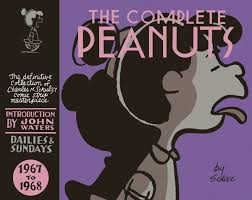
[READ: December 8, 2015] The Complete Peanuts 1967-1968

It’s 1967 and Schulz has had huge success with Snoopy’s Red Baron plots.  In December 1966 The Royal Guardsmen made a song called “Snoopy Vs the Red Baron” which made it to number 2 on the charts.  So The Red Baron plot takes over a lot of this year.  And while I enjoy seeing him like that and I get how it’s funny, I don’t really like it all that much–the jokes are too samey for me.  But despite all of the Red Baron excitement there are other things going on this year too.  Like the introduction of the Easter Beagle.  And of Franklin!

The kids get involved in many different sports this year.  In Feb 1967 Lucy begins arm wrestling (and beating) everyone.  She even takes on the Masked Marvel (Snoopy).  In Oct 1967 Snoopy plays hockey for the first time (I think).  He references Bobby Hull).  Later in Jan 1968 all the kids play hockey together.  Lucy beats everyone up and say how much she likes the game.  And at one point Snoopy smiles and is missing teeth.  In Oct 1968 Snoopy shoots and scores (on his doghouse) and says “they’re not sleeping well in Montreal tonight.”

In December 1967 Snoopy considers going to the Olympics in France for his ice skating.  He says he misses skating with Sonja Henie).  In April 1968 Snoopy is going to the Masters in Augusta.  When that doesn’t work out (we never see him there), later in April Snoopy is a wrist wrestler who is going to go to Petaluma for the world competition.  (There are many jokes about Petaluma).  Snoopy is disqualified because he has no thumbs.

In August 1968 Snoopy says “jogging is my thing.”  And in Nov 1968 we learn that Snoopy has a pool table but that Minnesota Fats won’t play him.

And of course there is baseball.

Peppermint Patty comes back in March 1967 to play against Charlie’s team.  She has a new player, Jose Peterson, who doesn’t really hang out in the strip for very long, but who is an awesome slugger.  In November of 1967, there’s a reference to the lousy New York Mets.  I didn’t realize it but at the time of this strip, the New York Mets were a recent expansion club with a terrible record.

In summer of 1967 Charlie and snoopy return to camp and they see Peppermint Patty is there.  Patty strikes out Charlie a whole bunch and says she considered letting him hit one but he wouldn’t want that, right?

In march of 1968 snoopy takes over as manager and is really mean.

And of course, Snoopy has a lot going on too.  We learn that August 10 is Snoopy’s birthday.  He also says a lot of things are gauche.

In a very funny skit, in May 1968 Snoopy watches a bird chomp a worm and then says “I’m going to be very very very very very very very very sick.”

June 1968 introduces Lila again, and how Snoopy pines for her.  Then in August she writes to Snoopy again.  And finally on Aug 24 we meet Lila for the first time.  Lila is a girl in the hospital.  But it’s not until the end of the month that we learn that Lila was Snoopy’s previous owner who lived in an apartment and had to get rid of him.  AND THAT’S ALL THAT’S SAID ABOUT IT!

On a lighter note, in March Snoopy pretends to be a piranha for a few strips.  In April 1967 there’s some Cheshire cat jokes from snoopy (who is only a smile)  April 1968 sees the first mention of the Easter Beagle (Lucy doesn’t believe Linus who is the only one to see him).

Linus and Lucy pop up a lot of course.  They revisit a lot of the same ideas with variations.  In August Linus’ grandma agrees to give up smoking to get Linus to give up his blanket.  He thinks she’ll never do it, but he goes through the real withdrawal.

In Dec 1967 Lucy ups her psychiatrist booth’s price to 7 cents (winter rates).  And then as the book ends in Dec 1968, Linus is taking shorthand notes for her.

Father’s Day this year had Peppermint Patty writing a card.  She says that her dad calls her a “rare gem,”  This phrase is used as a joke in the strip and then a few more times.

It seems like summer is a good time for new things as well.  There are two weeks of strips starring Peppermint Patty at camp!  She is a counselor of littler kids.  There is a little girl who looks like Marcie but isn’t (her name is Clara).  And then later that week another little girl, Sophie, calls her “Sir.”

And then July 31, 1968 introduces Franklin!  He and Charlie play at the beach for a few days.

Religion pops up from time in the strips, especially with quotes from the Bible.  But in March 1967, Violet asks Charlie if they go to church.  He says yes, but she says her family “used to…now they belong to a coffee house.”  And in April Schulz revisits the “here’s the church gag.”

[From the Peanuts wikia] On February 8, 1963, Sally watches while her big brother uses his hands to illustrate that old rhyme: “Here’s the church…here’s the steeple…open the door…and see all the people!” After carefully examining his closed fingers, she announces, “It looks like a rather small congregation!” Four years later, on April 8, 1967, Sally watches as Linus delivers the same rhyme…and then she provides an almost exact response: “Sort of a small congregation.”

Most of the strips are totally timeless, with me even thinking that I read some of them when I was much older than I did.  I can’t say as I remember a lot of specific strips, but I always remember the one from Dec 5, 1968 (which is from before I was born, so I obviously read it in a collection).  Peppermint Patty says that it snowed last night Her dad says that “when it snows you should always take a slice of bread out for the birds.”  She places a whole slice on the bird’s head.

I think the timelessness of the strips are what make reading these volumes so much fun.

In May 1967, Charlie asks Linus if he wants to be the first man on the moon.

In July 1967, the bird (unnamed yet) has “long hair” and Snoopy calls him a bird hippie.

Charlie writes to his pencil pal in Nov 1967 and says, “According to what I read, your country hates my country and my country hates your country.  I don’t hate you, and I don’t think you hate me.  I think about this a lot.  It makes sleeping at nigh very difficult.”

In Jan 1968, the girls are going to have a “crab-in.”

Dec 18 1968 Snoopy has a sled and Charlie looks at it and says “Rosebud?”

In June 1968, Snoopy says he thinks he is in love with Twiggy.

In August, Snoopy says that you never hear anyone sing “Chloe” anymore (although which song that is, I’m not sure.  Perhaps the Al Jolson one).

In Nov, Snoopy says he is feeling groovy (the Simon and Garfunkel song came out in 1966).

There are references to the election year with the birds holding ups signs that say ? and !!  Snoopy say he’ll vote for the one with the paw print on it.

My two favorite jokes in the book have to do with math.

Sally is trying to learn her times table and guesses answers like “Four-thousand six? elventy-twelve? fifty quillion? overly-eight?  twiddelty-two?”  Then she  asks “Am I getting close?” And Charlie responds, “Actually it’s kind of hard to say.”

In Dec 1968, Peppermint Patty says she loves numbers.  “Twos are sort of gentle, threes and fives are mean, a four is always pleasant.  I like sevens and eights too, too but nines always scare me.  Tens are great.”  When a classmate asks if she has prepared her division homework, she says “Nothing spoils number faster than a lot of arithmetic.”

~~~~

In my edition the May 1 strip is repeated instead of the May 3rd strip! (The missing strip will apparently be printed at the end of the next book).

John Waters give the best foreword yet.  He actually references strips in this book!

He says he became obsessed with peanuts when he had mono in 6th grade.  He loves the depression paranoia and delusions.   But John was all about Lucy.  He loves her politics, her manners “Get out of my way!” her narcissism and her rants.   He says he has a niece named Lucy and Schulz got the expression perfect when she yells “No” on page 61.

He also says that for the most part the strips don’ age at all (with a few exceptions).  He talks about Lucy shouting “police brutality” at Charlie as a crossing guard!  He also says that Schulz was criticized for including the minority characters (which is shocking).  Waters is also fascinated by characters like Roy who are rarely if ever heard.

Pig-Pen was an inspiration for Dingy Dave in A Dirty Shame; Divine cutting up her daughter’s jump rope in Female Trouble is inspired from a Peanuts strip.

He sums up with the attitude that Peanuts presents:

You are dealt a hand.  Deal with it.  But most importantly he teaches all ages that if you can learn to laugh at the things that cause you the most pain, you will be the strongest of all.

Read Full Post »

1965 SOUNDTRACK: TIME FOR THREE-Tiny Desk Concert #291 (July 27, 2013).

time for 3Time for Three are a string trio who play many types of music.  There are two violinists Zachary De Pue and Nick Kendall with a double bassist Ranaan Meyerand.  And over the course of their three songs (all original) they play classical, jazz, bluegrass and just about everything in between.

“Banjo Love,” features two contrary violin solos which get support from Meyer’s expressively propulsive bass.  It opens with the two guys strumming the violins before breaking into some lovely bowed playing.  Both violinists switch off solos (the blond player is a bit faster and more “showoffy” (but great)).  There’s even a bit of a bass solo after which the three guys all make a big grunt before continuing to the end of the song.

They say they are honored to be on the Tiny Desk series and compliment them on their new offices.

“Sundays” is a slow piece that features lots interesting bass parts behind the slow violin melodies.

They have funny stories about the origins of their songs.  “Don Don” is so named because the baseline goes don… don.  This has more of a bluegrass fiddle feel than a classical feel.  It’s super fast and fun with perfect slides and solos to really keep the song moving.

The notes say that they wished the guys played more, and I do too.  Interestingly I see that they have covered Daft Punk and Kanye West, so I guess they’re up for just about anything.

[READ: December 8, 2015] The Complete Peanuts 1965-1966

A whole bunch of ideas that I think of as BIG PEANUTS ideas come along in this book.  May of 1965 introduced the Daisy Hill Puppy Farm and Snoopy’s desire to meet his siblings.   In July of 1965 we get the first instance of snoopy at the typewriter writing “it was a dark and stormy night.”  We see Charlie Brown refer to the tree as a “kite eating tree” for the first time.  In July 1965 it’s the first time I can recall seeing the phrase “jelly bread.”  It’s the first appearance of Snoopy as Beau, the World War 1 flying ace (Oct 1965).  And in September 1966 we get the first appearance of Peppermint Patty!

The pop culture references seem to have dimmed somewhat too, although in January 1965, Linus cries “Annette Funicello has grown up!”

The “Happiness is” quotes are fewer, although Lucy squeezes Snoopy and says “Felicitas est parvus canis calidus,” which is Latin for “Happiness is a Warm Puppy.”   Of course later when he kisses her she freaks out “get some disinfectant, get some iodine” and he says “next time I’ll bite her on the leg.”

Linus’ blanket also takes on a mind of its own in March 1965 actually hissing at and attacking Lucy. (more…)

Read Full Post »

1963SOUNDTRACK: RESTORATIONS-Tiny Desk Concert #462 (August 14, 2015).

restor I don’t know Restorations, although I understand that they usually play pretty big loud guitar rock.   For the Tiny Desk they are stripped down (I guess) to the three guitars, but no drums or bass.  Lead singer Jon Loudon has a powerful and excellent voice.  On “Separate Songs” there are two guitars and a keyboard and wonderful harmonies.  The keyboardist sings backing vocals in the beginning of the song, so that when the lead guitarist joins in later, it’s even more impressive.

The guys are very friendly and funny.  The joke about the “desk” and about their constant tuning needs.

For “Tiny Prayers” all three play guitars and there some wonderful melodies that they play together.  The Future” is the slowest song of the three, but it contains all of the same elements–cool guitar sounds and wonderful harmonies.

The band has a great sense of melody.  And yet for all that I liked t his set, there was nothing that really stood out for me about the band.  They are simply a good rock band, and that’s not a bad thing.

[READ: November 29, 2015] The Complete Peanuts 1963-1964

The drawing style of Peanuts that I most associate with the strip has been pretty consistent by this point.  And most of the characters look “right” (although Snoopy will continue to morph over the years).

Why does Charlie Brown keep going?  Despite all of the abuse Charlie gets, this one strip seems to sum up his strengths: “adversity is what makes you mature…the growing soul is watered best by tears of sadness.”

I feel like Schulz was either looking up facts to write about for some of this year.  Because we get things like this: Lucy: “You have to have [a note excusing you from school] otherwise the school can’t collect its state-aid money.”  Is that true or has Lucy hoodwinked Linus and me?  Later Charlie tells Lucy “when cranes and herons stand on one leg they can’t be injured by ground lightning.”  Later, Linus tells Sally that birds “have muscles in their feet which automatically contract when they fall asleep (which is how they sleep on a limb without falling off).  He then says the same principle applies with Snoopy’s ears.  Is this true?

In July 1963, there must have been an eclipse as the strip spends several days telling everyone how to safely watch it.

Linus’ blanket continues to occupy a lot of attention, with Lucy continually yelling at him about it.  His blanket hating grandma returns and even takes it away (she gives him a dollar bill which he tries to snuggle with).

Linus is full of ambition in these years.  He wants to be a rancher for several weeks in 1963.  Although, horror of horrors, he doesn’t make the honor roll in March of 1963.  But that doesn’t stop him.  And in a big surprise in 1964, he runs for school president (and has but one failing…and it’s not his blanket).

Schroeder continues to dismiss Lucy, this time even saying the chances are a googol to one (and then writing out how many zeros that is) of them getting married.  In July 1963 she complains that Beethoven never made it on any bubble gum cards.  Later when Lucy asks him why he doesn’t like her, Schroeder gives a very simple answer.  She replies, “I hate reasons.”

Rachel Carson returns in Feb 1964 with Lucy saying “we girls need our heroines.”  Of course Lucy also gets this quotable moment: “The crabby little girls of today are the crabby old women of tomorrow.”

Attacks on consumerism continue with a shoddy baseball about which Charlie says “this is what is called ‘planned obsolescence.'”

Speaking of baseball, there’s plenty of it.  I enjoyed the Sunday strip where Charlie using Snoopy to show how to break up a double play.  In 1964, Charlie suffers from Little Leaguer’s Elbow (and the team does great without him).  And when Lucy hurts her elbow (and refuses to call it Washerwoman’s elbow) she says she’ll sue Babe Ruth, Ty Cobb and Willard Mullin (Mullin was a sports cartoonist).

In August 1963, we see the first mention of Charlie Brown’s baseball hero Joe Shlabotnik (and the very distressing moment when Lucy won’t give let Charlie have his card).

I got a real kick out of Schulz returning to the McCovey joke from last year (in January!) saying “or why couldn’t McCovey have hit the ball even two feet higher?”

In 1963’s National Library week, Sally gets her library card this time and she is even more excited than Linus was.  She even has the line: “Happiness is having your own library card.”

Sally also addresses helicopter parents of 1963: “My mother is watching me out of the window.  Mothers feel secure when they see a child of theirs playing in a sandbox.  Sigh.  She’s secure and I’m bored to death.”

The little red-haired girl is obsessed over from time to time. Especially during Charlie’s lonely lunches.

Frieda has definitely dwindled by now–even if she never really did much.  She does abuse Snoopy about chasing rabbits but in one strip, we seem him playing with bunnies and four sleeping on his stomach on top of his doghouse.  This seems to set in motion Snoopy’s love of all other animals.

Later, there’s a really funny strip with Snoopy trying to fill his water bowl from a tap.  Then it rains on him.  The punchline “That’s one I’m going to have to think about for a while” is hilarious.

And…Snoopy goes to the hospital for a couple weeks! (nothing serious).  Charlie says he has a private room “he has a health insurance policy that pays forty dollars a day!”

In September of 1963, there’s a joke about ZIP Codes (Snoopy forgets his) and then shortly after a new character named 5 is introduced.  He explains, “My dad says we have so many numbers these days we’re all losing our identity.  He’s decided that everyone in our family should have a number instead of a name.”  His sisters 3 and 4 look like Peppermint Patty (who hasn’t arrived yet).  ZIP codes were introduced in 1963.

At Halloween in 1963 Linus slips about the Great Pumpkin and says “if he comes” (like in the TV show).  He’s doomed!

In February of 1964 a whole set of strips focuses on the existence of the humane society.

And in May of 1964 we get the classic bit from the movie when Charlie puts a coin in Lucy’s can and she sings “Boy what a sound.  How I love to hear that ol’ money plink!  That beautiful sound of cold hard cash!  Nickels! Nickels! Nickels!”

In June of 1964 there is a very touching Father’s Day strip.  (Although it wasn’t officially recognized until 1966 and signed into law as a official day by Nixon in 1972).

I really enjoyed the series of strips where they clean out Snoopy’s house and the dimensions (which we never see) are enormous!  There’s stairs, a pool table and all kinds of cool things.

For years now, Peanut has had strips where charters hold up signs–sometimes for Beethoven’s birthday, or national library week.  But in Sept 1964 it gets a bit more surreal with a bird holding a sign that has  ! on it.  Later another bird’s sign says ; and ?   A fight breaks out about it.  It’s very funny.

And in October 1964 Lucy pulls away the football despite given Charlie a signed document… “it was never notarized.”

And the year ends with something of cliffhanger.  Charlie has to do a report on Gulliver’s Travels over his holiday break, but he keeps putting it off… what will happen in 1965?

The foreword was written by Bill Melendez.  Melendez first met Schulz when they collaborated on an animated commercial for the Ford Falcon in 1960.  In 1963, they worked together on a documentary about Schulz using more animation.  Then in 1965 Coca Cola contacted him to see if Schulz would like to make a Christmas special.  They had 5 days to write the outline.  They used the kids from the Ford commercial as the voices. And they had six months to make the move.  It first aired on December 9, 1965.

Melendez raves about their work (rightfully) and then talks about the many other specials the made together–a Veterans’ Day one called What Have We Learned, Charlie Brown, and a show about cancer called Why Charlie Brown, Why?   In total they made fifty network specials and 4 feature films.  He talks about how great it was that they found Vince Guaraldi for the music and that they used real kids and no laugh track.  It’s hard to believe that special is so old!

Read Full Post »

1961SOUNDTRACK: NICK LOWE-Tiny Desk Concert #87 (November 1, 2010).

lowe Nick Lowe is legendary.  And yet I don’t really know that much about him.  I knew he did “Cruel to be Kind” which is very dated sounding but still great.  I didn’t know that he wrote my favorite Elvis Costello song “(What’s So Funny ‘Bout) Peace, Love, and Understanding?” (which he first recorded with his band Brinsley Schwarz).  He also produced a bunch of Costello’s albums.

This Tiny Desk is a mellow affair, with Lowe gently playing acoustic guitar and his low, smooth vocals singing interesting lyrics: “His heart’s a prune / when it once was a plum / If you know him / that’s the kind of man that I’ve become” (from “Man That I’ve Become”).

“Rome Wasn’t Built in a Day” is done in the same vein.  Cathy, mellow pop, with an almost countryish feel.

“All Men Are Liars” is a pretty typical song about lying men, until you get this fascinating lyric: “Do you remember Rick Astley?  He had a big fat it.  It was ghastly.  He said I’m never gonna give you up or let you down.  Well, I’m here to tell you that rick’s a clown.”

“House for Sale” was a then new song.  And it’s just as sharp and strign as the rest.

At the time of this recording, Lowe was 61 and he sounds great.  His voice has changed, but it hasn’t lost anything.

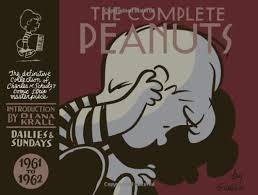
[READ: October 29, 2015] The Complete Peanuts 1961-1962

By this book, Peanuts had been in print for nearly 12 years.  And the core group has remained Charlie Brown, Lucy, Linus, Snoopy, Schroeder, and now Sally.  And to a smaller extent Shermie, Patty and Pig-Pen are still around.   But in 1961 he added a new character: Frieda, the girl with naturally curly hair.

One thing I hadn’t noticed so much in previous books is that he has been getting some very funny “jokey” punchlines.  Most of the Peanuts punchlines have been funny/thoughtful/amusing.  But I felt like this book had a few that were really funny.  Like Lucy saying in response to beauty being only skin deep “I have a very thick beauty.”  Or this funny groaner: Linus: “Do they always bring the cows in from the pasture at night?” Lucy: “Of course you blockhead, if they leave them out over night they get pasteurized.” I especially like that it isn’t even the final panel.  And in 1962, Charlie asks this question when he turns on the TV and sees reruns: “What would happen if comic strips had nothing but re-runs all summer?”

And of course, there’s a lot of baseball strips.  Including this one with a great set up and punchline.  Charlie is talking about the game and how “For one brief moment victory was within our grasp.”  To which Linus says, “And then the game started.” (more…)

Read Full Post »

1959SOUNDTRACK: TOM TOM CLUB-Tiny Desk Concert #82 (October 6, 2010).

tomtom Tom Tom Club were a side project of the rhythm section of the Talking Heads.  They had a hit with their song “Genius of Love” (you’d know the melody instantly).  I’ll be honest–I thought they only had one album out, but I see they had quite a few out and had recently re-formed and put out new records.

This set contains three songs.  “Wordy Rappington” which was on their debut, but which I’d never heard of.  I am shocked to see that it was a double A side with “Genius of Love.”  The song is a kind of amusing rap with a chorus of the children’s song “A Ram Sam Sam.” It is very kid friendly.

I will also be honest that I didn’t like The Tom Tom Club when they came out.  So even though I know the melody of “Genius of Love” I don’t know the song very well.  It’s kind of amusing though in that it name checks all kinds of musicians.  At one point they repeat “James Brown” over and over and then climax with “hit me!”

The music is surprisingly spare: an acoustic guitar or two, some bongos and an accordion (which plays the “Genius of Love” melody).

“Only the Strong Survive” is a cover of song by zydeco band The Franks.  Lead vocals and washboard are supplied by Mystic Bowie.

The band is having a ton of fun.  Considering Talking Heads were always kind of serious it’s nice to see Chris and Tina being silly..

[READ: September 29, 2015] The Complete Peanuts 1959-1960

This book marks more or less the ten-year anniversary of the first Peanuts strip.  Even though Patty (not Peppermint Patty) is on the cover, she gets very little time in the book.

The big news in this book is the arrival of Charlie’s little sister Sally!  In May of 1959 Charlie’s mom goes to the hospital for a few days.  And then Charlie is a proud big brother.  For a time, Snoopy is jealous and acts like a “fuzzy baby.”  However much Charlie talks about Sally, we don’t actually see her until August!  On a random Sunday Charlie is seen pushing her in her stroller (and missing out on baseball because of it).  There’s no really babyness for Sally.  She has a bottle, but while we saw a lot of baby time for Linus, there’s hardly any for Sally.  In fact, in October Snoopy gets her to dance.  And much later she gives Schroeder a hard time when he won’t play a lullaby for her.

She doesn’t really come into the picture all that much.  But by August of 1960, Sally thinks (still no speaking) that Linus is the cutest thing and has hearts floating around her when she sees him.  Charlie even has to wonder what’s going on here.  But Linus says, “I’m almost five years older than she.” (more…)

Read Full Post »

peanuts4SOUNDTRACK: BRIAN COURTNEY WILSON-Tiny Desk Concert #76 (August 25, 2010).

bcwBrian Courtney Wilson is not Brian Wilson. Rather, this Wilson sings  lovely religious songs.

This is an overtly Christian performance and as such I did not really enjoy it. Having said that, his voice is terrific and his backing vocalists are subtle and uplifting without overpowering the music.

He sings three songs: “All I Need” “Believe” and “Already Here.”  For some reason, there’s no video for “Believe” so you have to listen to the audio only track to hear it.

[READ: September 29, 2015] The Complete Peanuts 1957-1958

Some new themes emerge in this, the fourth volume of the Complete Peanuts.  Charlie seems to get branded with the “wishy-washy” curse a lot more (except when it’s raining and he’s not willing to give up his baseball game).

The angst is getting heavier now too with Charlie Brown saying “sometimes I think my soul is full of weeds).   Then in April 1958 he says “It always rains on the unloved.”   Even the normally chipper Snoopy (who at one point says “to live is to dance, to dance is to live”) gets a little mopey and introspective “when I was a puppy every day was a happy day suddenly bang, and I’m in my declining years.”

I feel like Lucy and Linus are showing up a lot more.  And Pig-Pen, really a one-joke character is appearing less but has not been forgotten.

I particularly enjoyed the concern that the earth was overpopulated (from Lucy).  And after she says “The earth can’t feed this many people” Linus replies “Why Don’t You Leave?” (more…)

Read Full Post »

1955SOUNDTRACK: BUILT TO SPILL-Perfect from Now On (1997).

330px-Perfect_From_Now_OnBuilt to Spill moved to the major labels and everything changed. No that’s not true. The band (well, Doug mostly) just sounds more serious about their music. What’s impressive is that there are no obvious  singles since each song is over 5 minutes long (except for one).

This is considered a classic 90s album but fans of the band and others.  And while I like it, it’s not my favorite.  A few of the songs are a little too drifty and anticlimactic.  But at he same time there’s some really amazing stuff here.

It opens with “Randy Describing Eternity” a cool song with a great riff and an interesting lyrics.  My favorite song (most days) on this record is “I would Hurt a Fly.” It has a fairly quiet intro with more intriguing lyrics: “I can’t get that sound you make out of my head/ I can’t even figure out what’s making it.”  The song waxes and wanes and even adds some cello. And then at 4 minutes, the song shifts gears entirely, stopping to add a brand new fast section with some great guitar work and wild noisy soloing.

“Stop the Show” is another favorite.  It opens with a slow meandering guitar section and then jumps to a great, frenetic set of verses. After about 5 and a half minutes the song turns into a crazy noisy fest and then switches to an amazingly catchy guitar instrumental solo outro, which could frankly go for five more hours. “Made Up Dreams” has several different elements in it. And even though it’s only 4:52, it still packs in a lot of music.

“Velvet Waltz” is over 8 minutes long. It has slow parts, and a lengthy middle section with strings (in waltz time of course). It builds slowly adding some cool guitar sections and a great long solo at the end. “Out of Site” is one of the shorter songs on the disc.  It has an immediate, fast section that is very catchy. It then mellows out to a slow cello-filled section. “Kicked it in the Sun” is kind of trippy.  At four and a half minutes a noisy section overtakes the music, but behind the noise is a beautiful, pretty guitar/keyboard melody.  Then it shifts out of the noise into a more rocking catchy section.

The final song is the nearly 9 minute “Untrustable/Part 2.”  It begins loud with great lyrics “You can’t trust anyone because you’re untrustable.”  Like the other songs it has several parts.  Around 4 minutes it turns into another song altogether. This continues for a bit and then at 7 minutes it shifts gears entirely into a keyboard dominated romp.

There’s so many interesting melodies and changes in this album, and it clear that it was completely influential on late 90s indie rock.  But I think what’s even more impressive is that each album get a little bit better.

[READ: September 29, 2015] The Complete Peanuts 1955-1956

Moving on to volume 3 of the Complete Peanuts.  Stylistically things are advancing towards the Peanuts characters we know now.  Yet they haven’t quite gotten there.  I think the kids’ faces (not their heads, just features) are still much smaller.  And Snoopy still looks like a real dog, although his nose grows year by year.

In the beginning of the year, there’s a funny line from Lucy, attacking commericalism. Charlie is reading her a book.  He says “Once upon a time they lived happily ever after.  The end”  And Lucy says “What’s on the rest of these pages, Advertising?”  Much later there a joke in which Lucy asks Schroeder how much a musician makes, and he relies “Money?  Who cares about money?  This is art. You Blockhead.”  It is ironic of course that Schulz went on to become so staggeringly wealthy–but maybe that just shows what good art can achieve.

Another one of my favorite sophisticated jokes comes when Lucy is flying a kite.  The joke is all about perspective. It’s hilarious. (more…)

Read Full Post »

1953SOUNDTRACK:CŒUR DE PIRATE-Cœur de pirate (2008).

Coeur-de-pirate-albumCœur de Pirate is the band name of Béatrice Martin, a Québécois singer and piano prodigy.  She was 19 when she released this album (and was accepted into conservatory school in Montreal when she was nine).

Given her musical background, one might expect more elaborately created music–more chamber pop, perhaps.  But this debut album is delightfully sweet and spare indie pop.  It is primarily simple piano songs with occasional extra accompaniment.

Most of the songs are simple, with unfussy arrangements and Martin’s beautiful voice.  The songs verge from charming piano melody to simple waltz to piano instrumental and a few upbeat almost dancey songs.  There’s even a guitar based song that adds a folk feel to the album.

There are 12 songs and the album runs only to 30 minutes.  It is charming and delightful.  The only thing I didn’t like so much was when Jimmy Hunt duets with her on “Pour un infidèle.” It’s not that I disliked his voice (which I did grow to appreciate after a few listens) it’s that his voice removes you from the insular little world that Martin has created.  When I am in it I don’t want any distractions.

The album definitely has a Francophone feel to it (her songs were described as “bringing la chanson française to a whole new generation of Quebec youth”) although she does remind me a bit of Regina Spektor’s later songs, too.

She also had a fluke hit with “Ensemble” when it was used with a funny baby based YouTube video that went viral (I’ve posted that at the bottom of the page).

You can listen to the whole album below

[READ: September 17, 2015] The Complete Peanuts 1953-1954

Moving on to volume 2 of the Complete Peanuts.  As 1953 opened, the characters remained in that older style–Snoopy still looks a lot like a dog, and Charlie’s head is still much bigger (or actually I guess his face is still smaller).  By the end of the book, they have morphed a little closer to the Peanuts most of us are familiar with, but they still look “different.”

I enjoy the way the Schulz celebrates the holidays with a simple but nice sentiment (Schroeder playing his piano with the music staff reading “Happy New Year”).  Indeed, Schulz celebrates most holidays.  Valentine’s Day, Income Tax Day (!) and of course, he has lots of fun with Hallowen (no great pumpkin yet though).

This volume seems to be a lot about Lucy (which may be why she is on the cover).  In the first few strips she gets expelled from nursery school.  Later on she quits nursery school because they didn’t teach how to be a nurse.  Lucy also tends to have a regular punchline, with regard to Schroeder of “I’ll probably never get married.”  Lucy also begins in earnest her counting career–trying to count all the stars (and getting exhausted) or all the raindrops, or the amount she jumps rope.  And she is still a fussbudget, with a joke at the end of 1954 having Schroeder compose the “Fuddbudget Sonata” for her.

Linus, who is still a baby, has taken to “shooting” people with his finger  (he struggles to crawl for a ball only to have Snoopy walk up and take it away, so he looks at Snoopy and says “bang”).  He is still crawling and toddling for much of the year, although by the end he seems to be growing up.  Nevertheless, Lucy is still giving him a hard time–constantly shouting at him when he is not looking and then commenting that “he’s awfully nervous.”

There’s a lot of baseball jokes as they move into spring (how did he keep coming up with original baseball jokes after all those years?) inducing jokes about sponsorship.  And then Lucy starts taking up golf (and is very good at it).

Schroeder continues to play beautifully (and to get upset by everyone who bothers him, especially Lucy and Snoopy.  He has a crisis of conscience when he says “sometimes I thin I like Brahms even better than Beethoven.”

Schulz included some occasionally topical material.  So there’s a joke about the popularity of “Doggie in the Window”  (It went to number 1 in April of 1953 and stayed there for 8 weeks).  Snoopy has been listening to it all day.

And of course there is a ton about Snoopy too.  he still looks like a dog and still does a lot of doggie things (and Schulz is always spot on with them).  I really like the joke where Snoopy eats a moth and then coughs up the dryness.  Or when he falls asleep under a tree and wakes up covered in leaves.  There are even a few jokes in which Snoopy hates being patted on the head.  And of course, Snoopy just loves zooming around (especially through croquet hoops).  This is mostly like Snoopy giving everyone a hard time, especially Charlie Brown (with the constant refrain of “You drive me crazy”).

One thing that I like about these early strips is that even though Charlie Brown has a lot of angst, he also has a great deal of self-confidence.  Like when he is mad at Violet and the punch line is “but I know you don’t think I’m Perfect)  There’s even a funny joke (or series of jokes) about graffiti on a fence (!).  In one, it says “Charlie Brown loves all the girls” (in another it says “Charlie Brown loves Charlie Brown”).

The TV jokes continue (I especially like the one with Shermy watching and the screen clears up to say Why Aren’t You in School?).  Most of them are variations on people sitting on front of each other. and blocking the view.

In June of 1954, Schulz uses the word security to refer to Linus’ blanket (evidently coining the phrase “security blanket”), which continues in one form or another throughout the book.  Linus starts to become really smart–outwitting Charlie Brown at houses of cards and magic tricks and the wonderful punchline of him blowing up a square balloon.

The biggest change comes in July 1954 with the addition of Pig Pen or ‘Pig Pen’ as he was first called. He doesn’t do a lot but it leads to a lot of jokes about being dirty.

And in December 1954, a new short-lived character named Charlotte Braun (or Good Ol’ Charlotte Braun) enters the strip.  She has wild curly hair and talks very loudly.  She is something of a foil to Charlie, but she is never really developed.

The book has a Foreword by Walter Cronkite.  He says that he was supposed to interview Schulz, but on the day they were scheduled, he took ill.  So Cronkite never got to meet with Schulz.  This is shame although I have to say that Schulz and Cronkite were such huge figures that they certainly should have met many times over the years.

Cronkite reveals a bit more about the Schulz’ Sparky nickname–that he was given the nickname by an uncle who was referencing the horse Spark Plug in the Barney Google strip.  I like Cronkite’ summary:

Now here you have a confluence of coincidences that would never be accepted even by the producers of a Hollywood pot-boiler.  A baby nicknamed after a cartoon characters growing up to be one of the greatest and most popular cartoonist of all time!

Cronkite also praises Schulz’ economy of dialogue and illustration and likewise keeps his own foreword brief as well.

I’m really excited about continuing through the years with these books.

For ease of searching I include Coeur de Pirate, Beatrice Martin, Quebecois, francaise

And here’s that (very funny) viral video that used the Cœur de pirate song:

[youtube-https://www.youtube.com/watch?v=8vNxjwt2AqY]

Read Full Post »

1950SOUNDTRACK: FRAZEY FORD-Tiny Desk Concert #73 (August 15, 2010).

frzeyFrazey Ford used to be in the Be Good Tanyas.  Here she is touring her debut solo album Obadiah.  She is quite a character, wearing a leopard print outfit.

But her music is really complex and interesting.  On the opener, “Firecracker” she plays the guitar with unusual chord progressions but it’s her voice that is so arresting.  She use atypical phrasings and pronunciations that belie her origins (I could never guess where she was from).  Strangely, I get a kind of Cat Stevens vibe from the way she says words, but also another inexplicable emphasis: the way she pronounces exploding as explohdun.

She talks briefly about her new record while apologizing for having to tune her guitar.  “Lost Together” slower, pretty song.

“If You Gonna Go” is a breakup song which she messes up and then apologizes for, saying she’s nervous and very tired.  And she mocks herself for wearing a ridiculous cheetah outfit.  She says she bought it in London where everyone was dressed like this.  Stephen Thompson chimes in that if it was cooler they’d all be dressed like that.

She asks if they want one more and she ends with “The Gospel Song.”

It’s a really good introduction to an unusual voice.

[READ: September 10, 2015] The Complete Peanuts 1950-1952

After reading the Sunday Peanuts books, I had to go back and start the series from the beginning.  Holy cow, Peanuts started in October 1950 and ran into the 21st century!  That’ amazing.  It’s also amazing to see how different everyone looked back then.  It’s very disconcerting.  The only thing more disconcerting is to immerse yourself in the old comics, start to really appreciate them, and then see a contemporary version and wonder why he changed them so much.

When the strip first started there were just three of them: Good Ol’ Charlie Brown, Shermy and Patty (not Peppermint Patty) and they are all four years old.  Those first comics are really really different–the kids are practically stick figures.  (Although Charlie always had that little wisp of hair).  The kids all have huge heads and tiny bodies and are very minimal in their expressions.  Snoopy is there too and he looks very much like a real dog.  As it turns out I like this version of snoopy better than the current one.  He looks much more like a dog and he acts alike a dog–Schulz gets some great jokes out of doggie behavior.  Things like Snoopy hearing and smelling food and running over to beg started almost from the beginning.  As did they ways that Snoopy interacts and often drives the other characters crazy.

peaWhat’s mostly different about the early ones is that the kids are all mean to each other and CB sometimes wins in the verbal sparring.   He’s as much of a buster as the others.  It’s really fun and funny. (more…)

Read Full Post »

« Newer Posts - Older Posts »