Feeds:
Posts
Comments

Archive for the ‘Artists’ Category

dq25SOUNDTRACK: ARCHER PREWITT-“O, KY” (2005).

wikldernessArcher Prewitt formed The Coctails (a kitschy lounge act) in the early 90s, several years before the lounge revival.  Then he joined The Sea and Cake and has been making amazing music with them.  And he has also released several solo albums.

He has also published some comics (Sof’ Boy) with Drawn & Quarterly.

This song comes from his album Wilderness.  The title of the song is clever, too.

It’s upbeat and folky with a little psychedlia and rock thrown in.  I like Prewitt’s voice quite a bit–it’s simple but really strong.  But the selling point on this song (and others from this album that I have listened to) is the composition and arrangement of these songs.

I like the way this one goes from simple guitar to orchestration (although presumably not a real orchestra) for the chorus.  And how post chorus there are flutes and other instruments to pick up the momentum which adds a vaguely psychedelic feel to it.

At four minutes (the song is five) it changes direction entirely and turns into a nearly new song with big guitars and drums. And it rather rocks.

And just to make Archer the all around dude that he is.  He also drew the cover art.  Jeez.  He’s probably super nice and friendly, too.

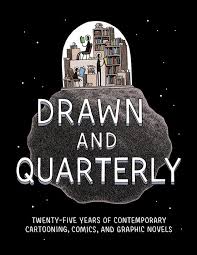
[READ: January 3, 2016] Drawn and Quarterly: Twenty Five Years 

I have liked a lot of D+Q books for a long time, although I never really considered a comprehensive look at their publishing house.  This book–about 775 pages long–is about as comprehensive as it gets.

This book contains a few previously published cartoons and excerpts as well as a whole slew of previously unpublished pieces.  There are essays and histories and reminiscences and love love love for the little Montreal graphic novel publisher.

I didn’t know much about the history of D+Q–that Chris Oliveros started the publisher in 1989 out of his house.  That he was the only employee for years.  And that he was essential in getting the term “graphic novel” used by everyone–including the library of congress!

He weathered distribution problems, he weathered the rise and fall of indie comics in the late 90s and he has come through with some of the most beautiful books published.  D+Q has also brought attention to foreign artists as well as out of print artists.

Really, if you have any respect for graphic novels (that aren’t superhero-based) you owe thanks to D+Q. (more…)

Read Full Post »

rhineSOUNDTRACK: HMSTR-Tiny Desk Concert #413 (December 24, 2014).

hmstrThe only thing I could think of to pair with a complete telling of Wagner’s Ring Cycle (aside from the entire thing itself, which… forget about it), was the smallest, most inconsequential music I could find.

Enter HMSTR.

HMSTR played the Tiny Desk Christmas show in 2014.  And really, they must be seen to be believed.  Not because they are spectacular, but because the joke isn’t really very funny if you just listen to the music.

Starting with some bizarre synth sounds, after 20 seconds the songs bursts into a lo-fi punk anthem.  It’s all buzzing guitars and a simple synth over some majorly lo fi drums.  There’s even a somewhat catchy “chorus” section.  After a minute, the guitars fade and sleigh bells signal the end of the song.

So whats the joke?  See for yourself

All in a tiny Tiny Desk setting.

[READ: May 20, 2015] Richard Wagner’s The Ring of the Nibelung

Yes, this is a massive graphic novel depicting Wagner’s “Music Dramas.”  The text was translated by Patrick Mason and then Russell adapted the whole thing to fit his story.

Everyone loves “Flight of the Valkyries,” but hardly anyone has listened to the entire Ring (it’s 4 operas and 15 hours long).  Except for the Bugs Bunny version, of course.  I have been interested in the Ring for a long time, but I wasn’t willing to devote that much time to it either.  So this book is perfect. (more…)

Read Full Post »

bpSOUNDTRACK: GRIMES-“Kill v. Maim” (2015).

grimesI don’t know Grimes very well at all.  When I first heard this song I didn’t really know what to think, but after repeated listens, I think it’s great.

It opens with a synth riff (and air horns) and one of Grimes’s many voices (this one is kind of childlike).  But by the end of the second line, she screams “they don’t know me” and that seems to set up the various personas in this song.

It’s the pre-chorus that I find so catchy–sung like the cheerleader chant “B-E-H-A-V-E aggressive.  B-E-H-A-V-E nevermore.”  And then the super fast chorus (with her voice lifted to an incredibly high pitch).

There’s a slower section with what I assume is her natural voice (which is quite lovely).  But it’s soon back to the fun chorus.  I need to hear more from her, but if this is her only good song, that’s okay.  It’s angry and you can dance to it.  Welcome to 2016!

[READ: December 20, 2015] Bitch Planet

This series is a great manifesto for the new year–don’t take shit from anybody.

Kelly Sue DeConnick is a force to be reckoned with.  In addition to presenting Captain Marvel as a woman (in the amazing series of that name) and making some other cool looking series that I intend to read, she has created this feminist masterpiece.  Bitch Planet addresses violence and injustice against women and the whole “prison culture” that is always titillating for men.  It pushes Orange is the New Black to even further extreme that a comic book can.

Designed in a retro style by Valentine De Landro, the book comes complete with ads for “crap” in the back of each issue.   Which you may actually be able to buy. (more…)

Read Full Post »

resist3SOUNDTRACK: CHARLIE SIEM-Tiny Desk Concert #134 (June 15, 2011).

siemWhen he was 3 years old, Charlie Siem heard violinist Yehudi Menuhin play Beethoven’s Violin Concerto. That was all it took to inspire him to pursue the violin. Siem studied at Eton and the Royal College of Music, and now he plays one of Menuhin’s old violins—a stunning 1735 Guarneri del Gesu.  Upon describing this centuries old instrument he says “it helps me a lot when I’m doing my… little thing.”  He is also greatly amused when NPR’s Stephen Thompson asks if he can borrow it.

Siem recently discovered that he’s related to the 19th-century Norwegian violin virtuoso and composer Ole Bull. So he started off his Tiny Desk show with Bull’s bucolic Cantabile.  His introduction is great.  He says that Bull was a precursor to Paganini, who emigrated to the States and set up a colony on Pennsylvania.  He calls him a “really crazy guy.”  It’s a beautiful piece with occasional really high notes.  This violin seems to have an unreal sound to it, bringing it what sounds like harmonic notes or something.

Paganini’s Introduction and Variations on Paisiello’s “Nel Cor Piu”  (an aria from a now-forgotten Paisiello opera), contains a grab bag full of violin special effects.  This is just incredible.  His fingers move faster than can be believed.  There are trills all up and down the neck, there’s pizzicato plucking with his left hand (how?).  In a section of “harmonics” he even whistles the final note.  It’s amazing to watch.

Leopold Godowsky: Alt Wien (“Old Vienna”) (arr. Heifetz)  This is a lovely piece with lots of high keening notes in an arrangement by the incomparable Jascha Heifetz.

It’s amazing that Siem can be so good and yet somehow I’d never heard of him.  His kind of virtuosity is amazing.  And, as it turns out he’s a total hunk with a deep resonating actor’s voice as the pages of Italian Men’s Vogue magazine.  He’s also the 2011 spokesman for Dunhill, the men’s fashion house.  The write up says that for his Tiny Desk Concert appearance, you could say Siem dressed “casual, but with an understated elegance,” right down to his left-hand pinky, with its pink-painted fingernail.

I definitely need to hear more from him.

[READ: December 8, 2015] Victory

This final book in the trilogy sees the culmination of French Resistance against the Nazis.

We learn in the introduction that it has been four years since the occupation began and although victory seems within sight, things have been getting worse.  There’s hardly any food or resources and the Nazis are growing even more angry and vicious.  On June 6, 1944 the Allies landed in Normandy.  But they had a lot of fighting to do before they could liberate Vichy.

As this book opens we see Paul called into the prison because of his drawings.  He looks older now (a great detail on the drawing) and he finds it much easier to lie to the guards.  After an interrogation, Lucie’s father–the policeman we saw in the previous book who seemed to turn a blind eye to Paul’s activity–accuses him of sneaking around to see Lucie.  Paul catches on quickly that the man is helping him and when they are free together, Paul learns that there are people on his side who he never suspected. (more…)

Read Full Post »

resist2SOUNDTRACK: SIERRA LEONE’S REFUGEE ALL STARS-Tiny Desk Concert #118 (April 6, 2011).

sierraSierra Leone’s Refugee All Stars are famous for their story.  Its members met in refugee camps during Sierra Leone’s civil war and formed a band to spread joy during an otherwise difficult time.  But the band’s music is what has stood the test of time.  Ten years, two albums and an award-winning documentary later, these eight men are still riding that upbeat reggae groove.

The band consists of three drummers (all with hand-held drums) and one percussionist.  There’s 2 guitars (one electric and one acoustic) a bass and everybody sings.  Their music has a reggae feel, although it’s not exactly reggae, I don’t think.

“Jah Come Down” opens the show. The acoustic guitar keeps the melody while the electric guitar plays a riff throughout.  Occasionally the bass comes in with a cool line or two adding a nice low end.

“Living Stone” has a different singer (the percussionist).  His vocals are a bit more mellow, as this song is.  It’s amazing to see the age range of the players.

“Tamagbondorsu (The Rich Mock The Poor)” is the final song.  It opens with a guitar lick that reminded me of Paul Simon’s Graceland until i re-thought and realized that Graceland sounded like this.

The songs are fun and lively, perfect for dancing (as the singer does during the long instrumental outro).  Most reggae sounds the same to me, and these three songs do tend to blend together quite a lot.  But the music is fun and the players’ skill is undeniable.

Here;s to ten more years.

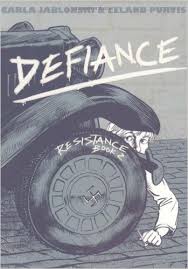
[READ: December 4, 2015] Defiance

This book is set three years into the Nazi occupation of France.  Things are sort of the same but worse for the residents of Vichy.  Neighbors inform on neighbors, and some residents collaborate with the Germans (and are more successful because of it).  And then in 1943, a new French-based Nazi police force called the Milice begin keeping watch over their own people

This aggressiveness causes more resistance, of course. And Paul has been drawing detailed and insulting pictures and posting them all over town (which is making the Milice quite upset).

Of course the kids are taking more aggressive stances now, too.  Some say that the posters are causing more harm because it makes the police mad.  But other kids’ parents have joined the police–some of whom are nice to the kids.  Even Paul’s sister, Marie, believes what her teachers say about Marshall Philippe Pétain (there’s a lesson about Pétain at the end of the book) and his governance.  And no one is going to say anything about the Resistance.   (more…)

Read Full Post »

resistSOUNDTRACK: LUISA MAITA-Tiny Desk Concert #100 (December 26, 2010).

maitaI’ve not heard of Maita.  The NPR write up speaks about the electronic flourishes and deep grooves of her songs.  Felix Contreras worried that their stripped down ensemble (only guitar, bass and fascinating bongos) would have a hard time creating that sound.

And in one way they do.  Except that it’s clear they didn’t even try.  Rather, they play a simple, but engaging kind of mellow Brazilian dance music.  In the first song, “Ai Vem Ele,” the guitar and bass play the same grooves except when they each take some meandering moments.  The percussion keeps a quiet but steady rhythm and Maita sings vocals and accent notes all over the place to keep the song interesting.  I really enjoyed at the end of the song when the bassist played exactly the vamping solo that she was singing.

“Alento” is a much faster song, with quickly sung lyrics.  It allows for rapid guitar playing and more uptempo feel.

They only play two songs (about 8 minutes long), but it really shows the kind of range she is capable of.

[READ: December 1, 2015] Resistance

This First Second graphic novel is about the Nazi occupation of France.  It’s not exactly light reading and yet Jablonski has taken this incredibly dark story and found an excellent and compelling narrative about one family who works as part of the resistance to fight back against their oppressors.

This is the first book in a trilogy and I am curious to see what the next two books bring as this story was nicely wrapped up but there are so many more stories which could be told.

Jablonski also helpfully sets up the situation in the introduction.  She explains how France was split in two as a result of the armistice agreement.  She gives a very brief but powerful explanation for why they would agree to splitting their country in half.  Paris and the upper portion of France became Occupied while Vichy and the southern part of France were “Free” (but still with a large Nazi presence).

This story is about an average family.  Paul Tessier and his parents and little sister live in the free part of France. Paul is an artist, and I love the way Purvis juxtaposes Paul’s art with what is actually happening (placing Paul’s “drawing” in the middle of the action so we know he is observing everything. (more…)

Read Full Post »

1965 SOUNDTRACK: TIME FOR THREE-Tiny Desk Concert #291 (July 27, 2013).

time for 3Time for Three are a string trio who play many types of music.  There are two violinists Zachary De Pue and Nick Kendall with a double bassist Ranaan Meyerand.  And over the course of their three songs (all original) they play classical, jazz, bluegrass and just about everything in between.

“Banjo Love,” features two contrary violin solos which get support from Meyer’s expressively propulsive bass.  It opens with the two guys strumming the violins before breaking into some lovely bowed playing.  Both violinists switch off solos (the blond player is a bit faster and more “showoffy” (but great)).  There’s even a bit of a bass solo after which the three guys all make a big grunt before continuing to the end of the song.

They say they are honored to be on the Tiny Desk series and compliment them on their new offices.

“Sundays” is a slow piece that features lots interesting bass parts behind the slow violin melodies.

They have funny stories about the origins of their songs.  “Don Don” is so named because the baseline goes don… don.  This has more of a bluegrass fiddle feel than a classical feel.  It’s super fast and fun with perfect slides and solos to really keep the song moving.

The notes say that they wished the guys played more, and I do too.  Interestingly I see that they have covered Daft Punk and Kanye West, so I guess they’re up for just about anything.

[READ: December 8, 2015] The Complete Peanuts 1965-1966

A whole bunch of ideas that I think of as BIG PEANUTS ideas come along in this book.  May of 1965 introduced the Daisy Hill Puppy Farm and Snoopy’s desire to meet his siblings.   In July of 1965 we get the first instance of snoopy at the typewriter writing “it was a dark and stormy night.”  We see Charlie Brown refer to the tree as a “kite eating tree” for the first time.  In July 1965 it’s the first time I can recall seeing the phrase “jelly bread.”  It’s the first appearance of Snoopy as Beau, the World War 1 flying ace (Oct 1965).  And in September 1966 we get the first appearance of Peppermint Patty!

The pop culture references seem to have dimmed somewhat too, although in January 1965, Linus cries “Annette Funicello has grown up!”

The “Happiness is” quotes are fewer, although Lucy squeezes Snoopy and says “Felicitas est parvus canis calidus,” which is Latin for “Happiness is a Warm Puppy.”   Of course later when he kisses her she freaks out “get some disinfectant, get some iodine” and he says “next time I’ll bite her on the leg.”

Linus’ blanket also takes on a mind of its own in March 1965 actually hissing at and attacking Lucy. (more…)

Read Full Post »

juiaSOUNDTRACK: AVI AVITAL-Tiny Desk Concert #239 (September 12, 2012).

aviAvi Avital plays a mandolin. But he doesn’t ply bluegrass. Indeed, much like the Punch Brothers covering Debussy, Avital uses the mandolin to play more classical type of music.  He is the first mandolinist to be nominated for a Grammy in the Best Instrumental Soloist category.

He has had this mandolin for about thirteen years and he loves it.  He has been using the same Israel lutier since he was 17, exchanging them until he found this one.  And he can really play the heck out of it.

He plays only two songs in the ten minute concert, but they really showcase his skills.

“Nigun” was written by Ernest Bloch in 1923 for violin and piano.  NPR says Avital’s arrangement, like the original, pivots between the ecstatic and the introspective, rising in intensity (and pitch) until finally disappearing in a mist of quietly plucked notes.  If you think of the mandolin as just strumming along to pop songs, you’ll be blown away by this.  He plays notes that I suspect were never meant to be played…sliding all the way down to the highest high notes on the highest strings.  I don’t know that it sounds better than a violin, but it is pretty neat.

“Bucimis” is a raucous Bulgarian folk tune in the odd meter of 15/16. “It’s almost 4/4, but not quite,” he says. “I can play it, but I can’t dance it.”  This song is absolutely wild, especially at the end.  While the first song was pretty, this song showcases just what you can do with a mandolin.  It’s intense.

[READ: June 19, 2013] Julia’s House for Lost Creatures

I don’t normally write about kids picture books (if I did my whole blog would be about them as we read so many).  But this one gets a special mention because a) it was published by First Second and b) I love Ben Hatke’s drawing style so much.

This is a delightful story which you have to start on the title page.  It shows a giant turtle with a huge house on its back.  And on the next page the text says “Julia’s house came to town.”

Julia puts in a mailbox and settles in by the sea. (more…)

Read Full Post »

1963SOUNDTRACK: RESTORATIONS-Tiny Desk Concert #462 (August 14, 2015).

restor I don’t know Restorations, although I understand that they usually play pretty big loud guitar rock.   For the Tiny Desk they are stripped down (I guess) to the three guitars, but no drums or bass.  Lead singer Jon Loudon has a powerful and excellent voice.  On “Separate Songs” there are two guitars and a keyboard and wonderful harmonies.  The keyboardist sings backing vocals in the beginning of the song, so that when the lead guitarist joins in later, it’s even more impressive.

The guys are very friendly and funny.  The joke about the “desk” and about their constant tuning needs.

For “Tiny Prayers” all three play guitars and there some wonderful melodies that they play together.  The Future” is the slowest song of the three, but it contains all of the same elements–cool guitar sounds and wonderful harmonies.

The band has a great sense of melody.  And yet for all that I liked t his set, there was nothing that really stood out for me about the band.  They are simply a good rock band, and that’s not a bad thing.

[READ: November 29, 2015] The Complete Peanuts 1963-1964

The drawing style of Peanuts that I most associate with the strip has been pretty consistent by this point.  And most of the characters look “right” (although Snoopy will continue to morph over the years).

Why does Charlie Brown keep going?  Despite all of the abuse Charlie gets, this one strip seems to sum up his strengths: “adversity is what makes you mature…the growing soul is watered best by tears of sadness.”

I feel like Schulz was either looking up facts to write about for some of this year.  Because we get things like this: Lucy: “You have to have [a note excusing you from school] otherwise the school can’t collect its state-aid money.”  Is that true or has Lucy hoodwinked Linus and me?  Later Charlie tells Lucy “when cranes and herons stand on one leg they can’t be injured by ground lightning.”  Later, Linus tells Sally that birds “have muscles in their feet which automatically contract when they fall asleep (which is how they sleep on a limb without falling off).  He then says the same principle applies with Snoopy’s ears.  Is this true?

In July 1963, there must have been an eclipse as the strip spends several days telling everyone how to safely watch it.

Linus’ blanket continues to occupy a lot of attention, with Lucy continually yelling at him about it.  His blanket hating grandma returns and even takes it away (she gives him a dollar bill which he tries to snuggle with).

Linus is full of ambition in these years.  He wants to be a rancher for several weeks in 1963.  Although, horror of horrors, he doesn’t make the honor roll in March of 1963.  But that doesn’t stop him.  And in a big surprise in 1964, he runs for school president (and has but one failing…and it’s not his blanket).

Schroeder continues to dismiss Lucy, this time even saying the chances are a googol to one (and then writing out how many zeros that is) of them getting married.  In July 1963 she complains that Beethoven never made it on any bubble gum cards.  Later when Lucy asks him why he doesn’t like her, Schroeder gives a very simple answer.  She replies, “I hate reasons.”

Rachel Carson returns in Feb 1964 with Lucy saying “we girls need our heroines.”  Of course Lucy also gets this quotable moment: “The crabby little girls of today are the crabby old women of tomorrow.”

Attacks on consumerism continue with a shoddy baseball about which Charlie says “this is what is called ‘planned obsolescence.'”

Speaking of baseball, there’s plenty of it.  I enjoyed the Sunday strip where Charlie using Snoopy to show how to break up a double play.  In 1964, Charlie suffers from Little Leaguer’s Elbow (and the team does great without him).  And when Lucy hurts her elbow (and refuses to call it Washerwoman’s elbow) she says she’ll sue Babe Ruth, Ty Cobb and Willard Mullin (Mullin was a sports cartoonist).

In August 1963, we see the first mention of Charlie Brown’s baseball hero Joe Shlabotnik (and the very distressing moment when Lucy won’t give let Charlie have his card).

I got a real kick out of Schulz returning to the McCovey joke from last year (in January!) saying “or why couldn’t McCovey have hit the ball even two feet higher?”

In 1963’s National Library week, Sally gets her library card this time and she is even more excited than Linus was.  She even has the line: “Happiness is having your own library card.”

Sally also addresses helicopter parents of 1963: “My mother is watching me out of the window.  Mothers feel secure when they see a child of theirs playing in a sandbox.  Sigh.  She’s secure and I’m bored to death.”

The little red-haired girl is obsessed over from time to time. Especially during Charlie’s lonely lunches.

Frieda has definitely dwindled by now–even if she never really did much.  She does abuse Snoopy about chasing rabbits but in one strip, we seem him playing with bunnies and four sleeping on his stomach on top of his doghouse.  This seems to set in motion Snoopy’s love of all other animals.

Later, there’s a really funny strip with Snoopy trying to fill his water bowl from a tap.  Then it rains on him.  The punchline “That’s one I’m going to have to think about for a while” is hilarious.

And…Snoopy goes to the hospital for a couple weeks! (nothing serious).  Charlie says he has a private room “he has a health insurance policy that pays forty dollars a day!”

In September of 1963, there’s a joke about ZIP Codes (Snoopy forgets his) and then shortly after a new character named 5 is introduced.  He explains, “My dad says we have so many numbers these days we’re all losing our identity.  He’s decided that everyone in our family should have a number instead of a name.”  His sisters 3 and 4 look like Peppermint Patty (who hasn’t arrived yet).  ZIP codes were introduced in 1963.

At Halloween in 1963 Linus slips about the Great Pumpkin and says “if he comes” (like in the TV show).  He’s doomed!

In February of 1964 a whole set of strips focuses on the existence of the humane society.

And in May of 1964 we get the classic bit from the movie when Charlie puts a coin in Lucy’s can and she sings “Boy what a sound.  How I love to hear that ol’ money plink!  That beautiful sound of cold hard cash!  Nickels! Nickels! Nickels!”

In June of 1964 there is a very touching Father’s Day strip.  (Although it wasn’t officially recognized until 1966 and signed into law as a official day by Nixon in 1972).

I really enjoyed the series of strips where they clean out Snoopy’s house and the dimensions (which we never see) are enormous!  There’s stairs, a pool table and all kinds of cool things.

For years now, Peanut has had strips where charters hold up signs–sometimes for Beethoven’s birthday, or national library week.  But in Sept 1964 it gets a bit more surreal with a bird holding a sign that has  ! on it.  Later another bird’s sign says ; and ?   A fight breaks out about it.  It’s very funny.

And in October 1964 Lucy pulls away the football despite given Charlie a signed document… “it was never notarized.”

And the year ends with something of cliffhanger.  Charlie has to do a report on Gulliver’s Travels over his holiday break, but he keeps putting it off… what will happen in 1965?

The foreword was written by Bill Melendez.  Melendez first met Schulz when they collaborated on an animated commercial for the Ford Falcon in 1960.  In 1963, they worked together on a documentary about Schulz using more animation.  Then in 1965 Coca Cola contacted him to see if Schulz would like to make a Christmas special.  They had 5 days to write the outline.  They used the kids from the Ford commercial as the voices. And they had six months to make the move.  It first aired on December 9, 1965.

Melendez raves about their work (rightfully) and then talks about the many other specials the made together–a Veterans’ Day one called What Have We Learned, Charlie Brown, and a show about cancer called Why Charlie Brown, Why?   In total they made fifty network specials and 4 feature films.  He talks about how great it was that they found Vince Guaraldi for the music and that they used real kids and no laugh track.  It’s hard to believe that special is so old!

Read Full Post »
blueblue SOUNDTRACK: NICK BUZZ-A Quiet Evening at Home (2013).

quietIt seemed like Martin Tielli was done making music after his (so far) final solo album in 2009.  He has been focusing on (gorgeous) visual arts since then.  But then in 2013, Tielli along with Jonathan Goldsmith, Hugh Marsh and Rob Piltch recorded another Nick Buzz album (cover painting by Tielli)–possibly their last as well, but who knows.

This album is almost entirely mellow, with beautiful slow pieces and delicate singing and instrumentation–with some exceptions.  The biggest exception is the first song and single (with video) “The Hens Lay Everyday.”  It is unlike anything else on the album.  It is a weird, electronic fast song with pulsing beats and funny lyrics (and a crazy video).  It’s kind of a shame that it’s on this album because I want more music like that.  But the rest of the album is also wonderful in a very different way.  This song just doesn’t fit.

Beginning with the second song, the album is a beautiful album of wonderful ballads.

“This is Not My World” is a delicate guitar song with simple keyboard washes.  Martin’s voice even sounds different on the song–I almost didn’t recognize him until the last few verses.  “Milchig” opens with a buzzy violin (that sounds almost like a fly).  Tielli did this song with The Art of Time Ensemble (it was called “Moglich”).  It has a gentle guitar and Tielli’s keening voice and spoken word–“he had given me ‘the relax.'”  There’s several sections in this song, and I especially like the slowly lurching middle section.

“Sea Monkeys” opens with some delicate chimes and underwatery sounds.  And once again, Tielli’s voice sounds different.  I love this peculiar song about ordering and “growing” sea monkeys.  He says he only wanted plankton or krill but during that evening, the sea monkeys started building their city, and after 4 and a half minutes, the song turns somewhat more sinister with a section about the Crustacean Monkey Queen.  The delicate music grows harsher and more mechanical sounding.  It’s pretty intense.  And it coincidentally relates to the book below.

“If You Go Away” has a vaguely Spanish guitar feel to it.  It’s a very delicate, slow ballad (I should have realized it was an old song written by Jacques Brel) with strummed guitar and gentle percussion.  It has a lounge feel as well (the romantic lyrics aid in that style).  It was recorded live with audience clapping at the end.

The mood picks up a little with the next song, “The Happy Matador.”  It’s played on acoustic guitar with flamenco-esque runs.  It’s a delightful song even if lyrically it’s a little dark.  “Eliza” is a darkly comic song with a kind of circusy feel.  It opens with accordion, adds a violin and basically makes fun of a woman named Eliza, with the great last line: “The only incredible thing about Eliza is the terrible terrible music she inspires.”

“A Quiet Evening at Home” opens with some strange noises like Circo did, but this is an older, more mellow album and they quickly give way to some pretty, delicate guitar chords.  About two and a half minutes of gentle chords are disrupted by a noisy saxophone and some manipulated spoken words.  This process repeats itself for about six minutes of mellow, slightly weird, but really enjoyable music.

“Uncle Bumbo’s Christmas” continues in that delicate vein, but this time with actual words.  It has gentle echoed guitar and some occasional strings.  It’s not exactly a Christmas song although the lyric “I love everything about Christmas, except Christmas” is decidedly ambiguous.  There’s beautiful overlays of vocals and guitar for the middle two minutes of the song before it resumes with a slightly more uptempo and much more catchy end section.  This song gets better with each listen.

“The House with the Laughing Windows” opens with a tinkling piano melody.  It hovers between ominous and dreamy.  I like the way the song gently, almost imperceptibly, builds over the course of its 4 and a half minutes.  And I love the way the guitars start playing louder as if the song is going to build to something bigger but it never quite does.  John Tielli plays theremin on this track.

“Aluminum Flies” is a slightly louder song which is much more meandering and ends with what I believe is the sound of windshield wipers.  The final song is the lovely “Birds of Lanark County.”  It opens with chickadees chirping and a beautiful delicate acoustic guitar melody from Martin.  Michele Williams sings lovely backing vocals.

It’s amazing how different this album is from Circo–same band members but an entirely different style, and a simply gorgeous collection of songs.

[READ: November 25, 2015] Blue on Blue

I had never heard of Quentin S. Crisp before (he’s not to be confused with Quentin Crisp, the British raconteur who died in 1999).  Except that I knew he contributed lyrics to the most recent Kodagain album.  But I received an advance copy of this book with Brendan Connell’s latest book (its publication date is December 15 (from Snuggly Books)).

This story was fantastic (in both senses of the word).

The story is told in 5 parts.  And what I loved about it was that the central part of the story is a fairly conventional story about love and loss, and yet the other four parts frame the story with an other-worldliness that is almost familiar, but not quite.

The story begins with the statement “I am a citizen of the ASAF, the Alternative State of the American Fifties.”  There’s a footnote attached which explains that the ASAF “ia an artificial history zone ‘reclaimed’ from sunken parallel time.”  This is a potentially worrisome beginning to a book to be sure, and yet the book does not go through any rabbit- or worm- hole, this is simply the set up for the story. (more…)

Read Full Post »

« Newer Posts - Older Posts »