 SOUNDTRACK: KISS-Animalize (1984).
T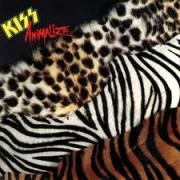 his year, 1984, was the first time that I saw Kiss live. Sadly I remember more about the opening band (Loudness) asking if New York was having a good time (and the fans screaming that we were in New Jersey). But I still have my booklet from the show and I do remember a few things from the show (again, sadly they were not in makeup). So this album holds a special place for me, even though in retrospect it’s not as good as Lick It Up.
“I’ve Had Enough (Into the Fire)” starts the album off with a bang—blistering solos from new guitarist Mark St. John. But, as with Lick It Up, the album for me is overshadowed by the (massive) single. “Heaven’s On Fire.” It’s such a lame little sing-along (and yes I do remember that song from 1984 show—Paul really milked it). But man it’s such a bad song. Musically, “Burn Bitch Burn” is interesting, but what were they thinking with those lyrics “I want to put my log in your fire place…burn bitch burn?” That’s a far cry from “I am the doctor of love.” “Get All You Can Take” is, to my knowledge, the first time Kiss has said the word fuck in a song (“What fucking difference does it make?” Is sung by the deeper response voices in the chorus. It’s a catchy song with an interesting riff. “Lonely is the Hunter” has a kind of 70s southern rock feel. It also seems to be calling back to some earlier songs in the style of singing—which only reminds you how much better the earlier song was. The band is relying a lot on call and response vocals on this album. And they’re okay but seem like a something of a crutch..
“Under the Gun” continues as another sort of generic fast rocker from this era. “Thrills in the Night” is one of my favorite songs on the disc–it sounds so much like Kiss of the 70s. And with Paul’s vocals and the guitars, this could have come off of his solo album. “While the City Sleeps” is a fairly uninspired Gene song. None of these songs are bad, really, they’re just not as exciting as they might be. “Murder in High Heels” has more of that 70s rock swagger that Gene likes to pull off. It’s just not always clear that the 70s swagger rock works well with the heaviness of other songs on the record, like the band wasn’t sure which direction to go in. So even though this disc is the one that brought me back to Kiss, it has some good songs, but it doesn’t really hold up all that well.
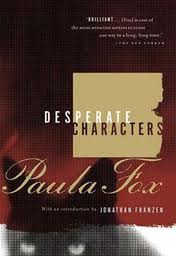
[READ: August 1, 2012] Desperate Characters
David Foster Wallace, Jonathan Franzen and Tom Bissell have all championed this book. Bissell was instrumental in getting it republished once it went out of print. Franzen wrote the introduction to the newly published version. David Foster Wallace blurbed the book: “A towering landmark of postwar Realism….A sustained work of prose so lucid and fine it seems less written than carved.” It was also on his syllabus. Zadie Smith has also written favorably about Fox’s fiction.
So why did it take me so long to read this book? (I read the original version, which is what the library had. I’m curious about Franzen’s introduction and will get to it eventually).
S. knows Paula Fox as a children’s author, which surprised me even more when I read the grittiness of this book.
It is submerged in downtrodden New York City of the late 60s, where people throw garbage out their windows, where racial tensions run high and where everything feels dirty. This powerful description late in the book sums up the attitude about the City:
They drove through miles of Queens, where factories, warehouses, and gas stations squeezed up against two-story, two-family houses so mean and shabby that, by contrast, the ranks of uniform and tidy tombstones rising from cemetery islets that thrust up among the dwellings seemed to offer a more humane future. Sidewalks, brutal slabs of cracked cement, ran for a block or two, then inexplicably petered out, and along the center of the tarmac streets, short lengths of old trolley tracks occasionally gleamed among the potholes. Here and there, the skeletons of a vast new apartment complex sat on the rent ground; tree roots and rocks and earth rolled up around its foundation. Cries of boredom and rage were scrawled across the walls of factories, and among these threats and imprecations, invitations and anatomy lessons, the face of an Alabama presidential candidate stared with sooty dead eyes from his campaign posters, claiming this territory as his own. His country, warned the poster – vote for him – pathology calling tenderly to pathology. [For those ignorant of history like me, that candidate was George Wallace. This was his third time running, this time as part of the American Independent Party].
But that’s just the descriptions. What is this story about? Simply, it is about Otto and Sophie Bentwood, a successful childless couple living in Brooklyn. Otto is a lawyer, and, Sophie is a successful translator (I liked that Sophie was employed and not “just” a housewife). But Sophie hasn’t felt up to translating lately and Otto’s successful practice hits a bump when long time partner Charley decides to leave to work on more important causes.
Otto is rather cut off emotionally–Charley has been his friend and partner for decades yet he can barely muster a proper goodbye when he steps out the door. And while Otto and Sophie are mostly happy, he has more or less pushed her into the arms of another man. She looks back on this brief affair with fondness. However, the fact that the affair is never suspected and the fact that it ended the way it did are just more indignities that Sophie has to suffer.
But what sets off the action in the story is an act of kindness. Sophie sees a cat that is hanging around the alley behind their brownstone. Amid the people throwing garbage out the window and hanging up sheets to act as curtains, Sophie decides to do a nice deed for this cat. She brings it some milk. It hungrily laps up the milk and when Sophie goes to pet it, it bites her really hard on the hand. And literally the rest of the story follows the swelling of her hand. (more…)
Read Full Post »
 SOUNDTRACK: “WEIRD AL” YANKOVIC-“Amish Paradise (single)1996).
 Al took some time off between Alalpalooza and Bad Hair Day and he roared back on the scene with “Amish Paradise,” a wonderful parody of Coolio’s “Gangsta’s Paradise.” There’s a funny saga about how Coolio didn’t appreciate the joke and Al (who always asks permission even if he doesn’t need to) was really upset because he thought he had the green light. For awhile there was an unpleasant scene between the two (not like they were in the same circle or anything) but when they finally patched things up Al admitted he could stop wearing a bulletproof vest.













 I Just Read About That...