SOUNDTRACK: THE FLAMING LIPS: AUSTIN CITY LIMITS FESTIVAL 2010 (on Palladia TV 2011).
It must be tough to take a festival like Austin City Limits and truncate it into 2 hours. It must also be tough to be a pretty much headling band like The Flaming Lips and to be playing in the middle of the day when your cool stage stuff is probably less impressive (but good for them for going all out!).
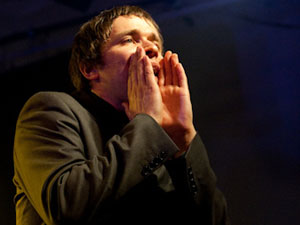
Some fun things to see during their set: the camera mounted on Wayne Coyne’s microphone (huge close-ups of his face); the guns that shoot streamers, Cliph the drummer makes the sample sound effects that you need to make during the songs, tons of back up dancers (who I believe are fans that won a contest or something), the amazing multi-instrumental skills of Steven Drozd.
This broadcast only showed two Lips songs (criminally underrepresented, but I understand). They played “I Can be a Frog” which is a wonderful audience participation song even if it’s nowhere near their best song.
And “She Don’t Use Jelly” which I understand as it was their hit and the crowd (and even the band) always seem into it, but that song is like twenty years old and they didn’t play any other bands’ old singles. I won’t complain to hear that song, but there are just so many good ones to choose from that it seems silly to play that one.
[READ: November 6, 2011] “The Mermaid of Legend and Art”
A while back I read a few old articles that I got from JSTOR, the online archiving resource. This month, I received some links to three new old articles that are available on JSTOR. So, since it’s the holiday weekend, I thought it would be fun to mention them now.
I wrote the review of this article before I realized that I had only read part 3 of 3. There were some clues (like the start mentioning “the first few lines of my opening chapter”), but since the link I was given went here, I assumed that the other chapters were not available (until I saw the tiny footnote that said this was continued from pg 172).
So, I’m including my original post at the bottom for history’s sake, but I’m going to write the revised review here.
I don’t quite understand why this article was broken up into three sections. This is especially egregious because of the figures included in the articles. They do not really correspond to the sections where they are written about. So, for instance he mentions Figure 13 on the last page of the article when we are already up to Figure 36 (and Figure 13 is fifty-some pages away). For most of the other figures, he always seems to be a few pages behind, as if they needed to put the pictures throughout the article rather than where they are mentioned–it was bad enough having it in three sections (in my print puts) but imagine having to flip back thirty some pages to see what the hell he’s talking about! Of course, this was 1880, they had more free time.
So, anyhow, the beginning of this article talks about the history of the mermaid in folk tales and the Bible. Evidently Brahma visited Menu (Aka Noah) in the guise of a fish–which is how he was able to build the ark. There is also a lengthy discussion about the importance of fish in the Old Testament. In addition to the whole IXTHUS thing, fish were a very useful form of currency. So it is nor surprise that they used representations of fish and sea creatures in ancient Rome and Greece. (more…)
Queensrÿche fulfilled the promise of their debut EP with this album. It takes the blueprint of the EP and expands it wonderfully. They introduce some cool low vocal chants to compliment Tate’s soaring alto (like on “En Force”), they also introduce some wonderful effects and riffs and scales (also on “En Force”).
There’s also some really great, odd “keyboard” bits thrown in as kind of sound effects or jarring moments (“Deliverance”). “Deliverance” also has great backing vocals, and I love the way the “Deliver Us” part of the song is quite different from the soaring of the rest of the vocals. The back and forth of “No Sanctuary” also showcases the bands skills very well.
The band even shows signs that they’re not sticking to standard heavy metal. On “N.M. 156” there’s some sci-fi chanting and the really cool section of the song in which Tate sings “Forgotten…Lost…Memories” and the “Lost” part is a completely unexpected note. They were taking chances from the beginning.
“The Lady Wore Black” is updated with the stunning “Take Hold of the Flame,” a slightly more progressive version of that first song. “Before the Storm” was the first song I heard from this album and it has always been my favorite on the record (this is one of those few albums where the better songs aren’t front loaded). “We watch the sun rise and hope it won’t be our last” (they were always happy guys).
“Child of Fire” opens with a wonderful riff and the compelling, “the souls that are damned by the pain that you bring send you higher.” The song settles down into a slow part and Tate growls “Damn you and the pain they must feel” and you can tell he means it (whatever else the song is about).
All this time I don’t think I ever realized that “Roads to Madness” was nine minutes long. It is definitely foreshadowing the kind of epic work they would do later. And it closes out the album in a cathartic blast. It’s wonderfully pure metal from the mid-80s.
[READ: October 20, 2011] Celebrations of Curious Characters
I had never heard of Ricky Jay before getting this book, but apparently he is a reasonably well know radio personality (on KCRW), he is also an actor on Deadwood, and he’s a magician. This book is a collection of his KCRW radio show broadcasts along with accompanying pictures from his vast collection of obscure ephemera.
There are forty-five entries in the book–each one is a page long (it’s an oversized book and they are two columns each). Each essay is Jay’s take on a particular subject or, as the title says, curious character. Jay is a collector of esoteric information, especially that related to magic and, for lack of a better word, freakish behavior. One of the most enjoyable parts of the book are the pictures that accompany each entry. The pictures come from Jay’s collection and each picture’s provenance is given in the back of the book. So we get pictures like “The little Count Boruwlaski, engraving by A. van Assed ([London]) Borowlaski [sic], 1788). or Lithograph of Chung Ling Soo (Birmingham: J. Upton, c. 1912) or Frontispiece portrait from George Devol, Forty Years a Gambler on the Mississippi (Cincinnati: Devol & Haines, 1887). Some of these photos you can see on his website. Or you can enjoy this picture of a chicken firing a gun that is not in the book (it comes from his site). (more…)
SOUNDTRACK: METRIC-Live at the 9:30 Club, June 18, 2009 (2009).
I love the new Metric album and this tour supported that disc, so, it’s a win-win for me! Metric sound great live, and the notes on the NPR page where I downloaded this give a fascinating history of the band. Evidently they burnt out in 2005 while touring for Live It Out. So they made solo records and kind of went their separate ways. Then:
in March 2008, Haines was on stage, in the middle of a live solo performance, when she had an epiphany: She was tired of being sad. While playing one of the standout cuts from her gloomy but beautiful album Knives Don’t Have Your Back, Haines stopped, turned to the audience and said, “I don’t want to play these songs anymore.” Instead, she spent the rest of the show performing her favorite Metric tunes.
The band reunited and made Fantasies, the poptastic album that I love so much.
This show plays pretty much all of the album (except “Collect Call” and “Blindness”) and they rock the house! The only odd part for me is the opening track, “Satellite Mind.” The band chose to have the first half of the song performed with just the keyboards, so it has no bottom end at all. It sounds kind of tinny and weird. Then when the guitars and bass kick in (for the rest of the show, thankfully), the band sounds whole again.
The other weird thing is Emily Haines’ banter. I like chatty lead singers (–The Swell Season’s banter is great, Wayne Coyne’s banter is emotional but enjoyable), but there’s something about Haines’ musing that are just kind of…lame. She’s very earnest, but her thoughts are kind of, well, vapid. So, I just skip past all the chatter and enjoy the music.
It’s a really great, rocking set and the crowd is very into it.
[READ: August 25, 2011] Atlas of Remote Islands
If you need an unusual but doubtlessly cool book, my brother-in-law Ben is your man. For my birthday and Christmases he often gets me books that I have never heard of but that are weird and interesting.
This book is no exception. As the subtitle states, this is a book about fifty remote islands that virtually no one lives on. True, some are inhabited, but many are not. And a goodly amount of them are little more than icebergs (I wonder how they will survive global warming). There’s even one that the accompanying story implies was created from bird droppings. (more…)
SOUNDTRACK: THE KOPECKY FAMILY BAND-Tiny Desk Concert #131 (June 6, 2011).
I’d never heard of The Kopecky Family Band, but the write-up about them was pretty interesting, so I decided to give the Tiny Desk concert a listen. The band (all 7 of them) play a great collective of music: two guitars (acoustic & electic) bass, cello, violin, drums and keyboard. They play a sort of traditional folk with a very full sound.
Indeed, they remind me an awful lot of The Head and the Heart (the singer’s voice in particular), although they are from different edges of the continent and have been playing music about as long as each other (indeed, The Kopecky Family Band released an EP in 2008 whereas Head and the Heart formed in 2009).
And the Kopecky website offers lots of free music (which is very cool).
“Howlin’ at the Moon” is a full acoustic sounding track. “Birds” has a simply gorgeous whistle/xylophone melody that is as beautiful as it is catchy. “Disaster” is a tender ballad with wonderful harmonies. And “Red Devil” is a somewhat more rocking song, which really helps to demonstrate the bands’ diversity.
And the band is charming. Keyboardist/singer Kelsey admits to having left a trinket of some kind of the office bookshelves (which are littered with things). It’s a wonderful set, and because of it, I downloaded the band’s first EP from their site.
[READ: June 5, 2011] Great Philosophers Who Failed at Love
Shaffer was signing books at BEA this year. My coworker told me that he was very funny and that he signed her book in an amusing way. He happened to be signing at the table next to the line I was on. Sadly, he finished before I was able to get to him. But I was pretty close to the beginning of the line, so I asked if I could grab a copy of his book, which I did (although no autograph for me).
This is a silly book of nonfiction. It looks at thirty-seven philosopher or thinkers and their utter failure at love. Each man (and occasional woman) has had some distinguishing characteristic that made them pretty lousy in the emotional range.
The title of the book is funny and is meant to be kind of surprising: these smart folks were terrible at love. Of course, spending a minute or two thinking about who these people were and what they did, it’s not surprising that they were lousy at love. These were intellectuals, people who spend most of their time in their own mind. Of course they couldn’t have a serious relationship.
Nevertheless, these stories are all more or less amusing (Louis Althusser accidentally strangled his wife to death(!) which isn’t amusing per se, but the story of it is, kind of). Shaffer does a great job at keeping each entry brief but really retaining the salient points of the thinker’s philosophy and a cogent example of his or her lousiness at love. He also throws in some amusingly snarky comments of his own as he goes along.
I was delighted that the book order was done alphabetically rather than chronologically. A chronological list would have been a little too samey in terms of each person’s context. The alphabetical list allows for jumping around from say Plato to Ayn Rand which keeps the stories interesting and fresh.
At the end of each person’s piece, there’s an “In His Own Words” which offers a quote that details his or her written philosophy regarding love.
Dare I say that this is an ideal bathroom book? It certainly is. And it makes you feel a little better about yourself (if you haven’t for instance, adopted your mistress as your daughter (Sartre)).
In March, I reviewed (and loved) Low’s new single, “Try to Sleep.” That song and two others are presented here in this Tiny Desk concert.
The band for this gig is just Alan Sparhawk on guitar and vocals and his wife Mimi Parker on backing vocals (and thigh slaps). It’s a very stripped down sound, but it really suits these songs (I don’t know the originals of the other two–“Nightingale” and “Something’s Turning Over”) which all come from their new album C’mon.
Their harmonies are wonderful (they are quite striking on “Something’s Turning Over” where I thought she was playing a keyboard, but it is her voice!) and the melodies are pretty terrific too. As I said last time, I’ve never really listened to Low very much (I’ve been sort of turned off at the idea of their being spare and depressing). Strangely, this session which is just the two of them is the opposite of spare. I don’t know if this is a good introduction to the band, but it’s a wonderful introduction to this album. And it’s a surprisingly catchy collection of songs from a bunch of ol’ mopesters.
Although, perhaps the biggest surprise comes at the end of the show when, before leaving, Sparhawk starts playing “Sweet Home Alabama” and Parker even gets the “turn it up” part right.
I wasn’t expecting to listen to this more than once or twice, but I’m really entranced by this session.
[READ: May 10, 2011] Emily of New Moon
Sarah loves the Anne of Green Gables and Emily of New Moon book series. She still has the books from when she was a kid (the copy I read has her signature and phone number (several area code changes ago) written on the inside front cover). After reading the L.M. Montgomery biography, I figured it was time to look into these books. I was going to start with Anne, but we watched the movie not too long ago so I decided that I’d start fresh with an unknown subject.
Emily is a 12-year-old girl whose mother has died and whose father is deathly ill. Indeed, within a chapter or two, Emily finds herself an orphan. I don’t know a thing about 100 year old adoption laws in Canada, but the upshot is that someone from Emily’ mother’s family, the Murrays, will take care of her until she is old enough to do so on her own. However Emily’s mother ran off with a boy when she was very young (which was a disgrace to the family name), and Emily herself is a willful and strong child. Frankly, no one wants her. So, with Emily eavesdropping, the Murray clan discusses her future and decides to make her draw straws for her fate. (more…)
SOUNDTRACK: KANYE WEST-My Beautiful Dark Twisted Fantasy (2010).
Before buying this album I really only knew of Kanye West as a loudmouthed guy who tweeted a lot and told off George Bush. But then everyone was raving about this album (Pitchfork gave it a 10 out of 10!). So I decided to check it out. And I can’t get over how great an album it is.
Now I’m going to start this review by mentioning a few things I dislike about rap as a genre. 1) I dislike all of the “guests” that appear on a record–I bought the album because for you, not your friends. 2) I dislike excessive use of “unh” and “yeah” at the beginning of a track; when you have nothing to say–let the backing music flow, save your voice for actual words. 3) Rap is still terribly misogynist and vulgar–I’ve nothing against vulgarity per se (I do have something against misogyny) but excessive use is lazy, and it stands out much more in a rap song since you’re saying the words not singing them.
The Kanye West album is guilty of all three of these things, and yet I still think it’s fantastic. The first reason is because it goes beyond a lot of rap by introducing real musical content into the songs. This is not an “all rap is just a beatbox” dismissal of rap, it’s an observation that rap tends to be more about the lyrics and the musical accompaniment can get kind of lazy. West’s songs have (beautiful) choruses, strings, and samples that augment the rest of the song, as opposed to samples that ARE the song. And Kanye West’s voice is great. His delivery is weird and twisted, a little cocky but more funny, with a twisted attitude that is really cool–and to my rather limited palate of rappers, it’s original.
The opening of the disc “Dark Fantasy” has a chorus singing “Can we get much higher” which is catchy and cool (and is used in the promo for The Hangover 2). The switch from this opening to the rapping works well (aside from the FOUR “yea”s). Although I don’t love the yeahs, I love his delivery, and that he occasionally ends lines with these weird “hunh” sounds, that are wonderfully emphatic.
The guests start showing up on track 2, but even the guests can’t detract from the excellent guitars of the song (and the cool solo). And I’ll say about the guests that I like some of them, but for the most part I’d rather hear Kanye.
“Power” samples King Crimson’s, “21st Century Schizoid Man”; anyone who samples King Crimson is alright with me. But to use it so perfectly, to make it part of your song is real genius. It works musically as well as within the overall concept of the album.
“All of the Lights” (with the pretty piano intro) features scads of guests including John Legend, The-Dream, Elly Jackson, Alicia Keys, Fergie, Kid Cudi, Elton John (!), and Rihanna. I can hear some of these people but not Elton John (why would he agree to be on a track where you can’t even hear him?). It is a beautiful pop track nevertheless.
“Monster” is a monster of tracks with yet more guests (I like that some of these guests break with the typical guest, like Bon Iver (!)). And I really like Nicki Minaj’s verse. [I’m not familiar with her work at all (in fact I keep wanting to say Minja instead of Minaj) but her verse with the wonderfully crazy vocal styling she displays is weird and cool and very powerful–I would like to check out her solo album, but the samples I heard weren’t that interesting]. It also has a great repeated chorus of being a “motherfucking monster.”
It’s followed by the even more catchy “So Appalled” (with FIVE guest rappers–some of whom I’ve never heard of but who do a good job. I love Cyhi da Prince’s lyrics: “I am so outrageous, I wear my pride on my sleeve like a bracelet, if God had an iPod, I’d be on his playlist” or “So call my lady Rosa Parks/I am nothing like them niggas baby those are marks/I met this girl on Valentine’s Day/fucked her in May/she found out about April so she chose to March” or this line, “y’all just some major haters and some math minors.”
“Devil in a New Dress” opens with a bunch of “unhs” (which I dislike) but this is nice ballad in the midst of all of the noise (and it has some clever lyrics). It morphs right into “Runaway” one of the more audacious singles I can think of. The piano melody is so simple (a single note to start) and the lyrics show Kanye as a loser in relationships. It’s a surprisingly thoughtful song for a song with a chorus that goes: “Lets have a toast for the douchebags, let’s have a toast for the asshole; a toast for the scumbags every one of them that I know. You been putting up with my shit for way too long…runaway fast as you can.” It gets even more audacious when you realize the last 4 minutes of the song are a solo with distorted voice. And the video…the video is 35 minutes long!
The sentiment of that song is erased by the next one, “Hell of a Life”. It opens with a great distorted guitar riff and lyrics about sex with a porn star. “Blame Game” is a surprisingly honest song about being nasty to your girlfriend (“I’d rather argue with you than be with someone else”). It features a sample of Aphex Twin’s (!) “Avril 14th”. And it’s quite a sad but lovely track. It ends with a very long skit by Chris Rock. I like Chris Rock, but this dialogue is kind of creepy because the woman who Rock is talking to (about the great sex she gave him) seems to be a robotic sample–why not have an actual woman talk to him?
The final track, “Lost in the World” has a lengthy intro by an auto-tuned Bon Iver. It’s one of my favorite tracks on the disc, especially the end, where the processed vocals get even weirder but accent the beat wonderfully. This track morphs into what is the actual final track, “Who Will Survive in America” which is basically a long recitation from Gil-Scot Heron. It works great as an album closer.
So, despite several things I don’t like about the disc, overall, it’s really an amazing release. And I can overlook the few things I dislike because the rest is so solid. I can’t decide if it’s worth looking for his earlier releases. How can they live up to this one?
[READ: May 6, 2011] McSweeney’s #37
This is the first McSweeney’s book where I’ve had to complain about the binding. The glue peeled off pretty quickly from the center cover. Fortunately, the back cover held up well. I’m guessing it’s because there’s an extra book tucked into the front cover which prevents the book from closing nicely when it’s removed.
But aside from that, the design of the cover is very cool. It is meant to look like a book (duh), but actually like a 3-D book, so the bottom right and top left corners are cut on diagonals (this makes for a very disconcerting-looking book inside–with triangles cut across the top). The artwork inside is also cool. In keeping with this appearance, each two page spread looks like a book with a spine drawing in the gutter of the pages). And the bottom of each page has lines making it look like the bottom of a book. (The illustrated margins are by SOPHIA CARA FRYDMAN and HENRY JAMES and there are interior paintings by JONATHAN RUNCIO).
The front matter is wonderful. Although it gives the usual publishing information, the bulk of this small print section is devoted to counteracting all the claims that the book is dead. It offers plenty of statistics to show that not only are the public reading, they are reading more than ever. The introduction also goes a long way towards arguing against the idea that people are reading less now than in the past. When was this “golden age” of readers? There’s also the wonderfully encouraging news that 98% of American are considered literate.
SOUNDTRACK: PETER BJORN AND JOHN-SXSW May 26, 2009 (2009).
This brief set at SXSW (available from NPR & KEXP) showcases the band’s (then) new record Living Thing. The album was just about to be released, so these are all previews of the album (“New music is the best music”). The album itself is very sparse and these live songs are equally sparse, but are slightly different in construction (some songs have different instrumentation live than on record).
The crowd is very responsive, and the band is really funny. During “Just the Past” there’s a section where the song sounds like it ends, but it is just a pause, and the band tsk tsks the audience for applauding too early. There’s also a joke about John being Joaquin Phoenix and taking up a career in rap.
It’s a wonderfully lively set, even if it is a bit short (the gripe with almost every SXSW download). It’s a good introduction to the album and a great introduction to a band who has been around for ten years and just started making inroads into American consciousness a few years ago.
[READ: April 16, 2011] Five Dials #1
Five Dials is an online magazine. It is free to subscribe (and to download). All previous issues are available on the site in PDF format. I learned about it because they printed the eulogies for David Foster Wallace in Issue 10. But the magazine looked interesting in itself, so I decided to go back and read the whole run (the most recent issue is #18).
The only real complaint I have with the magazine is that they don’t put a publication date anywhere on it. Which is a shame if you’re anal retentive like me. According to Wikipedia, the inaugural issue came out in June of 2008. It’s a monthly (ish) publication and, although I originally thought it would be a literary magazine, it proves to be very much of a magazine-magazine. And a good one at that.
There’s a letter from the editor, there’s Current-ish Events, there’s essays, reviews and even fiction. There’s also a “classic” letter from a “classic” author. The magazine also has some very cool black and white art in it. The style is very crisp and one that I find quite agreeable. (more…)
SOUNDTRACK: DAVID FRANCEY AND MIKE FORD-Seaway (2009).
Mike Ford introduced me to Louis Riel on his album Canada Needs You, Volume One. The song “Louis & Gabriel” features the lyrics “Oh, Louis Reil, here comes your friend Gabriel” outrageously simplistic (it is for kids after all) but so incredibly catchy it’s in my head whenever I see this book. This is Ford’s most recent album, a collection of songs by himself and David Francey–who I didn’t know before this disc.
Seaway is a collection of 16 songs which are in one way or another about the sea. Two of the songs appear on Ford’s release Satellite Hotstove, but the rest are new. I don’t know if Francey’s songs are new or not. I’m also unclear from the credits if Ford and Francey worked on these songs together (the notes suggest they did) or if they were recorded separately and then compiled.
The songs are primarily folk–simple acoustic numbers, often solo guitar, but sometimes with accompaniment. Mike Ford has a great, strong voice, and is capable of some interesting stylistic changes. His songs are more vibrant on this disc. Francey has a wonderful, almost whispered voice. He has a gentle Scottish accent which is great for his storytelling songs. Mostly he speak-sings, but on some tracks, like “The Unloading” he sings a full-bodied chorus.
But it’s Ford’s song that bring a lot of variety to the disc. “There’s No Rush” has a sort of calypso feel to it and “When You’re the Skip” has a wonderfully dramatic sea-shanty/musical feel to it. And “21st Century Great Lake Navigators” is a rap–Ford frequently raps a song on his various albums. His voice is very well suited to it, and his rhymes are clever and often funny.
This is a charming disc. I wouldn’t say it’s essential, but it’s a good introduction to both singers, and, of course .
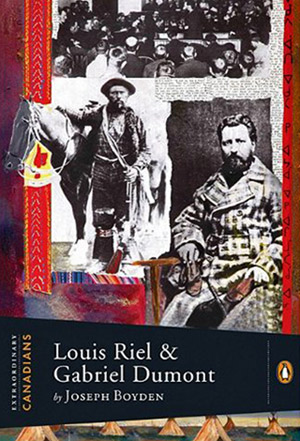
[READ: January 26, 2010] Louis Riel & Gabriel Dumont
Of the six Extraordinary Canadians books, I was least excited to read this one. I’m not sure why, but I wound up leaving it for last. But lo and behold it was easily the most engaging and, dare I say, exciting story of the six. I’m sure part of that is because I didn’t know the outcome (even if Gabriel was somewhat famous in the U.S., I still didn’t know what had happened to him or to Louis). And by the end of the book, I absolutely couldn’t put it down.
Joseph Boyden is a Métis writer (who I’ve never read before). It’s obvious from the get-go that he is sympathetic to Riel and Dumont (which is to be expected in a biography, I would think). He gets a tad heavy-handed about John A. Macdonald, but it seems justified. For really you can pretty much take only one of two points of view about Riel and Dumont: they are either rebel heroes, standing up for the oppressed Métis, or they are traitors, intent upon destroying Canada’s expansion.
Now, I admit that I don’t know much about Canada’s expansion. The first prime minister, John A. Macdonald, was instrumental in Canadian Confederation and was the driving proponent for the completion of the Canadian Pacific Railway. But as with American westward expansion, Native cultures are in the way of this expansion. (more…)
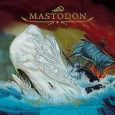
This is the CD that started it all. Well, for me and Moby Dick- related music, anyhow. My friend Andrew asked if I would be reviewing it along with Moby Dick. And, yes I am.
Leviathan is sort of a concept album about Moby Dick. I say sort of because it’s not entirely about Moby Dick. The opener, “Blood and Thunder” features the chorus: “White Whale. Holy Grail. And it also features lyrics that seem to come straight from the book: “break your backs and crack your oars, men.” There’s also the tracks “I am Ahab” and “Seabeast,” the latter features the lyrics: “Dear Mr Queequeg you have been informed your life’s been saved”
And yet, not everything is about Melville’s saga: “Island” bears no resemblance that I can see and the final track, a slow instrumental is called Joseph Merrick (who was the elephant man).
Musically the disc runs from bludgeoning metal (“Island”) to complex and intricate bludgeoning metal (“Iron Tusk,” which features a stereophonic drum solo opening). “Blood and Thunder” has some great catchy riffs with some vocals that demand a lyric sheet for clarity. “I am Ahab” features some extended vocal notes! But there’s more to it than that. “Seabeast” has a great slow intro guitar solo and features a two different vocalists to very good effect.
And the whole disc is chock full of time changes, crazy drum fills (how can he play so many different drums so quickly?). “Megalodon” has a great odd guitar riff in the middle break section (and has nothing to do with Moby Dick at all).
As you near the middle of the album you get a couple of amazingly complex tracks. “Naked Burn” features a great melodic middle section (coupled with really catchy vocals, too). And the highlight is the thirteen plus minute “Hearts Alive.” It begins as a very pretty acoustic guitar piece. After about two minutes the heavy guitars kick in and there’s several different middle sections with varying degrees of melody. By the midway point we’ve heard a few more very beautiful picked guitar sections, until it ends with some strong heavy guitar chords that slowly fade away.
So it’s a super heavy progressive rock/speed metal concept album for people who don’t like real concept albums (but who like their metal literate). Who would have guessed it would have made so many best of the year lists?
[READ: Week of June 28, 2010] Moby-Dick [Chapters 111-End]
The end is here and BOY did I not see that coming. I honestly had no idea how the book ended (how is it I knew the basics of the story but didn’t know the ending? Talk about everyone agreeing to the spoiler alert!). The other thing that surprised me was how damned exciting those last 70 pages were. Now it could be a simple build up from the slowly paced early chapters–we were all lulled by the waves and the diversions–but man, when Melville wanted to, he produced the goods. If you want young people to read this book, just assign them the last 70 pages. I realize that all the art and such will be lost, but if they read just the end parts, they’ll come away with a much better perception of the book, and maybe they’ll want to read the rest later. [I’m not a fan of abridged things of course, so I’d want them to read the original full text, just the end of it].
And I absolutely cannot believe [spoiler alert–okay the whole post is a spoiler, even if I didn’t know, the book is over 150 years old, so chances are you may have heard…] (more…)
SOUNDTRACK: THE DECEMBERISTS-“The Mariner’s Revenge Song” (2005).
This was the hardest week for music tied to Moby-Dick. (I’m saving Mastodon for the grand finale). I don’t really have anything that relates directly to the book. I have a number of nautical-themed songs, but very little in the way of albums. And, it’s true that this song doesn’t have anything to do with Moby-Dick directly.
However, it’s a 9 minute song about a mariner getting swallowed by a whale just for revenge. So, it’s sort of related.
The Decemberists are one of your more nautical bands (and I’ve reviewed all of the albums here somewhere). Their first album, Castaways and Cutouts featured an album cover with a ship with ghosts drifting from it.
This song has an accordion fueled shanty feel as we follow the tale of a young lad who seeks revenge on the rake who used and abused his mother and left her a poor consumptive wretch. After fifteen years, he finally hears tale of the rake–he’s now a captain at sea.
So the lad hires on with a privateer and hunts down the captain’s ship. As he is about to fire muskets upon him, a giant whale crashes on their ships, swallowing the two men whole (tell me, Ishmael, what kind of whale might do that?).
And it’s from inside the whale the we hear this tale. The lad’s mother’s dying words echoing among the ribs of the beast:
“Find him, bind him
Tie him to a pole and break
His fingers to splinters
Drag him to a hole until he
Wakes up naked
Clawing at the ceiling
Of his grave
*sigh*”
And it’s catchy as all heck, too!
[READ: Week of June 21, 2010] Moby-Dick [Chapters 87-110 ]
Pirates! I didn’t expect pirates in the book. Week 5 opens with Ishmael discussing pirates in the low shaded coves of Sumatra. Ahab intends to sail right through those piratical waters to get to Java because sperm whales are known to frequent the area. And indeed they do. A whole fleet of sperm whales is seen but at about the same time, the pirates come out and give chase. My notes in the margins are a little diagram of a fleet of whales with an arrow and then a tiny Pequod and another arrow and then a jolly roger.
The Pequod easily outruns the pirates and still manages to keep the whales in sight. So, they jump into the fray and start harpooning away. However, as the saying goes, “The more whales the less fish” (389). (more…)
 SOUNDTRACK: THE FLAMING LIPS: AUSTIN CITY LIMITS FESTIVAL 2010 (on Palladia TV 2011).
 It must be tough to take a festival like Austin City Limits and truncate it into 2 hours. It must also be tough to be a pretty much headling band like The Flaming Lips and to be playing in the middle of the day when your cool stage stuff is probably less impressive (but good for them for going all out!).













 SOUNDTRACK: MASTODON-Leviathan (2004).
 This is the CD that started it all. Well, for me and Moby Dick- related music, anyhow. My friend Andrew asked if I would be reviewing it along with Moby Dick. And, yes I am.
 SOUNDTRACK: THE DECEMBERISTS-“The Mariner’s Revenge Song” (2005).
 This was the hardest week for music tied to Moby-Dick. (I’m saving Mastodon for the grand finale). I don’t really have anything that relates directly to the book. I have a number of nautical-themed songs, but very little in the way of albums. And, it’s true that this song doesn’t have anything to do with Moby-Dick directly.
 The Decemberists are one of your more nautical bands (and I’ve reviewed all of the albums here somewhere). Their first album, Castaways and Cutouts featured an album cover with a ship with ghosts drifting from it.
 I Just Read About That...