 SOUNDTRACK: ‘TIS THE SEASON: Praise and Worship Christmas: A Collection of Inspirational Holiday Classics (2001).
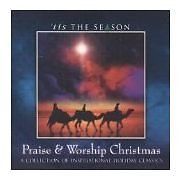 This Christmas Collection came from Sarah. As you can tell from the title and subtitle and sub-subtitle, this is a religious disc. And as you can tell from the title and subtitles, they have gone way over the top.
The group consists of a bunch of performers and a choir from something called The Evergreen Community Church/The Rock. Presumably not the actor The Rock, although that would be pretty cool.
As with a lot of contempo-Christian music, they’ve decided to add a rock flair to it. So these are 13 songs sung very passionately and with little restraint. Because if you can have an echo pedal, you should use it. And for some reason, nothing says Christmas like alto saxophone.
“O Come All Ye Faithful” features that sax prominently. Up next, I was pretty surprised to hear a rocking harmonica solo on “Joy to the World.” For the most part the folkiness was okay until the choir at the end.
“Do You Hear What I Hear” has a solid drum machine and an excess of R&B vocals. Up next, the music for “What Child is This?” is understated and pleasant. Shame that the singer is shooting for the rafters. Their version of “Go Tell It On the Mountain” is not gospel-tinged and, stranger yet, they changes the stress of the chorus to the “ow” of mountain.
“Angels We Have Heard on High” brings that saxophone back and back and back. “O, Little Town of Bethlehem” has a quiet piano motif, but once again, it is oversung.
“We Wish You A Merry Christmas” makes excessive use of that echo pedal on the vocals. “Hark! The Herald Angels Sing” was pretty good. No complaints.
But try to imagine just how over the top and ponderous you could make an a capella (plus echo) version of “O Come, O Come Emmanuel.”
“Silent Night” loses all of its power in this folkie rendition. I’m noticing the fretless bass and cheesey sax rather that the echoed vocals. Amazingly, “Amazing Grace” is understated musically with just an acoustic guitar but the singer overcompensates.
The disc ends on a high note (not literally). On “Joy to the World” the folkie harmonica and guitar work nicely.
[READ: December 22, 2017] “The Christmas Banquet”
Once again, I have ordered The Short Story Advent Calendar. This year, there are brief interviews with each author posted on the date of their story.
Hello. Welcome. It’s finally here: Short Story Advent Calendar time.
If you’re reading along at home, now’s the time to start cracking those seals, one by one, and discover some truly brilliant writing inside. Then check back here each morning for an exclusive interview with the author of that day’s story.
(Want to join in? It’s not too late. Order your copy here.)
This year I’m pairing each story with a holiday disc from our personal collection.
I haven’t read much Nathaniel Hawthorne and this story makes me not want to read much more. This is the kind of story that is really trying to make a point. It’s really unsubtle about a lot of what it’s doing and yet when it came down to it I feel like I missed the entire point.
This story has an opening bookend with Roderick sitting with friends and reading a manuscript that he wrote. It’s a strange opening because he begins to describe a man. Rosina listening, comments, “I believe I have a glimmering idea of what you mean.” I have to wonder, how hard can it be to describe a person?
Anyhow, in his story a man has died and in his will, he has decreed that ever year a Christmas banquet will be held and the guests of honor will be ten of the most miserable persons in Christendom. But, he does not want to make them happy, no, he wants them all to be at a banquet where they can feed off of each others’ misery. There was a wreath of cypress, a crown for the wofulest.
The majority of the guests, as is the custom with people thoroughly and profoundly sick at heart, were anxious to make their own woes the theme of discussion, and prove themselves most excellent in anguish.
Some of the guests include a man with ulcers on his heart, a misanthropist, a woman full of melancholy. The meal appears to contain tureen of viper soup, fricassee of scorpion and apples of Sodom for dessert.
Amid these wretches comes a young stranger Gervayse Hastings, who looked mystified and bewildered. The others felt he was in no way as wretched as the others. They called him, traitor and imposter. But they were assured by the attendants that he was there for a good reason.
Indeed, he came back the next year. The other diners were there for being guilty of possibly murdering someone, a woman whose baby died while she was away who lives in fear that her baby has been buried alive. There’s a married couple who hate the sight of each other. A fat man who desired melancholy for any laughter might kill him. They were all aggravated at the sight of Gervayse Hastings.
At each successive feast for decades Gervayse Hastings made an appearance even though the other guests were different.
I wish I had a glimmering of what Gervayse Hastings was going through. It sounds like he cannot feel anything, that he is devoid of happiness or sadness and is just numb. It is written stiffly and with serious challenge to read, either because it was written in 1846 or because it was genuinely hard for Hawthorne to express such a thing. Either way the story is more of a challenge to read than either an enjoyable story or even a morality play.

 I Just Read About That...
Leave a comment