Feeds:
Posts
Comments

Archive for March, 2017

2010 SOUNDTRACK: ANTIBALAS-Tiny Desk Concert #243 (October 4, 2012).

antibAntibalas (Spanish for “bulletproof”) is a Brooklyn ensemble.  Eleven members turned up for the Tiny Desk.  And they are quite the ensemble.  There are trumpets, saxophones, two guitars, a bass and a ton of percussion.  There’s a percussionist/keyboardist wearing a lucha libre mask (!) and the lead singer (singing in English and some other language) has what looks like tribal paint on his face. (He also plays conga and cowbell).

The blurb states:

There just aren’t many bands like Antibalas. These are jazz players making dance music: Their music is big and fun, and their guiding spirit is Fela Kuti, the brilliant big-band leader and Nigerian Afrobeat pioneer. Afrobeat is a musical style featuring nearly endless songs, mixing funk and jazz, grooves and riffs, with the rhythm carried by not only the drums, but everyone. Everyone — horn players, bass players, guitarists — plays rhythm in Afrobeat music.

It’s one thing for a big group to make a big sound — and, sure, Antibalas does that — but what stands out is the subtlety of this ensemble; the way the horns weave in and out of each other, sometimes complementing and at other times inspiring and creating musical conversation between players. That extends to all the players, from vocals to guitar. When you start to listen to that conversation and you hear that build in a rhythm, it’s so powerful, so full of joy. If they come to your town, drop what you’re doing and go see them. Wear dancing shoes.

They play two songs, but they are long and full of rhythm.  “Dirty Money” runs just under 6 minutes. I really like the way the horns seems to echo and answer each other during the slow sections.  While the whole band sings the backing voices.  And when the masked guy switches from percussion to keyboards, it’s got a  groovy 70s sound coming out of that machine.   All of it is anchored by the bass, keeping a steady rhythm.  One of the trumpeters switches to trombone for a solo as well.

“Him Belly Go No Sweet” has an even funkier feel–lots of percussion and staccato horns slowly working with each other to create a big sound.  Even though there’s plenty if music in this song it’s impressive how much they use silences—things are never quiet (there’s always a bass line or percussion) but for such a big outfit they can really get things to quiet own.  The end half of the song sees the band singing “go up  go down” while the lead singer seems to improvise a whole bunch of stuff.

It is, indeed, hard not to dance to this.

[READ: July 10, 2016] “Baptizing the Gun”

This was a very dark story and, if nothing else, it made me never want to go to Lagos, Nigeria.

The story is told in first person by a priest.  He is not wearing his collar and is driving a borrowed VW Beetle through the traffic of Lagos.

As the story opens, a woman is screaming because a thief just pulled an earring out of her ear–tearing her earlobe. He is caught and, astonishingly, “ringed with tires, doused in petrol, and set ablaze.”  Even though there is barely any fuel to be had “there’s always enough for the thief.”

The priest believes his trip was a success and many parishes have promised his parish in the Niger Delta money and materials.

But on his way back (at 18:03) the car dies in traffic. (more…)

Read Full Post »

15 SOUNDTRACK: SPIRIT FAMILY REUNION-Tiny Desk Concert #244  (October 8, 2012).

sruI first heard Spirit Family Reunion when NPR covered their show at Newport Folk Festival in 2012 (a few months before they played the Tiny Desk).  I really enjoyed their set which was vibrant and fun.  And clearly Bob Boilen did too.

Spirit Family Reunion was my favorite find at this year’s Newport Folk Festival. The group makes music I’d call “new old-timey,” but which its members call “open-door gospel” — gospel music that’s not tied to any particular religious denomination.

There are 6 0f them plating–an upright bass, banjo, guitar, fiddle washboard (!) and drums.  And they play three songs.

“Leave Your Troubles At The Gate” opens largely a capella and then just takes off with some wild fiddling and fast strumming from everyone else.  For this song, the guitarist sings lead and the fiddler sings a higher pitched backing vocal—his voice is powerful and at an unexpected pitch.   They finish up and he says, “first song of the day… that’s a way to wake up.”

For the second song, “Green Rocky Road,” the violinist sings this one.  It changes the tone of the band since his voice is so different—strained and intense sounding.  When the song ends, he says, I hope you like singing….  we need help on this one.”

Throughout “I’ll Find A Way” he tries to encourage everyone to sing along (it’s hard to hear if they do): “Its fun, don’t be bashful.”   It is a simple song with an easy to repeat refrain.  And it is indeed uplifting: “When we’re singing together we’re shining a light on the dark places between us.”

[READ: July 10, 2016] “Foster”

This is a story set in Ireland.  It’s about young girl whose Ma is about to have another baby.  The girl is being shipped out to a friend for the summer so that her mom and dad can have the baby in peace.

The story is about the girl, but it is also about the couple who have fostered her.  They are much better off than the girl’s family–a far more successful farm with a much nicer house.  But something about them seems a little off to the girl.

I enjoyed the story although I was unclear when it was set.  The setting is quite rural, and there is talk of an outhouse and a chamber pot.  But there is also a television and plastic washing up on the shore, so it’s not as old as I thought. (more…)

Read Full Post »

nySOUNDTRACK: TAKEN BY TREES-Tiny Desk Concert #253   (November 29, 2012).

treesTaken By Trees plays only 2 songs, and it’s one of the shortest Tiny Desk Concerts I can think of (it’s not even 7 minutes long).  I clearly have gotten Taken By Trees confused with a number of bands with similarly constructed names (band with By and The in the title), for I had no idea what this band sounded like.

They are a four-piece with a lead singer, Victoria Bergsman, who sings in such an understated way that it’s almost melodic speaking.

“I Want You” has a reggae feel to it—the quick guitar chords and slow bouncy bass, but with Bergsman’s delivery the song couldn’t sound less reggae.

“Only You” is a bit more uptempo.  It was in this song that I noticed Bergsman’s accent (she and the band are from Sweden).  The set up of this song is similar to the previous one–a deep bass running through under high guitar chords.  It doesn’t sound reggae this time, but it sounds very delicate.

This was a gentle concert, which I enjoyed, although I don’t know that I’d ever want to see them live.

[READ: July 14, 2016] ”La Vita Nuova”

I enjoyed the fragmentary way that this story was constructed.  The story begins on the day that Amanda’s fiance left her.

Her parents were upset and angry.  Her friends said that he was no good.

She walked home, took out her wedding dress and brought it to work where she had all of the children at her school “decorate it.”  The school didn’t appreciate this gesture: “your personal life is not an appropriate art project for first grade.”

Then she lost her job at the school and later that year her ex-fiance married someone else (as her friend said he would). (more…)

Read Full Post »

2014_11_10SOUNDTRACK: LORD HURON-Tiny Desk Concert #247 (October 25, 2012).

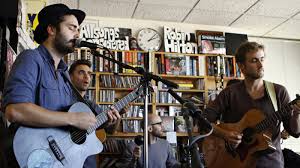
lordhironLord Huron is one of those bands that I hear of a lot, but whom I don’t really know much about. I also think they are someone I like, but listening to this Tiny Desk Concert, it’s clear they are not any of the bands I think they are.

As far as this Tiny Desk Concert goes, Lord Huron proves t be a five piece folk outfit.  They have lovely harmonies

“She Lit A Fire” is a pretty standard folk song.  Although I like the way the song shifts gears to a faster guitar style.  I really like the way the one guy’s guitar sounds like mandolin, too.  “Time To Run” is a bit faster and catchier.  In fact, when the oh oh oh oh part comes in, it’s hard not to want to sing along.  And the middle part where it’s just guitar and bongos is pretty hard not to enjoy.

“Lonesome Dreams” opens with some echoed bass notes. It’s got some really catchy parts although I don’t really love the yodeling voice that he puts on.  The band does four songs (practically unheard of).  “Ends of the Earth” opens with that same yodeling voice, but once the harmonies kick in it sounds great.

I didn’t realize that Lord Huron had only released their first album in 2012.  They have really made a name for themselves.

[READ: July 20, 2016] “Primum Non Nocere”

I enjoyed this whole story except for the very end which seemed to turn the story into something else.  In retrospect that something else is also pretty interesting and it throws a whole new light on the story, but I enjoyed the story so much as it was that the twist really impacted the way I enjoyed the rest of the story.

The title translates as “first, do no harm” and the story is about a youngish girl and her mother–who is a psychotherapist. 

I loved the way the story began.  Jewel is totally embarrassed that her mother asks her patients if they are “Cell phoning.”  She says it all the time.  How lame.  Until she realizes that her mom is actually asking if they are “self-harming.”

Her mother was brutally honest about a lot of things and was, of course, right about everything.  One thing that her mother always said was “that no one ever gets beyond high school. It’s all high school for the rest of your life.” Not true, Jewel knew, yet also true.

Her patients loved her for that unconventional understanding. She stood up for them; she visited their homes and talked to their problematic relatives, went to the store with them, walked them along the river, allowed them to bring their pets to their therapy sessions. She came to her children’s defense, too, with teachers or friends or the parents of those friends. She was brutally honest, blunt.

(more…)

Read Full Post »

booksSOUNDTRACK: YO LA TENGO-Tiny Desk Concert #271 (April 15, 2013).

y-o-la-tenI’ve enjoyed Yo La Tengo’s music for years and years.  I have many of their records, although I’d never consider them a favorite band. They’re just a reliable band I like.   This Tiny Desk Concert sees the venerable band in acoustic format (with no drums!).  Ira Kaplan sings and plays guitar, drummer Georgia Hubley sings backup and bassist James McNew plays an acoustic 12-string guitar.

Yo La Tengo has a lot of diversity in their records.  And even here, their songs sound quite different.  I had never before considered that on “Is That Enough” Kaplan sounds like someone out of A Mighty Wind (Harry Shearer perhaps?)  I also never considered how much they sound like The Velvet Underground (which I guess others have, but I especially noticed when Hurley sings her slow song).  McNew also adds some lovely high-pitched harmony vocals (compared to Georgia’s deeper harmonies).

After the first song, Kaplan says, “You in the back will never hear this one”  They start “Tears Are In Your Eyes” from their 2000 album (and I can’t help but hing that McNew’s 12 sting is out of tune).  Georgia sings and sounds incredibly like Nico on this song.

It’s strange how Ira keeps whispering to Georgia (you can kind of hear him) throughout the song–the microphone is really sensitive.

“Ohm” is one of my favorite songs from their album Fade. Its simple, but with some great harmonies and I love the way the song–which is fairly straightforward–goes up an octave during the “say goodnight “ part.  That little melody shift really makes this song wonderful.  And it sounds terrific here.   I also love how the end is a repeating of the same chord and chanting vocals while Ira plays a wild (but acoustic) guitar solo.

I’ve never really considered seeing Yo La Tengo live (they tour all the time), but maybe I should.

[READ: January 23, 2017] “Don’t Be Evil”

Before Simon Rich started writing longer pieces for the New Yorker, his Shouts & Murmurs pieces were usually pretty short–and he crammed a lot of funny into that short space.

This piece is all about Google.  It’s kind of one-note, but it’s still pretty funny.  And its brevity prevents it from wearing out its welcome.

So it begins with him saying how much he loves the Google Dictionary feature.  It’s really convenient, but sometimes the results can be strange.  Then he gives some examples: (more…)

Read Full Post »

[ATTENDED: March 4, 2017] The Flaming Lips

I saw The Flaming Lips back in 2015 and I was thrilled at how much bigger their show had become since 2000 when I saw them the first time.  When I saw they were touring again for their new album and were playing The Fillmore, I knew that I had to see them again, and this time I needed Sarah to experience the show with me.  She doesn’t know their music very well (she liked a couple of songs and actively disliked a number of them (mostly their noisy covers)–but I knew they wouldn’t play those).  I couldn’t stop talking about that previous show, so I think her expectations were pretty high.  And she told me they did not disappoint.

Having clipping. as the opening band was unusual because if there was ever a show I couldn’t imagine Sarah at it would be a loud, screechy vulgar hip hop band.  But it served as a palate cleanser for The Flaming Lips.

I noticed that they added even more stuff to the previous set, but it was weird that they have all of this great stuff on stage, but then they tend to obscure it as well.  Between the lights in front of the stage (how weird to see all those lights dangling in front of the performers) and the fog machines, sometimes you couldn’t even see the cool stuff going on.  But it was all part of the sensory overload of the show.

Before the show started, Wayne and some of the other guys came out and checked some things. Its was funny to see Wayne walk out on stage and wave to us.  He even shot some hand-held confetti cannons at us.  But then they went back stage and it took another fifteen or so minutes for them to start.

In front of the stage were all of the strands hanging down.  It was impossible to know what they were, until the music started and we saw that they were light strands.  And as the music swelled, Wayne conducted the lights and the music.  It was very cool. (more…)

Read Full Post »

[ATTENDED: March 4, 2017] clipping.

I first heard clipping. on All Songs Considered about a month ago.  The song was noisy and brash and vulgar and featured incredible rapping from a voice that I recognized but couldn’t place.  Then they told us that the rapper was Daveed Diggs who was Thomas Jefferson and the Marquis de Lafayette in Hamilton.  He won a Tony for the role(s).  And now here he was fronting this band of experimental glitch-hop.  And there he was just a few dozen feet from us. 

I love the Fillmore, but it’s one of the few venues that we don’t ever seem to be able to get very close to the stage for.  I guess the artists are a little more popular (and tend to sell out) so there’s less wiggle room at some of the other shows.  So we were further back than I would have liked.  But we could still fully absorb the spectacle.

Clipping are not exactly the kind of band I’d pair with The Flaming Lips (who sing about rainbows and love and whatnot).  And indeed, the contrast was pretty stark.  But the Lips have a crazy stage set-up and it seemed to work perfectly with the kind of static and noise that Clipping creates.  And I’m sure they loved being able to hook into the Lips’ wall of video screens behind them. (more…)

Read Full Post »

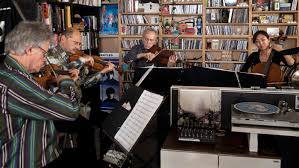
 socks kronosSOUNDTRACK: KRONOS QUARTET-Tiny Desk Concert #322 (November 25, 2013).

2013 was the 40th anniversary of Kronos Quartet.  I first heard of them about eight years after they started with their cool arrangement of “Purple Haze.”  And then I learned that they were like a sponge, soaking up and playing music from all over the world: In just one year they released albums with tango, songs by South African composers, Polish composers, jazz musicians and so much more.

I have many of their releases, although I realized I more or less stopped listening to new stuff from them around the turn of the century (since when they have released some 16 albums!).

Well, amazingly, the Quartet is still the same original players (except for the cellist–the cello is like Kronos’ drummer as they seem to replace her every couple of years).

They play three pieces here and the three range the gamut from dark and broody to rather sweet to quirky.  In other words, typical Kronos.

For more info:

The musicians —  David Harrington (violin) and longtime members John Sherba (violin) and Hank Dutt (viola) and new (as of 2013) cellist Sunny Yang — could reminisce over more than 800 new works and arrangements they’ve commissioned in 40 years. But instead, the new-music train pushes ever onward to new territories. They remain a living, breathing world-heritage site for music.

Now in the midst of its 40th-anniversary tour, Kronos brings to this Tiny Desk Concert a new arrangement, a work from a new album and, for Kronos, something of a chestnut, a piece the group recorded a whopping five years ago.

“”Aheym” (Yiddish for “homeward”) was written for Kronos by Bryce Dessner; a member of the Brooklyn rock band The National, he studied composition at Yale. The music thrives on nervous energy, pulsating with strumming and spiccato (bouncing the bow on strings) while building to a tremendous fever.”

I love this piece. It is intense and dramatic with its 4-3-3 bowing from all four members.  There’s an interesting cello melody with pizzicato strings from the rest.  The overall melody seems somewhat circular with different instruments taking on different leads.  But this song also plays with some interesting bowing techniques.  In addition to the spiccato (about 4 minutes in), the players drag the bow for momentary scraping and scratching sounds.

Another wonderfully dramatic moment comes at 7 minutes where each musician takes a turn bowing his or her note while the violin plays a super fast series of notes.  The song builds and build in dramatic until it gets to about nine and  half minutes and it reaches its powerful ending.

“Lullaby,” opens with plucked cello notes and strummed viola.  “It is a traditional song with Afro-Persian roots (from the group’s Eastern-flavored 2009 album Floodplain), [and] is woven from different cloth altogether. Colorful tones that lay between our Western pitches are threaded through the music, anchored by a gorgeous solo from violist Dutt; his contribution takes on the warm and weathered sound of a grandmother singing to a child.”  It is slow and moody and beautiful.

Harrington introduces the final piece by saying it’s by a performer that no one had heard of–including, until recently, even himself.

“Kronos caps off the concert with another hairpin turn, this time to a fresh arrangement of “Last Kind Words,” a little-known blues song from around 1930, recorded by singer and guitarist Geeshie Wiley. In Jacob Garchik’s exuberant arrangement (which Kronos premiered this fall), interlocking strums and plucks provide a kind of rhythm section, while Harrington’s violin stands in for the now-forgotten blues singer.”

There’s lots of plucked notes from everyone–including plucked bent note on the viola which gives it a real “early” guitar sound.  While I don’t know what Geeshie sounded like, so I can’t compare the violin to her vocal, the whole thing sounds great together.  In fact the whole thing is unlike any string quartet I’ve heard–so different and wonderful.

I’m going to have to bust out so Kronos CDs.

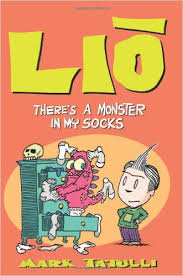
[READ: September 10, 2016] There’s a Monster in My Socks

I’ve been quite puzzled about the publication history of the Liō books.  And this just adds another layer of confusion.  This book covers the exact same time period as Happiness is a Squishy Cephalopod which was published in 2007.  The difference is that Cephalopod placed all of the strips in order, while this one seems to move things around quite a bit (the thinner format also means that it can’t quite handle the single panel strips very well.   But more egregious is that this volume (remember, the one printed after the previous one) prints the Sunday color strips in black and white.

The book also leaves some of the strips out.  It covers the date range from May 15, 2006 – Feb 16, 2007 (Cephaolopod went to May 23), but while it has the Feb 14 strip, it does not have the Feb 15 strip.  Weird.

So, basically this is an inferior version of the same book, but the publishers presumably wanted the books in this more friendly size (or some other nefarious reason).

I’ll include the review of Cephalopod below.

And, here’s the current list of existing Liō books. It’s a shame that there are years and years of strips thus far uncollected. (more…)

Read Full Post »

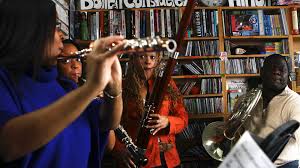
dressSOUNDTRACK: IMANI WINDS-Tiny Desk Concert #277 (May 29, 2013).

windsFor some reason this video and audio has been removed from the NPR site (no explanation is given).  But I found it elsewhere and was able to really enjoy it.

But they have left up the blurb:

When Igor Stravinsky began composing The Rite of Spring, his ballet for vast symphonic forces, he could hear the music in his head but couldn’t quite figure out how to write it down. It was just too complicated.

Today, 100 years after The Rite‘s premiere, the fearless musicians of Imani Winds make it all sound remarkably easy, given that they’ve condensed Stravinsky’s massive walls of sound down to just five instruments: bassoon, clarinet, flute (doubling on piccolo), oboe and French horn.

Make no mistake: Many of the jagged rhythms and crunching chords remain viscerally intact, albeit on a more intimate scale. As the group huddled behind Bob Boilen’s desk, bassoonist Monica Ellis noted the opposing ratios, saying, “It’s apropos in some strange way that we are playing one of the most massive pieces in some of the smallest instrumentation in one of the smallest settings that it could possibly be played in.”

The setting might be small, but in this clever arrangement by Jonathan Russell, we learn that a wind quintet, when called upon, can make a mighty and sonorous wail. Just listen to how the Imanis cap off “Dances of the Young Girls” with the entire quintet in full cry (at about 4:30 into the video). The bassoon repeats a fat bass line while the clarinet runs its snaky scales. The piccolo, in piercing chirps, serves as a foil to a frenzied oboe and snarling “whoops” from the French horn.

But not everything in The Rite is all pound and grind. Stravinsky’s transparent introduction, almost impressionistic, is a fluttering aviary of winds — even in the original — with individual colorings for each instrument. It’s all rendered beautifully here by Imani Winds, musicians brave enough to play David to Igor Stravinsky’s imposing Goliath.

This concert is fascinating to watch (and listen to) because even though this piece is familiar (to me) in theory, it’s apparent that I don’t really know it.  And I can see why this piece was so controversial when it came out–it is weird and chaotic and almost random at times.  I imagine that seeing it as a ballet might make it more cohesive, but it’s still pretty out there.

I love that the bassoon seems to be the primary instrument–one that doesn’t typically take center stage.

The group breaks up their selections into three primary chunks.

Selections from The Rite of Spring:

For “Introduction” the bassoon is the primary instrument playing the initial melody.  Then the clarinet and oboe give the whole thing an unsuaul sound–to say the least.  The French horn actually works as the the bass for this part.  It’s also neat watching the flautist switching between flute and piccolo.  I’m not sure when the second part “Augurs of Spring” begins, but I assume it’s when the bassoon repeats that initial melody and then the French horn plays a staccato bass note. The music sounds kind of threatening but whimsical at the same time.

Somewhere in here “Dances of the Young Girls”  begins.  I assume once the piccolo starts chirping and swooping.   And then the band grows very loud before abruptly stopping.

The second segment she describes as incredibly picturesque. “Ritual of Abduction” begins nosily with almost total chaos from all the instruments–the piccolo stands out as sharp and piercing.  As with the other segments, I’m not sure when “Spring Rounds” begins, but I have to wonder if this is when the music seems to go circular and then slow down. There are low notes from the French horn while someone is playing accent notes that sound, not off, but dissonant–providing stark contrast with the rest of the slow movement.  There are some blares of music from the French horn as well.

I’m guessing that “Dancing Out of the Earth”  begins with the fast bassoon melody: up down up down up down up down with trills and swirls from the flutes and clarinet.  It rises and rises very dramatically and then stops.

They tell us that it’s not possible to play the entire ballet so they have taken the “greatest hits” and for this show it’s the greatest hits of the greatest hits.  Consider it a deconstruction with five instruments. But it still evokes the spirit of this sacrificial dance.

She talks about how controversial this was in 1913, “when ballet was meant to be about… I was going to say flamingos…. fairies swans, the other water animals.”   This is the final moment the virgin who sacrifices herself dances herself to death.  And they are going to exemplify trombones and timpani and all that loud stuff (the French horn player laughs and says “Grr I am trombone”).

“Sacrificial Dance: The Chosen One” begins with a three note melody–again it is somewhat threatening.  There’s lots of little fast runs by the French horn with accents from everyone else.  It stops dramatically at one point and then resumes with so many different melodies.  And then comes the surprise ending with a rising flute line and then a low end from the horn.

Without taking away anything from Imani Winds, I ‘m sure this performance doesn’t do the whole thing any justice.  But it is amazing to imagine how much more there is to it.  And it is amazing that these five instruments can evoke so much.  It’s an uncomfortable and somewhat shocking first listen.  It’s amazing that is over 100 years old, although it sounds so contemporary.

I don’t know why it’s not on NPR any more. I found it on YouKu (whatever that is).  I have been able to watch it twice but on two other times I was unable to watch it.  So keep trying, it’s worth the effort.

[READ: May 5, 2016] The Boy in the Dress

David Walliams is best known (if he is known at all) as the tall one on the sitcom Little Britain.

I had no idea he wrote books (he has done over half a dozen children’s books), and I was happy to start with this, his first one.

This book is illustrated by Quentin Blake, who is best known (if he is known at all) as the illustrator for the Roald Dahl books.  So his simple, somewhat sloppy, style might look familiar.

The story is, as the title suggests, about a boy who wears a dress.  And the story is very funny–not because it makes fun of him for wearing a dress, oh no.  In fact, I love the story for going out of its way to show that it is normal that a boy might want to wear a dress. (more…)

Read Full Post »

luchSOUNDTRACK: THE CRISTINA PATO TRIO-Tiny Desk Concert #305 (September 21, 2013).

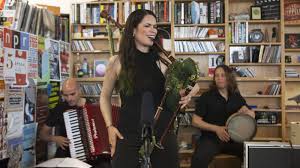
patoI didn’t know who Cristina Pato was or what instrument she played.  So when the show started (without visuals), I assumed she was the accordionist (because the show starts with some wild accordion music).  But in fact, Pato is playing the bagpipe.  Pato’s instrument is the gaita, a Galician bagpipe, and her roots lie in traditional Galician music — though she also boasts graduate degrees in classical piano, music theory and electronic composition.

I love the sound she band gets together with the funky staccato accordion notes and the wild racing pipes.  They are very jazzy and very idiosyncratic.  Her percussionist uses several different types of drums—the ubiquitous box drum and a hand held drum as well as various shakers and other sound makers.

They play three songs.  It’s interesting how much of the first song is taken up without the bagpipes—there’s lenghy sections where the accordion has the floor and she is just happily dancing around.  And the accordionist is amazing.  he plays all kinds of different styles and gets an amazing range of sounds out of that one instrument. He wails!  Of course I see now that the song is actually written by the accordionist: “Victor Prieto: ‘Mundos Celtas.'”  So it’s no wonder that she is happy to sit back and let him shine.  (Prieto , like Pato, is a native of the town of Orense in Galicia).  While he is playing, she whoops and hollers to get everyone pumped.  But once she gets her instruments going she is a nonstop blur of fingers and wild notes.  I particularly like that she has a section where the note is slightly flat and she continues to slowly raise it until it gets in pitch.  I also love–due to the nature of the bag pipes–that she can scream and whoops while still pressing air out of the bags.  And at the end of the song, she is just wild with fast notes.  It’s a very intense piece.

The second piece “Traditional/Cristina Pato: “Alalá Re-rooted” starts with her singing.  She is unmiked so you can’t really hear her, but I don’t really enjoy her singing as much as her playing so it’s okay.  I do love the interesting sounds the percussionist Shane Shanahan (Shanahan is American, but is also a longtime member (with Pato) of Yo-Yo Ma’s Silk Road Ensemble) is making.  Overall, this is a fairly dissonant piece—with her sounding almost like a free jazz players (but on pipes rather than sax).  I do love near the end where she almost seems to get a harmonic overtone on the pipe.  It’s a great moment—but fairly weird how the song just sort of fades away before seguing into the final song.

Victor Prieto & Emilio Solla: “Muñeira For Cristina” this song seems to be all about percussion with lots of drumming and a very noisy tambourine that Pato plays.  She gets the crowd clapping along and then  when she and Prieto play the same awesome riff together,it sounds great.  I love watching her shake the finger part while she’s playing it, to get a cool almost whammy bar sound out of it.  The song totally rocks and the whole set with the unlikely combo of accordion and bagpipe is startlingly wonderful.

[READ: April 20, 2016] Comics Squad: Lunch!

I really enjoyed the first Comics Squad book and I was delighted that a second one came out.  I just recently saw that a third one is coming out the summer–I love that it is called Detention and is coming out on Independence Day.

Like the first collection, this one is edited by Jennifer L. Holm and Matthew Holm (Babymouse/Squish) and Jarrett J.  Krosoczka (Lunch Lady).

But the rest of the line up is quite different this time around, which is cool–allowing other artists to shine.  This time there are stories from Cece Bell (El Deafo) ; Jason Shiga (a great indie artist who does some kid-friendly and some decidedly not kid friendly books) ; Cecil Castelucci & Sara Varon ; Jeffrey Brown and Nathan Hale (his own series of historical stories).

Like the previous book, the Holms and Krosoczka sprinkle the book with comments and interstitials from Babymouse and Lunch Lady. (more…)

Read Full Post »

« Newer Posts - Older Posts »