 SOUNDTRACK: THE ART OF TIME ENSEMBLE with MARTIN TIELLI–Korngold: Source & Inspiration (Enwave Theatre, Harbourfront Centre, Toronto, ON, January 30, 2009).
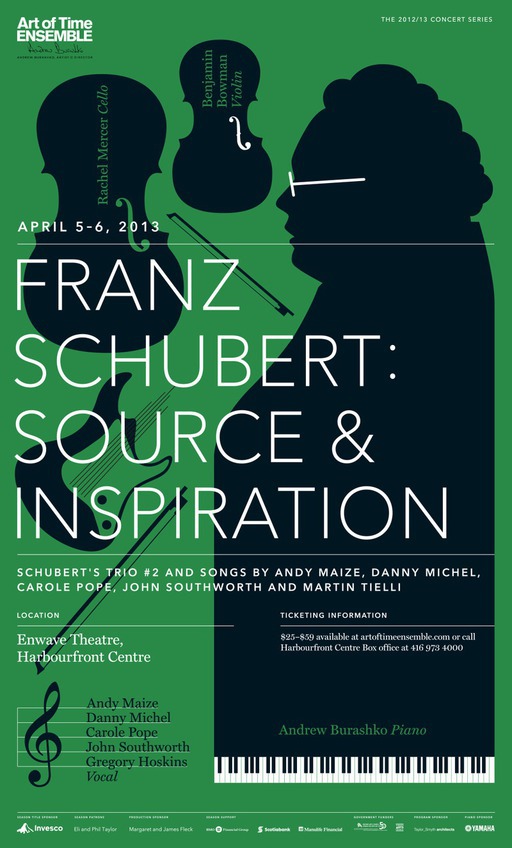 After seeing The Art of Time Ensemble yesterday, it was quite serendipitous that I would have a show from them (featuring Martin Tielli) to post about on the following day.
This concert is the third in the Art of Time’s “Source & Inspiration” series. Two years earlier the first concert focused on composer Franz Schubert. The previous year’s concert focused on Robert Schumann. This time the spotlight was on the 20th century Jewish composer Erich Korngold–a composer of European pedigree who became well known for his wonderful Hollywood film scores.
This concert featured Korngold’s Suite for Two Violins, Cello and Piano as the ‘source’ as well as new songs inspired by this work from Martin Tielli, Danny Michel and John Southworth.
This recording is only 8 minutes long because there’s only two Martin Tielli songs. “Lied Two” (the German word for song is lied (pronounced leed) so Martin called his “Lied Two.” And “Moglich” which translates into “possible.” Both pieces are played with by the orchestra. Martins sings.
The more dramatic of the two would be “Moglich” with his loud whispered “Relaxxxxx at the end.” For more information about the show, you can click on this link.
Full Program & Repertoire:
Suite Op. 23 for 2 Violins, Cello and Piano Left-hand
Erich Korngold
i.Praeludium und Fuge
ii.Walzer
iii.Groteske
iv.Lied
v.Rondo-Finale
INTERMISSION
Athabasca
Adventures of Erich Korngold
—John Southworth
The Sailor Song
Island
—Danny Michel
Lied 2
Moglich
—Martin TielliPerformers
Andrew Burashko, piano
Danny Michel, singer
Erika Raum, violin
Stephen Sitarski, violin
John Southworth, singer
Martin Tielli, singer
Winona Zelenka, cello
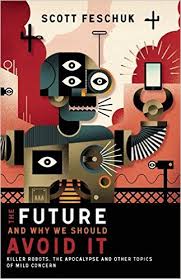
[READ: November 22, 2015] The Future and Why We Should Avoid It
The title of this book made me laugh so I set it aside to read it. Little did I know that it would be so very funny that I put aside other things so I could finish it.
I hadn’t heard of Feschuk before. He has written two previous books (How Not to Completely Suck as a New Parent sounds pretty good) and writes mostly for MacLean’s magazine.
As you might guess from the title, this book looks at the future, and Feschuk’s predictions are uncanny. For instance, I brought the book home and decided to look at it in the bathroom. And the introduction states quite clearly:
By now, life should be awesome and leisurely and you should be wearing a spacesuit and high-fiving your wisecracking robot sidekick. Except instead your dishwasher is broken, your god-damn iTunes won’t sync up and right now you’re reading this book on a toilet in your bathroom instead of where you should be reading it–on a toilet in your hover car.
Too right, too right.
Feschuk looks at the present and the future from different categories: like Gadgets, which he segues nicely with Killer robots (he returns to this theme several times). He talks about how quickly companies run out of ideas. The iPod was revolutionary. The iPhone was cool. The iPad was neat. To be followed by the… the.. the iWatch? really? He then goes on to imagine the iToaster (to logical extremes–very funny).
The biggest concern in the future, he says, is security, like people hacking into this iToaster. Or the Cloud, in general. He also talks about a $100 bracelet from Netatmo which tracks UV exposure and lets you know via smartphone when to go inside.
Leisure comes next with some fairly typical TSA bashing, but Feschuk is very funny about it–with a lengthy section just about checking in baggage. I also enjoyed the way he plays with the trendy word Staycation, by creating other words:L Overstacation, Dismaycation (the perspective of all teenagers on every vacation they’re ever forced to take with their families), Cabernacation, J.J.cation (a funny dig at Lost) and many more.
I also enjoyed his “guess which of these cruises is fake.”
Politics in Canada is very detailed and very funny (probably funnier if you know Politics in Canada, but even if you just like to make fun of Rob Ford and Stephen Harper, it is very funny. Harper’s lack of empathy is really exploited, as is the fact that he wrote a book about old-time hockey (while he was prime minister!). Even Justin Trudeau is mentioned (how prescient, although not really, I guess). And of course, there’s lots of poking fun at Rob Ford–much moreso than any of our Late Night hosts have ever done.
He also devotes a lengthy chapter to Politics in the U.S. He really skewers the U.S. 2012 campaign. Most readers will have forgotten many of the painful, funny details we had to put up with back then, but Feschuk took good notes and we get to relive all the nonsense (which somehow seems so much more simple than the nonsense of this year).
For Our Health and Our Bodies he had lots of great advice. I especially liked some of the five things he likes best about jogging: 1. Stopping, and 4. Getting Injured–where you can say you’d be out there if you weren’t hurt!
Feschuk spends a lot of time talking about winter in Canada. I have suffered through a few long winters in New Jersey, so I can appreciate the sections to a degree. But maybe readers in sunnier climates won’t be able to. Nevertheless, he’s pretty spot on about hitting February and feeling there is no end in sight to the cold.
He has lots of funny sections about hockey parents (who may be possibly worse than soccer parents). He gives some typical parents: “Talks only about his own kid” dad. “Bag of noisemakers” mom, “Berates his kid in front of everyone” dad. “Refuses to learn anything about hockey” mom (which is not as charming as she thinks it is). I also enjoyed the way he imagines if the hockey parents behaved in a similar way for the kids’ Christmas holiday pageant. “Wake Up, conductor. YOU GOTTA CALL THAT!” “Go, Emma!! SINNNNNNNG!!!”
I also really enjoyed his advice. He has good advice for college students: “slice of bread, peanut butter, slice of processed cheese, layer of BBQ Fritos, second slice of bread. You’re welcome.” Or how to deal with a recession. He talks about actual online suggestions: scavenge dumpsters, home haircuts, sew designer labels in your kids’ clothes. Or even “forcing you children to shower with you to save water. Who knew traumatic memories could be so environmentally friendly?”
Or why not do what the folks at walletpop suggest and reuse your calendar…there are only seven permutations so why buy a new one when yo can pick up a matching old one.
If I had one gripe about the book it would be the rather large amount of celebrity references as punch lines. They’re easy jokes (even is some are quite funny) and some of them (like Kirstie Alley fat jokes) are pretty lame and way overused. Although he does have a good handle on arts and entertainment with his list of future sequels to movies like Ferris Bueller’s Day Off 3, Ghost 2, and Do the Right Thing Again (with excellent summaries).
He also really rags on George Lucas for his wooden dialogue in the Star Wars films. Like the line “I am haunted by the kiss you should never have given me.” Or this line from movie number III, during a battle: “From my point of view, it is the Jedi who are evil.”
To recap: Anakin is hurtling along a river of lava, fighting to the death with his best friend and mentor, and so consumed with rage that just moments earlier he almost killed his pregnant wife. And so naturally he chooses this moment to break out the William F. Buckley method of rebuttal. When Anakin’s legs were subsequently cut off, I’m surprised he didn’t yell: “From my point of view, OWWWWW!”
For Science and Space he yells about jetpacks:
How hard can it be to harness the volatile power of a white-hot rocket, strap it to a person’s soft fleshy back, overcome the inherent challenges posed by atmospheric and gravitational forces and launch the person toward the sky without the certainty of a horrible fiery death?
He address robot butlers, superpowers (individual), aliens and even 23andMe the name of which “respects the horror-movie tradition of that all shadowy, fear-inducing corporations must have benign, cutesy monikers.”
And then there’s a hilarious section about beer company advancements like the Coors lite blue window (which David Cross has also mocked with fervor). But Feschuk’s twist is that economists need to see what the beer makers are doing to judge the fragility of the economy. If in 2006 when the economy was great, Coors could waste money on the blue if its cold nonsense, what does it mean in 2014 when their latest advancement is the Coors Lite Cold Activation Window Pack–“a small hole in the beer case that allows us to see if the mountains are blue and the beer is cold. A hole. In a box. As indicators go it’s enough to prompt the governor of the Bank of Canada to warn of our imminent return to barter economy.”
The final two chapters are Aging and Death. The aging one is pretty funny with him proposing ways to grow older like, moving to Shaving Cream Commercial World (where ever man is chiseled and wears only a towel).
He ends by teasing futurist Ray Kurzweil and the talk about the Singularity (when machine become smarter than people). Kurzweil says that with nanobots in our bodies we will become immortal. Feschuk imagines the horrors of immortality, but decides it’s all moot anyway because of our impending death by asteroid.
Overall, this book made me laugh (and read aloud to Sarah) a lot. There are some really really funny jokes in here. I will definitely have to check out more of Feschuk’s writing.

 I Just Read About That...
Leave a comment