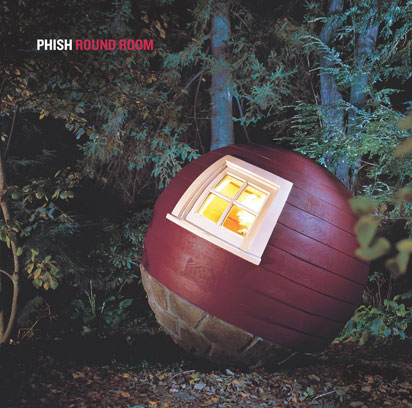
 SOUNDTRACK: PHISH-Round Room (2002).
 After Farmhouse, Phish went on a hiatus. No one knew it would be quite so brief, but there was really a feeling that they were done.
And then they quietly released Round Room in 2002. And it bursts forth with an 11 minute song.
“Pebbles and Marbles” has an interesting riff—complex and pretty. And when I listened to it again recently I didn’t really quite recognize it. But that’s because it’s nearly 12 minutes long and the really catchy part comes later in the song. At around 5 minutes, the catchy chorus of “pebbles and marbles and things on my mind” announces itself. And it is a good one.
“Anything but Me” is a pretty, mature song that is slow and piano heavy. “Round Room” is a boppy little ditty (clearly a song written by Mike). It is sweet and a little weird. “Mexican Cousin” sounds a lot like a cover (maybe an old song by The Band) except for the solo which is very Trey. It’s a funny, silly ode to Tequila. “Friday” is a slow six minute song with two sections. The verses are spaced out a bit, delicate riffs that are mostly piano once again. The middle section is sung by Mike (which makes it more mellow somehow).
“Seven Below” is an 8 minute song. It has another great riff (and the intro music is cool and bouncey). When the vocals come in, it’s got gentle harmonies as they croon the sweet song). Most of the 8 minutes are taking up with a guitar solo. “Mock Song” is another of Mike’s songs. This one seems to be a random selection of items sung to a nice melody. Then when the chorus comes it’s quite nice, how this is a “just a mock song.” The first verse is sung by Mike, then Trey does a kind of fugue vocal with different words in verse two.
“46 Days” opens with funky cowbells and turns into what seems like a classic rocking folk song—few words but a great classic rock melody (complete with 70s era keyboards). “All of These Dreams” is a mellow piano piece, another mature song. “Walls of the Cave” has an interesting piano melody that opens the song. The song is nearly ten minutes long and the middle part has a nice flowing feel to it. There’s also a few sections that are separated be drum breaks—something that doesn’t often happen in Phish songs. When the third part opens (to almost exclusively percussion, their vocals all work in a very nice harmony. It’s a long song but with so many parts it always stays interesting. “Thunderhead” is another piano-based song with some guitar riffs thrown on top. But it is largely a slow, mellow piece.
“Waves” is an 11 minute song with long instrumental passages. It also begins with a kind of Santana feel to it, but it is a largely meandering song, with a simple melody that they stretch out for much of the song. So this album proves to be an interesting mix of long jams and mellow ballady type songs. It seems like Phish had a big mix of things to let loose.
[READ: November 1, 2013] If Walls Could Talk
This book reminds me of the work of Mary Roach—exploring a topic in great detail and including lots of amusing insights. The two big differences here are that Worsley is British and that she goes back very far in British history to give us this fascinating information about the development of certain rooms of the house.
Worsley begins with the bedroom. She looks at the furniture—the history of the bed from lumps with straw to fantastically ornate full poster beds that were made for kings who might never actually use them.
Then she moves on to more personal matters—sex (including deviant sex and venereal disease); breast feeding (for centuries mothers felt they were not equipped to take care of and nurse their own children, hence wet-nurses) and knickers (royalty had an entourage designed specifically to assist with underthings). Indeed, privacy was an unknown thing in olden times. Even royalty was expected to receive people in all of the rooms in the house. Initially the bed chamber was for their most intimate friends, not just for sleeping.
The section on old medicine was also fascinating, they believed that it was vaporous miasma that did you more harm than say, excrement-filled water.
The section on Sleep discusses what was also in a recent article by Gideon Lewis-Kraus—that there were two sleep times at night. With no electricity there was no artificial light to keep people up late so they would go to sleep early, wake up in the middle of the night (the best time for conception of children) and then sleep again.
The next section is about the bathroom and why it took so long for plumbing to catch on. What’s interesting about this book and this section is that this looks at British history and she explicitly states that things in America were quite different, and advanced more quickly.
Perhaps the most interesting thing about the book is the way she dispels false history about “medieval” being unenlightened. Medieval people not only washed and bathed , but their baths were quite pleasant, with herbs and flowers spread around the tub. They even created bathhouses (which did develop a sense of ill repute). It was between 1550-1750 that the “dirty” centuries came along. A Puritan fear of nakedness came across the country. Washing oneself all over was considered sexual. There was also fear that water spread illness (which would have been true if the water wasn’t clean, but they took it too far). And hot water would reintroduce that miasma again. And while the Tudors did wash, it was done with extreme care. So don’t think of Medieval as dirty.
The history of the toilet is also fascinating, with chamber pots being placed virtually anywhere—in the dining room and parlor for instance. (And the engraving of some one emptying a chamber pot into the street is of course, revolting). There is a question of why internal plumbing took so long to catch on in England. They had made “sewers” decades before anyone considering putting a flushing toilet into a house—since servants were there to clean a bedpan, there was just no need.
The section on the living room was a little less scandalous, and therefore a little less interesting. Although I did enjoy hearing about the introduction of fireplaces and chimneys. And I was fascinated to read about the window tax (the reason why many English house have bricked up windows).
There is also some information on formalities and manners which I enjoyed as well.
The final section is about the kitchen. Originally kitchens were preferred to be off site and staffed by men because without proper refrigeration or even ventilation, kitchens would smell terrible. There’s also a lot of information about the way food was prepared and distributed back in the olden days—there were lots of options at the grand feasts, but people mostly picked at different things rather than stuffing themselves a lot. The excess food was then given to the servants. And of course, they did consume a lot of alcohol back then. But the primary reason was because the water wasn’t safe to drink and the alcohol was able to make it safer. It was also considerably weaker than our beers and spirits of today (although gin was considered a real danger when it came around).
The final conclusion talks about how with climate change and global warming we are likely to have to revert to many of the olden ways of life—conserving water, building houses that deal with the heat and cold better (without a/c and heating). And she has a point. There is a lot to learn about sustainability that our disposable society could take from older societies.
I really enjoyed this book a lot. It was interesting and informative and also quite funny.
You can hear an interview with Worsley at NPR. And there was also a TV series of the book which the BBC aired. Many of episodes are available on YouTube.

 I Just Read About That...
Leave a comment