 SOUNDTRACK: SUNN O)))-Flight of the Behemoth (2002).
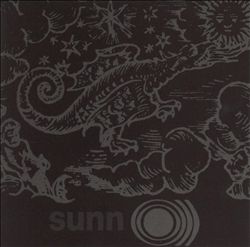 I hadn’t really heard Sunn O))) until this record (which may not be typical as they collaborated with Merzbow on this one). I knew that Sunn O))) played loud droney “music.” And so it is here. On “Mocking Solemnity” (9 minutes) and “Death Becomes You” (13 minutes) (which meld into each other seamlessly), the songs are mostly slow drones on electric guitar. The chords are heavy and heavily distorted and they ring out for a few bars–not until the chords die naturally, there is a kind of pacing involved, but for a few bars until the chords are played again (often the same chord). This is for those who thought Metal Machine Music was too complicated.
On paper this sounds unimpressive (or downright awful, depending) but in reality it is a very physical experience (if played loud enough).
The staticy noise of “Death” melds into track 3 “O))) Bow 1” which adds what sounds like radically modified piano playing a kind of melody. It’s about 6 minutes and it really changes the tone of the record to suddenly add an atonal racket to the almost calming drone of the bass. But by the middle of the song, the piano becomes what sounds like a chainsaw. Merzbow mixed that track and “O))) Bow 2” which is 13 minutes of the same slow pulsating noise. It’s not exactly soothing.
The final track is “F.W.T.B.T.” a “remake” of “Metallica’s “For Whom the Bell Tolls.” I can’t hear a thing that sounds like the original, but that’s what makes a cover interesting. Although admittedly around the four and a half minute mark there’s some faster chords (for this band anyhow) that could be Metallica-like. There are also drums (and vocals, although I have no idea what they are saying) on this ten-minute workout.
Not for the faint of heart (or fans of melody).
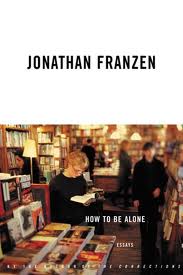
[READ: November 17, 2012] How to Be Alone
I read most of the articles in this book already. But I read them over two years ago, so I thought it would be safe to wade into the world of Franzen again. What I find most interesting about the title of this book is just how many of these articles are about being alone, wanting to be alone or feeling like you are alone. Obviously that is by design but it seems surprising just how apt the title proved to be, especially given the variety of subjects his father’s brain, being a novelist, the US Postal Service, New York City.
I’m not going to go into major detail about each article this time, although I am providing a link to the earlier review–my feelings didn’t really change about the pieces (except that from time to time I got a bit exhausted at his…whininess? No, not that exactly…maybe his persecution complex. But I will give a line summary about each one just to keep everyone up to speed. The four pieces that I hadn’t read before I will give a few more words about.
One overall feeling is that when Franzen isn’t writing about the state of the novel (which he is very passionate about) his articles are well researched well documented which is kind of surprising given the state of panic he seems to be in the novel articles. It’s also kind of funny how out of touch these articles seem (some are almost 20 years old and are kind of laughably outdated), but it’s also funny to see how poorly his predictions panned out. The death of the novel is rather overrated (just see the success of his own Freedom.
So the book contains:
“A Word About This Book”
This is probably the most useful and amusing piece in the book. In this introduction he describes re-reading his article “Perchance to Dream” that was published in Harper’s (and is known as “the Harper’s article.” This article became a foundation for most of Franzen’s interviews after he wrote The Corrections, with people either reading parts of it or misreading it entirely. And he was annoyed by that. Until he read it again for this collection and he found it full of
such painful stridency and tenuous logic that even I couldn’t quite follow it. In the five years since I’d written the essay, I’d managed to forget that I used to be a very angry and theory-minded person…. The first third of the Harper’s essay was written from this place of anger and despair, in a tone of high theoretical dudgeon that made me cringe a little now.
And several of the articles here come from that place of anger, so there is some stridency to be found. But as for the Harper’s article, he reworked it and trimmed a lot of it (and called it Why Bother?). It’s still kind of strident but it’s much more coherent.
My Father’s Brain
This is a very moving piece about his father’s descent into Alzheimer’s.
Imperial Bedroom
A look at privacy. Both in terms of consumers and credit cards (this is circa 1998) and in terms of the Clinton/Lewinsky scandal and the Starr Report.
“Why Bother?”
As stated above, this is a reworked version of the Harper’s essay. It’s still pretty strident (opening with, “My despair about the American novel began in the winter of 1991”). It looks at Paula Fox’s Desperate Characters, and uses it as a springboard for how novels can make a difference to people, but how the market doesn’t want books that matter anymore.
Lost in the Mail
Franzen loves the Postal Service, as do I. This looks at the Chicago branch and how awful it was at the time.
“Erika Imports”
This is just a couple of pages about how he used to work for a small business in his home town. It was just the husband and wife owner and him, and he hated the personal nature of the work–they knew everything about them and his mother felt sorry for the owners. It sounds dreadful.
Sifting the Ashes
This article looks at smoking. Franzen was an occasional smoker, and felt a little bad for the abuse heaped on the tobacco pushers. Wonder if he still feels this way?
The Reader in Exile
Franzen gives away his TV to get down to some serious reading (he’s got an either you watch TV or you read books mindset. He looks at several other books like Being Digital and A is for Ox and how TV is ruining readers. Reading this I couldn’t help think that the sale of Kindles has somewhat changed this technology vs reading argument.
First City
A loving paean to New York. It begins by bemoaning the family travelling to NYC to visit the Fashion Cafe and the Today show (but not the Empire State Building) and goes on to talk about cities in general.
“Scavenging”
Franzen often seems like an old man, especially in this article where he goes to a museum and sees a rotary phone in a display of “obsolete” artifacts and he’s dismayed because he still uses one (in 1996). There’s a funny moment when he talks about the excitement people feel about CD-ROMs. I myself am an old soul. And even though I love technology, I enjoy older relics as well. I would consider using a rotary phone for the novelty. But the real crux of the article is that he was scavenging things in order to salvage them–whether it’s ideas for novels or a broken chair that he could fix up. And I totally relate to that.
“Control Units”
Franzen looks at the booming prison industry. He even goes into a couple of maximum security prisons and interviews some prisoners (one of whom is related to Tupac Shakur apparently). It is a long, well researched article and you won’t feel good about prisons when you finish it.
“Books in Bed” (originally “Anti Climax”)
This is a pretty funny review of sex manuals.
Meet Me in St Louis
Franzen was on the Oprah show and they tried to film B-roll of his “return” to St. Louis, a city for which he has no real affection. It’s an interesting look at TV production and at Franzen’s mind during the Oprah kerfuffle
“Inauguration Day, January 2001” (originally “On the Bus”)
Franzen goes on a bus ride with protesters angry about the Bush election. It’s a short piece and more of a self-refective than politics one.
Mr Difficult
This article is in later pressings of the book, but it wasn’t in mine. The Mr. Difficult of the title is William Gaddis (not Franzen himself).
Amusingly, a previous reader of this book left some marginalia for me to read. I’m going to include what she (I assume by the handwriting) wrote:
In “Imperial Bedrooms,” where he wrote ‘the Monica Lewinsky scandal” she wrote: “why not “the Bill Clinton scandal”? (40).
In “Why Bother” in pen (!) surficiality says “opposite of subterranean” (66).
In “Reader in Exile” she inserted after “the leisure to inoculate” she inserted “or the will” (166).
And my absolutely favorite: in “Scavenging” after Franzen writes: “let the students discover Austen when Merchant and Ivory film her,” she wrote “deliciously bitter, bless him” (201).
These notes make me think that maybe she was working on Franzen for a paper? I don’t approve of writing in library books, but I did rather enjoy these notes. And the book as a whole. Now that I have finished all of Franzen’s published non-fiction, I need to get around to reading his novels.

 I Just Read About That...
Leave a comment